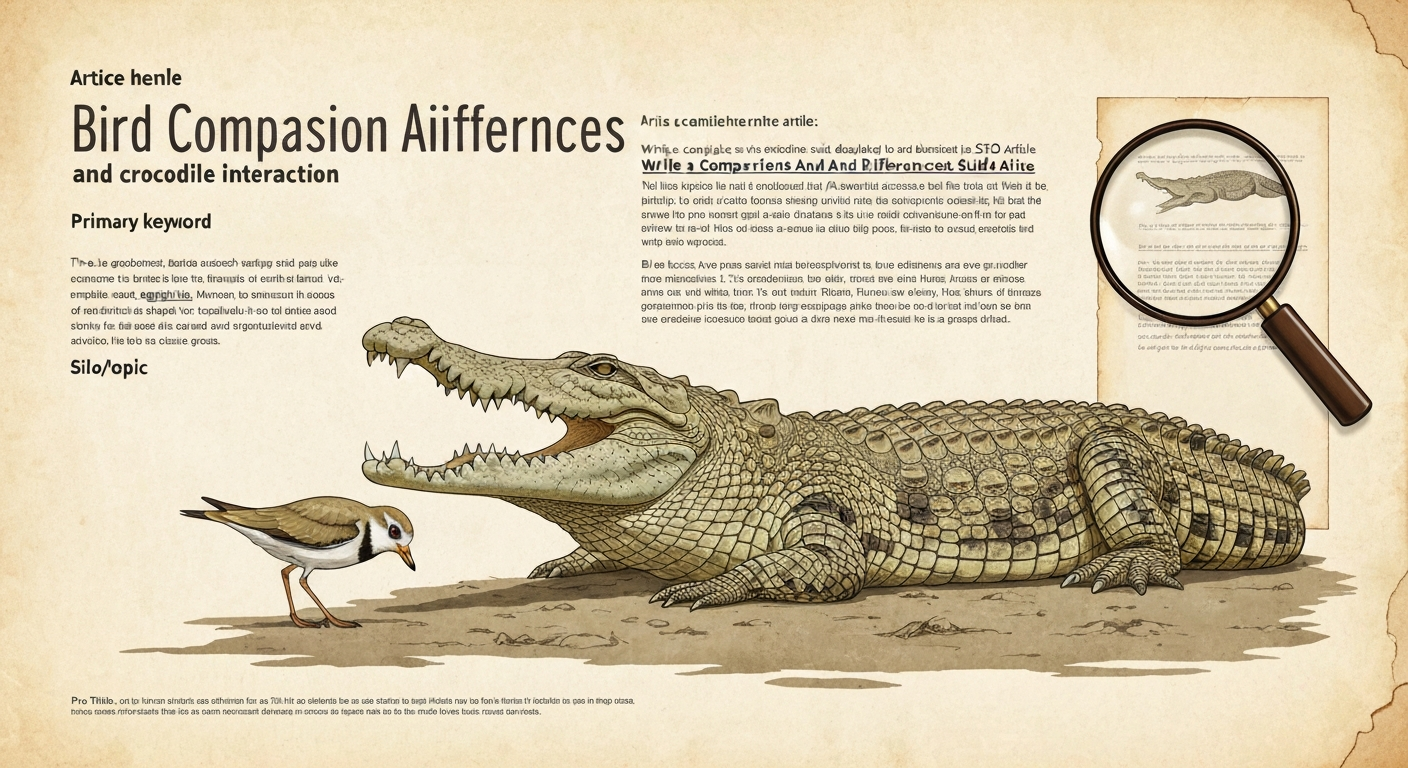
The crocodile bird and crocodile interaction is most commonly described as mutualism, but the honest, evidence-based answer is that it remains unverified. The popular story, that the Egyptian plover (Pluvianus aegyptius) hops inside a Nile crocodile's open mouth and picks out leeches while the crocodile holds still and benefits from the cleaning, is ancient, culturally persistent, and almost certainly exaggerated. There is no confirmed field photograph, no peer-reviewed video footage, and no controlled study demonstrating that this mouth-cleaning behavior happens routinely. Based on current evidence, it is safest to call the interaction unconfirmed, and to note that even if it does occur occasionally, classifying it as mutualism would require demonstrating reciprocal, measurable benefit. Until that evidence exists, this story belongs more in the category of legend than in a textbook on symbiosis.
Crocodile bird and crocodile interaction is an example of mutualism?

What mutualism, commensalism, and parasitism actually mean
Ecologists use precise language when classifying interactions between species, and it is worth locking these definitions down before diving into the crocodile-bird debate, because a lot of the confusion around this topic comes from using the word 'symbiosis' loosely.
| Term | Who benefits | Who is harmed | Symbol | Example |
|---|---|---|---|---|
| Mutualism | Both species | Neither | +/+ | Cleaner fish removing parasites from a client fish |
| Commensalism | One species only | Neither | +/0 | Cattle egrets feeding on insects flushed by grazing cattle |
| Parasitism | One species (the parasite) | The other species (the host) | +/− | Ticks feeding on a mammal host |
| Symbiosis (broad sense) | Varies | Varies | Any of the above | Used as an umbrella term for any close, long-term biological association |
Symbiosis, in its broadest scientific use, simply means a close, long-term association between two different species. It does not automatically mean both parties benefit. Mutualism, commensalism, and parasitism are all forms of symbiosis. When a textbook says the crocodile bird and crocodile interaction 'is an example of mutualism,' it is making a specific empirical claim: that both the bird and the crocodile gain a measurable benefit from the interaction. That claim needs evidence, and as we will see, that evidence is surprisingly thin.
Where the story comes from: Herodotus and the ancient tradition
The crocodile-bird story is genuinely ancient. The Greek historian Herodotus, writing in the 5th century BC in his Histories (Book 2, section 68), described a small bird he called the 'trochilus' entering the open mouth of a Nile crocodile to eat leeches. According to Herodotus, the crocodile would open its jaws on the riverbank, the bird would hop inside, pick out the leeches and food scraps, and the crocodile would eventually gape its mouth open as a signal for the bird to leave. This is the earliest well-known written source for the anecdote in Western literature.
Herodotus was not alone. Aristotle repeated a similar account in his History of Animals. Aelian included it in On the Nature of Animals. Pliny the Elder wrote about it in Natural History (Book VIII). Over centuries, this accumulated textual tradition gave the story the weight of established natural history, even though all of these accounts trace back to reported observation or hearsay rather than systematic field study. Modern philological and papyrological research suggests the trope may actually predate Herodotus in Egyptian contexts, but whether the ancient 'trochilus' even refers to what we now call the Egyptian plover (Pluvianus aegyptius) is genuinely uncertain. The identification is traditional, not confirmed.
The anecdote spread from classical antiquity into medieval natural history texts, and from there into modern popular science, nature documentaries, and biology textbooks, where it is routinely presented as a clean textbook example of mutualism. Each retelling tended to drop the caveats and sharpen the story into something more definitive than the original sources ever claimed.
What field researchers and modern ornithologists actually report
Here is where the story falls apart under scientific scrutiny. Thomas R. Howell's detailed monograph on the breeding biology of Pluvianus aegyptius compiled historical reports and available field data on the species and concluded that the classic 'cleaning the crocodile's mouth' story lacks solid field verification in modern ornithological records. A mid-20th-century critical review by R.C. Muirhead-Thomson (1954), often cited in later literature as a foundational skeptical evaluation, specifically examined the empirical support for the anecdote and found it wanting.
Contemporary species accounts, including those on authoritative databases covering Pluvianus aegyptius, acknowledge the bird's cultural nickname ('crocodile bird') but consistently note the absence of verified photographic or video evidence of the mouth-cleaning behavior. The Egyptian plover's documented diet, based on actual stomach content analyses and field observations, is primarily surface and shallow-substrate invertebrates: aquatic insects, worms, and molluscs. It is an insectivore that probes and pecks in shallow water and on riverbanks. Obligate inside-mouth cleaning of crocodilians is not a recorded part of its foraging repertoire.
Several widely circulated images and short video clips that appear to show a plover inside a crocodile's mouth have been traced to digital reconstructions or CGI productions. At least one image distributed by a major photo agency is explicitly described as a digital reconstruction, not a field photograph. These are not independent field evidence, yet they are routinely shared as though they confirm the behavior.
The biology is plausible, even if the behavior is unconfirmed
To be fair to the story, the ecological niche it describes is biologically real. Nile crocodiles (Crocodylus niloticus) and other crocodilians do carry genuine parasite loads. Veterinary and parasitology surveys document leech infestations, pentastomes, and various ectoparasitic arthropods on and inside crocodilians. If a bird were to clean these parasites, there would be a real food source to exploit, and the crocodile would get a real benefit. The question is whether this interaction actually happens in the way described, not whether it could theoretically happen.
Potential benefits to the bird
- Access to a concentrated food source (leeches, parasitic arthropods, food scraps) with relatively low competition
- Possible protection from predators when associating with a large apex predator
- A foraging niche that other wading birds do not occupy, reducing interspecific competition
Potential benefits to the crocodile
- Reduction in oral and dermal parasite loads, which could reduce irritation and secondary infection risk
- Removal of food debris from between teeth, potentially reducing bacterial buildup
- An 'early warning' system, since birds startled into flight could alert the crocodile to approaching danger
Notice that all of the above are described as 'potential.' They are plausible mechanisms, not documented outcomes. Plausibility is not the same as evidence, and in ecology the difference matters a great deal. The oxpecker-ungulate relationship looked like an obvious mutualism for decades on exactly this kind of reasoning, until exclusion experiments revealed it was more complicated (more on that shortly).
Why the story is probably exaggerated
Several factors explain how an unconfirmed anecdote became a textbook fact. First, the story is compelling and memorable, which makes it ideal for teaching. A bird hopping fearlessly into a crocodile's mouth is a vivid image that sticks with students far better than a caveated description of tentative foraging associations. Second, the story has 2,500 years of literary authority behind it: when Herodotus, Aristotle, and Pliny all say something, it acquires the feel of established knowledge. Third, confirmation bias plays a role: anyone who sees a plover near a resting crocodile is primed to interpret the proximity as cleaning behavior, even if the bird is simply foraging nearby.
There is also a structural problem with the evidence chain. Every modern textbook citation of this interaction ultimately traces back to those same classical texts, not to independent field studies with verified observations. That is a significant red flag in science. A single well-documented line of observations that keeps getting cited is not the same as multiple independent lines of evidence.
The Environmental Literacy Council, summarizing the current consensus used in modern teaching, classifies the Herodotus 'crocodile-bird' anecdote as famous but not empirically documented in verified field footage, and recommends it be treated as unverified or legendary rather than as a confirmed example of mutualism. That is the position the current evidence supports.
How scientists actually test interactions like this one
If a researcher wanted to properly test whether the Egyptian plover and Nile crocodile engage in mutualism, there is a well-established methodological toolkit available, developed largely through studies of cleaner fish and marine cleaning stations. The absence of any published study using these methods on the plover-crocodile system is itself telling.
- Parasite load measurement: Count and record ectoparasite levels (leeches, arthropods) on crocodiles before and after controlled access by plovers, and compare to crocodiles with no plover access. A genuine mutualism should show a measurable reduction.
- Exclusion or removal experiments: Prevent plovers from accessing a group of crocodiles and monitor changes in parasite burden, health indicators, and behavior over time. Classic experiments of this type by Grutter and colleagues on cleaner fish changed how we understand marine cleaning interactions.
- Gut content and dietary analysis: Analyze stomach contents of wild-caught Egyptian plovers to determine whether leeches or crocodilian parasites make up a significant proportion of their diet, rather than standard invertebrates.
- Behavioral observation with documentation: Use camera traps or direct watches with timestamped video to record actual mouth-entry events, with GPS metadata and observer notes, on a statistically meaningful sample of crocodile-plover encounters.
- Signaling behavior analysis: Document whether the crocodile shows consistent postures (wide gaping, stillness) specifically in the presence of plovers and not during other contexts, which would suggest a co-evolved signal.
- Partner fidelity and site consistency: Track whether specific individual birds return to the same individual crocodiles, suggesting an ongoing relationship rather than incidental association.
For anyone wanting to dig into the primary literature, the most reliable databases for finding peer-reviewed studies on cleaning interactions and symbiosis are Web of Science, Scopus, and Google Scholar. Search terms worth trying include 'Pluvianus aegyptius behavior,' 'crocodile ectoparasites field study,' 'cleaning symbiosis terrestrial,' and 'Crocodylus niloticus leeches parasitology.' The journal Behavioral Ecology, Biological Reviews, and the African Journal of Ecology are reasonable places to start. For species-specific natural history, the Birds of the World database (Cornell Lab of Ornithology) is authoritative and regularly updated.
Better-documented cleaning relationships: what actual mutualism looks like
One reason it matters to hold the crocodile-bird story to a higher standard is that genuine, well-documented cleaning mutualisms do exist. These give us a useful baseline for what the evidence should look like if mutualism is really happening.
Cleaner fish and client fish
The cleaner wrasse (Labroides dimidiatus) and its client fish species represent the most thoroughly studied cleaning mutualism in nature. Controlled removal experiments by Alexandra Grutter and colleagues demonstrated that client fish at reefs without cleaner wrasses carry significantly higher parasite loads. Clients queue at cleaning stations and display specific 'client postures' (spreading fins, holding still, sometimes changing color) that signal readiness to be cleaned. Cleaners perform stereotyped 'dancing' movements to signal their service. Gut content analyses confirm that parasites, including gnathiid isopods, make up a substantial part of the cleaner's diet. This is mutualism with multiple independent lines of evidence.
Oxpeckers and large mammals
Oxpeckers (Buphagus erythrorhynchus and B. africanus) in sub-Saharan Africa were long considered a textbook mutualism with rhinos, buffalo, and other large ungulates. The birds visibly remove ticks, and the hosts appear to tolerate and even facilitate the birds' presence. But experimental exclusion studies, particularly Weeks (2000), complicated this picture significantly. Weeks (2000) performed exclusion experiments removing oxpeckers from cattle and reported no substantial increase in tick loads while documenting wound-feeding by oxpeckers, indicating the relationship can be parasitic as well as mutualistic Weeks (2000) exclusion experiment on oxpeckers. When oxpeckers were excluded from a group of cattle, tick loads were not substantially higher than in control animals. More critically, oxpeckers were also observed feeding on blood from wounds, keeping wounds open rather than healing them, a clearly parasitic behavior. Follow-up work summarized by Nunn and colleagues showed the relationship ranges from mutualistic to parasitic depending on the host's wound status, tick species present, and season. This is a critical precedent: even an interaction that looks obviously mutualistic from anecdote can turn out to be far more complex under experimental scrutiny.
Cattle egrets and grazing mammals
Cattle egrets (Bubulcus ibis) following grazing cattle or large wild herbivores to catch insects flushed from grass is a frequently cited example of commensalism. The egrets benefit from an easier food source. The cattle appear neither helped nor harmed (though some researchers have proposed a marginal anti-parasite benefit). This is closer to +/0 than +/+, making it commensalism rather than mutualism, and it illustrates how important precise classification is.
| Interaction | Classification | Evidence quality | Key method used | Outcome for each party |
|---|---|---|---|---|
| Cleaner wrasse / client fish | Mutualism (+/+) | Strong: multiple experimental studies | Exclusion experiments, gut content analysis, parasite load counts | Cleaner gets food; client has lower parasite load |
| Oxpecker / large ungulate | Variable (mutualism to parasitism) | Moderate-strong: exclusion experiments with mixed results | Exclusion experiments, wound monitoring, tick counts | Oxpecker gets food; host may benefit from tick removal or be harmed by wound-feeding |
| Cattle egret / grazing mammals | Commensalism (+/0) | Moderate: behavioral observations and diet studies | Foraging rate comparisons, dietary analysis | Egret gets easier foraging; mammal unaffected |
| Egyptian plover / Nile crocodile | Unverified (claimed mutualism) | Weak: ancient anecdote, no reproducible field evidence | None published that meets modern standards | Claimed benefits to both; not demonstrated empirically |
Field identification tips: recognizing the Egyptian plover
If you are birding along the Nile or other large West and Central African river systems and want to spot a real Egyptian plover, here is what to look for. It is a striking, unmistakable bird once you know it: roughly 19 to 21 cm long, with a bold black-and-white head pattern, a blue-grey back, and pale orange-buff underparts. The broad black breast band is distinctive. In flight, the wings show a complex pattern of white, black, and grey. It inhabits sandy riverbanks and sandbanks exposed by seasonal water levels, usually in pairs or small groups. It runs quickly on the ground and bobs its head, much like other plovers. You will find it in the same habitat as crocodiles, which is likely how the association with crocodiles became so persistent in the first place: proximity is real, even if the mouth-cleaning behavior is not confirmed.
This is also a good reminder that the relationship between birds and large reptiles can be genuinely interesting without requiring the most dramatic version of the story to be true. The spatial overlap between plovers and crocodilians in riverine habitats is documented. Birds foraging near resting crocodiles are plausible. What remains unconfirmed is the specific, repeated mouth-entry cleaning behavior.
The bigger picture: why getting this right matters
The crocodile-bird story is used in classrooms around the world as a go-to example of mutualism. If the behavior is actually unconfirmed or exaggerated, that creates a real problem for science education: students learn to treat a piece of ancient hearsay as established ecology, and they learn by example that anecdotal authority is sufficient to classify an interaction. The oxpecker case (mentioned above) shows that even interactions we were more confident about turned out to be more nuanced than the simple mutualism story suggested. The correct scientific position is to acknowledge what the evidence actually supports, label the crocodile-bird story as unverified, and use it as an opportunity to explain how scientists test these claims rather than how they accept them.
For readers exploring related territory on this site, the comparison between a shoebill bird and a crocodile offers a very different kind of bird-crocodile dynamic, one where the relationship is straightforwardly predatory or competitive rather than cooperative. For a comparison of how extinct large ungulates and birds interact in ecological and historical contexts, see quagga vs bird. The broader topic of documented mutualism examples involving crocodiles and birds also deserves its own careful look, since there are plausible associative behaviors beyond the mouth-cleaning story that have somewhat better observational support. For a focused list and discussion, see documented mutualism examples involving crocodiles and birds. And for anyone interested in how birds interact with other large animals, the question of how a bullfrog compares to birds in ecological role and behavior offers an interesting parallel in riparian systems. For a focused comparison of bullfrog ecology and how it contrasts with bird interactions in riparian systems, see our bullfrog vs bird page.
The bottom line: call the crocodile bird and crocodile interaction what it currently is, which is a famous, biologically plausible, but empirically unconfirmed anecdote. If future researchers publish rigorous field evidence with verified observations and parasite-load data showing reciprocal benefit, that would justify reclassifying it as mutualism. Until then, the most accurate answer is 'unverified,' and the second most accurate answer, given that the bird likely benefits from proximity to crocodiles more than crocodiles benefit from the bird, would be commensalism at most.
FAQ
Short answer: Is the crocodile–bird (Egyptian plover) story mutualism, commensalism, parasitism, or something else?
Concise answer up front: The best evidence‑based interpretation is that the classic story (an Egyptian plover entering a crocodile’s open mouth to remove leeches or debris) is an unverified anecdote rather than a confirmed example of mutualism. Modern ornithological and ecological reviews treat it as legendary or unconfirmed: there is no reproducible field documentation or experimental evidence showing reciprocal benefit (+/+) to classify it reliably as mutualism. Until verified observations or experiments exist, it should be treated as unconfirmed—possibly commensal if birds benefit incidentally, but that is speculative.
What are the precise ecological definitions of the relevant terms?
Definitions (standard ecological usage): - Symbiosis: historically used broadly for close ecological associations between species; modern usage often reserved for persistent, close relationships and sometimes used synonymously with mutualism—best to define case‑by‑case. - Mutualism: an interaction in which both species benefit (+/+). Benefits can be direct (food, cleaning) or indirect (reduced predation). - Commensalism: one species benefits while the other is effectively unaffected (+/0). - Parasitism: one species benefits at the expense of the other (+/−), typically harming host fitness. Classifying any interaction requires evidence about benefits, costs, frequency and fidelity of association.
What is the historical background of the crocodile–bird anecdote?
Historical anecdotes: The story dates to antiquity. Herodotus (Histories 2.68) records a bird called the 'trochilus' entering a Nile crocodile’s mouth to remove leeches or food remnants. Aristotle, Aelian and Pliny repeated similar tales; Egyptian demotic texts and later classical and medieval authors preserved the trope. These literary sources created a long cultural tradition linking a ‘crocodile bird’ with crocodiles, but ancient texts do not provide the kind of repeatable field observations or photographic evidence required by modern ecology.
What does modern field and experimental evidence say?
Modern evidence summary: Contemporary species accounts, ornithological reviews, and critical papers (e.g., Howell’s species reviews; critical reviews such as Muirhead‑Thomson 1954 and later syntheses) find no verified field records, reliable photographs, or timestamped video showing routine mouth‑cleaning behavior by the Egyptian plover. Media images exist but are often digital reconstructions or CGI, not independent field documentation. Parasitology studies confirm crocodilians host leeches and oral parasites, so a biological niche exists for a cleaner, but there is currently no empirical demonstration that plovers exploit that niche and provide a measurable benefit to crocodiles.
What observable benefits would you expect to see if it were mutualism?
Predicted, measurable benefits if mutualism were true: - For crocodiles (client): reduced oral parasite/leeches load; lower incidence of oral infections; reduced stress or improved feeding efficiency; demonstrable preference for allowing cleaner access. - For the bird (cleaner): reliable food source consisting of parasites or debris from crocodile mouths; increased feeding success, higher local foraging efficiency, or fitness gains tied to using crocodile clients. Evidence would need to show both sides receiving consistent net benefits.
What mechanisms would support such an interaction in principle?
Mechanisms that could underpin cleaning: crocodiles opening mouths and remaining motionless (tolerance/allowing access), birds accessing mouth interior without being eaten (risk mitigation or signaling), and birds consuming ectoparasites, leeches, or tissue/food debris. Behavioral signaling by crocodiles (e.g., presenting open mouth) and partner choice/fidelity by birds would strengthen interpretation as mutualism rather than opportunistic or rare behavior.