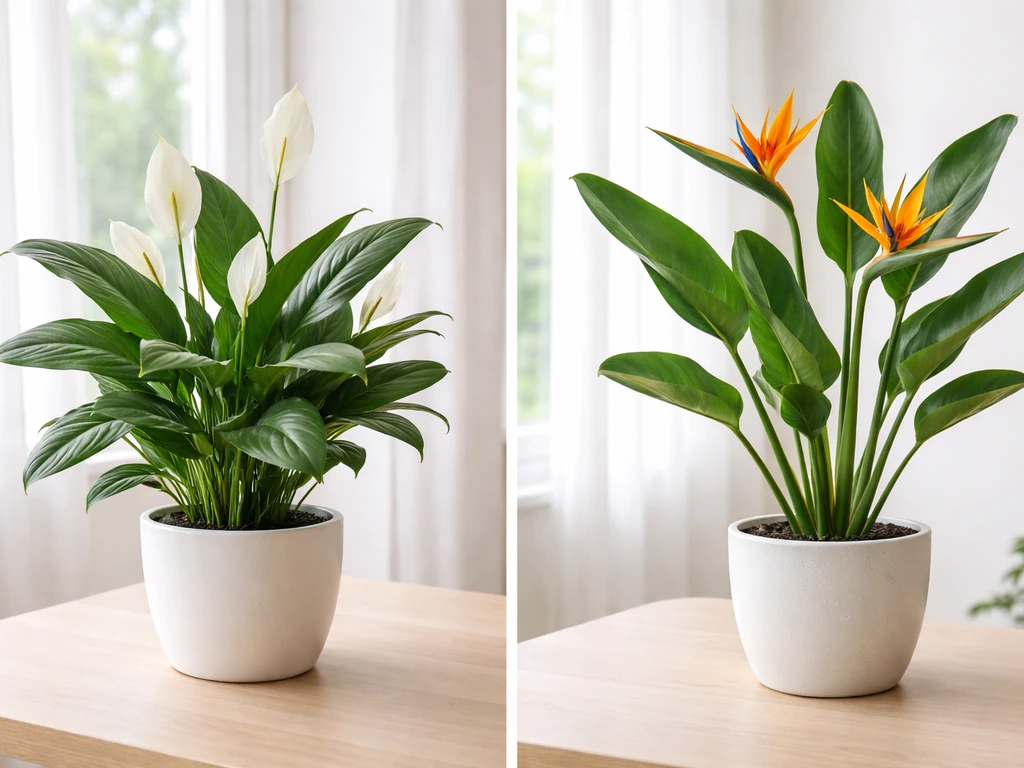
If you are staring at a plant and genuinely unsure whether it is a peace lily or a bird of paradise, you are not alone. These two plants get mixed up constantly, especially in garden centers where labels fall off or online listings use vague photos. The short answer: a peace lily (Spathiphyllum) stays low and compact with glossy, dark green leaves and white sail-like blooms, while a bird of paradise (Strelitzia reginae or Strelitzia nicolai) grows tall and architectural with large paddle-shaped leaves and dramatic orange-and-blue flowers. They are genuinely different plants, both in looks and in what they need from you. This guide walks through every distinction you need to make the call, set up the right care routine, and keep whichever one you have actually thriving.
Peace Lily vs Bird of Paradise: How to Tell and Care

Quick ID: Leaf Shape, Growth Habit, and Overall Look
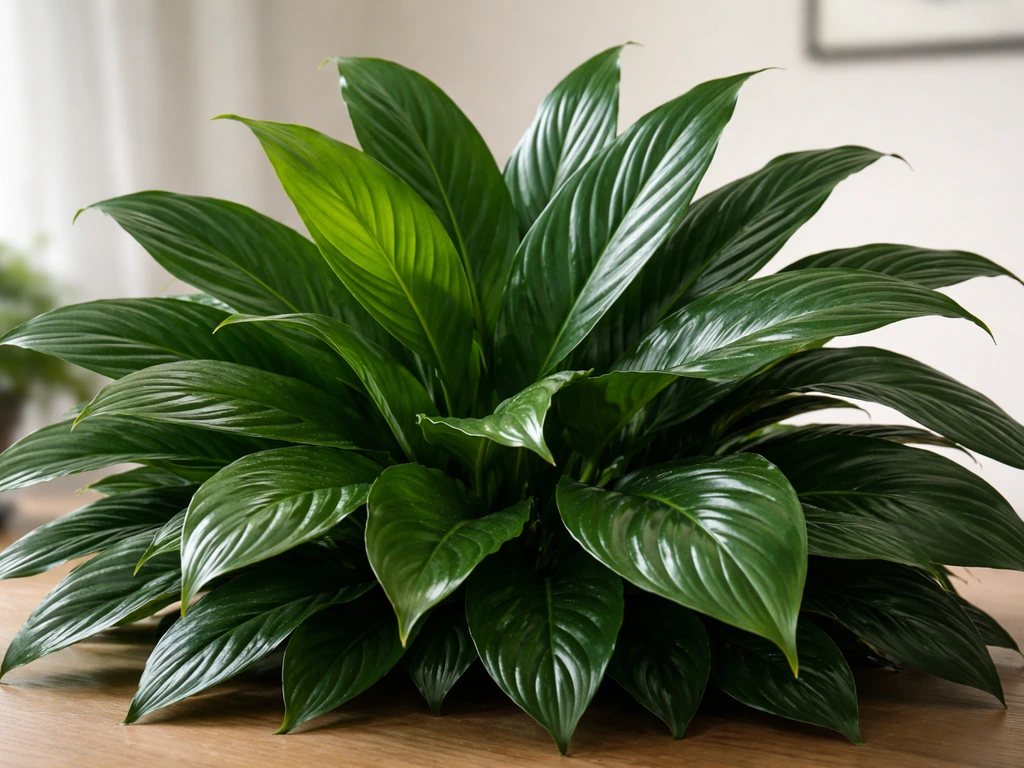
The fastest way to tell these two apart is to look at the overall silhouette before you even get close. A peace lily grows as a low, clumping mound. Its leaves emerge directly from the base on individual petioles, forming a dense, arching rosette that rarely exceeds 18 to 24 inches indoors. The leaves are lance-shaped to oval, deeply ribbed, and a rich, dark glossy green. The whole plant has a soft, rounded look.
A bird of paradise is a completely different presence in a room. Strelitzia reginae develops a fan-like crown of upright, paddle-shaped leaves arranged in two opposite rows on stiff stems. Outdoors, a mature clump stands roughly 4 to 5 feet tall. Indoors, S. nicolai (the giant white variety) can push past 6 feet, but even the smaller S. reginae will dominate a corner in a way a peace lily never does. The leaf bases stack and overlap in a way that creates a trunk-like silhouette, which is completely different from the peace lily's basal clump. If your plant looks more like a miniature banana tree than a leafy mound, it is almost certainly a bird of paradise.
Here is a quick at-home check: run your fingers along a stem. Peace lily petioles are slender and flexible, connecting directly to individual leaves. Bird of paradise stems are thick, stiff, and hold the leaf upright like a paddle on a pole. The leaf texture is also a giveaway: peace lily leaves have a subtly wavy surface with pronounced parallel veins, while bird of paradise leaves are smoother and more leathery, sometimes developing a slight split along the margins as they age.
| Feature | Peace Lily (Spathiphyllum) | Bird of Paradise (Strelitzia) |
|---|---|---|
| Mature indoor height | 1–3 feet | 4–8+ feet |
| Leaf shape | Lance to oval, glossy, ribbed | Large, paddle-shaped, leathery |
| Growth form | Low basal clump | Upright fan with trunk-like base |
| Stem type | Slender, flexible petioles | Thick, stiff, upright stems |
| Leaf color | Deep, dark green | Blue-green to mid green |
Flower Differences: Color, Structure, and Blooming Cues
The blooms are where these two plants become almost impossible to confuse. A peace lily flower is a spadix-and-spathe structure: the familiar white "sail" is actually the spathe, a modified leaf that cradles a greenish-white or cream spadix (the bumpy central spike). The spathe ranges from about 4 to 12 inches long, and the peduncle (flowering stem) rises clearly above the foliage. Peace lilies bloom freely indoors without needing a specific season to trigger them. Given decent indirect light and consistent care, they will produce flowers multiple times a year.
A bird of paradise flower is structurally completely different. It consists of 3 orange sepals and 3 blue petals, two of which are fused together and folded over the reproductive structures. The whole thing sits upright out of a heavy, boat-shaped reddish-green bract on a stiff stem that rises above the foliage, sometimes up to 5 feet tall. The effect really does look like a tropical bird mid-flight, which is exactly where the common name comes from. Outdoors in warm climates, Strelitzia blooms in autumn, winter, and spring. Indoors, blooming is much harder to coax out, requiring strong light, a root-bound pot, and patience. Many indoor bird of paradise plants simply never bloom.
If you want to explore the full botanical complexity of this flower's structure, it is worth knowing that the crane flower vs bird of paradise distinction gets into exactly how the Strelitzia bract and petal arrangement work, since "crane flower" is one of the other common names for Strelitzia reginae. The naming overlap can add to confusion, but the bloom structure is always the tell.
Care Needs Comparison: Light, Watering, Humidity, and Soil
This is the section that matters most if you just bought one of these plants and are trying to figure out what to do with it. Their care needs overlap in a few ways but diverge in others, and getting the light and watering wrong is where most people lose these plants.
Light
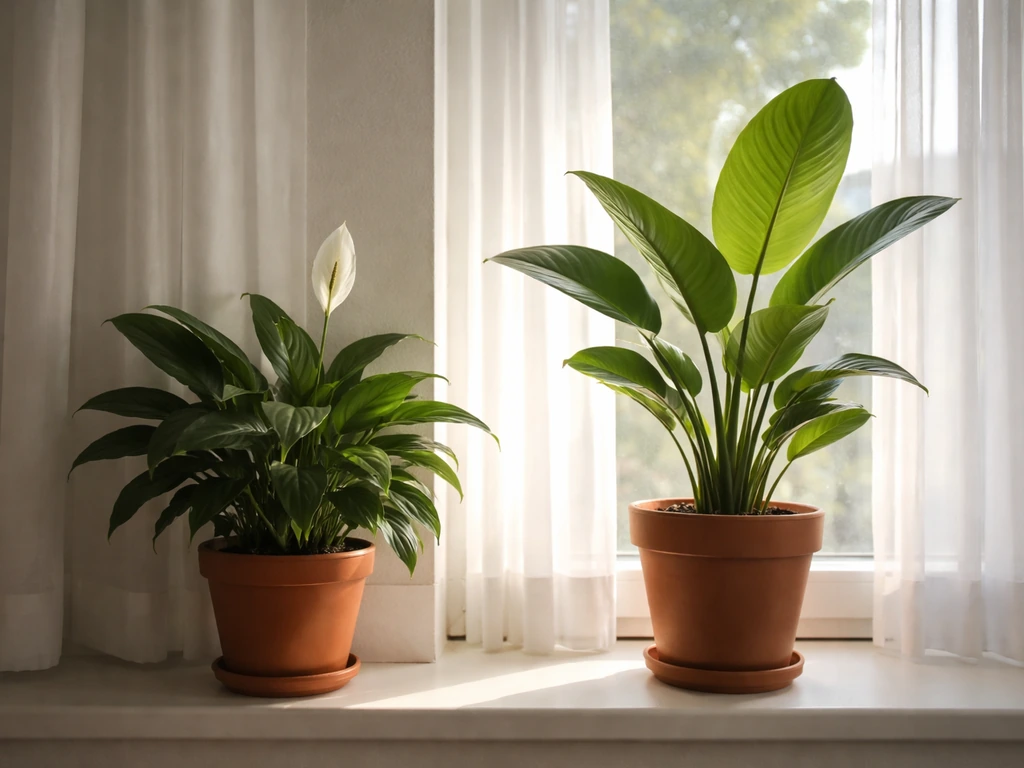
Peace lily is genuinely tolerant of lower light conditions. It will survive in a north-facing room or a spot away from windows, though it will bloom far less. Bright, indirect light is the sweet spot for both good foliage and flowers. Direct sun will scorch its leaves. Bird of paradise is a full-sun plant by nature and needs as much bright light as you can give it indoors. A spot right in front of a south or west window is ideal. In lower light, the leaves will still look okay for a while, but the plant will not grow well and flowering indoors becomes essentially impossible.
Watering
Peace lily likes consistent moisture but punishes you for overwatering. The rule is to let the top inch of soil dry out before watering again. If the soil is heavy and wet and the leaves are drooping, overwatering and poor drainage are the most likely culprits: the fix is to let it dry significantly, improve drainage, and empty any standing water from the saucer. Bird of paradise needs more drying time between waterings. For Strelitzia, letting the top 50% of the soil dry out before watering again is the right benchmark. Overwatering is the leading cause of root rot in potted Strelitzia, particularly in cool temperatures or in pots that retain excess moisture.
Humidity and Temperature
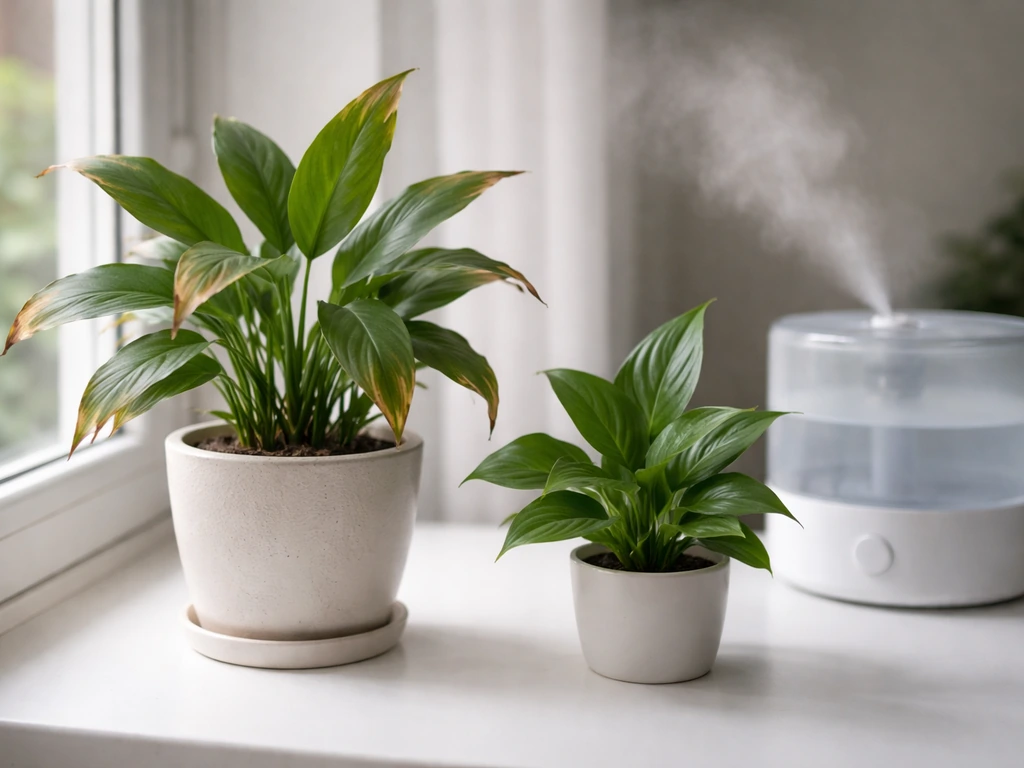
Both plants come from warm climates and appreciate humidity above 40%, but peace lily is more visibly sensitive to dry air, showing brown leaf tips when the air is too dry. Neither plant tolerates cold drafts or temperatures below 50°F (10°C) for extended periods. Bird of paradise is actually more tolerant of drier indoor conditions than peace lily once established, but it dislikes being near cold windows or air conditioning vents in winter.
Soil
Both plants want well-draining potting mix. Peace lily does well in a standard indoor potting mix with some perlite added to improve aeration. Bird of paradise prefers a chunkier, well-aerated mix, something like a standard potting mix cut with perlite or coarse sand at a 2:1 ratio. Neither plant should sit in compacted, waterlogged soil.
| Care Factor | Peace Lily | Bird of Paradise |
|---|---|---|
| Light | Low to bright indirect | Bright indirect to direct sun |
| Watering frequency | Top 1 inch dries between waterings | Top 50% dries between waterings |
| Humidity | Prefers higher humidity (50%+) | Tolerates moderate humidity |
| Temperature tolerance | 55–85°F, no cold drafts | 55–90°F, no cold drafts |
| Soil | Standard mix + perlite | Chunky, well-draining mix |
| Difficulty | Beginner-friendly | Intermediate to advanced |
Pet and Child Safety: What You Need to Know
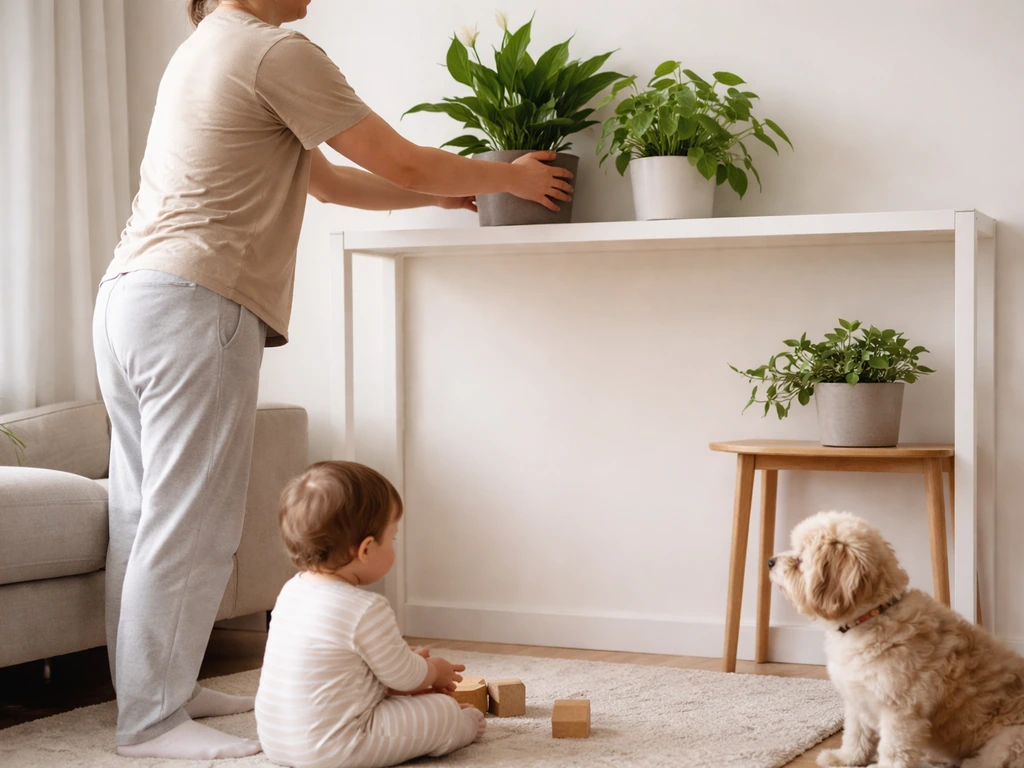
Neither plant is fully safe around pets or small children, and this is worth taking seriously before you decide where to put it in your home.
Peace lily (Spathiphyllum) contains insoluble calcium oxalate crystals throughout its leaves, stems, and flowers. When any part of the plant is chewed or swallowed, those crystals cause immediate, intense burning and irritation of the mouth, lips, and tongue. In humans, especially children, this typically results in drooling, lip swelling, nausea, and vomiting. In pets, the symptoms are similar: oral irritation, excessive drooling, retching, vomiting, diarrhea, and difficulty swallowing. The effects are painful but rarely life-threatening, and they tend to be self-limiting because the immediate mouth burn usually discourages continued chewing. That said, if ingestion occurs, contact Poison Control or your veterinarian immediately.
Bird of paradise (Strelitzia) is also toxic to pets. Ingestion can cause nausea, vomiting, and drowsiness in cats and dogs. If you suspect your pet has eaten any part of a Strelitzia plant, contact the ASPCA Animal Poison Control Center at (888) 426-4435 or a local veterinarian right away. Do not wait for symptoms to appear.
If you have curious cats, dogs, or toddlers in the house, keep both plants out of reach. Peace lily is probably the higher-risk plant in practice because people tend to place it at lower heights, making it more accessible. A hanging basket or a high shelf is safer than a floor pot for either species in a pet-heavy household.
Common Problems and How to Fix Them
Yellow leaves and brown tips are the two complaints I hear most from people growing either of these plants. The causes overlap but are not identical, so it helps to know which plant you are troubleshooting.
Peace Lily Problems
- Yellow leaves with wilting: This is the classic overwatering symptom. Check whether the soil is consistently wet. Cylindrocladium root and petiole rot causes lower leaves to yellow and wilt and is directly linked to waterlogged conditions. Let the soil dry appropriately, improve drainage, and consider repotting if roots are brown and mushy.
- Browning leaf tips and margins: This is 'marginal leaf burn,' which involves the yellowing and death of leaf tips and edges. The most common causes are low humidity, fluoride in tap water, or fertilizer salt buildup. Switch to filtered or distilled water, mist the plant, or use a pebble tray with water beneath the pot.
- Drooping leaves with dry soil: The plant is thirsty. Peace lily will droop dramatically when it dries out too much, but it usually recovers quickly after a thorough watering.
- Drooping with wet soil: Overwatering. Empty the saucer, let the top inch dry, and reduce watering frequency.
- No flowers: Usually a light problem. Move the plant to a brighter spot with indirect light. Peace lilies that never bloom are almost always in too-low light.
- Yellowing of older lower leaves only: This is often normal aging or a nitrogen deficiency. A balanced liquid fertilizer applied monthly during spring and summer usually resolves it.
Bird of Paradise Problems
- Yellow leaves: The most common causes are overwatering (especially in autumn and winter in cooler homes), low light, cold drafts, or nitrogen deficiency. Start by checking the soil: if it is soggy, reduce watering significantly and ensure the pot drains freely.
- Brown leaf edges: Usually caused by low humidity, underwatering, or salt buildup from fertilizer. Flush the soil occasionally to remove excess salts and increase humidity around the plant.
- Leaves splitting or tearing: This is actually normal in mature plants and happens naturally. If the splits are severe and the edges are brown, it may indicate low humidity or physical damage.
- Root rot: Overwatering is the leading cause of root rot in potted Strelitzia. Signs include yellowing leaves, a sour-smelling soil, and a plant that looks wilted despite wet soil. Remove the plant from its pot, trim any black or mushy roots, let them air dry briefly, and repot in fresh, well-draining mix.
- Slow or no growth indoors: Bird of paradise is a slow grower regardless, but very slow or stalled growth is almost always a light issue. It needs a genuinely bright spot to thrive.
Pests are a factor for both plants. Spider mites (especially in dry indoor air), mealybugs, and scale are the most common offenders. Wipe leaves with a damp cloth regularly, and treat infestations with neem oil or insecticidal soap at the first sign. Catching pests early makes a big difference.
Which One Should You Actually Get?
If you are a beginner, or if your space does not get a lot of direct sun, get a peace lily. It is one of the most forgiving houseplants available. It tolerates lower light, tells you when it needs water by drooping slightly, and blooms without much coaxing. It is a genuinely good plant for someone who is still figuring out their home's light levels and watering rhythm.
Bird of paradise is a statement plant that rewards patience and the right conditions. If you have a large, bright room and you want something architectural that will eventually grow into a real focal point, it is worth the extra effort. Just go in knowing that indoor blooming is unlikely unless you can give it several hours of direct sun daily, and that it grows slowly. People who fall in love with the giant bird of paradise vs bird of paradise question are often surprised to find that the giant variety (Strelitzia nicolai) is actually easier to get dramatic foliage from indoors, even if it rarely flowers.
One thing worth noting: bird of paradise is frequently confused with several other tropical plants beyond just peace lily. If you have a plant with similarly bold tropical leaves and are still not certain of the ID, it helps to compare it against close relatives. For example, heliconia vs bird of paradise is another common mix-up, since heliconia also has paddle-shaped leaves and tropical flower bracts. Similarly, if the leaves look more strap-like or canna-like, the canna lily vs bird of paradise comparison might help you nail down the ID.
If the flower itself is what caught your attention and you are trying to figure out exactly what you are looking at, there are a few other plants that can be mistaken for Strelitzia blooms. The parrot flower vs bird of paradise comparison is useful here, since both have bold, colorful bracts that superficially resemble each other. And if you have ever seen a botanical LEGO model and wondered how it stacks up to the real thing, the lego bird of paradise vs orchid set comparison is a surprisingly fun tangent that shows just how distinctive the Strelitzia silhouette really is.
The bottom line is straightforward. Peace lily for lower light, easier care, and pet-safer placement at manageable heights. Bird of paradise for a bright space where you want a bold, long-term statement plant and are prepared to give it time. Either way, once you know which plant you actually have, the right care plan is simple to follow and the common problems are easy to fix.
FAQ
My plant has tropical flowers, how can I confirm which one it is if the leaves look similar?
If your goal is white “sails,” check the bloom type first. Peace lily flowers are a greenish-white spadix wrapped by a white spathe, and the flowering stem usually rises above the leaves. Bird of paradise flowers look like upright 3 orange sepals with 3 blue petals from a boat-shaped bract, and indoor plants often do not bloom unless they get very strong light.
Do both plants droop when they need water, or is there a reliable way to tell watering problems apart?
Try the watering-response test: peace lily usually droops noticeably when it is thirsty, then perks back up after watering. Bird of paradise often stays more “upright” for longer, and droops are more likely to signal overwatering or root stress, especially if the soil stays wet.
How do I know when to water without guessing, especially after repotting?
Use pot weight and soil feel rather than a calendar. For peace lily, wait until the top inch is dry, then water thoroughly and empty the saucer. For bird of paradise, wait until the top half is dry (or about 50% of the pot depth). If you repotted recently, soil dries faster in smaller pots and slower in larger ones.
What’s the difference between brown tips on peace lily versus bird of paradise?
Brown tips can happen on both plants, but the “why” differs. Peace lily browning is often from dry air or inconsistent moisture, so increase humidity and keep watering consistent. Bird of paradise brown tips are more commonly linked to salts or irregular watering, so flush the soil occasionally and make sure you are not constantly wetting the root zone.
Why won’t my bird of paradise bloom indoors, and what should I change first?
Poor flowering in bird of paradise is usually a light issue plus pot conditions. Aim for several hours of direct sun daily (a bright south or west window), and allow the plant to become somewhat root-bound. If it is in a very large, constantly damp pot, flowering becomes much less likely.
What pests are most common on each plant, and where should I check first?
Scale, mealybugs, and spider mites all show up more when plants are stressed, especially with dry indoor air. For peace lily, rinse or wipe the leaves more frequently because it can look dull quickly under mite pressure. For bird of paradise, inspect the stiff leaf bases where pests hide, and treat early with insecticidal soap or neem.
How should I repot peace lily vs bird of paradise, and should I size up a lot?
Yes, but do it carefully. Peace lily can be repotted into a slightly larger pot because it prefers consistency, and too big of a pot increases overwatering risk. Bird of paradise tolerates being a bit snug and dislikes waterlogged mix, so choose a pot with good drainage and avoid jumping several sizes at once.
My leaves are yellow, what are the most likely causes and what quick checks should I do?
Clean the leaves for both, but prioritize what you can see. For peace lily, yellowing with limp growth often points to overwatering or stagnant drainage, then adjust watering and soil aeration. For bird of paradise, yellow leaves plus dry, gritty edges can be under/overwatering cycling, low light, or salt buildup.
Are these plants safe for homes with pets or toddlers, and what symptoms should I watch for?
If pets or small children are in the home, assume both are a no-chew situation. Peace lily toxicity is often associated with painful oral burning and swelling after chewing, which can lead to drooling and vomiting. Bird of paradise can cause vomiting and drowsiness in pets. The safest placement is out of reach, such as a high shelf or hanging container.
What is the biggest care mistake people make when they buy one plant but care for it like the other?
Avoid common mix-ups: don’t treat both like “medium light, water when sad.” Peace lily is more tolerant of lower light and can tolerate slightly more consistent moisture, while bird of paradise needs much brighter light and longer dry-down between waterings. If you follow a single routine meant for peace lily, bird of paradise often ends up waterlogged and fails to grow.
Vermilion Bird vs Phoenix: Key Differences and How to Tell
Side-by-side ID guide for vermilion flycatcher vs Phoenix, with plumage, habitat, behavior, and quick decision steps.