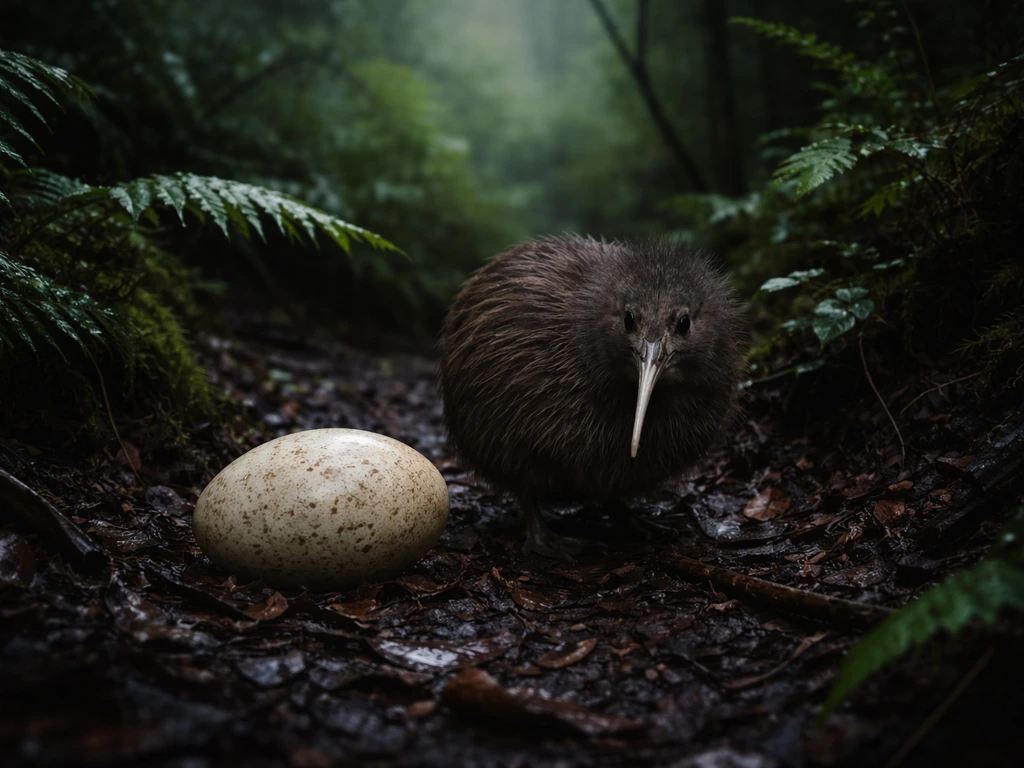
Kiwi birds and dodos are both flightless, and that single shared trait is basically where the similarities end. The kiwi is a small, nocturnal, chicken-sized bird still alive today in New Zealand, related to ostriches and emus. The dodo was a large, rotund, pigeon-relative that went extinct on the island of Mauritius in the late 1600s. They lived on opposite sides of the world, looked completely different, ate differently, and belong to entirely separate branches of the bird family tree. If you've ever mixed them up or wondered what sets them apart, this guide breaks it all down clearly.
Kiwi Bird vs Dodo: Key Differences and Spotting Tips

Marcus Hendricks
6 May 2026
What each bird actually is (and why they're so different)
The kiwi belongs to the family Apterygidae, genus Apteryx, and the order Apterygiformes. It's a ratite, which puts it in the same broad group as ostriches, emus, cassowaries, and rheas. Ratites are all flightless, and the kiwi is the smallest of the bunch by a wide margin. There are five recognized kiwi species, all endemic to New Zealand, and all of them are alive today (though several are threatened).
The dodo (Raphus cucullatus) is a completely different story taxonomically. It belonged to the order Columbiformes and the family Columbidae, which makes it a relative of pigeons and doves. Yes, really. The dodo's closest living relatives are pigeons, not ratites or any other flightless bird. A Reddit discussion reiterates that the Nicobar pigeon is presented as the dodo’s closest living relative. It went extinct around 1681, and everything we know about it comes from historical accounts, bones, and a handful of preserved specimens. No living dodo has existed for over 300 years.
This taxonomic gap is huge. Kiwi and dodos are not closely related at all. Their flightlessness evolved independently on their respective islands, a process called convergent evolution. So while they share that one headline trait, their biology, behavior, and anatomy diverged along completely separate paths.
Where they lived and what their worlds looked like
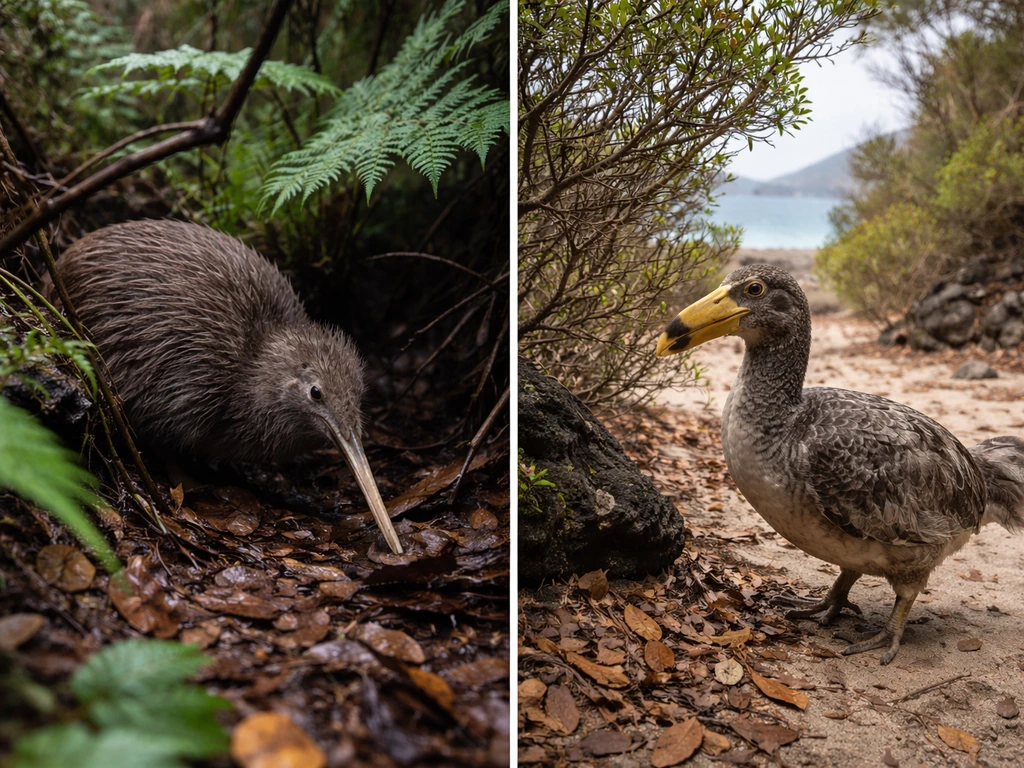
Kiwi are native exclusively to New Zealand, an archipelago in the southwestern Pacific Ocean. They inhabit a wide range of forest environments across the North Island, South Island, and several offshore islands. Their preferred habitats include native podocarp and broadleaf forests, scrubland, and even some pine plantations. They tend to favor dense, humid undergrowth with soft soil, which suits their foraging style (more on that below). New Zealand's geographic isolation meant kiwi evolved in an environment almost entirely free of land predators for millions of years.
The dodo lived on Mauritius, a volcanic island in the Indian Ocean roughly 900 kilometers east of Madagascar. Mauritius was covered in dense tropical forest when dodos roamed it. Like New Zealand for kiwi, Mauritius had no native land mammals that would have preyed on the dodo, which is a big part of why dodos evolved to be flightless and unafraid of large animals. The dodo's entire evolutionary history unfolded in that single island environment with no need to escape ground-level threats.
Spot the difference: body shape, size, wings, and beak
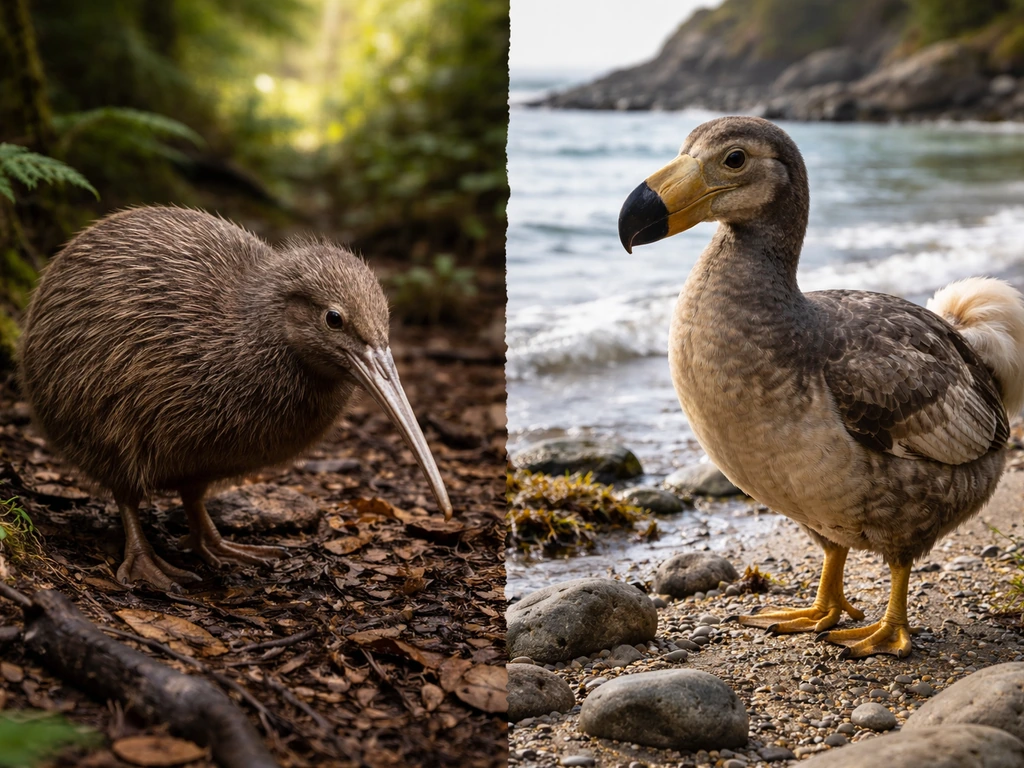
If you put a kiwi and a dodo side by side, you would not confuse them. They look strikingly different. Here's a clear breakdown of their physical traits.
| Feature | Kiwi | Dodo |
|---|---|---|
| Size | About 35–65 cm tall, roughly chicken-sized | Around 65–75 cm tall, closer to a large turkey |
| Weight | 1.3–3.3 kg depending on species | Estimated 10–17 kg based on skeletal remains |
| Body shape | Pear-shaped, compact, covered in shaggy hair-like feathers | Large, rotund, bulky body with a distinctive pot-bellied silhouette |
| Wings | Tiny vestigial wings, completely hidden under feathers | Small, stubby wings visible but useless for flight |
| Beak | Long, slender, flexible, slightly curved downward; nostrils at the tip | Large, hooked, heavy beak with a pronounced hook at the end |
| Head | Small, rounded head; long bill dominates the profile | Large head with a big, bulbous, hooked bill |
| Feathers | Shaggy, hair-like brown or grey feathers | Grey-brown plumage with fluffy tail feathers |
| Legs | Strong, short legs with powerful claws | Thick, sturdy, yellow legs built for walking on flat terrain |
| Eyes | Very small, limited daytime vision | Larger, forward-facing eyes |
One of the most distinctive kiwi features is that its nostrils are located at the very tip of its long bill, which is unique among birds. This allows kiwi to sniff out food underground. The dodo's beak, on the other hand, was short, thick, and heavily hooked at the tip, built more for crushing hard seeds and fruits. The two birds' bills are so different they look like they belong to animals from completely separate ecological niches, because they were.
What they ate and how they found food
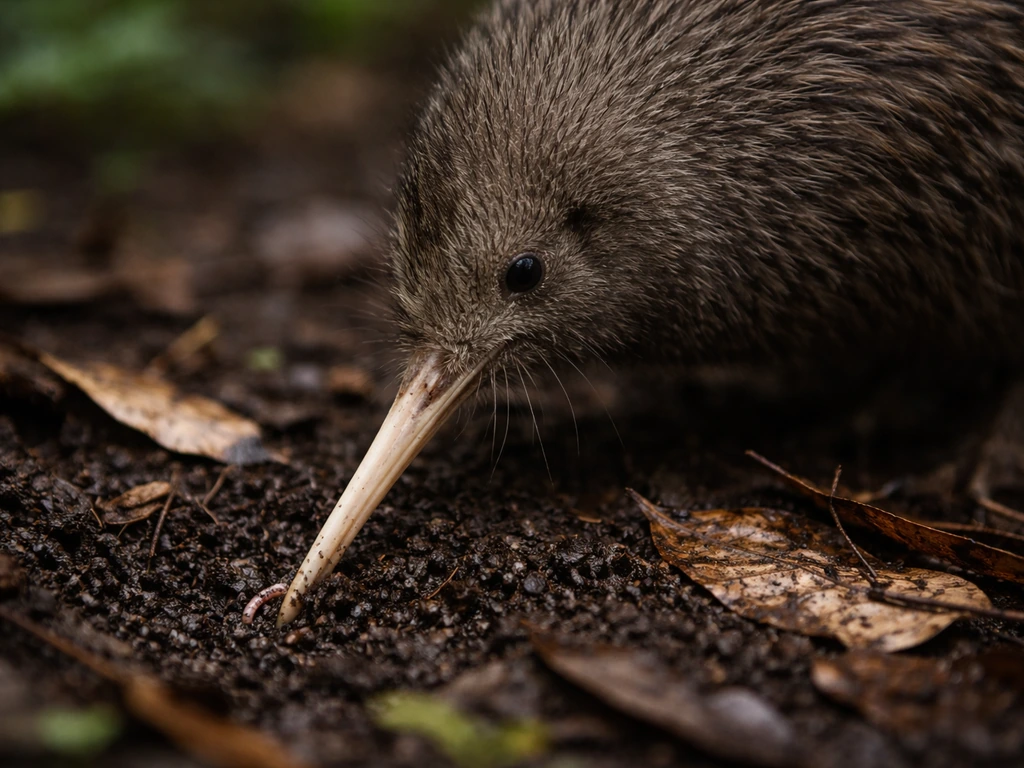
Kiwi are omnivores with a strong focus on invertebrates. They probe their long bills deep into the soil and leaf litter, using their tip-of-bill nostrils to smell out earthworms, beetles, larvae, spiders, and other invertebrates. They also eat fallen fruit, seeds, and small amphibians or freshwater crayfish when available. Their foraging is almost entirely done at night, guided by smell and touch rather than sight. Kiwi have some of the best-developed olfactory systems of any bird, which is extraordinary given that most birds rely heavily on vision.
The dodo's diet is less precisely known since they're extinct, but evidence from their anatomy and the foods available on Mauritius points to a diet heavy in fallen fruits, seeds, nuts, and possibly roots or bulbs. Their heavy, hooked beak was well-suited to cracking open hard-shelled fruits. Some researchers have suggested they may have eaten crabs or other small animals opportunistically, but fruits and seeds seem to have been the dietary staple. Unlike the kiwi's underground foraging style, dodos appear to have foraged across the forest floor for whatever dropped from the trees above.
Flight ability and how each bird moved through its world
Neither bird could fly, but their locomotion and daily rhythms were quite different. Kiwi are nocturnal, meaning they're active at night and spend their days sheltering in burrows, hollow logs, or dense vegetation. When they move, they walk and run on their powerful legs, but they're not sprinters. They navigate using their exceptional sense of smell and sensitive bristles (rictal bristles) around their face. Kiwi are also surprisingly territorial and vocal, often calling loudly at night to communicate with mates and establish territory.
The dodo, based on what we can reconstruct, was a diurnal or at least non-nocturnal ground dweller that walked slowly through the forest floor. Its body was heavy and its legs, while sturdy, weren't built for speed. Dodos were presumably active during daylight hours foraging for fruit. Historical accounts from sailors described dodos as slow-moving and seemingly unafraid of humans, which contributed directly to their demise. That same pattern of human contact is at the heart of the often asked question, dodo bird vs human. The kiwi's nocturnal, burrowing lifestyle actually offers some protection from predators, which is one reason they've survived while also being one of the reasons they're so rarely seen.
The kiwi is also the only ratite that is primarily nocturnal. Compare that to its ratite cousins like ostriches and emus, which are large, fast, daytime runners, and the kiwi stands out as a real outlier in its own group. If you're curious about how the kiwi stacks up against another ratite, the kiwi vs ostrich comparison makes for a fascinating contrast in just how far ratites have diverged. If you want a clear parallel, the toucan vs dodo bird comparison shows how different flightless birds can be in more than just where they live.
Common mix-ups: why people confuse these two birds
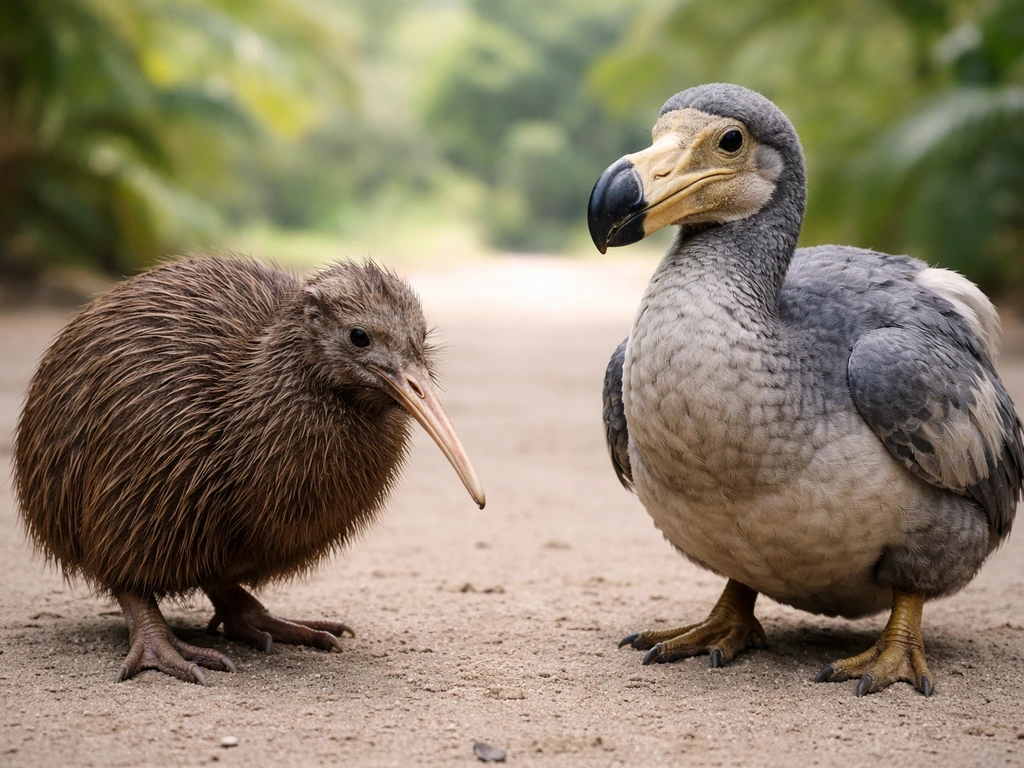
The most common reason people lump kiwi and dodos together is simple: both are famous flightless birds, both are island endemics, and both have become cultural icons associated with unusual or endangered birds. If your only exposure to either comes from cartoons, logos, or trivia questions, it's easy to file them under the same mental category. But ornithologically, they have almost nothing in common beyond flightlessness.
Another source of confusion is the way both birds are used as shorthand in popular culture. The dodo is a symbol of extinction and evolutionary naivety. The kiwi is a national symbol of New Zealand and lends its name to everything from fruit to slang for New Zealanders. These cultural associations don't map onto the actual birds at all, and they blur the distinctions further.
Some people also assume that because the dodo was an island bird that went extinct, the kiwi must be on the same trajectory. That's not accurate. Kiwi are threatened, yes, but they are actively managed through conservation programs and several species are stable or recovering. The dodo had no such intervention, and the circumstances of its extinction were far more sudden and extreme.
It's also worth noting that flightlessness in birds is far more widespread than most people realize. If you want a quick comparison, dodo bird vs t rex is another example of two very different species being confused by their reputation rather than their biology. The dodo is often compared to other large, unusual birds like the shoebill or even the terror bird. If you are also curious about “dodo bird vs shoebill,” the comparison gets even more dramatic because the shoebill is a very different kind of predator and bird altogether. The kiwi comparison to the ostrich is equally illuminating for understanding just how diverse flightless birds can be in body plan and lifestyle.
Why the dodo disappeared and what's keeping kiwi alive
The dodo's extinction is one of the most well-documented cases of human-caused species loss in history. When Dutch sailors arrived on Mauritius in 1598, they encountered dodos that had evolved with no natural predators and displayed no fear of humans. Sailors killed dodos for food in large numbers. But direct hunting wasn't even the primary driver of extinction. The settlers who colonized Mauritius brought with them rats, pigs, cats, dogs, and monkeys, all of which preyed on dodo eggs and chicks, which the dodo laid on the ground in nests with no defensive behavior to speak of. That is why the kiwi bird vs egg comparison often comes up when people talk about how vulnerable bird eggs are to introduced predators. Habitat destruction from land clearing compounded the pressure. Within roughly 80 years of first contact, the dodo was gone. The last credible sighting is recorded around 1681. Nature’s 2003 analysis also dates the last confirmed dodo sighting to 1662 and estimates extinction at 1690 based on statistical modeling blank" rel="noopener noreferrer">last credible sighting is recorded around 1681.
Kiwi faced a nearly identical set of pressures after humans arrived in New Zealand, first Maori settlers around 1280 CE and then European colonizers from the late 1700s onward. Introduced predators, especially stoats, rats, and possums, devastate kiwi populations. Stoats alone are estimated to kill around 95% of kiwi chicks in areas without predator management. Habitat destruction from farming and urban development has also reduced kiwi range significantly. All five kiwi species are currently listed as either vulnerable, endangered, or nationally vulnerable under New Zealand's threat classification system.
The key difference is that kiwi have the benefit of active, modern conservation intervention. These DOC/BNZ material on Operation Nest Egg also addresses how kiwi chick vulnerabilities and predator pressure contribute to very high early chick mortality from predators like stoats. New Zealand has invested heavily in predator-free island sanctuaries, mainland predator control programs, and captive rearing (Operation Nest Egg) that incubates and raises kiwi chicks in safety before releasing them into the wild. These programs have produced measurable population recovery in several species, particularly the North Island brown kiwi in managed areas. The dodo had no such safety net. By the time the scale of the problem was apparent, it was already too late.
Kiwi vs dodo at a glance
| Trait | Kiwi | Dodo |
|---|---|---|
| Status | Living (5 species, several threatened) | Extinct (last seen ~1681) |
| Origin | New Zealand | Mauritius, Indian Ocean |
| Closest relatives | Ostriches, emus, cassowaries (ratites) | Pigeons and doves (Columbidae) |
| Order | Apterygiformes | Columbiformes |
| Size/weight | Chicken-sized, 1.3–3.3 kg | Turkey-sized, ~10–17 kg |
| Beak | Long, slender, nostrils at tip | Short, heavy, hooked |
| Activity pattern | Nocturnal | Likely diurnal |
| Diet | Invertebrates, fruit, roots | Fruit, seeds, nuts |
| Foraging method | Probing soil by smell | Foraging forest floor by sight |
| Flightless? | Yes | Yes |
| Flight evolved away | Evolved independently from ratite ancestors | Evolved independently from pigeon ancestors |
If there's one thing to take away from all of this: kiwi and dodos are about as different as two flightless birds can be. Same broad category, completely different animals. The kiwi is a small, nocturnal, smell-hunting, soil-probing survivor. If you want a fun twist on the mix-ups, “dugast small bird vs typhoon” is another comparison people often run into online kiwi vs dodo. The dodo was a large, slow, fruit-eating island giant that vanished within a century of human contact. Knowing those core differences makes it easy to keep them straight, and to appreciate just how remarkable it is that kiwi are still here at all.
FAQ
What are the fastest, field-style cues to tell a kiwi from a dodo?
Use bill shape and activity time. Kiwi have a long bill with nostrils at the very tip and they forage at night by probing soil and leaf litter. Dodos had a short, thick, hooked beak and were described as walking on the forest floor during daylight.
Can you ever see a dodo in real life, or is it only known from fossils?
If you see a “kiwi” in a museum or on a tour today, it is a living animal, typically observed in controlled habitats or sanctuaries. A “dodo” can only be compared using bones, historical writings, or preserved specimens, so it cannot be directly observed in the wild.
How did nesting behavior make kiwi and dodo conservation outcomes so different?
Kiwi nests are typically hidden in burrows or under vegetation, often with camouflage and low visibility. Dodos laid eggs on the ground in open nests, which is one reason introduced mammals could wipe out entire breeding attempts quickly.
What senses do kiwi rely on compared with how dodos likely found food?
Kiwi have rictal bristles and a very sensitive sense of smell that helps them navigate and locate food without sight. Dodos likely relied more on visual daytime activity, since their reconstructed rhythm was diurnal or non-nocturnal.
Does being flightless mean kiwi and dodos are evolutionarily related?
Kiwi are classified as ratites, but not all flightless birds are “close relatives.” The key distinction is that kiwi and dodos became flightless independently through convergent evolution, so you should not treat ratite status as a sign they share a lineage.
Why do people keep confusing kiwi and dodos in the first place?
Common mix-ups come from logos, cartoons, and trivia that lump exotic flightless birds together. The correction is to ignore the cultural label and anchor on concrete traits, like kiwi nostrils at the bill tip and dodo’s thick hooked beak.
Are kiwi currently threatened for the same reasons as dodos were?
Kiwi are protected with ongoing management, like predator control and captive incubation programs, so population trends can improve locally. Dodos disappeared within about 80 years of human contact, and there is no equivalent recovery program possible now.
How does modern conservation change the way kiwi populations look today?
In predator-managed areas, kiwi chick survival can be dramatically higher than in unmanaged regions, and some populations have shown measurable recovery. That means comparing kiwi “rarity” to dodo “absence” can be misleading, because the effort to prevent decline is active.
What habitat clues would help you place kiwi vs dodo in the right ecological setting?
Look for the habitat pattern. Kiwi live in New Zealand forest and scrub with soft soil for probing, including places like podocarp and broadleaf forest and some plantations. Dodos were tied to Mauritius’ tropical forests and foraged on the ground near fruiting plants.
What’s one red flag claim about kiwi and extinction that readers should be skeptical of?
If a source suggests kiwi went extinct like the dodo, treat it as inaccurate. Kiwi have multiple species still living today, with threat levels that vary by region and strong human-led intervention improving survival in many managed sites.
Next Article
Kiwi Bird vs Egg: How to Tell Them Apart and What Next
Learn to distinguish kiwi bird vs egg, understand nesting and incubation, chick timeline, and safe next steps outdoors