If you're staring at something moving low and fast through the desert brush right now and wondering whether it's a roadrunner or a snake, here's the quick answer: if it has legs, a raised crest, and a long tail pointing slightly upward, it's a roadrunner. If it moves in smooth, sinuous S-curves with no visible limbs, it's a snake. Those two cues alone will separate them in about three seconds. But there's a lot more useful detail here if you have a moment, so let's go through the full picture.
Roadrunner Bird vs Snake: How to Tell Them Apart Safely

Marcus Hendricks
22 Apr 2026

Quick Identification Checklist: Roadrunner vs. Snake
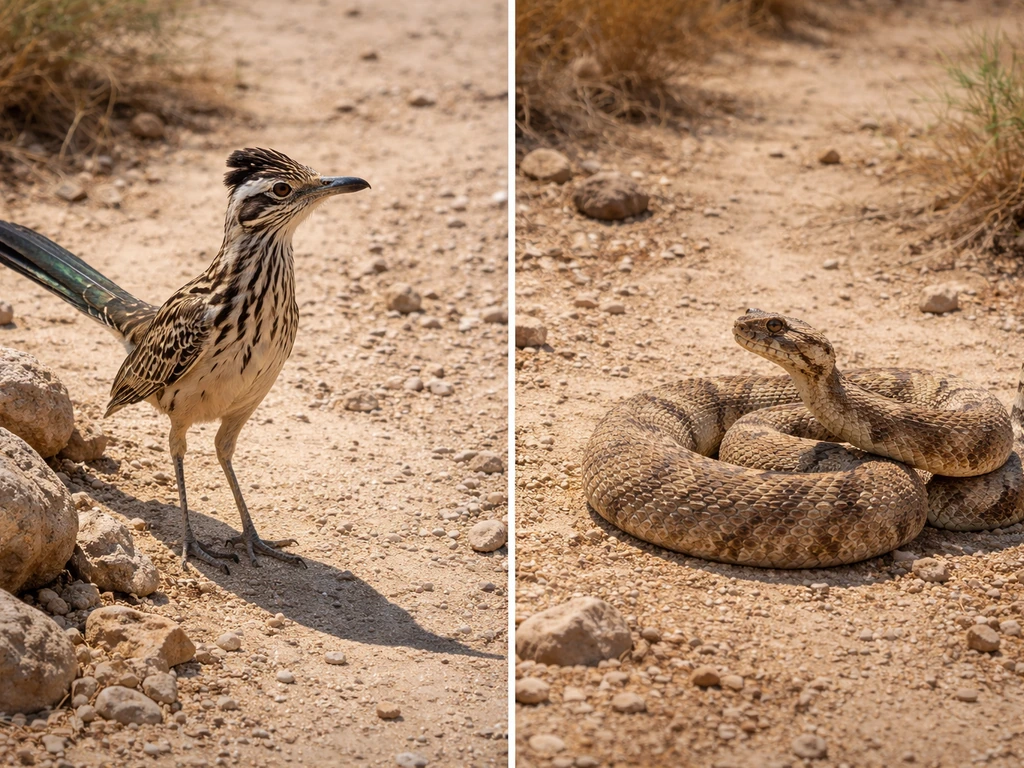
Run through this checklist in the field. The more boxes you check on one side, the more confident you can be in your ID.
| Feature | Greater Roadrunner | Rattlesnake (or most snakes) |
|---|---|---|
| Legs visible | Yes — long, obvious legs | No legs at all |
| Body length | 52–62 cm (about 20–24 in) with a distinct head, neck, body, tail | Variable; body is one continuous tube shape |
| Head shape | Large, flat-topped head with a long straight bill | Triangular or blunt head, no bill |
| Crest | Shaggy, raised or lowered crest of black feathers | None |
| Tail | Very long, stiff, straight tail often angled upward | Tapered tail, rattles at tip if rattlesnake |
| Movement | Runs upright on two legs, can move very fast | Lateral S-curve motion, no upright posture |
| Eye markings | Bare patch of colorful skin behind/around each eye | Round or elliptical pupils, scale-covered head |
| Sound | Low cooing calls; bill-clacking | Rattling sound when threatened (rattlesnakes) |
| Where seen | Running on open ground, roads, fence lines | Coiled or stretched on warm rocks, ground, or brush edges |
Body Shape and Movement: The Easiest Things to Notice First
The Greater Roadrunner is built like a stretched-out, speed-optimized ground bird. Adults run 52 to 62 centimeters long (roughly 20 to 24 inches), with long legs, a long neck, and a very long, stiff tail. When one sprints past you, the whole silhouette is unmistakably upright. The legs are doing all the work, the neck is stretched forward, and that long tail is often cocked slightly upward behind them. It looks like something designed specifically to run, because it is.
A snake has none of that. Its body is one continuous, uniform tube that ripples in S-shaped lateral curves as it moves. There are no limbs breaking the outline, no neck-to-body-to-tail distinction you can point to from a distance. Even a large rattlesnake crossing a road looks fundamentally different from a roadrunner: it stays low to the ground, moves slowly relative to a running roadrunner, and never lifts its body up onto limbs.
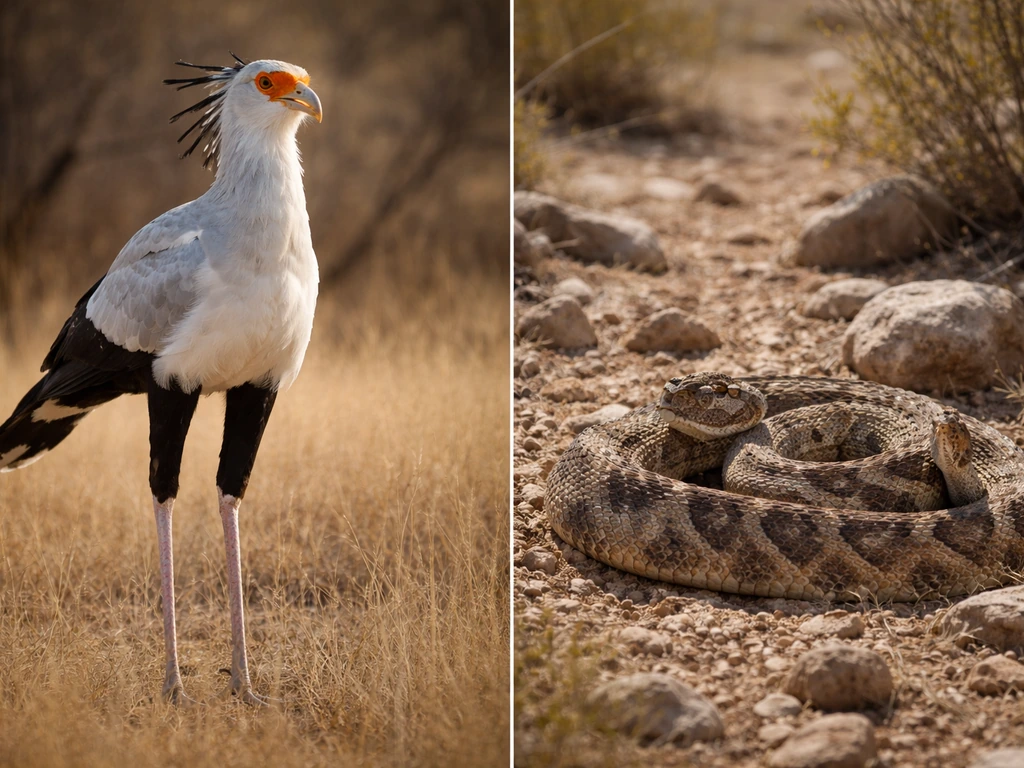
A common question is rattlesnake vs secretary bird, since both are snake-associated in how people describe their hunting behavior. If you’re wondering who would win rattlesnake vs secretary bird, that’s a different kind of snake hunter with very different size, behavior, and hunting style than the roadrunner. If you see something running upright on two legs, you already know it isn't a snake.
One movement cue worth mentioning specifically: roadrunners carry their tail at an upward angle when running, which creates a very distinct rising-line profile from behind. Snakes, by contrast, keep their entire body at or near ground level. That tail angle alone, spotted from 20 meters away, is often enough to make the call confidently.
Head, Bill, and Markings vs. Snake Facial Features
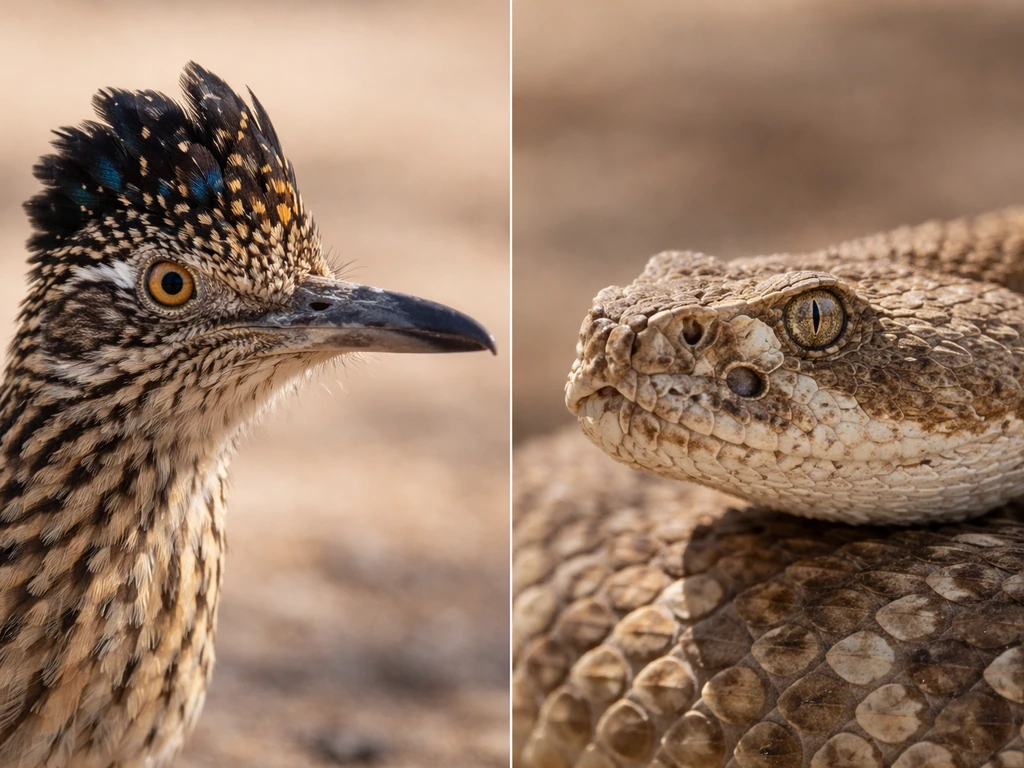
Up close, the head differences are dramatic. The roadrunner has a large, flat-topped head with a very long, heavy, straight bill. Think of a cuckoo (it is one, technically) scaled up and adapted for catching prey on the ground. If you meant a Senna bird versus a chuck, that’s a different kind of comparison worth checking next senna bird vs chuck.
If you are seeing a coucal bird and want to know how it differs from a snake, it helps to compare their movement and overall body shape side by side coucal bird vs snake. Behind and around each eye, there's a bare patch of skin that shows blue and red coloring in adults. On top of the head sits that classic shaggy crest of dark feathers, which the bird raises or lowers depending on its mood.
The overall look is almost prehistoric, with bold markings and an alert expression.
A rattlesnake's head is triangular and flat, covered entirely in scales, with no bill, no crest, and no bare skin patches. The eyes are small and set back in the skull, with vertical elliptical pupils (unlike most harmless snakes, which tend to have round pupils). The tongue is constantly flickering out, which is a sensory organ, not an attack cue. There's no beak. There's nothing on the head that resembles a crest or colored eye patch. Once you're looking at both animals' heads, even in a photo, there's really no confusion possible.
Body markings can briefly cause confusion at a distance because both animals show streaked or patterned brown and tan coloration. The roadrunner is streaked overall, brownish on the back with white and dark streaking, which can blend into dry brush or sandy soil. Rattlesnakes also show banded or diamond-patterned brown and tan markings. But the streaking on a roadrunner runs lengthwise along feathers, while rattlesnake patterns are crossbands or diamonds arranged around the cylindrical body. If you can see the texture, feathers vs. scales is the definitive call.
Behavior and Habitat: What You're Seeing and Where You're Seeing It
Roadrunners live in arid and semi-arid habitats: desert scrub, chaparral, open grasslands with scattered brush, and the edges of woodlands. They're active during the day, often spotted sprinting across roads, running along fence lines, or pausing on a prominent rock to survey their territory. The National Park Service notes they're frequently seen on roads and fence boundaries within their range, which is exactly the kind of open-edge habitat where someone might also spot a rattlesnake warming up on a sunny surface.
That habitat overlap is the main reason for real-life confusion. Both animals use open, sunny, warm ground. Both are found in the American Southwest and similar arid regions. Both will appear along trail edges and roadsides, especially in the morning when temperatures are cooler. Right now, in late April, rattlesnakes are coming out of their winter dormancy and are actively foraging, which Arizona Game and Fish confirms. Roadrunners are year-round residents in their range. So spring is exactly the season when you're most likely to see both animals in the same area at the same time.
Behaviorally, roadrunners are bold and often surprisingly tolerant of human presence. They'll stand on a fence post and stare at you, bob their crest, or trot away at a brisk pace without panic. Rattlesnakes, by contrast, will typically coil defensively, rattle, or attempt to move toward cover if they sense you nearby. If the animal is actively approaching you out of apparent curiosity, it's almost certainly a roadrunner. If it's coiled, motionless, or rattling, you're looking at a snake.
Do Roadrunners Actually Eat Rattlesnakes? How That Relationship Works
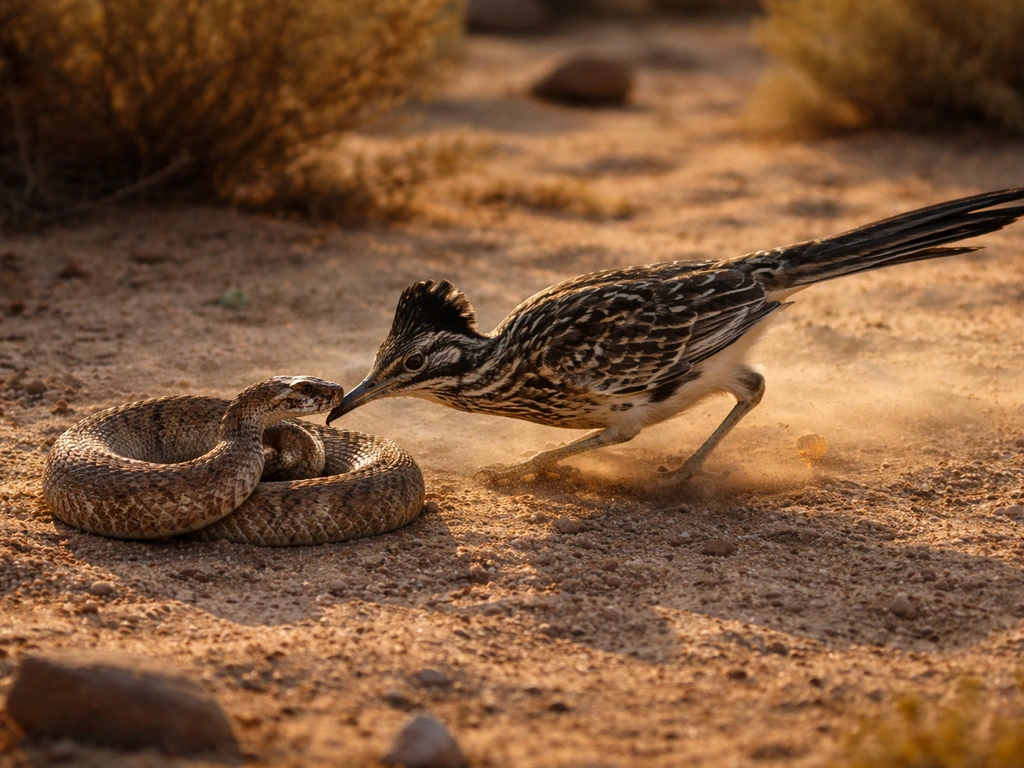
Yes, and it's not just a cartoon exaggeration. Greater Roadrunners genuinely hunt and kill snakes, including rattlesnakes. Cornell Lab of Ornithology describes the method directly: roadrunners kill rattlesnakes by pecking them repeatedly in the head. They're fast enough, and their bill is heavy enough, to land multiple rapid blows before a rattlesnake can strike accurately. The bird's long neck gives it reach and maneuverability, and it uses its wings to deflect or confuse the snake during the attack.
That said, it's worth being specific about what roadrunners typically target. Their diet includes young rattlesnakes more regularly than large adult ones. A full-grown adult rattlesnake is a much more dangerous target, and roadrunners are pragmatic hunters. They're not going to take unnecessary risks when lizards and smaller prey are available. But they absolutely will go after juvenile rattlesnakes and smaller snake species as part of their normal diet.
The ecological relationship goes beyond hunting. Research published in the Wilson Journal of Ornithology found that 53.3% of Greater Roadrunners actively defended their nest sites from snake predators using direct antipredator behaviors. So the roadrunner-vs-snake dynamic isn't one-sided: roadrunners face snake predation on their eggs and chicks, and they respond to it aggressively. It's a genuine two-way ecological relationship, with the roadrunner holding its own in a surprising number of those encounters.
If you're watching a roadrunner and a snake interact in the field, the roadrunner is typically the aggressor, not the prey. The bird will approach with its crest raised, make rapid movements to distract the snake, and attempt to land bill-strikes on the snake's head. It's one of the more remarkable behaviors you can observe in North American wildlife, and it's completely real. This predator-prey dynamic is somewhat similar in spirit to what's been described in comparisons of other snake-hunting birds, though the roadrunner's close-quarters, on-foot hunting style makes it particularly distinctive.
Why Roadrunners Can Do This Without Getting Killed
A few anatomical and behavioral factors work in the roadrunner's favor. First, their legs give them speed and the ability to dodge: rattlesnakes can only strike a distance roughly equal to half their own body length. A roadrunner that maintains the right distance and moves quickly has a real tactical advantage. Second, the long bill keeps the bird's head away from the strike zone during attacks. Third, roadrunners have been observed using their spread wings as a kind of shield or distraction. It's not luck, it's a refined hunting technique developed over evolutionary time.
What to Do When You Encounter a Roadrunner or a Rattlesnake
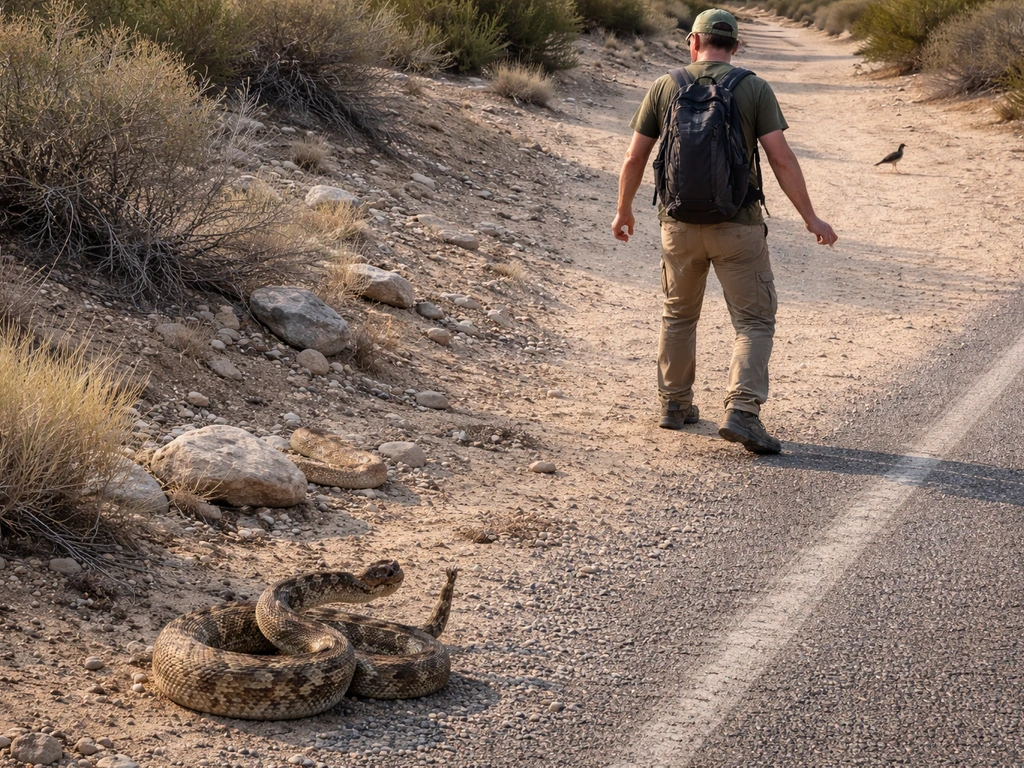
If you've identified what you're seeing as a roadrunner, relax. Roadrunners are harmless to humans and genuinely interesting to observe. Give them space so you don't disturb them, but there's no safety concern. Watch from where you are, enjoy the sighting, and don't try to approach or feed them.
If you've identified it as a rattlesnake, the guidance is straightforward. The National Park Service recommends maintaining at least 25 yards (about 23 meters) as a minimum safe distance from most wildlife, and that's a solid baseline. Remember that rattlesnakes can only strike roughly half their own body length, but don't use that as an excuse to get close. Most rattlesnakes will move away toward cover if given the opportunity. The City of Albuquerque's wildlife guidance puts it well: move cautiously, give the snake a clear escape route, and wait for it to leave on its own.
Never attempt to pick up, handle, or kill a rattlesnake. A significant number of snakebite injuries happen to people who are actively trying to handle or kill the snake, not to people who simply walked past one. If a rattlesnake is in your yard or home and won't leave on its own, keep it in sight from a safe distance and contact your local animal control or a licensed snake relocator rather than approaching it yourself.
If a bite does occur, treat it as a medical emergency immediately. Call 911 or get to the nearest emergency room as fast as possible. Poison Control (reachable at 1-800-222-1222 in the US) can also provide immediate guidance. Do not apply tourniquets, try to suck out venom, or cut the wound. Keep the bite below heart level if possible, stay calm to slow your heart rate, and get professional medical help as fast as you can.
Practical Next Steps After Your Sighting
- Confirm your ID using the checklist above before acting. Legs and crest mean roadrunner. No legs and lateral movement mean snake.
- If it's a rattlesnake, back away slowly and give it a clear path to cover. Don't make sudden movements.
- Keep children and pets back immediately. Rattlesnakes strike reflexively, not maliciously.
- If the snake is on a trail or public land and poses a hazard, report it to the local park ranger or land management office rather than attempting to move it.
- If the snake is on your property and won't move on, contact local animal control or a licensed snake relocation service.
- For any bite, call 911 immediately. Don't wait to see if symptoms develop.
The roadrunner and the rattlesnake share territory across the American Southwest, and encounters with both are a normal part of spending time outdoors in that region. If you still find yourself asking how are a bird and a snake similar, start with the basics you can see at a glance: movement, body shape, and where they keep their head and tail.
Knowing how to tell them apart quickly and what to do in each case makes the whole experience safer and, honestly, a lot more interesting. Watching a roadrunner hunt is one of the genuinely surprising things you can see in the field, and understanding the biology behind it makes it even better. It is the same ornery bird vs snake matchup that makes road-runners such formidable hunters when you spot one on the ground.
If you're also curious about how a roadrunner compares to another desert predator, see roadrunner bird vs coyote for a related matchup to consider next.
FAQ
What should I do if I can’t clearly see legs or the head crest when trying to decide roadrunner bird vs snake?
In the roadrunner, the crest and bill are easy to confirm if you can see the head angle, but in shadows or brush the safer default is “bird unless proven otherwise.” Use two independent cues: visible legs and an upright, neck-and-tail silhouette during motion. If you cannot confirm either, treat it as a snake until you can back away for a clearer view.
Can a roadrunner ever move in a way that looks like a snake, and how do I avoid the mistake?
Roadrunners can pause, crouch, or move in short bursts that briefly break the “smooth zigzag” idea. Still, even when they stop, they typically keep their body elevated by the legs, and their tail is often held at an angle behind them. A snake, on the other hand, stays low to the ground even when it pauses, and its movement pattern stays continuous along the body.
How can I tell what to do in the moment if the animal seems to be approaching me in roadrunner bird vs snake situations?
If the animal is in the open and moving toward you, back up slowly and keep visual contact from a distance. Roadrunners may bob the crest and continue trotting, but they will not typically coil, rattle, or “hold still” in a defensive posture. If you hear any rattling or you see coiling, assume it is a snake and give it space immediately.
Why does lighting or camera blur make roadrunner bird vs snake identification harder, and what cue stays most reliable?
At dawn or after rain, snakes can move more actively and may briefly lift the head higher than usual, and birds can look flatter when viewed low from certain angles. The most reliable discriminator is texture: feathers form a streaked outline with visible softness and segmentation at the neck and tail, while snakes show scaled continuity with crossbands or diamonds wrapped around a cylinder.
Does the roadrunner bird vs snake checklist still work around nests, juveniles, or eggs on the ground?
Nest and juvenile issues are common. Young roadrunners can look slimmer and may keep their crest lower, and juvenile snakes can be smaller with less dramatic head shape. If you see an animal near ground nests, eggs, or cover, do not try to “get closer to confirm,” keep a wider buffer, and watch from a distance.
Is it safe to take close photos for confirmation when I’m unsure roadrunner bird vs snake?
If you want to document it, zoom in rather than approaching, and avoid kneeling near brush where a snake could strike from cover or where you could corner a nesting bird. Take photos from where you can stay back and move away instantly if it changes posture.
What if it’s a snake-like animal but I don’t hear rattling, does that change the safe approach?
Yes, there are non-rattling snakes that do not show obvious rattles, so “no rattle” is not proof. Use the presence of legs and the upright, crest-and-bill silhouette for birds, and for snakes rely on scaled continuity plus a ground-level body track. When uncertain, treat the animal as a snake and keep the distance recommended for wildlife.
What’s the safest next step for roadrunner bird vs snake if one shows up in my yard or campsite?
If you’re in a yard or campground, keep people and pets inside and maintain distance rather than attempting to shoo it. For snakes that won’t move on, contact local animal control or a licensed wildlife handler. For roadrunners, disturbance is usually the bigger issue, so keep pets away but you can often simply wait for it to move off on its own.
What should I do during a bite emergency, and does the “roadrunner bird vs snake” confusion affect what I should report?
If a bite happens, the key decision is speed and correct first aid, not identification. Call emergency services immediately, remove jewelry or constricting items near the bite, keep the person calm, and avoid cutting, sucking, or tourniquets. If you can, note the time of bite and any symptoms onset for the medical team.