Title: Secretary Bird vs Lion: Size, Strength, Hunting Methods and Ecological Roles Compared
Secretary Bird vs Lion: Comparative Size, Behavior & Ecology

Marcus Hendricks
18 Jul 2026
Meta description: Secretary bird vs lion: compare size, weapons, hunting tactics, and ecological roles with real data on these two iconic African savanna species.
A secretary bird weighs roughly 3 to 4.5 kg and stands about 1.2 meters tall. A male lion tips the scales at 150 to 250 kg and stretches nearly 2.5 meters from nose to rump. These two animals share the African savanna, occasionally cross paths, and both kill prey with specialized weapons, but that is essentially where the comparison ends. One is a bird classified in order Accipitriformes; the other is the largest cat on the continent. Understanding what each animal actually does, how it hunts, and what role it fills in the ecosystem is far more interesting than asking which one would win a fight.
Why compare a secretary bird and a lion at all?
People searching 'secretary bird vs lion' are usually coming from one of two directions. Some have just watched a video of a secretary bird stomping a cobra and want to know how that same bird stacks up against the apex predator sharing its grassland. Others are building a broader mental picture of the African savanna and want to understand how a large, oddly terrestrial bird fits into an ecosystem dominated by megafauna. Both are fair questions. This article works through the anatomy, the numbers, the hunting behavior, and the ecological reality of both species, so you leave with a clear, evidence-grounded picture rather than a sensationalized one. Where relevant, comparisons to the secretary bird's interactions with other fast predators like the cheetah are worth keeping in mind as a broader frame. For another relevant comparison, see secretary bird vs peacock. For another relevant comparison, see secretary bird vs human. For a focused comparison of speed, hunting tactics, and interactions with a faster mammalian predator, see secretary bird vs cheetah.
At a glance: secretary bird vs lion by the numbers
| Attribute | Secretary Bird (Sagittarius serpentarius) | Lion (Panthera leo) |
|---|---|---|
| Classification | Bird — order Accipitriformes, family Sagittariidae | Mammal — order Carnivora, family Felidae |
| Height / body length | ~1.1–1.5 m tall (standing) | ~1.4–2.5 m head-to-body length |
| Body mass | ~2.3–4.5 kg | Female ~120–180 kg; male ~150–250 kg |
| Wingspan | Up to ~2.0–2.12 m | Not applicable |
| Top speed | Up to ~30 km/h on foot; can fly | Burst speed ~50–80 km/h (short distances) |
| Primary weapons | Rapid foot strikes (~195 N force); hooked beak | Canine teeth; forelimb claws; bite force ~1,100–1,800 N |
| Diet | Snakes, reptiles, small mammals, large invertebrates | Large ungulates (wildebeest, zebra, buffalo); occasional smaller prey |
| Typical prey size | Up to ~1–2 kg; snakes up to large constrictors | 20–300 kg ungulates; cooperative hunting extends upper range |
| Hunting method | Stalking on foot; rapid stomping kicks | Ambush; cooperative pride hunts; suffocation bite |
| Range | Sub-Saharan Africa (open grassland, savanna) | Sub-Saharan Africa; small population in Gir Forest, India |
| Lifespan (wild) | ~10–15 years | ~10–14 years (females up to ~16) |
| IUCN status | Endangered | Vulnerable |
| Sexual dimorphism | Weak to moderate (males slightly larger) | Pronounced (males significantly larger; mane present) |
Taxonomy and identification: one is a bird, one is a cat
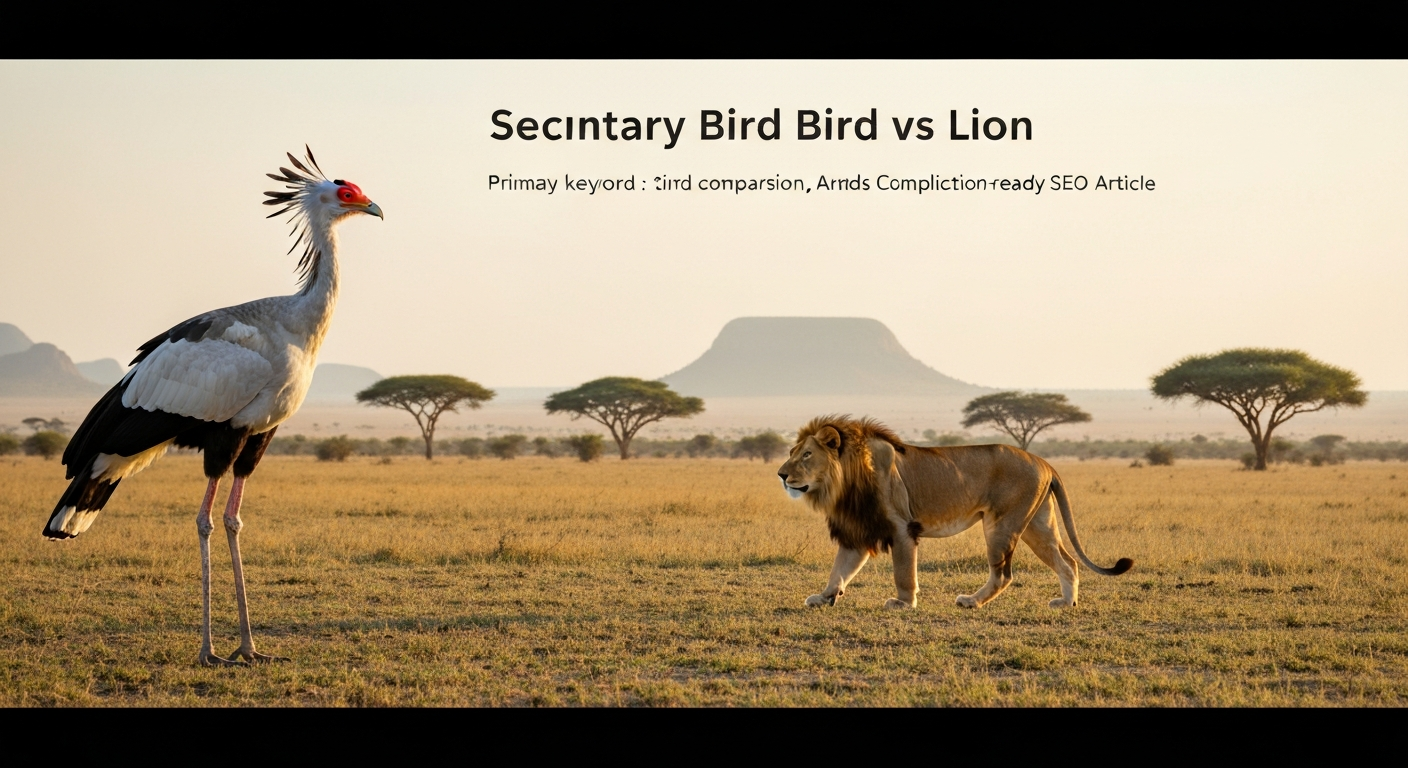
The secretary bird, Sagittarius serpentarius, is the sole living member of both its genus and its family, Sagittariidae. It sits within the order Accipitriformes, which also includes hawks, eagles, and Old World vultures, but the secretary bird is distinct enough that it earned its own family classification back in 1779 when Miller first formally described it. It looks unlike any other raptor: long crane-like legs, a bare red-and-orange face, black crest feathers fanned behind the head like old-fashioned quill pens tucked behind an ear (hence the name), a hooked eagle-style beak, and a body that is built for walking rather than perching.
The lion, Panthera leo, is a mammal in the family Felidae, genus Panthera, which it shares with tigers, leopards, and jaguars. A male lion is unmistakable: massive build, a mane ranging from sparse and tawny in some East African populations to thick and dark in others, and a tail ending in a dark tuft. Females are mane-free and noticeably smaller. If you are standing on an open savanna and something is walking toward you on two long legs with feathered wings folded at its sides, that is the secretary bird. If something is low to the ground, tawny-coated, and weighing as much as a motorcycle, that is the lion. There is genuinely no identification challenge between these two.
Key visual differences at a glance
- Secretary bird: feathered body, bare facial skin (red-orange), long feathered legs, two-toed foot structure adapted for striking, hooked raptor beak
- Lion: fur-covered body, whisker pads, retractable claws on four padded paws, prominent canine teeth, mane present in males
- Secretary bird stands upright on two legs and is roughly human waist height at the back
- Lion crouches low to the ground; shoulder height of a male is roughly 1.0–1.2 m
- Secretary bird flies; lion does not
- Lion is 40–100 times heavier than a secretary bird depending on sex and individual
Anatomy and primary weapons: kicks vs claws and teeth
The secretary bird's most studied weapon is its foot. A peer-reviewed 2016 study by Portugal and colleagues, published in Current Biology, measured the striking force of a secretary bird kick at approximately 195 Newtons, which is roughly five times the bird's own body weight. Contact duration is extremely brief, around 10 to 15 milliseconds, meaning the strike is too fast for most prey to react to before the damage is done. The toes are short, blunt, and powerful rather than long and gripping like an eagle's talons. The hooked beak is used secondarily for tearing food after the prey has been immobilized or killed by the feet. This foot-strike system is tailored for stunning and killing snakes and reptiles on the ground without getting bitten in the process.
The lion's arsenal is categorically different in scale and mechanism. Published biomechanical estimates place lion bite force somewhere between approximately 1,100 and 1,800 Newtons, depending on study methodology and which part of the jaw is measured. The canine teeth are designed for puncturing and holding, while the carnassial molars shear meat. The forelimbs are massively muscled and topped with semi-retractable claws typically 3 to 4 cm long; lions use these to drag prey down, maintain grip during a chase, and hold struggling animals still for the killing bite. A lion's standard kill method on large prey is a sustained suffocation bite to the throat or muzzle, which can take several minutes. This is a mammalian bone-and-muscle system optimized for overwhelming and asphyxiating animals many times the size of a secretary bird.
From a comparative anatomy standpoint, the two animals are built on entirely different structural principles. The secretary bird has an avian skeleton: hollow bones, a lightweight frame, a keeled sternum for flight muscles, and a tarsometatarsus (the fused lower leg bone) that acts as a rigid lever for those powerful strikes. The lion has the dense, robust mammalian skeleton of a large felid, with a broad skull housing the jaw-closing muscles, a flexible spine that stores and releases energy during a sprint, and deep chest muscles attached to large scapulae. Neither body plan is 'better' in absolute terms; they are precisely engineered for completely different jobs.
Size, strength and locomotion: the numbers and what they mean
A secretary bird in the field is a tall, long-legged bird, typically between 1.1 and 1.5 meters in height, with a wingspan that can reach about 2. Regional assessments give sexed wingspan ranges (female 1.20–1.32 m; male 1.26–1.35 m reported for some samples) and provide population-trend data for southern Africa BirdLife South Africa: Secretarybird species page (regional metrics and status). 0 to 2.12 meters. Body mass sits in the range of 2.3 to 4.5 kg. It is mostly a walker, covering large distances of open savanna on foot each day in search of prey, but it is capable of flight and roosts in trees overnight. On the ground it moves at a steady walking pace; when chasing prey or startled it can run, though top running speed is modest compared to most mammalian predators.
A male lion is an entirely different proposition physically. Head-and-body length runs from about 1.7 to 2.5 meters, shoulder height around 1.0 to 1.2 meters, and mass from roughly 150 to 250 kg, with females considerably lighter at 120 to 180 kg. For authoritative adult size metrics, see National Geographic: African lion facts and measurements, which reports head-and-body lengths around 1.7–2.5 m and male masses typically 150–250 kg. Lions can achieve burst speeds of approximately 50 to 80 km/h over short distances, making them among the fastest large land animals in Africa over a sprint, though they have poor endurance and typically stalk to within 30 meters or less of prey before charging. The mass difference between a lion and a secretary bird is so extreme (roughly 50 to 80 times greater for a male lion) that the secretary bird's impressive 195 N kick, while devastating to a snake, would have negligible effect on a lion.
Sexual dimorphism in lions is pronounced and well documented: males are substantially larger than females and carry the iconic mane, which varies in color and density by region and age. In secretary birds, dimorphism is weak to moderate; some morphometric studies from southern Africa report small differences in wing measurements between sexes, but in the field the two sexes are extremely difficult to tell apart without close inspection. Both sexes hunt and both incubate eggs. This is a meaningful contrast to the lion, where females do the majority of cooperative hunting while males primarily defend territory.
How each animal hunts: very different strategies for very different prey
Secretary bird hunting technique
The secretary bird hunts almost entirely on foot, striding through open grassland and flushing prey by stamping through vegetation. When it locates a snake, lizard, small mammal, or large insect, it delivers a series of rapid, powerful downward kicks to the head and body of the prey item. The 10 to 15 millisecond contact time of each strike is faster than most snake strike reactions, which is the critical adaptation that allows this bird to take venomous species including cobras and puff adders with relatively low risk of envenomation. After the prey is stunned or dead, the beak is used to tear and consume it. Secretary birds have also been observed dropping hard-shelled or tough prey from height to break it open, a behavior seen in other raptors.
Typical prey includes snakes up to considerable size, monitor lizards, rodents, small ground birds, and large invertebrates like locusts and beetles. Prey items generally weigh well under 2 kg. The secretary bird does not cooperate with others during hunts; it is a solitary forager. A breeding pair may forage in proximity but do not coordinate attacks. This is one of the starkest behavioral contrasts with the lion.
Lion hunting technique
Lions are ambush predators that rely on cooperation within a pride to take large prey reliably. A typical hunt involves multiple females spreading out and silently flanking a herd of wildebeest, zebra, or buffalo before one or more individuals initiate a charge. The prey is brought down with forelimb swipes and claws, then killed with a throat or muzzle bite that suffocates rather than exsanguinates. George Schaller's foundational fieldwork in the Serengeti, later supplemented by Packer and colleagues, documented how cooperative hunting substantially increases success rates and allows lions to tackle prey like Cape buffalo that weigh up to 700 kg. Solitary lions, typically males, can and do hunt alone but have lower success rates and tend to take smaller or weaker prey.
The typical prey size range for lions is approximately 20 to 300 kg in routine hunting, with cooperative groups occasionally taking buffalo at 500 to 700 kg. This is orders of magnitude larger than anything a secretary bird encounters. The ecosystems these two predators regulate are therefore completely non-overlapping in terms of trophic function.
What actually happens when a secretary bird and a lion meet?
In practice, a secretary bird on the savanna simply avoids a lion. A bird weighing under 5 kg has no defensive or offensive mechanism that would matter to an animal weighing 200 kg, and the secretary bird's instinct would be to fly or move away rather than engage. Lions, for their part, are not known to actively hunt secretary birds; the energetic return on catching a 3 kg bird that can fly is not worth the effort for an ambush predator built for large ungulates. There are no well-documented cases of lions regularly preying on secretary birds in the scientific literature, and no basis for framing this comparison as a genuine contest. The secretary bird's striking power, impressive as it is relative to its body size, is scaled for snakes and small reptiles, not for large carnivores. A 195 N kick to a lion would be roughly equivalent to a mild slap in terms of the force-to-body-mass ratio.
The myth worth busting here is the idea that a 'powerful' animal is powerful in all contexts. The secretary bird is genuinely one of the most forceful kickers relative to body weight in the avian world, and it dispatches venomous snakes that would kill humans. But force applied to a 30 cm cobra and force applied to a 200 kg lion are not remotely comparable scenarios. Respecting what each animal is built for is the honest way to read these comparisons.
Ecological niches: why neither can substitute for the other
The secretary bird and the lion occupy the same biome but function at completely different trophic levels and in completely different ecological roles. The secretary bird is a mesopredator and specialist ground hunter that suppresses populations of snakes, rodents, and large invertebrates across open grassland and savanna. By keeping snake populations in check, it indirectly supports small mammal diversity and reduces the risk of livestock and human snakebite in areas where it forages near farms. It is a diurnal, terrestrial forager that covers large areas of open ground, making it sensitive to habitat fragmentation and the loss of open grassland to agriculture.
The lion is an apex predator that regulates populations of large herbivores. Without lion predation, ungulate populations in savanna ecosystems can grow beyond the carrying capacity of the vegetation, triggering overgrazing cascades that degrade habitat for dozens of other species. Lions also create carrion that sustains vultures, hyenas, jackals, and other scavengers, making them a keystone species in a way the secretary bird is not. Remove the secretary bird and snake populations likely expand; remove the lion and the entire large herbivore trophic dynamic shifts. These are not interchangeable functions.
Both species are currently under pressure. The secretary bird is listed as Endangered on the IUCN Red List, with BirdLife International documenting substantial recent population declines driven primarily by habitat loss, pesticide use reducing prey availability, and collision with power lines. The lion is listed as Vulnerable, with population fragmentation, human-wildlife conflict, and prey base depletion as the main threats. African lion subpopulations in West Africa are assessed as even more critically threatened. Both animals depend on the persistence of intact savanna ecosystems, making their conservation concerns structurally linked even though their ecological functions are distinct.
Human encounters and wildlife considerations
Secretary birds are not dangerous to humans under normal circumstances. A startled or cornered bird could theoretically deliver a painful kick, and the beak is sharp enough to cause injury, but unprovoked attacks on people are not a documented concern. They are sometimes seen foraging near roads and farm margins and tend to move away from human approach rather than toward it. In areas where grassland persists near agricultural land, they are generally regarded as beneficial due to their consumption of venomous snakes and crop-damaging rodents.
Lions are an active human safety concern across their range. Human-lion conflict is one of the primary drivers of retaliatory killing, and lions account for dozens of documented human fatalities each year across sub-Saharan Africa, particularly where natural prey has been depleted and livestock is available. Conservation organizations including the IUCN Cat Specialist Group actively work on coexistence frameworks, compensation schemes for livestock losses, and protection of movement corridors to reduce conflict. This is a fundamentally different human-wildlife dynamic than exists with the secretary bird.
Related comparisons worth exploring
If the secretary bird's interactions with other fast African predators interest you, the secretary bird vs cheetah comparison is a natural next step: both are built for speed in their own way, but their predatory niches, body plans, and threat responses differ sharply. The secretary bird vs human comparison is also informative for understanding scale, strike force in a human context, and why this bird commands genuine respect despite being bird-sized. And if you want to explore how the secretary bird measures up to another large, visually striking bird with long legs and dramatic plumage, the secretary bird vs peacock comparison covers the contrast between a predatory raptor and a display-focused galliform in detail. One sibling topic in this site's range, the colonel vs full bird colonel comparison, covers military ranks rather than biology and is outside the scope of this article.
The bottom line on secretary bird vs lion
The secretary bird and the lion are both remarkable animals shaped by millions of years of evolution on the African savanna, and placing them side by side is a useful exercise in understanding scale, specialization, and ecological function. The secretary bird is a lightweight, precision striker that takes prey no larger than a small snake or rodent, uses one of the fastest and most forceful kicks in the bird world relative to body mass, and plays a vital role in controlling mesopredator and reptile populations. The lion is a massive cooperative ambush predator that regulates large herbivore populations and anchors the top of the mammalian food web. They are not competitors, not realistic combatants, and not ecological substitutes for each other. They are two very different evolutionary solutions to life in the same landscape, and both deserve the conservation attention their Endangered and Vulnerable listings demand.
FAQ
What are the essential numeric/spec data points required for an evidence‑based “secretary bird vs lion” article?
Provide at‑a‑glance, cited numeric values with ranges and sample sizes where available: height/length, wingspan (bird) or head‑body length (lion), standing height, typical adult body mass (male and female ranges), maximum reported mass/length, lifespan (wild and captive), geographic range area (continent/bioregions; simple km2 or descriptive range), top and cruising speed (or burst speed with context), primary diet composition (percentages or ranked prey types if available), typical prey size limits, primary weapons and their quantitative metrics (beak length, talon morphology, kick force in N for secretarybird, bite force estimates in N for lion, claw dimensions if available), grip/strike mechanics (contact durations, forces), and conservation status (IUCN category and most recent assessment year). For every numeric entry include a primary source citation and note regional variation or uncertainty ranges.
Which primary sources and reference categories should be collected and prioritized?
Prioritize peer‑reviewed literature, authoritative species accounts, and international conservation databases: 1) IUCN Red List / BirdLife species factsheets (conservation status, range, trends). 2) Peer‑reviewed biomechanics and behavioral papers (e.g., Portugal et al. 2016 for secretarybird kicking strike; lion bite‑force and hunt kinetics papers). 3) Mammal Diversity, ITIS, and integrated taxonomic authorities for taxonomic statements. 4) Regional monitoring/atlas reports (BirdLife South Africa, SANBI) for sexed morphometrics and population trends. 5) Foundational field monographs (e.g., Schaller, Packer) and recent reviews for lion sociality and hunting. 6) Museum morphometric datasets or osteology papers for comparative anatomy claims. 7) Reputable natural history outlets (National Geographic) only to support general facts, but verify numeric claims from primary literature. Record DOI/URLs, publication year, sample sizes, and any caveats.
What taxonomy and identification facts must be included and what references support them?
State: secretarybird = Sagittarius serpentarius (order Accipitriformes, family Sagittariidae — sole extant species of its family); lion = Panthera leo (family Felidae). Cite ITIS, Mammal Diversity, and BirdLife/IUCN taxon pages for authoritative taxonomy. Include key visual/functional ID differences: feathers vs fur, long crane‑like legs and crest in secretarybird, wingspan and beak morphology vs lion’s mane (males), paw anatomy, dentition (canines). Support anatomical claims with avian anatomy texts and mammalian osteology/morphometrics (museum datasets or review articles).
What comparative anatomy and weapon metrics should the article present?
Compare form and function with cited metrics: secretarybird — beak type, tarsus length, toe arrangement, talon curvature, measured kick force (~195 N from Portugal et al. 2016), contact duration (~10–15 ms); lion — skull morphology, canine dimensions, estimated bite‑force range (~1,100–1,800 N from biomechanical studies), forelimb muscle mass and claw structure. Explain how feathers/fur, skeletal differences, and muscle distribution affect performance. Use comparative anatomy references, museum morphometrics, and biomechanics papers.
How should hunting methods, prey size, and ecological niches be documented and sourced?
Describe each species’ hunting strategy with field and experimental sources: secretarybird — obligate terrestrial stalking raptor that detects and dispatches snakes, reptiles, small mammals and invertebrates by repeated kicks and stomps; cite BirdLife factsheet and field studies. Lion — social ambush predator using cooperative stalking, short high‑speed bursts and grappling to subdue large ungulates; cite Schaller, Packer, and hunt‑kinematics literature. Include prey size distributions, typical maximal prey relative to predator mass, and habitat preferences (open savanna/grassland versus mixed habitats). Explain niche separation and why one cannot substitute for the other using energetics, prey size capacities, and social hunting evidence.
How to assess realistic interactions, recorded encounters, and myth‑busting claims?
Compile credible observations and research on interspecific encounters: search field reports, museum records, published natural history notes, and verified observational databases for any documented secretarybird–lion interactions. Report probability: extremely low (different prey focus and behavior; lions rarely attack birds except opportunistically). Explain likely outcomes using relative size and weapon metrics: lion overpowering bird in direct contact; secretarybird capable of injuring small predators or snakes with kicks but extremely unlikely to kill an adult lion. Use biomechanics and natural history literature to debunk myths (e.g., secretarybird vs lion duels) and cite sources for each counterclaim. If no verified recordings exist, state that explicitly and cite the search scope.