The quagga is not a bird. It was an extinct subspecies of plains zebra, a hoofed mammal classified as Equus quagga quagga, that roamed the Karoo and southern grasslands of South Africa until the last known wild individual was shot in the 1870s and the last captive animal died in Amsterdam in 1883. If you landed here expecting a bird comparison, you are in good company. The name 'quagga' sounds like it could belong to a wading bird or a tropical parrot, and some historical illustrations have added to the confusion. This article explains exactly what the quagga was, how it differs from any bird on a biological level, and why the mix-up happens in the first place.
Quagga vs Bird: Is the Quagga a Zebra or a Bird? Quick ID Guide

Marcus Hendricks
16 Jul 2026
Quick ID at a Glance
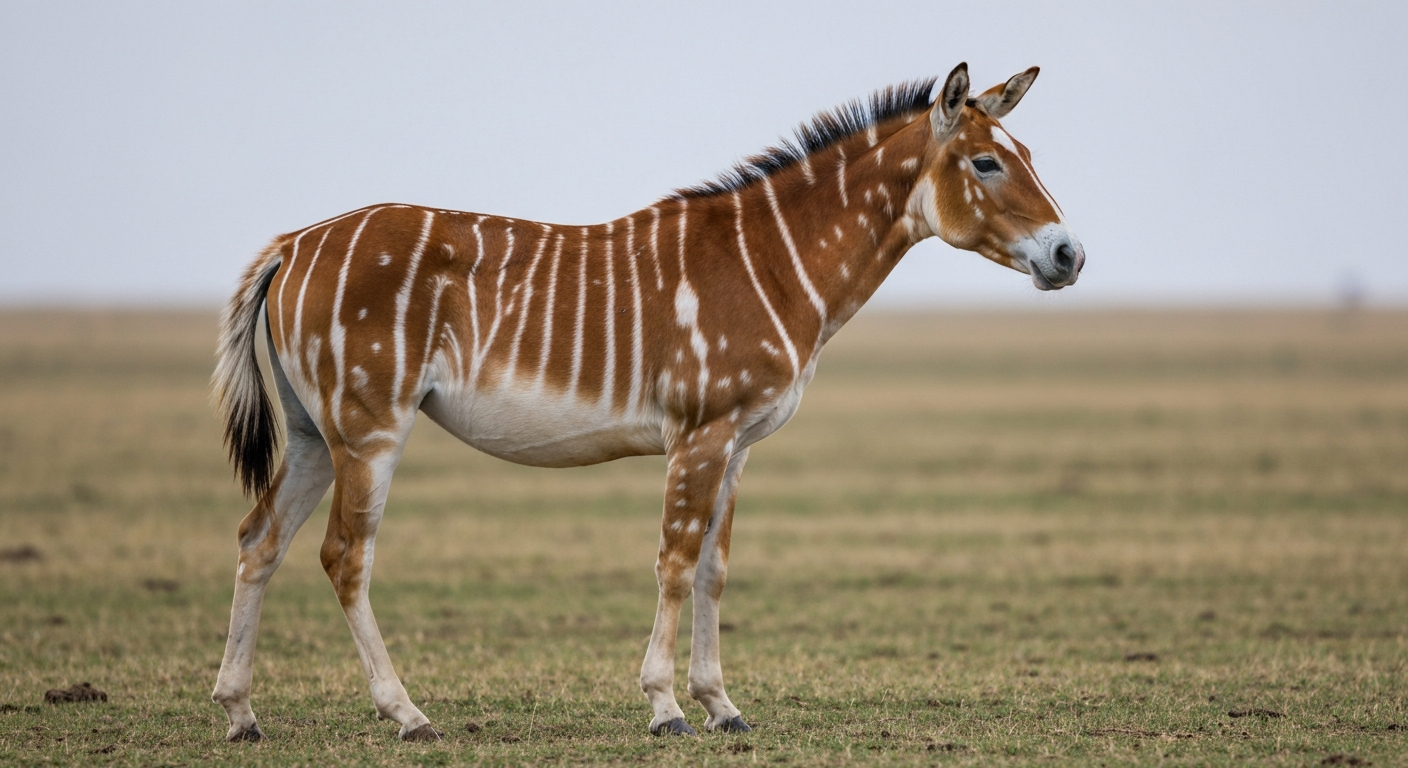
If you are looking at a photograph or museum specimen and need a fast check, one visual scan settles it: the quagga had four hoofed legs, a horse-like head with a mane, and brown-and-white striped patterning confined to its front half, fading to plain brown toward the hindquarters. No feathers, no wings, no beak, no talons. Any bird, by contrast, has a beak (no lips or teeth in living species), feathers covering its body, two legs with scaled feet, and two wings even when those wings are flightless. Those features are mutually exclusive. If an animal has hair and hooves, it is a mammal. Full stop.
What the Quagga Actually Was
Taxonomy and classification
The quagga sits squarely in the mammalian order Perissodactyla, the odd-toed ungulates, alongside horses, tapirs, and rhinoceroses. Its full trinomial name is Equus quagga quagga. It belongs to the family Equidae (the horse family), genus Equus, and is a subspecies of the plains zebra (Equus quagga). The ITIS taxonomic database, GBIF Backbone Taxonomy, and Mammal Species of the World all list it this way. Ancient DNA studies, beginning with the landmark 1984 Higuchi et al. Nature paper (the first published ancient-DNA sequence from any extinct animal), confirmed that quagga mtDNA falls within the range of plains zebra variation, supporting its subspecific rather than full-species status. A follow-up study by Leonard et al. in Biology Letters (2005), using mitochondrial sequences from multiple museum specimens (GenBank accessions AY914318 to AY914323), reinforced that conclusion.
Appearance and the famous 'faded stripe'
The quagga's most distinctive feature was its striking colour gradient. The head, neck, and forequarters carried bold brown-and-white stripes similar to other zebras, but from roughly mid-body backward the stripes faded and the coat transitioned to plain brown or tan, with a white belly and white legs. This partial striping is what makes museum specimens immediately recognisable and is central to the Quagga Project's selective-breeding goals. The animal stood roughly 125 to 135 cm at the shoulder, similar in build to other plains zebras, with a stocky body, short erect mane, and a tail ending in a tuft of longer hair.
Historical range and behavior
Quaggas ranged across the Karoo region and southern grasslands of what is now South Africa, particularly in the Cape Colony and the Orange Free State. They were gregarious grazers, living in herds and often sharing rangeland with ostriches and other plains animals. Early European settlers described them as bold and easily approached, traits that, combined with intense hunting pressure and competition with livestock for grazing, accelerated their decline. Their call was reportedly a bark-like 'kwa-ha-ha', the Khoikhoi onomatopoeia that gave them their name.
Extinction and Efforts to Bring the Quagga Back
Commercial hunting for meat and hides, combined with the conversion of grassland to farmland and direct persecution to protect livestock grazing, wiped out wild quaggas by the late 1870s. The last confirmed captive individual died on 12 August 1883 at Artis Zoo in Amsterdam. What makes the quagga scientifically significant beyond its extinction is the physical evidence left behind: approximately 23 preserved skins and a small number of complete or partial skeletons are held across European and North American natural-history museums. Key specimens include a complete skeleton at the Yale Peabody Museum (used in the Leonard et al. 2005 genetic study) and historic skins catalogued at the Natural History Museum in London (example specimen reference 1864.7.2.3). These museum holdings are the primary voucher sources for both morphological study and DNA extraction.
The Quagga Project and 'breeding-back'
Founded in 1987 by Reinhold Rau, the Quagga Project in South Africa takes a selective-breeding approach to approximate the quagga's reduced-striping phenotype. The method works by identifying plains zebras with naturally reduced striping, breeding them selectively across generations, and attempting to produce animals ('Rau-quaggas') whose coat pattern resembles museum specimens. The project has produced several generations of reduced-stripe animals and has reintroduced some to reserves. However, peer-reviewed critiques, including work published in South African journals examining the politics and methodology of the project, point out that phenotypic resemblance is not the same as taxonomic identity. For a detailed sociopolitical, taxonomic and methodological critique of the Quagga Project, see the peer‑reviewed South African commentary 'blank" rel="noopener noreferrer">The micro‑politics of macromolecules in the taxonomy and restoration of Quaggas' (SciELO), which discusses limits of phenotype‑only restoration and evidence needed to claim taxonomic identity. Breeding back recovers coat appearance, not the specific genetic makeup of the extinct subspecies, and authoritative de-extinction reviews (including framework work by Seddon et al. available via PMC) recommend that any credible restoration claim needs nuclear and mitochondrial DNA comparison alongside museum-voucher verification and ecological assessment, not just visual similarity.
Quagga vs Bird: The Full Anatomical and Physiological Breakdown
This is where the comparison becomes genuinely instructive, because the differences are not just superficial. These two groups of animals, mammals and birds, diverged from a common reptilian ancestor hundreds of millions of years ago and have accumulated deep biological separations at every level of anatomy and physiology. Here is the checklist I use when helping students distinguish a mammal from a bird using primary biological criteria.
- Body covering: quagga (mammal) has hair and a keratinous mane and tail; birds have feathers (also keratin-based but structurally entirely different, with a rachis, barbs, and barbules).
- Teeth vs beak: the quagga had a full set of equid teeth adapted for grazing, including large incisors and molars; no living bird species has true teeth (tooth loss occurred in the avian lineage early in their evolution).
- Limbs: quagga had four limbs, all used for locomotion, terminating in a single enlarged hoof on each foot (one functional toe, perissodactyl plan); birds have two legs and two wings, with the forelimbs fully modified into wings even in flightless species.
- Reproduction: quagga was viviparous, giving birth to live young (typically one foal) and nursing with mammary glands; birds are oviparous, laying hard- or soft-shelled eggs and lacking mammary glands entirely.
- Respiratory system: mammals including the quagga breathe with a diaphragm-driven tidal lung system; birds use a unique air-sac system (typically nine air sacs) that drives unidirectional airflow through fixed, non-expanding lungs attached to the dorsal body wall, a design described in detail in Sturkie's Avian Physiology and reviewed in peer-reviewed respiratory physiology literature.
- Circulatory system: both birds and mammals have four-chambered hearts and are endothermic (warm-blooded), but birds have higher resting body temperatures (typically 40 to 42 degrees Celsius) and proportionally larger hearts relative to body mass compared to similarly sized mammals.
- Middle-ear ossicles: mammals have three middle-ear bones (malleus, incus, stapes); birds have one (the columella/stapes). This is one of the key anatomical markers used in fossil classification.
- Skeleton: mammalian skeletons have a lower jaw made of a single dentary bone fused at a midline symphysis; birds have a kinetic skull with a separate lower jaw of fused bones. The quagga skeleton also lacks a wishbone (furcula) and keeled sternum, both diagnostic bird features.
- Skin glands: mammals have diverse skin glands including sweat, sebaceous, and mammary glands; birds lack sweat glands and most have only a uropygial (preen) gland.
Side-by-Side Comparison Table
| Feature | Quagga (Equus quagga quagga — Mammal) | Typical Bird (Class Aves) |
|---|---|---|
| Taxonomic class | Mammalia | Aves |
| Body covering | Hair / fur, short mane, tufted tail | Feathers (contour, down, flight feathers) |
| Mouthparts | Teeth: incisors, canines reduced, molars for grinding | Beak (rhamphotheca): no true teeth in living species |
| Limb plan | Four legs, single hoof per foot | Two legs + two wings; feet with scales and claws |
| Reproduction | Viviparous; single live foal; mammary glands | Oviparous; hard-shelled eggs; no mammary glands |
| Respiratory system | Tidal lungs, diaphragm-driven | Fixed lungs, air-sac system, unidirectional airflow |
| Heart chambers | Four | Four (higher resting temp: ~40-42 °C) |
| Middle-ear bones | Three (malleus, incus, stapes) | One (columella/stapes) |
| Skeletal hallmarks | Single dentary lower jaw, no furcula | Kinetic skull, furcula (wishbone), keeled sternum |
| Skin glands | Sweat, sebaceous, mammary glands | Uropygial (preen) gland only in most species |
| Diet / feeding | Grazer: grasses and low vegetation | Highly variable: seed, insect, fish, nectar, carrion |
| Historical range | Karoo and southern grasslands, South Africa | Every continent and major ocean |
| Conservation status | Extinct (last captive died 1883) | Varies by species: from Least Concern to Extinct |
| De-extinction efforts | Quagga Project (selective breeding-back); no full genomic resurrection | Not applicable |
| Vocalization mechanism | Larynx (mammalian, bark-like 'kwa-ha-ha') | Syrinx (unique avian vocal organ at bronchial fork) |
How to Confirm the Identity in Photos and Museum Specimens
If you are looking at an old illustration, a museum specimen, or an archival photograph and need to determine quickly whether you are looking at a quagga or a bird, work through this visual checklist from the most obvious features inward.
- Count the limbs and check their structure: four hoofed legs means mammal; two legs plus wings (even stub wings) means bird.
- Check the head: a long horse-like face with visible lips and nostrils set on a fleshy muzzle is a mammal; a beak with no fleshy lips is a bird.
- Look at the body surface: if you can see individual hair shafts, especially in a mane or coat, it is a mammal; overlapping feathers with visible rachis lines are a bird feature.
- Check striping or patterning context: the quagga's stripes fade from front to back, and the pattern sits on a brown-tan coat; no bird species produces this exact gradient, though some large terrestrial birds such as ostriches share savanna habitat and superficially large silhouettes.
- Consult museum records directly: the Natural History Museum London data portal (quagga specimen example: 1864.7.2.3), the Yale Peabody Museum mammalogy catalogue, and the Quagga Project's worldwide museum census are the most accessible primary sources for verified specimen images. These records include photographed skins that make the mammalian hair texture immediately visible.
- For historical photographs: only five confirmed photographs of live quaggas exist, all taken at London Zoo between 1863 and 1870. These are held by the Zoological Society of London and are widely reproduced in academic literature. Cross-check any supposed quagga image against these known five photographs.
For museum visits, institutions most worth checking are the Natural History Museum in London (Tring), the Naturalis Biodiversity Center in Leiden (holds the most complete quagga skin and skeleton collection in Europe), the Humboldt Museum fur Naturkunde in Berlin, and the Yale Peabody Museum in New Haven. Each provides catalogue access online, and many specimen images are available through their public data portals.
Why Do People Search 'Quagga vs Bird' in the First Place?
This is a fair question and one worth taking seriously rather than dismissing. Several genuine sources of confusion push people toward this search.
The name sounds avian
Phonetically, 'quagga' sits comfortably alongside bird names. 'Quail', 'quetzal', 'querquedula' (an old name for teal ducks), and 'quelea' all begin with similar sounds, and the doubled-vowel ending mirrors names like 'myna', 'tinamou' or 'jabiru' in their exotic feel. Readers unfamiliar with equid taxonomy can easily see 'quagga' on a list and assume bird without any additional context. This is also exactly the kind of confusion this site is built to resolve. A similar naming ambiguity appears with the bullfrog vs bird comparison, where the word 'frog' is clearly non-avian but online taxonomic searches surface it on bird-focused pages. For a parallel case, see the bullfrog vs bird comparison.
Historical illustrations and artistic stylization
Nineteenth-century natural-history illustrators worked at a time when live specimens were rare and artist-rendered field sketches circulated widely. Some early quagga illustrations, particularly in popular encyclopedias and broadsheets, used bold graphic lines to represent the striped coat. When reproduced at small scale or in black-and-white woodblock prints, the patterning can look superficially similar to the bold barring seen on birds such as bar-tailed godwits, zebra finches (whose name compounds the confusion), or even some plover species. The stylization of equid stripes into tight graphic marks is visually adjacent to avian barring patterns in low-resolution historical prints. Consulting the original color plates in works like the Proceedings of the Zoological Society of London, or George Edward Lodge's illustrations in major Victorian zoological volumes, immediately clarifies the mammalian subject, but these sources are not always the first thing a general reader encounters in a web image search.
The quagga's savanna context overlaps heavily with birds
Quaggas shared their habitat with ostriches, secretary birds, ground hornbills, and a wide range of large savanna birds. Early accounts of southern African wildlife often described quaggas alongside these birds in the same passage. This co-occurrence in natural-history narratives means that readers encountering 'quagga' in a list of African wildlife might group it mentally with the birds mentioned around it. This is the same contextual effect that has led to interesting comparisons elsewhere on this site: the shoebill bird versus crocodile comparison, for example, works precisely because these two very different animals occupy the same swamp ecosystems and early naturalists frequently described them together. See related mutualism examples between crocodiles and birds for an ecological illustration of interspecies interactions. Shared habitat does not imply shared taxonomy.
Zebra finch and 'quagga' as an art or design term
In some regional art and craft traditions, 'quagga' has been used as a descriptive term for bold striped patterns, and this decorative usage occasionally appears on textiles or design objects alongside bird imagery, further blending the association. Additionally, the zebra finch (Taeniopygia guttata), a striped bird native to Australia, is widely kept as a pet and is frequently described in terms that echo quagga descriptions ('boldly striped', 'brown and white patterning'). Someone reading both descriptions back to back without the taxonomic context can reasonably produce a mental conflation.
A Repeatable Method for Comparing Birds to Non-Bird Animals
Whether you are on this site to check a quagga, a bullfrog, or a crocodile against a bird (and all three of those comparisons are genuinely useful in ecology and in education), the same checklist works every time. I use this approach when introducing animal classification to new birdwatchers who are still calibrating their taxonomic intuitions.
- Start with body covering: feathers confirm bird; hair or scales set you in another direction immediately.
- Check the forelimbs: wings (even vestigial ones) are a bird hallmark; four-legged animals are not birds.
- Look at reproduction: egg-laying alone is not diagnostic (reptiles and monotremes lay eggs too), but mammary glands and live birth together confirm mammal.
- Listen to the vocalisation if possible: birds produce sound through the syrinx, a structure unique to the class Aves located at the fork of the bronchi; mammals use the larynx. Recorded calls and their spectrographic structure differ accordingly.
- Check the respiratory architecture: birds have air sacs and fixed lungs; mammals breathe with a muscular diaphragm and expandable lungs. This is not visible externally but is critical in fossil or specimen identification.
- Consult a primary taxonomic source before finalising: ITIS, GBIF, and the IUCN Red List all provide free, verifiable classification data. For birds specifically, the IOC World Bird List and the Clements Checklist are the standard references.
This framework applies directly to other comparisons that come up regularly on a bird-focused site. The crocodile-bird mutualism examples are a good illustration: crocodiles and birds interact closely (plover species removing parasites from crocodile mouths is the classic case), but the anatomical differences between a reptile and a bird are just as fundamental as those between a mammal and a bird. Shared ecosystems and even direct physical contact between species do not blur their biological boundaries. The quagga and the ostrich grazed the same South African plains, but one was a mammal and one was a bird, and no amount of superficial visual similarity changes that.
FAQ
Short definitive answer: Is the quagga a bird?
No. The quagga (Equus quagga quagga) is an extinct subspecies of the plains zebra (a mammal, family Equidae), not a bird. Authoritative taxonomic databases list it as a subspecies of Equus quagga (ITIS: https://www.itis.gov; GBIF: https://www.gbif.org/species/5787161). Genetic studies (e.g., Higuchi et al. 1984; Leonard et al. 2005) place quagga specimens inside plains‑zebra variation, supporting mammalian identity (Nature 1984: https://www.nature.com/articles/312282a0; Biology Letters 2005: https://royalsocietypublishing.org/doi/10.1098/rsbl.2005.0323).
Concise natural‑history profile of the quagga (taxonomy, appearance, extinction, de‑extinction efforts)
Taxonomy: Equus quagga quagga — a southern subspecies of the plains zebra (Equus quagga) recognized in standard mammal checklists (Mammal Species of the World). Appearance: strongly reduced striping on the hindquarters and rump with brownish, zebra‑like head and foreparts; museum skins and historical illustrations document phenotype (museum census: Quagga Project https://www.quaggaproject.org/quaggas-in-museums-worldwide/; NHM London specimen: https://data.nhm.ac.uk/object/491a3c42-bd80-4132-b8a1-f5f30c2ea3f9). Extinction: hunted in the 19th century; last wild and captive records mid–late 1800s. Genetic evidence from museum skins (Higuchi 1984; Leonard 2005) confirms its close relation to plains zebras. De‑extinction/’breeding‑back’: The Quagga Project (started 1987) selectively breeds low‑striped plains zebras to produce animals resembling the quagga’s appearance (https://www.quaggaproject.org/the-project/). Critics note phenotype ≠ genetic identity and recommend genetic, ecological and voucher evidence before claiming taxonomic restoration (e.g., critical commentary and de‑extinction reviews: https://www.ncbi.nlm.nih.gov/pmc/articles/PMC6265789/; critique https://www.scielo.org.za/).
What clear anatomical and physiological differences distinguish mammals (quagga) from birds?
Key differences (brief): - Body covering: mammals have hair/fur; birds have feathers. - Thermoregulation and integument: mammary glands and lactation in mammals; birds have egg‑laying with brooding and no mammary glands. - Skeletal: mammals lack an avian furcula and have different limb bone orientations; birds have a furcula (wishbone), keeled sternum (in flying species) and hollow pneumatic bones. - Respiratory: mammals use lungs with a diaphragm; birds have air‑sac system and unidirectional airflow. - Skull/ear: mammals have three middle‑ear ossicles; birds have a single columella (stapes). - Reproduction: most mammals give live birth (except monotremes), milk young; birds are oviparous with amniotic eggs. - Vocal organ: mammals often use larynx; birds use syrinx. Sources: Sturkie’s Avian Physiology; avian respiratory reviews (https://www.ncbi.nlm.nih.gov/pmc/articles/PMC11864839/).
Structured list of behavioral and ecological differences between quagga (mammal) and birds
Behavioral/ecological differences: - Social structure: plains zebras are social, forming harems or bachelor groups; bird social systems vary widely (pairs, flocks, colonies). - Locomotion: quadrupedal terrestrial movement in zebras; birds: bipedal terrestrial locomotion plus flight in most species. - Diet and foraging: quaggas/plains zebras are grazers (grass specialists); birds occupy diverse niches (insectivores, granivores, raptors, nectarivores). - Nesting/rearing: mammals often use communal dens or range‑based rearing with lactation; birds build nests and provision via regurgitation or food carrying. - Habitat use: zebras occupy savannas and grasslands; birds inhabit virtually all habitats, including savannas but with different microhabitat use. Sources: IUCN plains zebra account (https://nc.iucnredlist.org/redlist/amazing-species/equus-quagga/pdfs/original/equus-quagga.pdf) and general avian ecology texts.
A plain‑English comparison ‘table’ of representative anatomical/physiological traits (for readers who expect side‑by‑side info)
(Presented as a readable side‑by‑side breakdown) - Taxonomic class: Mammalia (quagga) vs Aves (birds). - Skin covering: hair/fur vs feathers. - Reproduction: live birth (placental mammals) + lactation vs egg‑laying (oviparity) + incubation. - Skeleton: limb columns for running, non‑pneumatic limb bones vs pneumatized bones, furcula, often keeled sternum. - Respiratory system: lungs + diaphragm vs lungs + extensive air‑sac system with unidirectional airflow. - Ear bones: three ossicles (malleus, incus, stapes) vs single columella/stapes. - Vocal organ: larynx vs syrinx. - Examples for quick ID: hooved, four‑toed fore/hind feet and mane = mammal (zebra/quagga); beak, feathers, bipedal stance or flight = bird. (Sources: Sturkie’s Avian Physiology; mammalogy references; avian respiratory review https://www.ncbi.nlm.nih.gov/pmc/articles/PMC11864839/).
Visual ID cues and example images to verify quagga vs bird
Visual ID cues for quagga (mammal): hooved (ungulate) feet; four‑legged gait; fur/hair and mane; zebra‑like facial shape and teeth for grazing; lack of feathers, beak, wings. Consult high‑resolution museum skin photos (Natural History Museum London specimen: https://data.nhm.ac.uk/object/491a3c42-bd80-4132-b8a1-f5f30c2ea3f9) and Yale Peabody skeleton records (https://peabody.yale.edu/explore/collections/mammalogy). For birds: look for feathers, beak, wings, feathered preen oil gland, and bipedal posture. Suggested image resources for verification: museum specimen pages (NHM London, Yale Peabody), Quagga Project photos (https://www.quaggaproject.org/quaggas-in-museums-worldwide/), GenBank/NCBI sequence entries for voucher IDs. Use specimen catalogue numbers and museum photos as primary visual vouchers.
Next Article
Crocodile bird and crocodile interaction is an example of mutualism?
Is the crocodile bird–crocodile interaction mutualism, commensalism, or myth? Clear, evidence-based answer for birdwatch