
A bird of paradise comparison works best when you start by narrowing down exactly which species you're looking at, because the family Paradisaeidae contains around 45 species spread across several genera, and the traits that separate them vary wildly depending on which pair you're comparing. The most useful approach: identify the genus first, then work through plumage, size, display behavior, and range to pin down the species. This guide gives you a repeatable checklist to do exactly that, whether you're separating closely related Paradisaea species in the field or trying to figure out why a juvenile male looks nothing like the adult you expected.
Bird of Paradise Comparison: How to Tell Similar Species Apart

Marcus Hendricks
31 May 2026
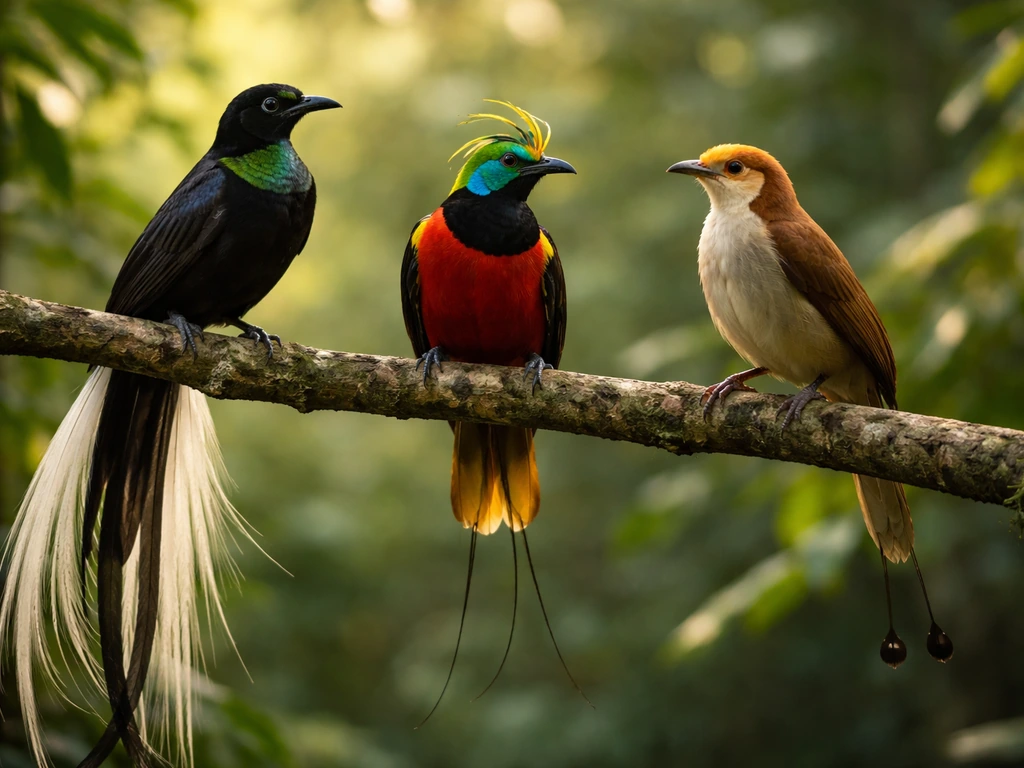
First, make sure you're comparing the right things
Before diving into feather details, it helps to clarify what you actually mean by "bird of paradise comparison," because the phrase gets applied to several very different situations. You might be comparing two species within the same genus (like Raggiana vs. Greater bird-of-paradise, both in Paradisaea). You might be comparing species from different genera entirely, like a Semioptera standardwing against a Cicinnurus magnificent. Or you might have stumbled onto the naming overlap between the birds and the Strelitzia plant, which the U.S. Fish & Wildlife Service actually labels as "bird-of-paradise" for a flower, not a bird at all. If you're looking at a photo of an orange-and-blue tropical flower, that's the plant. This article is about the birds.
The taxonomic family Paradisaeidae is your anchor. The Birds-of-Paradise Project organizes the family into 15 genera, and Cornell Lab's Birds of the World uses the same genus-level structure as a practical starting point. The IOC World Bird List (updated twice a year) is the most current source for species-level taxonomy, which matters because splits do happen: the Vogelkop superb bird-of-paradise, for instance, was long treated as the same species as the wider superb bird-of-paradise before courtship behavior differences confirmed it as a separate species. So your first step in any comparison is always: which genus, and is the taxonomy current?
Once you're inside the right genus, the comparisons become much more tractable. The greatest confusion tends to cluster within the Paradisaea genus (Greater, Lesser, Raggiana, Emperor, Blue, Red, and a few others) because the males all share a broadly similar body plan with flank plumes, but differ in plume color, size, and display style. Comparisons between genera are usually easier because the differences are more dramatic, though juvenile males can still throw you off.
Key traits to compare at a glance
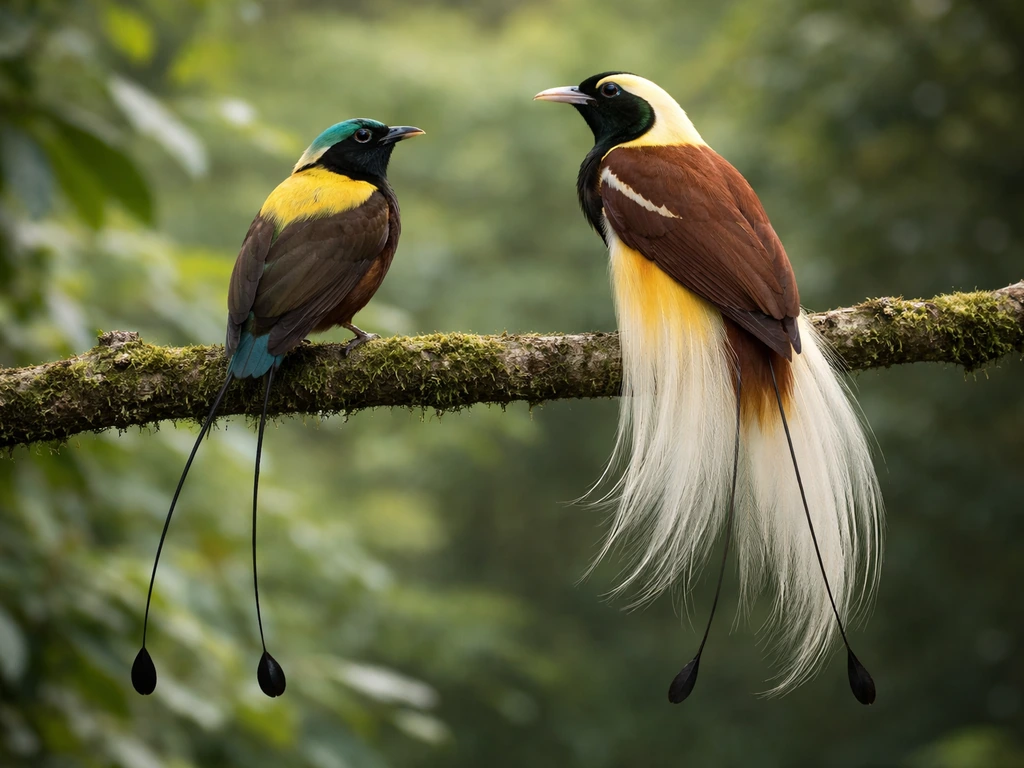
When you're looking at a bird and trying to narrow it down quickly, size and plume color are your fastest filters. Here's how the most commonly confused Paradisaea species stack up against each other and a couple of notable species from other genera.
| Species | Body Length (approx.) | Male Flank Plume Color | Bill Color | Tail Wires |
|---|---|---|---|---|
| Greater Bird-of-Paradise | 43 cm (male) | Yellow/white (creamy) | Blue-grey | Long central pair |
| Raggiana Bird-of-Paradise | 34 cm (male) | Red to orange-red | Blue-grey | Long central pair |
| Lesser Bird-of-Paradise | 32 cm (male) | Yellow/white (similar to Greater) | Blue-grey | Long central pair |
| Emperor Bird-of-Paradise | ~30 cm (male) | White with yellow base | Blue-grey | Long central pair |
| Blue Bird-of-Paradise | 30 cm (male) | Blue/violet | Blue-grey | Long central pair |
| Magnificent Bird-of-Paradise | 18–26 cm | Yellow back cape, green breast shield | Variable | Short curled pair |
| Standardwing Bird-of-Paradise | ~28 cm (male) | White wing flags, green breast shield | Variable | None |
Size alone is rarely enough to make a final call, but it helps you rule things out fast. Greater is noticeably larger than Lesser, even though both carry creamy white flank plumes. If you're looking at a medium-sized bird with red or orange-red plumes, Raggiana is your leading candidate. Blue is the only Paradisaea with genuinely blue flank plumes, making it the easiest to separate visually once you can see the plume color. The Magnificent and Standardwing are so different in structure from the Paradisaea species that genus-level separation is usually quick.
One thing to keep in mind: a peer-reviewed study published in 2024 detected biofluorescence in 37 of 45 bird-of-paradise species across 14 of 17 genera. This means color appearance can shift depending on the lighting conditions you're observing in. If you're looking at a photo taken in low light or under artificial light, plume colors may look different from what field guides show. Always try to confirm color identification in good natural daylight or cross-reference with multiple photos.
How behavior and display help you tell species apart
If you have the chance to watch a bird display, it's one of your most reliable identification tools, especially within the Paradisaea genus where static plumage can look similar. The courtship dances in this family are highly ritualized and species-specific, but there's an important catch: research on Raggiana and its congeners shows that closely related species can perform nearly identical pre-copulatory postures and movements. So you can't just look at a single pose and call it. You need to watch the full sequence.
One of the most diagnostic behaviors to watch for is whether the male performs an inverted display (hanging upside down while fanning plumes). Within Paradisaea, the Emperor bird-of-paradise and only two other species in the genus perform this inverted posture, so if you see a Paradisaea hanging upside-down during display, your shortlist just got very short. Other species in the genus display while upright or in branch-perched postures.
Calls are another useful layer, but again, context matters more than the sound alone. Male Greater birds-of-paradise produce eight variations of "wauk" calls, each linked to a different section of the courtship dance. Knowing which call occurs at which stage of the display is what makes it diagnostic, not just recognizing the call itself. Recordings on Xeno-canto include metadata such as "males at lek" and notes on whether the male observed was fully plumaged, which is genuinely useful when you're trying to determine whether you're hearing an adult or subadult.
- Inverted display: present in Emperor and a small subset of Paradisaea species; absent in most others
- Lek behavior: most Paradisaea males display communally at leks; some other genera (e.g., Magnificent) may use more solitary courts
- Call context: match calls to display phase, not just the sound; lek calls differ from alarm or contact calls
- Display duration: note how long the bird holds a given posture; ritualized sequences have a consistent order in each species
- Wing and plume orientation: the exact angle and direction plumes are fanned during display can differ between congeners
Feeding behavior is less useful for species ID but still worth noting. Birds-of-paradise are omnivores, eating fruit, insects, and small animals, and foraging height in the canopy can loosely correlate with habitat preferences. It's not diagnostic on its own, but if you see a bird feeding at a particular height and it doesn't match the expected range for the species you think it is, that's a reason to double-check.
Anatomy that tells species apart: plumes, wattles, beaks, and feet
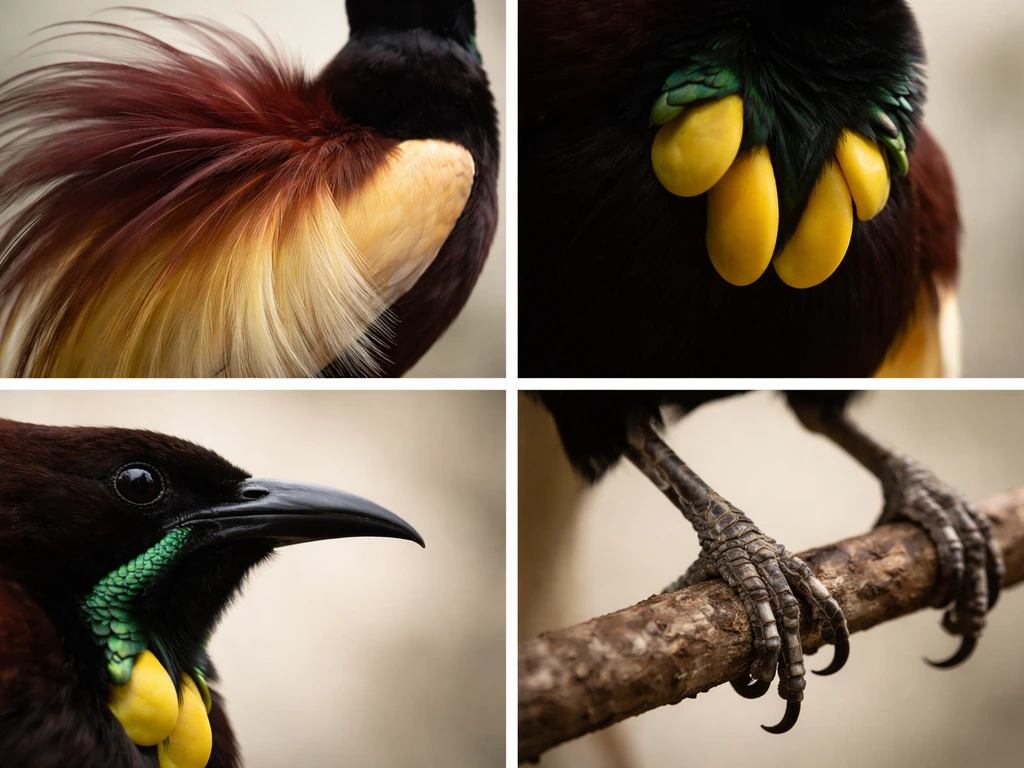
The ornamental structures in birds-of-paradise are genus- and species-specific, which is exactly why starting with taxonomy saves you time. Applying the wrong anatomical trait set to the wrong species leads to misidentification every time. Here's what to look at in each anatomical category.
Ornamental plumes and crests
The long flank plumes in Paradisaea species grow from beneath the wings and cascade outward during display. In Greater, they're long and creamy white to pale yellow. In Raggiana, they're shorter and vividly reddish-orange. In Lesser, they closely resemble Greater's but the bird is smaller and the yellow tones can be slightly different. The Blue bird-of-paradise is the outlier in the genus, with blue and violet plumes and a habit of displaying while hanging inverted. Outside Paradisaea, the Magnificent bird-of-paradise has a bright yellow cape across the back (not flank plumes), and the Standardwing has white flag-like plumes on the shoulders/wings rather than the flanks, plus barbule-level structural details in those flags that are visible under close inspection.
Bare skin, wattles, and facial features
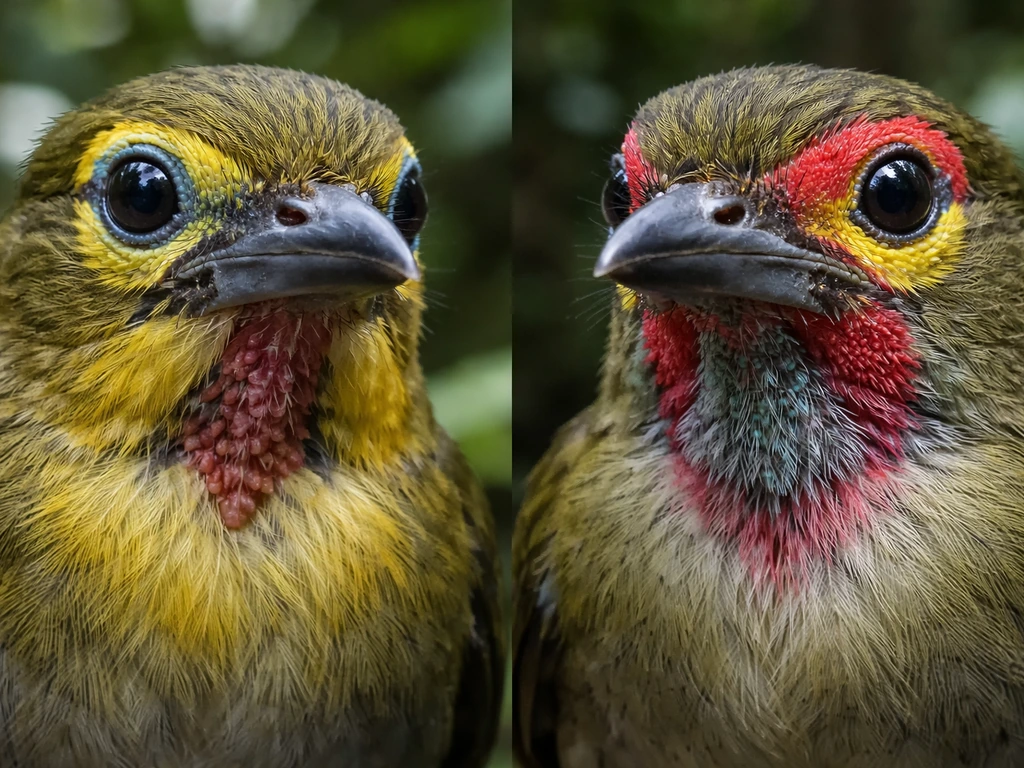
Many species have bare skin patches or wattles on the face or throat, and these are highly genus-specific. The Blue bird-of-paradise has a distinctive white eye-ring and bare blue facial skin. The Magnificent has a turquoise-blue crown patch that reflects light intensely. The Standardwing has a bare green breast shield in adult males. These bare-skin features are among the most reliable markers at close range because they don't fade or shift with lighting the way iridescent plumes can.
Beak and foot structure
Bill morphology is useful but needs to be applied carefully. Most Paradisaea species have a similar blue-grey bill, so within-genus bill shape comparisons are subtle. What's more useful is comparing bill length and curvature across genera, where differences are more pronounced and relate to foraging ecology. On the topic of sexual differences: in some bird-of-paradise species, females actually have larger bills than males, so don't assume the larger-billed individual is always male. Feet and tarsus structure are rarely diagnostic in the field but become relevant when examining museum specimens or detailed photographs, where tarsus length relative to body size can support genus-level identification.
Where each species lives: range and habitat
New Guinea is the center of the family's distribution, but the altitude bands and island specifics vary enough between species that range can be a useful filter. The Birds-of-Paradise Project notes a general range baseline of lowlands to about 6,500 feet (roughly 2,000 m) for the family, but individual species occupy different slices of that range.
| Species | Primary Range | Typical Altitude Band | Habitat Type |
|---|---|---|---|
| Greater Bird-of-Paradise | Aru Islands, southwest New Guinea | Lowlands to ~1,500 m | Forest and forest edge |
| Raggiana Bird-of-Paradise | Southern and eastern New Guinea | Up to ~1,500 m (foothill forest) | Forest edge and foothill forest |
| Lesser Bird-of-Paradise | Northern New Guinea | 0–1,500 m | Lowland and foothill forest |
| Emperor Bird-of-Paradise | Northwest New Guinea | ~400–1,500 m (sometimes lower) | Hill forest |
| Blue Bird-of-Paradise | Southeast New Guinea | 1,000–1,800 m | Mid-montane forest |
| Magnificent Bird-of-Paradise | New Guinea and nearby islands | Lowlands to mid-montane | Forest interior |
| Standardwing Bird-of-Paradise | North Maluku (Bacan, Halmahera) | Lowland to foothill forest | Forest |
Range overlap is where misidentification becomes most likely. Raggiana overlaps slightly with Greater, Lesser, and Emperor birds-of-paradise in parts of New Guinea, and the altitude bands for Lesser and Raggiana are nearly identical in some areas. If you're in the field and your location falls within an overlap zone, you cannot use range as a deciding factor. You need plumage, behavior, or call to make the call. The Standardwing is the easiest to rule in or out by geography because it's restricted to North Maluku (Bacan and Halmahera islands), not New Guinea at all. If you're not on those islands, you're not looking at a standardwing.
Males, females, and juveniles: the same species can look very different
Sexual dimorphism in Paradisaeidae is extreme. In most species, males have the elaborate ornamental plumage and females look completely different: mostly brown, cryptic, and with minimal ornamentation. This is so pronounced that historically, males and females of the same species were sometimes described as separate species entirely. Your comparison checklist must account for sex before anything else. If you see a plainly patterned brown bird and an elaborately plumed one in the same tree, they might be the same species.
Juvenile males add another layer of complexity. Young males typically go through a period where they resemble females, then pass through one or more subadult plumage stages before reaching full adult ornamentation. This can take several years. A Xeno-canto recording of Raggiana bird-of-paradise even includes a note that the male observed "was not yet fully plumaged," which shows how commonly this comes up in the field. The takeaway: a male that looks like a female or has partially developed plumes is almost certainly a subadult, not a different species. Don't route a brown bird straight to "female" without considering whether it could be an immature male.
Molt also matters for color accuracy. Because birds replace feathers through molt, juveniles can show distinct juvenile (juvenal) plumage compared with adult plumage molt also matters for color accuracy. Birds replace feathers at least annually, and fresh plumage often looks more vivid than worn plumage later in the cycle. A Raggiana's reddish plumes can look faded and duller toward the end of the breeding season. When comparing plumage from photos taken at different times of year, this can create apparent color differences that aren't actually species differences. If in doubt about a plumage color, note the time of year and whether the plumes look fresh or worn.
- Males: look for ornamental plumes, tail wires, breast shields, or bare-skin patches
- Females: typically brown and cryptic; compare bill size and subtle facial patterns for species clues
- Subadult males: may show partial plumes, intermediate colors, or female-like body plumage with a few adult features
- Worn plumage: colors will look duller and plumes shorter than in fresh breeding plumage
- Time of year: breeding season = freshest, most vivid plumage; post-breeding can look significantly different
The male vs. female differences within these birds are deep enough to deserve their own dedicated treatment, which goes well beyond what fits in a checklist section here. Similarly, the detailed comparison between Greater and Lesser birds-of-paradise, or between the male and female plumage stages across age classes, are each worth exploring in their own right.
How to avoid the most common misidentifications
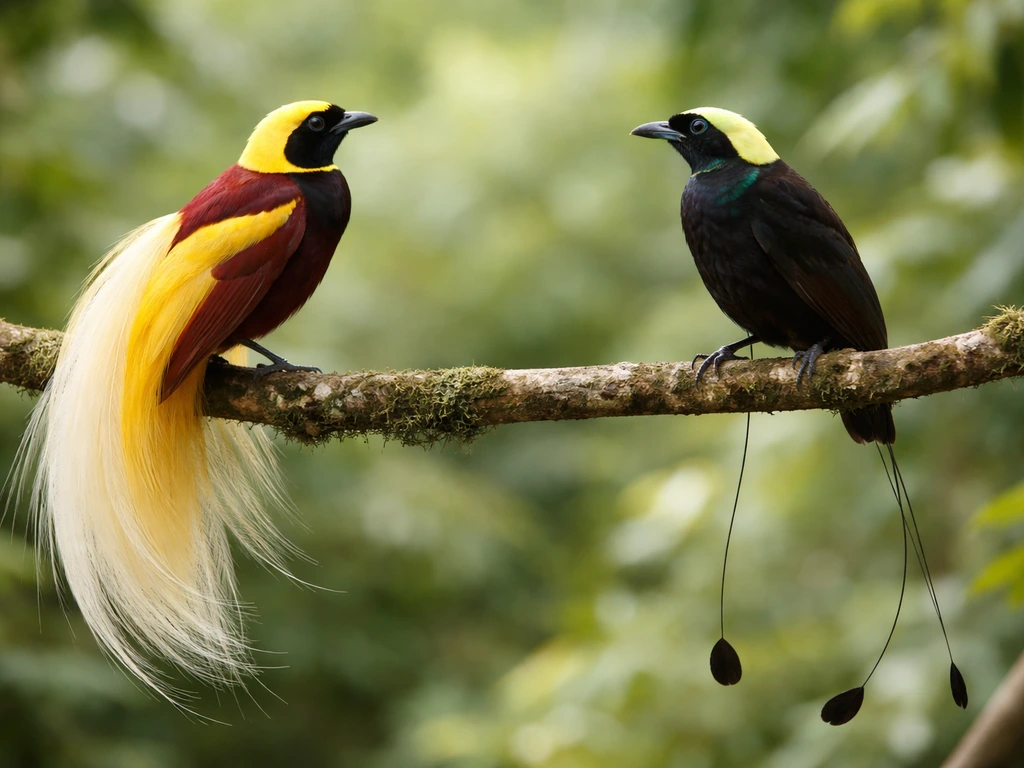
The mistakes people make most often with bird-of-paradise identification fall into a few predictable patterns. Here's a step-by-step checklist you can apply immediately when you're trying to confirm a species.
- Confirm it's actually a bird: the name "bird-of-paradise" is also used for Strelitzia plants. If you found the term on a gardening or wildlife planting site, double-check you're looking at a bird account, not a flower.
- Check the geography: where was the bird observed or photographed? Standardwing is only on North Maluku. Greater is centered on the Aru Islands and southwest New Guinea. Blue is in the southeast highlands. Geography alone can eliminate most of the family.
- Determine sex first: is the bird elaborately plumed (likely adult male) or plain brown (likely female or subadult male)? Don't try to ID to species until you know which sex/age class you're working with.
- Check for subadult plumage: if the bird shows partial ornamental features, intermediate plume development, or female-like coloring with hints of adult pattern, treat it as a subadult male and compare against both adult male and female descriptions.
- Note the plume color and position: flank plumes (Paradisaea), wing flags (Standardwing), back cape (Magnificent), or breast shield? Plume position narrows the genus quickly.
- Use size as a filter: Greater is noticeably larger than Lesser or Raggiana. If the bird looks large and has creamy plumes, that points toward Greater. Smaller with red plumes points toward Raggiana.
- Watch the display if possible: note whether the bird hangs inverted (Emperor and a few others) or displays upright. Don't rely on a single pose; watch the full sequence.
- Listen in context: if calling, note whether the bird is at a lek and whether the call is part of a display sequence or a contact/alarm call. Match to species-specific recordings on Xeno-canto using those same contextual filters.
- Control for lighting: photographs taken in low light may make plume colors look different from field guide illustrations. Compare images in natural daylight when possible, and remember that biofluorescence can shift apparent colors under certain light conditions.
- Cross-reference with current taxonomy: if you're comparing species that were recently split (like the Vogelkop superb bird-of-paradise), check the current IOC World Bird List version to confirm the split is reflected in whatever field guide or app you're using.
The most common specific mistake within the Paradisaea genus is confusing Raggiana with either Greater or Lesser because all three are medium-to-large birds with long tail wires and are found in overlapping elevation bands in parts of New Guinea. The key discriminator is plume color: Raggiana's plumes are distinctly reddish to orange-red, while Greater and Lesser carry creamy yellow-white plumes. If the plumes are reddish, it's Raggiana. If they're creamy white, you're choosing between Greater (larger, Aru Islands/southwest New Guinea) and Lesser (smaller, northern New Guinea). The Blue bird-of-paradise is the easiest Paradisaea to confirm because nothing else in the genus has blue flank plumes.
The umbrella bird (a cotinga, not a bird-of-paradise at all) is another source of confusion, especially for beginners, because both groups feature dramatic male ornamental displays. But the umbrella bird is in a completely different family, found in Central and South America rather than New Guinea, and its "ornament" is a feathered crest over the head rather than flank plumes. If you're comparing the two, the family and geography differences settle it instantly. The bird-of-paradise vs. If you want the quickest version, the bird-of-paradise vs strelitzia comparison boils down to whether you're looking at a flower or a bird in the first place. Strelitzia (the plant) comparison is similarly a fast ruling-out exercise once you confirm you're looking at a bird.
One final point worth emphasizing: the Vogelkop superb bird-of-paradise case is a reminder that static plumage alone isn't always enough. That species was misidentified for a long time because the plumage looks similar to the wider superb bird-of-paradise. It was the courtship dance differences (smoother, differently patterned movements) that confirmed the split. When in doubt, behavior and vocalizations are your most robust tools, especially when you're working with species that have been recently split or are known to overlap.
FAQ
What should I do first if I am not sure I am even looking at a bird-of-paradise (not a different family) from a photo?
Start with non-plumage clues, location, and body plan. Birds-of-paradise are largely restricted to New Guinea and nearby islands, and they have flank ornament structures tied to display. If the bird shows a crest-based display, or the setting is Central or South America, use family-level comparison and rule out lookalikes before doing any fine plume or color work.
How can I tell whether the plume color I see is real or affected by lighting (especially in photos)?
Treat color as probabilistic. If the photo was taken in shade, at dusk, or under artificial lighting, avoid making a species call solely from hue. Cross-check with at least two independent photos of the same individual or with a brief comparison of the face bare-skin features, which tend to be more stable than iridescent feather color.
When I see a brown bird and an ornamented bird in the same area, how do I know they are not different species?
Assume it is possible they are the same species with strong sex dimorphism. Verify whether the ornamented individual’s features match the known male markers for that area, then look at age cues in the brown bird, especially for partial plumage development or early ornamental feathers, which would suggest an immature male rather than a different species.
What is the quickest way to separate Raggiana from Greater or Lesser in a field encounter?
Use plume color plus a size sanity check. Raggiana’s flank plumes are distinctly reddish to orange-red, while Greater and Lesser have creamy white to pale yellow flanks. If you can also estimate overall size, use it to choose between Greater and Lesser after you have confirmed the flanks are not reddish.
How do I handle cases where I only witness one pose during courtship, not the full display sequence?
Do not lock in a species based on a single posture. In this group, multiple species can share very similar pre-copulatory movements. If you cannot watch the complete sequence, rely more heavily on repeatable cues you can observe across moments, such as whether an inverted hanging display occurs consistently, and use audio if available.
If I hear a call but I cannot confirm the bird’s age, how should I use vocalizations for ID?
Use calls as supporting evidence, not a sole decision maker. Prefer recordings with known context, such as whether the male was fully plumaged, and look for call-to-stage alignment when possible. If you are working from a general audio clip without metadata, keep a wider shortlist and confirm with display behavior or stable facial features.
What should I do if a bird is in an overlap zone where range is not decisive?
Switch to a decision rule that does not depend on geography. Prioritize plume color (especially flank plume tone within Paradisaea), display mechanics (upright versus inverted posture), and bare-skin markers near the eye and face. Use range only to narrow what cannot be ruled out, then let plumage and behavior decide.
How can I avoid mistaking a subadult male for a female?
Look for developmental signs, not just overall darkness or plainness. Subadult males often pass through stages where they resemble females first, then gradually develop ornamental plumes. If you see any patchy or partially formed ornament feathers, or a mix of plain and developing structures, treat it as an immature male rather than immediately assigning sex based on brown plumage.
Why might two photos of the same species show different “brightness” even when the species seems correct?
Molt timing and wear can change the apparent intensity of plumage. Fresh feathers usually look more vivid, while worn feathers can look duller later in the cycle. If the photos were taken months apart, note seasonal timing and treat color brightness as an unreliable differentiator unless you can confirm feather freshness cues.
What anatomical features are most reliable when I can get close enough to see the head and face?
Focus on bare-skin patches and eye-ring traits when visible. The blue species’ distinctive eye-ring and facial bare skin, and other genera’s crown or breast shield patches in adults, tend to be more consistent than iridescent plume color that shifts with light angle.
How should I think about bill shape differences if many bills look similar at a glance?
Bill details are usually subtle within a genus, so avoid using bill color alone. Compare bill length, curvature, and proportions across genera if you have a clear view, and treat bill shape as a secondary check after you have identified the genus using more obvious structural traits like flank plume placement.
Are feet and tarsus features ever useful outside museum specimens?
They are rarely decisive in typical field photos because angle, focus, and distance often obscure them. If you do have high-resolution, well-framed images, tarsus proportions can help at the genus level, but in most cases you will get better results by combining display posture, facial bare-skin markers, and flank plume color.
What is the most common “confuser” besides other bird-of-paradise species?
Non-related ornamentals can mislead people, especially when they show dramatic male displays. A classic example is the umbrella bird, which is not a bird-of-paradise and has a different family and geography. If the environment or display anatomy suggests a crest-based structure rather than flank plumes, stop the species-level comparison and re-evaluate the family first.
If a species was recently split or previously lumped, what should I prioritize in my comparison?
Prioritize behavior and vocal patterns over static plumage, because splits are often confirmed by differences in courtship mechanics. If two taxa look too similar in feather appearance, watch for smoother or differently patterned movement sequences and corroborate with call context when available.