
"Bird of paradise" and "Strelitzia" are two completely different things that share the same common name. If you want a deeper comparison, this umbrella bird vs bird of paradise guide breaks down the key differences people confuse. One is a real bird (actually a whole family of birds, Paradisaeidae, with more than 40 species) living in tropical forests in New Guinea and nearby islands. The other is a genus of flowering plants native to southern Africa, most famously Strelitzia reginae, the orange-and-blue flower you've seen in florist shops and gardens. The plant got its common name because its open flower looks like a bird-of-paradise fanning out its plumage. That visual metaphor is the entire reason the confusion exists.
Bird of Paradise vs Strelitzia: Key Differences Explained

Marcus Hendricks
29 Jun 2026
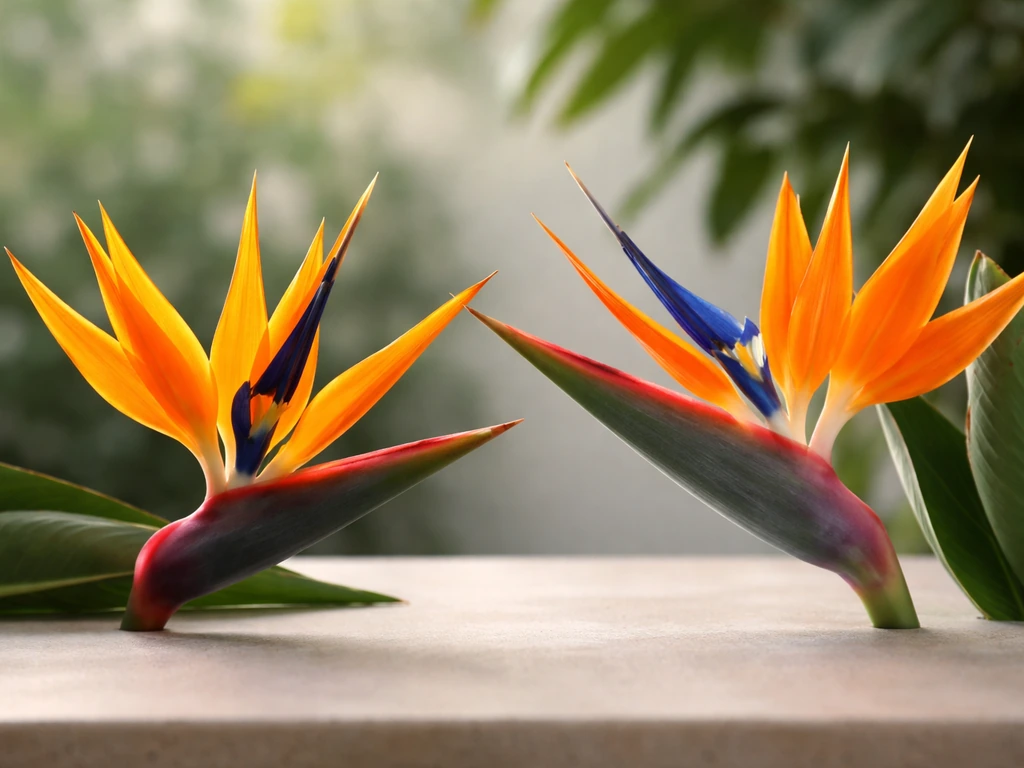
What "bird of paradise" and "Strelitzia" actually mean
"Strelitzia" is a botanical genus name covering several species of perennial flowering plants in the family Strelitziaceae. The genus is named after Queen Charlotte of Mecklenburg-Strelitz, not after any bird. Strelitzia reginae (the most common species) is called "bird of paradise flower" or "crane flower" in everyday horticultural language. Strelitzia nicolai, the giant white version, is sometimes sold as "white bird of paradise" or "giant bird of paradise." The U.S. Fish and Wildlife Service, the Royal Horticultural Society, and North Carolina State University Extension all use "bird of paradise" as a standard common name for plants in this genus, which is partly why search results for the term can return plant pages even when you were thinking about the bird.
"Bird of paradise" used for the animal means a member of Paradisaeidae, a family of passerine birds found mainly in New Guinea, eastern Indonesia, and northeastern Australia. The family includes manucodes, paradigallas, astrapias, parotias, riflebirds, sicklebills, paradise-crows, and the standardwing, among others. When people talk about "the bird of paradise" in a wildlife or birdwatching context, they almost always mean one of these species. The name comes from their spectacular, often iridescent plumage and extravagant courtship displays, which early European explorers found so exotic they assumed the birds must come from paradise.
Bird or plant? A fast way to figure it out
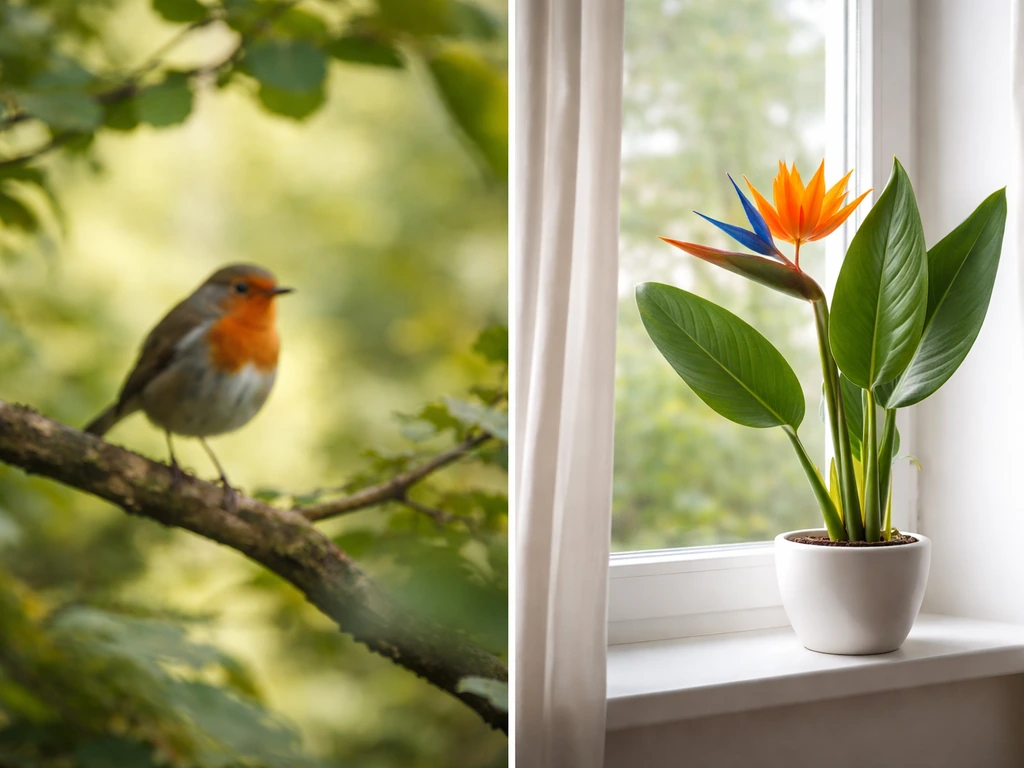
The quickest diagnostic is context. Ask yourself: where did you encounter this thing? If you saw it in a garden, a flower arrangement, a plant nursery, or a houseplant, you are almost certainly looking at a Strelitzia. If you saw it in a nature documentary, a wildlife photograph from New Guinea, a zoo aviary, or it was moving and making sounds, you are looking at a member of Paradisaeidae. The two organisms do not share a habitat or a continent in the wild.
- It has roots, stems, leaves, and flowers: it's the Strelitzia plant.
- It's in a vase, a pot, or a garden bed: it's the Strelitzia plant.
- It's alive, has feathers, and is flying or perching: it's a bird of paradise (Paradisaeidae).
- The photo or video shows a male with elaborate plumage doing a courtship dance: it's a bird of paradise (Paradisaeidae).
- You found it on a plant ID app or someone asked you to identify a houseplant: it's almost certainly Strelitzia.
- The location is New Guinea, eastern Indonesia, or a tropical forest in the Pacific: it's probably a bird of paradise (Paradisaeidae).
- The location is southern Africa, a temperate garden, or a florist: it's Strelitzia.
Birds of paradise (Paradisaeidae): what they look and act like
Birds of paradise (family Paradisaeidae) are passerine birds, meaning they're in the same broad order as sparrows and crows. There are more than 40 species, and they vary significantly in size: the king bird-of-paradise weighs around 50 grams (about the weight of a large letter), while a curl-crested manucode can reach 430 grams. The feature that makes these birds unmistakable in male individuals is their plumage. Males often carry elongated, iridescent, or bizarrely structured feathers on their heads, flanks, wings, or tails. The king of Saxony bird-of-paradise, for example, has two long head plumes that look almost artificial. Parotias perform a dance while wearing a "ballerina skirt" of flank feathers. Nothing in the plant kingdom replicates that behavior.
Female birds of paradise are, by contrast, generally brown, rufous, or olive, with streaky or barred underparts. This sexual dimorphism is one of the most dramatic in the bird world. If you're looking at a fairly plain, medium-sized brown bird from New Guinea and wondering if it's a bird of paradise, the answer might still be yes because females look nothing like the males. Courtship display is the clearest behavioral cue: males gather at display sites called leks and perform elaborate dances, sometimes using ultraviolet-reflective feather structures to enhance their visual effect.
Common lookalikes for the bird
Within Paradisaeidae itself, species like riflebirds (which also live in Australia) are sometimes mistaken for each other. Riflebirds perform a spreading-wing display that looks similar across species. Outside the family, some birds of paradise are confused with bowerbirds (Ptilonorhynchidae), which are closely related and also native to New Guinea and Australia, but bowerbirds are known for building elaborate structures rather than wearing elaborate plumage. The key difference is behavioral and structural: bowerbirds don't have the elongated ornamental feathers that define the Paradisaeidae family. For more detail on how male and female birds of paradise differ, or how species within the family compare to each other (like greater vs lesser birds of paradise), those distinctions go well beyond the bird-vs-plant question here. For more on the specific comparison, see our guide to greater bird of paradise vs lesser bird of paradise.
Strelitzia (bird of paradise plant): what it looks and grows like
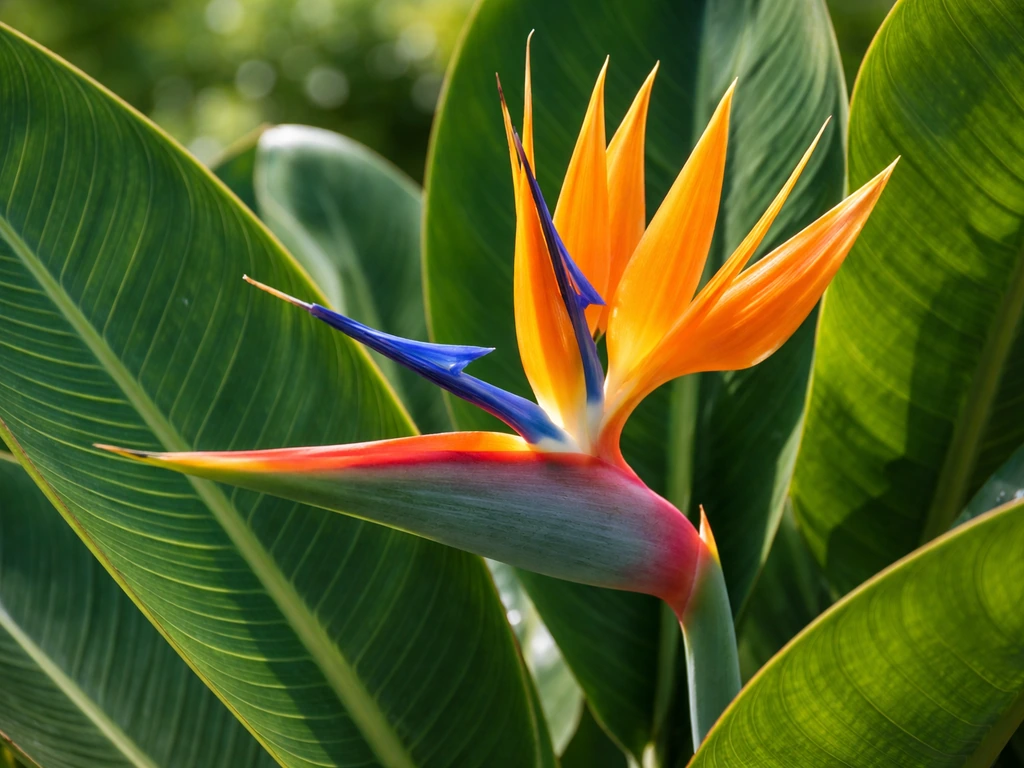
Strelitzia is a genus of perennial plants native mainly to southern Africa. The most commonly grown species is Strelitzia reginae, which reaches about 1 to 1.5 meters tall and produces flowers from a stout, horizontal spathe (a boat-shaped bract). The flower itself has three brilliant orange sepals that fan upward, and three petals in purplish-blue or white, with two of those petals fused into an arrow-like structure that forms a channel. The whole open inflorescence genuinely does look like a crested tropical bird poking out of a green beak, which is exactly why the common name stuck.
The leaves are a reliable ID cue even when the plant isn't flowering. Strelitzia leaves are large, paddle-shaped, and arranged in two strict ranks, fanning out from the base like a crown. Strelitzia nicolai, the giant species, can reach 7 to 8 meters tall with a trunk-like base and develops white-and-blue flowers with a dark purplish-black bract rather than the orange of reginae. If your plant has broad, banana-like leaves arranged in a fan and doesn't have flowers yet, you're almost certainly looking at a Strelitzia or a close relative.
Common lookalikes for the plant
The two most frequent plant lookalikes are Heliconia and Ravenala (traveller's tree). Heliconia species are sometimes called "false bird of paradise" because their bracts are similarly boat-shaped and brightly colored (usually red, orange, or yellow), but Heliconia bracts are arranged vertically in alternating rows, not emerging from a single horizontal spathe the way Strelitzia does. Ravenala madagascariensis (the traveller's tree) is in the same plant family as Strelitzia (Strelitziaceae) and has structurally similar flowers, but its bract is typically green rather than orange or dark blue, and the overall plant fans out dramatically into a giant paddle shape that's easy to distinguish at a distance. If you're looking at a photo labeled "bird of paradise" and the flower is red or coral with no blue or orange, it's probably Heliconia, not Strelitzia.
Bird vs plant: side-by-side comparison
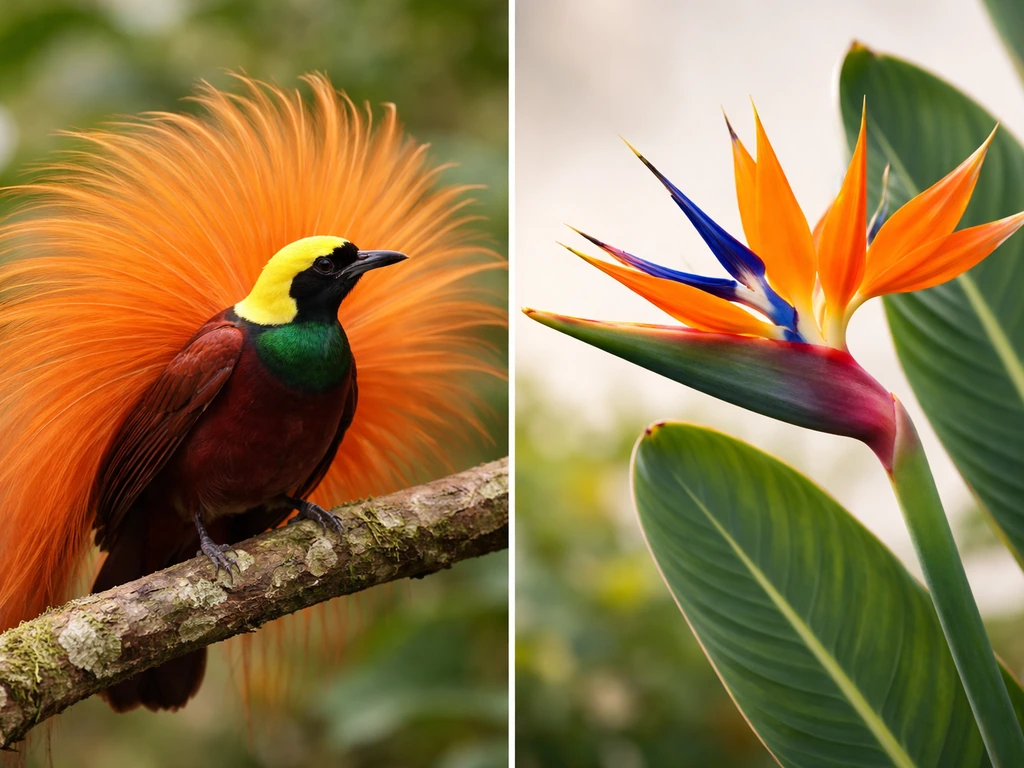
| Feature | Bird of paradise (Paradisaeidae) | Bird of paradise plant (Strelitzia) |
|---|---|---|
| What it is | A bird (family of passerine birds) | A flowering plant (genus in Strelitziaceae) |
| Scientific group | Family Paradisaeidae | Genus Strelitzia |
| Native range | New Guinea, eastern Indonesia, NE Australia | Southern Africa |
| Number of species | More than 40 bird species | 5 main plant species (reginae, nicolai, etc.) |
| Key visual cue | Elaborate male plumage, often iridescent and elongated | Orange sepals + blue/purple petals on a horizontal spathe |
| Leaves or feathers | Feathers (birds have no leaves) | Large paddle-shaped leaves in a two-ranked fan |
| Movement/behavior | Flies, perches, sings, performs courtship dances | Stationary plant; does not move or behave |
| Where you'd find it | Tropical forest, wildlife photography, zoos | Gardens, nurseries, florist shops, houseplants |
| Size range | 50 g to ~430 g body mass | 1–1.5 m (reginae) to 7–8 m (nicolai) |
| Common lookalikes | Riflebirds, bowerbirds, female birds of paradise | Heliconia (false bird of paradise), Ravenala (traveller's tree) |
Naming confusion checklist
Here are the most common mistakes people make, and how to correct them fast: If you want a quick “bird of paradise comparison” check, use the naming confusion checklist to sort bird names from Strelitzia plant labels bird vs plant: side-by-side comparison.
- Assuming a search result for "bird of paradise" always means the bird: official sources like the U.S. Fish and Wildlife Service routinely title Strelitzia plant pages as "bird-of-paradise," so search results are mixed.
- Thinking "Strelitzia" is a single species: it's a genus with several species, and the common name "bird of paradise" can refer to reginae, nicolai, or other members.
- Mistaking the plant for the bird because the flower looks like plumage: the resemblance is a visual metaphor, not a biological relationship.
- Assuming a female bird of paradise is a different (non-paradise) species because it's brown and plain: females are genuinely drab compared to males.
- Calling Heliconia a "bird of paradise": Heliconia is a separate genus entirely, though it's commonly mislabeled this way in garden centers and social media.
- Thinking Strelitzia nicolai (the giant white species) is a banana plant: the leaves are similar, but banana plants (Musa) don't produce the characteristic spathe-and-flower structure.
How to figure out which one you're actually looking at
If you have a photo and you're not sure, work through these steps in order:
- Check for feathers vs. leaves. If the organism has feathers, you have a bird. If it has green leaves and a stem or trunk, you have a plant. This single check resolves 95% of cases.
- Look at the location or context in the photo. A tropical forest canopy in New Guinea points to Paradisaeidae. A garden, pot, or flower market points to Strelitzia.
- Check the flower structure if it's the plant. Orange fan-shaped sepals with blue or purple petals from a horizontal green spathe = Strelitzia reginae. White sepals with a dark purplish bract on a large tree-like plant = Strelitzia nicolai. Brightly colored vertical bracts in a zigzag arrangement = probably Heliconia, not Strelitzia.
- For the bird, look at plumage and behavior. Extraordinary elongated or iridescent feathers on a male, often in a forest setting in the New Guinea region, combined with any display posture = Paradisaeidae. Plain brown female bird from the same region with no ornamental feathers could still be a female bird of paradise.
- Use the leaf shape as a shortcut for plant ID if no flower is present. Two-ranked, large paddle leaves in a fan arrangement on a plant = almost certainly Strelitzia or a close relative like Ravenala. Wait for flowering to confirm the species.
- Run it through a plant or bird ID app. For plants, apps like iNaturalist or PictureThis handle Strelitzia well. For birds, apps like Merlin (Cornell Lab) can help with Paradisaeidae species if you have a clear photo, though coverage of New Guinea species is more limited than North American birds.
The bottom line is that the shared common name is genuinely misleading, and you're not wrong to be confused. The overlap is not a naming error so much as a centuries-old compliment: the plant's flower is so vivid and exotic-looking that naturalists reached for the most spectacular bird name they knew. Once you see each organism clearly, you'll never mix them up again. If you're here because you're trying to sort out which species of bird of paradise you're looking at (like comparing the greater bird of paradise to the lesser, or identifying a male vs female), those are bird-side questions worth exploring further within the Paradisaeidae family. For a quick guide to the differences, see bird of paradise male vs female. If you're here about the plant, the flower color and bract shape are your fastest tools.
FAQ
If I search “bird of paradise” and get plant results, is that always wrong?
Not always. “Bird of paradise” is a standard common name for Strelitzia in horticulture, so mixed results are expected. Wildlife sources use the term for Paradisaeidae, so the deciding factor is whether the page is about flowers and leaves (plant) or species and habitats (birds).
What quick ID feature tells me the difference if I’m looking at the plant but it has no flowers yet?
Use the leaf architecture. Strelitzia has large paddle-shaped leaves that fan in two strict ranks from the base. Heliconia can be red and showy, but its bracts and plant structure look more vertically layered than Strelitzia’s fan from a single horizontal spathe
Can a “white bird of paradise” listing be Strelitzia?
Yes. “White bird of paradise” is commonly used for Strelitzia nicolai, the giant species. The key is the dark purplish-black bract and the white-and-blue flowers, even though the common name is still based on the birdlike look.
How do I tell Heliconia from Strelitzia when both are called “bird of paradise” online?
Check how the bracts originate and their orientation. Strelitzia’s flower comes from a stout, horizontal spathe and opens with orange-and-blue (or white-and-blue) contrast. Heliconia’s bracts are typically arranged vertically in alternating rows, and the overall color scheme is often coral, red, orange, or yellow without the same orange-blue fan pattern.
If the photo label says “bird of paradise,” could it be a bowerbird instead of a true bird of paradise?
Sometimes, yes. Bowerbirds are also native to New Guinea and Australia and are often shown in “paradise” image collections. The practical way to separate them is behavior, bowerbirds are known for building structures (bowers), while birds of paradise are defined by elaborate ornamental plumage and lek-based courtship.
Are female birds of paradise easy to misidentify compared with males?
Very. Females are usually brown, rufous, or olive and can look plain compared to the elaborate male plumage. If the only visible cues are color and size, you may need a behavioral clue like lek attendance or courtship display rather than relying on appearance alone.
In the bird family, what’s a common confusion among birds of paradise species?
Riflebirds are frequently mixed up because their courtship involves spreading-wing displays that can look similar across species. If you’re identifying at species level, you often need more specific field marks or context (location, display site, and detailed plumage structure), not just the broad “bird of paradise” look.
Do birds of paradise and Strelitzia occur in the same places in nature?
No. Birds of paradise live mainly in New Guinea and nearby islands, while Strelitzia plants are native mainly to southern Africa. The shared name is metaphorical, so a location that fits one is not a reliable indicator of the other.
Next Articles
Bird of Paradise Comparison: How to Tell Similar Species Apart
Master a bird of paradise comparison to distinguish similar species using plumage, size, calls, displays, anatomy, and r
Batman vs Bird: Identify the Animal and Tell Them Apart
Learn what Batman vs bird means and use field marks, behavior, and habitat to ID the right animal fast.
Nighthawk Bird vs Whippoorwill: Field ID Guide
Side-by-side field ID for nighthawk vs whippoorwill: size, silhouette, habitat, flight, calls, and quick checklists.