The fastest way to separate a Common Nighthawk from a Whip-poor-will is to listen first and look second. If you hear a persistent, three-syllable chant repeated over and over from the edge of the woods, that's a Whip-poor-will. If you hear a sharp, nasal 'peent' from something wheeling high overhead in open sky, that's a Common Nighthawk. Those two sounds alone will resolve the confusion about 90% of the time. But if you want the full picture, including what to do when you only have a silhouette, a partial perch view, or no sound at all, keep reading.
Nighthawk Bird vs Whippoorwill: Field ID Guide

Marcus Hendricks
24 Apr 2026
Quick ID: Size, Silhouette, and Overall Look
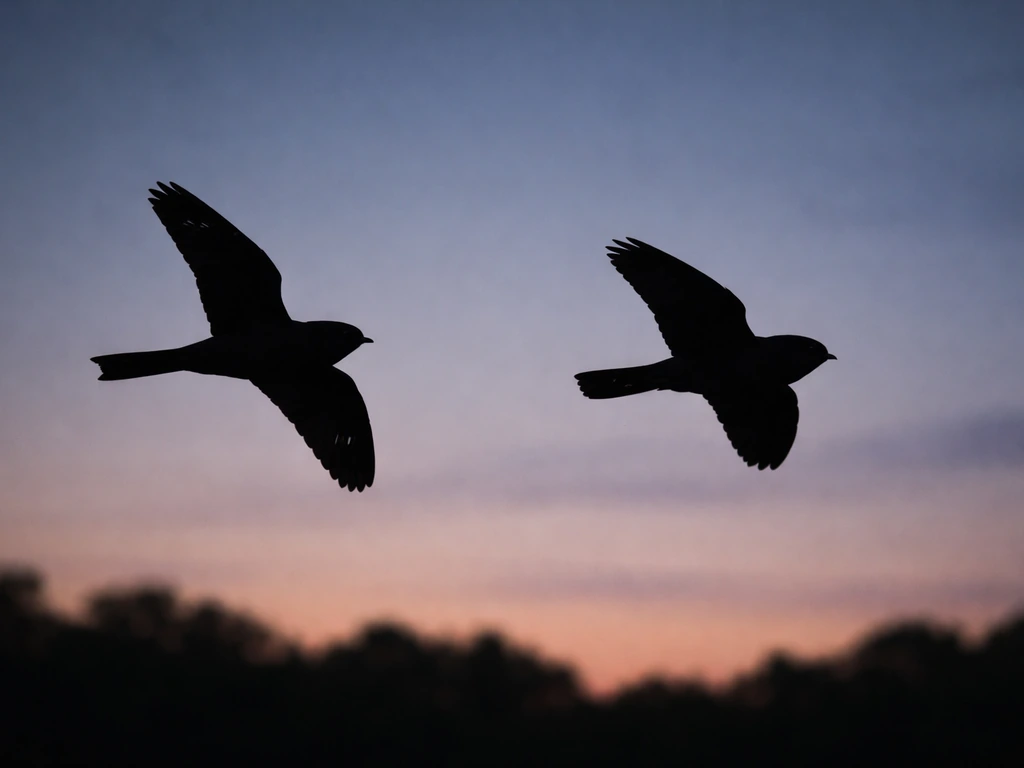
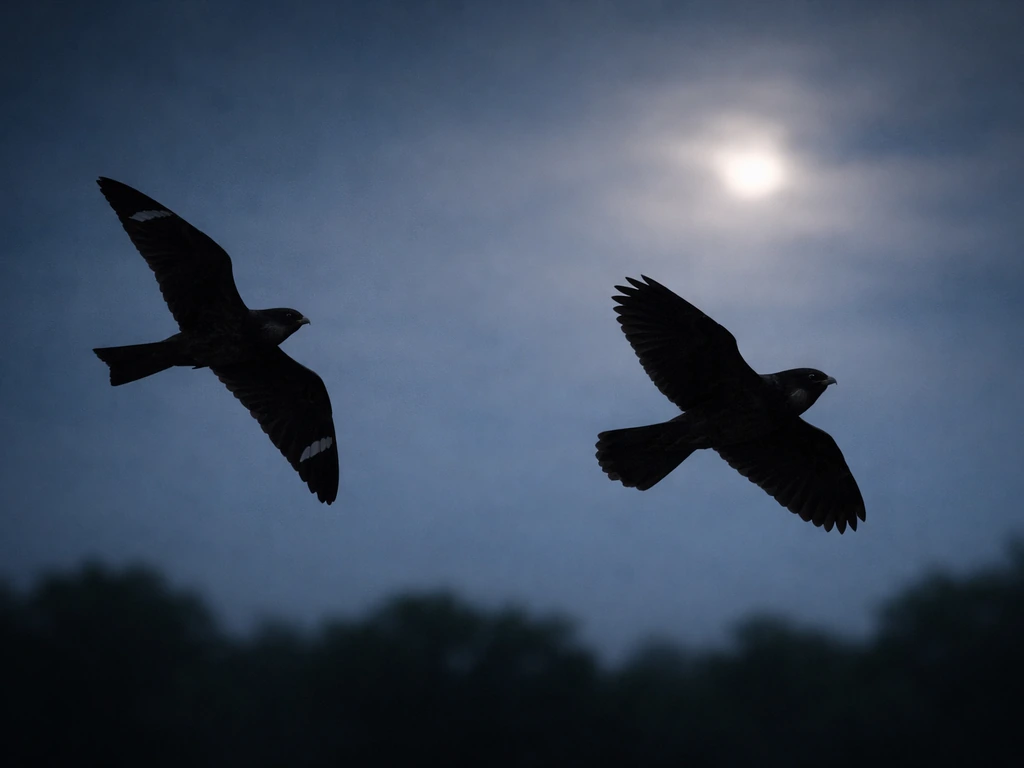
Both birds are medium-sized, cryptically patterned nightjars with mottled brown-gray-black plumage that makes them nearly invisible when still. But their shapes in flight are strikingly different once you know what to look for.
The Common Nighthawk is 8.7 to 9.8 inches long with a wingspan of 20 to 25 inches. Its wings are long, narrow, and sharply pointed, giving it a look somewhere between a falcon and a large swift. The tail is long and slightly forked. In flight, the most immediately obvious mark is a bold white bar across each wing, visible even at considerable distance against a lit sky. Males also show a white throat patch and a white tail band. The overall impression is a slender, angular bird with aggressive, erratic wingbeats.
The Eastern Whip-poor-will is similarly sized but looks stockier and rounder-winged in the air. It lacks the nighthawk's sharp wing points and bold white wing bar. Its wings are broader and more rounded at the tips, and its flight is softer and more moth-like rather than angular and darting. Plumage is heavily cryptic, a mix of brown, black, and gray that mimics dead leaves almost perfectly. Males show white outer tail tips, but you rarely see those unless the bird fans its tail in flight.
| Feature | Common Nighthawk | Eastern Whip-poor-will |
|---|---|---|
| Length | 8.7–9.8 inches | Similar range, slightly stockier build |
| Wingspan | 20–25 inches | Slightly shorter, broader wings |
| Wing shape | Long, narrow, sharply pointed | Broader, more rounded tips |
| Key wing mark | Bold white wing bar (both sexes) | No white wing bar |
| Throat patch (male) | Bright white | White, but less prominent |
| Tail | Long, forked, white tail band (male) | Rounded, white outer tips (male) |
| Overall impression | Angular, falcon-like | Rounded, moth-like |
Habitat and Where Each Species Shows Up
Habitat is one of the most underused ID tools for these two birds, and it does a huge amount of the work before you even lift your binoculars.
Common Nighthawks are birds of open and semi-open country. You'll find them over grasslands, prairies, savannahs, beaches, and cities. Yes, cities: nighthawks famously nest on flat gravel rooftops and forage over parking lots and sports fields where lights attract insects. They're also common at forest edges and in scrubby open habitat. If you're watching a bird wheeling high over an open sky, a stadium, or a wide suburban street at dusk, nighthawk is immediately the better fit.
Whip-poor-wills are woodland birds. They're tied to dry, open forests with good leaf litter, particularly oak or mixed woodlands where the ground cover gives them camouflage for daytime roosting and nesting. They'll forage along woodland edges and clearings, but they aren't birds of wide-open sky the way nighthawks are. If you're in or near a forest at night and something is calling from low in the trees or from a forest road, Whip-poor-will is strongly favored.
Behavior and Flight Style
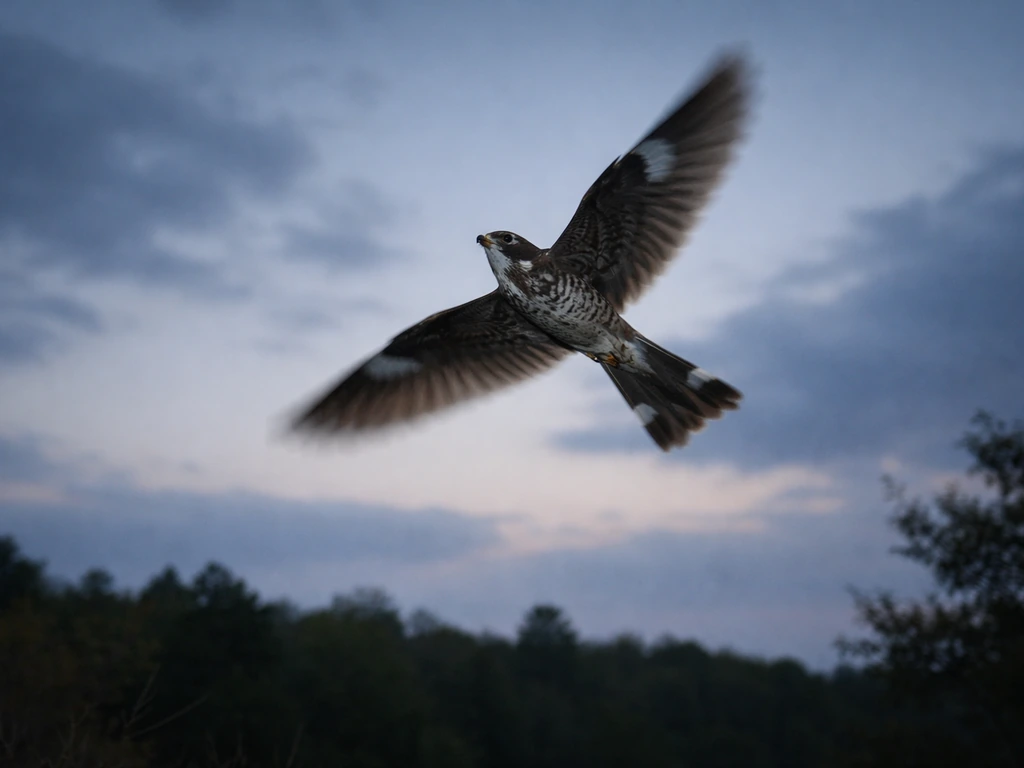
Watching how a bird moves is often as useful as seeing its field marks, especially at low light.
Common Nighthawks are aerial foragers. They chase insects on the wing with erratic, acrobatic flight high in the air, often well above treetop level. The wingbeats are irregular and floppy-looking but cover ground fast. Males put on a dramatic courtship display: they circle high, then dive steeply, pulling up at the last moment. At the bottom of the dive, air rushing through the primary feathers produces a deep, mechanical booming sound. That dive-boom combo is unmistakable and specific to nighthawks. They're most active at dusk and dawn rather than deep in the night, which makes them easier to spot against a lit evening sky.
Whip-poor-wills hunt very differently. They're perch-and-sally hunters: they sit on a low branch or on the ground and make short flights out to snap up moths and other insects, usually within about 15 feet of the ground. They also make longer, low-level flights along woodland edges and clearings, fluttering close to the ground in a way that looks more like a large moth than a bird. They're strictly nocturnal, most active after full dark, and they spend daylight hours completely motionless on the ground or on a horizontal branch, relying entirely on camouflage rather than cover.
Call and Sound Differences
Sound is the single most reliable separator, and if you learn just two calls you'll never mix these birds up again.
The Common Nighthawk's main vocalization is a loud, buzzy, nasal 'peent' or 'beer,' given frequently while flying. It's sharp and electric-sounding, and you'll often hear it before you see the bird. It's a single-note call, not a chant, and it's given sporadically as the bird flies rather than in a sustained, repetitive sequence.
The Eastern Whip-poor-will is in an entirely different category as a vocalist. The male repeats its three-syllable 'whip-poor-will' call hundreds of times in a row on spring and summer evenings, sometimes for minutes without stopping. The emphasis falls on the first and third syllables. If you're close enough, you may even catch a soft 'cluck' just before each phrase starts. This chanting from a fixed spot in the woods is impossible to confuse with a nighthawk's sporadic flight peents once you've heard both. The Whip-poor-will song functions as a territorial broadcast, delivered from a conspicuous perch repeatedly through the night.
A practical tip: if you're uncertain in the field, pull up a free bird sound app like Merlin and play the calls back to back. A Cornell Chronicle article notes that Merlin Bird ID provides instant identification using sound-based methods like playing bird calls free bird sound app like Merlin. The difference is immediately obvious to anyone who hears them together.
Feeding and Roosting Patterns
Understanding how and where each bird feeds and roosts helps you predict where to look and what posture to expect when you find one.
Common Nighthawks feed entirely on the wing, scooping up flying insects at altitude. They roost on the ground, on flat rooftops, on bare branches, or on fence posts, always lengthwise along the surface rather than perching upright like a songbird. During the day they're inconspicuous on their roost, relying on camouflage. They're most likely to be seen actively foraging during the active dusk and dawn windows rather than at midnight.
Whip-poor-wills are ground nesters that lay eggs directly on leaf litter with no constructed nest. Daytime finds them either flat on the ground blended into fallen leaves, or pressed lengthwise along a branch. At night they perch on low branches or rest on the ground between foraging sallies. Because they hunt low and from fixed perches, they don't cover the kind of sky territory a nighthawk does. Look for them along forest roads and trail edges after dark, often where you can see their eyes reflecting light.
Field Marks When the Bird Is Perched
A perched nightjar is one of birding's great camouflage challenges. Here's what to check when you've actually got one sitting still.
Common Nighthawk perched
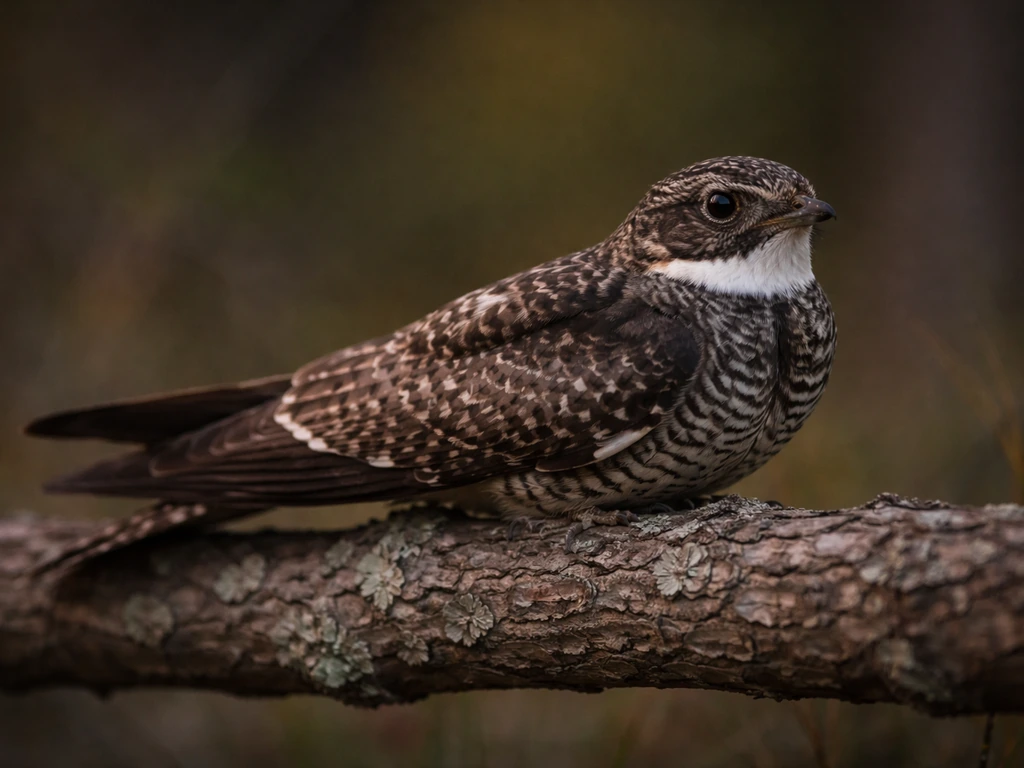
- White throat patch is the first thing to look for on a male — bright and clearly visible even in low light
- Long, pointed wing tips extend well past the tail when folded — if the wingtips project noticeably beyond the tail tip, think nighthawk
- White wing bar visible as a pale line across the folded wing
- White tail band visible on males when the tail is fanned or partially open
- Overall posture is flat and low, pressed along a branch or surface
Eastern Whip-poor-will perched
- No bold white wing bar — the wing looks uniformly mottled brown and gray
- Wing tips do NOT extend past the tail when folded — tail projects further than wingtips
- Rounder head profile with large, dark eyes that may reflect eyeshine at night
- White outer tail corners visible on males when the tail spreads
- Plumage looks more rufous-brown overall compared to nighthawk's cooler gray tones
- Often found on or very near the ground, or pressed flat along a low horizontal branch
The Single Most Common Confusion and How to Break It
Most people mix these birds up because they know both are nocturnal, mottled brown, and roughly the same size. The confusion usually happens when someone hears a bird at night without a clear look, or gets a brief flight view at dusk. Here's how to cut through it fast. If you are also trying to identify creature-on-creature action like Godzilla vs Kong, you will get faster results by focusing on the most distinctive cues first Godzilla vs Kong bird.
The one-test rule: ask yourself where you are and what you're hearing. If you're in open country or over a city and you hear sporadic 'peent' calls from high overhead, it's a nighthawk. If you're near woodland and something is chanting its own name over and over from a fixed spot, it's a Whip-poor-will. If you want a fun way to remember the differences, think of it as batman vs bird, where nighthawks and whip-poor-wills play to totally different strengths. Location plus call behavior resolves the ID in almost every real-world scenario.
If you genuinely have no sound to go on and only a flight silhouette, look at the wing shape. Pointed wings with a visible white bar mean nighthawk. Rounded wings with no bar mean Whip-poor-will. If the bird is flying high and erratically over open sky, it's almost certainly a nighthawk regardless. Whip-poor-wills simply don't hunt that way.
A common myth worth busting: people assume both birds are equally nocturnal, but nighthawks are actually most active at dusk and dawn, not the middle of the night. If you're watching a bird actively foraging while the sky is still twilight blue, nighthawk is much more likely. Whip-poor-wills get going after true dark.
Your Next Steps in the Field Right Now
- Note your habitat first — are you in open country or near woodland? That single factor shifts the probability significantly before you even look up.
- Listen before you look — a chanting three-syllable call from the woods is a Whip-poor-will; a sporadic nasal 'peent' from overhead is a nighthawk.
- If you see a flight silhouette, check the wing shape: pointed and angular with a white bar means nighthawk; rounded and moth-like with no bar means Whip-poor-will.
- If you get a perched view, look at the wingtip position relative to the tail — nighthawk wingtips project past the tail, Whip-poor-will's do not.
- Download Merlin (free, from Cornell Lab) and use the Sound ID feature or the recorded calls to compare what you're hearing in real time.
- Check the time of evening — dusk activity strongly favors nighthawk; deep-night activity after full dark favors Whip-poor-will.
- If you see a dive-boom display, that's a nighthawk — Whip-poor-wills don't do it.
These two birds share the same family and a similar lifestyle, but once you internalize the habitat-plus-call combination, you'll find they're actually pretty easy to separate. The Whip-poor-will is a woodland chanter that hunts low and slow; the nighthawk is a sky-hunting acrobat of open spaces. If you like creature matchups, you can also compare a predator like a shark with a nimble bird in a separate guide on shark vs bird behavior. Keep that image in your head and the ID clicks quickly every time.
FAQ
What if I hear a Whip-poor-will style “chant” but I’m not near woodland, can it still be a Whip-poor-will?
It can, but it’s less likely. Whip-poor-wills usually call from a fixed spot in dry, leaf-littered woodlands and forest edges. If you’re in open sky country or a city and the calls are coming from high overhead, that pattern usually favors a nighthawk, especially if you also notice sporadic peent calls during flight.
How can I tell them apart if both calls are faint or start at different times?
Do a quick timing check. Nighthawk peents tend to occur sporadically as the bird flies, often in twilight when sky is still lit. Whip-poor-will phrases repeat in long, sustained strings from the same perch area after true dark. If the sound seems “stationary” for minutes, lean Whip-poor-will.
I only see a silhouette, no sound. What’s the fastest wing check I can do?
Focus on wing tip shape and any strong contrast across the wings. Pointed, sharply angled wings with a noticeable white bar strongly indicates nighthawk. More rounded wings, no obvious white bar, and a softer moth-like flight strongly indicate Whip-poor-will.
At what time of night should I expect to see activity for each bird?
Common nighthawks are often actively foraging at dusk and dawn, so you may still see movement while the sky has a bluish cast. Whip-poor-wills are typically quiet and motionless until after full dark, then become active.
Can Common Nighthawks ever sing or chant like Whip-poor-wills?
Usually no. Nighthawk vocalizations are single-note, buzzy nasal peents or beer calls that occur intermittently while flying. A long, repetitive, multi-syllable phrase coming from a fixed spot is much more consistent with Whip-poor-will.
What if the bird is perched. How should posture and location guide the ID?
Nighthawks can roost lengthwise along flat surfaces like rooftops, or along bare branches and fence posts, often looking like a streak of mottled pattern rather than an upright “perch.” Whip-poor-wills more often sit lengthwise on low branches or lie on leaf litter, with daytime stillness being a big clue.
I see eye shine or reflections at night, which species is more likely?
Eye shine can happen with both, but it’s more useful with context. If the reflections come from a low perch on the ground or along a forest road while calling is stationary, Whip-poor-will is more likely. If reflections are from a bird high overhead that’s actively maneuvering, that favors nighthawk.
Why might my bird app not help, or give confusing results at night?
Apps often improve when you play the exact call and match the time and location context. If background noise is strong or the recording is distant, the algorithm can mis-rank species. Use the app as a side check, then confirm with habitat and call behavior, fixed-position chanting versus sporadic flight calls.
What’s a common mistake when trying to ID these birds during twilight?
People often assume they are equally nocturnal. If you’re still in twilight blue and the bird is actively flying and giving sporadic peent calls, nighthawk is far more likely. If it’s well after dark and the sound is a steady, repeated chant from a set area in the woods, Whip-poor-will is the better fit.
If I’m not sure, what single question should I ask myself first in the field?
Where are you relative to habitat, and does the sound behavior match “fixed perch chanting” or “in-flight sporadic calls.” That habitat-plus-behavior pairing usually resolves the ID faster than trying to rely on size alone.