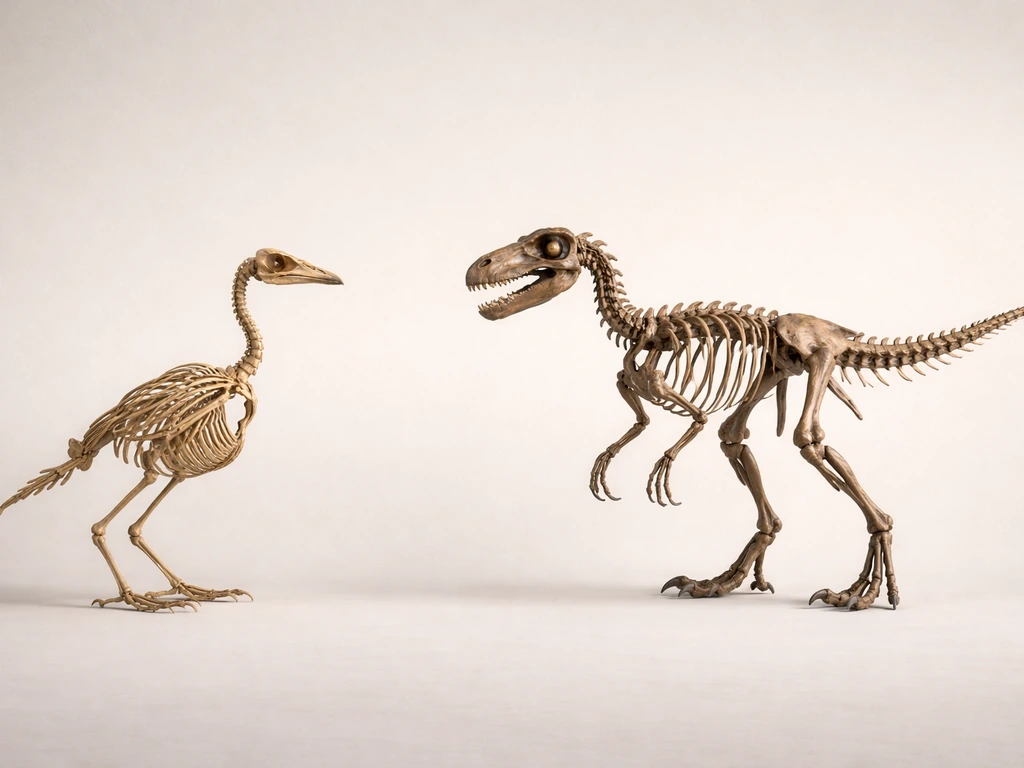
Yes, a T. rex skeleton and a bird skeleton do look strikingly similar at first glance, and that confusion is completely justified. Birds are literally living theropod dinosaurs, which means the skeletal blueprint they share with T. rex is real, not coincidental. But once you know which bones to look at, the differences become unmistakable, and you can sort them out in minutes at any natural history museum. This guide walks through every major skeletal region, explains the functional logic behind each difference, and ends with a practical checklist you can use the next time you're standing in front of a mounted skeleton.
T-Rex Skeleton vs Bird Skeleton: How to Tell the Differences

Marcus Hendricks
21 Apr 2026
Why T. rex and birds look so alike (and what 'skeleton vs skeleton' really means)
The reason people search for 'T. rex skeleton vs bird skeleton' is that modern science has made the evolutionary connection impossible to ignore. Birds descended from theropod dinosaurs, the same broad group that includes T. rex.
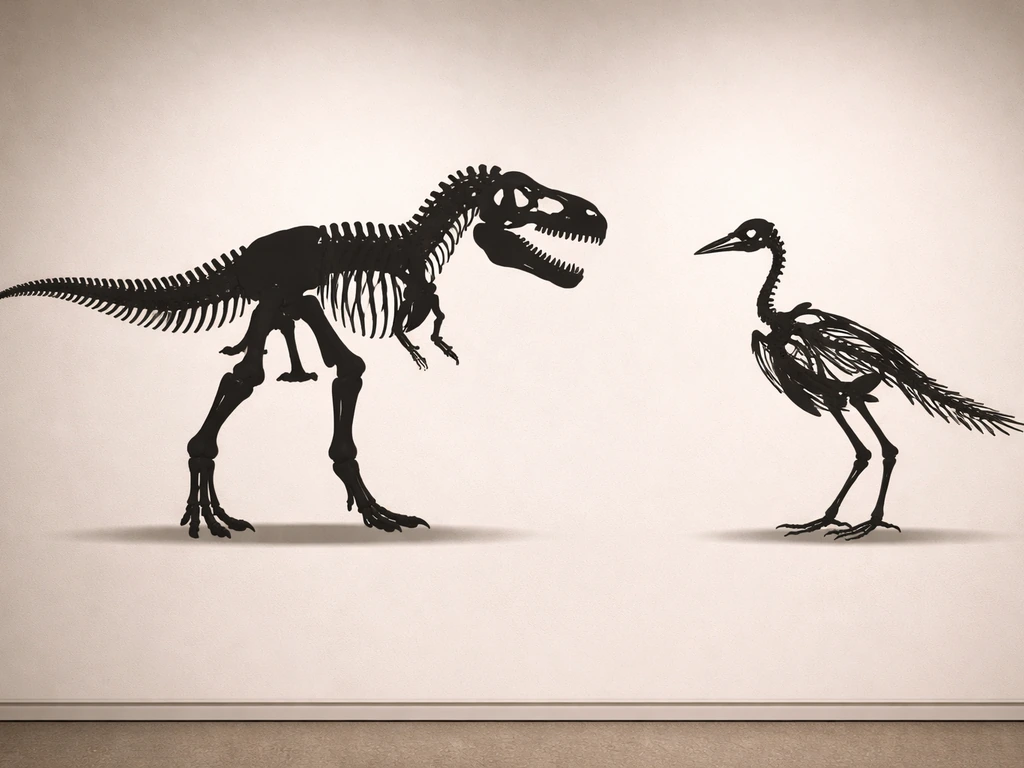
That shared ancestry shows up in the skeleton directly: both are bipedal, both carry their weight on two hindlimbs, both have an upright posture in mounted displays, and both have pneumatized bones (hollow, air-filled vertebrae and limb bones) connected to a sophisticated respiratory system involving air sacs. When you stand in front of a museum mount of T. rex and then look at a large bird skeleton nearby, the overall silhouette rhymes. That's not a trick of display or lighting.
That's 150+ million years of shared anatomical heritage showing through.
What 'skeleton vs skeleton' really means here is functional anatomy: which structural features tell you how each animal moved, fed, balanced, and breathed? The goal is not just naming bones but reading them. When you compare the two skeletons region by region, you stop seeing a vague resemblance and start seeing two animals that took the same starting blueprint in dramatically different directions. T. rex scaled up massively, kept a long counterbalancing tail, retained teeth, and reduced its forelimbs to near-vestigial nubs. Birds fused everything they could, shrank the tail to a stub, lost the teeth, and transformed the forelimb into a wing. Those divergences are written clearly in bone, and they're what this guide focuses on.
It's worth noting that the broader comparison between bird skeletons and theropod dinosaur skeletons involves a wider cast of species than just T. rex. If you're also curious about how the pattern holds across other dinosaur groups, that's a related angle worth exploring separately. Here, the focus stays tight: T. rex versus a generic bird skeleton, feature by feature.
Big-picture body plan: where they match and where they don't
At the whole-body level, both T. rex and birds share a bipedal, digitigrade stance, meaning both walk on their toes with the ankle elevated off the ground. Both hold the trunk roughly horizontal (not upright like a kangaroo), balanced over the hindlimbs. Both have a relatively large head compared to many other animal groups. And both have pneumatized skeletons: bone walls invaded by air pockets connected to the respiratory system, which is one of the most striking biological traits linking theropods and birds.
That's where the visual similarity starts to break down. T. rex is enormous (up to 12 meters long, around 8,000 to 14,000 kilograms in life estimates), while even the largest bird skeletons are tiny by comparison. More importantly, T.
rex has a long, muscular tail that accounts for roughly half the animal's body length and serves as the primary counterweight to the massive head and trunk. A bird has almost no tail structure at all in skeletal terms. The posterior end of a bird is a short, fused nub called the pygostyle. That single difference reshapes the entire center-of-mass geometry of the two animals.
Additionally, T. rex has a massive, tooth-bearing skull while birds have a lightweight, toothless beak. The forelimbs of T. rex are famously tiny and two-fingered; a bird's forelimbs are fully transformed into wings with a fused hand region.
These are not subtle differences, and they're all visible from across the room at a museum.
Skull and jaws: the fastest region to sort out
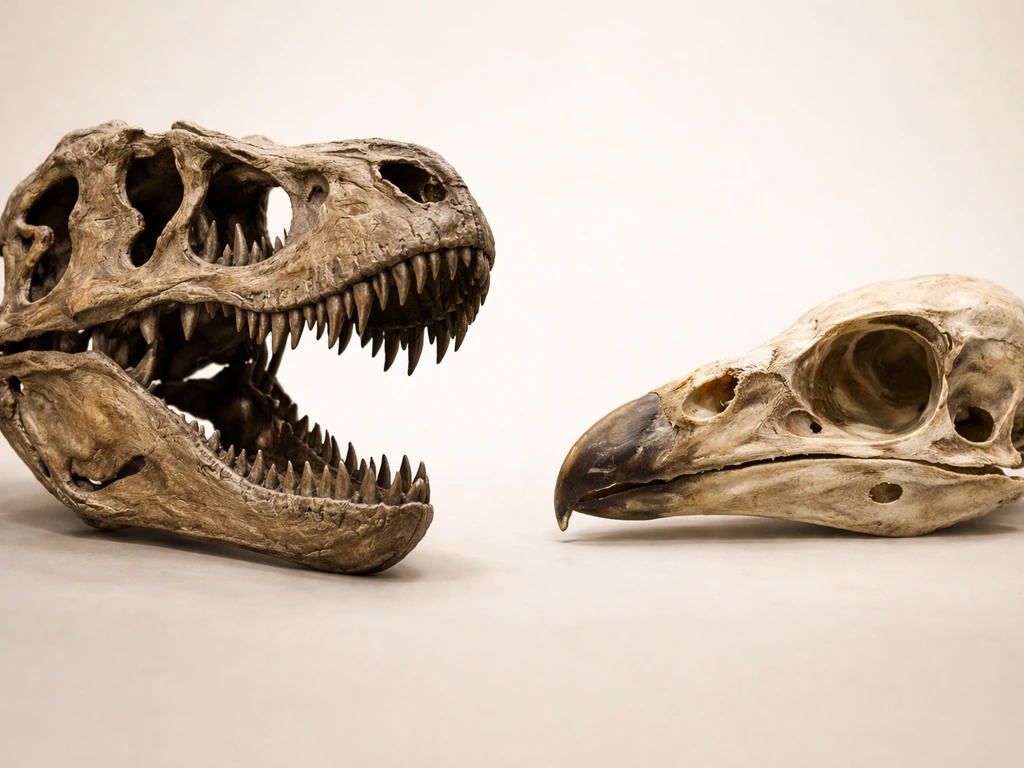
The skull is often the first place your eye goes, and it's one of the clearest discriminators. T. rex has a massive, deep skull with fully functional teeth throughout its life. The premaxillary teeth at the front of the upper jaw are arranged in a laterally oriented row and are D-shaped in cross-section, a detail confirmed repeatedly in tyrannosaur identification literature.
The teeth toward the back of the jaw are robust, serrated, and recurved, adapted for holding and crushing rather than slicing. There are no teeth in any living bird skeleton. Birds have a keratinous beak supported by toothless jaw bones, and the jaw bones themselves are relatively slender and lightly built compared to the massive maxillary and dentary bones in T. rex.
Cranial openings are another quick check. T. rex has large fenestrae (openings) in the skull that reduce weight while maintaining structural integrity, including a large orbit (eye socket) that in tyrannosaurs faces somewhat anteriorly and is often described as keyhole-shaped. The nasal openings in T.
rex are positioned further back along the snout than in many other theropods. Birds have large orbits relative to skull size (contributing to the enormous eyes birds are known for), but the overall skull architecture is radically lighter and more rounded, with a braincase that is proportionally much larger relative to skull length than in any non-avian dinosaur. A T. rex skull is deep, long, and powerfully braced; a bird skull is a thin-walled, lightweight capsule.
Vertebrae, ribs, and the thorax: reading the fused vs unfused spine
This is the region that surprises people most, because both T. rex and birds have pneumatized vertebrae, meaning the vertebral bone is invaded by hollow spaces and canals connected to the air-sac system. If you look at the side of a T. rex dorsal vertebra in a museum, you can sometimes see these openings (called pleurocoels). The same pattern shows up in bird vertebrae. The pneumatization is real shared biology, a consequence of the same type of air-sac respiratory architecture that both groups evolved. So the pneumatization alone won't tell you which skeleton you're looking at.
What will tell you is fusion. Birds have one of the most extensively fused vertebral columns in all of vertebrate anatomy. The lumbar, sacral, and some caudal vertebrae are consolidated into a single bony structure called the synsacrum, which is also fused to the pelvic bones (ilium, ischium, and pubis) to form a rigid posterior platform.
In birds, the synsacrum is an extended sacrum formed by incorporating additional fused or partially fused vertebrae, ending near the pygostyle as the tail becomes a short fused structure The lumbar, sacral, and some caudal vertebrae are consolidated into a single bony structure called the synsacrum. Some birds also develop a notarium, fusing thoracic vertebrae anteriorly.
In T. rex, the vertebral column remains separately articulated through most of its length. The sacral vertebrae are co-ossified into a sacrum, but nothing approaching the sweeping, multi-region fusion of a bird synsacrum. If you run your eye along the spine of a mounted skeleton and see one continuous, unbroken bony plate running from mid-back through the pelvis, you're looking at a bird.
If you see individually articulated vertebrae throughout the dorsal and caudal series, you're looking at a non-avian theropod like T. rex.
Rib structure and the thoracic cage also differ. Birds have a keeled sternum (the carina) to anchor flight muscles, a feature entirely absent in T. rex. Bird ribs often have blank" rel="noopener noreferrer">uncinate processes (small bony extensions that brace adjacent ribs and stiffen the thorax for the breathing mechanics of flight). T. rex ribs are large and robust, part of a deep thorax built for massive muscle attachment, not for the rapid respiratory cycling birds need during flight.
Pelvis and hindlimbs: similar posture, very different structure
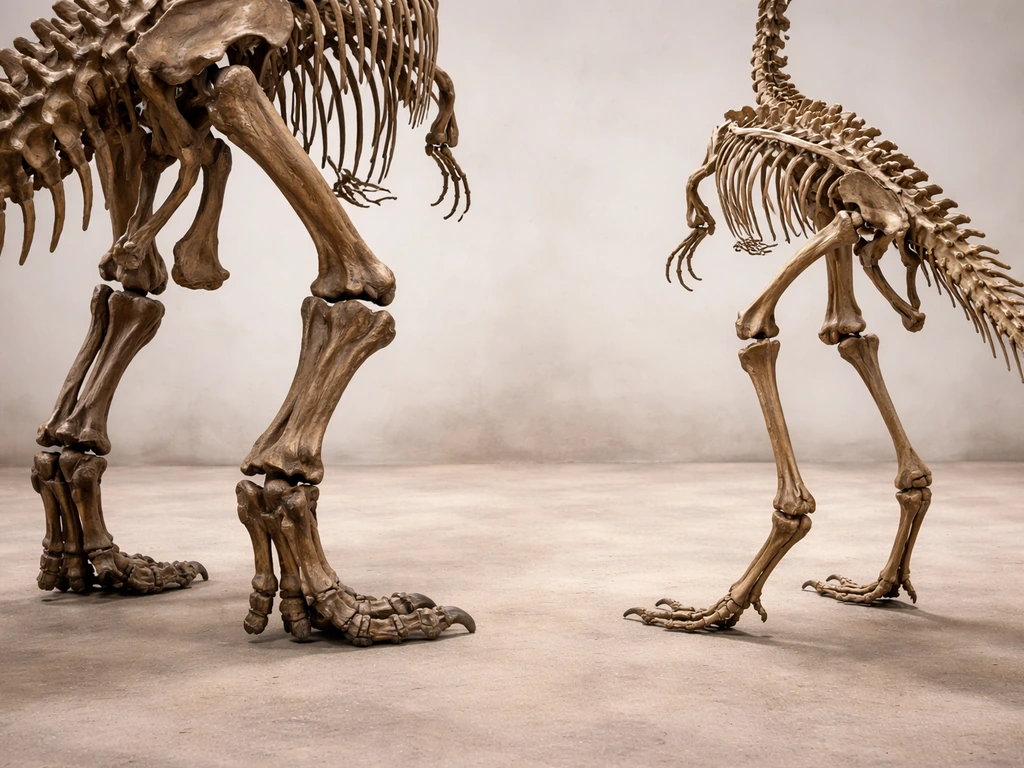
Both T. rex and birds have an 'open' pelvis architecture (technically opisthopubic in T. rex, a trait shared with birds), meaning the pubis points rearward rather than forward as in most other reptiles. This is one of the most cited pieces of evidence linking theropods to birds, and it contributes to the visual similarity of the pelvic region in mounted skeletons. But the degree of fusion sets them apart decisively. In birds, the ilium, ischium, and pubis are fused into the synsacrum complex, forming a locked, rigid structure. In T. rex, the three pelvic bones are present and articulated but remain as distinct, separately identifiable elements.
The hindlimb proportions also differ, even though both animals are bipedal and digitigrade. T. rex has a relatively short, robust femur, a longer tibia, and a highly specialized metatarsus. The tyrannosaur metatarsus shows what's called the arctometatarsalian condition: metatarsal III is pinched and compressed near the ankle joint, sandwiched between metatarsals II and IV.
This is a mechanical feature associated with force transmission during locomotion, and it gives the T. rex foot a distinctive compact, columnar look at the ankle. Birds, by contrast, have a tarsometatarsus, in which the ankle bones (tarsals) and metatarsals are fused into a single elongated bone. This fusion is another one of those clean sorting criteria: if the lower leg ends in a single fused shaft before the toes, it's a bird.
If you see separate metatarsals (even if they're compacted together), you're looking at a non-avian theropod.
Hands and feet: where function tells the story
The forelimb and hand of T. rex are arguably the most famous diagnostic feature of the entire animal, partly because they're so strange. Tyrannosaurids are functionally didactyl, meaning the manus (hand) is reduced to two functional digits, with the third either vestigial or absent. The arms themselves are short relative to body size to a degree that still puzzles researchers, and the hands have large claws on those two remaining digits. In functional terms, T. rex forelimbs were not used for prey capture in the same way earlier theropods used theirs. They're a remnant of a three-fingered ancestor, scaled down and reduced over tens of millions of years.
A bird wing skeleton is the opposite story: the forelimb is the primary locomotor organ for most species, and the hand region has been dramatically transformed rather than reduced in the same way. The avian wing hand is formed by a carpometacarpus, in which multiple carpal bones and three fused metacarpals combine into a single rigid element. Three digits are present, though they are modified and partially reduced compared to a generalized theropod hand.
The humerus, radius, and ulna of a bird wing are slender and elongated relative to body size, built for aerodynamic function. If you're looking at a forelimb with a tiny two-clawed end and massive arm bones, it's T. rex. If you see a long, lightweight limb ending in a fused metacarpal plate (the carpometacarpus), it's a bird.
At the foot end, both animals are functionally tridactyl in their main weight-bearing digits (digits II, III, and IV), but the construction differs. Birds typically have digit I (the hallux) pointing rearward and digits II through IV pointing forward, a configuration suited to perching and grasping. The entire lower foot is that fused tarsometatarsus. T. rex feet are large, forward-facing, with three main weight-bearing toes and a reduced dewclaw-like digit I. The metatarsals are separate (with the arctometatarsalian compression at digit III near the ankle). Bird feet look elegant and lightweight; T. rex feet look like load-bearing columns.
Tail and center of mass: the most underrated difference
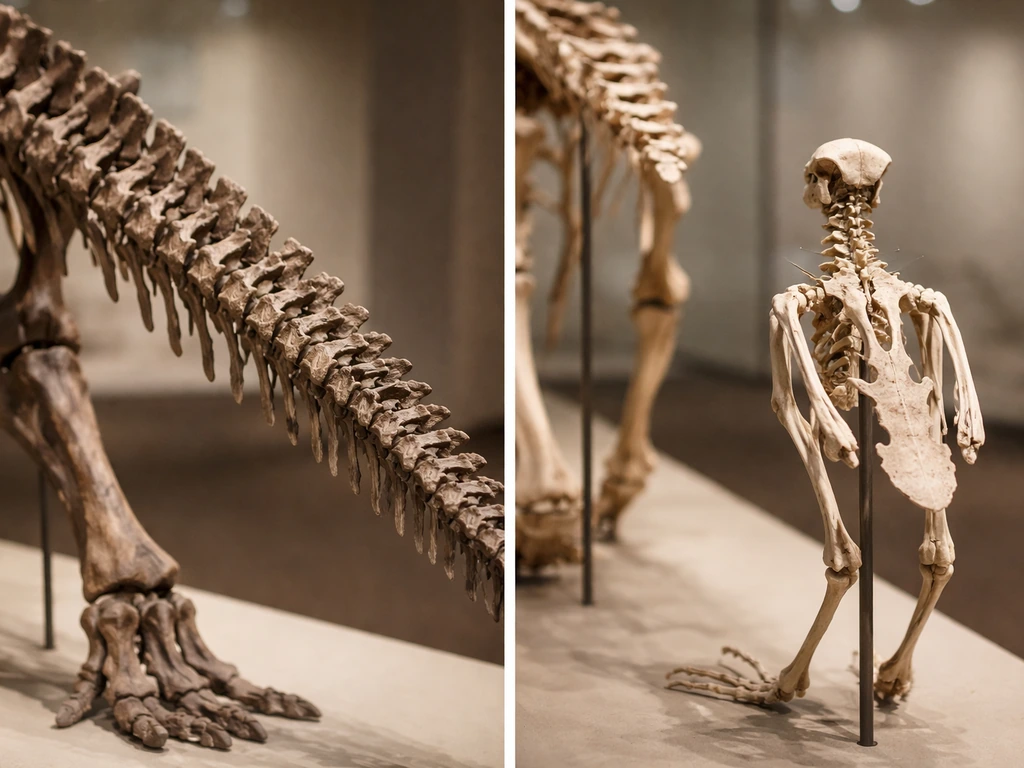
The tail is where the two skeletons diverge most dramatically in terms of biomechanics. T. rex has a long, deep caudal vertebral series, with dozens of individually jointed vertebrae extending from the pelvis nearly as far as the head is in front of the hips. This tail is not decoration. It's a massive counterweight that balances the heavy head and thorax over the hindlimbs, and it's packed with muscle that powers the hindlimb retraction during walking. The center of mass in T. rex sits roughly over the hips, maintained in balance by the tail on one side and the head/neck/trunk on the other. Jointed, segmented tails like this give precise three-dimensional control over body rotation during movement.
Birds have almost entirely eliminated this structure. The caudal vertebral series in birds is drastically shortened, and the terminal vertebrae are fused into the pygostyle, a small, blade-shaped or plow-shaped bone that anchors the tail feathers. It supports the fan of flight feathers that birds use for steering and braking, but it contributes almost nothing to counterbalancing a large head or trunk.
Instead, birds redistribute their center of mass by positioning the legs further forward under the body and by having a relatively large, heavy thorax (with flight muscles). The result is a fundamentally different balance strategy: birds are a compact, front-heavy machine with a short posterior; T. rex is a long, balanced beam with mass distributed across a much greater length. This difference is visible the moment you look at the tail region of any mounted skeleton.
Side-by-side skeletal comparison
| Skeletal Region | T. rex | Bird |
|---|---|---|
| Overall posture | Bipedal, horizontal trunk, long tail counterweight | Bipedal, compact trunk, shortened fused tail (pygostyle) |
| Skull | Massive, deep, heavily braced with large fenestrae | Lightweight, rounded, large braincase relative to length |
| Teeth | Present throughout life; D-shaped premaxillary teeth, serrated posterior teeth | Absent; toothless beak (rhamphotheca) |
| Vertebral fusion | Separately articulated through most of the column; sacrum fused but limited | Extensive: synsacrum fuses lumbar, sacral, and caudal vertebrae with pelvic bones |
| Sternum | Flat or lightly structured; no keel | Keeled sternum (carina) for flight muscle attachment |
| Ribs | Large, robust; no uncinate processes confirmed | Smaller, often with uncinate processes bracing adjacent ribs |
| Pelvis | Open (opisthopubic); three pelvic bones articulated but separate | Fully fused into synsacrum complex; rigid posterior platform |
| Forelimb/hand | Tiny arms; functionally two-fingered (didactyl); large claws on remaining digits | Long wing; carpometacarpus (fused hand bones); three modified digits |
| Metatarsus/foot | Separate metatarsals; arctometatarsalian compression at digit III near ankle | Fused tarsometatarsus; hallux typically reversed for perching |
| Tail | Long, jointed caudal vertebral series; major counterweight and locomotor role | Short, fused pygostyle; supports tail feathers only |
How to check at a museum in minutes: your practical checklist
Next time you're at a natural history museum, here's a fast, reliable sequence for comparing any mounted theropod skeleton to a bird skeleton. You don't need to know every bone's name. You just need to know where to look and what questions to ask. A bird dinosaur skeleton comparison like this is what you use to spot the real evolutionary pattern in any museum display.
- Look at the tail first. Does the animal have a long, jointed tail extending well behind the hips? That's a non-avian theropod. Does the tail region end in a short, fused nub almost flush with the pelvis? That's a bird. This single check eliminates the most confusion immediately.
- Check the teeth. Any teeth at all? You're looking at a non-avian dinosaur. A smooth, toothless jaw margin suggests a bird (or a non-tooth-bearing dinosaur relative). For T. rex specifically, look for large, serrated teeth with the front row having a slightly different, more incisiform shape than the back row.
- Look at the forelimbs. Tiny arms with only two visible clawed digits and no wing surface? T. rex. A long limb ending in a fused paddle-like hand bone (carpometacarpus) with three reduced digits? Bird. This is one of the fastest visual checks available.
- Examine the lower spine and pelvis junction. In a bird, the spine and pelvis merge into a single continuous bony structure (synsacrum) with no clear boundary. In T. rex, you can see individually articulated vertebrae running all the way back to where the sacrum begins. The bird's posterior looks like a solid plate; the theropod's looks like a chain.
- Look at the foot. A fused lower-leg bone that becomes a single shaft before splitting into toes? That's the bird tarsometatarsus. Separate metatarsals (even if tightly packed) meeting the ankle as distinct elements? Non-avian theropod. If you can also see the middle metatarsal being noticeably pinched near the ankle, you may be looking at an arctometatarsalian theropod like a tyrannosaur.
- Check the sternum if it's visible. A large, keeled breastbone is a bird marker. A flat or absent sternal plate points to a non-avian theropod.
- Look at the overall spine for vertebral fusion. Run your eye from shoulder to tail along the backbone. Multiple separate, distinct vertebrae all the way through? T. rex-type. A region of the spine where vertebrae seem to disappear into a single fused block (especially mid-back through pelvis)? Bird.
- Check vertebral bone texture if you can get close enough. Both bird and T. rex vertebrae may show openings or pits related to pneumatization (air sacs), so pneumatized bone alone is not a sorting tool. Focus on fusion and overall proportions instead.
Common misreads to watch out for
- Bipedal posture alone does not mean bird: many non-avian theropods stand upright and walk on two legs. Posture is a shared trait, not a discriminator.
- Hollow bones alone do not mean bird: theropod dinosaurs including T. rex have pneumatized, hollow bones just as birds do. This is a shared evolutionary feature, not a bird-only marker.
- Large size does not rule out bird: ostriches and emus are large birds, and extinct relatives like moas were enormous. But no living or recently extinct bird approaches T. rex proportions, so size is useful context but not a hard rule.
- A toothless jaw in a fossil doesn't automatically mean bird: some non-avian theropods had reduced or toothless jaws. But combined with a short fused tail and fused tarsometatarsus, toothlessness strongly supports bird identity.
- The opisthopubic pelvis (pubis pointing backward) is shared between T. rex and birds: don't use pubis orientation alone to identify a bird skeleton. You need the full fusion pattern of the synsacrum to make that call.
The comparisons between T. rex and bird skeletons sit within a broader conversation about how bird skeletons differ from dinosaur skeletons generally, including groups like ornithischians that have a very different hip structure from theropods. The hip architecture comparison is particularly interesting, since the theropod-to-bird transition involved skeletal changes that cut across both saurischian and ornithischian body plans in ways researchers are still debating. If you find the pelvis and hip mechanics here interesting, those related angles are worth following up on separately.
The bottom line is straightforward: T. rex and birds are genuinely related, and the skeleton proves it. Bird skeleton vs dinosaur skeleton comparisons become much easier once you focus on those bone-level fusion and function cues, not just the overall shape T. rex and birds.
But that relationship doesn't make them hard to tell apart. A bird vs dinosaur skeleton comparison like this is the fastest way to see how evolution shaped structure and function. A specific way to apply those cues is to compare the bird hip vs lizard hip differences in pelvic structure bird vs dinosaur skeleton. It just means the differences are evolutionary ones, not arbitrary ones.
Once you know that birds fused everything T. rex kept separate, shortened what T. rex kept long, and transformed what T. rex reduced, the two skeletons become easy to read.
Start at the tail, check the teeth and hands, confirm with the foot and spine, and you'll have a confident answer within five minutes of walking up to any mounted skeleton.
FAQ
What is the fastest way to tell which skeleton I am looking at if I only have 30 seconds?
Use a two-step “silhouette, then lock in one diagnostic cue.” First, check length and balance: T. rex reads as a long-beamed animal with a huge tail, while a bird reads as a short-bodied animal with a compact posterior. Then confirm with a single hard marker: if the spine shows a long sequence of distinct vertebrae into the tail, it is not a bird; if the pelvis and mid-back form a rigid fused synsacrum plate, it is a bird.
If both have pneumatized vertebrae, how can I avoid being fooled by that shared trait?
Yes, pneumatized bones can make vertebrae look similar even though they come from different evolutionary outcomes. In practice, don’t decide based on air spaces alone. Follow pneumatization with fusion checks: look for the bird’s extensive synsacrum (a continuous fused platform from lumbar and sacral regions into the pelvis) versus the separately articulated vertebrae seen in T. rex.
Do all bird skeletons show the same diagnostic features, or can species variation confuse the comparison?
Bird skeletons are not all the same, and a museum “bird” mount might be a particular species with shortened, modified, or partially fused elements that can obscure cues. The most reliable universal bird cues are the beak (no teeth), a fused tarsometatarsus (ankle and metatarsals as one shaft), and fusion-heavy trunk construction (synsacrum and often further thoracic fusion). If those show up, species variation is less likely to mislead you.
Can museum mounting or reconstruction make a T. rex look more “bird-like,” and what should I watch for?
Mounted displays sometimes re-articulate or stylize elements for clarity, which can make bones look more or less “fused” than in a natural position. Pay attention to bone surfaces and boundaries rather than posture: in birds, the synsacrum complex appears as a continuous rigid bony structure spanning from the mid-back region through the pelvis, whereas in T. rex you can typically trace individual vertebrae in the dorsal and caudal series.
What if the dinosaur skeleton is not actually T. rex, does the same “bird vs theropod” logic still hold?
If you are looking at a smaller theropod or a non-tyrannosaur dinosaur, some cues can shift in intensity, especially tail length and forelimb reduction. T. rex-style teeth and the specific foot mechanics (arctometatarsalian pinching at the ankle) are tyrannosaur-specific. The safest approach is to use bird-specific fusion markers (synsacrum) plus avian limb markers (carpometacarpus in the wing region, fused tarsometatarsus in the leg).
If I see no obvious teeth, does that automatically mean it is a bird skeleton?
Teeth can be missing for reasons other than “it is a bird,” especially in fossil preservation. So treat “no teeth” as a clue only after you confirm the presence of a beak-supported jaw region rather than just blank jaw edges. For a living bird skeleton, teeth absence is expected, but for fossils, use the combination of toothlessness plus the distinctive bird wing and hindlimb fusion patterns.
Which specific limb features should I compare to avoid getting misled by general arm or skull size?
For the forelimbs, the cleanest decision aid is the shape of the “end” of the wing/hand. T. rex has short arms ending in two functional clawed digits, while birds have a wing hand where multiple hand bones are fused into a carpometacarpus. For the ankle-to-foot transition, T. rex keeps separate metatarsals with the arctometatarsalian compression, while birds have one fused tarsometatarsus before the toes.
If a bird’s tail looks odd in a display, what bony feature should I use to confirm it is a bird?
Some birds show a reduced or differently shaped tail fan due to how the specimen was prepared, so the absence of a long bony tail doesn’t always look dramatic. Instead of focusing only on tail length, confirm the bony outcome: birds should show a pygostyle that is a short fused terminal structure. Then corroborate using the fused trunk (synsacrum) and fused lower leg (tarsometatarsus).
How can I use biomechanics (balance) as a cross-check, without overinterpreting the pose in the mount?
Yes, use the center-of-mass strategy as a reality check. T. rex balances a heavy head with a long tail that behaves like a counterweight beam, and the legs sit under a long body axis. Birds redistribute mass more forward with a heavier thorax for flight muscles and a shortened posterior, leading to a more compact front-heavy look. If the balance “story” contradicts your bone-based cues, re-check fusion markers first.
Next Article
Bird vs Dinosaur Skeleton: Bone-by-Bone ID Guide
Learn bone-by-bone how to tell a bird skeleton from a dinosaur, using skull, wings, ribs, pelvis, and feet traits.