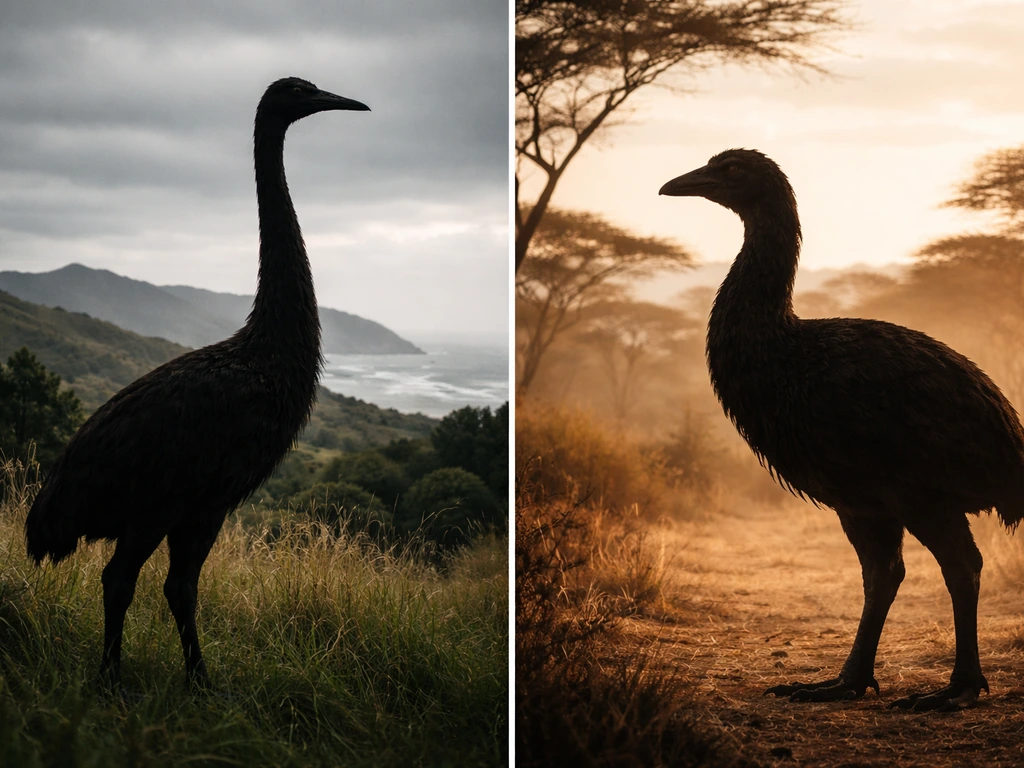
Vorombe titan and elephant bird are not the same animal, but they are closely related and both lived on Madagascar. It can help to compare Vorombe titan directly with other elephant birds to see why they are treated as separate species. Vorombe titan is actually the largest species within the broader elephant bird family (Aepyornithidae), and it was formerly classified as Aepyornis titan before a 2018 re-analysis moved it into its own genus. So when people ask "which was bigger," the answer is Vorombe titan, by a significant margin. Think of it this way: all Vorombe are elephant birds in the family sense, but not all elephant birds are Vorombe.
Vorombe titan vs Elephant bird: key differences explained

Marcus Hendricks
11 May 2026
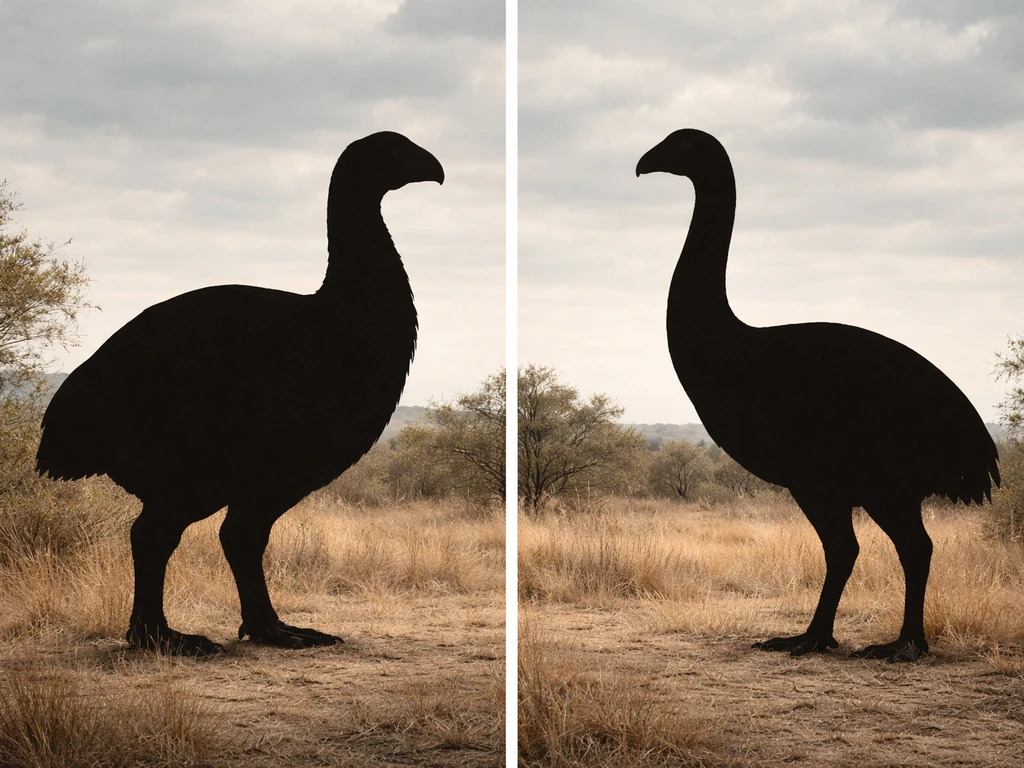
Are Vorombe titan and elephant bird actually the same bird?

This is the source of almost all the confusion, so let's clear it up first. "Elephant bird" is a common name that gets applied loosely to any member of the family Aepyornithidae. For most of the 20th century, scientists lumped most of these birds into the genus Aepyornis, with Aepyornis maximus and Aepyornis titan being the two most famous species. Then in 2018, James Hansford and Samuel Turvey published a major morphometric re-analysis in Royal Society Open Science.
In that 2018 Royal Society Open Science work, Hansford and Turvey provided the morphometric and genus-level conclusions supporting the allocation of the largest morphotype to Vorombe (rather than Aepyornis titan), with the PDF available via UCL Discovery [published a major morphometric re-analysis](https://discovery. ucl. ac. uk/10056027/8/Hansford_rsos.
181295. pdf). They examined appendicular limb bone measurements across museum specimens and concluded that the largest morphotype, previously called Aepyornis titan, was morphologically distinct enough to deserve its own genus. They named it Vorombe titan, with Vorombe coming from the Malagasy word for "large bird.
" The result is that the modern Aepyornithidae family now contains three recognized genera: Aepyornis, Mullerornis, and Vorombe, with Vorombe titan being the only species in its genus.
There is a wrinkle here worth knowing about. A 2023 ancient DNA study published in Nature Communications analyzed mitochondrial DNA extracted from fossil eggshells and found limited genetic divergence within Aepyornithidae. In other words, the genetics suggested the family was less diverse than the skeleton-based species and genera hypotheses indicated. This does not settle the debate, but it does mean the genus-level split between Vorombe and Aepyornis remains genuinely contested among researchers. More on that in the uncertainty section below.
Where they lived and when
Both Vorombe titan and the other elephant birds (Aepyornis species) lived exclusively on Madagascar, the large island off the southeast coast of Africa. Madagascar has been isolated from the African mainland for around 88 million years, which is why it developed such a unique fauna. Aepyornithidae as a whole survived into the Holocene, meaning these were not ancient Cretaceous dinosaur-era birds but genuinely recent animals.
Current evidence puts their extinction somewhere between roughly 1,000 and 500 years ago, with human arrival on Madagascar (estimated around 2,000 years ago or earlier) playing a major role through hunting and habitat destruction. These extinctions are also one reason people ask how elephant birds vs humans played out on Madagascar. Some fossil evidence and historical accounts from early Arab traders hint that isolated populations may have survived even later in remote parts of the island.
Vorombe titan and Aepyornis maximus were both present in broadly the same geographic and temporal window, though their specific regional distributions within Madagascar are not fully mapped.
Size, body structure, and how they moved
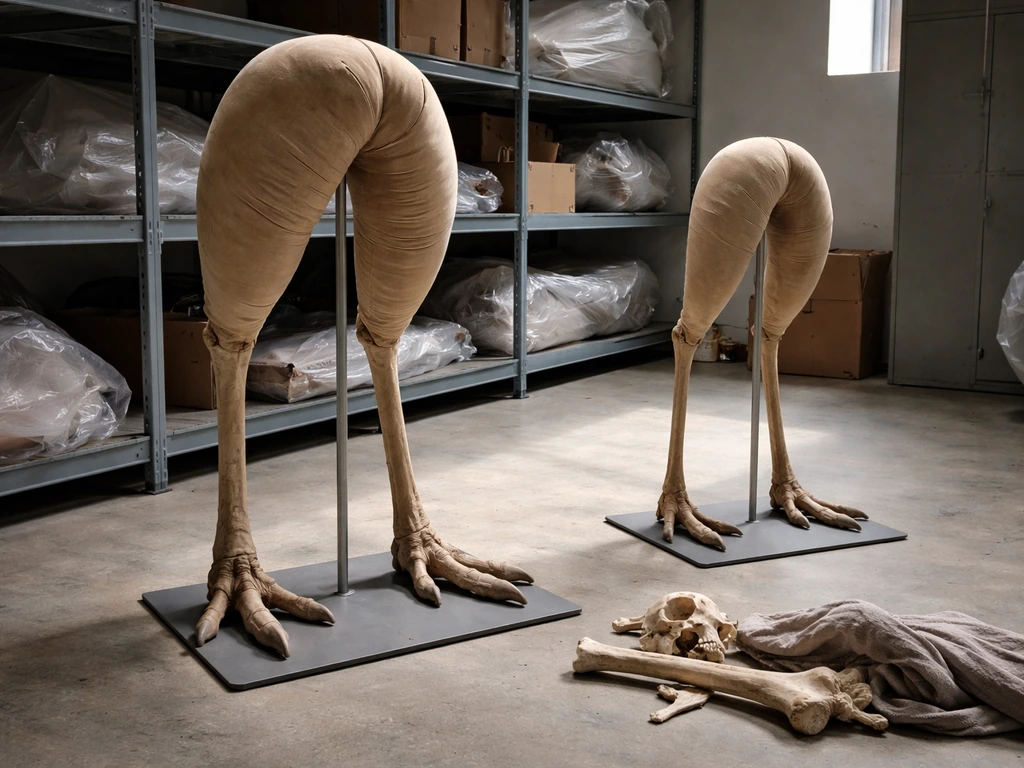
This is where the two differ most dramatically and most practically. Vorombe titan holds the record as the heaviest bird known to science. Estimates based on limb bone measurements put its body mass at around 650 to 730 kilograms, with some estimates reaching close to 860 kg. For comparison, Aepyornis maximus, the heaviest of the remaining Aepyornis species, weighed roughly 275 to 400 kg.
So Vorombe titan was not just a little bigger; it was potentially twice the mass of the next largest elephant bird species. If you're comparing goliath bird options, the goliath birdeater vs bird debate is a separate question about predator size and hunting behavior. In terms of height, elephant birds were generally not as tall as they were heavy. They were stocky, wide-bodied birds, not particularly long-legged relative to their bulk.
Vorombe titan's height is estimated at around 3 meters, while Aepyornis maximus stood roughly 2 to 3 meters tall. The giant moa of New Zealand was actually taller, but lighter than Vorombe, illustrating how body proportions varied across these large ratites.
Both Vorombe and Aepyornis were ratites, meaning they were flightless birds with a flat, raft-like sternum (breastbone) lacking the keel that anchors flight muscles in flying birds. Their locomotion was entirely terrestrial. They moved on two robust, thick-boned legs built to support enormous mass. Their feet were wide and three-toed, providing a stable platform. Unlike ostriches, which can sprint at high speed, elephant birds and Vorombe were almost certainly slow-moving animals given their bulk. Their vestigial wings were tiny and functionally useless for anything other than possibly balance or display.
| Trait | Vorombe titan | Aepyornis maximus |
|---|---|---|
| Estimated mass | 650–860 kg | 275–400 kg |
| Estimated height | ~3 m | ~2–3 m |
| Leg bones | Exceptionally robust, wider proportioned | Robust but comparatively narrower |
| Wings | Vestigial, non-functional | Vestigial, non-functional |
| Locomotion | Terrestrial, slow-moving biped | Terrestrial, slow-moving biped |
| Sternum | Flat, ratite-type (no keel) | Flat, ratite-type (no keel) |
Diet, behavior, and how they used their habitat
Neither Vorombe titan nor any Aepyornis species left behind behavioral records, so everything here is inferred from anatomy, isotope analysis of bones, and the types of vegetation present in their fossil habitats. Both were almost certainly herbivores. Their beaks were relatively small compared to their enormous bodies, suggesting they were grazers or browsers of low vegetation rather than animals that needed a powerful bill for cracking hard seeds or tearing bark. Isotope studies of Aepyornis bones have pointed toward a diet of C3 plants, meaning forest and shrub vegetation rather than open grassland grasses. This fits with the idea that elephant birds inhabited forested and densely vegetated areas of Madagascar rather than open savannas.
Whether Vorombe titan had a meaningfully different diet or habitat preference compared to Aepyornis maximus is genuinely unknown. Their enormous size difference does suggest some degree of ecological separation, which is common in large herbivores sharing the same landscape. Larger body size often correlates with an ability to process lower-quality, tougher vegetation. It is plausible that Vorombe fed on coarser plant material or ranged more widely than the smaller Aepyornis species, but this is speculative. What is clear is that Madagascar's forests and scrublands were capable of supporting multiple large ratite species simultaneously, much as Africa supports several large herbivores today.
Eggs and what we know about reproduction
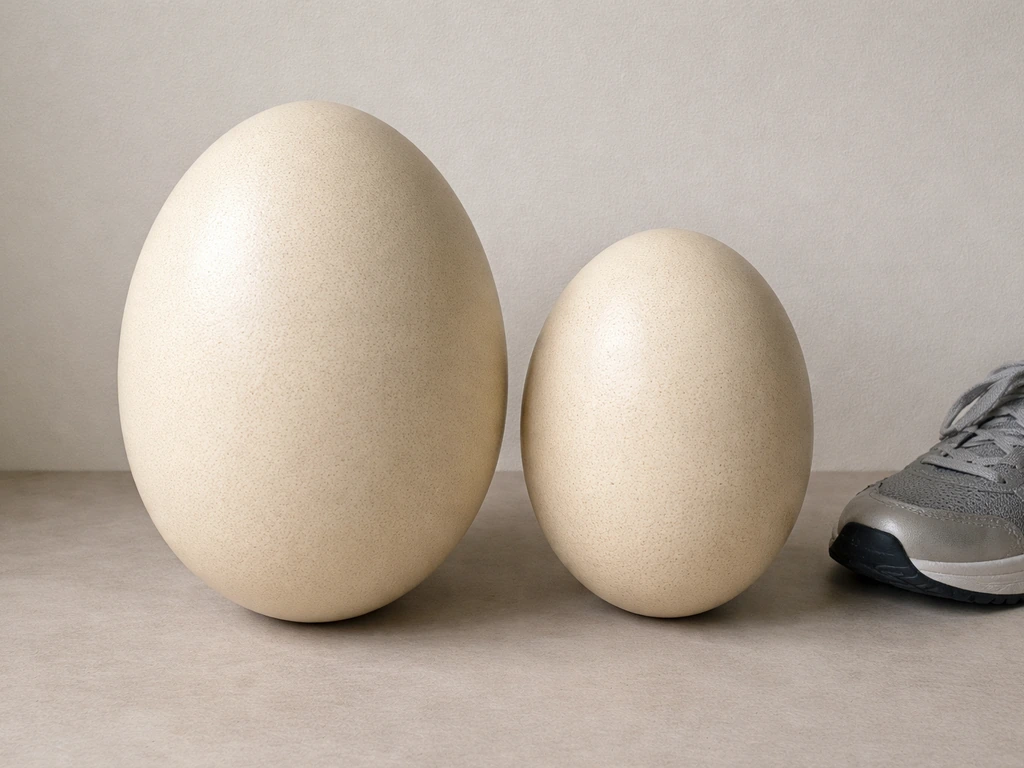
Elephant bird eggs are one of the most famous things about this entire group, and for good reason. Aepyornis eggs are the largest eggs of any known animal, with volumes of around 9 to 10 liters in the biggest specimens. To put that in perspective, a single elephant bird egg holds the equivalent of roughly 160 chicken eggs or about 7 ostrich eggs. These eggs have been found intact or in fragments across Madagascar and are occasionally traded or displayed in museums. The thick, hard shell is around 3 to 7 mm thick, which is what allows fossil eggshell to survive and even yield usable DNA thousands of years later.
Here is an important practical note: most of the giant eggs referenced in popular media are attributed to Aepyornis maximus, which was the species most well-known before the 2018 reclassification. Because Vorombe titan was only recently split off as a separate genus, we do not have definitively assigned Vorombe eggs as opposed to Aepyornis eggs in many existing collections. The ancient DNA eggshell study from 2023 was partly trying to address exactly this kind of attribution problem.
Given Vorombe's dramatically larger body size, its eggs were likely even larger, but this has not been confirmed with certainty. Nesting behavior is entirely unknown; we have no direct evidence of nest structure, clutch size, incubation behavior, or parental care for any elephant bird species.
How to tell them apart from fossils and illustrations
If you are looking at a museum skeleton, a fossil specimen, or a scientific illustration and want to figure out whether you are looking at Vorombe titan or one of the Aepyornis species, the key distinguishing features come down to limb bone proportions and overall size.
- Tarsometatarsus width and robustness: Vorombe titan has proportionally wider, more massively built lower leg bones relative to their length compared to Aepyornis. Hansford and Turvey's 2018 analysis specifically used appendicular limb element measurements to separate the morphotypes.
- Overall skeletal scale: Vorombe titan specimens are simply much larger. If a skeleton or bone looks almost implausibly massive next to a large Aepyornis specimen, it is likely Vorombe.
- Body proportions: Vorombe tends toward a more compact, extremely wide-bodied silhouette. Aepyornis maximus is large but slightly more elongated in comparative reconstructions.
- Museum labeling history: Many older museum specimens labeled 'Aepyornis titan' are now recognized as Vorombe titan. If you are reading older literature or looking at pre-2018 museum labels, 'Aepyornis titan' and 'Vorombe titan' refer to the same physical animal.
- Egg attribution: Most eggs currently in collections were identified before the genus split. Without DNA analysis, you cannot reliably assign a loose egg to Vorombe versus Aepyornis based on size alone.
For illustrations specifically, Vorombe titan is typically depicted with an even more barrel-chested, heavily built body than Aepyornis maximus. If an illustration labels the bird as the 'world's heaviest bird' or emphasizes extreme mass over height, it is almost certainly depicting Vorombe titan. If the emphasis is on height or the bird is depicted as more slender and ostrich-like, it is more likely representing a different ratite entirely, possibly a moa. If the emphasis is on height or the bird is depicted as more slender and ostrich-like, it is almost certainly depicting Vorombe titan moa.
Taxonomy and ratite relationships explained simply
Ratites are the group of flightless birds that includes ostriches, emus, rheas, cassowaries, kiwis, and the extinct moas and elephant birds. Even though cassowaries are much smaller, their shared flightlessness makes the comparisons with elephant birds surprisingly common. They are united by their flat sternum and flightlessness, though modern genetic research has shown their relationships are more complex than previously thought. The ratite tree has been reshuffled considerably by genomic studies over the past two decades.
Within the ratite family, Aepyornithidae (elephant birds) are actually most closely related to kiwis, which is surprising given the size difference. This relationship is based on molecular phylogenetics, not anatomy. The Aepyornithidae family itself, as reorganized by Hansford and Turvey in 2018, now contains three genera based on skeletal morphometry: Mullerornis (smaller, lighter elephant birds), Aepyornis (mid-sized species including A. maximus and A. hildebrandti), and Vorombe (the single giant species, V. titan). GBIF and some current taxonomic databases reflect this three-genus arrangement, though others still lump Vorombe back into Aepyornis pending further genetic confirmation.
One thing worth noting for readers who have encountered the sibling topic of giant moa versus elephant bird: moas (Dinornithidae) were a completely separate family from New Zealand, not closely related to elephant birds despite superficial similarities in size and flightlessness. If you are weighing similar “behemoth vs bird watcher” style comparisons, note that moas are a separate New Zealand family rather than closely related elephant birds. Convergent evolution produced similarly built giant birds on two different island groups, but they sit in different branches of the avian tree.
What we genuinely do not know yet
The Vorombe versus Aepyornis question is more scientifically open than most popular accounts suggest. Here is how to read conflicting claims you will encounter.
- The genus split is based on bones, but DNA is ambiguous. The 2023 Nature Communications eggshell DNA study found limited mitochondrial divergence across Aepyornithidae. This does not prove Vorombe and Aepyornis are the same genus, but it raises the question of whether skeletal differences alone justify separate genera. The debate between morphological and molecular taxonomy is ongoing and legitimate.
- Mass estimates vary widely. Published estimates for Vorombe titan range from around 650 kg to over 860 kg depending on the allometric formula used to extrapolate from limb bones to body mass. Treat any single precise figure with some skepticism.
- Egg attribution is unresolved. We cannot currently assign most fossil eggs to specific genera without ancient DNA analysis. The 2023 eggshell DNA study was a step toward resolving this, but full attribution across museum collections has not been completed.
- Regional distribution within Madagascar is poorly understood. Whether Vorombe and Aepyornis occupied different parts of the island or overlapped substantially is not established from the fossil record.
- Extinction timing is approximate. The commonly cited date range of 1,000 to 500 years ago comes from radiocarbon dating of bones and eggshells, but the data are patchy and some researchers think populations may have persisted longer in remote areas.
The practical takeaway when reading about these birds is this: if a source confidently states exact weights, precise species counts, or definitive behavioral habits for elephant birds without any caveats, it is probably oversimplifying. The science is genuinely evolving. That said, the core distinction, that Vorombe titan was an exceptionally massive, morphologically distinct member of the elephant bird family rather than a synonym for the whole group, is well-supported by the 2018 analysis and remains the current working taxonomy in most major databases.
FAQ
When people say “elephant bird,” are they referring to Vorombe specifically or to the whole group?
It depends on what you mean by “elephant bird.” If you mean the broader family Aepyornithidae, both are elephant birds. If you mean the specific species once labeled Aepyornis titan, then that animal is now Vorombe titan, so Vorombe is the correct name for the giant end of the spectrum.
Which was bigger in a practical, numbers-first comparison: Vorombe titan or Aepyornis maximus?
If your comparison is strictly body mass, Vorombe titan is generally the larger one based on limb-bone mass estimates. The margin is so big that even the lower Vorombe estimates still overlap less with the upper Aepyornis maximus estimates, but exact figures vary because they come from reconstruction models rather than direct weights.
Were elephant birds and Vorombe titan slow movers, or could they run fast?
Both were flightless ratites, but they were not “slow like clumsy birds” in the simplistic sense. Their robust leg bones and stocky bodies strongly suggest low-speed walking or steady movement, and their wings were tiny, so they almost certainly lacked the burst-and-run lifestyle some people assume for ostrich-like birds.
What do scientists think they ate, and why isn’t the beak a clue to “hard seed cracking”?
They did not need a large cracking or tearing bill to eat like some specialized seed or browse feeders. The small relative beak size, plus bone chemistry pointing to C3 plants in at least some Aepyornis species, supports grazing or browsing on forest and scrub vegetation rather than a diet that required heavy-duty bill mechanics.
How many eggs did Vorombe and Aepyornis lay, and do we know anything about incubation or parental care?
Because nesting is not directly observed, different sources often guess clutch size, incubation, and parental care. A safer approach is to treat eggshell and isotope evidence as constraints on egg biology, while assuming behavior remains uncertain until new fossils or trace evidence provide stronger signals.
Are the largest elephant bird eggs in museums reliably Vorombe eggs, or are they often Aepyornis?
Be cautious with “egg sizes” in popular media. Most widely reproduced giant-egg claims refer to Aepyornis specimens that were historically more commonly recognized, and Vorombe eggs were not widely assignable in collections before the genus split was integrated into databases.
If I find an elephant bird fossil or a museum label, what evidence is usually used to decide Vorombe titan versus Aepyornis?
Many identifications from fossils and museum material rely on limb-bone proportions, overall size, and sometimes which morphotype the specimen resembles. If a specimen is incomplete, or the bones are from mixed collections, it can be hard to assign it confidently to Vorombe versus an Aepyornis species, which is why some classifications still differ between databases.
Why do some sources still lump Vorombe back into Aepyornis, and does the DNA study prove the split is wrong?
The genus split is actively debated, but it is not arbitrary. Ancient DNA from mitochondrial sequences extracted from eggshells suggests limited divergence across the family, which weakens the certainty of some skeletal-based splits. That said, “contested” means researchers still disagree on rank or boundaries, not that Vorombe is definitely a misidentified synonym.
Could the “elephant bird” in comparisons actually be a moa, not Vorombe?
Yes, and it’s a common confusion point. Vorombe and Aepyornis were Madagascar elephant birds, while moas were New Zealand birds in an entirely different family. Their similar flightlessness and large body sizes come from convergent evolution, not close relation.
How can I tell whether a website or book oversimplifies Vorombe titan versus Aepyornis?
If a source gives very specific behavioral claims, exact weights with no uncertainty ranges, or confident species-level identifications for eggs or remains, treat it as a red flag. For this group, the most reliable claims are the broad taxonomy, Madagascar endemism, flightlessness, and general herbivory, while weights and diet details should be presented as estimates.
Next Article
Giant Moa vs Elephant Bird: How to Tell Them Apart
Side-by-side ID guide for giant moa vs elephant bird: size, beak, legs, habitat, diet, and key differences.