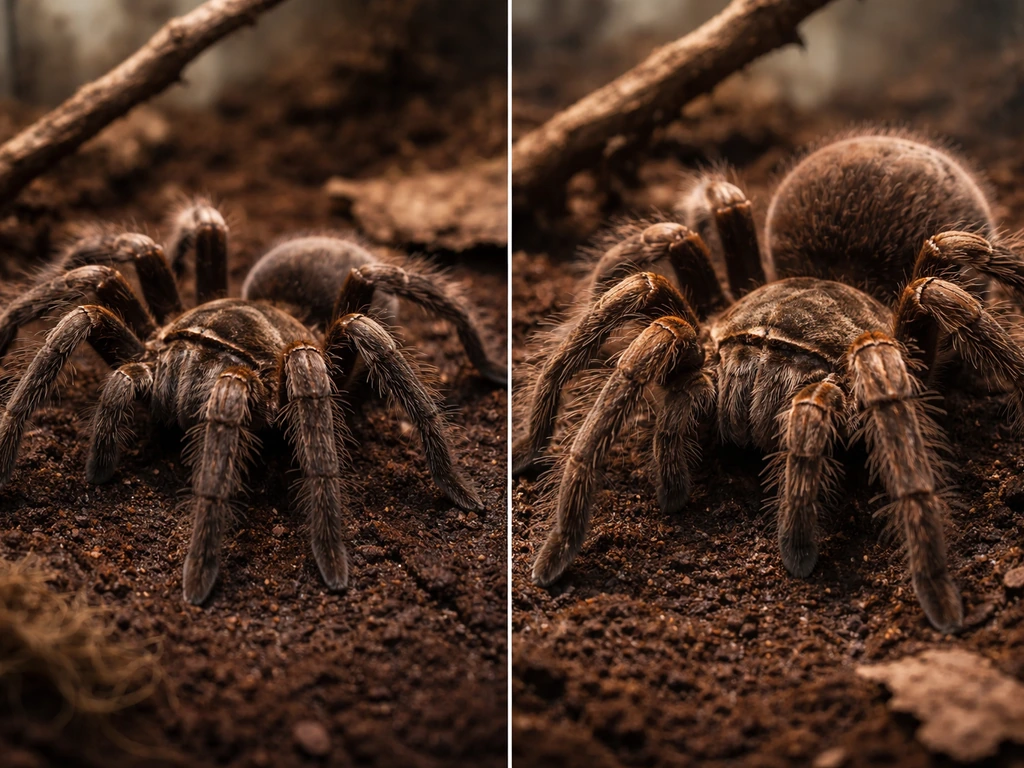
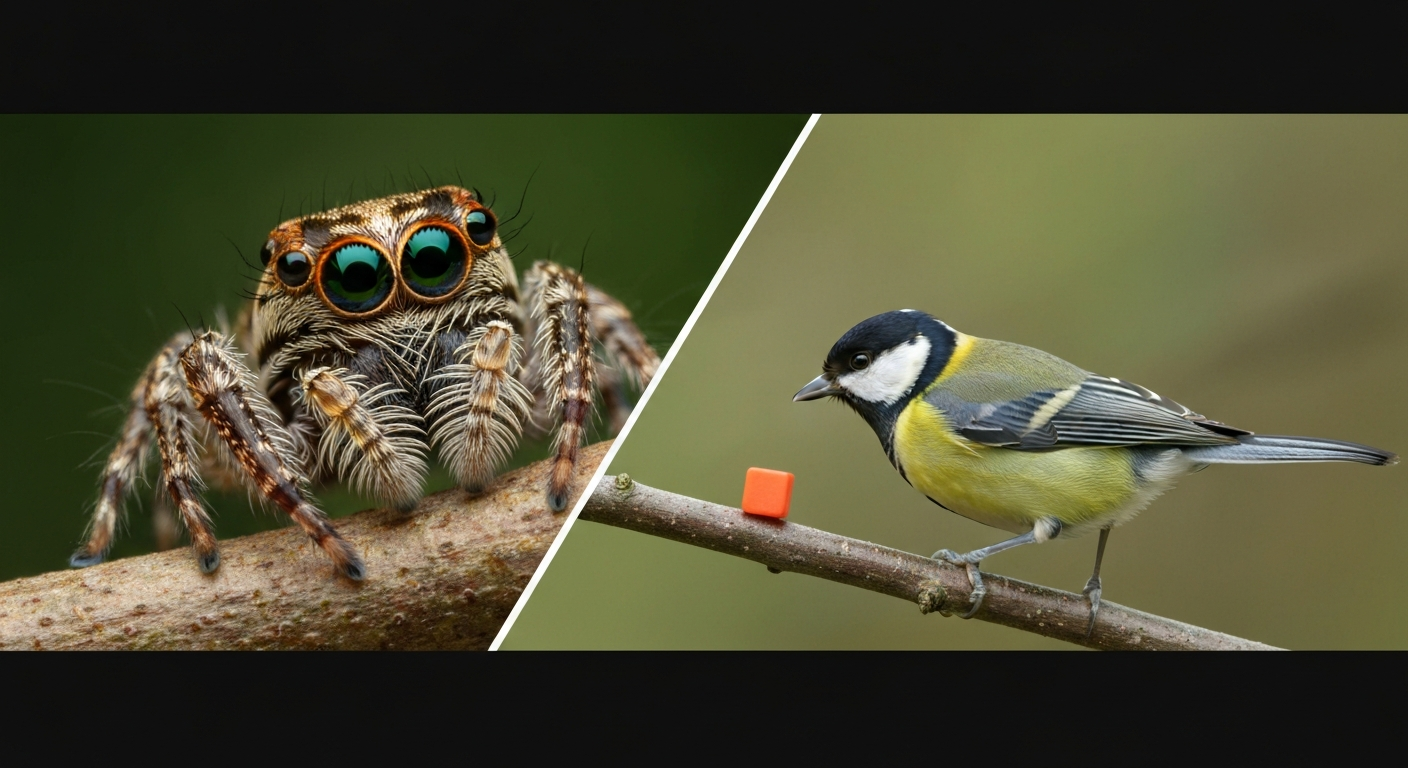
Spiders and birds both have consistent, repeatable individual differences in behavior that researchers call 'animal personality,' but how those personalities are built, measured, and expressed could not be more different. A bold jumping spider and a bold great tit share the same scientific label for their trait, yet one navigates the world through a modular set of eyes with near-microscopic acuity, while the other processes sound, sight, and social cues through a surprisingly complex vertebrate brain. If you have ever watched a tarantula freeze or a crow problem-solve, you have already witnessed animal personality in action. This article unpacks exactly what that means, how researchers measure it, and what the real contrasts are between these two wildly different groups.
Personality: One Was a Spider, One Was a Bird, Comparing IQ

Why compare personality in spiders and birds at all?
The comparison might seem odd at first. Spiders and birds sit at very different ends of the animal kingdom: one is an arachnid with a relatively simple nervous system, the other is an often highly social vertebrate with remarkable cognitive capacity. But that contrast is exactly what makes the comparison worthwhile. When you find the same phenomenon, consistent individual behavioral differences, arising independently in such distantly related lineages, it tells you something important about evolution. It suggests personality is not a quirk of vertebrate complexity but a broadly adaptive strategy that emerges under the right ecological pressures.
For birdwatchers and naturalists, this framing is genuinely useful. If you keep a pet tarantula alongside backyard birds, or you are simply curious about why some individual animals seem bolder or more curious than others of the same species, understanding the shared science, and the real limits of that similarity, will sharpen how you interpret what you observe. It also connects naturally to comparisons between birds and other invertebrates and non-bird taxa, such as the differences explored when comparing an octopus to a bird, a centipede to a bird, or looking at the tarantula's own biology in depth.
What researchers actually mean by 'animal personality'
The term sounds informal, but the science behind it is tight. Réale and colleagues in 2007 defined animal personality (also called animal temperament) as consistent among-individual behavioral differences that are stable over time and across contexts. The key word is consistent. An individual spider or bird is not just responding randomly to each situation. It has a characteristic tendency, say, toward boldness or timidity, that you can measure repeatedly and get the same answer. These tendencies also often cluster together into what Sih, Bell and Johnson (2004) called behavioral syndromes: correlated suites of behaviors across contexts. A bold individual tends also to be exploratory and risk-taking. These traits travel together, and that co-variation has ecological and evolutionary consequences.
A foundational meta-analysis by Bell, Hankison and Laskowski in 2009 reviewed hundreds of studies and found that behavior is indeed significantly repeatable, with roughly 35 percent of variance in any given behavior attributable to stable among-individual differences (a mean repeatability coefficient of about 0.37). That is not a trivial amount. It means individual identity is one of the strongest predictors of how an animal will behave on any given day, more powerful than chance, and comparable in magnitude to many environmental effects. This is the empirical backbone for treating personality as a real biological phenomenon rather than a metaphor.
How researchers measure personality: the assays and what they reveal
Measuring personality requires repeated observations of the same individual under controlled conditions. The suite of standardized assays used across taxa includes open-field or novel-room tests (placing an animal in an unfamiliar arena and recording locomotion and exploration), novel-object tests (presenting an unfamiliar item and measuring approach or avoidance latency), emergence tests (timing how quickly an animal leaves a shelter), predator-response assays (measuring freeze duration or flight initiation distance after a simulated threat), social interaction trials, and problem-solving tasks. Nakagawa and Schielzeth (2010) provide the standard statistical framework for estimating repeatability from these repeated measures using linear mixed models, and the rptR software package by Stoffel and colleagues (2017) is now widely used to calculate intraclass correlation coefficients (ICCs) that quantify how much behavioral variance sits between individuals rather than within them.
One important caveat, flagged in methodological reviews by Dingemanse (2020), is the risk of pseudo-repeatability: if you always test an animal in the same context, you might be measuring context consistency rather than true personality. Good studies use truly independent repeated measures, randomize the order of tests, and report full variance decompositions rather than just a repeatability estimate. Assay validity also differs by taxon. For example, a study comparing food neophobia assays in dairy calves demonstrated the value of cross‑assay validation and species‑specific calibration (Use of a food neophobia test to characterize personality traits of dairy calves, Scientific Reports) For example, a study comparing food neophobia assays in dairy calves demonstrated the value of cross‑assay validation and species‑specific calibration (Use of a food neophobia test to characterize personality traits of dairy calves — Scientific Reports).. A novel-object test has obvious face validity for a curious corvid, but for a nocturnal burrowing tarantula that almost never encounters novel visual stimuli in the wild, the same test needs species-specific calibration to mean anything ecologically.
Spider personalities: what the research shows
Boldness and exploration in social spiders
The social spider Stegodyphus dumicola has become a model system for spider personality research. Boldness in these spiders is typically quantified as the latency to resume movement after an aversive stimulus, such as a brief simulated predator attack. Studies by Pruitt and colleagues (2013) showed that individual boldness differences are stable and that persistent social interactions actually make personality differences more pronounced over time. Critically, bold 'keystone' individuals disproportionately influence colony-level outcomes: they drive foraging speed, prey capture rates, and collective attack behavior. Work by Keiser and colleagues (2018) went further, showing that experimental selection for collective aggressiveness changes the social structure of colonies, demonstrating that individual personality scales directly to group-level ecology.
Tarantulas: bold loners with long life histories
Tarantulas (family Theraphosidae) are largely solitary, long-lived spiders, and their personality research is thinner than that of social spiders, but the observable behavioral variation is real. Female theraphosids can live for decades, while males typically mature, wander in search of mates, and die within a year or two after maturity. That stark life-history difference shapes behavior. Males exhibit what Costa and Pérez-Miles describe as clear wandering behavior at maturity: they leave their burrows and move extensively across the landscape, a behavior driven by reproductive urgency. Females, by contrast, remain sedentary and burrow-tending. In captivity, keepers consistently observe differences in boldness between individuals of the same species: some tarantulas emerge readily and explore; others stay cryptic for months. Those differences appear stable, fitting the repeatability criterion for personality.
The Goliath bird-eating spider: personality in a giant
Theraphosa blondi, the Goliath birdeater, is the world's heaviest spider, with a legspan that popular accounts place up to around 28 to 30 centimeters. It is a ground-dwelling, largely nocturnal Neotropical species that relies primarily on vibration and chemosensory detection rather than vision for hunting. Its defensive repertoire is impressive: stridulation (a threat-display hissing sound), urticating hairs flicked from the abdomen (a uniquely New World theraphosid adaptation), and large fangs capable of delivering a painful bite. Behavioral variation within the species is evident in captive settings. Some individuals are consistently defensive and reactive; others are notably more tolerant of disturbance. Parental care in this group consists primarily of egg-sac guarding by the female, a behavior that itself varies in intensity among individuals and populations. Many Theraphosa species lack formal IUCN Red List assessments, meaning their conservation status is Not Evaluated, a concern given their presence in the exotic pet trade.
Jumping spiders: the cognitive outliers of the spider world
No discussion of spider personality is complete without salticids, the jumping spiders. The genus Portia is particularly famous. Experimental work by Tarsitano, Jackson, and Cross documented that Portia spiders execute planned detours to reach prey, choosing indirect routes that temporarily take them away from line-of-sight with the target. This requires maintaining a representation of the prey's location without being able to see it, a form of planning that most researchers did not expect to find in an animal with a brain smaller than a pinhead. The sensory basis is key: Salticidae have a modular multi-eye system in which the anterior median (principal) eyes have exceptionally high spatial acuity and moveable retinas, allowing detailed visual scanning and the kind of target locking that supports these complex locomotor plans. Attention and distraction in the modular visual system of a jumping spider, Journal of Experimental Biology (2021 review/experiment) documents how salticid anterior median eyes provide exceptional spatial acuity and attention-like visual processing that supports detailed target locking and prey-tracking Attention and distraction in the modular visual system of a jumping spider — Journal of Experimental Biology (2021 review/experiment). Personality differences in jumping spiders map onto exploration and prey-choice flexibility, with some individuals consistently taking bolder, more varied foraging routes than others.
Bird personalities: what the research shows
The great tit as the model species
In birds, the great tit (Parus major) is the canonical personality model, partly because of the sheer volume of long-term field data available from Dutch and UK populations. Dingemanse and colleagues in 2002 showed that exploratory behavior in a novel room (how quickly and thoroughly an individual investigates five novel objects) is significantly repeatable, heritable, and correlated with aggression, dispersal distance, and physiological stress responses. Fast explorers tend to be bolder, more aggressive, and more likely to disperse. Slow explorers are more flexible and responsive to environmental cues. This is a textbook behavioral syndrome, and it has real fitness consequences: in stable, predictable environments, slow explorers outperform fast ones; when conditions fluctuate unpredictably, fast explorers do better. That interaction between personality and environment is now a central theme in the field.
Corvids: personality with a cognitive bonus
Corvids (ravens, crows, jays, jackdaws) sit at the extreme end of avian cognitive complexity. Individual personality differences in corvids are well-documented: neophobia (fear of novel objects) varies consistently among individuals and populations, and this has been studied both in the lab and in wild urban populations. Bold, neophilia-prone individuals are more likely to exploit new food sources, access novel environments, and dominate social interactions. Ravens and crows also show consistent individual differences in social behavior, including varying tendencies toward cooperation, deception, and social tolerance. Mating behavior in corvids often involves prolonged pair-bond formation, and individual personality differences in boldness and sociality influence partner choice and reproductive success.
Raptors and songbirds: broader examples
Raptors show consistent individual differences in exploration and boldness that have practical consequences for conservation and rehabilitation. Individual hawks and falcons vary in how quickly they approach novel objects or recover from disturbance, and those differences predict survival and breeding success in the wild. Songbirds across many families show repeatable boldness and exploration scores, and in several species these correlate with song complexity, parental investment, and territory acquisition. The common thread across birds is that personality differences are tied to life-history trade-offs: bold, fast-exploring individuals tend to invest heavily in current reproduction at some cost to future survival; cautious individuals invest more in self-maintenance and long-term survival.
Sex differences and life-history effects
Sex differences in personality are well-documented in both groups, but the mechanisms and magnitudes differ substantially. In Goliath birdeater spiders, the sex difference in behavior is among the most dramatic in any animal. Females live for decades, rarely leave their burrows voluntarily once established, and invest heavily in egg-sac guarding. Males mature much faster, live only a year or two after reaching adulthood, and spend their entire mature life in an active, wandering, risk-taking behavioral mode. This is not individual variation in the usual sense: it is a fixed, sex-linked behavioral strategy shaped by extreme life-history divergence. The relevant comparison for anyone interested in this in more depth is covered in the goliath bird-eating spider male vs female comparison.
In birds, sex differences in personality tend to be subtler and more context-dependent. Male songbirds typically show higher boldness and aggression during the breeding season, driven by testosterone, but these differences can reverse outside breeding or in species with reversed sexual roles, such as phalaropes where females are the more brightly colored and aggressive sex. In raptors, females are often larger than males (reverse sexual size dimorphism), and this size asymmetry correlates with behavioral differences: females tend to take larger prey and show higher neophobia in some study systems. Parental care personality differences in birds are particularly interesting: some studies find that bold parents provision chicks at higher rates but are also more likely to abandon a nest under disturbance, while cautious parents show greater nest fidelity.
Why they're so different: sensory, cognitive, and evolutionary roots
Sensory worlds
The sensory architecture of spiders and birds could hardly be more different, and this shapes everything about how personality is expressed and measured. Most mygalomorph spiders, including tarantulas and the Goliath birdeater, rely primarily on mechanosensory and chemosensory cues. They detect vibration through slit sensilla and lyriform organs on their legs, and use contact chemoreception to assess mates, prey, and territory. Vision plays a minor role. Research by Zamani (2026) on spatial orientation and cognition in theraphosids highlights the use of silk cues and substrate vibration as primary orientation tools under natural conditions. This means that a 'novel-object test' designed for a visual animal is almost irrelevant to a tarantula unless the object also produces vibration or chemical signals. Jumping spiders are the major exception: their principal eyes achieve a spatial acuity comparable to some vertebrates, and their personality assays must be visually oriented to be valid. For a broader contrast of highly divergent cognitive and sensory strategies, see octopus vs bird.
Birds, by contrast, are heavily visual animals with trichromatic or tetrachromatic color vision (many species see into the UV range), highly developed auditory processing, and in some species, magnetic sense for navigation. Their brains are structured to integrate multi-modal sensory streams in real time. This sensory richness supports the kind of detailed environmental monitoring that underlies complex personality expressions: a bold corvid is not just unafraid of novelty, it is actively processing, categorizing, and remembering novel stimuli in ways that a tarantula simply cannot.
Neural architecture and learning capacity
Spider nervous systems are highly efficient but architecturally simple compared to vertebrate brains. Spiders lack a centralized cortex and work with a distributed ventral nerve cord and optic ganglia. Despite this, some spiders, particularly salticids and social species, show learning and memory capacity that regularly surprises researchers. Portia's planned detours are a clear example. But the ceiling of spider cognition sits far below that of corvids or even most passerine birds. Birds have a pallium that performs functions analogous to the mammalian cortex, supporting associative learning, episodic-like memory, causal reasoning, and social learning. Corvids pass mirror self-recognition variants, plan for future needs, and deceive conspecifics strategically. These are capacities that no spider has been shown to approach.
Evolutionary pressures
Animal personality theory predicts that repeatable behavioral variation is maintained by balancing selection: no single personality type wins in all environments or conditions. For social spiders, the mix of bold and shy individuals in a colony buffers against unpredictable food availability and predation risk. For birds, frequency-dependent selection and fluctuating environments maintain fast and slow explorer types within populations. The evolutionary drivers are broadly similar in concept, but the mechanisms and timescales differ. Spider generations can be short (annual in many species) or very long (decades in some theraphosids), while most bird species turn over in one to a few years. Longer-lived, slower-reproducing individuals face different selection pressures on personality than short-lived, fast-reproducing ones, which is part of why Goliath birdeater females and great tit females express such different personality profiles despite both being 'bold-shy' variants within their respective species.
Spider vs bird personality: a direct side-by-side comparison
| Trait or dimension | Spiders (general) | Birds (general) |
|---|---|---|
| Cognition and learning | Efficient, largely associative; Portia shows planning; most mygalomorphs show limited learned flexibility | High capacity; corvids show causal reasoning, planning, and social learning; songbirds show associative and song learning |
| Social structure | Mostly solitary; social species (Stegodyphus) show collective personality effects driven by bold keystone individuals | Highly variable; many species form complex pair bonds, flocks, or cooperative breeding groups with socially differentiated roles |
| Sensory specialization | Predominantly mechanosensory/chemosensory in mygalomorphs; high-acuity vision in salticids only | Predominantly visual (including UV) and auditory; some species have magnetic sense; multi-modal integration is the norm |
| Boldness | Measured via latency to resume movement; varies among individuals and influences colony outcomes in social species | Measured via novel-room exploration, flight initiation distance; heritable in great tits; predicts dispersal and survival |
| Exploration | Context-limited in mygalomorphs; more elaborate in salticids; exploration of spatial environment documented with silk-cue use | Well-documented across taxa; fast vs slow explorer syndrome is one of the best-studied personality axes in animal behavior |
| Parental care | Primarily egg-sac guarding by female; varies among individuals; males provide no care in most species | Biparental care common in many families; personality of both parents influences nest success; bold parents may show lower nest fidelity |
| Mating behavior | Males exhibit vigorous, wandering search behavior; courtship via vibration or visual displays (salticids); females often cannibalize males | Pair bond formation involves song, display, and often prolonged assessment; individual personality affects mate choice and reproductive success |
| Sex differences in personality | Extreme in Theraphosa: females sedentary and long-lived, males nomadic and short-lived; functionally different behavioral strategies | Subtler and more seasonal; testosterone-driven in breeding season; reversed in species with reversed sexual roles |
| Behavioral syndrome strength | Documented in social spiders; limited data for solitary species but captive observations suggest real individual consistency | One of the strongest bodies of evidence for behavioral syndromes in any animal group |
| Repeatability estimate (R) | Fewer formal studies; emerging data consistent with R > 0.3 in social species | Mean R ≈ 0.37 across behaviors in Bell et al. (2009) meta-analysis; some traits (exploration) exceed 0.5 in long-term field studies |
Practical implications: pet care, safety, and conservation
Keeping spiders and birds with personality in mind
For tarantula and Goliath birdeater keepers, recognizing individual personality is directly relevant to safety. A consistently defensive individual, one that reliably stridulates, flicks urticating hairs, or adopts a threat posture when disturbed, should be handled less and housed with more cover, not because it is 'aggressive' in the mammalian sense but because its stable behavioral tendency toward threat-response means handling stress is higher for that individual. Conversely, a reliably calm individual can often be observed and interacted with more freely. These differences are real and stable, not random moods.
For bird keepers and falconers, personality assessment is already an informal part of the trade: a bold, exploratory bird will adapt to new environments faster but may also be harder to condition to stay on the lure. A shy, slow-exploring bird may bond more reliably but take longer to recover from disturbance. Raptor rehabilitation programs increasingly recognize that individual boldness predicts release success, with bolder individuals faring better after release into the wild.
Conservation relevance
Personality matters for conservation because bold and exploratory individuals are often the ones who colonize new habitats, cross barriers, and adapt to human-modified environments. In birds, urban populations consistently show higher boldness and lower neophobia than rural counterparts, partly because bold individuals are selectively favored in human environments. For spiders, personality affects how well colonies buffer against habitat fragmentation. Goliath birdeaters face collection pressure from the exotic pet trade, and the lack of formal IUCN assessments for most Theraphosa species means we have little baseline data on wild population structure, making it hard to predict how personality-driven variation in dispersal behavior will interact with habitat loss. That is a real knowledge gap.
What these two very different animals actually share
Strip away the differences in anatomy, sensory systems, and cognitive firepower, and spiders and birds share a genuinely important biological reality: individual identity matters. Knowing the species tells you what an animal can do; knowing the individual tells you what it will do. That principle, backed by decades of repeatability data, is the core of animal personality research. Whether you are watching a Portia spider plan a detour, a Goliath birdeater guard her egg sac, a raven manipulate a conspecific, or a great tit boldly investigate a novel feeder in your garden, you are watching the same underlying phenomenon: evolution maintaining consistent individual differences because no single behavioral type wins everywhere, every time. For a concise side-by-side overview of behavior, sensory systems, and care implications, see tarantula vs bird. The spider and the bird arrived at personality by very different routes and express it through completely different mechanisms, but the selective logic is remarkably similar.
FAQ
What is meant by 'animal personality' and how is it defined in scientific studies?
Animal personality refers to consistent among‑individual differences in behaviour that are stable over time and/or across contexts. Scientists operationalize this using repeatability (intra‑class correlation) and frameworks linking traits to ecology and life history (e.g., Réale et al. 2007). Empirically, meta‑analyses show behaviour is often significantly repeatable (mean R ≈ 0.3–0.4), justifying the personality concept when proper sampling and statistics are used.
How do researchers measure personality across very different taxa like spiders and birds?
Common assay types are shared (open‑field/novel‑room tests, novel‑object tests, emergence/latency, predator‑response, social preference, problem‑solving), but assays require species‑specific validation. Repeat measures and mixed‑model estimates of repeatability (ICC) are standard practice; tools like rptR implement variance decomposition for GLMMs. Important cautions include avoiding pseudo‑repeatability and ensuring the assay reflects ecologically relevant motivation for the focal species.
Which behavioural traits are typically studied and compared (e.g., boldness, exploration, sociality, parental care, mating)?
Researchers commonly quantify boldness (risk taking or latency to resume activity), exploration (movement in novel space), sociality (tendency to associate or cooperate), parental care (provisioning, guarding or brood tending) and mating behaviours (courtship intensity, mate search). These axes are measured repeatedly and sometimes combined into behavioural syndromes when traits covary across contexts.
How do spiders typically express personality on these axes?
Expression depends on clade: • Social spiders (e.g., Stegodyphus) show repeatable boldness and activity traits that scale to colony function (latency to recover after disturbance predicts attack speed). • Salticids (jumping spiders, Portia) show exploration, boldness and sophisticated problem‑solving tied to excellent vision. • Mygalomorphs/tarantulas (e.g., Theraphosa) may show consistent defensive boldness/aggression, burrow fidelity and different responses to disturbance driven by mechanosensory cues; many show limited parental care beyond egg‑sac guarding by females.
How do birds typically express personality on these axes?
Birds show well‑documented, repeatable variation: • Great tits and other songbirds: exploration/boldness in novel‑room/open‑field assays correlates with aggression, dispersal and reproductive timing. • Corvids and parrots: high problem‑solving and exploration variability linked to boldness and neophobia. • Raptors: individual differences in hunting style, boldness and tolerance of human proximity; parental care often shows consistent individual patterns in provisioning and nest defence.
What are the main differences in sensory and cognitive underpinnings between spiders and birds?
Sensory/cognitive bases differ by taxon and ecology: • Birds: rely heavily on vision and audition, often large brains relative to body, extensive learning, social cognition and flexible problem solving (especially corvids, parrots). • Spiders: diversity — salticids have exceptional, modular high‑resolution vision supporting planned detours and flexible stalking (Portia); many mygalomorphs rely on mechanosensory and chemical cues and simpler spatial strategies. Overall, birds tend to show broader learning capacity and social cognition, while some spiders exhibit notable domain‑specific problem solving tied to their sensory toolkit.
Goliath Bird-Eating Spider Male vs Female Guide
Spot male vs female Goliath bird-eating spider fast with traits, mating behavior, misID fixes, and care tips.