If you're staring at a piece of art, a game character, or a coat of arms and trying to figure out whether you're looking at a phoenix or a dragon, you're not alone. These two legendary creatures share a few surface-level traits (fire, dramatic silhouettes, enormous wingspans in artistic depictions) that make them easy to mix up at first glance. But once you know exactly what to look for, telling them apart is actually straightforward. This guide walks you through every key visual and narrative cue you need, whether you're decoding a fantasy game card, a heraldic emblem, or just settling a debate.
Phoenix Bird vs Dragon: Key Differences and How to Spot Them

Marcus Hendricks
2 Apr 2026
Phoenix vs dragon: what each one actually is
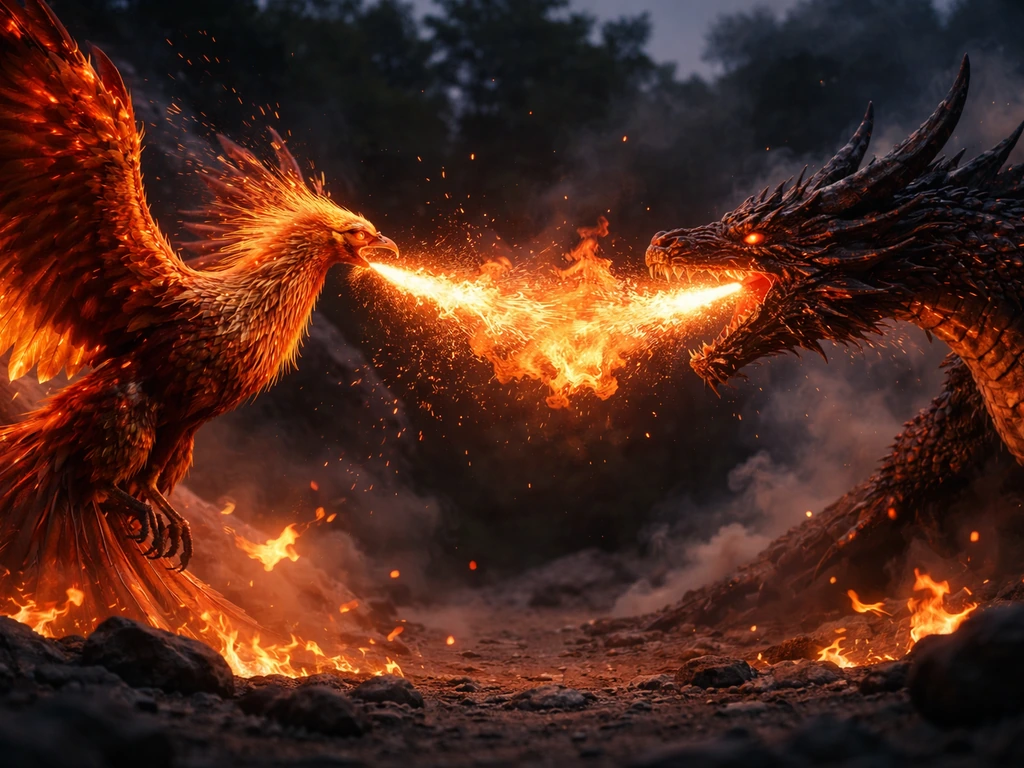
The phoenix is a mythological bird, not a reptile. Britannica describes it as a "fabulous bird" rooted in ancient Egyptian and Classical traditions, where it was associated with sun worship. The core myth involves the phoenix dying in fire or immolating itself and then rising again from the ashes, which is the detail that defines it above all else. Britannica describes the phoenix as a fabulous bird rooted in ancient Egyptian and Classical traditions, associated with sun worship, whose core myth includes dying in fire and rising again from the ashes dies in fire or immolating itself and then rising again from the ashes. It is fundamentally a bird: it has feathers, wings shaped like those of an eagle, a beak, and taloned feet. The rebirth-from-flames cycle is not just a cool visual trick; it is the entire point of the creature. Without the renewal motif, you don't have a phoenix, you have a fiery bird of some other kind.
The dragon, by contrast, is a reptilian composite. Britannica is blunt about this: the term "dragon" has no zoological meaning. It is a mythological construct assembled from features borrowed from various real animals, typically lizards, snakes, and bats. European medieval depictions describe dragons as blank" rel="noopener noreferrer">huge, fire-breathing, scaly, and lizard-like, with bat-like leathery wings, two or four legs, a long muscular tail, and rows of spines or horns. East Asian dragons follow a completely different template, typically wingless and serpentine, tied to water and air rather than destructive fire. So even within the "dragon" category, there is significant variation, which is part of why the phoenix-vs-dragon confusion happens in the first place.
Visual traits side by side
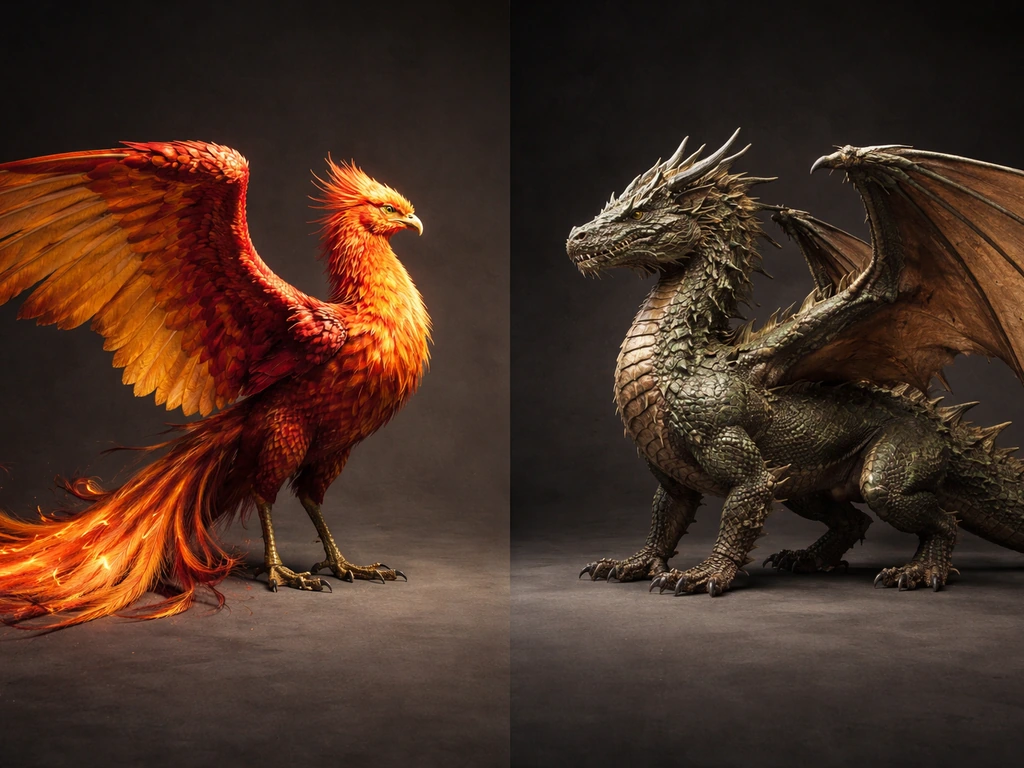
The fastest way to tell a phoenix from a dragon is to look at the body covering, the wing structure, and the overall body shape. Here is a direct comparison of the traits that matter most in visual identification.
| Trait | Phoenix | Dragon (European) | Dragon (East Asian) |
|---|---|---|---|
| Body covering | Feathers (red, gold, orange) | Scales, often with spines or horns | Scales, serpentine, no spines typical |
| Wings | Feathered, eagle-like | Leathery, bat-like (sometimes feathered) | Usually absent or vestigial |
| Legs | Two (bird-like) | Two or four clawed limbs | Four clawed limbs (or none) |
| Head | Eagle-style beak, sometimes crested | Reptile jaw, fangs, horns | Elongated snout, whiskers, antler-like horns |
| Tail | Feathered tail plume | Muscular, barbed or spiked | Long, smooth, serpentine |
| Fire association | Burns and rebirths; flame is renewal | Breathes fire outward; flame is weapon | Less fire; associated with storms/water |
| Body shape | Compact, upright, bird posture | Saurian/lizard, horizontal stance | Serpentine, elongated |
| Stance in art | Rising upward from flames | Coiled, crouching, or in flight attacking | Coiling, undulating |
The feathers vs scales distinction is the single most reliable visual cue. If you see scales anywhere on the body, you are almost certainly looking at a dragon. If you see feathers, a bird-like beak, and taloned feet, lean toward phoenix. The wing shape is the second strongest cue: phoenix wings look like enlarged eagle wings with visible feather layers, while European dragon wings are typically leathery membranes stretched over finger-like spurs, structurally closer to a bat than any bird.
Story and behavior patterns that give each away
Beyond physical appearance, the narrative role each creature plays in a story or artwork is a major identification cue. The phoenix myth is almost entirely about personal renewal, resurrection, and cyclical rebirth. Whether in Egyptian mythology (where it connects to the sun-god and creation), in Christian medieval allegory (where it became a symbol of resurrection), or in heraldic tradition, the phoenix's defining action is dying and coming back. It does not attack armies or guard treasure. It burns, and then it is reborn. That is the complete behavioral loop.
Dragons, on the other hand, are creatures of dominance and elemental power. European medieval depictions consistently frame the dragon as a threat: it breathes fire as a weapon, it terrorizes towns, it hoards gold. The action is outward and aggressive. A dragon's fire goes toward something or someone. A phoenix's fire is internal and transformative. When you see a creature in a story that breathes fire at an enemy or burns down a village, that is dragon behavior. When the creature burns itself and rises from the ash, that is phoenix behavior. The direction of the fire, inward-renewal versus outward-weapon, is one of the clearest narrative separators.
This distinction also applies to mood and posture in static images. A heraldic phoenix is nearly always depicted rising upward with wings raised, head tilted back or upward, emerging from a bed of flames beneath it. A heraldic dragon is typically shown in a combatant posture: claws extended, jaws gaping, tail raised and barbed. One creature ascends, the other confronts.
A practical checklist for art, games, and emblems
When you are looking at a specific image and trying to confirm which creature you have, go through these checks in order. The first few alone will usually settle it.
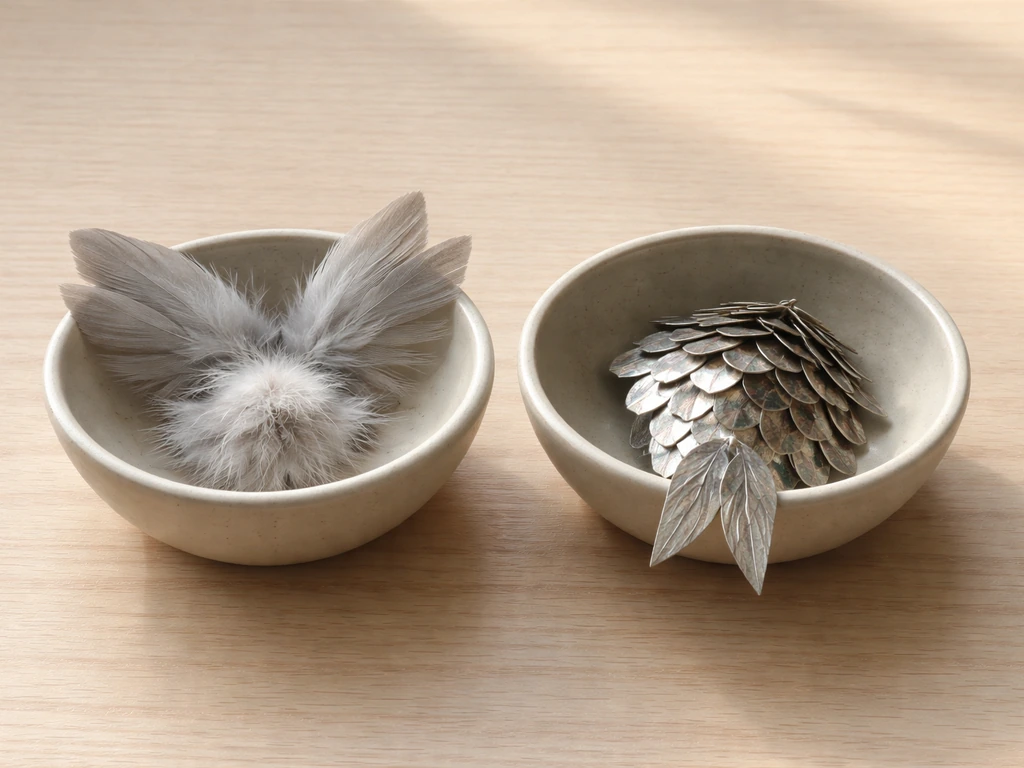
- Feathers or scales? Feathers anywhere on the body (wings, chest, tail) point to phoenix. Scales anywhere, especially on the body or tail, point to dragon.
- How many legs? Birds have two. If you count four limbs plus wings, it is almost certainly a dragon. A phoenix has two legs and two wings, like any bird.
- What shape are the wings? Feathered and layered like an eagle = phoenix. Leathery membrane with visible bone spurs = European dragon. No wings at all = likely an East Asian dragon.
- Is there a beak or a snout? A hooked eagle-style beak = phoenix. A wide reptilian jaw with fangs and possibly horns = dragon.
- Is fire coming from the mouth or surrounding the base of the body? Fire erupting from the mouth is a classic dragon trait. Flames rising from below, with the creature emerging upward from them, is the standard phoenix posture.
- Is the creature shown complete or partial? Heraldic phoenixes are frequently shown as only the upper body: head, chest, and wings of an eagle rising from flames. The full body is often not depicted at all. A complete reptilian body with all four limbs and a barbed tail points to a dragon.
- What is the color palette? Red, gold, orange, and flame-yellow feathers are standard phoenix colors. Dragon color varies widely (green, red, black, gold) but the texture will look scaled or leathery rather than feathered.
- What is the creature doing in context? Rising, renewing, or associated with sun and rebirth = phoenix. Attacking, guarding, or threatening = dragon.
The heraldic context deserves a special note here. In logos, city flags, and official seals, the phoenix is almost always rendered as an upper-body eagle figure rising from a fire, with wings raised and head upturned. This is sometimes called the "Phoenix rising" posture in heraldic terminology, and it is highly standardized. If you see a logo with a bird-like figure emerging upward from stylized flames, the default assumption should be phoenix, not dragon, unless you can spot scales or a reptilian head.
Real birds that actually resemble phoenix imagery
No real bird literally rises from the ashes, obviously, but several species share visual traits that have fueled phoenix iconography for centuries. Understanding which real birds inspired phoenix imagery helps you avoid accidentally calling a real species a "phoenix" in descriptions or identification contexts.
The most frequently cited real-bird connection is the ancient Egyptian Bennu. This figure was depicted as a heron in New Kingdom artwork and was directly linked to sun worship, creation, and themes of rebirth. The Bennu is widely considered the visual and conceptual ancestor of the Classical phoenix, which means the heron body plan (long neck, upright posture, large wingspan) is actually closer to the original phoenix template than the eagle-shaped heraldic phoenix that became dominant in European art. If you want to understand how the Bennu relates to the phoenix in deeper detail, the connections between Egyptian and Greek mythology around this figure are genuinely fascinating.
In terms of plumage coloring, the golden pheasant is the species most often proposed as a "phoenix lookalike" due to its vivid red, orange, and gold feathering that visually echoes the flame-palette artists use for phoenixes. The flamecrest (Regulus goodfellowi) offers another angle: it has a defined orange-yellow crest on top of the head that closely resembles the fiery crown motif common in phoenix illustrations. The Eurasian hoopoe is another species that comes up frequently in this conversation, with its dramatic fan-shaped orange crest tipped in black creating exactly the kind of bold head-crown silhouette that artists reach for when painting phoenix figures.
The key distinction to keep in mind is that these species resemble phoenix iconography through color and crest shape only. None of them have the overall eagle-like build of a heraldic phoenix, and none approach the size or silhouette of a phoenix as typically illustrated. If someone points to a real bird and calls it a phoenix because it has orange feathers, the right response is to check the crest structure, overall body shape, and whether the species has any actual connection to the phoenix myth, or whether it is just a brightly colored bird that happens to share a color palette.
It is also worth noting that phoenix-like imagery shows up across several mythological traditions through creatures that are not the classical phoenix at all. For example, the vermilion bird of East Asian mythology is a separate fire-associated bird figure that often gets conflated with the phoenix. If you are trying to sort out those distinctions, the comparison between the vermilion bird and the phoenix is worth reading through carefully because the two share superficial traits but come from entirely different mythological systems.
Misconceptions and misidentifications to watch for
The most common mistake is treating any fiery bird as a phoenix. Fire in the visual is not sufficient for phoenix identification. The phoenix's defining identity is the rebirth cycle, not the flame itself. A bird depicted breathing fire or surrounded by flames without any rebirth context could be any number of mythological fire-birds. For instance, the Basan, a Japanese legendary bird, has plumage described as resembling tongues of flame and a bright red comb, but it is a completely separate mythological entity with no rebirth association. Flame-colored plumage alone does not make something a phoenix.
Another frequent confusion comes from dragon variability. Because dragons differ so much across cultures, some viewers assume that any winged, fire-associated creature with feathers must be a phoenix variant of a dragon. It is not. The feathers vs scales distinction holds even when the artistic style is ambiguous. Similarly, wyverns (a specific heraldic creature with only two legs and wings, rarely fire-breathing) are sometimes mistakenly called dragons or confused with phoenixes when they appear in logos or game art. If you see a two-legged winged creature with scales and a barbed tail but no fire, you are likely looking at a wyvern, not a dragon and definitely not a phoenix.
The name and icon confusion gets particularly tangled in heraldry. The phoenix head-and-chest rising from flames has been used in official seals and city emblems for centuries, and because those emblems are often simplified or stylized, the phoenix can look abstract enough that viewers read it as a dragon, an eagle, or a generic bird. The reliable check here is always the flames beneath: if a bird-like figure is specifically emerging upward from fire with wings raised, the heraldic convention almost universally means phoenix, not dragon and not a real eagle species.
It is also worth separating the phoenix from other mythological fire-birds that the site covers. The phoenix versus the thunderbird is a comparison that trips up a lot of readers in North American contexts, since both are powerful legendary birds with elemental associations, but they come from completely unrelated mythological traditions and carry different symbolic meanings. Similarly, if you are trying to understand the difference between a phoenix and another legendary opponent in mythology, the phoenix versus the griffin is a useful reference because griffins, like dragons, are reptilian-avian hybrids that blend eagle and lion or reptile traits in ways that can visually overlap with phoenix depictions.
One more misconception worth correcting: the phoenix is not a fire-breather. This surprises a lot of people who have absorbed a lot of fantasy game and film tropes. Fire breathing is a dragon trait. The phoenix is engulfed in or produces flames as part of its death-and-rebirth cycle, but it does not project fire outward as a weapon. If a creature in a game or story is described as using fire breath as an attack, that is dragon behavior regardless of how it looks. The liver bird and the phoenix comparison is another case where naming and heraldic iconography lead to frequent mix-ups, particularly in British civic heraldry where bird figures are used prominently in city emblems.
If you are interested in how power and dominance are framed between these types of mythological birds, the debate over which is more powerful between the vermilion bird and the phoenix is a good example of how different cultural traditions rank these creatures and why those rankings matter for interpretation. And while this article focuses on mythological birds rather than living reptiles, if you ever need to distinguish a real scaly animal from a bird in a completely different context, the comparison of a bearded dragon versus a bird covers the biological differences between reptiles and birds in practical terms.
How to confirm what you're looking at right now
If you are trying to confirm whether a specific image, game card, or emblem is a phoenix or a dragon today, here is the fastest verification path I would recommend.
- Run the feathers-vs-scales check first. Zoom in on the body and wings. Feathered texture = bird/phoenix direction. Scaled or leathery texture = dragon direction. This single check resolves the majority of cases.
- Count the limbs. Two legs and two wings = phoenix (bird anatomy). Four legs plus wings = European dragon. No wings + serpentine body = East Asian dragon.
- Look at the wing membranes specifically. Feather layers visible along the wing edge = phoenix. Thin membrane with bone struts visible (like a bat) = dragon.
- Check the fire position. Flames rising from below with the creature emerging upward = phoenix. Flames coming from the mouth outward = dragon.
- Search the source material's terminology. If the image comes from a game, show, book, or heraldic reference, search the exact name of the creature in that source plus the word "lore" or "heraldry." The official description will usually use "rebirth," "renewal," or "resurrection" for a phoenix and "fire-breathing," "dragon," or "serpent" for a dragon.
- For heraldic emblems specifically, search the city or organization name plus "coat of arms" or "seal phoenix" and check whether the official blazon (the heraldic description) uses the word phoenix. Official blazons are the most reliable confirmation available.
- If you are still unsure, reverse-image search the image and filter for credible reference sites (mythology encyclopedias, heraldry databases, official game wikis). Do not rely on social media descriptions, which frequently mislabel both creatures.
The bottom line is this: the phoenix and the dragon are visually distinct once you know the checklist, but a lot of popular art intentionally blurs the line between them for dramatic effect. When in doubt, always go back to two things: body covering (feathers vs scales) and the direction of fire (inward renewal vs outward weapon). Those two cues, applied consistently, will sort nearly every case you encounter.
FAQ
If I only see flames, how can I tell whether it’s a phoenix or a dragon?
Use the direction of action, not just the presence of flames. If the artwork shows the creature firing fire outward to attack or burn something, that aligns with dragon behavior. If the image centers on a death-and-rebirth loop (often with the creature rising from ashes or flames), that aligns with phoenix symbolism, even if the flames are stylized or secondary.
What should I check first when the image is a simplified logo or city emblem?
In logos and seals, stylization can remove fine details, so prioritize the flames position and the posture. Phoenix emblems are commonly built as an upward-rising bird emerging from a flame base, with wings raised and head up. Dragon logos are more often horizontal or angled as a combat threat, with jaws/claws emphasized and flames used as attack effects.
What if the creature has birdlike wings, but its body seems unclear?
Look for outward scale coverage, including on the face, neck, and tail. A winged creature with reptilian textures, horned or spined head elements, and a barbed tail pattern is more consistent with dragon variants or wyverns than with phoenixes, even if it has a birdlike silhouette.
Does a phoenix ever breathe fire like a dragon?
Treat “fire breath” as a decision rule: projecting fire as an attack strongly points to dragons. A phoenix may be surrounded by flames or associated with burning during its rebirth, but it typically is not depicted “breathing” fire outward in the way dragon attack scenes are framed.
I saw a two-legged winged creature, is it automatically a dragon?
Wyverns are a common source of mix-ups. If the creature has two legs (not four), wings, and a scaled body with a barbed tail, it is usually a wyvern. A phoenix should read as fully bird-formed (feathers, beak, talons) and follow the rebirth-rising convention.
Can a brightly colored “fire bird” be called a phoenix, or is that too broad?
Color can mislead. Bright reds, oranges, and golds can be used for many creatures, including non-phoenix fire birds. The reliable check is whether it has bird construction cues (beak, talons, feather layers) and whether the story art includes rebirth from ashes rather than only “looks fiery.”
How do I handle dragons that look very different across cultures?
If the creature has an eagle-like build plus a resurrection-rising composition, the heraldic phoenix template is likely. If it has a serpentine, wingless, water-air associated dragon shape (common in East Asian iconography), it likely is a dragon type regardless of any flame references.
What’s the best way to avoid calling a real bird a phoenix in descriptions?
When an artwork borrows only the “phoenix” look from a real bird, you will usually see a bird-with-crest that resembles flame colors, not a full eagle-built, rising-from-ashes phoenix scene. Use the presence of mythic rebirth context (ashes, renewal cycle) and the overall body plan as your gatekeepers.
How can I use the story description, not just the art, to confirm the creature?
Sometimes phoenix and dragon are swapped due to generic fantasy terms. If the text or animation describes the creature guarding treasure, terrorizing towns, or using fire as a weapon, treat it as dragon-oriented. If the description emphasizes resurrection, self-immolation, and cyclical return, treat it as phoenix-oriented.
What if the scene includes both a bird-like figure and a reptile-like figure?
If your image shows multiple creatures or an ensemble, confirm which one is shown “rising from flames” and which one is “attacking with fire.” In mixed scenes, artists may place a phoenix-like resurrection figure near a flame base while a dragon-like threat projects fire outward, so the interaction framing can be the clearest identifier.