Here is the short answer: the vermilion bird and the phoenix are not two competing real-world species you need to tell apart in the field. One is a living, photographable bird you can find perched on a fencepost in Arizona today, and the other is a mythological creature that exists in legend, literature, and symbolism. Once you understand that split, the comparison becomes much more interesting and much more useful.
Vermilion Bird vs Phoenix: Key Differences and How to Tell

Marcus Hendricks
4 Apr 2026
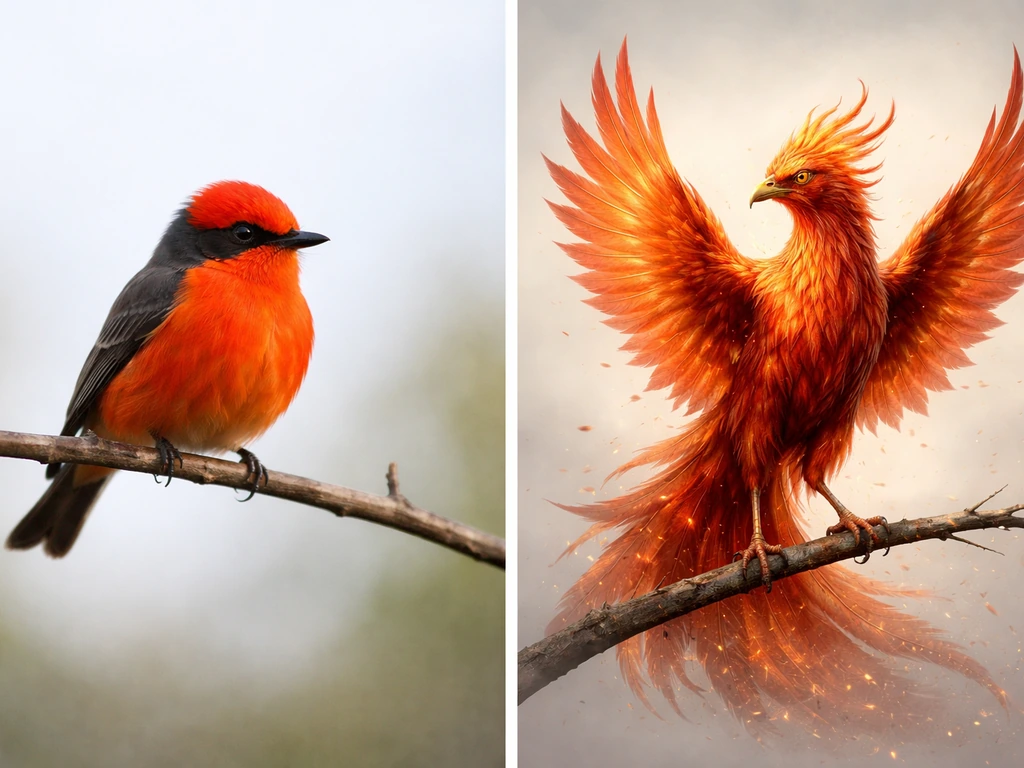
Quick ID: what makes a vermilion bird vs phoenix different
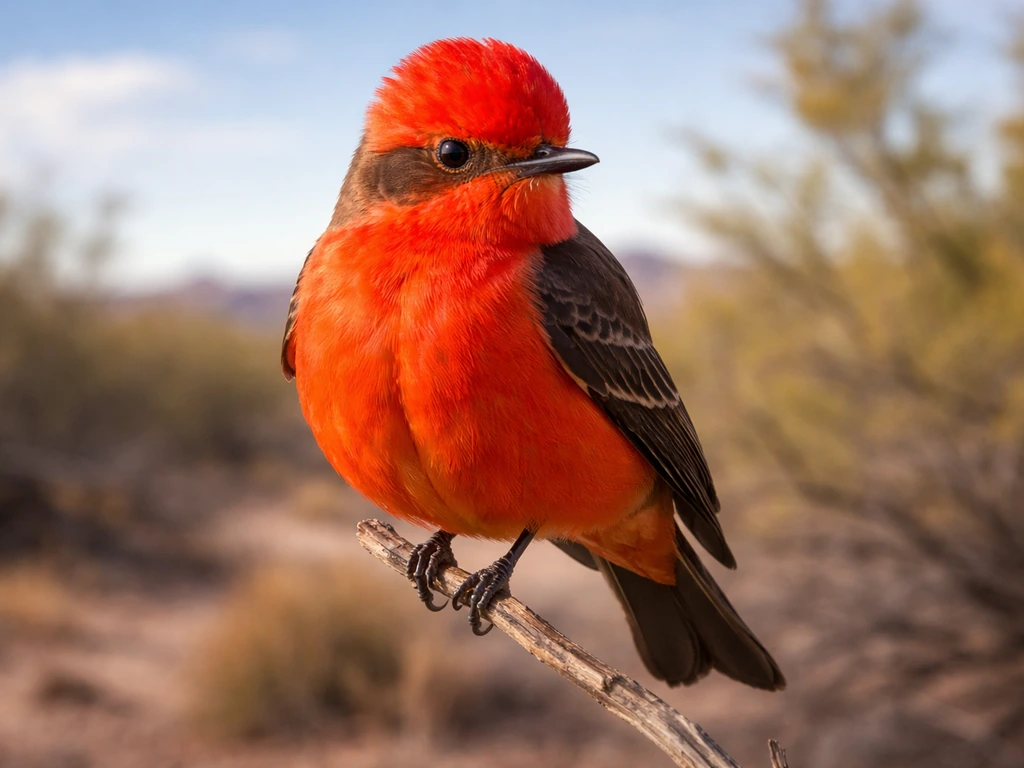
When birders or curious searchers type "vermilion bird," they almost always mean the vermilion flycatcher (Pyrocephalus rubinus), a small passerine native to the American Southwest and beyond. It is a real bird, it has a range map, and you can submit a sighting to eBird right now. "Phoenix," on the other hand, almost never refers to a living bird in identification contexts. In mythology and symbolism, the phoenix is a legendary creature associated with fire, the sun, and cyclical rebirth.
It has no field marks because it has no field presence. The confusion between the two tends to come from their shared fire-and-flame visual identity: both are strongly associated with brilliant red, orange, and gold colors. But only one of them will show up in your binoculars.
| Feature | Vermilion Flycatcher (real bird) | Phoenix (mythological) |
|---|---|---|
| Existence | Living species, documented by science | Legendary creature, no physical specimens |
| Classification | Passerine, family Tyrannidae | Myth; no taxonomic classification |
| Range | American Southwest, Central/South America | No geographic range; appears in global mythology |
| Size | Small, roughly 5–6 inches long | Described as enormous, often eagle-sized or larger |
| Plumage (male) | Flaming red crown/underparts, dark brown back and mask | Typically described as gold, scarlet, and purple flames |
| Behavior | Aerial insect hunter, perches openly | Immortal; dies in flame and is reborn from ashes |
| Can you photograph it? | Yes, commonly photographed | No; depicted only in art and literature |
Distinctive plumage, size, and overall body shape
The vermilion flycatcher is a compact, upright-perching bird that runs about 5 to 6 inches from bill tip to tail. The adult male is one of the most visually striking small birds in North America. His crown, throat, and entire underside burn with a flaming red that genuinely looks like someone turned up the color saturation on a painting. That vivid red contrasts sharply with a dark brown back, wings, and a brown mask that runs across the face. Females are completely different: they wear a streaky brown-and-white palette with a salmon-pink or peachy wash on the belly, which surprises a lot of first-time observers who expect another red bird.
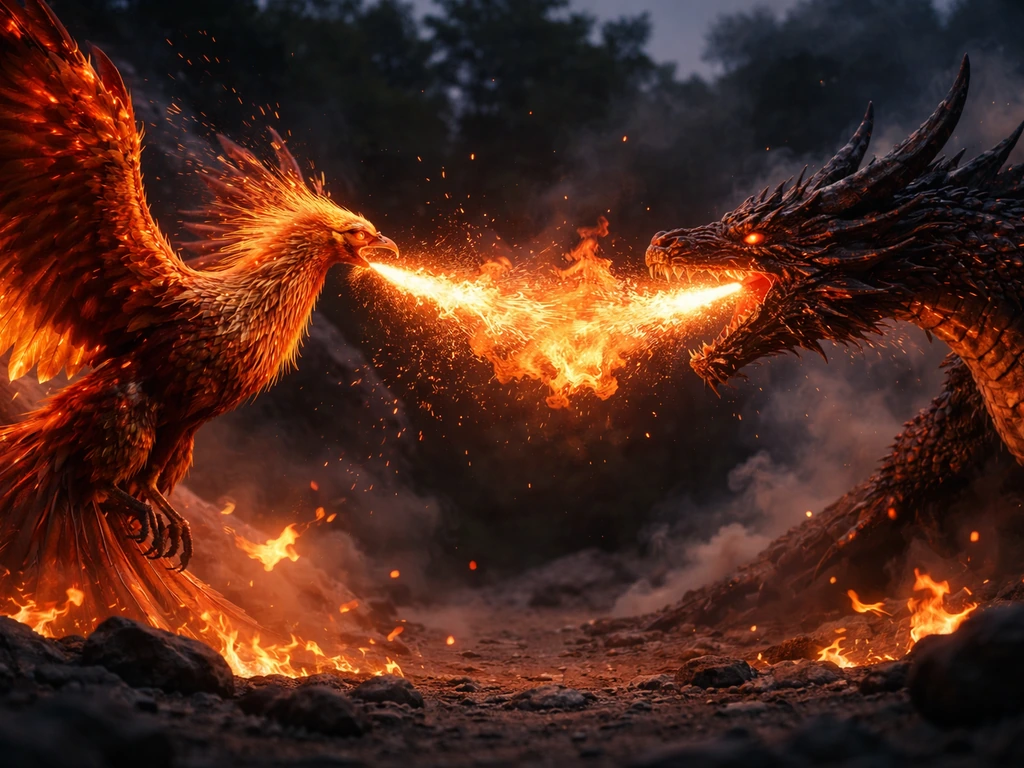
The phoenix, as described across centuries of mythology, is generally depicted as much larger, often comparable to an eagle or even larger. Accounts vary wildly, but the consistent visual themes are gold, scarlet, and purple plumage with an unmistakable luminous or flame-like quality. Some traditions give it a peacock-like tail, others a crown of feathers, and many describe it as literally glowing. There is no standardized "field description" because the phoenix is a cultural construct, not a biological one. If you see something described as having fire-bright red-orange plumage, your first instinct should be to ask whether you are looking at a bird or an artwork. If it is a bird, run through the vermilion flycatcher checklist.
Bill/face and key markings to check first
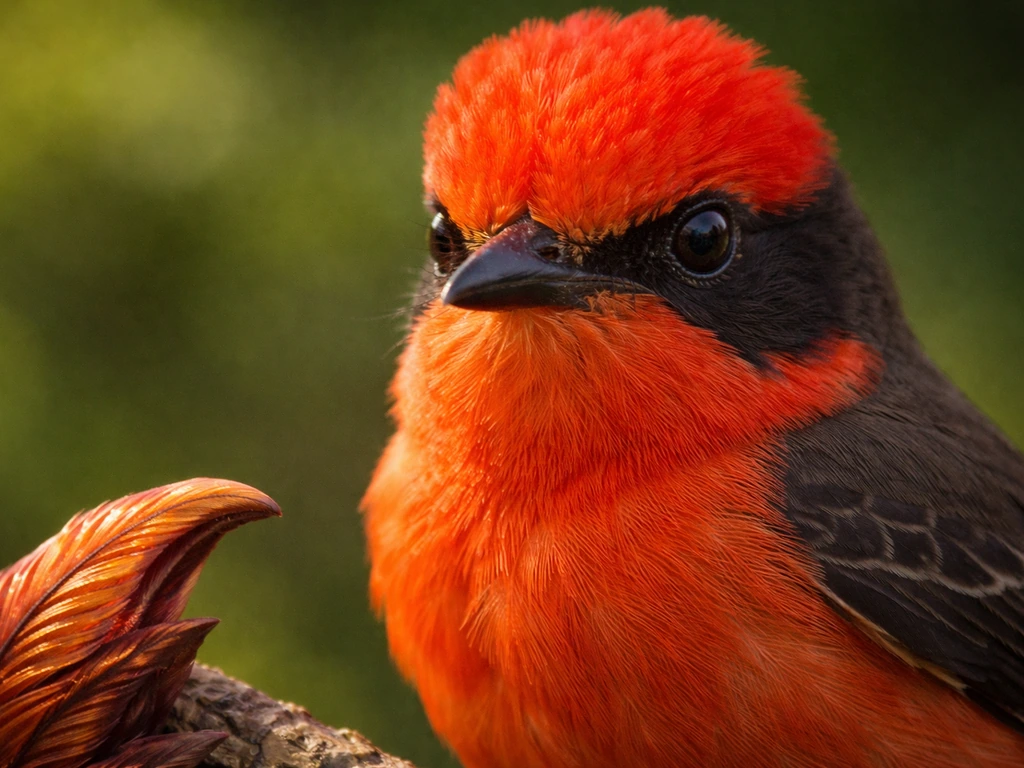
For the vermilion flycatcher, the face is where you get your fastest confirmation. The adult male has a dark brown or blackish mask that wraps from the bill through and behind the eye, cutting cleanly across the brilliant red of the crown and throat. That mask-and-crown contrast is a diagnostic mark you can see even in a quick glance or a mid-quality photo. The bill itself is short, slightly hooked at the tip, and typically dark.
It is built for catching insects in flight, which is exactly what flycatchers do: they launch from a perch, snap up a flying insect, and return to the same spot. That hunting behavior around the face and bill region is something you can watch for in the field.
The phoenix, in artistic and literary depictions, is typically shown with a hooked, raptor-style bill suited to its status as a majestic, powerful creature. But since no two depictions agree perfectly, this is not a useful identification marker. What matters for practical purposes is this: if you are looking at a photograph of a real bird and trying to figure out what it is, the face marks of the vermilion flycatcher (the dark mask plus that red crown) are distinctive enough that you should be able to match them quickly. If you are looking at glowing, fire-wreathed artwork or a stylized illustration, you are almost certainly looking at a phoenix or a phoenix-inspired design, not a vermilion flycatcher.
Behavior and habitat: where you're likely to see each
The vermilion flycatcher is a bird of open country in the American Southwest. All About Birds life history guidance describes vermilion flycatchers as occurring in open country across the American Southwest, including arid scrublands, farmlands, deserts, parks, and canyon mouths open country in the American Southwest.
If you want to find one, head to stream corridors and riparian areas: look along stretches of river or creek lined with willow, sycamore, cottonwood, or mesquite. These birds favor the interface between open ground (where they can spot and chase insects) and nearby perching trees or shrubs. You will often see males sitting conspicuously on exposed branches, wire fences, or tall shrubs, which makes them much easier to spot than many small birds that stay hidden in dense vegetation.
They are year-round residents in parts of Arizona, New Mexico, Texas, and California, and their range extends through Mexico and into South America.
The phoenix, according to most mythological accounts, is associated with no specific geographic habitat in a real-world sense. Traditions from ancient Egypt, Greece, Arabia, and China each place the phoenix in different legendary landscapes. In some stories it lives in Arabia or Ethiopia; in others it nests in a sacred tree or on a mountaintop. The common thread is fire and the sun, not a mapped habitat you can visit. For a deeper look at how the phoenix stacks up against other legendary creatures in bird mythology, the comparison of phoenix bird vs dragon covers the mythology angle in useful detail.
Song/calls and flight style differences
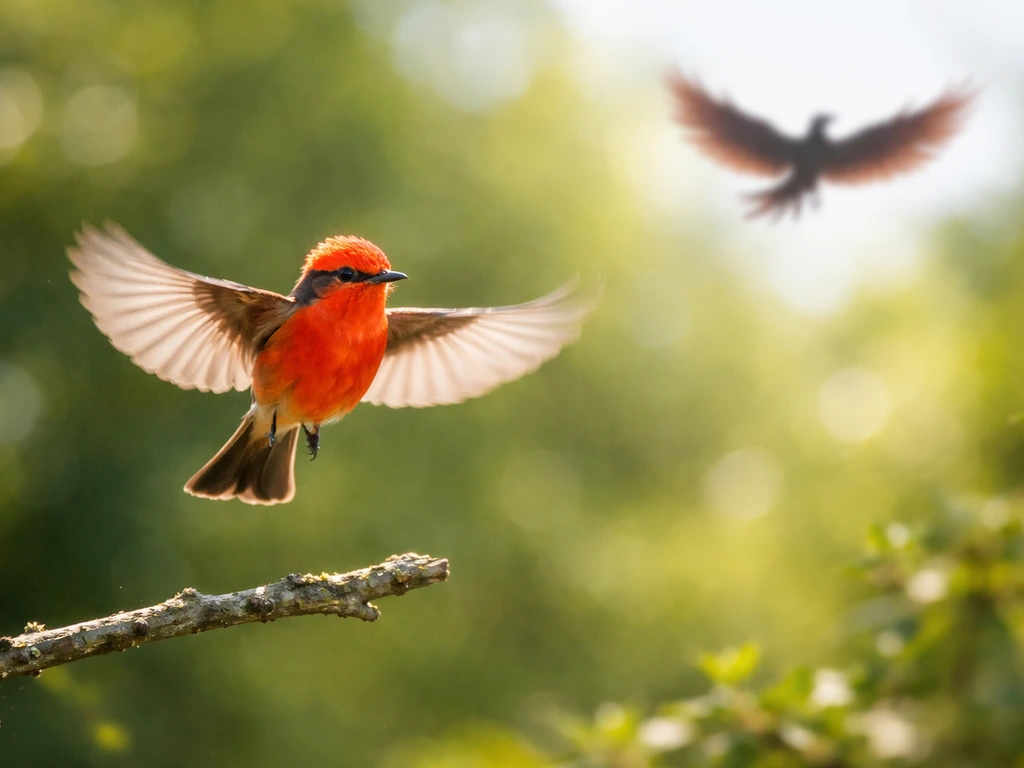
The vermilion flycatcher has a pleasant, high-pitched, somewhat tinkling call. During breeding season the male performs a butterfly-like display flight, hovering and fluttering with his brilliant red breast puffed out while singing a soft, repetitive pit-a-see type phrase. Outside of display flights, his everyday flight style is typical of flycatchers: short, direct sallies from a perch to catch an insect, then a return to roughly the same spot. The wingbeats are quick and the flight arcs are low and purposeful. If you hear a light, musical call from a streamside perch in the Southwest and then see a flash of red, a vermilion flycatcher is near the top of your candidate list.
The phoenix has no documented vocalizations, obviously. Mythology does sometimes describe it as having a beautiful, haunting song, but this is narrative embellishment rather than a field mark. What is worth noting is that the flight of the phoenix is universally described as grand, soaring, and fire-streaked, nothing like the quick dart-and-return style of the vermilion flycatcher. These flight-style contrasts actually show up usefully when comparing mythological birds to one another; the question of phoenix bird vs thunderbird gets into how different cultures imagine the flight and power of their legendary avian figures.
Common myths and confusion points
The biggest source of confusion here is the shared fire-and-flame color palette. Both the vermilion flycatcher and the phoenix are associated with burning red, orange, and gold. The word "vermilion" itself refers to a brilliant red pigment, and "phoenix" evokes the same visual territory. When someone sees a brilliantly red bird for the first time, it is genuinely startling enough to feel legendary, and reaching for "phoenix" as a descriptor is an understandable poetic leap.
Another point of confusion: "vermilion bird" is also the name of one of the Four Symbols in Chinese mythology, a divine red bird associated with the south and with fire. This mythological Vermilion Bird (Zhuque) is, like the phoenix, a non-real creature. So when someone searches "vermilion bird vs phoenix," they might actually be asking about two mythological birds rather than a real bird versus a myth. If that is your question, the power comparison between these two legendary figures is covered directly in <a data-article-id="685F89D6-4FD7-402B-82A9-4EEA8E37D0">vermilion bird vs phoenix who is more powerful. But for anyone coming from a birding or identification angle, the vermilion flycatcher is almost certainly what is meant by "vermilion bird" in a practical context.
People also sometimes encounter the phoenix concept in the context of other mythological birds and wonder how these legends relate to real species. The bennu bird vs phoenix comparison is a useful reference point here, since the ancient Egyptian bennu is one of the most credible historical roots of the phoenix legend and is sometimes linked to real herons. Similarly, if you are curious about how different cultures have constructed their own versions of the immortal fire-bird, exploring the comparison of liver bird vs phoenix shows how far the phoenix archetype has traveled across cultures and time periods.
One more misconception worth addressing: some readers assume that because the vermilion flycatcher looks so improbably vivid, it must be an exotic or rare species. It is neither. It is locally common within its range and well-documented by birders across the Southwest. It is striking, yes, but it is a normal, living bird with a nest, eggs, and a diet of insects. The phoenix remains in the world of symbols and stories, as does any creature compared in pieces like phoenix bird vs griffin, where the focus is entirely on legendary attributes rather than field identification.
How to confirm your ID with photos/resources
If you have a photo of a brilliant red bird and you want to confirm it is a vermilion flycatcher, here is the fastest practical workflow. Start with Merlin Bird ID from the Cornell Lab of Ornithology. Use the Photo ID feature: upload your image and Merlin will compare it against a database of real species and give you a short list of candidate matches in seconds.
Merlin Bird Photo ID uses photo identification technology trained on images linked to eBird checklists and archived in the Macaulay Library, and it can cover thousands of bird species database of real species. This is genuinely one of the best quick-ID tools available, and it is free.
Keep in mind that if your photo has multiple birds in the frame, Merlin may latch onto a different, more clearly visible bird rather than your intended subject, so crop tightly around the bird you want identified before uploading.
After Merlin gives you a candidate, cross-check it against expected habitat. Vermilion flycatchers belong in open Southwest landscapes, particularly stream corridors with riparian trees like willow, cottonwood, and mesquite. If your sighting happened in that kind of environment, that strongly supports the ID. If you photographed the bird somewhere in the eastern U.S., the United Kingdom, or anywhere far outside the species' documented range, you should look more carefully at other possibilities and consider whether the bird might be an escaped captive or a lookalike species.
For deeper research, Cornell Lab's All About Birds page for the vermilion flycatcher gives you range maps, life history notes, sound recordings, and photo galleries that let you compare your image to documented specimens. eBird lets you check what other birders have reported in your specific location and time of year, which is one of the most reliable reality-checks available. If your photo is showing something that looks more fantastical than biological, with luminous or flame-like plumage that does not match any known species, you are almost certainly looking at an artistic depiction of a mythological bird rather than a real one. No real bird glows. The vermilion flycatcher just looks like it does.
For anyone drawn to this topic because of a fascination with legendary birds more broadly, it is worth noting that the question of real versus mythological comes up across many bird comparisons. Even something as grounded as a bearded dragon vs bird comparison can blur the line between creature categories when people are trying to understand how different animals are classified. The key takeaway here is straightforward: if you are birding, you are looking for the vermilion flycatcher. If you are reading mythology, you are meeting the phoenix. They share a color story, but they do not share a world.
FAQ
Can a “phoenix” be spotted in the wild like a real bird?
No. The phoenix is a legendary creature, so there are no verified sightings or scientific records you can “check.” If someone shows you a “phoenix” photo, it is almost always artwork, a costume prop, or a heavily stylized composite rather than an actual bird.
What are the fastest signs that a red-orange “phoenix” image is actually artwork, not a bird?
If you are trying to identify a bright red-orange bird, start by confirming you are dealing with a real wildlife photograph, not an illustration. A quick red flag is glow-like, flame-edged lighting around the feathers, or a scene that looks more like a mural or concept art than natural habitat.
What should I do if I think I saw a vermilion flycatcher but I was outside the Southwest?
Yes, your most useful check is geography and season. Vermilion flycatchers are strongly tied to the American Southwest riparian zone. If the sighting is far outside that region or in a time of year when local reports are essentially nonexistent, treat the ID as uncertain and compare against other lookalikes.
How do I identify a vermilion flycatcher if it is not an adult male?
Look for the adult male face pattern, the dark mask crossing the eye plus the vivid red crown and throat. If the bird is a female or a juvenile, the overall look will be more brown and streaked, so rely less on “all-red” assumptions and more on structure (upright perch, flycatcher hunting behavior, and face contrast when visible).
Why did photo-ID tools give me a different bird than the one I photographed?
Use crop-and-focus discipline. If the photo includes multiple birds, Merlin and similar tools may identify the most prominent subject, not the one you care about. Crop tightly around the target bird, especially the head and face, because that is where confirmation features live.
What behavior differences help confirm vermilion flycatcher versus other red birds?
Your best field timing clue is behavior. Vermilion flycatchers perch conspicuously and do short, direct sallies to catch insects, returning to the same spot. If you see continuous hovering like a hummingbird, or large sustained soaring like a raptor, that suggests you should keep looking.
Can I use sound to tell vermilion bird from phoenix?
If you hear a musical, high-pitched “tinkling” type call near a streamside perch in the Southwest, that supports vermilion flycatcher. By contrast, the phoenix concept has no documented real vocalizations, so any “phoenix song” you encounter online is storytelling or an artistic soundtrack.
What is a simple decision rule when the colors match both descriptions?
They can be confused because both are described with fire-like colors, but one is a living bird and one is myth. A practical decision aid is: if your evidence is field-related (perching, insect-catching flights, habitat), it points to vermilion flycatcher. If your evidence is narrative or “glowing” visuals, it points to phoenix-inspired depiction.
Does habitat matter more than color for vermilion flycatcher identification?
A vermilion flycatcher typically fits an open, warm landscape edge near water (riparian trees and shrubs). If the bird is in dense forest interior, high alpine habitat, or arid desert with no nearby vegetation or water, the vermilion flycatcher hypothesis should be challenged first.
Is “vermilion bird” always the same thing as the phoenix?
If your “phoenix” claim is coming from the term “vermilion bird,” be aware that Chinese mythology includes Zhuque, a non-real symbolic creature. People sometimes blend Zhuque with phoenix discussion, so clarify whether you mean a real bird (vermilion flycatcher) or a mythological fire bird (phoenix or Zhuque).