The Vermilion Bird (Zhuque, 朱雀) and the Fenghuang (鳳凰) are two genuinely different entities in Chinese cosmology and culture, even though both are mythic birds and both get called 'phoenix' in casual English translation. The Vermilion Bird is one of the Four Symbols, a directional and astral guardian tied to the south, the color red, and the element Fire. The Fenghuang is a composite auspicious bird with deep roots in classical literature, imperial ideology, and ritual art. They overlap visually in some periods of Han funerary art, which is where most of the confusion starts, but their origins, functions, iconography, and symbolic roles are distinct enough that once you know what to look for, you can reliably tell them apart.
Vermilion Bird vs Fenghuang: Key Differences Explained

Marcus Hendricks
20 Jul 2026
Why these two keep getting mixed up
The confusion has a few causes. First, nineteenth and twentieth century Western translators routinely rendered 鳳凰 (fenghuang) as 'phoenix,' and sometimes applied that same label to Zhuque as well, erasing any distinction between the two. Scholars note that nineteenth–twentieth century Western translators and popular writers often rendered 鳳凰 as 'phoenix' and sometimes applied 'phoenix' to both fenghuang and Zhuque, while contemporary scholarship and museum labels increasingly distinguish the entities. Second, both are red or fire-adjacent birds in popular imagination, which makes them look interchangeable at a glance. Third, Han funerary art genuinely does place phoenix-like birds alongside Zhuque in the same cosmological programs, so even trained eyes can struggle when standing in front of a tomb mural without clear labels. Contemporary scholarship and museum curators are increasingly careful to separate the two, but popular websites, video games, and fantasy media still blend them freely. The practical fix is context: ask yourself whether the bird is functioning as a directional cosmic guardian or as an auspicious, imperial, courtly emblem, and the distinction almost always resolves itself.
Key distinctions at a glance
| Feature | Vermilion Bird (Zhuque 朱雀) | Fenghuang (鳳凰) |
|---|---|---|
| Chinese characters | 朱雀 (zhu = vermilion/red; que = small bird) | 鳳凰 (feng + huang, two distinct lexemes) |
| Primary category | Cosmic directional guardian; one of the Four Symbols | Auspicious divine bird; imperial and ritual emblem |
| Direction/element | South, Fire, Summer | No fixed single direction; associated with virtue and harmony |
| Astronomical role | Guardian of the southern Seven Lunar Mansions (Twenty-Eight Mansions system) | No dedicated astral role |
| Typical context | Funerary tomb murals, star maps, cosmological diagrams (southern wall) | Imperial textiles, bronzes, ritual objects, wedding and court decorations |
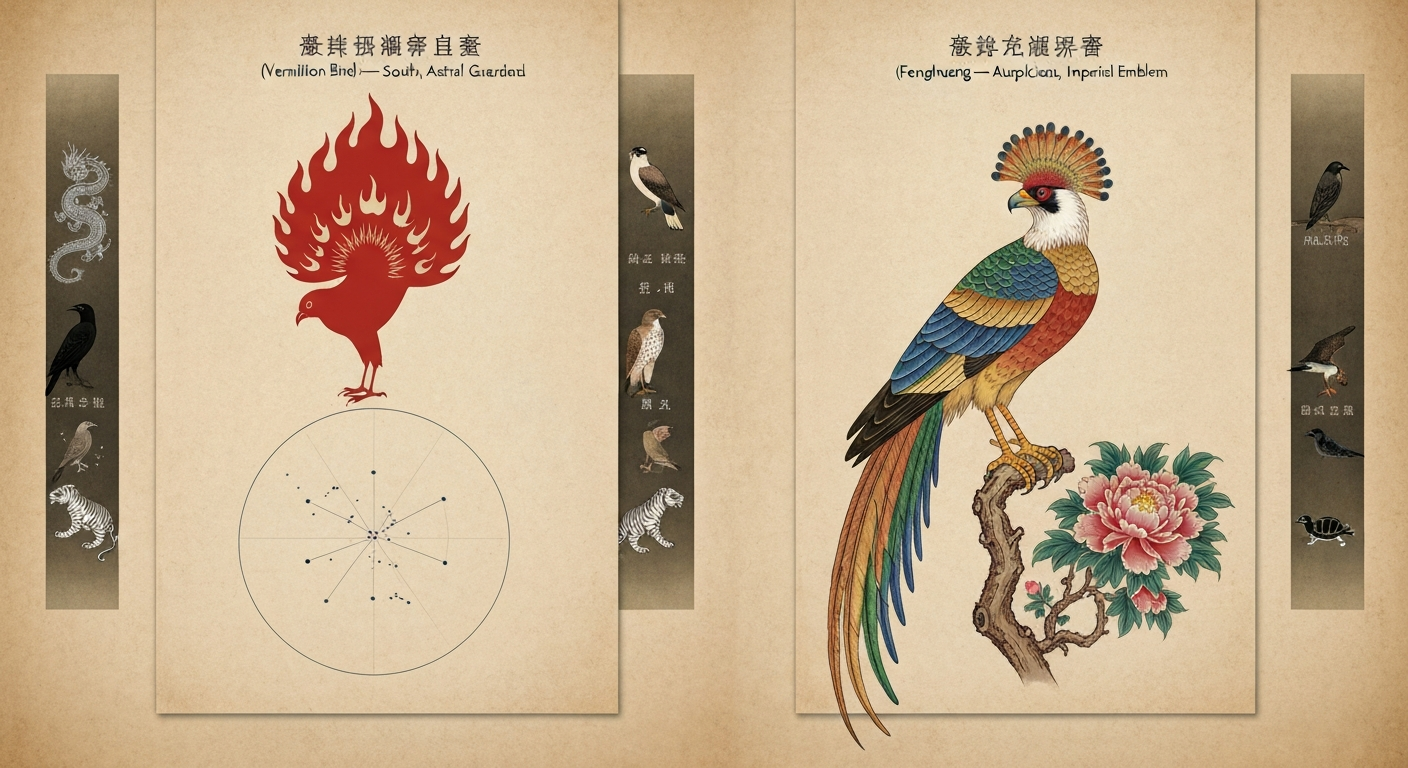
| Appearance | Schematic, stylized, often monochrome red; fanned tail, upright posture | Composite, multi-colored, crested, long flowing tail, peacock-like plumes |
| Paired with | Azure Dragon (east), White Tiger (west), Black Tortoise (north) | Dragon (emperor), or appears in pairs (two fenghuang = marital/imperial harmony) |
| Gender symbolism | No strong gendered polarity; directional/astral function | Originally feng (male) + huang (female); later associated with the empress |
| Western conflation | Sometimes called 'phoenix' or 'red phoenix' | Routinely called 'Chinese phoenix' |
Origins and mythic lineages: Zhuque and Fenghuang
The Vermilion Bird's cosmological birth
Zhuque emerges primarily as an astronomical and cosmological construct. The Huainanzi (second century BCE), one of the most important Han syncretic texts, explicitly assigns the Vermilion Bird as the guardian of the south within the Four Symbols framework alongside the Azure Dragon (east), White Tiger (west), and Black Tortoise (north). Its identity is inseparable from the Twenty-Eight Lunar Mansions system used in Han astronomy: the southern seven of those twenty-eight mansions are collectively the 'Vermilion Bird' group. Modern scholars Xiaochun Sun and Jacob Kistemaker (The Chinese Sky During the Han, BRILL, 1997) have reconstructed this mapping in detail from Han star catalogues, confirming that Zhuque functions first and foremost as an astral/directional category, not as an independent mythic character with its own stories.
The Fenghuang's literary and ritual roots
Fenghuang has a far richer narrative history. The Shijing (Book of Songs) and the Shanhaijing (Classic of Mountains and Seas) are among the earliest textual sources where phoenix-type birds appear, and later commentators drew on both to build the classical image of the fenghuang. The Han dictionary Shuowen Jiezi preserves crucial philological detail: it records 鳳 (feng) as a 'divine bird' and distinguishes it from the character 凰/黃 (huang), treating them originally as a gendered pair, feng being male and huang female. Over time, the two characters fused into the single cultural unit 鳳凰 used in literary and artistic contexts ever since. The Yiwen Leiju compendium cites both Shuowen and Shanhaijing entries for 鳳, giving us a clear chain of transmission from early classical sources into later dynastic tradition. See the CTEXT entry for 鳳, which reproduces Shuowen and Shanhaijing citations confirming these early attestations CTEXT entry for 鳳 (Shuowen & Shanhaijing citations).
Cosmological and cultural roles
Zhuque's role is primarily functional and structural within a system. It anchors the south in every cosmological diagram, tomb layout, and directional ritual that uses the Four Symbols framework. In Han tomb architecture, the Vermilion Bird is placed on the southern wall of the burial chamber, acting as a cosmic guardian that orders the dead person's journey within a correctly oriented universe. That funerary protective function is central to understanding why it appears so consistently in pictorial stones and sarcophagi. Edward H. Schafer's monograph The Vermilion Bird: T'ang Images of the South (University of California Press) traces how vermilion/southern imagery carried through into Tang literary and visual culture as well, documenting the formal features that art historians use to recognize it across periods.
Fenghuang operates in a completely different cultural register. It is an omen bird: its appearance signals a virtuous ruler, a prosperous era, or divine approval of the dynastic order. In courtly and imperial material culture, fenghuang decorates imperial robes (especially those associated with empresses), screens, bronze mirrors, and ritual vessels. Where Zhuque guards a cosmic quadrant, fenghuang endorses a social and moral order. It appears on wedding gifts and textiles as a symbol of conjugal harmony and auspiciousness. That shift from cosmic guardian to imperial virtue emblem is the clearest functional line between the two.
What the Vermilion Bird looks like in art
Across Han tomb murals, pictorial stones, and funerary sarcophagi, the Vermilion Bird is rendered in a recognizably schematic way. Scholars studying Han tomb imagery note that these figures are often abstracted: stylized spreading wings, a fanned or flame-like tail, and an upright, forward-facing posture. The color is monochromatic red or cinnabar, which directly signals its cosmological identity (朱, zhu, means vermilion or cinnabar red). The form is not meant to be naturalistic or decorative; it is a legible symbol in a cosmological program, the visual equivalent of a compass point. A useful field check when looking at Han art: if the bird is red, single, placed on a south wall or southern quadrant of a compositional scheme, and lacks elaborate polychrome patterning or a crested head, you are almost certainly looking at Zhuque. Research published on Han tomb imagery explicitly cautions that archaeologists and art historians avoid conflating these schematic guardian figures with the more ornate courtly fenghuang. For a similarly structured visual comparison of two confusingly named plants, see our comparison of Yellow Bird vs Butterfly Magnolia.
What the Fenghuang looks like in art
Fenghuang iconography is richer and more variable across periods, but several features are consistent. It is a composite bird: its anatomy combines features from multiple species, including a crested head, a long flowing tail with layered plumes that recall both peacock and pheasant feathers, and a body treated with polychrome detail (gold, red, green, blue). It frequently appears alongside specific plant motifs, particularly peony (牡丹) and wutong/paulownia (梧桐), the latter a tree that classical texts describe as the only one worthy of a fenghuang's perch. It appears in pairs (two fenghuang, or fenghuang paired with a dragon representing the emperor and empress respectively), and it is heavily decorated rather than schematically simplified. On an imperial robe or a lacquered screen, the fenghuang is unmistakably the center of decorative attention, loaded with symbolic detail that a purely directional guardian figure like Zhuque never carries.
Fire, south, yin, yang: unpacking the elemental and gender associations
Zhuque's elemental and directional associations are fixed and explicit in classical sources. Fire corresponds to south, and south corresponds to summer, and all three correspond to Zhuque. This is not metaphorical decoration; it is a structural assignment within the Five Phases (wuxing) and Four Symbols cosmological systems documented in texts like the Huainanzi. The character 朱雀 encodes this directly: 朱 (zhu) means cinnabar red, the color of fire and the south, and 雀 (que), meaning small bird, serves as the classifier that marks it as a bird-type symbol rather than a mammal (as the White Tiger is) or a reptile-composite (as the Black Tortoise-Snake is).
Fenghuang's elemental and gender associations are more complex and shifted over time. The early philological tradition in Shuowen preserved a gendered distinction: 鳳 (feng) was originally the male and 凰 (huang) the female. By the medieval and later imperial periods, this had transformed into a courtly gender emblem where fenghuang as a unit represented the empress, paired against the dragon representing the emperor. Some later texts also associate fenghuang with the south and fire, which is one reason the two birds get conflated, but this is a secondary association borrowed from the cosmological system rather than fenghuang's primary symbolic register. Fenghuang's core identity is about virtue, harmony, and imperial legitimacy, not elemental direction-keeping.
How both birds changed across dynasties
Early texts and Han period formalization
The Four Symbols framework, including Zhuque, was formalized during the Han dynasty and appears most visibly in Han tomb art and astronomical treatises. Han pictorial stones and sarcophagi show Zhuque as a standardized cosmological marker, its form schematic and its placement consistent. At the same time, fenghuang-type birds appear in Han art too, sometimes in the same funerary contexts, which is why modern scholars warn against casual conflation. The two traditions ran in parallel: one serving an astronomical and funerary ordering function, the other carrying older literary associations with divine kingship and good omens.
Tang dynasty elaboration
Edward Schafer's The Vermilion Bird documents how Tang literary culture inherited and extended the vermilion-south imagery, with poets and officials using it in ways that blended astral, geographic, and aesthetic meaning. Southern China itself was associated with the Vermilion Bird's domain in literary imagination. Meanwhile, fenghuang iconography in Tang decorative arts became increasingly elaborate, polychrome, and explicitly courtly. Tang gold and silver work, textiles, and mirror-backs from this period show the fenghuang in its most ornate pre-Song form.
Song to Qing: the fenghuang's imperial peak
From the Song dynasty onward, fenghuang iconography became deeply embedded in imperial and aristocratic material culture. Its pairing with the dragon as an empress-emperor dyad was standardized and regulated. Zhuque continued to appear in ritual, cosmological, and geomantic contexts, including feng shui diagrams and Daoist ritual art, but its role as a courtly prestige symbol was minimal compared to fenghuang. By the Ming and Qing dynasties, fenghuang dominated imperial textiles and architecture (the phoenix robes of empresses, phoenixes on palace eaves and screens), while Zhuque remained embedded in technical cosmological and Daoist-ritual traditions that required the Four Symbols framework. Regional variations also developed: Korean and Japanese art adopted the Four Symbols (including the Vermilion Bird, known as Suzaku in Japan) through Tang-era cultural transmission, and independently developed phoenix iconography that borrowed from fenghuang but diverged in local artistic traditions.
How to identify which bird you're looking at: a practical checklist
Whether you're in a museum, browsing a catalogue, or analyzing an image online, these concrete cues will help you identify whether you are looking at Zhuque or Fenghuang.
- Check the placement: Is the bird on a south wall, in a compass rose, on a star map, or in a funerary cosmological program? That points to Zhuque. Is it on an imperial robe, a wedding textile, a decorative bronze, or a courtly screen? That points to Fenghuang.
- Check the morphology: Is the bird schematic, upright, with stylized flame-feathers and a monochrome red/cinnabar coloring? Zhuque. Is it composite, crested, polychrome, with long layered tail plumes and ornamental detail? Fenghuang.
- Check the pairing: Is the bird grouped with an Azure Dragon (east), White Tiger (west), or Black Tortoise (north)? That is the Four Symbols set, and the red bird is Zhuque. Is it paired with a dragon as a two-bird or bird-and-dragon motif, or shown in a pair of identical birds? That is Fenghuang.
- Check the plant motifs: Wutong/paulownia trees and peony flowers are classic Fenghuang companions. Neither is associated with Zhuque.
- Read the characters if they are present: 朱雀 = Zhuque (directional, astral). 鳳凰 = Fenghuang (auspicious, imperial). If you see only 鳳 alone, that is the older male form of fenghuang, not Zhuque.
- Consider the object's function: Astronomical charts, geomantic diagrams, Daoist ritual objects, and funerary goods are Zhuque territory. Imperial court objects, marriage gifts, and prestige decorative arts are Fenghuang territory.
- Be skeptical of Western labels: If an English-language source calls both birds 'phoenix,' go back to the original Chinese designation and apply the above checks. Modern museum labels are increasingly reliable, but older catalogue entries and popular sources often conflate the two.
A note on the Western phoenix comparison
Neither Zhuque nor Fenghuang is the Chinese equivalent of the Greek/Egyptian phoenix. The Western phoenix is primarily a rebirth and resurrection symbol, tied to cycles of fire-death and renewal. Fenghuang does not burn and resurrect; it appears as an omen of virtue and disappears when virtue declines. Zhuque is a cosmic structural marker, not a narrative figure at all. Translating either as 'phoenix' imports a set of meanings that simply do not belong. It is a useful shorthand for introducing non-specialist audiences to the concept of a divine Chinese bird, but it should never be treated as an accurate equivalence. This is the same kind of category error that happens when people assume similar-looking animals must have the same identity, a pattern that comes up with real birds too when comparing visually similar species. For a different example of how visually similar creatures can be confused, see hornet vs bird for a focused comparison. For a comparable case of visual confusion between species in popular media, see doctor bird vs hummingbird. For a comparable case of mistaken identity among visually similar species, see the colibri bird vs hummingbird comparison.
Where they appear in modern media
In video games, anime, and fantasy fiction, Zhuque and Fenghuang are frequently interchangeable or outright fused into a single 'fire phoenix' character. The Four Symbols appear together in games drawing on East Asian mythology (often in the same titles that feature Azure Dragon, White Tiger, and Black Tortoise), and the Vermilion Bird there is usually given more personality and narrative agency than its classical cosmological role warrants. Fenghuang appears as a prestige summon or boss creature in many games, usually depicted with elaborate plumage consistent with its imperial iconography. Neither depiction is historically faithful, but recognizing the classical distinction helps you understand what the designers were drawing on (and what they changed). Museum collections at institutions including the Palace Museum in Beijing and the Metropolitan Museum of Art in New York hold objects that clearly illustrate both traditions for anyone who wants to verify the visual distinctions in person.
FAQ
What is the fundamental difference between the Vermilion Bird (Zhuque) and the Fenghuang?
Zhuque (朱雀) is a cosmological/astral guardian from the Four Symbols (四象): the southern protector tied to the color vermilion, the element Fire, and the seven southern lunar mansions in Han astronomy. It functions primarily as a directional/astronomical motif and funerary guardian. Fenghuang (鳳凰), by contrast, is an auspicious, composite 'phoenix'‑type bird from classical literature and ritual, associated with imperial and court symbolism, marriage, and moral/auspicious meanings rather than an astronomical lodestar. (See Huainanzi / Han astronomical sources; Shuowen citations; Sun & Kistemaker; Edward H. Schafer.) Links: https://ctext.org/huainanzi/bing-lve-xun/zh ; https://books.google.com/books?id=87lvBoFi8A0C ; https://ctext.org/text.pl?if=gb&node=550382&remap=gb
How do cosmological and elemental roles differ between the two?
Zhuque = one of the Four Symbols: guardian of the south, color vermilion/red, element Fire, season Summer, mapped to the southern group of seven lunar mansions in the Twenty‑Eight Mansions system (Han astronomy). Fenghuang has no fixed role in the Four Symbols system; its role is ritual/auspicious and symbolic—later associated with the empress, harmony, virtue, and imperial ceremony rather than directional/astral governance. (See Sun & Kistemaker; Shuowen; secondary scholarship.) Links: https://books.google.com/books?id=87lvBoFi8A0C ; https://ctext.org/wiki.pl?chapter=550382&if=gb
What visual/iconographic features reliably distinguish Zhuque from fenghuang in art and artifacts?
Key visual cues: Zhuque — usually single, schematic/abstracted bird; fanned or flame‑like tail; stylized wings; often rendered monochrome or predominantly red; frequently placed as a southern wall/tomb guardian or in star maps. Fenghuang — ornate, crested head, composite anatomy, layered/multi‑coloured plumage, long flowing peacock‑like tail, decorative floral pairings (peony, paulownia), often appears in pairs or with dragons on court textiles, bronzes, and jewelry. Use placement and surrounding motifs to confirm identification. (See art‑historical studies and Han tomb imagery.) Links: https://www.researchgate.net/publication/399544105_Animating_the_Cosmos_The_Azure_Dragon_White_Tiger_Vermilion_Bird_and_Dark_Warrior_in_Han_Tomb_Art_and_Thought ; https://dokumen.pub/metamorphic-imagery-in-ancient-chinese-art-and-religion-1ed-9781032376493-9781032376578-9781003341246.html
What contextual clues (placement, pairing, associated motifs) help identify which bird is depicted?
Contextual checklist: 1) Placement: southern wall, tomb mural, or star map → likely Zhuque. Court robes, bridal textiles, imperial screens, mirror‑backs → likely fenghuang. 2) Pairing: solitary guardian with other Four Symbols → Zhuque; paired birds (male/female) or with dragons → fenghuang. 3) Motifs: astronomical lodges, compass markers → Zhuque; floral motifs, crowns, empress/imperial regalia → fenghuang. 4) Color/detail: schematic vermilion/red stylization → Zhuque; polychrome, crests, elaborate tails → fenghuang. (See Cambridge/Bulletin of SOAS and Han funerary studies.) Link: https://api.repository.cam.ac.uk/server/api/core/bitstreams/1fd143da-4743-4111-aa11-1e34707513b1/content
How did gender associations develop for fenghuang and how does that differ from Zhuque?
Early philology records 鳳 (feng) and 凰/黃 (huang) as a gendered male/female lexical pair; over time they fused into the single auspicious emblem 鳳凰 representing balance and the empress (paired with the dragon for the emperor) in imperial iconography. Zhuque, by contrast, is not a gendered imperial emblem but an astral guardian—its symbolism is directional and cosmic rather than courtly gendered roles. (See Shuowen and later court material culture studies.) Link: https://ctext.org/wiki.pl?chapter=550382&if=gb
Why do some museum labels or popular sources call both birds 'phoenix'?
Western translators and popular writers historically used 'phoenix' as a convenient analogue for several East Asian mythic birds, which led to conflation of fenghuang and Zhuque in 19th–20th century texts and labels. Contemporary scholarship and improved museum practice now separate the terms by context and function: fenghuang → 'Chinese phoenix' (auspicious/court), Zhuque → 'Vermilion Bird' (astral/southern guardian). Always check contextual cues on objects and prefer specialist catalog entries or peer‑reviewed scholarship for identification. (See modern reception notes and Wikipedia survey of usage.) Link: https://en.wikipedia.org/wiki/Fenghuang</answer>
Next Article
Yellow Bird vs Butterfly Magnolia: How to Tell Them Apart
Distinguish a yellow bird from a butterfly magnolia by flowers, leaves, bird motion, beaks, and local season clues.