
The doctor bird is a hummingbird. Specifically, it is the Streamertail (Trochilus polytmus), Jamaica's national bird, known locally as the doctor bird because of the male's dramatic elongated black tail feathers. So if someone asks you to compare a doctor bird versus a hummingbird, the real question is usually: how do you identify a Streamertail specifically, and how does it differ from other hummingbird species you might see in the same region? That is what this guide will walk you through, feature by feature.
Doctor Bird vs Hummingbird: How to Identify the Right Bird

Marcus Hendricks
11 Jun 2026

Why people confuse doctor bird and hummingbird
The confusion has a few layers. First, the name "doctor bird" sounds like a completely different type of bird, not a hummingbird at all. Visitors to Jamaica who hear locals call it the doctor bird may not realize they are already looking at a hummingbird species. Second, the Streamertail shares all the classic hummingbird traits: it hovers at flowers, it darts between blooms at high speed, and it feeds on nectar using a long specialized bill and tongue.
Nothing about its behavior signals that it belongs in a separate category, because it does not. It is simply one of roughly 360 hummingbird species worldwide, just with an unusually striking appearance. Third, the name itself has cultural weight in Jamaica, where it appears in tourism materials, national branding, and even music industry names, which reinforces the idea that it is something distinct and uniquely Jamaican rather than one member of a large bird family.
Wikipedia also notes that “Doctor Bird” is a Jamaican reference that extends beyond birding into popular usage, linking the term to Jamaica’s identity and the national bird nickname cultural weight in Jamaica, where it appears in tourism materials, national branding, and even music industry names.
There is also a naming overlap worth knowing about. The Streamertail is sometimes called the swallow-tail hummingbird or the scissors-tail hummingbird, all referring to the same species. The closely related Black-billed Streamertail (Trochilus scitulus) is found only in the extreme eastern part of Jamaica and is now treated as a separate species by major taxonomic authorities. When someone in Jamaica points out a doctor bird, they are almost certainly talking about the Red-billed Streamertail unless you are in that narrow eastern range.
Visual ID: size, shape, beak, and wing cues
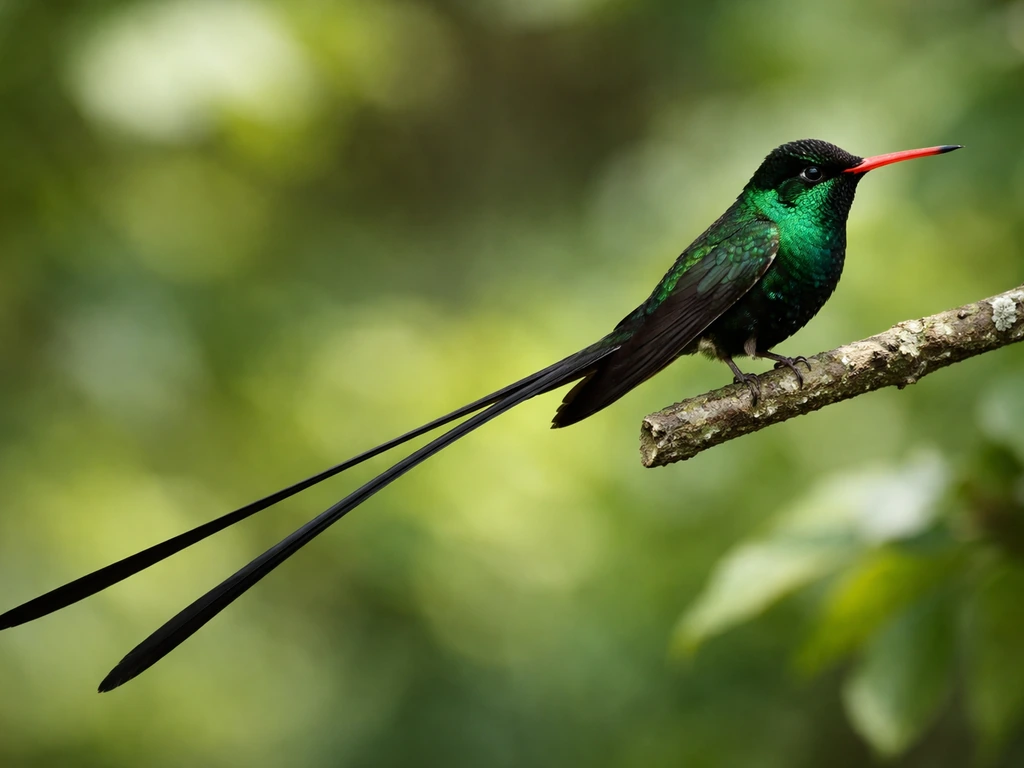
The single most reliable visual feature on an adult male Streamertail is the tail. The two central tail feathers grow into long, crossing black streamers that can significantly exceed the bird's body length. Nothing else in Jamaica's hummingbird fauna looks like this. When the bird hovers, the streamers trail below it and oscillate slightly, giving the impression of a miniature helicopter with a dangling fork. This is what earned it the nickname "doctor bird," a reference resembling a doctor's long coat tails.
The bill on the Red-billed Streamertail is a straight coral-red with a black tip. This is a useful second marker because many hummingbirds have bills that are black, dark gray, or pinkish at the base but rarely that clean red-and-black two-tone pattern. Look for the bill color in good light and from the side.
Body size is typical for a small hummingbird. Without the streamers, the Streamertail is not noticeably larger or smaller than many other hummingbirds you might encounter. Yellow bird vs butterfly magnolia comparisons can also help you narrow down what you are actually seeing at the flower. The wings are narrow and pointed, as with all hummingbirds, and they beat so fast (around 35 to 45 wingbeats per second in hovering hummingbirds generally) that they produce the characteristic blur and audible hum. The black crest on the male adds a top-hat silhouette at rest that no other Jamaican hummingbird matches.
Behavior in the field: feeding method and flight style
Behaviorally, the doctor bird does everything a hummingbird does. It hovers in front of flowers, blank" rel="noopener noreferrer">extending its bill and long tongue deep into the bloom to extract nectar. The tongue is highly specialized, with flexible flaps and a wringing mechanism near the bill tip that allows it to process nectar rapidly while maintaining a hover. At feeders, you will see the bill inserted cleanly while the wings maintain that suspended, vibrating hover. Licking rates inside a flower can reach 10 to 15 cycles per second, all happening faster than you can track with the naked eye.
Flight style is what makes any hummingbird stand out from other small birds. They do not flap-and-glide the way passerines do. They move in short, explosive bursts between flowers, then lock into a hover. The Streamertail does this with the added visual drama of those trailing tail streamers, which sweep and cross during flight, especially during display. Males also produce a distinctive whirring sound in flight caused by their fluttering wing feathers, not just the wingbeat itself. This mechanical wing sound is something you can learn to recognize in the field once you have heard it a few times.
Like all hummingbirds, doctor birds will also take insects midair or pluck them from vegetation. When hawking insects, the lower jaw flexes downward to widen the gape for capture. This is a less commonly observed behavior, but if you see a hummingbird making short aerial sallies and snapping at small flies, that is completely normal and does not mean you are looking at a different species.
Color pattern and plumage cues by sex and age
This is where a lot of misidentifications happen, because male and female Streamertails look very different from each other, and young males look different from adults. Knowing all three will save you a lot of confusion in the field.
Adult males
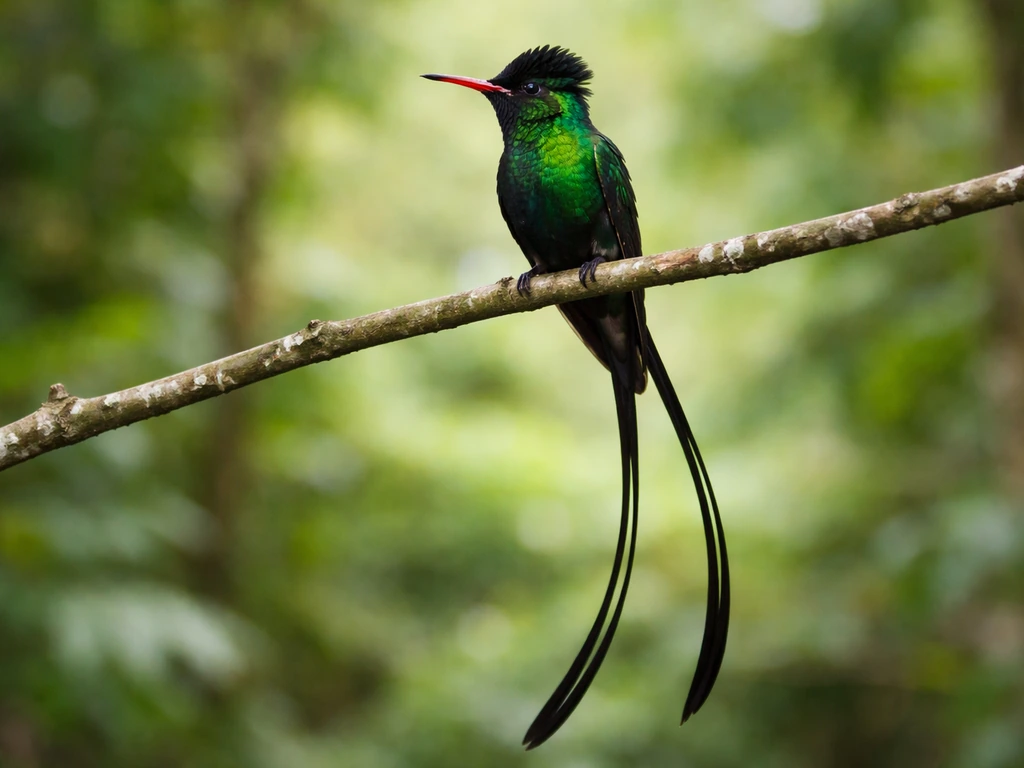
Brilliant iridescent green on most of the body, a black crest, that coral-red bill with a black tip, and the defining long black tail streamers. The iridescence shifts with the angle of light, which is normal for hummingbirds. The feather microstructures scatter light to produce that metallic shimmer, so the color you see from one angle will look different from another. Do not be thrown off if the green looks dull or dark in shade.
Adult females
Females are much quieter in appearance. Green upperparts, white underparts, and dark tail feathers with white tips. They lack the streamers entirely and the bill coloration is less vivid. A female Streamertail could be confused with several other hummingbird species at a glance, which is why the white underparts combined with the dark-tipped tail and location (Jamaica) are your best anchors. Many female hummingbirds across species follow this same pattern of being greener and duller than males, so habitat and range (covered below) become especially important when sexing birds in the field.
Immature males
Young males resemble adults in plumage but lack the full tail streamers. This is a documented age cue across the streamertail complex. An immature Black-billed Streamertail, for example, looks like an adult minus the long tails. So if you see what looks like a male Streamertail but the tail seems short or unimpressive, you may be looking at a juvenile rather than a different species. Give the bird a second look at the bill color, crest, and body iridescence to confirm.
Sound and timing cues
The Streamertail's most distinctive acoustic feature is the mechanical wing sound produced by fluttering tail and wing feathers during flight. It is a higher, more complex whirring than the standard hummingbird hum, and research has specifically linked it to the feather structure of the male. If you are near a male and it is actively flying or displaying, this sound is hard to miss.
Standard hummingbird vocalizations are also useful. Most hummingbirds produce sharp, high-pitched chips and chattering calls, often while defending a feeder or flower patch. The Streamertail is no different. Males are particularly vocal and active, defending nectar sources aggressively. If you hear persistent high-pitched chipping coming from a flowering tree or garden feeder and then see a small hovering bird, you are almost certainly watching a hummingbird, and in Jamaica, almost certainly a Streamertail.
In terms of activity timing, hummingbirds are most active in the early morning and late afternoon when temperatures are cooler and flower nectar has replenished. Midday heat can slow activity somewhat, but Streamertails, like most hummingbirds, are diurnal and can be found visiting flowers throughout daylight hours. If you are visiting Jamaica and hoping to photograph one, mornings at flowering gardens or near Heliconia and hibiscus plantings give you the best odds.
Habitat and range differences

This is the clearest filter of all. The doctor bird (Streamertail) is endemic to Jamaica. It is found nowhere else in the world. If you are not in Jamaica, you are not looking at a doctor bird. Full stop. Within Jamaica, the Red-billed Streamertail (Trochilus polytmus) is found across most of the island, while the Black-billed Streamertail (Trochilus scitulus) replaces it in the extreme eastern end. Both are considered doctor birds locally, but they are now classified as separate species.
The Streamertail thrives in a wide range of Jamaican habitats: gardens, forest edges, secondary growth, parks, and even urban flowering plantings. It is not a shy or remote species. You do not need to hike into wilderness to find one. Many visitors first see them at hotel garden feeders or around cultivated flowering plants.
If you are outside Jamaica and see a hummingbird that reminded you of pictures of doctor birds, you are looking at a different hummingbird species. This is why a hornet vs bird comparison never fits here, since the Streamertail is unmistakably a hummingbird. North American visitors familiar with the Ruby-throated Hummingbird (which has a brilliant red throat on males and white throat on females, with metallic green on the back) should note that the bill and tail will look very different from a Streamertail. The colibri bird is another name that sometimes surfaces in related comparisons, referring to hummingbirds generally in French and Spanish-speaking regions, which is a separate naming tradition worth knowing about if you are traveling in the Caribbean or Latin America.
Quick comparison checklist and next steps
| Feature | Male Streamertail (Doctor Bird) | Typical Other Hummingbird |
|---|---|---|
| Location | Jamaica only | Americas broadly (species-dependent) |
| Bill color | Coral-red with black tip | Usually all-black, dark, or pink-based |
| Tail | Long black streaming feathers (adult males) | Short, rounded, or forked but not dramatically elongated |
| Crest | Black crest present | Most species lack a visible crest |
| Female plumage | Green above, white below, dark tail with white tips | Varies; often green above, lighter below |
| Flight sound | Distinct mechanical whirring from wing feathers | Standard hum from wingbeats |
| Body iridescence | Bright green, shifts with light angle | Varies; some brilliant, some dull |
| Immature males | Adult-like but no streamers yet | Similar pattern: duller than adult males |
If you are in the field right now trying to make a call, here is the fastest path to a confident ID:
- Confirm your location first. Are you in Jamaica? If not, you are not looking at a doctor bird.
- Look at the tail. Does the bird have long, crossing black streamers trailing behind it? Adult male Streamertail confirmed.
- Check the bill. Is it coral-red with a black tip? That rules out almost every other Jamaican hummingbird.
- For females or juveniles, note the green-above, white-below pattern and the dark tail with white tips.
- Listen for the mechanical whirring sound from the male in flight, distinct from the standard wingbeat hum.
- Take a photo if you can: get one from the side to capture bill color and tail length, and one from below or front to capture throat and belly coloration.
- Cross-check against a Jamaica-specific field guide or a reliable app like Merlin Bird ID with your location set to Jamaica. The Streamertail will appear at or near the top of likely matches.
The bottom line is that the doctor bird is not a mystery once you know it is simply a hummingbird with an exceptional tail and a culturally rich local name. If you are comparing birds outside Jamaica, this is also where the vermilion bird versus fenghuang question comes up vermilion bird vs fenghuang. If you are in Jamaica, you will likely find one without much effort.
If you are elsewhere in the Americas and are trying to ID a similar-looking hovering bird at a flower, use the checklist above alongside a regional field guide to narrow it down by location, bill shape, and tail characteristics. Those three features together will resolve most hummingbird ID questions faster than any other approach.
FAQ
If I’m in Jamaica and see a hovering hummingbird with a red bill, does that automatically mean it’s the doctor bird (Streamertail)?
Not automatically. The red-and-black two-tone bill is a strong clue, but you still need to check the tail and sex. Adult males have the long crossing black tail streamers, while females lack them. Also confirm the bill color in good light from the side, since shade can make iridescent green look much darker.
How can I tell a juvenile male (shorter tail) from a different species when the streamers are not fully developed?
Use a combination check rather than tail length alone. Look for male-associated traits that can persist in juveniles, such as the black crest shape and overall iridescent green on the upperparts. Then verify the bill pattern (red with a black tip) and compare the bird’s general body proportions to local hummingbird options in your immediate area.
Are doctor birds ever seen outside of Jamaica, for example on trips to other Caribbean islands?
They should not be considered a realistic possibility. The Streamertail is endemic to Jamaica, so if you are outside Jamaica, any hummingbird that resembles it is almost certainly a different species. In that case, rely more on local range information and the specific bill and tail traits rather than the common name people might be using.
What’s the quickest way to confirm whether I’m looking at Red-billed vs Black-billed Streamertail within eastern Jamaica?
The most practical field approach is location plus bill and range. Black-billed Streamertail occurs only in the extreme eastern part of Jamaica, so if you are not in that narrow area, assume Red-billed. When you are in the eastern range, use bill color and pattern in good light to separate the two, since both can share the overall Streamertail “look.”
Can a female doctor bird be mistaken for another hummingbird, and what is the most reliable anchor feature?
Yes, females can be confusing because they lack the dramatic tail streamers. The most reliable anchors are Jamaica location plus the underpart contrast (white underparts) combined with the darker tail showing white tips. Bill color is less vivid on females, so don’t rely on bill alone.
Do “swallow-tail” and “scissors-tail hummingbird” refer to the same bird as “doctor bird,” or are they different species?
In this context, they refer to the same species (Streamertail). The names describe the tail shape and trailing look. If the bird’s tail streamers match the Streamertail pattern, the naming overlap is just different nicknames rather than a different species.
What if the bird is perched and not hovering, do I lose the key identification features?
You lose some behavior clues, but you do not lose the best visual markers. For males, the black crest and overall silhouette at rest are helpful, and the bill pattern plus tail structure still matter. For females, focus on the white underparts and the dark tail with white tips, then use context (Jamaica and habitat) to narrow the match.
How should I interpret the “hummingbird hum” versus the Streamertail’s mechanical whirring sound?
The Streamertail can produce a higher, more complex whirring linked to feather structure during flight and display, rather than the generic hummingbird hum. If you hear persistent high-pitched chips plus see active hovering and aggressive guarding behavior, that strongly supports a Streamertail. Use sound only when the bird is in motion or actively displaying, since distance and background noise can blur differences.
Could a bird snapping at insects midair be confused with something else, and is it normal behavior for Streamertails?
It is normal for hummingbirds to take insects midair or from vegetation, and Streamertails can do this. If you see short aerial sallies followed by quick snaps at small flies, it does not automatically indicate a different species. The confirmation step is still the bill pattern, crest, and (for males) the tail streamers.
If I’m using a feeder at a hotel or garden, what should I watch for to avoid misidentification?
Watch for approach and insertion style, plus which sex is visiting. Streamertails will hover suspended while inserting the bill cleanly into blooms or feeders, and males will often look more conspicuous due to crest and, if present, long tail streamers. Also notice whether the bird appears in the Jamaica context consistently, since most similar-looking hummingbirds elsewhere will not match the doctor-bird endemic rule.
Next Articles

Godzilla vs Kong Bird: Identify the Exact Bird Lookalike
Disambiguate and ID the exact bird behind searches like Godzilla vs Kong bird using field marks, habitat, range, behavio

Batman vs Bird: Identify the Animal and Tell Them Apart
Learn what Batman vs bird means and use field marks, behavior, and habitat to ID the right animal fast.

Nighthawk Bird vs Whippoorwill: Field ID Guide
Side-by-side field ID for nighthawk vs whippoorwill: size, silhouette, habitat, flight, calls, and quick checklists.