If you searched 'Godzilla vs Kong bird,' you are most likely trying to identify either the kaiju Rodan (the giant pterosaur-like monster from the Godzilla franchise) or the Giant Condor (another Toho birdlike kaiju), not a specific real-world bird species. But if something about that pop-culture imagery made you spot a massive, dark, broad-winged bird in real life and now you want to know what it actually is, the answer is almost certainly an Andean Condor or a California Condor, and this guide will help you tell them apart from every common lookalike.
Godzilla vs Kong Bird: Identify the Exact Bird Lookalike

Marcus Hendricks
6 Jul 2026
What does 'Godzilla vs Kong bird' actually mean?
The phrase pulls in two directions at once. In online meme culture, 'Godzilla bird' almost always refers to Rodan, the fire-spewing kaiju who has appeared alongside Godzilla since 1956 and beside Kong in the MonsterVerse. Reddit communities routinely call Rodan 'the goofy bird,' Know Your Meme has a dedicated 'Bird Rodan' entry, and blank" rel="noopener noreferrer">the official Godzilla website even spotlights the Giant Condor as 'The Bird Who Challenged Godzilla.' So 'Godzilla vs Kong bird' is frequently just shorthand for these fictional monster-birds, not a literal identification question.
The second direction is a real birding question: someone sees a massive, prehistoric-looking bird with a huge wingspan, dark plumage, and a bald head, thinks it looks like something out of a kaiju movie, and types exactly that into a search bar. That instinct is not wrong. Real condors genuinely look like something that should be fighting Godzilla. If that second scenario is why you are here, keep reading. If you meant “shark vs bird” as a matchup idea, it is usually just a playful concept rather than a real-world or biological comparison.
The real bird behind the Godzilla/Kong comparison
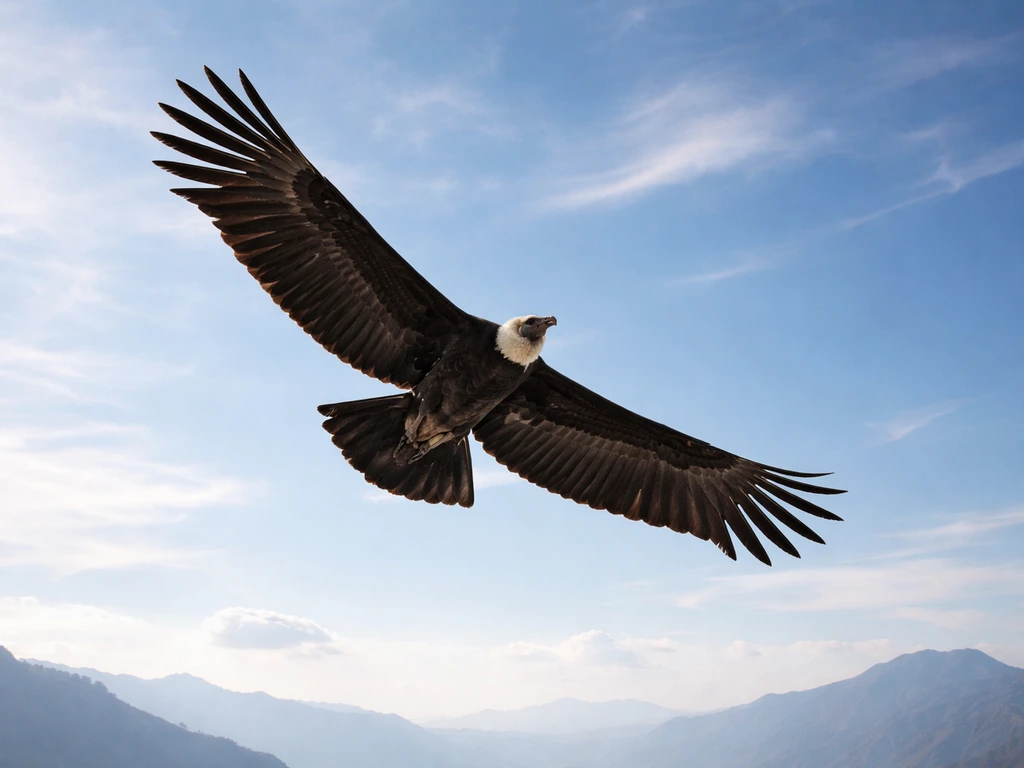
The bird most people are picturing when they reach for monster-movie comparisons is a condor, specifically either the Andean Condor (Vultur gryphus) or the California Condor (Gymnogyps californianus). Both are genuinely enormous: the Andean Condor holds the Guinness record as the world's largest living bird of prey, with a wingspan that can exceed 10 feet (3 meters) and a body weight up to about 33 pounds (15 kg). California Condors are slightly smaller but still staggering, with wingspans up to 9.5 feet. When one of these birds glides overhead on flat, motionless wings, the 'kaiju' comparison makes complete sense.
The other kaiju touchpoint, Rodan, is visually inspired by pterosaurs rather than any living bird, which is why he looks so alien. If you saw something that more closely resembled a flying reptile with a narrow pointed wingspan and no visible head-neck boundary, you may have glimpsed a Great Blue Heron, a Sandhill Crane, or a Turkey Vulture in poor light conditions, all of which get misidentified constantly.
Species breakdown: anatomy, behavior, habitat, and range
| Trait | Andean Condor | California Condor | Turkey Vulture |
|---|---|---|---|
| Wingspan | Up to 10.5 ft (3.2 m) | Up to 9.5 ft (2.9 m) | Up to 6 ft (1.8 m) |
| Body weight | Up to 33 lbs (15 kg) | Up to 26 lbs (11.8 kg) | Up to 5.3 lbs (2.4 kg) |
| Head color (adult) | Red/dark with wattle (male), red (female) | Bright orange-red | Red, unfeathered |
| Plumage | Black with white wing patches and ruff | Black with white wing linings | Dark brown-black, silver flight feathers below |
| Flight style | Flat-winged, barely flaps, soars for hours | Flat-winged, rarely flaps | Pronounced V-shape (dihedral), rocks/tilts |
| Habitat | Andes mountains and coastal cliffs, Venezuela to Tierra del Fuego | Cliffs and mountain ranges, California/Arizona/Utah/Baja | Widespread across Americas, open country to forest edges |
| Range note | South America only (wild) | Reintroduced in western North America | North and South America, very common |
Behaviorally, condors are almost exclusively carrion feeders. They locate food by sight and by watching other scavengers, not by smell, which is the opposite of Turkey Vultures. They roost communally on cliff faces and thermal-soar for hours, covering hundreds of miles a day without a single wingbeat. That effortless, rigid-winged soaring is the single most distinctive behavioral cue in the field.
How to tell these birds apart in the field
Size and silhouette first
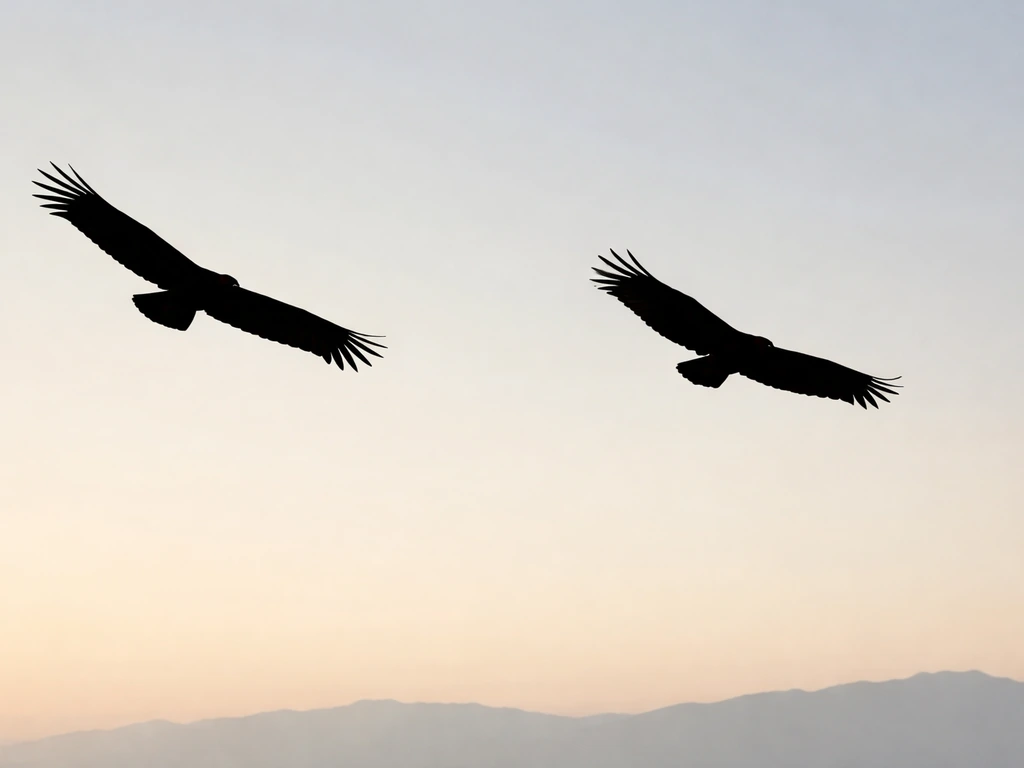
Size is your anchor. A condor in the air looks roughly twice the size of a Turkey Vulture. If you have ever watched a Red-tailed Hawk soar and thought it looked big, a condor overhead will make it look like a sparrow. The wings are also notably rectangular and broad compared to the Turkey Vulture's slimmer, more fingered silhouette. Andean Condors also hold their wings flat like a plank when gliding, creating a very different profile from the rocking, V-angled Turkey Vulture.
Key field marks to nail the ID
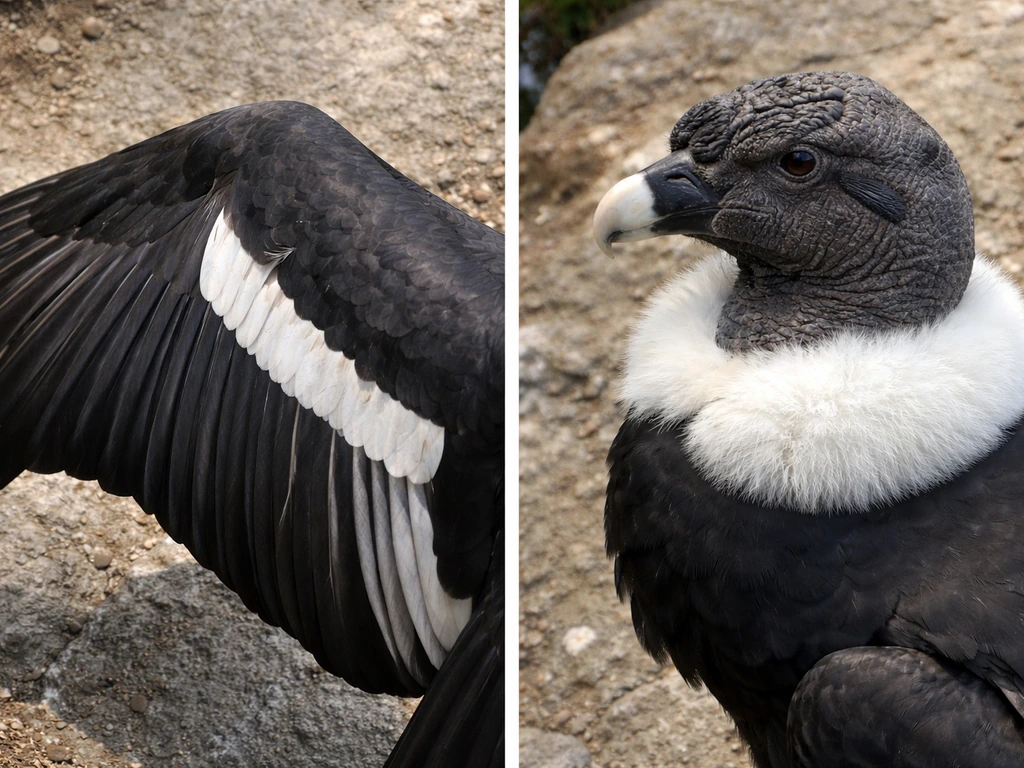
- White wing patches: California Condors show bright white triangular patches on the underside of the inner wing (wing linings); Andean Condors have a broad white ruff at the neck and white upperwing patches visible from above
- Head color: Adult California Condors have a vivid orange-red head; Andean Condors show red to dark red heads with a fleshy wattle (males have a more prominent comb/wattle); Turkey Vultures have a small, plain red head that almost disappears against the body
- Flight angle: Condors fly flat-winged; Turkey Vultures tilt side to side in a pronounced V (dihedral); Golden Eagles also soar but with a slight dihedral and brown plumage without a bare head
- Flap frequency: If the bird flaps more than once every few minutes while soaring, it is probably not a condor
- Body bulk: Condors look barrel-chested from below; Turkey Vultures look relatively slender
- Tail shape: Condors have a short, rounded tail; Turkey Vultures have a longer, more wedge-shaped tail
Gender differences within condor species
Male and female Andean Condors look noticeably different, which surprises a lot of birders because it is relatively rare in large raptors. Males have a distinctive fleshy comb (caruncle) on the forehead and a larger wattle than females. Females lack the comb entirely and have red irises, while males have dark brown irises. Both sexes carry the same bold white wing patches and black body plumage. In California Condors, the sexes look alike in plumage, so gender cannot be reliably determined from appearance alone in the field.
Common lookalike confusion
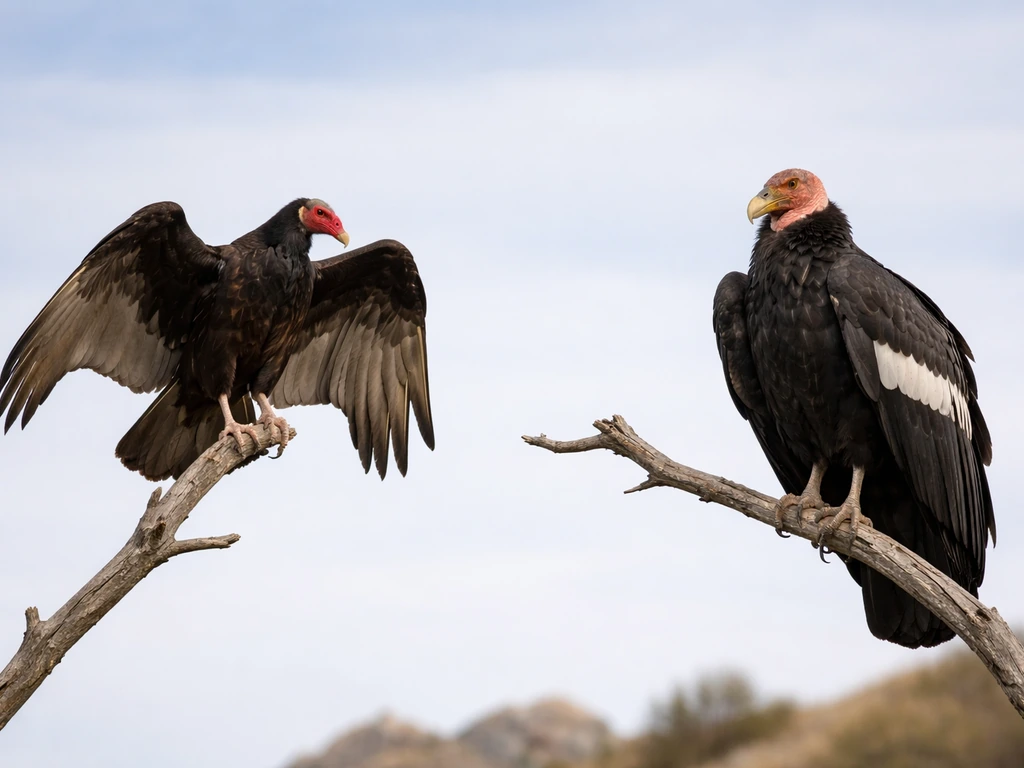
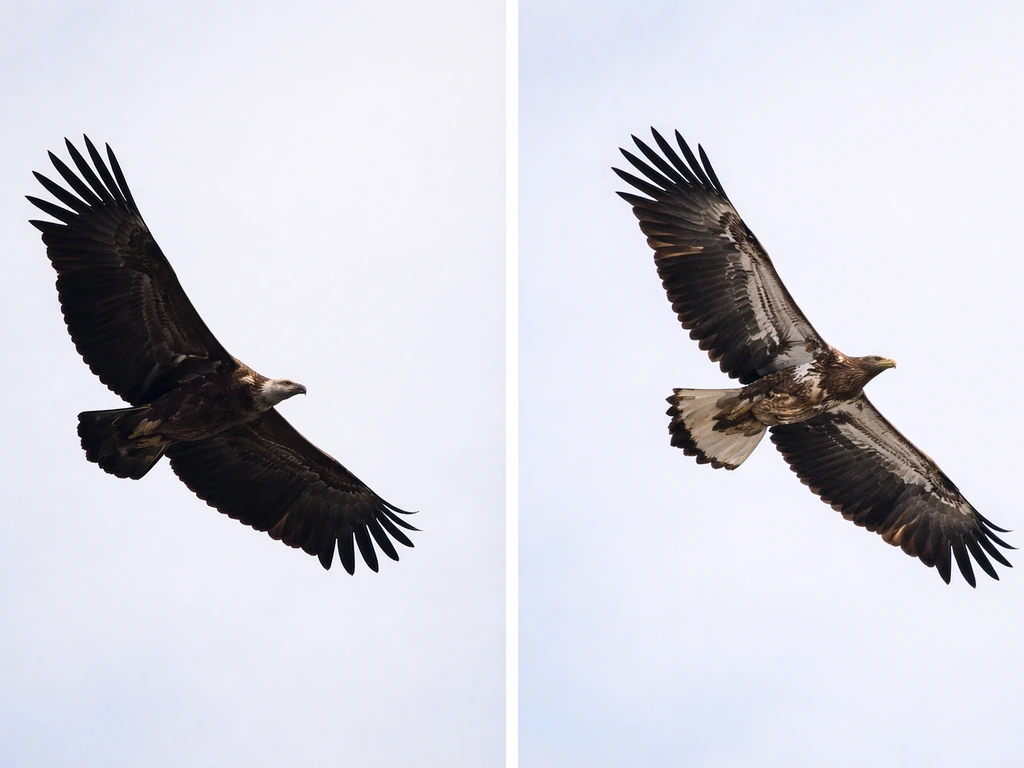
Turkey Vultures cause the most confusion at a distance because they share the dark plumage and bare head. The dihedral wing posture and constant rocking tilt are the fastest separators. Golden Eagles can overlap in habitat with condors and are also large and dark, but they have fully feathered heads, a tawny-gold nape, and a different wing shape. Black Vultures are another lookalike but are noticeably smaller, have short tails, silvery wingtips (not white patches), and flap in quick bursts between glides. In low light or at great distance, Great Blue Herons can seem huge and pterosaur-like, but their slow, measured wingbeats and retracted neck posture in flight make them easy to separate once you know what to look for.
Where Godzilla and Kong actually fit in
Rodan, the most famous 'Godzilla bird,' is modeled on pterosaurs, not on any living bird. His design borrows from Pteranodon: a long pointed beak, narrow swept wings without visible feathers, and a crested head. Nothing alive today looks like Rodan. The Giant Condor kaiju (who literally challenged Godzilla in the 1966 film 'Ebirah, Horror of the Deep') is a much closer analog to a real condor, and the Toho creative team clearly drew on condor imagery for that creature's look.
Apocalypse Bird vs Whitenight is a popular fandom comparison that mixes up different fictional monster-birds, so use it as context but rely on real field marks for ID. That connection is probably why people typing 'Godzilla bird' into a search engine sometimes end up needing condor ID help.
In the MonsterVerse, 'Godzilla vs. Kong' does not prominently feature a bird kaiju, but meme culture blends all of these references freely. It is also worth checking how the fictional battle angle in Batman vs bird comparisons changes what people think they are seeing. You might also have seen the 'Godzilla flips the bird' meme format or 'Godzilla vs. 5 billion pigeons' joke posts, which are purely humorous and have nothing to do with real bird ID. If your search came from those angles, you are now in the right place to learn about the actual animals that inspired kaiju designers in the first place.
If you enjoy comparing fictional creature matchups alongside real-world animal equivalents, you might also find the comparisons on this site between similarly giant-seeming or misidentified birds interesting, including how a shark stacks up against large seabirds, or the classic confusion between nighthawks and whippoorwills where pop-culture naming causes constant misidentification. If you are unsure whether you are looking at a nighthawk or a whippoorwill, the key differences in calls and posture can help you confirm the species nighthawks and whippoorwills.
How to confirm your ID and what to do next
The most reliable modern tool for confirming a large, unfamiliar bird is the Merlin Bird ID app from the Cornell Lab of Ornithology. It has three identification modes that work well for this kind of situation: Photo ID (upload a photo and the app uses computer vision trained on millions of images from the Macaulay Library), Sound ID (hold the phone up and let it identify the call in real time), and a step-by-step mode where you answer questions about size, color, and behavior. For condors specifically, Photo ID is your best bet since they are visually striking and the app's training data is strong for large raptors.
- Photograph the bird if you can, ideally from below showing the wing pattern and head color, and from the side showing body bulk and tail shape
- Note your exact location (GPS coordinates or a named place) and the date and time, because range data is critical: if you are in western North America, a California Condor is possible; if you are in South America near the Andes, an Andean Condor is likely; if you are anywhere else and the bird is large and dark, Turkey Vulture is the statistically safer starting point
- Open Merlin Photo ID and submit the photo, or use the step-by-step ID with your size and location data
- Cross-reference on eBird's Explore function, which acts as a regional field guide and shows which large soaring birds have recently been reported in your area
- If Merlin flags a condor, report the sighting on eBird immediately as condor sightings (especially California Condors) are tracked by conservation programs and your data genuinely helps researchers
- For Andean Condor confirmation in South America, BirdLife International and local birding groups maintain active monitoring networks and welcome observer reports
One practical note on using these tools: Merlin can occasionally misfire on unusual angles or poor lighting, so treat its suggestion as a strong starting point, not a definitive answer. If the app says condor but you are in a location completely outside the known range, go back to the field marks and look again at Turkey Vulture or Golden Eagle. Location plus field marks together will always beat either one alone. Bird identification works best as a puzzle where you stack multiple clues until only one species fits, exactly the approach experts like the Audubon Society and Cornell Lab recommend.
FAQ
I saw a huge dark bird overhead, could it be a condor or is it just a Turkey Vulture like the article warns?
Start with flight posture. Condors typically hold wings flatter and soar with minimal rocking, while Turkey Vultures usually show a more pronounced V-angled, rocking dihedral during gliding. Then check head visibility, Turkey Vultures often look smaller and more uniform in silhouette, condors read as a larger, broader, more rectangular “plank” wing profile.
How can I tell an Andean Condor from a California Condor quickly in the field?
Don’t rely on gender, because Andean Condors show male facial caruncles while California Condors often look similar between sexes. For species ID, use geography first (Andean Condor is South American, California Condor is North American). If you are outside those expected ranges, treat it as a likely mis-ID and re-check Turkey Vulture or Golden Eagle field marks.
What should I do if the Merlin app labels my bird as a condor but I am far outside condor range?
Use it as a shortlist, not a verdict. Re-run ID using Sound ID if you can capture calls, or switch to the step-by-step mode and force the app to consider cues like head feathering, wing shape, and wing posture. Then physically compare your bird’s head (bare vs feathered), wing silhouette, and riding style against Golden Eagle and Turkey Vulture, since range mismatch is a major red flag.
Are condors attracted to the kind of carcasses that birders might be near, making them easier to spot?
Yes, condors are scavengers and will exploit carrion when available, but sightings still depend on local food availability and thermals. They may arrive late to a carcass once other scavengers indicate it, so if you are watching a place for only a few minutes you can easily miss the condor response window.
Can lighting or distance make Rodan-like “pterosaur” features appear on a real bird?
Definitely. In poor light, some birds can look more reptile-like because the head-neck boundary may be hard to see and contrast can flatten wing detail. If the bird shows visible feather structure on the wings, a distinct head and neck outline, and any flapping cadence, it is very unlikely to be anything like Rodan, and you should re-check common large raptors and herons.
What is the quickest tell between a Golden Eagle and a dark condor at mid-distance?
Check the head. Golden Eagles have fully feathered heads, often showing a different color tone on the nape area, while condors have a bald or bare-looking head with no feathered cap. If the head looks feathered, Golden Eagle becomes the leading candidate regardless of overall darkness.
If I miss the first moment and only see the bird’s wings during a glide, what single cue should I prioritize?
Prioritize wing shape and angle during soaring. Broad, rectangular-looking wings held flatter are more condor-like, while Turkey Vultures more often show slimmer, fingered silhouettes and the characteristic rocking dihedral. This remains useful even when you cannot clearly see facial features.
Why do male and female Andean Condors look different, and can I reliably use that for ID?
Male Andean Condors have a fleshy forehead caruncle and a larger wattle, females lack the comb and can show red irises. You can use it if you have a clear, close view, but it is easy to overcall when the bird is distant or backlit. Use sex cues only as a secondary confirmation after geography, size impression, and wing posture.
Next Articles
Batman vs Bird: Identify the Animal and Tell Them Apart
Learn what Batman vs bird means and use field marks, behavior, and habitat to ID the right animal fast.
Nighthawk Bird vs Whippoorwill: Field ID Guide
Side-by-side field ID for nighthawk vs whippoorwill: size, silhouette, habitat, flight, calls, and quick checklists.
Parrot Flower vs Bird of Paradise: How to Tell Them Apart
Quick checklist to tell parrot flower or parakeet flower from bird of paradise using blooms, leaves, and growth habit.