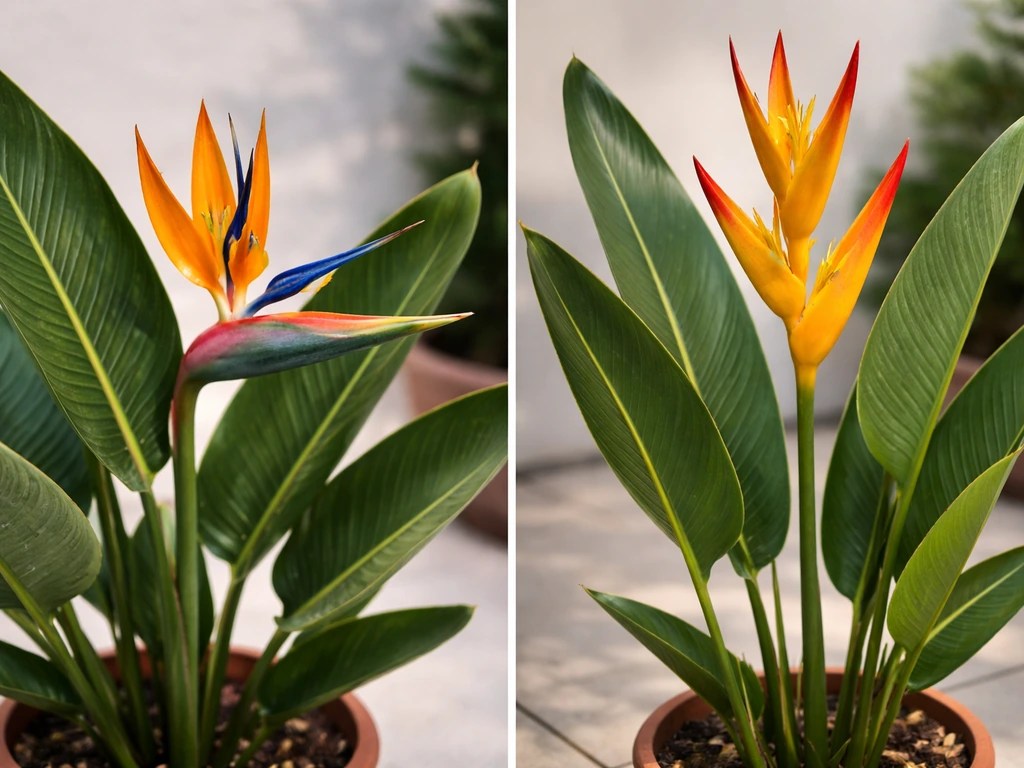
blank" rel="noopener noreferrer">The name "parrot flower" (or "parakeet flower") almost always points to Heliconia psittacorum, a tropical perennial with waxy, bract-based blooms in orange-red tones. "Bird of paradise" most reliably points to Strelitzia reginae, the South African native with three bold orange sepals and three blue petals that together form an unmistakable bird-head shape. If you are trying to tell canna lily vs bird of paradise apart, the label alone can mislead you, so use the botanical name and flower shape to confirm. They are genuinely different plants from different families, and once you know what to look for in the flower, leaf, and overall size, you will not mix them up again.
Parrot Flower vs Bird of Paradise: How to Tell Them Apart

Marcus Hendricks
28 Jun 2026
Why these names get confused in the first place
Both plants have vivid, tropical-looking blooms that remind people of exotic birds. Heliconia psittacorum has the word "psittacorum" right in its Latin name, which means "of parrots," so it has been called parrot's beak, parakeet flower, and false bird-of-paradise across different regions and cultures. Heliconia psittacorum is described as [“false bird-of-paradise”](https://www. ust.
edu. ph/ust-manila-plant-databse/false-bird-of-paradise/) and is also known in English as “parrot’s beak” and “parakeet flower. ”. For confirmation and botanical details, the Royal Horticultural Society lists Heliconia psittacorum (parakeet flower) under its accepted name [Heliconia psittacorum has the word "psittacorum" right in its Latin name, which means "of parrots,"](https://www.
rhs. org. uk/plants/8552/heliconia-psittacorum/details). Meanwhile, Strelitzia reginae has been called bird of paradise, crane flower, and even "bird of paradise flower" so universally that the entire Strelitzia genus carries that label.
When a garden center puts both plants on the same shelf under loosely worded signs, or when an online seller uses marketing-friendly common names without botanical backup, the confusion is almost guaranteed.
There is a third layer of confusion worth knowing about: "parrot flower" is also used for Alstroemeria psittacina, sometimes called parrot lily. That plant is completely different again, a lower-growing perennial with tubular red-and-green flowers. So the phrase "parrot flower" can technically point to at least two different genera depending on where you are or who is selling it. The safest move is always to ask for, or search for, the botanical Latin name before you buy.
The regional naming problem makes this worse. In parts of Southeast Asia, the Caribbean, and Central America, Heliconia psittacorum gets marketed simply as "bird of paradise" because it fills a similar ornamental niche. In the United States and Europe, Strelitzia reginae has a near-monopoly on that label. Neither usage is technically wrong, but together they create a situation where two completely different plants share overlapping common names depending on where you shop.
Quick ID checklist: parrot/parakeet flower vs bird of paradise
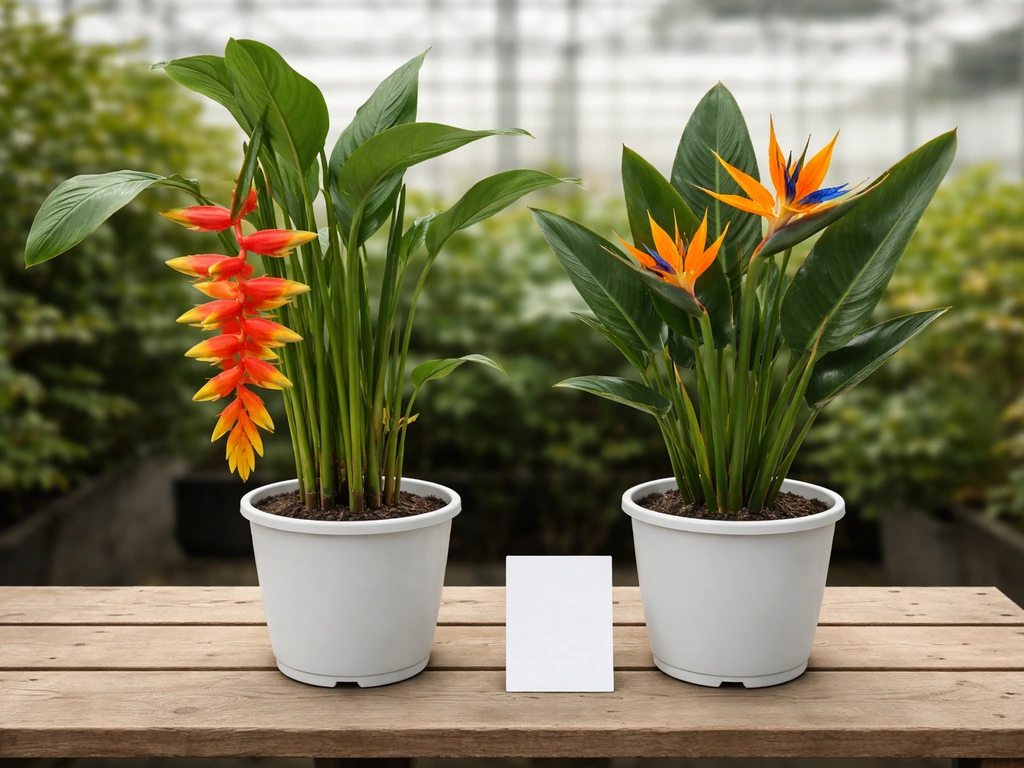
Run through this list when you are standing in front of a plant at a nursery or looking at a photo online. You only need two or three matching traits to feel confident about what you have.
| Trait | Parrot/Parakeet Flower (Heliconia psittacorum) | Bird of Paradise (Strelitzia reginae) |
|---|---|---|
| Botanical name | Heliconia psittacorum | Strelitzia reginae |
| Flower structure | Multiple waxy bracts (spathes) arranged along a stalk, each bract housing coiled flowers inside | Single upright bract from which 3 orange sepals and 3 blue petals emerge like a bird's head |
| Dominant flower color | Orange-red bracts with green-tipped sepals | Bright orange sepals + vivid blue/purple petals |
| Inflorescence direction | Can be erect or drooping depending on cultivar; bracts in 2 ranks with 2-7 bracts per stalk | Always upright, emerging stiffly from a heavy horizontal bract |
| Leaf shape | Lanceolate to elliptical, banana-like, carried on tall stalks | Paddle-shaped, long-stalked, leathery, held more rigidly |
| Plant height | Typically around 50 cm indoors; can reach larger outdoors depending on conditions | 0.8 to 1.2 m in height with a spread up to about 2.5 m |
| Overall look | Bushy tropical clump, flowers nestled above banana-like foliage | Clumping, architectural, flowers held on bare rigid stems above the leaf mass |
| Other common names | False bird of paradise, parrot's beak, parakeet flower, parrot heliconia | Bird of paradise flower, crane flower (Strelitzia reginae); wild banana, giant white bird of paradise (Strelitzia nicolai) |
How the flowers actually look up close
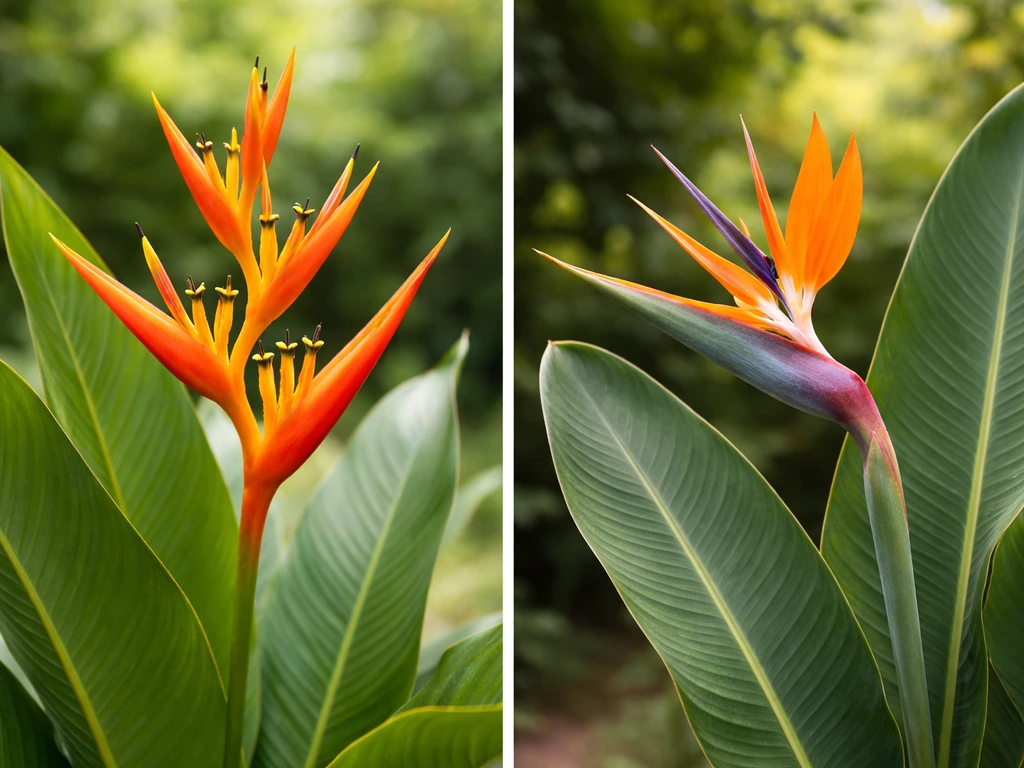
This is where you can settle the question in seconds. Strelitzia reginae produces what most people picture when they hear "bird of paradise flower": a rigid, boat-shaped bract (usually purplish-green) held horizontally, from which three vivid orange sepals fan upward and three blue petals, two of them fused together, fold over the stamens and style to create a pointed crest. The whole arrangement genuinely resembles a tropical bird's head poking out from a leaf. Every flower on a Strelitzia stalk follows this exact three-plus-three structure.
Heliconia psittacorum works completely differently. If you are comparing the crane flower look against the bird of paradise, focus on the stacked waxy bracts versus the boat-shaped bract and blue petals Heliconia psittacorum. Its inflorescence is made up of a series of brightly colored waxy bracts, technically called spathes, stacked along a rachis (the central stalk). Each bract is a hollow boat shape, and nestled inside each one is a coil of smaller flowers.
The Cambridge Butterfly Conservatory describes the typical arrangement as 2 to 7 upcurved orange-red bracts in two alternating ranks, with orange-red sepals that have green-banded tips. It is more like a layered architectural structure than a single bird-head sculpture. The green-tipped detail on the sepals is a useful quick marker: Strelitzia reginae does not have green tips on its orange parts.
The color families overlap enough to cause confusion in photos. Either way, if you are trying to nail down the plant from common names, a quick comparison like peace lily vs bird of paradise can also help you avoid mix-ups. Both plants lean orange-red, and both have a tropical brightness to them. But the blue in Strelitzia reginae is unmistakable and absent in Heliconia psittacorum. If you see blue petals, you are almost certainly looking at a Strelitzia. If the bloom is all orange-red with green highlights and a stacked-bract arrangement, you are looking at Heliconia.
Leaves, stems, and overall plant habit
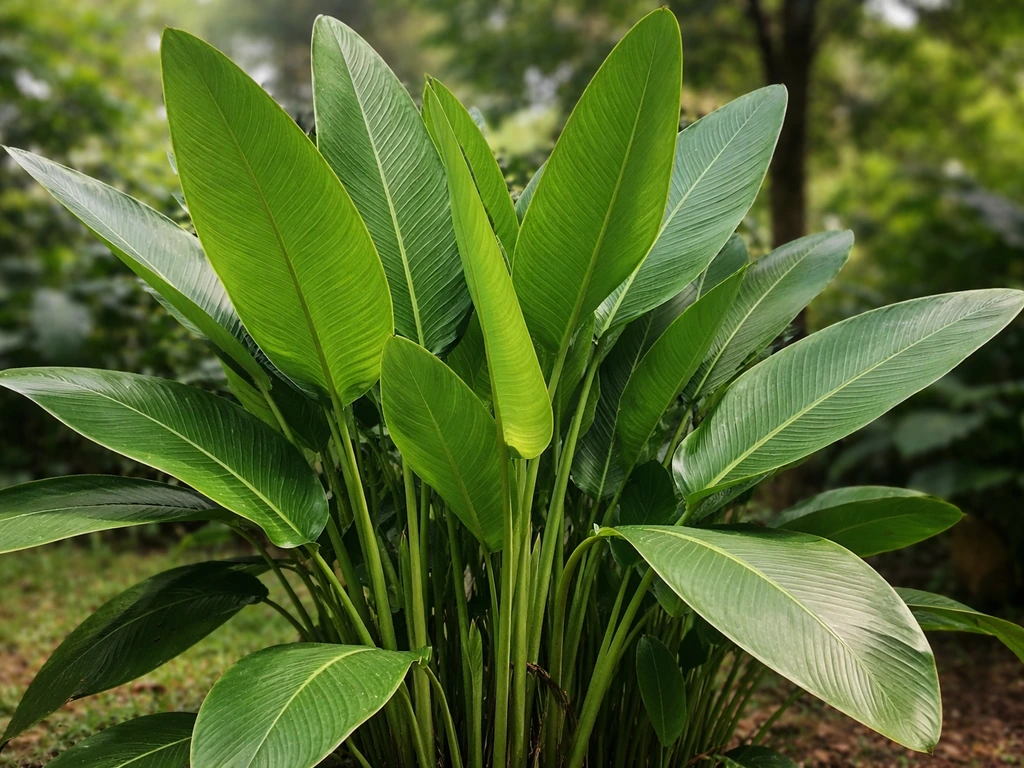
Both plants have tropical, bold foliage, but they feel different when you see them side by side. Heliconia psittacorum has lanceolate to elliptical leaves that closely resemble small banana leaves, soft and held on long petioles. The Chicago Botanic Garden describes the foliage as dark green and banana-like, with flowers borne above the clumps on erect stems. The overall effect is lush and jungle-like, more like a dense herbaceous perennial than a sculptural accent plant.
Strelitzia reginae is more architectural. Its leaves are paddle-shaped, thick, and leathery, carried on long channeled petioles. The plant forms a clumping rosette that typically reaches 0.8 to 1.2 meters tall with a spread of up to about 2.5 meters when mature. The flower stems are separate from the leaf stalks and stand rigidly upright, giving the whole plant a clean, sculptural silhouette. If you have seen a bird of paradise in a hotel lobby or as a landscape specimen in California or Florida, that structural quality is what you remember.
If the plant is labeled "bird of paradise" but has large fan-like leaves on thick woody stems and is very tall, you might actually be looking at Strelitzia nicolai, the giant white bird of paradise, which can reach 7 to 8 meters in height with clumps spreading about 3.5 meters. It is a common houseplant sold simply as "bird of paradise" despite being a much larger, different species. Strelitzia juncea, the narrow-leaved or rush-leaved bird of paradise, is another variant with dramatically thin leaf stalks instead of broad paddles. These are all distinct from Heliconia psittacorum, but knowing they exist helps you ask the right questions at the nursery.
How to verify the botanical name when buying or searching
Common names are unreliable. The only way to be sure you are getting the plant you want is to confirm the Latin binomial before you pay. Here is how to do that in practice.
- Ask the seller directly for the botanical name. Any reputable nursery staff member should be able to tell you whether the tag says Heliconia psittacorum or Strelitzia reginae. If they cannot tell you, that is a red flag.
- Check the plant tag or pot label. Mass-market retailers sometimes print only common names, but specialty growers and botanical-garden plant sales almost always include the Latin name. Look for it on the back of the tag.
- Search online using the botanical name plus a photo reference. Searching 'Heliconia psittacorum' or 'Strelitzia reginae' in Google Images gives you an instant visual confirmation you can hold up against the plant in front of you.
- For online purchases, check whether the listing includes a botanical name in the product description or specifications. Sellers like Desert-Tropicals and institutional plant finders (RHS, Chicago Botanic Garden, NC State Extension) all list both common and botanical names, and using those as references gives you a reliable verification baseline.
- If you have the plant but no label, look at the flower. The blue petals of Strelitzia reginae and the stacked orange-red bracts of Heliconia psittacorum are distinctive enough that a clear photo compared to a botanical reference will resolve the question quickly. If the plant has not bloomed yet, the leaf shape and overall habit can narrow it down significantly.
Growing conditions and care: what to expect from each plant
These two plants look similar enough that people sometimes care for one as if it were the other, and then wonder why it struggles. Their needs are genuinely different in a few key ways. If you are trying to choose between them, compare the look and care needs in lego bird of paradise vs orchid.
Heliconia psittacorum (parrot/parakeet flower)
This is a true tropical that wants warmth and moisture. The Chicago Botanic Garden recommends full sun to partial shade and organic-rich, evenly moist soil with good drainage. BBC Gardeners' World notes it is hardy only down to about 13 degrees Celsius, so in most temperate climates it is strictly a container plant that needs to come indoors before temperatures drop. Indoors, it prefers bright indirect light rather than harsh direct sun. It is an ever-blooming plant under the right conditions, which means consistent warmth and moisture matter a lot. Let it dry out or get cold, and flowering stops quickly.
Strelitzia reginae (bird of paradise)
Strelitzia reginae is from the dry, rocky coastal regions of South Africa, so it handles drier conditions far better than Heliconia. NC State Extension recommends well-lit, sunny spots with fertile, loamy, well-drained soil. Water freely and fertilize regularly during spring and summer, then pull back significantly in winter. UF/IFAS places it in USDA hardiness zones 10 through 11 for outdoor growing, making it a landscape plant in frost-free climates like southern Florida and Southern California. As a houseplant it is famously slow to bloom unless it gets enough direct light and is slightly root-bound. Overwatering is the most common mistake: Strelitzia reginae wants to dry out a bit between waterings, unlike Heliconia, which prefers consistent moisture.
| Care Factor | Heliconia psittacorum | Strelitzia reginae |
|---|---|---|
| Light | Full sun to partial shade; bright indirect indoors | Full sun preferred; very well-lit spot indoors |
| Water | Consistently moist; does not like drying out | Water freely in growing season; drier in winter |
| Soil | Organic-rich, evenly moist, well-drained | Fertile, loamy, well-drained; tolerates drier conditions |
| Minimum temperature | ~13°C; strictly tropical | Hardy in USDA zones 10-11 outdoors; protect from frost |
| Blooming trigger | Consistent warmth, moisture, and sun | Needs strong light and slight root restriction |
| Indoor viability | Yes, but needs warmth and humidity | Yes, common houseplant; slow to bloom without enough sun |
Common lookalikes and troubleshooting misidentification
Beyond Heliconia psittacorum and Strelitzia reginae, a few other plants regularly cause confusion in this space. Knowing them by name helps you rule them out quickly.
- Alstroemeria psittacina (parrot lily / parrot flower): A lower-growing perennial with tubular red flowers streaked with green and brown markings. NC State Extension lists 'Parrot Flower' as a common name for this species. It looks nothing like Strelitzia in bloom, but the shared common name causes real confusion in seed catalogs and online searches.
- Strelitzia nicolai (giant white bird of paradise / wild banana): Often sold as 'bird of paradise' at big-box stores. Has white and dark blue-purple flowers instead of orange and blue, and can grow 7 to 8 meters tall. If your 'bird of paradise' has enormous fan leaves and a tree-like trunk, this is likely what you have.
- Strelitzia juncea (rush-leaved bird of paradise): Sold under the bird of paradise name but has narrow, rush-like leaf stalks with no blade. Useful if you want the classic flowers with a more sculptural, minimal silhouette.
- Heliconia species in general: There are many Heliconia species beyond psittacorum, and some are marketed under bird-like names. If the bloom has stacked, boat-shaped waxy bracts along a central stalk with smaller flowers tucked inside each bract, it is a Heliconia regardless of what the label says.
- Canna lilies and peace lilies: Occasionally grouped with bird of paradise in tropical plant displays at garden centers. Both are easy to rule out by flower shape, but the confusion happens more in online image searches than in person.
If you already bought a plant under an ambiguous name and want to identify it without a flower, focus on the leaves and stems. Heliconia psittacorum has soft, banana-like leaves on slender petioles and forms a fairly compact clump. Strelitzia reginae has thick, leathery paddle leaves on stiff channeled stalks. Strelitzia nicolai has truly massive banana-style leaves on a trunk-forming stem. Reddit plant identification threads are full of people trying to sort these out from leaf photos alone, and the consensus is consistently the same: wait for a flower, or check the botanical name on your original receipt or tag.
The broader bird-of-paradise plant family also includes topics that come up alongside this one, including the comparison between heliconia and bird of paradise as a whole, and the differences between giant bird of paradise and standard bird of paradise. Crane flower, another common name for Strelitzia reginae, adds yet another alias into the mix. If you are doing research across these comparisons, always anchor your search to the botanical name and treat the common name as a starting point, not a final answer.
FAQ
If the plant label says “bird of paradise” but I cannot see the flowers, how can I confirm whether it’s Heliconia or Strelitzia?
Start with the leaves and stems. Strelitzia reginae has thick, leathery paddle leaves on stiff, channeled petioles, often forming a clumping rosette, and its flower stems stand rigidly separate from the leaf stalks. Heliconia psittacorum has softer banana-like leaves on long slender petioles, with a more herbaceous, layered clump look. If you still cannot tell, check for the botanical name on the tag or receipt, since “bird of paradise” is used for different genera in different regions.
My plant looks like it has orange-red and green parts, but there is no visible blue. Could it still be Strelitzia reginae?
In most cases, the classic Strelitzia look includes blue petals, so absence of blue is a red flag that you might not have reginae. Some photos make the blue hard to see due to lighting or seedpod stage, but the flower structure pattern is the real test: Strelitzia has a boat-shaped bract with three orange sepals and fused blue petals forming a crest. If the bloom is mainly stacked orange-red bracts with green-banded tips on the sepals, it is more consistent with Heliconia.
Can Heliconia psittacorum ever be sold or grown under the name “parrot flower” when it is actually Alstroemeria (parrot lily)?
Yes. “Parrot flower” can refer to Heliconia psittacorum, but it can also be used for Alstroemeria psittacina (parrot lily). Alstroemeria typically grows lower and has tubular red-and-green flowers rather than a stacked, waxy bract inflorescence. If the label is vague, confirm the genus (Heliconia vs Alstroemeria) before assuming care requirements.
What is the fastest flower-shape check I can do from a single photo?
Look for the bract arrangement. Strelitzia reginae shows a single, rigid, boat-shaped bract held horizontally, with three orange sepals fanning up and blue petals folding over the center. Heliconia shows a rachis with multiple upcurved, stacked waxy bracts (a layered structure), and each bract encloses smaller flowers. If you can clearly count whether it is “one crest” or “stacked bracts,” you usually get the answer immediately.
Are these two plants interchangeable in care, since they are both tropical and ornamental?
No, their moisture and blooming behavior differ enough that mixing them often causes frustration. Heliconia generally tolerates more consistently moist conditions and keeps producing when warmth and moisture are steady. Strelitzia reginae is more drought-tolerant once established, and overwatering is a common reason it fails to bloom. If you are unsure which you have, base care on the botanical name rather than the common label.
I have a “bird of paradise” in a pot and it will not flower. How can I avoid the most common mistake?
The most common issue is not light or not enough warmth, but also too much water. Strelitzia reginae often blooms poorly when it is kept too wet or when the plant stays too cool. Let the potting mix dry out somewhat between waterings, use bright light (often near a window with more direct morning sun than harsh midday sun), and avoid chilling temperatures that stop flowering.
If I buy “bird of paradise,” how do I prevent getting a different species like giant white bird of paradise?
Ask for or verify the Latin binomial on the tag before purchasing. “Bird of paradise” can be used for Strelitzia reginae, but it is also used for Strelitzia nicolai (giant white bird of paradise) and Strelitzia juncea (narrow-leaved/rush-leaved types). These differ dramatically in size and leaf shape, so botanical confirmation matters, especially if you have limited indoor space.
If I am checking leaf photos online, which leaf traits matter most for separating Heliconia from Strelitzia?
For a quick leaf-based screen, focus on texture and petiole structure. Heliconia leaves tend to look softer and more banana-like, with slender-looking petioles and a dense, jungle-like clump feel. Strelitzia leaves are thicker, leathery, paddle-shaped, and sit on stiff, channeled stalks. If the leaves look clearly paddle-like and leathery, Strelitzia is more likely.
What should I do if my plant is labeled with common names only, and I already bought it?
Take the safest next step: identify using the original tag or receipt first. If that information is missing, use a systematic check in order: (1) flower shape if available, (2) whether blue petals appear, (3) stacked bracts versus a single cresting bract, and (4) leaf texture and petiole stiffness. If you still cannot confirm, err on the more conservative approach for moisture by avoiding persistent soggy soil until you can verify the genus.
Next Article
Crane Flower vs Bird of Paradise: Quick ID Guide
Crane flower vs bird of paradise: quick visual ID, key differences in blooms, leaves, growth, and fix mislabels.