Colibri and hummingbird refer to the same group of birds. 'Colibri' is simply the Spanish and French-derived word for hummingbird, used across Latin America, France, and parts of the English-speaking world as a direct synonym. The only place the two terms mean something slightly different is inside formal taxonomy: Colibri (capital C, italicized) is also the name of a specific genus within the hummingbird family Trochilidae, containing five species known as the violetears. So if someone says 'colibri' in everyday conversation or a field note, they almost certainly mean hummingbird. If you see Colibri in a scientific checklist or species account, they mean one of those five violetear species specifically.
Colibri Bird vs Hummingbird: Field ID, Taxonomy, and Names

Marcus Hendricks
22 Jul 2026
Are 'colibri' and 'hummingbird' the same thing?
Yes, with one important nuance. In everyday language across most of the world, 'colibri' and 'hummingbird' are interchangeable. The Real Academia Española defines colibrí as the small, long-billed, brightly plumaged American bird, which is exactly what English speakers call a hummingbird. Collins English Dictionary lists 'colibri' as a British English variant and loanword for hummingbird. There is no biological or behavioral difference implied by the choice of word; it is purely a language difference, like calling the same animal a 'puma' versus a 'mountain lion' versus a 'cougar'.
The confusion usually arises when readers encounter Colibri in a scientific paper, a field guide species list, or a birding app and assume it must refer to something distinct from ordinary hummingbirds. It does, but only in the narrow taxonomic sense described in the section below. For practical identification and casual conversation, treat them as the same.
Two meanings of 'colibri': everyday name versus the genus Colibri
The word 'colibri' carries two distinct jobs depending on context, and mixing them up is the root of most confusion around this topic.
Meaning 1: the common-language name for any hummingbird
In Spanish, French, Portuguese-adjacent texts, and British English usage, 'colibri' (or colibrí with an accent) simply means hummingbird. It covers all roughly 360 species in the family Trochilidae. When a travel blog says 'we spotted a colibri at the feeder in Costa Rica,' they are talking about a hummingbird, full stop. No special taxonomic meaning is intended, and the writer probably has no idea which genus the bird belongs to.
Meaning 2: the formal genus Colibri (the violetears)
In ornithological literature, Colibri (always capitalized and italicized in proper usage) is a genus of five species within Trochilidae. These are medium-to-large hummingbirds called violetears, named for the iridescent violet or blue auricular (ear) patch that all members carry. The five currently recognized species are the Sparkling Violetear (Colibri coruscans), the Mexican Violetear (Colibri thalassinus), the Lesser Violetear (Colibri cyanotus), the White-vented Violetear (Colibri serrirostris), and the Brown Violetear (Colibri delphinae). The Mexican and Lesser Violetear were formerly lumped as a single 'Green Violetear' species; modern checklists including the IOC World Bird List now treat them as separate species. Every member of genus Colibri is a hummingbird, but not every hummingbird is a Colibri.
A quick taxonomy primer: Trochilidae, the genera, and where Colibri fits
Hummingbirds make up the family Trochilidae, which sits in the order Apodiformes alongside swifts. The family is exclusive to the Americas and currently contains around 360 species organized into more than 100 genera. That enormous diversity in genera is one reason 'hummingbird' as a common name covers such a huge range of sizes, bill shapes, colors, and behaviors.
Within Trochilidae, genus Colibri belongs to the subfamily Trochilinae (the typical hummingbirds) and sits comfortably among other larger-bodied genera. Its five species range from central Mexico through Central America and across much of South America, with the Sparkling Violetear being particularly widespread and common in Andean gardens. The Cornell Lab's Clements Checklist and the IOC World Bird List (v15.2) both maintain Colibri as a valid, well-defined genus, and BirdLife International/HBW species accounts provide detailed treatment for each member. blank" rel="noopener noreferrer">Handbook of the Birds of the World and BirdLife International Digital Checklist (excerpt PDF) treats Colibri thalassinus and Colibri coruscans as distinct species and provides species accounts for the genus. blank" rel="noopener noreferrer">Hummingbirds – IOC World Bird List (v15.2) lists genus Colibri within the hummingbird family Trochilidae. In short, Colibri is one small corner of the enormous hummingbird family tree.
- Family: Trochilidae (all hummingbirds, ~360 species)
- Subfamily: Trochilinae (typical hummingbirds)
- Genus Colibri: 5 species, all called violetears
- Diagnostic genus trait: a violet or blue auricular (ear) patch
- Body size: medium-to-large for hummingbirds (roughly 9.5 to 15 cm)
Regional names and language notes
One thing I find genuinely useful to know before reading any field note or nature article is which language and which country the writer is working in. Hummingbirds collect a remarkable number of local names, and knowing the equivalents prevents a lot of unnecessary confusion.
In Spanish, colibrí is the standard dictionary term (RAE-approved), but regional synonyms are extremely common. In Argentina, Chile, Peru, and parts of Central America you will routinely see picaflor ('flower-pecker') or chupaflor ('flower-sucker') in both casual speech and local field notes. In Mexico, colibrí is more universally used, but chuparrosa appears in some regional dialects. In French, colibri is the standard term, used in both France and Francophone parts of the Americas (for example, Guadeloupe and Martinique). In Portuguese, the standard term is beija-flor, which translates literally as 'flower-kisser'; the Dicionário Priberam and Michaelis dictionaries both define beija-flor as equivalent to colibri and hummingbird. In English, 'hummingbird' dominates, but 'colibri' appears in British English dictionaries and in older natural history texts.
Indigenous names add another layer. Across Mesoamerica and the Andes, hummingbirds held deep cultural importance and were given names in Nahuatl, Quechua, Aymara, and dozens of other languages long before European contact. For a comparative discussion of East Asian mythic birds and hummingbird symbolism, see Vermilion Bird vs. Fenghuang. The word 'colibri' itself is believed to derive from a Carib (Arawakan) language word recorded by early European explorers in the Caribbean. One vivid example of a locally rooted name: in Jamaica, the Streamertail hummingbird (Trochilus polytmus) is universally called the Doctor Bird, a name tied to Jamaican cultural identity. The Doctor Bird is Jamaica's national bird, and it is unambiguously a hummingbird, even though neither 'colibri' nor 'hummingbird' appears in its local name. This is a good reminder that any time a regional bird name puzzles you, checking whether the species belongs to Trochilidae is the fastest way to resolve it.
| Language / Region | Common term for hummingbird | Notes |
|---|---|---|
| English (global) | Hummingbird | Standard term; 'colibri' is a recognized variant in British English |
| Spanish (standard) | Colibrí | RAE-approved; used in Mexico, Colombia, Spain and much of Latin America |
| Spanish (regional) | Picaflor / Chupaflor | Common in Argentina, Chile, Peru, parts of Central America |
| French | Colibri | Standard term in France and Francophone Caribbean |
| Portuguese | Beija-flor | Standard in Brazil and Portugal; Priberam defines it as equivalent to colibri |
| Jamaican English | Doctor Bird | Refers specifically to the Streamertail (Trochilus polytmus), Jamaica's national bird |
| Carib/Arawakan (historical) | Colibri (origin) | Believed to be the etymological source of the French/Spanish term |
How to interpret 'colibri' when you see it in text or field notes
Context is everything here. The same four letters can mean completely different things depending on where they appear, and misreading them can lead to genuine identification errors, especially if you are a translator, a student working from a foreign-language source, or a birder compiling trip lists from mixed-language records. For examples of how similar names and appearances can cause cross-taxon confusion, see hornet vs bird which explains strategies for distinguishing insects from birds in field notes.
If you are a translator working from Spanish or French source material, treat 'colibri' or 'colibrí' as 'hummingbird' unless the text is clearly scientific and uses binomial nomenclature. In that case, check whether the author means the genus Colibri specifically or is using the word loosely. A phrase like 'the colibri visited the feeder' is a hummingbird; a phrase like 'Colibri coruscans forages at higher elevations' is a specific violetear.
If you are a birdwatcher reviewing trip reports from Latin America or the Francophone Caribbean, a sighting listed as 'colibri' without a species name is simply an unidentified hummingbird. It does not mean the observer saw a violetear. Ask for clarification or look for accompanying description details (size, bill shape, any ear patches).
If you are a student reading a biology or ecology paper, watch for the capital C and italic formatting. Colibri in italics with a capital C is the genus; 'colibri' in plain text is the common name. Many non-specialist texts are sloppy about this formatting distinction, so if you are in doubt, check whether a species name follows (e.g., 'Colibri thalassinus'), which confirms the taxonomic meaning.
- Lowercase 'colibri' in a non-scientific text: treat as 'hummingbird' (any species)
- Capitalized and italicized Colibri in a scientific text: the violetear genus specifically
- Colibri followed by a species epithet (e.g., coruscans): a specific violetear species
- Colibrí (with accent) in Spanish text: always just the word for hummingbird
- Regional names (picaflor, beija-flor, Doctor Bird): confirm family Trochilidae, then look up species
Side-by-side field identification guide
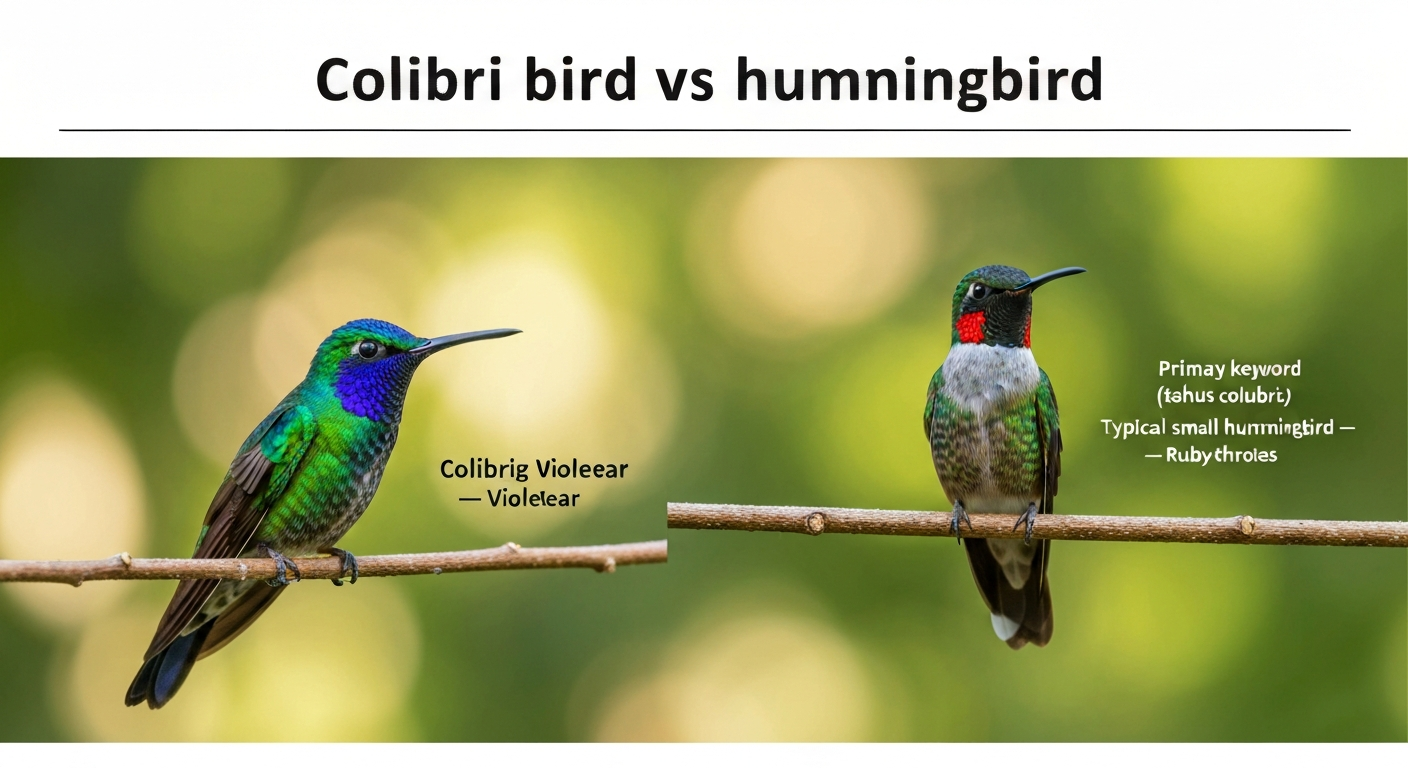
Since the genus Colibri (the violetears) is the only group where 'colibri' has a meaning distinct from 'any hummingbird,' the most useful field comparison is between a Colibri violetear and a representative 'typical' hummingbird. I'll use the Mexican Violetear (Colibri thalassinus) and the Ruby-throated Hummingbird (Archilochus colubris) as the main comparison pair, since they overlap in range and are among the best-documented species in their respective groups.
Size
The Mexican Violetear measures roughly 9.5 to 12 cm in length and weighs approximately 4.8 to 5.5 g. The Sparkling Violetear (Colibri coruscans), the largest in the genus, reaches 13 to 15 cm and can weigh up to 8.5 g. By contrast, the Ruby-throated Hummingbird averages about 7 to 9 cm and 2.4 to 3.6 g. Colibri species sit at the larger end of the hummingbird size range; if you see what looks like a big, robust hummingbird, the size alone should push you toward checking for violetear features.
Color and plumage
All Colibri species share metallic green upperparts as a base color. The defining feature is the violet or blue auricular (ear) patch on the side of the head, which is present in both sexes but more vivid in males. The Sparkling Violetear adds a large blue-violet chest/abdomen patch, making it one of the more strikingly marked hummingbirds in South America. The Brown Violetear (Colibri delphinae) is the odd member of the group: it is largely brown and buff rather than green, and its ear patch is less vivid. A typical small hummingbird like the Ruby-throated shows iridescent green upperparts in both sexes but lacks any ear patch; males have the well-known red gorget (throat patch) instead.
Bill shape
Colibri species have relatively straight, moderately stout bills, which is fairly unremarkable among hummingbirds. They are not the dramatically curved bills of a sicklebill or the extremely long bill of a hermit. This bill shape is worth noting because it limits them to flowers with moderate corolla depth; they are generalist foragers compared to the specialist hummingbirds with extreme bill morphology.
Tail
Colibri tails are square to very slightly notched. This is a reliable field mark, since many other hummingbirds have forked, deeply notched, elongated, or spatulate tails. The Sparkling Violetear has a blue-tipped tail that can flash visibly in flight. Compare this with something like the Streamertail (the Jamaican Doctor Bird), which has extremely long streamer tail feathers in males that make identification trivial.
Flight and wingbeat
All hummingbirds, including all Colibri species, are capable of sustained hovering through a figure-eight wing stroke that generates lift on both the downstroke and the upstroke. Peer-reviewed biomechanics research has documented that hummingbirds operate at among the highest mass-specific power outputs of any flying vertebrates, which is why their wingbeats are so rapid. Smaller hummingbirds beat their wings faster; the Ruby-throated Hummingbird beats at roughly 53 times per second, while the larger Sparkling Violetear beats somewhat more slowly. In the field, all hummingbirds look like a blur of wings, but the larger Colibri species look slightly less frantic than very small hummingbirds.
Range and habitat
Colibri species are mostly Central and South American. The Mexican Violetear breeds from Mexico through Central America into the northern Andes and occasionally wanders into the southern United States (Texas and adjacent states see rare visitors). The Sparkling Violetear is widespread through the Andes from Venezuela to Bolivia and into the highlands of southeastern Brazil. Colibri serrirostris (White-vented Violetear) inhabits lowland South America east of the Andes. Colibri cyanotus (Lesser Violetear) is found from Costa Rica into northern South America. None of the Colibri species are found in North America as regular breeding birds, which is why most North American birdwatchers will encounter 'colibri' only as a foreign-language word rather than as a bird on their local patch.
Feeding and behavior
Like all hummingbirds, Colibri species feed primarily on nectar and supplement their diet with small arthropods for protein. Mexican Violetears are well-known for their loud, repetitive song, which males deliver persistently from exposed perches during the breeding season, a behavior that makes them easier to locate by ear than most hummingbirds. Sparkling Violetears are common garden birds in Andean cities and will readily visit feeders with sugar-water solution. All Colibri species are territorial and will chase competing hummingbirds from feeding sites. This aggressive, conspicuous behavior combined with their larger size often makes them the dominant bird at a mixed hummingbird feeder in their range.
Comparison table: colibri (common use) vs Colibri (genus) vs a typical small hummingbird
| Feature | 'Colibri' (everyday word) | Colibri genus (violetears) | Typical small hummingbird (e.g., Ruby-throated) |
|---|---|---|---|
| What it refers to | Any hummingbird; all ~360 species | 5 violetear species only | One of ~360 Trochilidae species |
| Family | Trochilidae | Trochilidae | Trochilidae |
| Language context | Spanish, French, British English | Scientific / taxonomic texts | English common name |
| Body length | Varies: 6–22 cm across all species | 9.5–15 cm depending on species | ~7–9 cm |
| Body mass | Varies widely | ~4–8.5 g | ~2.4–3.6 g |
| Diagnostic color feature | Varies by species | Violet/blue auricular (ear) patch | Red gorget (males); green back |
| Bill shape | Varies widely (straight to curved) | Straight to slightly curved, moderate | Short, straight |
| Tail shape | Varies widely | Square to slightly notched | Slightly forked |
| Geographic range | All Americas | Mexico to South America; rare US vagrant | Eastern North America (breeds) |
| Hovering ability | Yes (all hummingbirds) | Yes | Yes |
| Feeder visits | Yes (most species) | Yes, common at Andean feeders | Yes, common in North American gardens |
| Conservation status (IUCN) | Varies by species | Least Concern (C. coruscans, C. thalassinus) | Least Concern |
What to photograph and label for field ID
Good photographs are the most reliable way to confirm a hummingbird ID, especially when you are trying to establish whether a 'colibri' sighting is a generic hummingbird or specifically a Colibri violetear. Here are the key features worth capturing and labeling in any ID image, whether you are contributing to eBird, asking for help on a birding forum, or building a reference collection.
- Bill: photograph in profile if possible; note length relative to head size, curvature (straight vs. decurved vs. upturned), and any color banding at the base. For Colibri, the straight moderate bill is a supporting feature.
- Gorget and auricular patch: capture the throat and ear region in good light, ideally with the bird facing you or at a slight angle. The violet/blue ear patch of Colibri species is the single most diagnostic feature; in poor light it can look dark or even black, so angled sunlight or flash helps reveal the iridescence.
- Tail: photograph from below or behind to show shape (square, forked, notched, elongated) and color patterning. The blue-tipped tail of the Sparkling Violetear is visible in flight.
- Upperparts: a dorsal shot showing the color and sheen of the back and crown helps distinguish green-backed species from brown or gray-backed ones. The Brown Violetear's brown upperparts immediately separate it from all other Colibri.
- Wingbeat and hovering posture: video clips are more useful than still photos here. Even a short clip lets you estimate relative wingbeat speed and body angle during hovering, which helps separate large and small hummingbirds.
- Size scale: try to get a reference object in frame, or photograph the bird next to a known feeder size. Colibri species look noticeably bulkier than small North American hummingbirds. A side-by-side photo of two species at the same feeder is ideal.
- Chest and abdomen: for the Sparkling Violetear, the blue-violet chest patch is nearly as diagnostic as the ear patch. Frame a full ventral shot to capture the extent of blue on the underparts.
A note on conservation and how to help
Both the Mexican Violetear (Colibri thalassinus) and the Sparkling Violetear (Colibri coruscans) are currently listed as Least Concern by the IUCN and BirdLife International, reflecting their wide ranges and relatively stable populations. The same applies to most widespread hummingbird species. That said, 'Least Concern' does not mean 'no threat'; habitat loss, agricultural expansion at forest edges, and climate-driven shifts in flowering phenology (the timing of flower blooms relative to hummingbird migration) are documented pressures across the family.
The most practical thing a reader can do is maintain a clean, correctly formulated sugar-water feeder (a 1:4 ratio of white sugar to water, no dyes or honey) during migration and breeding seasons, and to plant native flowering plants that provide natural nectar sources. For gardeners deciding on nectar sources, see a quick comparison of Yellow Bird vs Butterfly magnolia to pick a variety that flowers at times hummingbirds visit. For gardeners in Andean cities, where Colibri species are garden regulars, keeping feeders clean and shaded helps prevent fungal contamination that can harm birds. If you are in North America hosting ruby-throats or other species, the same principles apply. Submitting sightings to eBird is genuinely useful for monitoring population trends, and eBird's range maps for Colibri thalassinus and Colibri coruscans are updated weekly using exactly those community observations.
Common misconceptions worth clearing up
The biggest misconception is that 'colibri' refers to a different kind of bird from a hummingbird, perhaps something more exotic or rare. It does not. Every colibri is a hummingbird, and in everyday speech the words mean exactly the same thing. The second misconception is that the genus Colibri is the 'original' or 'true' hummingbird and that other genera are somehow variants. That is backwards: Colibri is one of more than 100 genera, and its five species make up a tiny fraction of hummingbird diversity.
A third misconception comes up specifically with the Doctor Bird name. Some readers assume that unusual local bird names like 'Doctor Bird' must refer to a completely different family of birds. In reality, the Jamaican Doctor Bird (Trochilus polytmus, the Red-billed Streamertail) is a hummingbird through and through, a member of Trochilidae with all the hovering, nectar-feeding, and iridescent-plumage traits the family is known for. Regional names deserve the same investigative respect as foreign-language names: always check the scientific name before concluding that two different names refer to two different kinds of birds.
Finally, some confusion arises from the word 'violetear' itself. Readers sometimes assume that a violetear must be visually distinctive enough to be immediately obvious in the field. In poor light or at a busy feeder, the ear patch can look dark rather than violet, and the bird just looks like a large green hummingbird. Direct sunlight or angled light is needed to see the full iridescence. If you are in the range of Colibri species and you see a large, green, robustly built hummingbird, look carefully at the side of the head before writing it off as unidentified.
FAQ
Are “colibri” and “hummingbird” the same term or different?
Short answer: In everyday language, yes — “colibrí” (Spanish) and the loanword “colibri” in English/French contexts are common‑language names for hummingbirds. However, Colibri (capitalized) is also a scientific genus within the hummingbird family (Trochilidae). So "colibri/colibrí" is usually a synonym for hummingbird in common use, while Colibri is a specific taxonomic group of hummingbird species in ornithological checklists.
Who uses each name (colibri vs hummingbird)?
"Hummingbird" is the standard English common name. "Colibrí" is standard Spanish (RAE). "Colibri" appears in English as a borrowing and in French; many reference dictionaries list it as a variant of hummingbird. Scientists use the Latin genus name Colibri to refer to particular species (e.g., Colibri coruscans). Other languages have their own words (Portuguese "beija‑flor", many Spanish regional names like "picaflor").
What is the quick taxonomy primer I need to know?
Family: Trochilidae (hummingbirds). Within Trochilidae there are many genera; Colibri is one such genus recognized by major checklists (IOC, Clements, HBW/BirdLife). Species examples placed in Colibri include C. thalassinus (Mexican/Green Violetear complex after recent splits), C. coruscans (Sparkling Violetear), and related violetears. Taxonomy is dynamic — consult IOC, Clements or HBW/BirdLife for current species lists and recent splits.
Are there any authoritative, field‑usable differences between birds called “Colibri” (genus) and other hummingbirds?
Yes — but they are genus‑level, not name‑level. Colibri species (the violetears) share typical traits used in field guides: medium‑to‑large body size for hummingbirds, metallic green upperparts, conspicuous violet/blue auricular patches in males, stout near‑straight bills, and a particular tail shape. Other hummingbird genera can differ greatly (e.g., long‑billed hermits, tiny bee hummingbirds, or gorgeted males). Use field characters (size, bill shape, tail shape, plumage patches) and range to separate Colibri spp. from other genera in the field.
Side‑by‑side field ID: size
Colibri: generally medium‑to‑large for hummingbirds (rough ranges ~9.5–15 cm total length depending on species). Other hummingbirds: range from ~6 cm (bee hummingbird) to >15 cm (some giant hummingbirds/streamertails). Measure relative size at a feeder or against nearby birds/plants as a quick cue.
Side‑by‑side field ID: color and plumage
Colibri: typically metallic green upperparts with violet/blue 'ear' patches (violetears) and variable iridescent throat/chest. Other hummingbirds: extremely variable — solid greens, brilliant gorgets (throats), rufous patches, or distinctive streaking. Iridescence changes with light angle; use pattern, not just color intensity.
Next Article
Vermilion Bird vs Fenghuang: Key Differences Explained
Compare Vermilion Bird vs Fenghuang: origins, symbols, iconography, ID checklist, FAQs & key differences.