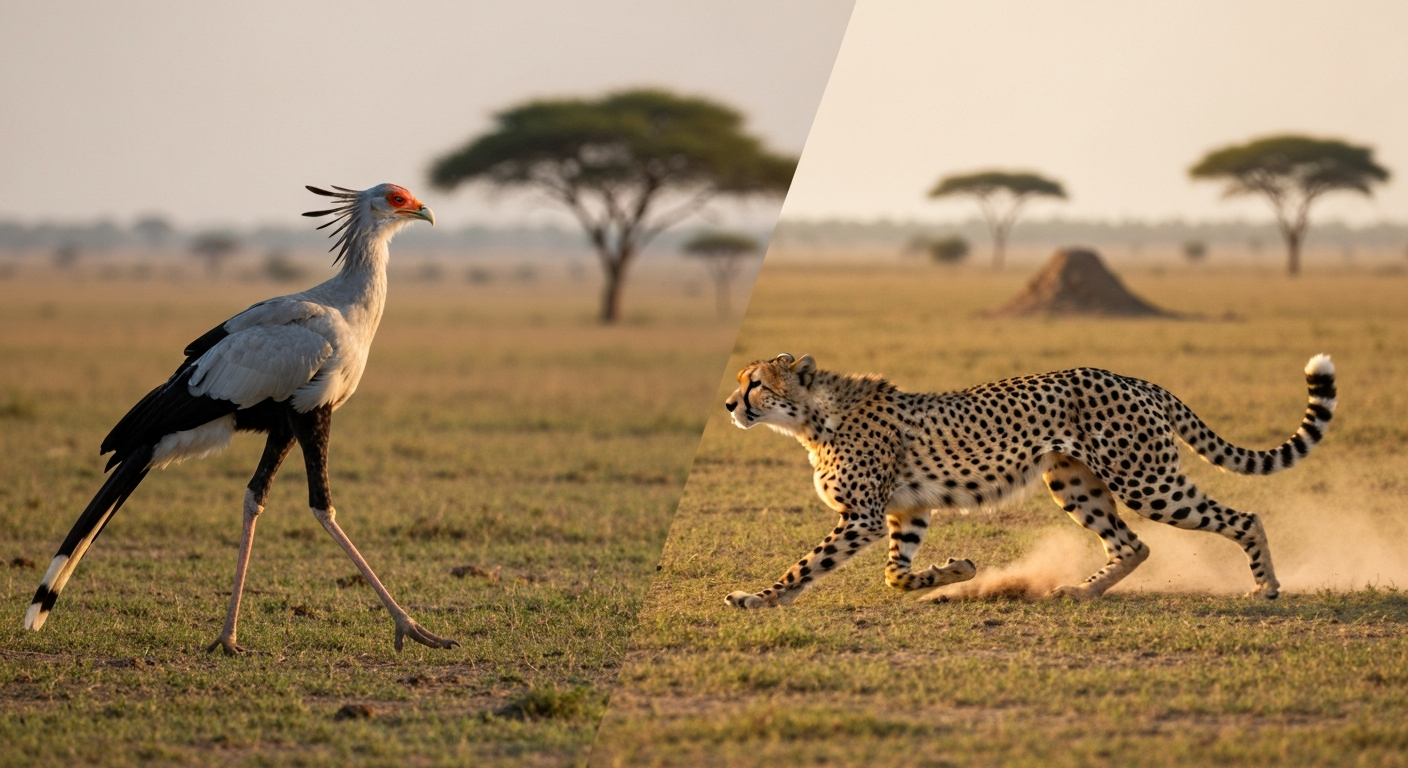
The secretary bird and the cheetah share the same African savanna, but that is about where the similarities end. One is a 1.3-metre-tall raptor that kills snakes with precision kicks delivering nearly 200 newtons of force. The other is a 40-to-72-kilogram cat capable of hitting 93 km/h in a sprint. Head to head, the cheetah wins any direct confrontation through sheer mass and predatory anatomy, but in practice these two animals rarely interact as rivals, and each has evolved a completely different toolkit for surviving the same landscape.
Secretary Bird vs Cheetah: Size, Speed, Hunts & Outcome

Marcus Hendricks
19 Jul 2026
Taxonomy and Classification
The secretary bird (Sagittarius serpentarius) is in a category of its own, literally. It is the sole living member of the family Sagittariidae, placed within the order Accipitriformes alongside hawks, eagles, and Old World vultures. NCBI Taxonomy: Sagittarius serpentarius lists Sagittarius serpentarius as the sole extant species in family Sagittariidae and places it in order Accipitriformes. Despite sharing that order with classic raptors, it looks and behaves unlike any of them, which is exactly why it earned its own family. The scientific name Sagittarius serpentarius translates loosely to 'archer of the serpents,' a fitting description for a bird that hunts snakes on foot across open grassland.
The cheetah (Acinonyx jubatus) sits in the family Felidae, the cat family, within the genus Acinonyx. It is the only living species in that genus, making it, like the secretary bird, taxonomically isolated. Cheetahs are more closely related to pumas and jaguarundis than to lions or leopards, a fact that surprises many people given how 'typical' a big cat the cheetah appears at first glance. Comparing a bird in order Accipitriformes to a mammal in family Felidae is essentially a cross-class comparison, which makes this pairing genuinely unusual and worth unpacking carefully.
| Feature | Secretary Bird | Cheetah |
|---|---|---|
| Scientific name | Sagittarius serpentarius | Acinonyx jubatus |
| Class | Aves (birds) | Mammalia (mammals) |
| Order | Accipitriformes | Carnivora |
| Family | Sagittariidae | Felidae |
| Genus | Sagittarius | Acinonyx |
| Living species in genus | 1 (sole extant species) | 1 (sole extant species) |
| IUCN status | Endangered (2020) | Vulnerable |
Geographic Range, Habitat, and Chances of a Real-World Encounter
Secretary birds are endemic to sub-Saharan Africa, with a historical range stretching from Senegal and Sudan in the north down through East Africa to South Africa. They are birds of open, short-grass savanna, grassland, and lightly wooded areas where they can stride and hunt on foot. They avoid dense bush and forested zones. Critically, their range has contracted significantly, and the species is now assessed as Endangered on the IUCN Red List following rapid population declines reported across much of their former range.
Cheetahs overlap substantially with secretary birds across sub-Saharan Africa, and they share a preference for open habitats: savanna, shrubland, and semi-arid plains. Cheetahs also occur in small pockets of Iran (the Asiatic subspecies, Acinonyx jubatus venaticus), but the bulk of the population is in Africa. They are listed as Vulnerable globally, with populations that are highly fragmented and declining.
A real-world encounter between the two is entirely plausible in places like the Serengeti, Kruger National Park, or the Masai Mara, where both species occupy the same open savanna. Field observers have documented cheetahs and secretary birds using the same habitat patches. However, direct interactions are rarely recorded, because cheetahs focus on ungulate prey and secretary birds spend their time hunting ground-level invertebrates, reptiles, and small mammals. They are not competitors in any meaningful ecological sense, and neither habitually preys on the other.
What They Look Like: Physical Appearance and Identifying Features
The secretary bird is unmistakable. It has a pale grey and black plumage, long black-feathered thighs that look like shorts, a distinctive crest of long black-tipped quills fanning out from the back of its head, and a bare red-orange facial patch around each eye. The tail ends in two extremely long central feathers that extend well past the wingtips when the bird is standing. It walks upright on long pink legs, giving it a stork-like profile from a distance. Up close, the strongly hooked beak makes the raptor identity clear.
The cheetah is a lean, deep-chested cat with a small rounded head, high-set eyes for wide-angle vision, and the iconic black 'tear marks' running from the inner corners of its eyes down to the corners of its mouth. Its coat is tawny to pale yellow with solid black spots, distinguishing it from the rosette-patterned leopard. The body is built for speed: a flexible spine, long legs, and a narrow waist give it a greyhound-like silhouette. The tail is long and banded at the tip, used as a rudder during high-speed turns.
Sexual Dimorphism and Age-Related Differences
Secretary birds show relatively modest sexual dimorphism. Males and females have the same plumage pattern, but males tend to be slightly larger, with longer crests and longer central tail feathers. In the field, sexing a lone individual is genuinely difficult without direct comparison or measurements. Juveniles have brownish-buff tones replacing the clean grey of adults, shorter crests, and a yellow (rather than orange-red) facial patch that deepens to adult coloration as the bird matures over its first few years.
Cheetahs show more pronounced size dimorphism. Males are meaningfully larger and heavier than females on average, and adult males often form coalitions of two or three (typically brothers) that hold territories and can bring down larger prey than a single female typically attempts. Cubs are born with a distinctive silvery-grey mantle of fur on their backs, thought to mimic the appearance of the honey badger as a predator-deterrence strategy. This mantle fades by about three months of age. Full adult size is reached at roughly two years, though social and hunting independence develops over a longer period.
Precise Measurements: How Big Are They Really?
Numbers matter here because both animals are often misrepresented in popular media. The secretary bird is one of Africa's tallest birds of prey. Field guide measurements put total body length at approximately 112 to 152 cm, with large adults reaching a standing height of around 1.3 to 1.5 metres. Wingspan extends up to roughly 2.1 metres in large individuals. A biomechanical study specimen used in force-plate experiments weighed 3.96 kg and had a measured hip height of 0.692 metres. So even at the upper end of the range, a secretary bird weighs somewhere between 3 and 5 kilograms. It is tall, but it is very light.
The cheetah is far heavier. Body mass across populations and studies ranges from roughly 21 to 72 kg, with most adults falling in the 40 to 50 kg range. Head-to-body length is typically 76 to 112 cm, shoulder height sits at around 60 to 80 cm, and the tail adds another 60 to 84 cm. So while the secretary bird can be taller at the head than a cheetah is at the shoulder, the cheetah outweighs the bird by a factor of roughly 10 to 15 times.
| Measurement | Secretary Bird | Cheetah |
|---|---|---|
| Body mass | ~3–5 kg | ~21–72 kg (typically 40–50 kg) |
| Total body length | ~112–152 cm | ~76–112 cm (head-body) + 60–84 cm tail |
| Standing height | ~1.3–1.5 m (head height) | ~60–80 cm (shoulder height) |
| Wingspan | Up to ~2.1 m | N/A (no wings) |
| Notable force output | ~195 N peak kick force | ~339 N estimated canine bite force |
How Each Animal Moves: Flight, Walking, and Sprint Speed
The secretary bird is fundamentally a walking bird. Despite being a fully capable flier, it spends most of its active day on the ground, striding through grass at a deliberate pace, often covering 20 to 30 kilometres a day on foot. It flies primarily to reach roost sites in acacia trees and for longer dispersal movements. When it does take flight, those broad wings carry it well, but hunting happens almost exclusively from the ground. The long legs are not just for show: they keep the bird's body above dense grass while its eyes scan for movement below.
The cheetah is built entirely around one thing: explosive speed over short distances. GPS and inertial-sensor data from wild cheetahs recorded a top measured speed of 25.9 metres per second, equivalent to approximately 93 km/h. Crucially, though, most chases are not flat-out sprints. The same study of 367 wild hunts showed a mean chase distance of around 173 metres, with some runs extending to 559 metres. What makes the cheetah truly dangerous is not just top speed but the combination of extreme acceleration, rapid deceleration, and tight turning ability, all supported by a semi-retractile claw system that provides grip on the ground, an elongated flexible lumbar spine that increases stride length, and muscle mass concentrated close to the body core to reduce limb inertia.
In a direct locomotion comparison, the cheetah is obviously faster. But the secretary bird's walking style is biomechanically specialised too: those long legs produce a powerful, high-amplitude stride that feeds directly into the animal's striking ability. The leg muscles that drive the bird's walk are the same ones that power its lethal kicks.
Hunting Strategies and What They Eat
The Secretary Bird's Ground-Strike Method
Secretary birds are opportunistic but specialised hunters. Diet studies show a menu that includes snakes (including venomous species such as puff adders and cobras), small mammals like rodents and hares, lizards, large insects, and bird eggs. The hunting technique that makes the secretary bird famous is its stomp-and-kick strike. Rather than grabbing prey with its talons in the way most raptors do, it delivers rapid, repeated downward stamps and kicks to stun or kill prey before swallowing it whole or in large pieces. Force-plate measurements from a controlled study quantified peak strike forces at a mean of approximately 195 newtons, about 5.1 times the bird's own body weight, with very short contact times. Against a snake, this means a strike powerful enough to pin and incapacitate the animal before it can retaliate. The bird uses its wings to shield itself from snake strikes during a confrontation.
The Cheetah's High-Speed Pursuit Method
Cheetahs are visual hunters that rely on stalking to close range before committing to a chase. They preferentially target small to medium-sized ungulates: Thomson's gazelle, impala, and springbok are classic prey items, with typical kill weights ranging from roughly 10 to over 100 kg depending on whether males are hunting cooperatively. The killing bite is a suffocating clamp to the throat or nape, held for several minutes until the prey suffocates. Unlike lions or leopards, cheetahs lack the raw bite force to crush bone, but comparative bite-force analyses estimate their canine bite force at around 339 newtons, more than adequate for the throat-hold technique. After a kill, cheetahs must eat quickly because they are easily displaced by lions, hyenas, and even vultures.
Side-by-Side Hunting Comparison
| Aspect | Secretary Bird | Cheetah |
|---|---|---|
| Primary method | Stomp and kick on foot | Stalk then high-speed chase |
| Prey size | Small (insects to small mammals/snakes) | Small to large ungulates (10–100+ kg) |
| Key weapon | Leg kick (~195 N peak force) | Throat bite (~339 N estimated) |
| Hunting habitat | Open grassland, short-grass savanna | Open savanna, shrubland |
| Speed during hunt | Walking pace | Up to 93 km/h in short bursts |
| Cooperation | Usually solitary | Males may form coalitions of 2–3 |
Fighting Anatomy and a Reasoned Verdict on a Hypothetical Confrontation
I want to be clear that direct confrontations between these two animals are not a documented ecological reality. This is a thought experiment, but it is worth grounding in the actual anatomy rather than just guessing from size alone.
The secretary bird's main weapons are its legs and feet. Those kicks deliver nearly 200 newtons of force at speeds rapid enough that a snake cannot evade them. The hooked beak can also tear flesh, and the long wings provide reach and balance during a confrontation. But the bird weighs at most around 5 kg, and its skeleton and musculature are built for agility and striking downward, not for sustained grappling with a large mammal.
The cheetah, weighing up to 72 kg, can deliver a suffocating throat bite, has four sets of non-retractile claws for grip, and possesses the speed to close any distance before the bird can generate a meaningful defensive strike. Its bite force, while modest for a big cat, is more than sufficient against an avian opponent. If a cheetah were motivated to attack a secretary bird (which would be extremely unusual in nature), the outcome would strongly favour the cheetah. The secretary bird's best defensive option would be flight, and it can certainly take off quickly from an open savanna, which means an escape is plausible if the bird detects the threat in time.
If you find that confrontation scenario interesting, the related comparison of secretary bird vs lion pushes this logic even further: against Africa's apex predator, the secretary bird's kick is essentially irrelevant to the outcome. For another comparative piece, see a concise comparison of the secretary bird vs peacock. The secretary bird vs human comparison takes a different angle, looking at what this bird can actually do to a person who disturbs it.
Conservation Status and Human Interactions
The secretary bird's Endangered classification reflects a genuinely serious situation. Rapid range-wide declines have been documented across sub-Saharan Africa, driven by habitat loss as grasslands are converted to agriculture, overgrazing that eliminates the open habitat structure the bird needs, and persecution. It is a species that was once widespread and taken for granted across African savannas, and its disappearance from large portions of its former range is a significant conservation concern.
The cheetah is Vulnerable, with a global population estimated at fewer than 7,000 adults spread across highly fragmented populations. Human-wildlife conflict, prey depletion, and habitat loss are the primary drivers. Cheetahs are among the most difficult large carnivores to maintain in protected areas because they range widely and frequently move outside reserve boundaries.
Both animals hold cultural significance in Africa, and both have historically been kept in captivity (cheetahs notoriously as hunting companions across ancient Egypt, Persia, and Mughal India). Secretary birds are a national symbol of South Africa, appearing on its coat of arms. In terms of human interactions, the cheetah poses a much more direct physical risk to people than the secretary bird, though cheetahs are generally non-aggressive toward humans compared to other large cats. Secretary birds can deliver a powerful kick if handled or cornered, but they are not predators of humans.
Quick Comparison: Secretary Bird vs Cheetah at a Glance
| Attribute | Secretary Bird | Cheetah |
|---|---|---|
| Class | Bird (Aves) | Mammal (Mammalia) |
| Weight | ~3–5 kg | ~21–72 kg |
| Standing height | ~1.3–1.5 m (full height) | ~60–80 cm (shoulder) |
| Top speed | Walking hunter; capable flier | ~93 km/h (25.9 m/s measured) |
| Primary weapon | Kick: ~195 N peak force | Throat bite: ~339 N estimated |
| Diet | Snakes, small mammals, insects | Small to large ungulates |
| Habitat | Open grassland, savanna | Savanna, shrubland |
| Range | Sub-Saharan Africa | Sub-Saharan Africa + Iran (Asiatic) |
| IUCN status | Endangered | Vulnerable |
| Taxonomy | Family Sagittariidae, sole species | Family Felidae, genus Acinonyx |
Which Is More Remarkable?
That is genuinely a hard call, and I think it depends on what impresses you. The cheetah's locomotion is arguably the most refined speed-adaptation in any large land animal: every element of its skeleton, musculature, claw geometry, and respiratory system is tuned for a single explosive pursuit. The secretary bird, on the other hand, is one of the most anatomically unusual raptors alive, a bird that walks like a crane, kills like a boxer, and belongs to a family with no other living members. For anyone interested in the secretary bird's unique position among raptors, the secretary bird vs peacock comparison is a useful contrast, placing the bird alongside another tall, long-legged species that uses its legs and display features in completely different ways. For a different kind of 'full bird' comparison, see colonel vs full bird colonel for more on the terminology and distinctions.
Both animals are threatened, both are ecologically irreplaceable, and both demonstrate that evolution produces spectacularly different solutions to the same basic problem of surviving the African savanna. The cheetah wins a hypothetical fight. The secretary bird wins for sheer evolutionary novelty.
FAQ
What are the scientific names and taxonomic positions of the secretary bird and the cheetah?
Secretary bird: Sagittarius serpentarius — the sole living species in family Sagittariidae, placed in order Accipitriformes in modern checklists (NCBI, HBW/IOC/BirdLife). Cheetah: Acinonyx jubatus — a member of genus Acinonyx in family Felidae (Mammal Diversity Database).
How do the two species compare in basic morphology and appearance?
Secretary bird is a large, long‑legged terrestrial raptor with a lanky profile, long crest feathers on the head, and a wingspan up to ≈2.1 m; total length ≈112–152 cm and standing height often quoted ~1.3–1.5 m. Cheetah is a slim, long‑limbed felid with spotted coat, semi‑retractile claws and long tail; head–body length ≈76–112 cm, shoulder/hip height ≈60–80 cm, tail ≈60–84 cm. Body mass differs markedly (see next question). (Field guides; Raptors of the World; mammal compendia).
What are precise size and weight ranges for each species?
Secretary bird: adult mass reported in studies and captive specimens typically ~2.3–4.5 kg (study specimen 3.96 kg measured in force experiments); total length ≈112–152 cm; standing hip height reported ~0.7–1.5 m depending on measurement method. Cheetah: adult mass range widely reported ≈21–72 kg (regional/sex variation; many populations average ~40–50 kg); head–body length ≈76–112 cm; shoulder/hip height ≈60–80 cm; tail ≈60–84 cm. (Portugal et al. 2016; mammal compendia; morphometric studies).
Can secretary birds fly, and how does each animal move?
Secretary bird: capable of flight for roosting, dispersal and display, but primarily a cursorial (ground‑walking) raptor that hunts by walking/striding in open grassland. Cheetah: obligate terrestrial sprinter; moves by walking/strolling during non‑hunting periods and produces extreme acceleration and high‑speed sprinting in short bursts during hunts (Nature 2013; National Geographic).
What are the top speeds and sprinting characteristics of the cheetah compared with the secretary bird?
Cheetah: documented top speeds up to ~25.9 m·s⁻¹ (~93 km·h⁻¹) in wild GPS/IMU studies, with hunts typically short (mean chase lengths ~173 m) and involving very high acceleration and tight turning dynamics. Secretary bird: not built for high‑speed running; locomotion is walking/striding and occasional flight — no comparable sprint speeds; hunting relies on walking and rapid kicking strikes rather than pursuit. (Wilson et al. 2013; Portugal et al. 2016).
How do their hunting strategies and typical prey differ?
Secretary bird: hunts principally on foot in grassland/savanna, feeding on snakes (including venomous species), lizards, small mammals, insects and bird eggs. Uses repeated, forceful kicks/stomps to stun or kill prey (documented in observational and experimental studies). Cheetah: stalks medium‑sized ungulates (Thomson’s gazelle, impala, springbok etc.), then uses short high‑speed chases to catch prey and kills by suffocating throat or nape bite. Prey size and technique are largely different: small/medium vertebrates and reptiles vs. medium ungulates. (Hofmeyr et al. 2014; Wilson et al. 2013; Portugal et al. 2016).