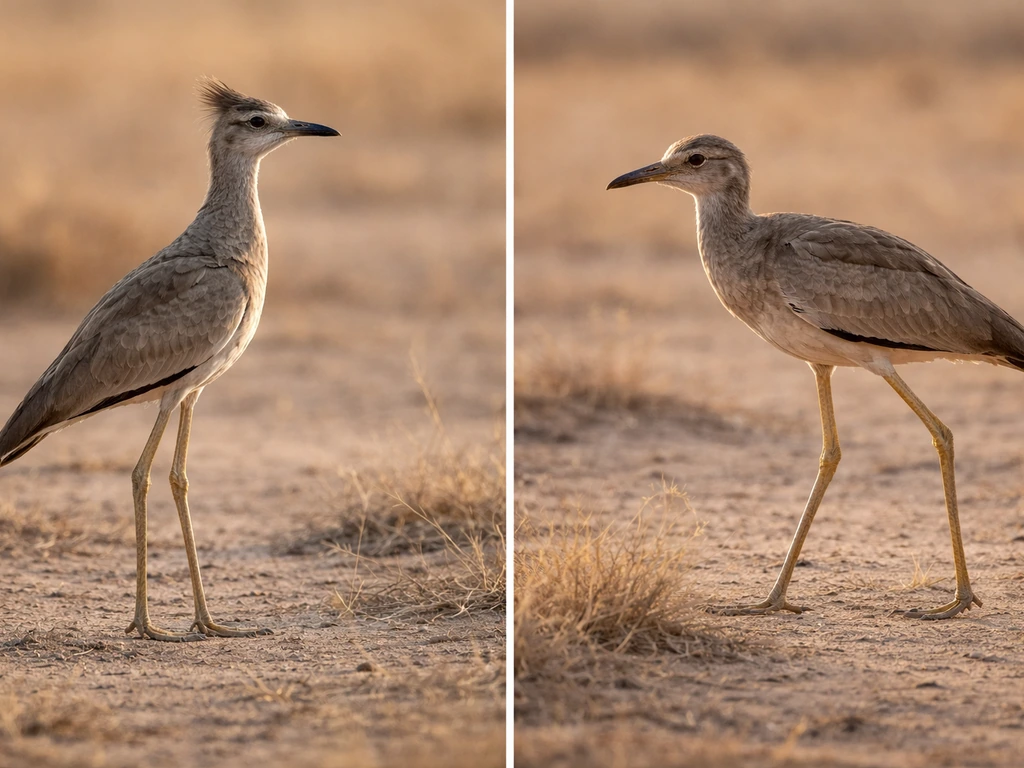
On the ground, a secretary bird has a real fighting chance against most eagles, and in many realistic close-range scenarios it could come out on top. Its kick force measures around 195 Newtons (roughly five times its own body weight), it stands nearly four feet tall, and its entire hunting strategy is built around disabling dangerous animals fast with precision leg strikes. But put the fight in the air, or give a large eagle like a harpy or golden eagle the space to build speed and dive, and the outcome flips hard in the eagle's favor. The honest answer is: location and distance decide this more than anything else.
Secretary Bird vs Eagle: Who Would Win a Fight?

Marcus Hendricks
7 May 2026
What each bird actually is
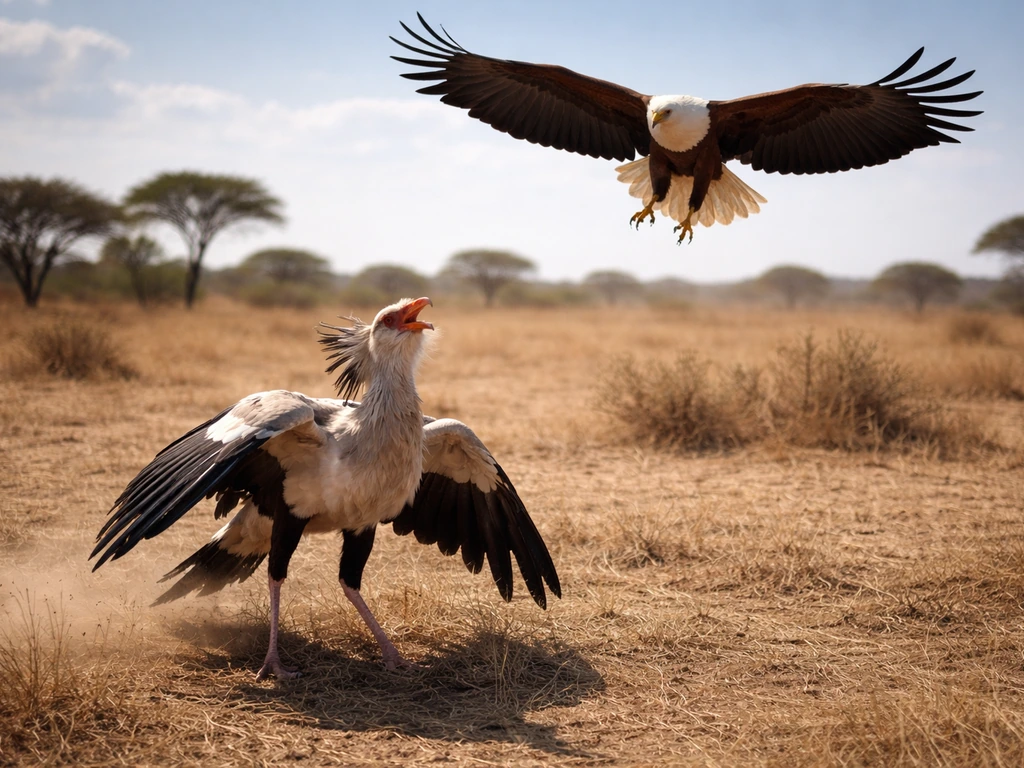
The secretary bird (Sagittarius serpentarius) is genuinely unlike any other bird of prey on Earth. It's the only living member of its own family, Sagittaridae, and the only bird of prey that hunts almost entirely on foot. It lives across the open savannas and grasslands of sub-Saharan Africa, stalking through tall grass to find snakes, lizards, rodents, and insects. Think of it as a raptor that decided wings were optional for hunting. It flies when it needs to reach its nest or perform courtship displays, but the ground is its real domain.
"Eagles" covers a wide range of species, so it helps to pin down who we're actually comparing. The three most relevant species for this conversation are the golden eagle (Aquila chrysaetos), the bald eagle (Haliaeetus leucocephalus), and the harpy eagle (Harpia harpyja). All three are large, powerful aerial predators that hunt via flight, using speed and talons as their primary weapons. They evolved to strike from above, not to brawl on the ground. That distinction matters enormously when you're trying to figure out who wins a fight.
Size, wingspan, and raw physical capability
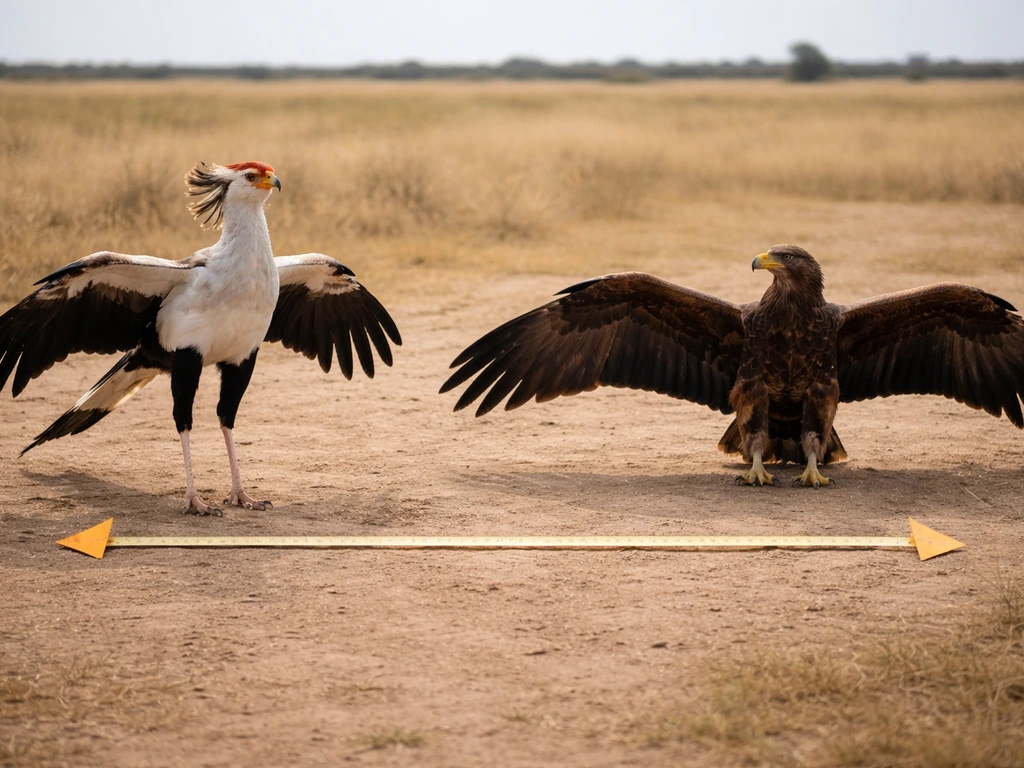
Let's look at the numbers side by side so you can actually see where each bird stands physically. These are the measurements that feed directly into any realistic fight prediction.
| Bird | Weight | Length | Wingspan | Key weapon |
|---|---|---|---|---|
| Secretary bird | 2.3–4.3 kg (5–9.4 lb) | ~120 cm (~4 ft tall) | 191–215 cm | Kick force ~195 N; long legs |
| Golden eagle | 3.0–6.1 kg (6.6–13.5 lb) | 76–102 cm | 203–224 cm | Talons; dive speed 240–320 km/h |
| Bald eagle (female) | 3.6–6.6 kg (8–15 lb) | Up to ~108 cm | Up to ~2.5 m | Talon grappling; aerial power |
| Harpy eagle (female) | 6.3–9 kg (14–20 lb) | 89–104 cm | Up to ~2 m | 13 cm rear talons; immense grip strength |
A few things jump out immediately. The secretary bird is not the heaviest bird here, especially when compared to a large female harpy eagle, which can weigh more than twice as much. But the secretary bird's height is a significant advantage on the ground. Standing nearly four feet tall on long, powerful legs, it has reach and leverage that a crouched or perched eagle simply cannot match at close range. The harpy eagle's 13 cm rear talons are arguably the most dangerous single weapon in this comparison, but only if those talons can make meaningful contact.
How each bird actually hunts
Hunting style is where these birds diverge most sharply, and it's the most important factor in any fight prediction. The secretary bird walks through grassland at a measured pace (about 120 steps per minute on average) and uses its feet to flush and strike prey. Britannica describes the secretary bird as a long-legged bird about 1. 2 m long with a reported wingspread around 2.
1 m, and notes it hunts on foot. When it finds a snake, it doesn't grab it with its beak and struggle.
blank" rel="noopener noreferrer">National Geographic describes secretary birds' distinctive hunting behavior, including foot strikes and using their wings during snake encounters, and notes that monitoring is needed to track numbers and declines foot strikes and wings used during snake encounters. It delivers rapid, hammering kicks to the head, fast enough and hard enough to stun or kill without giving the snake time to strike back.
That measured 195 N peak kick force isn't just impressive on paper; it's the product of an entire evolutionary history of ground combat.
Eagles hunt completely differently. Golden eagles are famous for their hunting stoops, diving at speeds of 240–320 km/h to slam into prey from above with their talons. Bald eagles use talon grappling and have even been documented tumbling in the air with prey or rivals locked together. Harpy eagles use a more stealthy perch-and-pounce strategy through forest canopy, relying on enormous grip strength and those long curved rear talons to dispatch prey quickly. What all three eagles share is that their weapons are most effective when they have space, speed, and the height advantage of flight. On the ground, without runway to build a stoop, an eagle's primary hunting mode is largely neutralized.
Behavioral aggression: do they actually fight other raptors?
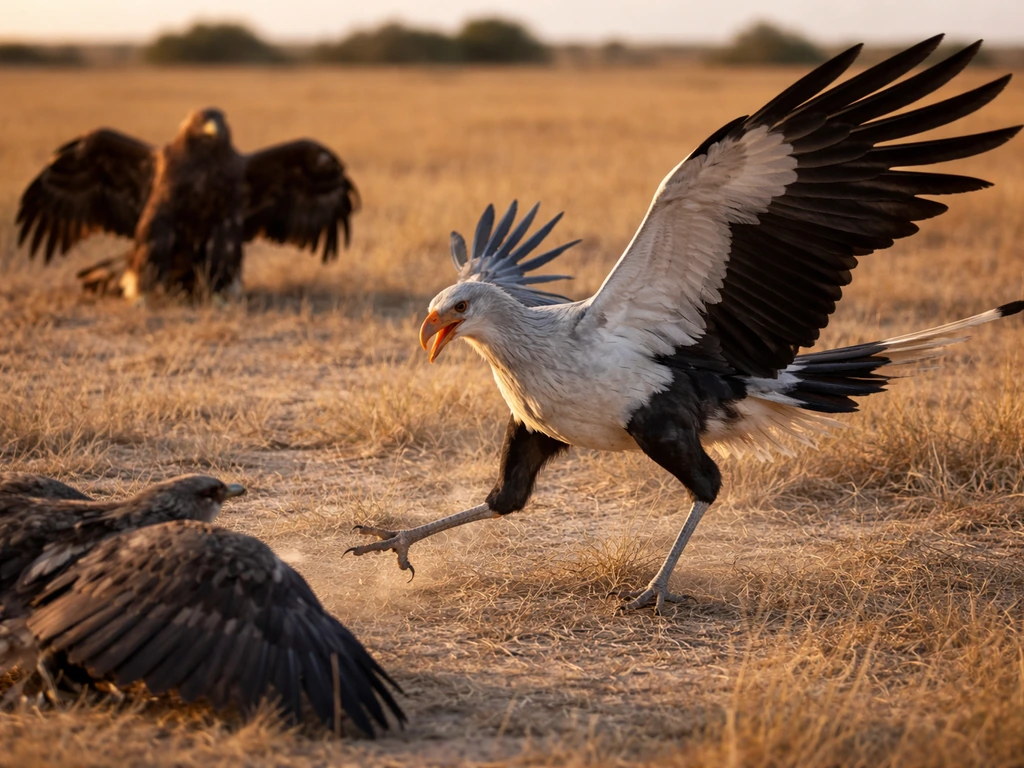
Secretary birds are not passive. Fact sheets describe them as aggressively flying at intruding raptors and birds competing for food or territory. In the wild, eagles are also known to steal secretary bird kills, and encounters between them can escalate. But the secretary bird's go-to response to aerial intruders, flying at them rather than standing and kicking, tells you something important: its ground-kick strategy is for prey, not aerial rivals. When it perceives a threat from the air, it tries to use flight to intercept, not its legs.
Eagles are not shy about aggression either. Golden eagles have documented agonistic encounters with other raptors, and harpy eagles have been recorded attacking humans who came too close to nests or prey. Bald eagles have been documented talon-grappling with rivals, sometimes at the cost of both birds' lives. These are not timid animals. The difference is that eagle aggression is generally tied to aerial territory and nest defense rather than ground-level brawling.
The fight scenario: what actually determines who wins
Here is where most online debates go wrong: they treat this as one fight with one answer. In reality, three variables flip the outcome more than anything else.
- Ground vs air: On the ground, at close range with no runway, the secretary bird's kick dominates. It can strike faster than an eagle can reposition, and its long legs give it reach that a grounded eagle struggles to match with its talons alone.
- Starting distance: If an eagle starts at any real altitude or distance and can build into a stoop, the calculation reverses. A golden eagle diving at 240–320 km/h can deliver a talon strike before the secretary bird can close the gap or prepare a kick response. Distance equals eagle advantage.
- Individual size and species: A large female harpy eagle weighing up to 9 kg is a different problem from a smaller male golden eagle at 3 kg. The heavier and more powerfully armed the eagle, the smaller the secretary bird's margin on the ground.
Who would win: the most likely outcomes
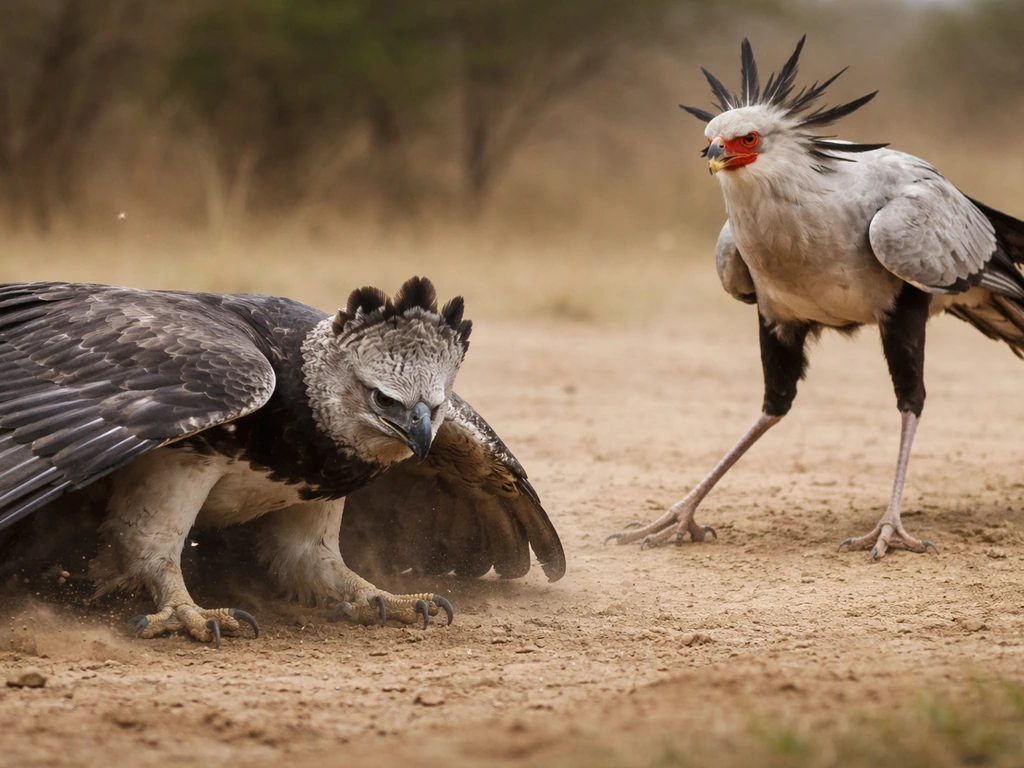
If the fight starts on the ground at close range, say within a few meters with no room for the eagle to build speed or altitude, the secretary bird is likely to win against a golden eagle or bald eagle of typical size. Its kick force, height advantage, and evolved precision for exactly this kind of quick-strike close combat give it a meaningful edge. The eagle's talons are dangerous, but at close range the secretary bird can potentially land multiple kicks before the eagle can grapple effectively.
Against a large female harpy eagle on the ground, the outcome is far less certain. That bird outweighs the secretary bird by a significant margin, carries 13 cm rear talons, and has legs thick enough to restrain large prey. A harpy eagle that successfully grabs the secretary bird with those talons could end the fight quickly. The secretary bird's best chance against a harpy is landing a decisive kick early before the harpy can get a grip.
If the fight happens in the air or the eagle gets to stoop from height, the secretary bird loses. It is not an aerial combatant in any practical sense. When comparing kori bustard vs secretary bird, the key difference is that the secretary bird relies on close-range striking rather than long-range, open-ground leverage It is not an aerial combatant in any practical sense.. Its wings serve navigation and courtship, not combat. A diving golden or harpy eagle delivers impact force far beyond what the secretary bird can counter with a kick it never gets to land.
The secretary bird comparison with the harpy eagle specifically is worth exploring in more depth if you want to go deeper on that matchup, since the harpy is the one eagle that genuinely threatens the secretary bird even on the ground. If you are asking how seriema vs secretary bird plays out, the same ground-versus-air logic largely decides the winner.
Similarly, comparisons between the secretary bird and other large, dangerous animals like pythons or cassowaries reveal just how specialized and effective the secretary bird's kick strategy really is in its home environment. For a different kind of “hunter vs hunter” scenario, the secretary bird vs python comparison highlights how its kick-based strategy stacks up against a snake’s ambush and constriction.
A secretary bird versus ostrich matchup would come down to very different strengths, since ostriches rely more on endurance and powerful kicks than on aerial predation secretary bird vs ostrich. Similarly, a secretary bird vs cassowary comparison highlights how specialized the secretary bird's kick strategy is in its own ground-based hunting niche.
A quick decision framework
- Is the fight on the ground at close range? Secretary bird wins most matchups except against a large harpy eagle.
- Does the eagle have altitude and distance to stoop? Eagle wins decisively regardless of species.
- Which eagle species? Golden and bald eagles at typical sizes are closer contests on the ground. A large female harpy eagle is the secretary bird's toughest ground opponent.
- What's the individual size variation? A large secretary bird (4.3 kg) vs a small golden eagle male (3 kg) strongly favors the secretary bird on the ground. Reverse those sizes and the margin shrinks.
A note on wildlife, ethics, and why this matters
This comparison is useful for understanding how two remarkable predators are built and why evolution produced such different strategies for the same basic goal: catching and killing prey efficiently. It's not a blueprint for anything. Both secretary birds and eagles are protected species, and in many countries it's a federal offense to disturb, harass, or interfere with eagles or their nests. In the United States, the Bald and Golden Eagle Protection Act specifically defines disturbance broadly enough to include actions that decrease biological fitness through interference with feeding, sheltering, or breeding. Secretary birds are listed as Vulnerable on the IUCN Red List, with declining populations from habitat loss across Africa.
The value in this comparison is what it teaches you about convergent and divergent evolution: two groups of apex predators that both evolved to rule their respective environments but arrived at completely different solutions. The secretary bird's kick is one of the most remarkable biomechanical adaptations in the bird world. Eagles' aerial mastery is equally stunning. Understanding which wins under which conditions tells you something real and fascinating about how nature builds hunters, and that's worth thinking about.
FAQ
Does a secretary bird beat every eagle on the ground, or are there exceptions?
Not every time. The ground advantage holds best when the eagle cannot secure a stable grapple, because secretary birds rely on landing multiple rapid kicks before the other bird’s talons lock on.
How much does distance matter, for example if it’s a few meters vs 30 meters?
Distance is a decisive factor because eagles that get even a short runway can transition into a diving stoop or a talon strike from height. Secretary birds do best in close-range, low-room encounters where no setup exists for an aerial strike.
Which eagles are most relevant to a “secretary bird vs eagle” comparison?
Broadly, use large, flight-capable species that rely on talons from the air, like golden, bald, and harpy eagles. Smaller eagles may reduce the threat because their dive speed, grip power, or talon size usually drop with body size.
If the fight starts on land but the eagle can lift off, what changes?
Once the eagle gains elevation or builds speed for a dive, the matchup flips quickly. Secretary birds are not built to counter impacts from above, so an “escape to air” by the eagle is a major swing.
Can the secretary bird use its wings as weapons if the eagle grabs it?
In most realistic scenarios, wings are not a substitute for the secretary bird’s signature leg strikes. The key defense is to land a decisive kick early, reducing the chance the eagle clamps with talons.
What if the eagle is already injured or fatigued, does the secretary bird’s odds improve?
Yes. If an eagle cannot maintain flight or has reduced grip effectiveness, the secretary bird’s repeated kick strategy becomes more effective, especially against species that depend on rapid talon contact to finish quickly.
Do nesting or territorial behaviors change who is more likely to engage?
They can change behavior and persistence. Eagles often escalate near nests or food, while secretary birds will also attack aerial intruders, but escalation does not guarantee a win, it just increases the chance of contact.
How should I think about “fight” outcomes since real encounters are not planned?
Treat this as a conditional matchup, not a guaranteed duel. In the wild, the first successful strike or the first stable talon contact usually ends the engagement faster than observers expect.
Is this the same as “secretary bird vs hawk” or “vs other raptors”?
Not necessarily. Many raptors are adapted primarily for perching and short bursts or for aerial capture, and their leg-to-grapple mechanics vary. The clearest predictor is whether their hunting depends on aerial space and dives rather than close ground brawling.
Why do some online comparisons claim the secretary bird is always stronger?
Most overlook the air-distance requirement. Secretary bird biomechanics favor ground striking, but eagles that can dive or strike from above create impacts that a kick-based counter cannot reliably interrupt.
Is it safe or ethical to disturb either bird to “test” outcomes?
No. Both are protected in many regions, and disturbing nests or feeding sites can be illegal. Any real-world “test” risks harm to the birds and legal consequences for people.
Next Article
Seriema vs Secretary Bird: How to Tell Them Apart
Learn fast, reliable cues to tell seriema from secretary bird by size, bill, legs, hunting, habitat, flight, and calls.