Under typical real-world conditions, the secretary bird wins this fight decisively. It has the reach, the leg armor, the strike force, and the hunting experience to stomp a rattlesnake into submission before the snake can land a clean, venom-delivering bite. That said, the rattlesnake is not a pushover, and a few scenario variables can genuinely flip the outcome. Here is the full breakdown of why the secretary bird has the edge, and exactly when the rattlesnake's odds improve.
Who Would Win Rattlesnake vs Secretary Bird? Likely Outcome

Marcus Hendricks
27 Apr 2026
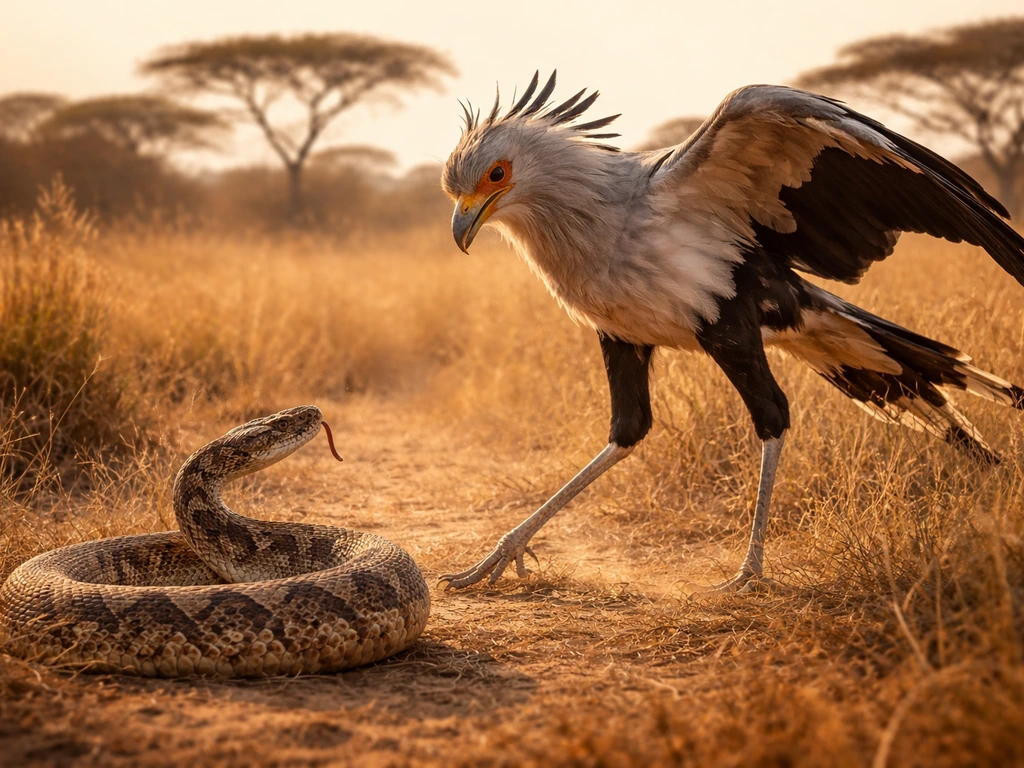
The likely winner, and when the result changes
The secretary bird (Sagittarius serpentarius) is one of the only birds on Earth that specifically evolved to kill snakes with its feet. It does not just tolerate snakes as prey, it is built for them. A healthy adult secretary bird in open terrain against a rattlesnake of average size will almost always come out on top. The caveat is size and environment: a very large rattlesnake (think a big eastern diamondback near two meters long) in dense low cover shifts the odds, because the bird's main weapon, a fast and accurate stomp, requires clear sightlines and room to maneuver. In open savanna-style habitat with good visibility, bet on the bird every time.
What each animal brings to the fight
The secretary bird's hunting toolkit
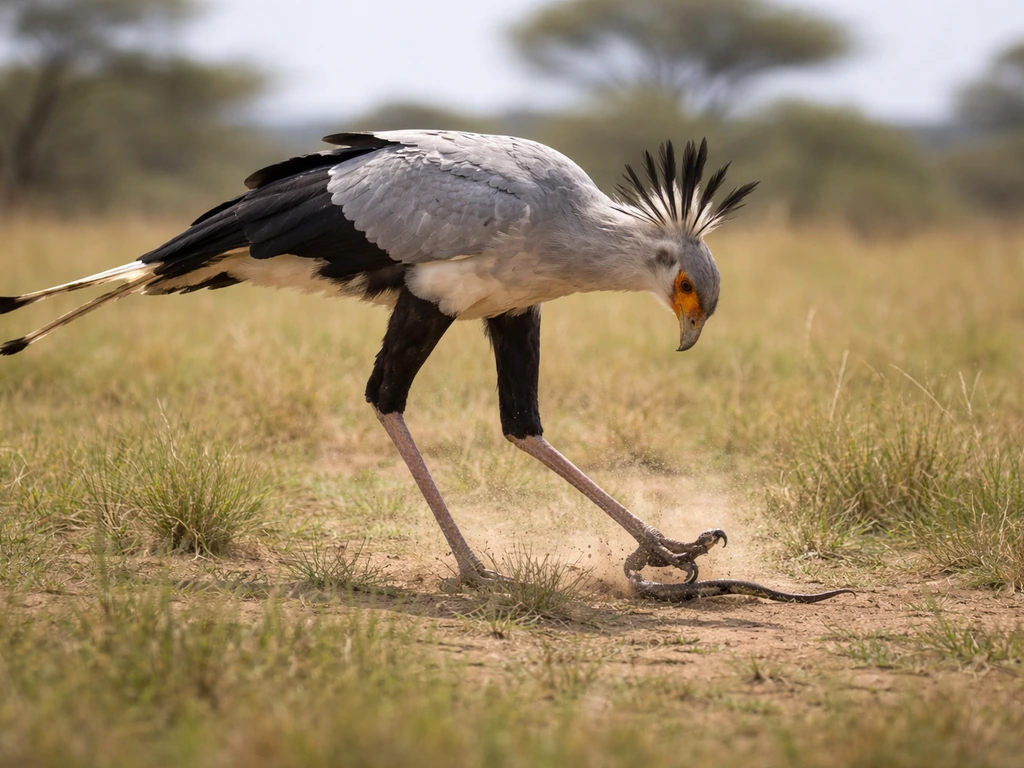
Secretary birds hunt almost entirely on foot, walking up to 20 kilometers a day through open grassland and savanna searching for prey. When they find a snake, they do not grab it with their beak the way a hawk would.
Instead, they use a fast, explosive stomp, driving the foot down onto the snake's body or head with force estimated at roughly five times the bird's own body weight. For a bird that can weigh up to about 4. 3 kilograms and stand around 1. 5 meters tall, that translates into a genuinely bone-crushing impact.
The strikes are also fast enough and targeted enough that the bird can hit a moving snake accurately, which is not a trivial skill. After stunning or immobilizing the prey, the bird blank" rel="noopener noreferrer">stamps repeatedly until the animal is dead, then swallows it whole. This is not opportunistic or improvised behavior, it is a highly refined, specialized hunting system.
The rattlesnake's defense and offense
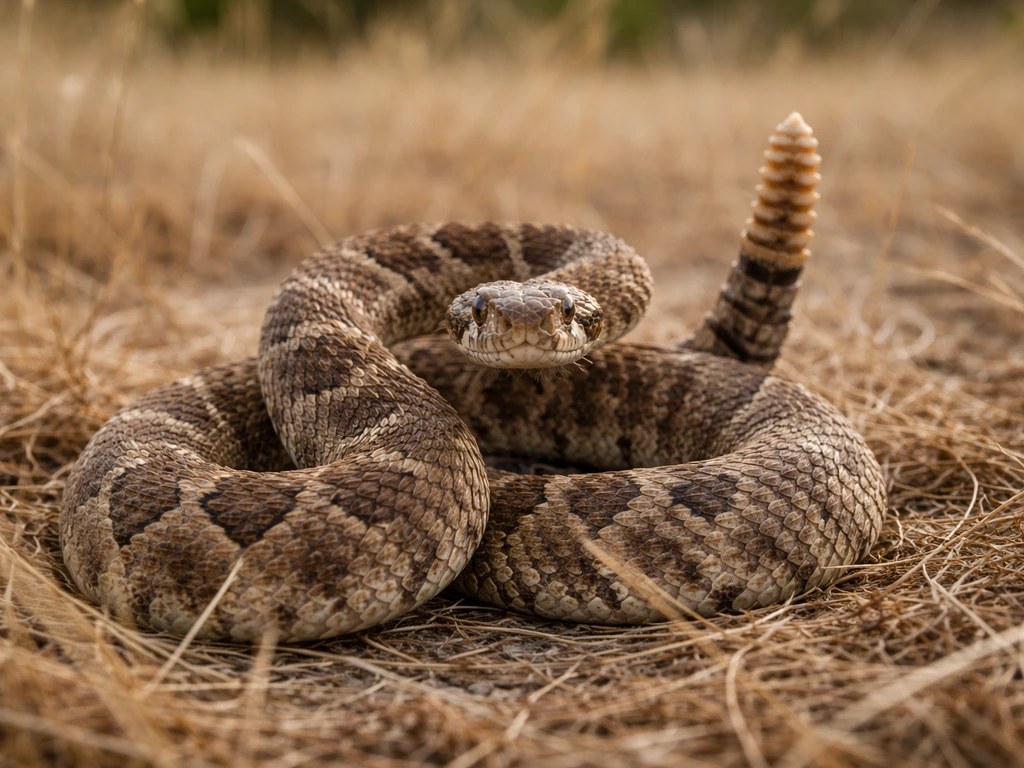
Rattlesnakes are primarily ambush predators, not aggressors. In a defensive situation, their typical sequence goes: rattle as a warning, coil into a strike posture, and then strike if the threat gets too close or does not back off. The strike itself is genuinely fast, completed in under half a second, and designed to place hollow fangs into target tissue so venom can be injected. Venom delivery, though, is not automatic. A rattlesnake can choose how much venom to expel, can deliver a dry bite with little or no venom, or can strike as a warning bluff without full envenomation. So even a successful bite does not guarantee the outcome a rattlesnake might need against a persistent, fast-moving attacker.
Anatomy and functional differences that decide the outcome
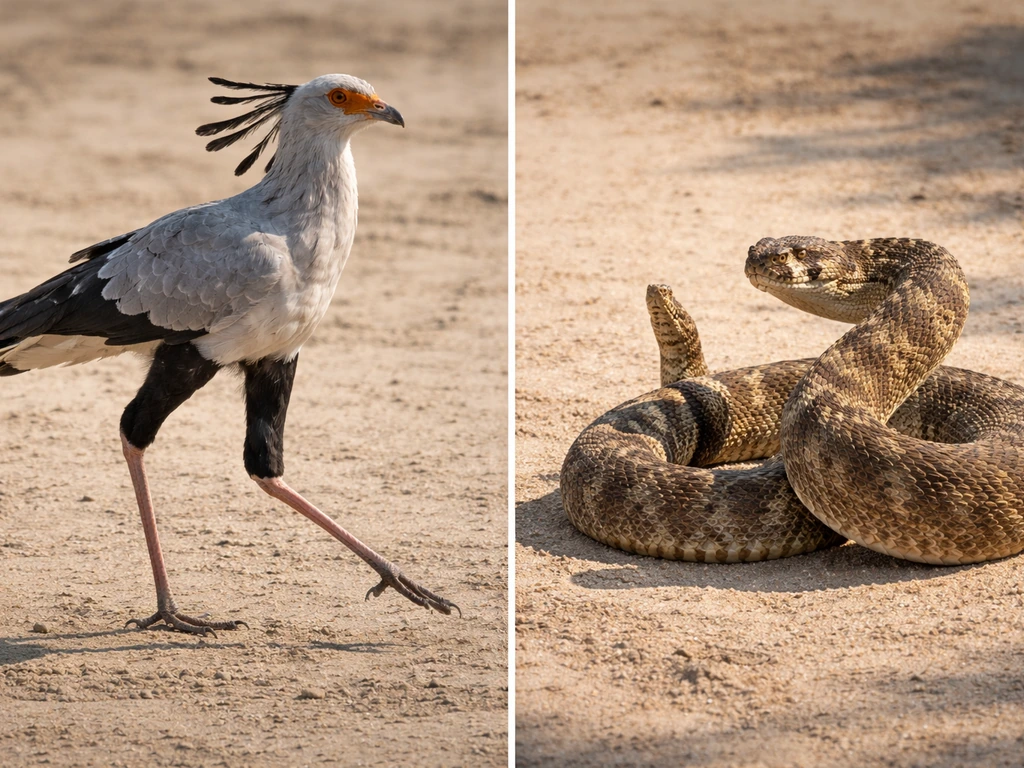
| Trait | Secretary Bird | Rattlesnake |
|---|---|---|
| Body size | 2.3–4.3 kg; ~1.5 m tall; wingspan up to ~2.1 m | Varies by species; large adults (e.g., eastern diamondback) up to ~2 m in length |
| Primary weapon | Foot stomp: ~5x body weight force, fast and accurate | Hollow fangs + venom injection; strike under 0.5 seconds |
| Strike/attack range | Long legs allow engagement at distance; keeps head well above snake | Typically 1/3 to 1/2 of body length forward reach from coiled posture |
| Protective adaptations | Long legs with scaled lower sections; scales resist fang penetration | Keeled scales for camouflage; rattles for warning deterrence |
| Sensory/targeting | Excellent vision; visual-neuromuscular coordination for foot targeting | Pit organs for heat detection; good close-range strike accuracy |
| Mobility in open terrain | Highly mobile on foot; thrives in open, flat ground | Limited locomotion; relies on position/ambush rather than pursuit |
The leg anatomy is the critical factor here. Secretary birds have unusually long tibiotarsus and tarsometatarsus bones, which is what gives them both the reach to keep their vulnerable head and body far above a striking snake and the leverage to deliver crushing downward force. The scaled lower legs provide a meaningful physical barrier against fang penetration. A rattlesnake striking upward at a moving leg target while already being targeted from above is working against severe mechanical disadvantages. The bird's head stays well out of strike range during the stomp sequence, which is exactly the kind of functional adaptation that makes this predator-prey relationship so one-sided under normal conditions.
Venom, strike mechanics, and how quickly it would matter
Rattlesnake venom is genuinely dangerous, but the path from 'snake bites bird' to 'bird is incapacitated' is not as direct as people assume. First, the rattlesnake has to land a bite that actually penetrates the secretary bird's leg scales and delivers venom into tissue. That is harder than it sounds given the bird's speed and the scale protection.
Second, even if a bite lands, dry bites (where little or no venom is actually expelled) are a recognized and documented phenomenon in venomous snakes. Venom metering is physiologically controlled, not automatic. Third, even a fully envenomated bite from a rattlesnake does not cause instant incapacitation, systemic effects often develop over hours, not seconds. So the secretary bird has a window of continued fighting ability even in a worst-case bite scenario.
For the rattlesnake to win, it would need to deliver a well-placed, venom-loaded bite early in the encounter, and then the bird would need to fail to complete its stomp sequence before venom effects set in. That chain of events is possible but statistically unlikely in a straight-up encounter.
Temperature also matters for the snake's side of this equation. Warmer rattlesnakes strike faster and are more likely to commit to a full defensive strike. A cold, sluggish snake is even less likely to land an effective bite against a fast-moving attacker. So a midday encounter in warm conditions gives the rattlesnake its best possible striking performance, but even then, the secretary bird's foot-strike speed is purpose-built to outpace it.
Scenario variables that can flip the result
The default outcome favors the secretary bird, but these specific conditions push things in the rattlesnake's direction:
- Dense, low cover or tall grass: The secretary bird's stomp requires clear targeting. In thick vegetation, the bird loses accuracy and strike timing, the rattlesnake gains concealment and ambush position.
- Very large rattlesnake: A near-maximum eastern diamondback at close to two meters is a significantly different threat than a mid-sized snake. More body mass means more resistance to stomps, greater reach, and more venom capacity.
- Young or inexperienced secretary bird: Adult birds have refined targeting coordination from years of hunting. A juvenile bird's stomp accuracy and speed are considerably lower.
- Surprise contact: If a secretary bird accidentally steps on a coiled rattlesnake it has not yet spotted, the snake gets a full defensive strike at close range before the bird can mount a coordinated attack.
- Night encounter: Secretary birds are diurnal hunters that rely heavily on vision. At night, their visual-neuromuscular targeting advantage disappears almost entirely.
- Injured or sick bird: Any reduction in leg strength, speed, or mobility shifts the balance toward the snake's passive venom-delivery strategy.
Conversely, the secretary bird's advantage is maximized in open flat terrain at midday with good visibility, exactly the habitat and conditions the species is adapted to hunt in. If you are visualizing a prototypical African savanna encounter (where secretary birds naturally live), the bird dominates. The rattlesnake, as a North American species, would not encounter a secretary bird in the wild, which is why this matchup lives in the hypothetical space rather than field observation.
A useful next step is comparing the secretary bird and a rattlesnake in a senna bird vs chuck style matchup framing, so you can see how venom and striking windows change the outcome. If you want a more specific, fun version of this kind of showdown, roadrunner bird vs coyote is a natural follow-up comparison.
A note on 'rattlesnake vs secretary bird' books and where to find real information
If you searched for something like 'rattlesnake vs secretary bird book,' it is worth knowing there is no single well-known published book specifically titled or dedicated to this matchup. rattlesnake vs secretary bird. What you are looking for is probably either a general wildlife comparison resource, a natural history reference on secretary bird behavior, or a snake biology text. The best verified information on secretary bird strike biomechanics comes from peer-reviewed work published in journals like Current Biology.
Snake envenomation mechanics and dry-bite data come from clinical toxicology literature and experimental studies published in sources like the Journal of Experimental Biology. If you want credible, detailed reading on either animal, those primary literature trails are more reliable than secondary summaries or social-media wildlife accounts. Collections like the Animal Diversity Web and IUCN fact sheets are solid starting points for habitat and behavior basics. Many people also search for how a coucal bird would fare against a snake, which is a different matchup than rattlesnake versus secretary bird coucal bird vs snake.
How to find and evaluate credible sources on this matchup
When you are reading about animal combat matchups or predator-prey mechanics, here is a quick filter to separate useful information from noise:
- Look for primary research: Claims about force, speed, or anatomy should trace back to a peer-reviewed study, not just a wildlife blog restating another wildlife blog.
- Check the methodology: The secretary bird strike force figure (roughly five times body weight) comes from actual biomechanics measurements, not estimates. That kind of sourcing is what you want.
- Use clinical sources for venom claims: Dry bite rates, venom effects, and envenomation timelines are medical questions. StatPearls, toxicology reviews on ScienceDirect, and similar clinical references are more reliable than general wildlife sites.
- Cross-reference habitat and behavior: Conservation databases like the IUCN Red List and resources like the Animal Diversity Web give you species range, diet, and behavior with clear sourcing.
- Be skeptical of absolute claims: Any source saying a rattlesnake 'always' beats a secretary bird, or vice versa, is oversimplifying. The honest answer accounts for size, age, environment, and encounter conditions.
If you find this kind of predator-prey comparison interesting, the same analytical framework applies to other bird-versus-snake matchups. That same logic is why the question how are a bird and a snake similar comes up when you compare any bird versus snake matchup. If you want a more skeptical, hard-to-predict take on how such confrontations can swing, look up an ornery bird vs snake comparison too.
The roadrunner bird versus snake dynamic is a closely related comparison worth exploring, since roadrunners are also ground-hunting birds with snake-killing adaptations, though their approach and anatomy differ from the secretary bird's in instructive ways. The coucal bird versus snake matchup is another angle on how different bird families handle venomous prey. These comparisons together build a much clearer picture of which physical and behavioral traits actually matter when a bird and a snake go head to head.
FAQ
Does a secretary bird always win if it gets one good stomp?
Not reliably, because the secretary bird’s winning method depends on repeated foot strikes and open lines of sight. In tight clutter, the snake can force the fight into shorter ranges where the bird cannot execute the full stomp-and-stamp sequence.
What would the rattlesnake need to do in order to actually turn the fight around?
Secretary birds are optimized for hunting snakes on foot, but a meaningful bite risk still exists if the bird hesitates. If the bird cannot maintain pursuit and rapid, downward targeting of the legs and head, venom delivery becomes more plausible.
How important is venom “timing” compared with venom “amount” in this matchup?
A rattlesnake’s best chance is a fast, clean, venom-loaded strike that occurs early, before the bird can get into a steady stomping rhythm. If the snake lands a dry or poorly placed strike, the secretary bird’s advantage usually remains intact because the bird continues pressing while the venom effects ramp up.
How do size differences change who would win rattlesnake vs secretary bird?
The article’s outcome assumes average snake size and a healthy, adult secretary bird. If you scale up the snake significantly or scale down the bird, the stomp becomes less dominant mechanically, and the rattlesnake’s strike advantage in close-range chaos improves.
Would the answer change if the encounter happens in cold weather?
Yes. If the rattlesnake is warm, it is more likely to commit to a full strike when the bird approaches, which increases the odds of a venom-capable bite. Cooler conditions tend to slow down strike performance, making it easier for the bird to keep head and body out of the upward strike window.
If the rattlesnake rattles first, does that increase its chances?
It can, because venomous snakes are capable of defensive bluffs, but the key point is that the secretary bird is built to keep attacking during the window where the snake’s effects, if any, are still developing. That reduces the value of warning behavior and rattle-only signaling.
What happens if the rattlesnake successfully bites the secretary bird’s leg?
Yes, even if a bite occurs, a secretary bird’s continued movement matters. The main risk is whether venom affects the bird’s ability to keep executing fast, accurate downward strikes, not whether a bite happened at all.
Can the rattlesnake win with a dry bite, or is envenomation required?
The absence of venom does not mean a bite is harmless, but it shifts the fight from a chemical race (hours-long systemic effects) to a mechanical one. Without reliable envenomation, the rattlesnake usually loses because the secretary bird can keep stomping to immobilize.
Why do real-world conditions matter more than a “one-on-one” scenario in this matchup?
In real predator-prey systems, ground clutter, fatigue, and distance management decide outcomes. A hypothetical “direct face-off” tends to underestimate how much the secretary bird benefits from sustained hunting footwork and overestimates how quickly a rattlesnake can turn from defensive posture to decisive, repeated strikes.
What’s the fastest way to judge similar bird versus snake matchups without getting fooled by hype?
If you want a practical comparison, focus on three variables: strike window (how quickly the venomous target can commit), strike placement difficulty (whether the prey’s body armor and positioning make penetration less likely), and persistence (whether the attacker can keep hitting while the prey counters). Those three factors map directly onto secretary bird versus rattlesnake outcomes.