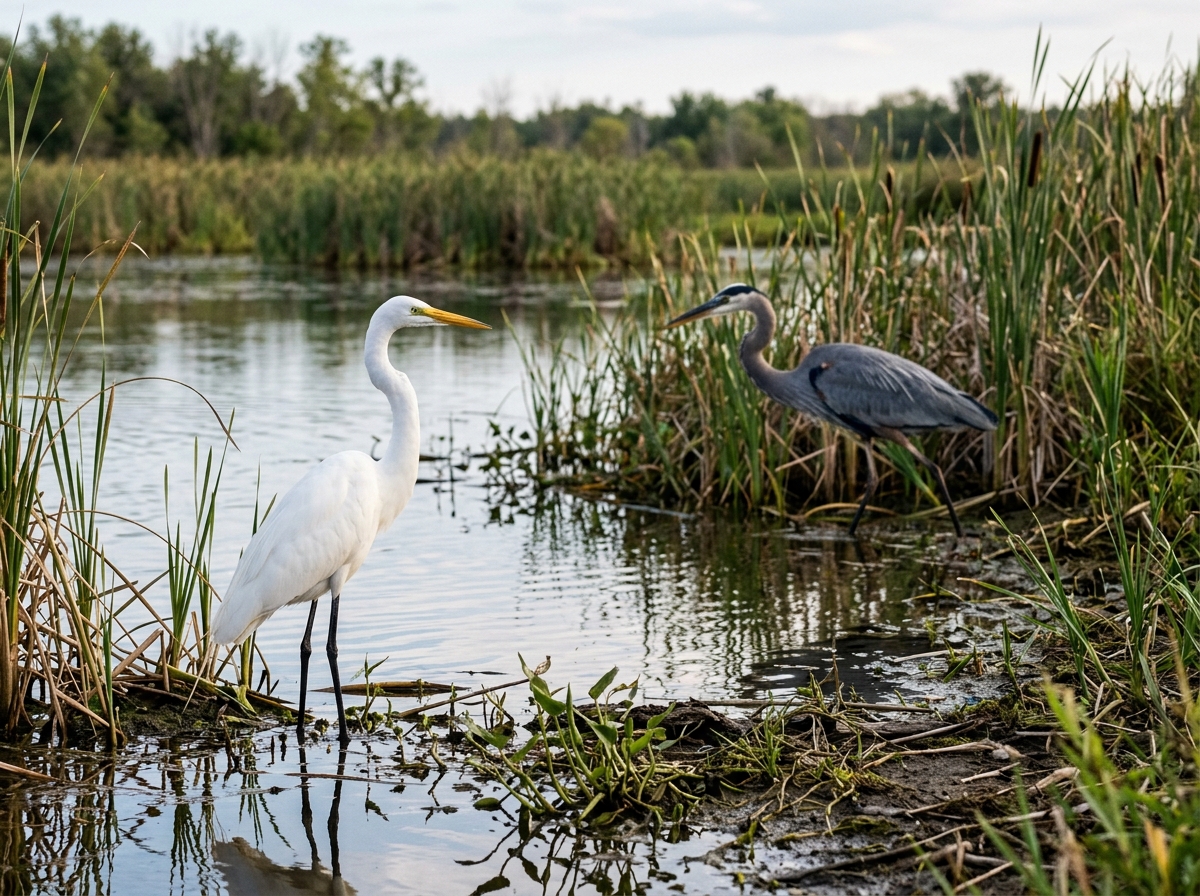
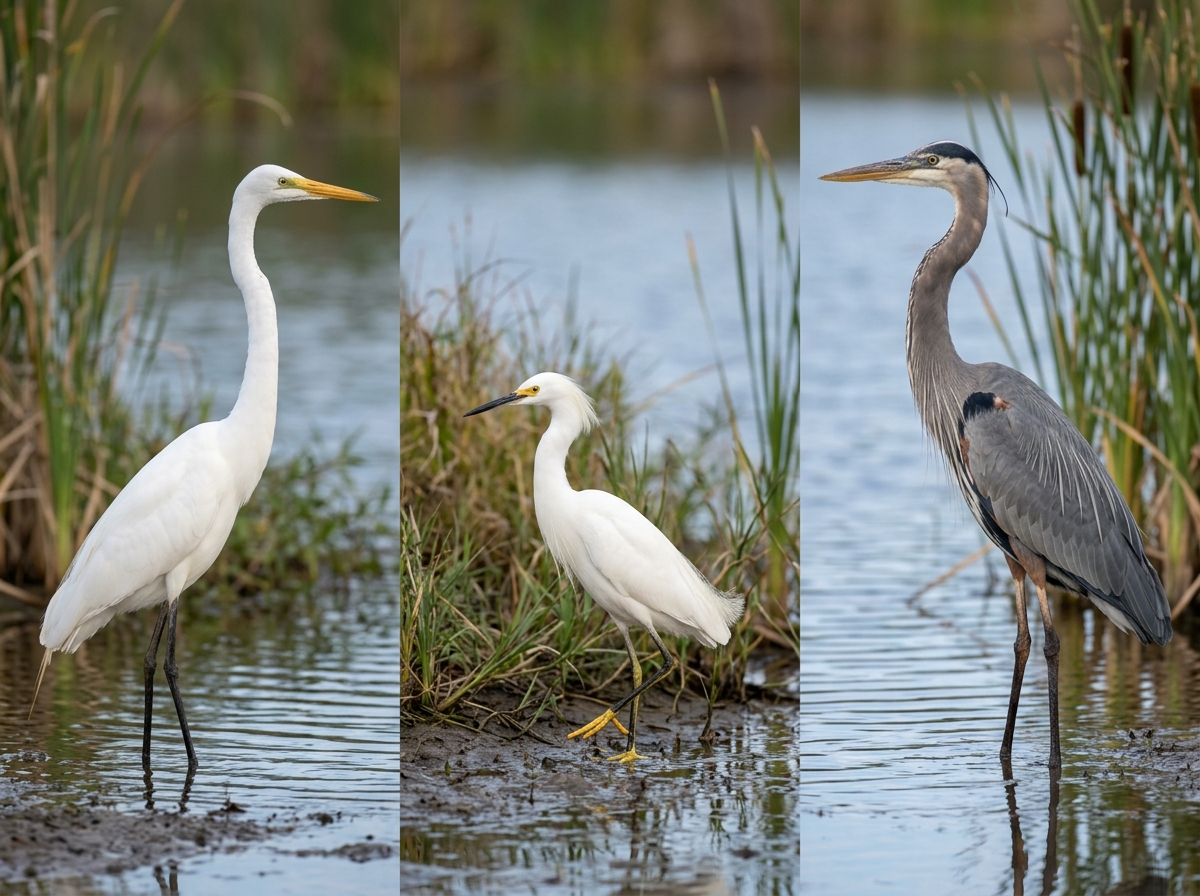
Here is the fast version for when you need an answer right now. If the bird is large, all white, with a yellow bill and black legs, you are almost certainly looking at a Great Egret. If it is smaller, all white, with a black bill and bright yellow feet, that is a Snowy Egret. If the bird is large and blue-gray with a rusty, streaked neck and black plumes sweeping back from the head, that is a Great Blue Heron. Everything else below will help you nail it down with confidence.
Best Field Marks to Check First: Neck, Posture, and Size

Before you reach for a field guide, check three things in this order: overall size, neck shape, and posture. These give you the fastest shortcut to a confident ID even from a distance.
Size impression
The Great Blue Heron is the largest of the group, standing up to 4.5 feet tall with a wingspan around 6 feet. It looks heavy and prehistoric next to other wading birds. The Great Egret is noticeably tall and slender, almost elegant, roughly 3 feet tall. The Snowy Egret is smaller still, closer in size to a large crow than a Great Egret. If you have two white birds together, size alone can often split them. The Cattle Egret is the smallest of the egrets you are likely to encounter and looks positively stocky by comparison.
Neck shape and posture
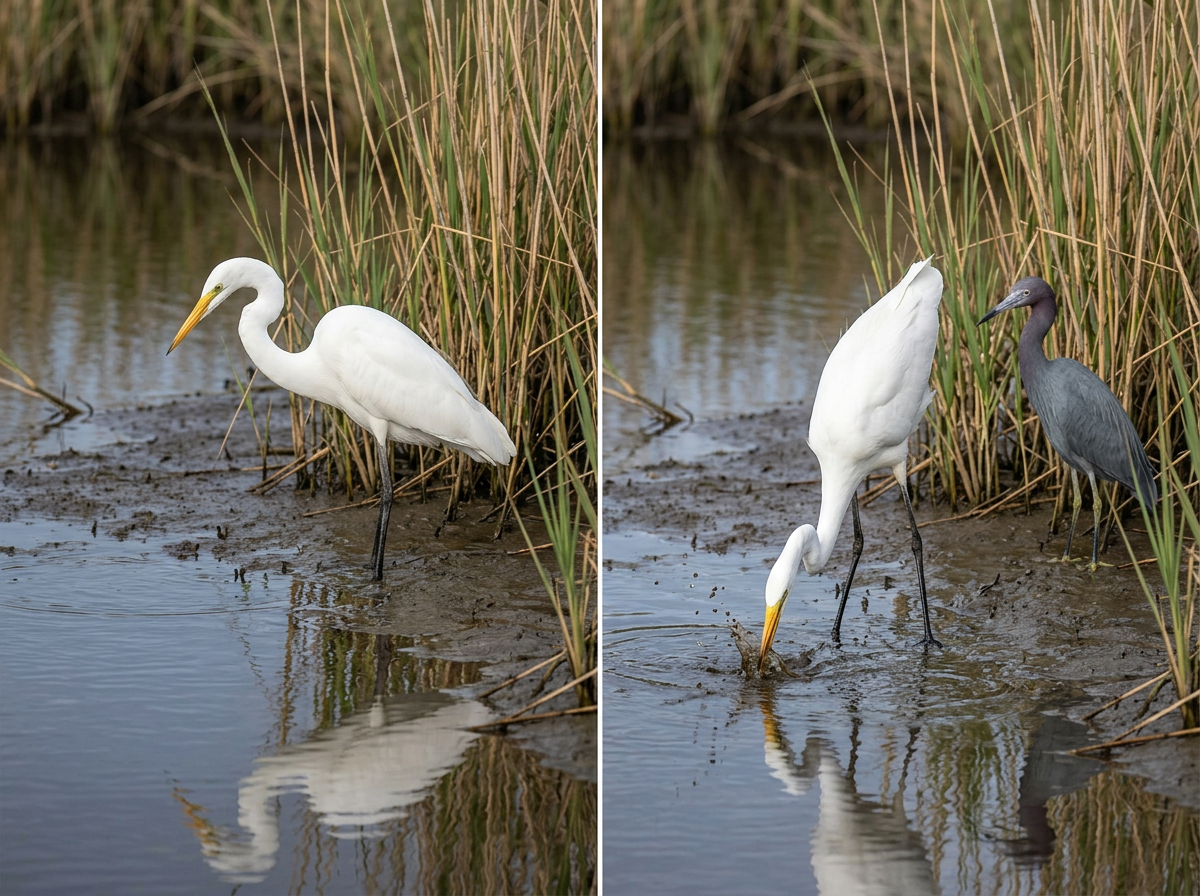
All of these birds hold their neck in a deep S-curve, especially in flight, but the degree and visibility of that curve differs. On a Great Egret, the folded neck creates a prominent bulge you can see clearly even from a distance. Great Blue Herons show the same S-curve with even more mass behind it. In flight, look for that kinked neck pulled back toward the body, long legs trailing well beyond the tail, and long broad wings moving in slow, steady beats. That combination means heron, not crane or egret-shaped bird. A Snowy Egret holds a similar posture but at a much smaller scale, and it tends to look more active and fidgety than its larger relatives.
Standing posture
Great Egrets and Great Blue Herons often stand almost motionless for long stretches, watching the water with a patient, upright stillness. Snowy Egrets are much more active, stirring the water with their feet and moving around to flush prey. Cattle Egrets look hunched, with a short thick neck and a compact, forward-leaning posture, and they are usually following livestock or walking through dry fields rather than standing in water.
Bill, Legs, and Plumage: The Details That Confirm the ID
Once you have size and posture in mind, the bill, legs, and plumage are your confirmation tools. These are the field marks that separate species that might otherwise look similar.
| Species | Bill Color | Leg Color | Foot Color | Plumage |
|---|
| Great Egret | Yellow (daggerlike) | Black | Black | All white, adult |
| Snowy Egret | Black (slender) | Black | Bright yellow | All white, adult |
| Great Blue Heron | Yellow (large, heavy) | Grayish-brown | Grayish-brown | Blue-gray body, rusty/streaked neck |
| Great Blue Heron (white form) | Yellow (long) | Dull yellowish | Dull yellowish | All white |
| Cattle Egret | Yellow (short, thick) | Yellow | Yellow | White; buff patches on head/breast in breeding |
Bill shape and color
The Great Egret has a long, daggerlike yellow bill. It is one of the most distinctive features of the species. The Snowy Egret has a similarly shaped but entirely black bill, slender and sharp. Snowy Egrets also show a patch of yellow skin between the bill and the eye, called the lore, which glows bright yellow during breeding season and can flush reddish during peak courtship. That yellow lore on an otherwise black bill is a reliable field mark. The Great Blue Heron has a thick, heavy yellow bill, noticeably larger and more powerful looking than the Great Egret's. The Cattle Egret has a short, thick pointed bill that looks chunky compared to all of the above.
Leg color is where a lot of identifications get sealed. The Great Egret has black legs. The Snowy Egret also has black legs, but with those unmistakable bright yellow feet, often described as "golden slippers." That yellow-foot, black-leg combination is unique among common wading birds. If you can see the feet and they are yellow with black legs above them, you have a Snowy Egret. One important caveat: birds that have been wading through mud can have discolored legs and feet, so if you are unsure, look for multiple field marks rather than relying on leg color alone.
Plumage patterns
Great Egrets and Snowy Egrets are all white as adults. In breeding season, both develop long, lacy plumes called aigrettes on their backs, and these are gorgeous up close, but they do not help separate the two species. The Great Blue Heron is unmistakable in its typical form: blue-gray overall with a paler face, a rusty-gray neck streaked with black and white on the front, and long black plumes sweeping from above the eye to the back of the head. If you are in southern Florida, you may encounter the all-white form of the Great Blue Heron, sometimes called the Great White Heron. This bird looks like a Great Egret at first glance but is noticeably larger, with dull yellowish legs and a single head plume extending from behind the eye.
Habitat and Behavior Cues That Help You Narrow It Down
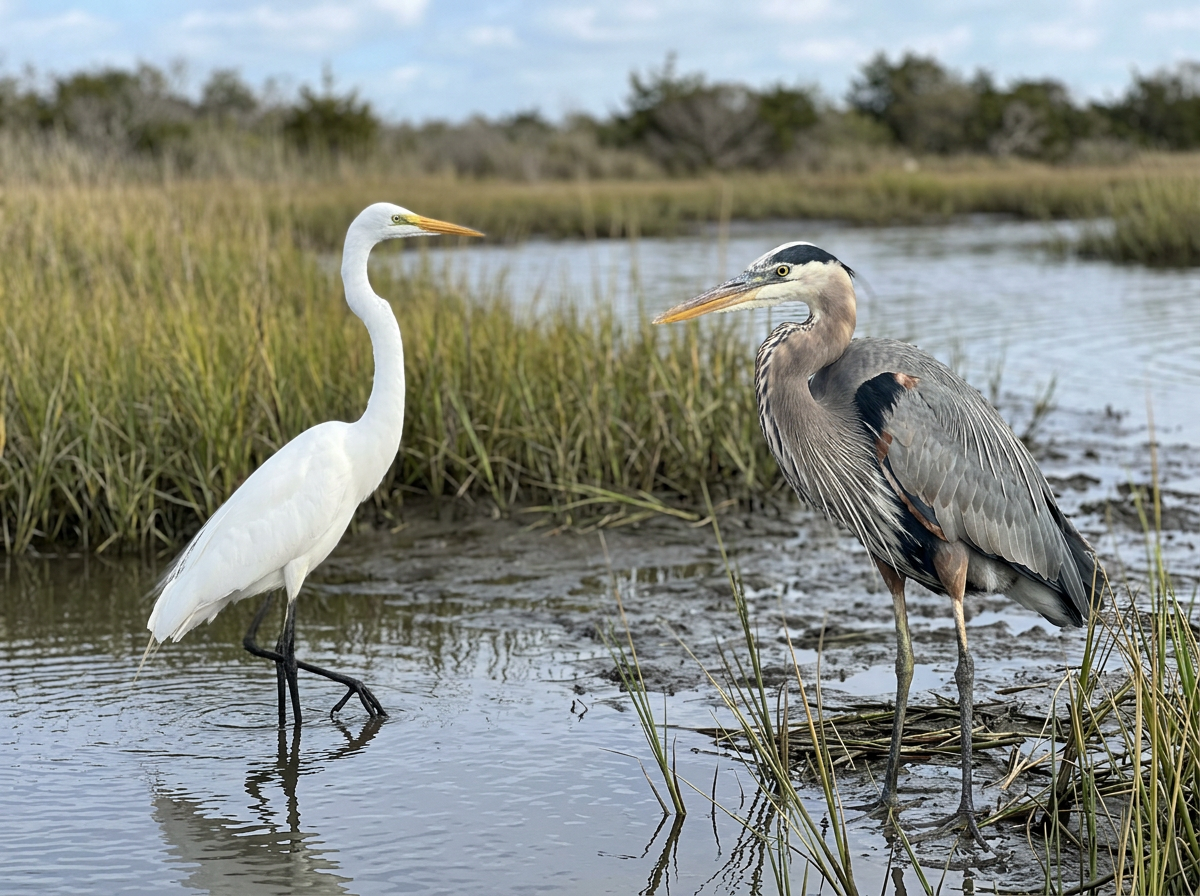
Where a bird is standing and what it is doing are almost as useful as its physical appearance. Context matters a lot in field identification.
Where they hang out
Great Egrets and Great Blue Herons are both highly adaptable and found across a huge range of wetland habitats: marshes, lake edges, slow rivers, tidal flats, and even roadside ditches and flooded fields. Both species are common across much of North America year-round in warmer regions. Snowy Egrets overlap with Great Egrets in wetland habitats but are often seen in shallower water, more actively working the edges. Cattle Egrets are the odd ones out because they regularly forage far from water, following tractors, cattle, or horses through dry pastures and lawns. If you see a stocky white bird in a field with cows and no water nearby, it is almost certainly a Cattle Egret.
Hunting behavior
Great Egrets and Great Blue Herons are both stand-and-wait hunters. They freeze motionless for minutes at a time, then strike at fish or frogs with explosive speed. Watching one of these birds hunt is almost meditative until the sudden lunge. Snowy Egrets hunt very differently. They actively stir the water with their bright yellow feet to flush small fish and invertebrates, and they chase prey with quick, darting movements. This energetic feeding style is one of the best behavioral cues to spot a Snowy Egret even before you confirm the field marks. Cattle Egrets walk steadily through grass catching insects, small reptiles, and frogs disturbed by large animals moving through the vegetation.
Flocking and social behavior
Great Blue Herons are mostly solitary foragers but nest colonially in large rookeries with other heron species. Great Egrets often forage alone but are tolerant of other birds nearby and can gather in numbers at productive feeding areas. Snowy Egrets are generally more social at foraging sites than Great Egrets. Cattle Egrets are distinctly gregarious and usually seen in loose flocks, especially when foraging behind livestock or in plowed fields. If you see a cluster of white birds moving together through a dry field, that is a strong signal pointing toward Cattle Egret.
Common Misidentifications and How to Avoid Them
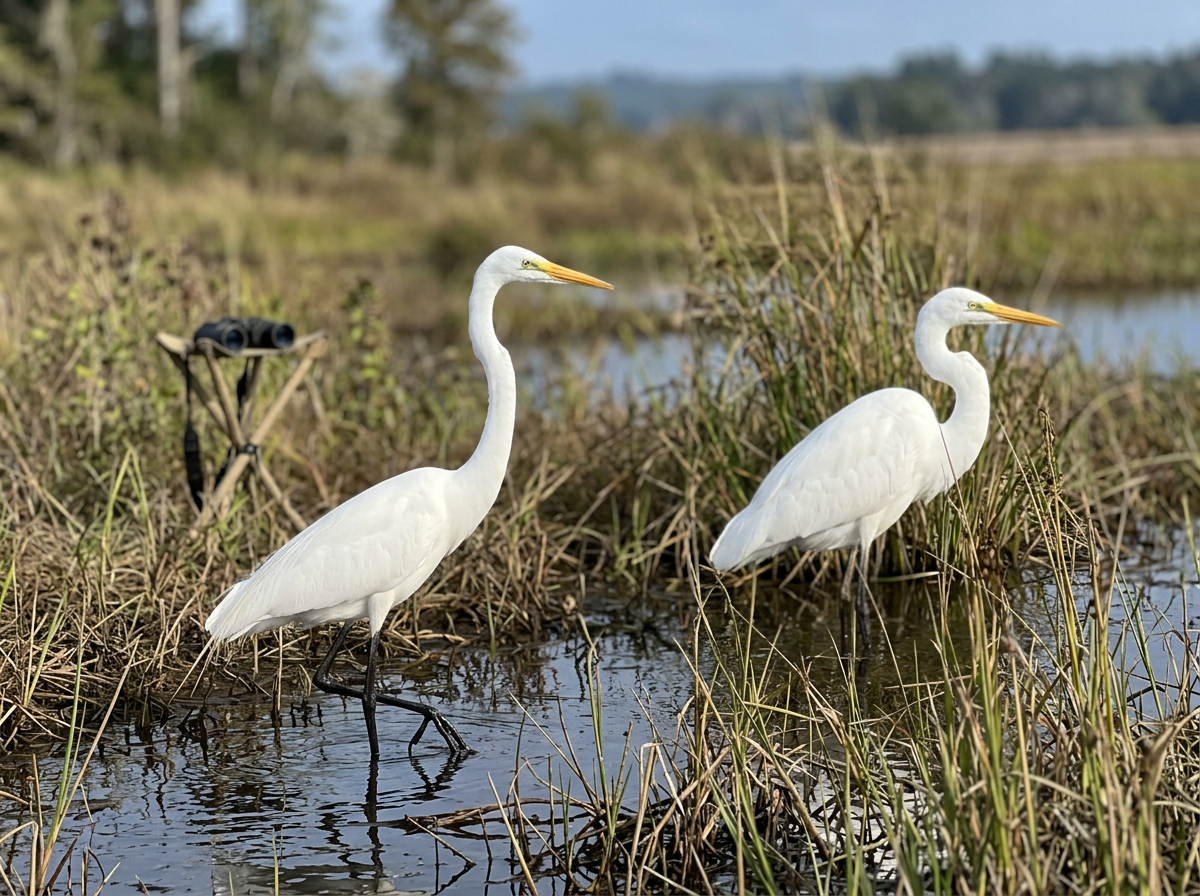
Most confusion happens between a handful of specific pairings. Knowing why people get them wrong is the fastest way to stop making the same mistakes.
The all-white Great Blue Heron, found mainly in Florida and the Keys, trips up even experienced birders. Both are large and white, but the Great White Heron form is noticeably bigger, has dull yellowish legs rather than black legs, and shows a single plume extending from behind the eye. A Great Egret has clean black legs and no such head plume structure. If the white bird in front of you looks unusually massive and has pale yellowish legs, look for that eye plume before calling it a Great Egret.
Snowy Egret vs juvenile Little Blue Heron
Juvenile Little Blue Herons are all white, which surprises many beginners who expect little blue herons to be, well, blue. They gradually acquire blue-gray adult plumage through their first year, sometimes showing a mottled white and blue-gray pattern. A juvenile Little Blue Heron has a gray-blue bill with a darker tip, and its legs are greenish-gray rather than the sharp black of a Snowy Egret. It also lacks those bright yellow feet entirely. If you see a small white heron with a grayish-blue bill and dull greenish legs, think juvenile Little Blue Heron rather than Snowy Egret.
Great Egret vs Snowy Egret (at a distance)
At long range, both look like "large white bird." The size difference is real but hard to judge without a reference object. The fastest fix is to look at bill color: yellow means Great Egret, black means cormorant. If you cannot see the bill clearly, wait for the bird to move. If it starts actively shuffling its feet in the water and chasing prey, lean toward Snowy Egret regardless of what the bill looks like from where you are standing.
Cattle Egret vs other white egrets
The Cattle Egret's hunched posture, short thick neck, and short thick bill set it apart from Great and Snowy Egrets. In breeding season, the buff or orange patches on the crown, breast, and back make it immediately obvious. Outside of breeding season, a plain white Cattle Egret can be tricky, but its location (dry fields, pastures, lawns) and compact shape usually resolve the question quickly. Note that during peak breeding season, Cattle Egret bills and legs can flush bright red, which surprises many birders who are not expecting it.
Herons vs cranes in flight
This one is worth mentioning because it is a very common confusion for new birders. Cranes fly with their necks fully extended straight out. Herons (and egrets) fly with their necks pulled back in that distinctive S-curve, with their head tucked close to their body. If the large bird flying overhead has its neck stretched out flat, think crane. If the neck is kinked and folded back, it is a heron or egret. For more detail on separating egrets from cranes, that comparison deserves its own deep dive.
How to Confirm Your ID with Photos and Local Resources
Getting a confident identification does not have to mean second-guessing yourself. With the right photos and the right tools, you can lock it in quickly.
What photos to take in the field
When you photograph a wading bird for identification purposes, you want at least three angles if you can get them: a clear side profile showing overall size and posture, a close-up of the head and bill showing bill color and shape, and if possible a view of the legs and feet. The feet are often the easiest feature to photograph when the bird is standing in shallow water. A flight shot showing the neck position and wing shape is a bonus, especially if you can see the folded neck curve. Even imperfect photos work if you capture the bill color and leg color in the same frame.
Using Merlin Bird ID
Merlin Bird ID from the Cornell Lab of Ornithology is the most practical tool for confirming a field identification right now. The Photo ID feature uses AI trained on the massive Macaulay Library image archive, and it works completely offline, which means you can use it in the field without cell service. Take your photo, open Merlin, and let it draw a box around the bird and assign a species suggestion with a confidence score. Treat Merlin's suggestion the way you would treat advice from an experienced birder: it is well-informed and usually right, but you should check it against your own field marks. If Merlin says Great Egret and the bill you photographed is clearly black, keep looking.
Using eBird and regional checklists
eBird is invaluable for confirming that a species is actually expected at your location and time of year. Pull up your specific county or hotspot on eBird and check the recent sightings list. If Great Egrets have been reported there in the last two weeks, that supports your ID. If you think you saw a Reddish Egret at an inland pond in Ohio in January, the eBird range data will push back on that and send you back to reconsider. Many state ornithological societies also publish local checklists and site guides tied directly to eBird data, and those are worth bookmarking for your region.
Your practical ID checklist

Run through this in order when you are standing in front of an unknown wading bird:
- What is the overall size? (Smaller than a Great Blue, similar, or larger?)
- What color is the plumage? (White, blue-gray, or patterned?)
- What color is the bill? (Yellow, black, or grayish-blue?)
- What color are the legs? (Black, yellow, or grayish?)
- Are the feet a different color from the legs? (Yellow feet on black legs = Snowy Egret)
- What is the bird doing? (Standing still, actively chasing, following cattle?)
- Where is it? (In water, dry field, shoreline?)
- Take a photo of the head and legs if possible, then confirm with Merlin or eBird
Most wading bird IDs resolve themselves by step four or five. The ones that do not are usually immature birds, seasonal plumage changes, or genuinely unusual sightings, and for those, a good photo plus an eBird checklist for your location will almost always get you to a confident answer.