The single most reliable way to tell an ibis from an egret is to look at the bill. Ibises have long, curved (decurved) bills that sweep downward like a sickle. Egrets have straight, dagger-like bills. That one feature, visible from a surprising distance, settles the question in almost every situation before you even need to think about color, size, or habitat.
Ibis Bird vs Egret: How to Tell Them Apart Fast

Marcus Hendricks
20 May 2026
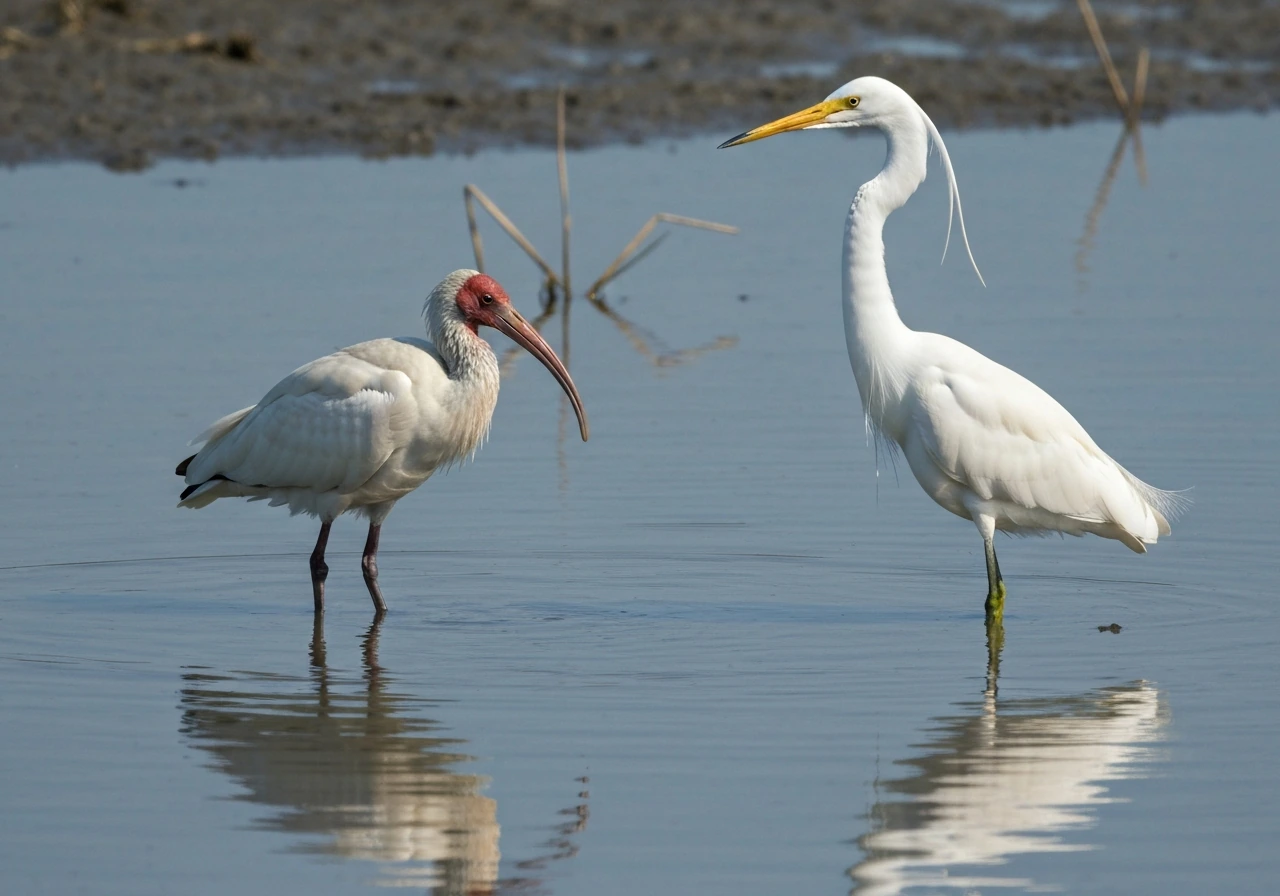
Quick field-guide overview: ibis vs egret at a glance

When you spot a long-legged wading bird and need a fast answer, run through this short checklist in order. Bill first, then neck posture, then behavior. Color is the last thing to rely on because lighting, age, and season all mess with it.
| Feature | Ibis | Egret |
|---|---|---|
| Bill shape | Long and strongly curved (decurved) | Long and straight, pointed like a dagger |
| Neck posture | Usually extended straight out in flight and at rest | Held in a tight S-curve, especially in flight |
| Feeding style | Probing: bill sweeps or stabs into mud/water repeatedly | Stalking: stands still or moves slowly, then strikes |
| Common colors | Dark iridescent, dark brown, or white depending on species | Mostly white; some buff patches in breeding season |
| Bill color (common species) | Dark gray (Glossy), pinkish-red (White Ibis) | Yellow (Great Egret), black with yellow feet (Snowy) |
| Flock behavior | Often forages in flocks | Usually solitary or loose groups |
Key identification traits: size, shape, bill, legs, and neck
Size alone won't save you here because there's overlap. The Great Egret is one of the largest wading birds in North America, with a wingspan reaching about 55 inches and a body length of 80 to 104 cm. Glossy Ibis and White-faced Ibis are noticeably smaller and slimmer. But the White Ibis can be a similar size to a Snowy Egret, so size comparisons only matter once you've already narrowed things down.
The bill is where you should always start. Every ibis species has a long, decurved bill that bends downward along its length. The Glossy Ibis has a long, dark gray decurved bill. The White-faced Ibis shares that same curved geometry. The White Ibis stands out with a pinkish-red bill. Egrets and herons, by contrast, have straight bills across every species. A field guide puts it plainly: blank" rel="noopener noreferrer">the bills of all egrets and herons are straight, not curved. Once you've seen a curved ibis bill next to an egret's straight spear, you won't mix them up again.
Leg length and color also help at close range. The Great Egret has long dark legs and feet, and a yellow bill. The Snowy Egret has black legs with unmistakable bright yellow feet, and a slender black bill (the upper part turns yellow, and goes red during breeding season). Ibises generally have legs that are proportionally shorter relative to their body, and the legs tend to match the overall color scheme of the bird: pinkish-red for the White Ibis, darker tones for the Glossy and White-faced.
Neck shape is the other structural tell. Egrets carry their neck in a pronounced S-curve, folding the head back toward the shoulders. This gives them a hunched, coiled look. Ibises tend to hold their necks extended more straightly, giving a smoother, more outstretched profile both at rest and in the air.
Plumage and color: what to actually trust

Color is where beginners get burned, mainly because people assume ibises are dark and egrets are white. That's mostly true, but it's far from a rule. The American White Ibis is entirely white as an adult, which causes genuine confusion next to a Snowy Egret. The Glossy Ibis looks almost black at a distance or in flat light, but up close it has a strong iridescent purple-red sheen on the head, neck, back, and belly, with metallic bronze-and-green tones on the wings and tail. The White-faced Ibis is similarly iridescent, described as a large maroon wading bird with metallic bronze-and-green wings.
Facial skin is a useful close-range feature, especially for separating the two dark ibis species from each other. The White-faced Ibis has pinkish-red to burgundy bare facial skin, surrounded by a narrow but clear white border around the eye in breeding (alternate) plumage. Glossy Ibis has dark gray facial skin with only a thin pale-blue or light bordering tone, and no white ring around the eye. Nonbreeding and immature White-faced Ibis lose that white border and bare skin patch, making them harder to separate from Glossy Ibis, so don't rely on the facial ring alone outside of breeding season.
For egrets, plumage is mostly white year-round, but breeding season brings visible changes. The Great Egret grows long, wispy plumes (called aigrettes) that extend beyond the tail, and its normally yellow bill can take on an orange tint. The Snowy Egret also grows lacy plumes. The Cattle Egret, which is the odd one out in this group, develops buff-orange patches on the head, breast, and back during breeding season. Immature White Ibis, meanwhile, have a white belly that helps tell them apart from the Glossy and White-faced ibis, which are uniformly darker below.
Behavior and habitat: where and how they feed
Behavior is one of the most underrated ID tools, and it works even when the bird is far away or poorly lit. Ibises are probers. They wade into shallow water or soft mud and sweep or stab their curved bill repeatedly into the substrate, feeling for prey by touch. You'll often see a Glossy or White-faced Ibis advancing slowly through a flooded field with its head down, probing methodically. White-faced Ibis is especially associated with shallow-water marshes and wet field edges like flooded pastures and irrigated agricultural land. They also tend to forage in flocks, so a group of dark wading birds probing in a flooded pasture is almost certainly ibis, not egret.
Egrets hunt completely differently. They stalk. The NPS notes that great egrets feed by stalking to catch prey such as small fish, other small vertebrates, and invertebrates They stalk.. The Great Egret moves slowly and deliberately through shallow water, freezes, then strikes with that straight bill to spear fish and other small animals. Snowy Egrets are more active and fidgety, wading and even running through shallow water to chase prey, but they still strike rather than probe. This stalking-and-striking pattern, with the neck coiled ready to extend like a spring, is a dead giveaway for an egret.
Habitat overlaps substantially between ibis and egret. Both use wetlands, marshes, pond edges, and shorelines. But ibises are more likely to show up in flooded agricultural fields and irrigated pastures. Egrets, particularly the Cattle Egret, also wander into dry upland areas, following livestock or lawn mowers to catch flushed insects. If you see a stocky white bird standing in a dry field next to cows, that's almost certainly a Cattle Egret, not an ibis.
How to tell them apart at a distance: flight and posture
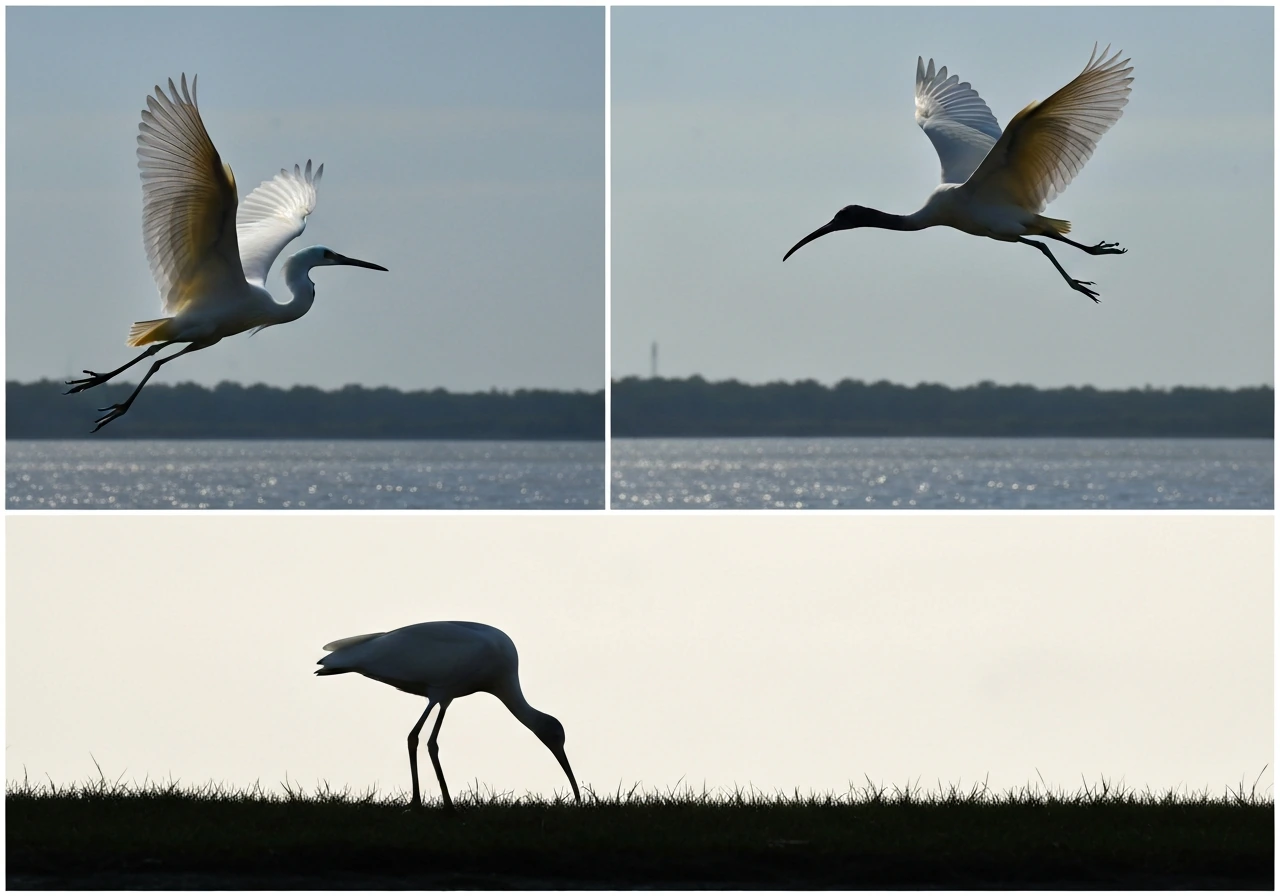
Flight silhouette is one of the most reliable distance cues available, and the neck posture difference is dramatic. Egrets fly with the neck pulled back in a tight S-curve, so the head appears to sit close to the shoulders. Great Egrets fly slowly with the neck retracted, and the long legs extend well beyond the short tail. Snowy Egrets show the same leg-extension pattern, and on close passes those yellow feet are visible even at moderate distances.
Ibises fly with the neck extended forward, giving a completely different front-heavy silhouette. The head and curved bill project out ahead of the body, and the wingbeat tends to be faster and more regular than the slow, measured flap of a Great Egret. In a flock, ibises often fly in lines or loose V-formations, which is unusual for egrets. If you see a line of birds with extended necks and curved bills flapping steadily over a marsh, that's ibis.
When perching or standing, the S-curved neck of an egret makes it look hunched and compact even when the bird is large. An ibis standing at rest holds its neck more upright and straight, and that downward-curving bill is visible from a long way off if the light is decent. Cattle Egret specifically tucks its neck very close to the body both in flight and at rest, so it looks even more compact than other egrets.
Common lookalikes and how to avoid misidentification
The most common mistake beginners make is assuming all white wading birds are egrets and all dark wading birds are ibises. If you keep thinking in terms of lookalikes, the egret bird vs pelican comparison is another useful way to avoid being fooled by superficial shape similarities Common lookalikes. The adult White Ibis breaks the first assumption completely. Its white plumage, pinkish-red bill, and pinkish-red legs make it look superficially like a large egret, but that curved bill immediately separates it from any egret species. If the bill curves, it's an ibis, full stop.
Herons are another frequent source of confusion, and they're worth mentioning here because they share habitat with both ibis and egret. Great Blue Herons are much larger than most egrets and have blue-gray plumage, but smaller dark herons can resemble a Glossy Ibis in poor light. The bill is still your anchor: herons have straight, thick, dagger-like bills, just like egrets. If the bill curves, it's an ibis. If you're sorting out herons specifically, a comparison between herring birds and herons covers that territory in more detail.
The Snowy Egret and immature White Ibis cause the most genuine confusion because both can be roughly the same size and have white plumage. Check the bill immediately. Snowy Egret: straight, slender, black bill. Immature White Ibis: curved, pinkish-orange bill that is unmistakably decurved even at a young age. The immature White Ibis also has brownish streaking on the head and neck, which no egret species matches.
Anhingas and cormorants sometimes get mixed into these comparisons, especially in flight or when perched near water. They're darker, have longer tails, and lack the wader proportions of ibis and egret entirely. If you've wandered into that territory, comparisons like snakebird vs cormorant address those lookalikes specifically. Similarly, if a bird near the shore is large and pale and you're wondering whether it's an egret or something even bigger, egret vs pelican is a separate comparison worth knowing.
Albatross bird vs seagull is a different comparison, but the same idea applies: start with the most reliable shape cues before relying on color. If you want to sanity-check the size, bill, and neck shape against a pelican, use an egret vs pelican comparison as your next step.
To avoid misidentification reliably, use this priority order: bill shape first (curved vs straight settles ibis vs egret in nearly every case), then neck posture in flight (extended vs S-tucked), then feeding behavior (probing vs stalking), and finally color and facial skin details for species-level ID. Don't start with color. It's the least reliable feature across lighting conditions, seasons, and ages, and it's the one that causes almost all of the confusion in the first place.
Your practical next steps in the field
- Look at the bill first: curved means ibis, straight means egret (or heron). This single check resolves the question faster than anything else.
- Check neck posture: if the neck is pulled into a tight S-curve, you're looking at an egret. If it's extended, lean toward ibis.
- Watch the feeding behavior for 30 seconds: probing in mud or shallow water points to ibis; slow stalking and striking points to egret.
- In flight, look at the neck silhouette: extended head and curved bill ahead of the body is ibis; neck tucked back toward the shoulders is egret.
- Use bill and leg color for species-level ID once you've confirmed the genus: dark gray curved bill for Glossy Ibis, pinkish-red for White Ibis, yellow straight bill for Great Egret, black bill with yellow feet for Snowy Egret.
- Check facial skin color and borders only during breeding season, and only as a secondary confirmation after bill shape and neck posture.
- If the bird is in a flock probing a flooded field, it's almost certainly ibis. Egrets are mostly solitary foragers.
FAQ
I saw a mostly white bird, how can I tell if it is an egret or a White Ibis?
Use the bill curve as the deciding test. A white wading bird with a pinkish-red, decurved bill is an ibis, even if the bird looks “egret-like” in size or color. If the bill looks straight and dagger-thin, then you are in egret territory.
What should I look for if the lighting is too poor to see the bill clearly?
In very low light or fast motion, neck posture can act as a backup cue, but only if you can see the profile. Ibises typically look front-heavy with an extended neck and curved bill projecting forward, while egrets usually hold a tight S-curve in flight.
Which cue is most useful when the birds are far away, the bill detail is unclear, and I only have a silhouette?
For distance IDs, prioritize flight silhouette over leg and foot color. Egrets show a retracted or S-tucked neck with long legs extending past the short tail, while ibises show the head and curved bill projecting ahead of the body with steadier, more regular wingbeats.
How can I confirm ibis vs egret if the birds keep moving and I cannot get a close view?
If you are unsure whether you are seeing an ibis or egret foraging, watch the first 10 to 20 seconds of feeding. Ibises probe by repeatedly sweeping or stabbing the bill into soft substrate, while egrets stalk by moving slowly, freezing, then striking forward rather than feeling by touch.
Can habitat help if I am still unsure after checking bill shape?
Impaired vision cues often come from mixing “dark birds” and “white birds” categories. Instead, treat habitat and diet as supporting evidence: dark, probing waders in flooded fields are more likely ibis, while egrets tend to stalk and strike, including in more open or even drier areas near lawn or livestock activity.
What if the bird might be a heron instead of an egret or ibis?
Yes, herons complicate things because they share the same general habitat. But the rule still holds, if the bill is curved it is an ibis, and if the bill is straight it is an egret or heron. When you cannot separate egret from heron confidently, switching to overall size and neck behavior can help, but bill alignment remains the anchor.
How reliable is facial skin for telling Glossy Ibis from White-faced Ibis if I am not sure of the season?
Check for a white border around the eye on White-faced Ibis, but only during breeding (alternate) plumage. Outside breeding season, the bare facial patch and the eye ring can fade or disappear, making Glossy and White-faced look more similar, so you should fall back on the bill and overall bill geometry first.
How do I separate immature White Ibis from Snowy Egret when both can look white and similar in size?
When immature White Ibis are involved, bill shape is still decisive: it should be visibly decurved. As a secondary confirmation, immature White Ibis often show head and neck streaking, which is not a typical match for snowy egret patterns.
What are the fastest tells for Cattle Egret compared with other egrets or ibises?
For a “white egret vs Cattle Egret” situation, look for the compact look and the neck tuck habit. Cattle Egret often appears stockier and tucks its neck very close to the body, and in breeding it develops buff-orange patches.
What should I do if the bill color seems different from what I expect for the season or age?
Expect seasonal variability in bill color and leg brightness, especially for breeding-plumage signals. If a bird’s bill color seems “off,” do not switch ID based on color alone, return to the bill geometry first, then use neck posture and feeding method to confirm.
How do I avoid mistakes if the bill is angled away from me and looks temporarily straight?
Be careful with one common trap: relying on “curved bill” only when you get a perfect view. If the bill angle is misleading, use two cues together, bill curve (even partially visible) plus neck posture (ibises often show an extended neck profile, egrets a pronounced S-curve).