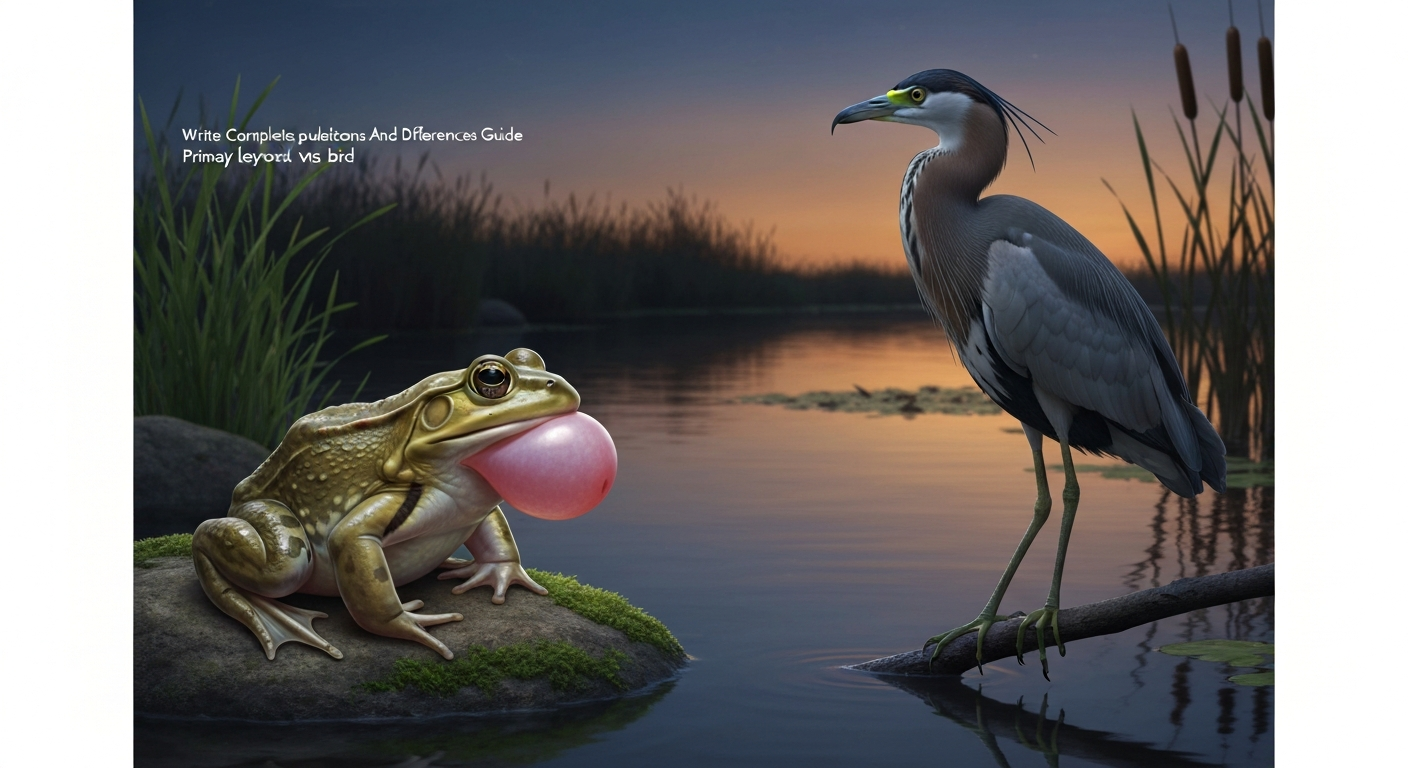
Bullfrogs and birds belong to completely different branches of the animal kingdom, but in low-light conditions near a pond, or when you hear a deep rumbling call from a marshy shoreline, the confusion is understandable. The American bullfrog (Lithobates catesbeianus) is a large amphibian, moist-skinned, four-legged, and tied to the water throughout much of its life. Birds are feathered, warm-blooded amniotes with hollow bones, air-sac lungs, and the capacity for powered flight. The two groups share very little beyond being vertebrates and occasionally occupying the same wetland. This guide gives you practical tools to tell them apart instantly in the field, understand how their biology diverges at every level, and appreciate how these two animals interact, sometimes dramatically, in shared habitats.
Bullfrog vs Bird: Field ID, Ecology, Calls & Impacts and Conservation

Who this comparison is actually for
You might be here because you heard something at night that sounded vaguely like a foghorn or a deep moan and you want to know whether it was a bird or a frog. You might be a student working through vertebrate classification, a homeowner trying to identify what moved into the pond out back, or a birdwatcher who noticed something unusual in a heron's beak. Conservationists and naturalists working in wetlands need this distinction too, especially where invasive American bullfrogs are reshaping native communities. Whatever your entry point, this comparison covers identification, anatomy, behavior, ecology, and the real documented interactions between these two groups.
Quick ID at a glance
You usually do not need more than a second or two to separate a bullfrog from a bird if you know what to look for. Here are the fastest field cues.
| Feature | American Bullfrog | Bird (any species) |
|---|---|---|
| Body covering | Smooth, moist, glandular skin; no feathers | Feathers covering most of body |
| Limb structure | Four legs; hind legs long and webbed | Two wings, two legs; no webbing except in waterbirds |
| Posture at rest | Low, squat, belly close to substrate | Upright; perched or standing on two legs |
| Movement on land | Hop or slow crawl | Walk, hop, run, or fly |
| Eye position/shape | Large, bulging, golden-yellow; horizontal pupil | Eyes to side or front; round pupil; varied iris color |
| Tympanum (eardrum) | Visible flat disk behind eye; larger than eye in males | Concealed beneath feathers; not visible |
| Call character | Deep, resonant 'jug-o-rum'; carries over water at night | Highly variable; whistles, chips, songs, screams |
| Activity pattern | Often calls at dusk through night; basks by day | Mostly diurnal; some species nocturnal (owls) |
| Size reference | Body 9–20 cm snout-vent; large adults can exceed 500 g | Range from 5 g (hummingbird) to 12 kg (ostrich) |
In dim conditions, focus on two things: body covering and limb count. A bullfrog will always have smooth, wet-looking skin and four visible legs held close to the ground. Any animal with feathers is a bird, full stop. If you can only hear the animal, a slow, deep, resonant bass note repeated from a wetland edge on a warm night is almost certainly a male bullfrog. Rapid, melodic, or high-pitched calls from trees or shrubs are almost always birds.
Taxonomy and life cycles: how far apart they actually are
Classification from the ground up
The American bullfrog sits in Class Amphibia, Order Anura (the frogs and toads), Family Ranidae, and its accepted scientific name is Lithobates catesbeianus (Shaw, 1802), maintained in the Amphibian Species of the World database at the American Museum of Natural History. Rana catesbeiana is still used in older literature, so you will see both names. Birds occupy Class Aves, a lineage of feathered theropod dinosaurs that are amniotes, meaning their embryos develop inside membraned eggs that can be laid on land. The two classes last shared a common ancestor roughly 350 million years ago. Calling a bullfrog 'bird-like' or vice versa is about as accurate as calling a fish a mammal.
Reproduction and development could not be more different
Bullfrogs use external fertilization. A female deposits a large floating egg mass in still, warm, shallow water, sometimes containing thousands of eggs, and the male fertilizes them in the water column. The eggs hatch into fully aquatic, gill-breathing tadpoles. In warm climates tadpoles can metamorphose within a few months, but in cooler regions they may spend two or even three winters as tadpoles before transforming into the recognizable adult form. After metamorphosis, bullfrogs still take one to three more years to reach sexual maturity. There is no parental investment after egg laying.
Birds do the opposite at almost every step. Fertilization is internal. Eggs are yolk-provisioned and enclosed in a hard or leathery calcium shell, and the embryo develops directly inside, bypassing any free-living larval stage entirely. Chicks hatch as either altricial (helpless, eyes closed, requiring intensive parental feeding) or precocial (mobile and downy within hours of hatching). Either way, parents invest heavily, from incubation through fledging. The contrast in parental investment is stark: a female bullfrog deposits thousands of eggs and moves on, while a pair of red-tailed hawks may spend three months raising two or three chicks to independence.
Anatomy: why these two animals look and work so differently
Skin and feathers
Amphibian skin is one of the most functionally unusual surfaces in the vertebrate world. It is moist, highly permeable, packed with mucous and granular glands, and participates actively in gas exchange, water balance, and chemical defense. Bullfrog skin contains no scales and absolutely no feathers. Avian feathers are complex beta-keratin structures that serve insulation, waterproofing, aerodynamic lift, and visual signaling simultaneously. Research published in Biological Reviews (2023) highlights how feather microstructure underpins all of these functions in ways that no other integumentary covering in the animal kingdom replicates. If you touch a bullfrog, it feels cool and damp. If you touch a bird, you feel a warm, structured surface of interlocking barbs. That sensory contrast reflects deep biological differences.
Skeleton and limbs
Bullfrogs have a simplified, highly modified skeleton designed for jumping. The spine is short and rigid past the sacrum, and the fused posterior vertebrae form the urostyle, a rod-like structure that transmits landing forces from the hind limbs. They have no ribs to speak of and no wishbone. Birds, by contrast, have a highly pneumatized (air-filled) skeleton where many bones connect directly to the air-sac respiratory system. The furcula (wishbone), keeled sternum for flight muscle attachment, fused clavicles, and hollow long bones are all avian traits completely absent in any frog. Bullfrogs have four fully limbed legs; birds have two wings and two legs, with the forelimbs so thoroughly modified for flight that most species cannot use them for anything resembling walking or grasping.
Respiratory and circulatory systems
Bullfrog respiration is a combination of pulmonary and cutaneous gas exchange. Anuran amphibians ventilate their small lungs in an intermittent, buccal-force-pump pattern, pushing air in with throat movements rather than expanding the chest. Crucially, a substantial fraction of total oxygen uptake and carbon dioxide release occurs directly through the permeable skin, particularly when the animal is in cool water. This cutaneous respiration is only possible because the skin remains moist and richly vascularized. Birds have evolved the most efficient respiratory system of any vertebrate. A system of air sacs, most of which do not participate in gas exchange directly, creates a nearly unidirectional airflow through small tubes called parabronchi in the lung. As reviewed by Maina in Biological Reviews (2017), this arrangement means fresh air passes over the gas exchange surface during both inhalation and exhalation, delivering far more oxygen per breath than a mammalian or amphibian tidal-breathing lung could manage. This efficiency is what makes sustained high-altitude flight possible for birds like bar-headed geese crossing the Himalayas. A bullfrog simply cannot match that metabolic ceiling.
Sensory organs, including ears and voice
One of the easiest field-identification features on a bullfrog is the tympanum, a flat, circular external eardrum visible just behind the eye. In male American bullfrogs the tympanum is noticeably larger than the eye, while in females it is approximately the same size as the eye. This size difference is one of the quickest ways to sex a bullfrog in the field. Birds have no external ear structure visible to the naked eye; the ear opening is concealed beneath specialized feathers called auriculars. Bullfrog eyes are large, golden, and positioned for nearly 360-degree vision with a horizontal pupil. Bird eyes vary enormously: raptors have forward-facing eyes for binocular depth perception, while ducks and shorebirds have eyes placed to the sides for wide panoramic vision.
Vocalization equipment is equally different. Male bullfrogs generate their deep advertisement calls via the larynx, which is amplified by a large vocal sac that balloons from the throat. Classic spectral analysis of the bullfrog advertisement call (described in work building on Capranica's 1966 research) shows two main energy regions: a narrow low-frequency peak near 200 Hz and a broader peak around 1.4 kHz. That low-frequency component is what gives the call its chest-vibrating quality at close range. Birds produce sound using the syrinx, a completely different structure located at the junction of the trachea and bronchi. The syrinx can control two independent sound sources simultaneously, which is why a wood thrush or a brown thrasher can produce complex, layered phrases that no frog can approach. The Macaulay Library at the Cornell Lab of Ornithology hosts recordings of both birds and amphibians, and programs like Raven Pro or the free tool Praat let you display spectrograms side by side to see how visually distinct a bullfrog's low-rumble spectrogram looks compared to any songbird.
Behavior and movement
How they get around
Powered flight is the defining movement of birds and it is something no living amphibian can do. Birds in flight move three-dimensionally across landscapes at speeds ranging from the 15 km/h hovering of a hummingbird to the 390 km/h stoop of a peregrine falcon. Bullfrogs move by jumping on land and by swimming with their powerful webbed hind legs. On land they are slow and awkward outside of a hop. In water they are surprisingly capable swimmers, able to dive and remain submerged for extended periods by relying on cutaneous respiration in cold water. A bullfrog does not migrate in any meaningful sense; birds routinely travel thousands of kilometers between breeding and wintering grounds.
Daily activity patterns
Bullfrogs are broadly active at dusk and through the night, particularly for calling, feeding, and territorial defense. During the day they bask at the water's edge or float at the surface to thermoregulate, since as ectotherms they rely on environmental heat rather than generating their own. The majority of birds are diurnal, active from dawn through early afternoon, with activity declining in midday heat. Nocturnal birds (owls, nightjars, some herons) are the exception rather than the rule. This means that in many wetland habitats, bullfrogs and birds are most active at different times of the day, reducing but not eliminating direct competition and conflict.
Territorial and breeding behaviors
Male bullfrogs establish and vigorously defend calling territories along shorelines throughout the warm months, with peak activity from late spring through summer in North American populations. Males will wrestle intruding males. Females visit calling males and select mates based on call quality and territory. This is purely acoustic and tactile courtship with no nest building, no display flights, and no pair bond. Bird breeding behavior is staggeringly more varied: from the simple scrape nest of a killdeer to the elaborate bower of a bowerbird, from strict monogamy to polygyny to cooperative breeding. Avian territorial behavior typically involves both visual displays and vocalizations, and in many species the pair bond lasts an entire breeding season or longer.
Habitat and geographic range
The American bullfrog is native to eastern North America, from Nova Scotia south to Florida and west through the central United States. It requires permanent, still or slow-moving fresh water for breeding, since its tadpoles need year-round aquatic habitat. This makes it strongly associated with ponds, lakes, river backwaters, marshes, and slow streams. It has been introduced extensively across western North America, Europe, South America, and parts of Asia, where it is now classified as one of the world's most problematic invasive species.
Birds as a class occupy every habitat on Earth, from Antarctic pack ice to high-altitude Himalayan slopes to open ocean. Wetland birds such as great blue herons, belted kingfishers, red-winged blackbirds, American bitterns, and various ducks and grebes are the species most likely to share a pond or marsh with bullfrogs. For a related predator comparison, see a shoebill bird vs crocodile comparison for insights into how large wetland predators interact and compete. This habitat overlap is where the predator-prey and competitive dynamics described later in this article play out. For a related comparison that contrasts a non-avian species with birds under a similarly phrased title, see quagga vs bird (internal resource: 74b9c323-3269-457c-9d18-9fa7cc4563a7). Upland bird species such as songbirds and raptors may encounter bullfrogs less frequently, though red-tailed hawks and great horned owls are generalist enough to take bullfrogs when opportunity arises.
Diet and feeding strategies
What bullfrogs eat and how they do it
Adult American bullfrogs are sit-and-wait ambush predators with an extraordinarily broad diet. Documented stomach-content studies and dietary surveys, summarized in the USGS Nonindigenous Aquatic Species profile, record insects, crayfish, fish, other amphibians (including their own kind), snakes, small turtles, small mammals, bats, and birds. They use a rapid strike with a sticky, forward-flipping tongue and engulf prey whole. The gape size of a large adult bullfrog is substantial: a 500 g frog can attempt prey that would surprise most observers. Diet composition shifts with body size and local prey availability, so a young bullfrog eats mostly invertebrates while a large adult is genuinely capable of taking vertebrate prey up to roughly the size of a small mouse or a nestling bird.
What birds eat and how they find food
Birds show more dietary specialization than bullfrogs, though many wetland species are themselves generalist predators. Great blue herons use a stand-and-strike technique almost identical in principle to a bullfrog's sit-and-wait strategy, plunging their bill into water to spear fish, frogs, and other prey. Kingfishers dive from a perch. Ospreys plunge-dive for fish. Hawks and owls hunt from aerial vantage points. Wading birds like egrets and ibises actively probe mud. The mechanisms are more varied and often more refined than the bullfrog's simple gape-and-swallow approach: a heron's bill can grip a slippery fish that a frog's tongue could never manage, and a falcon's talons can subdue prey far larger than itself. Plant material, seeds, and nectar are central to many bird diets but do not feature at all in an adult bullfrog's diet.
Predator–prey relationships and documented interactions
When bullfrogs eat birds
Yes, large bullfrogs eat birds. This is documented, not folklore. Bird remains and feathers have been recorded in bullfrog stomach contents across multiple dietary studies. The most vulnerable bird classes are nestlings that fall into or near water and fledglings that have not yet developed strong escape responses. Ducklings are particularly at risk: a large bullfrog stationed near a duck nest can take newly hatched ducklings entering the water for the first time. Songbird fledglings that land on low vegetation overhanging a pond are also in range. In areas where bullfrogs have been introduced, nest success of ground-nesting waterbirds can be measurably reduced because bullfrog density is high and the frogs are unfamiliar to the native bird community. Adult birds of most species are too large, fast, or alert for a bullfrog to take, but small species such as swallows or wrens that skim a pond surface repeatedly at predictable heights are theoretically at risk from a very large individual.
When birds eat bullfrogs
Bullfrogs are important prey for a wide range of bird species, especially large wading birds and raptors. Great blue herons and great egrets routinely take adult and subadult bullfrogs, flipping them to swallow head-first. Ospreys and red-shouldered hawks are documented bullfrog predators. Great horned owls hunt bullfrogs at night, which is when the frogs are most exposed. Sandhill cranes and wood storks will take frogs opportunistically. Even American bitterns, with their slow, stealthy hunting style, take frogs regularly. In the native range of the bullfrog, this predation pressure is part of normal population regulation. In introduced ranges, native bird predators often fail to fully compensate because they did not co-evolve with such a large, prolific frog, which is one reason introduced bullfrog populations can reach very high densities.
Competitive and indirect interactions
Beyond direct predation, bullfrogs and wetland birds compete for the same invertebrate, fish, and small vertebrate prey. In systems where invasive bullfrogs have become dominant, prey depletion can reduce foraging success for herons, egrets, and kingfishers. Invasive bullfrogs also suppress native frog and salamander populations, and native frogs are important prey for many bird species. The indirect effect is a simplified prey community with fewer small vertebrates for birds to exploit. There is also documented evidence that bullfrog tadpoles, through their sheer density and grazing pressure on algae and invertebrate larvae, alter the aquatic food web in ways that ripple upward to affect the fish and invertebrate prey that wading birds depend on. For a contrasting interaction type, see mutualism examples crocodile and bird for the classic mutualistic relationship between crocodiles and plover birds. This mirrors some of the ecological complexity seen in other predator-heavy wetland relationships, including the dynamics discussed in comparisons of shoebill birds with crocodiles and in crocodile-bird interaction examples on this site.
Invasive bullfrog impacts on native bird communities
The American bullfrog is listed among the world's 100 worst invasive species. In western North America, Europe, and parts of South America, introduced bullfrogs have been linked to declines of native amphibians, and the cascade effects reach birds. Species that depended on native frogs as prey face reduced food availability. Waterfowl nesting near high-density bullfrog populations experience elevated duckling predation. Conservation managers in affected regions now consider bullfrog control an indirect bird conservation tool. Where you are working in a restored wetland or monitoring nesting waterbirds in an introduced range, tracking bullfrog presence is a practical part of site management.
Identifying what you heard: call ID tips for the field
The single most common reason people confuse a bullfrog with a large bird is sound. The male bullfrog's advertisement call, a deep, resonant 'jug-o-rum' phrase repeated at intervals, carries long distances across still water on warm nights. It has a quality that is more felt than heard at close range, with that dominant low-frequency energy sitting near 200 Hz. Compare that to the booming call of an American bittern (a 'pump-er-lunk' with more mid-frequency energy), the deep hooting of a great horned owl (a series of structured hoots with clear tonal quality and spacing), or the rolling prehistoric rattle of a sandhill crane. All are deep and striking sounds from wetland edges, but each has a distinct rhythm and tonal character. If you can load a recording into Raven Pro or Praat and look at the spectrogram, the bullfrog's call will show that distinctive low-frequency smear near 200 Hz plus a higher energy band, while bird calls will show more tonal structure, harmonic stacking, or rapid frequency modulation depending on species. The Macaulay Library and Xeno-canto are the go-to archives for comparison recordings.
Practical guidance: reporting sightings and managing conflicts
If you are in western North America, Europe, South America, or Asia and you find what you believe is an American bullfrog, it matters to record it. The USGS Nonindigenous Aquatic Species (NAS) database accepts location reports for invasive bullfrogs, and regional wildlife agencies in most countries have their own reporting portals. Photograph the tympanum if you can safely do so; a tympanum clearly larger than the eye confirms a male bullfrog and is good documentary evidence. For homeowners with ponds experiencing duckling losses, excluding bullfrogs from nesting areas with temporary pond fencing during the first few weeks after hatch is a non-lethal management option. Where removal is legal and appropriate, it should be done in coordination with local wildlife authorities, particularly in areas where native amphibians are also present and could be affected by non-selective trapping. For birdwatchers, noting bullfrog presence and call activity in eBird checklists or local nature-recording platforms as supporting habitat notes adds useful ecological context to your bird observations.
Side-by-side summary
| Category | American Bullfrog | Birds (Class Aves) |
|---|---|---|
| Class | Amphibia | Aves |
| Order | Anura | Multiple orders (Passeriformes, Accipitriformes, etc.) |
| Key species example | Lithobates catesbeianus | Great blue heron, red-tailed hawk, great horned owl |
| Body covering | Moist, permeable, glandular skin | Feathers (beta-keratin) |
| Thermoregulation | Ectotherm (external heat) | Endotherm (internal heat generation) |
| Fertilization | External, in water | Internal |
| Larval stage | Free-living aquatic tadpole (months to 3 years) | None; direct development inside egg |
| Respiration | Pulmonary + cutaneous (skin) | Lung-air-sac parabronchial system (unidirectional) |
| Vocal organ | Larynx + vocal sac | Syrinx |
| Call character | Deep bass 200 Hz peak; broad 1.4 kHz component | Highly variable; complex songs and calls |
| External ear | Visible tympanum behind eye | Concealed; no external structure visible |
| Native range | Eastern North America; introduced globally | Every continent; enormous range variation by species |
| Primary habitat | Permanent freshwater ponds, lakes, marshes | Every terrestrial and aquatic habitat on Earth |
| Diet breadth | Opportunistic generalist; insects to vertebrates | Varies by species; insects to fish to mammals |
| Can eat birds? | Yes; nestlings, ducklings, small birds documented | Not applicable |
| Can be eaten by birds? | Yes; herons, raptors, owls regularly prey on frogs | Not applicable |
| Invasive status | Listed among world's 100 worst invasive species | Varies; some introduced bird species are invasive too |
The bullfrog versus bird comparison ultimately comes down to two animals that evolved along completely separate vertebrate lineages, adapted to overlapping wetland spaces, and ended up in direct ecological conflict in many parts of the world. Understanding the difference clearly, whether you are identifying a nighttime call, monitoring a nest site, or managing an invaded wetland, starts with getting the biology straight. Bullfrogs are fascinating, capable, and in some contexts genuinely dangerous to bird populations. Birds are not just victims in this story: herons and raptors are among the most effective natural controls on bullfrog numbers that wetland systems have. Keeping both sides of that relationship in view is what makes wetland ecology so rewarding to study.
FAQ
What are the taxonomic differences between bullfrogs and birds?
Bullfrogs: class Amphibia, order Anura, family Ranidae; the American bullfrog is Lithobates catesbeianus (synonym Rana catesbeiana) (Amphibian Species of the World). Birds: class Aves — feathered, amniote vertebrates (Cornell Lab). These are separate major vertebrate classes with distinct evolutionary histories and diagnostic characters (feathers, syrinx, amniotic eggs for birds; moist skin, larval stage and external fertilization for many amphibians). (Sources: AMNH Amphibian Species of the World; Cornell Lab of Ornithology.)
How do their life cycles and reproduction differ?
Bullfrogs: external fertilization in water; females lay large egg masses that hatch to aquatic tadpoles with gills. Tadpoles may take months to years to metamorphose (can overwinter), then transform into juvenile frogs and reach sexual maturity after multiple years (Animal Diversity Web; USGS). Birds: internal fertilization, females lay yolk‑provisioned shelled eggs; embryos develop inside the egg and hatch as chicks (direct development). Avian young vary from altricial to precocial and typically receive parental care. (Sources: Animal Diversity Web; Cornell Lab.)
What are the key anatomical differences?
Integument: birds have feathers (β‑keratin structures used for flight, insulation, signaling); bullfrogs have smooth, glandular, permeable skin used partly for cutaneous respiration and osmoregulation. Respiratory system: birds use a lung–air‑sac system with largely unidirectional flow (highly efficient); bullfrogs combine lungs with substantial cutaneous gas exchange. Skeletal/locomotor: birds have lightweight pneumatic bones, keeled sternum (in flyers), wings; bullfrogs have anurian skeleton adapted for hopping and powerful hind limbs, and lack feathers and wing structures. Vocal apparatus: birds have a syrinx; frogs produce calls with a larynx and vocal sacs. (Sources: Biological Reviews; Maina review; amphibian respiratory literature.)
How do bullfrogs and birds differ in behavior and movement?
Bullfrogs: primarily aquatic/semiaquatic, strong swimmers, hop or walk on land, most active at dusk and night (many are crepuscular/nocturnal), males call from water to attract mates. Birds: many species fly as primary long‑distance movement; ground‑ and water‑birds exhibit walking, swimming or wading; diel activity varies widely (diurnal, nocturnal, crepuscular). Flight enables birds to escape predators and exploit aerial food sources; bullfrogs rely on camouflage, jumping and aquatic escape. (Sources: general avian and herpetological ecology summaries.)
Where do bullfrogs and birds live (habitat and geographic range)?
Bullfrogs: native to eastern North America but widely introduced globally; occupy permanent/semipermanent freshwater bodies with vegetation (ponds, lakes, marshes). Birds: global distribution with species occupying almost every habitat from oceans to deserts and urban areas; habitat is species‑specific. Note: introduced bullfrogs have established in many regions and occupy similar aquatic habitats, sometimes overlapping bird breeding or foraging areas. (Sources: USGS NAS; Cornell Lab.)
What do bullfrogs and birds eat, and how do their diets compare?
Bullfrogs: opportunistic generalist predators—diet includes insects, crustaceans (crayfish), fish, other amphibians, reptiles, small mammals, bats, and occasionally birds or bird nestlings/feathers (diet shifts with size and availability). Birds: diets vary enormously by species (insectivores, granivores, piscivores, raptors, omnivores). Some bird species prey on amphibians; others are prey for large bullfrogs in certain circumstances. (Sources: USGS NAS diet summaries; regional diet studies.)},{
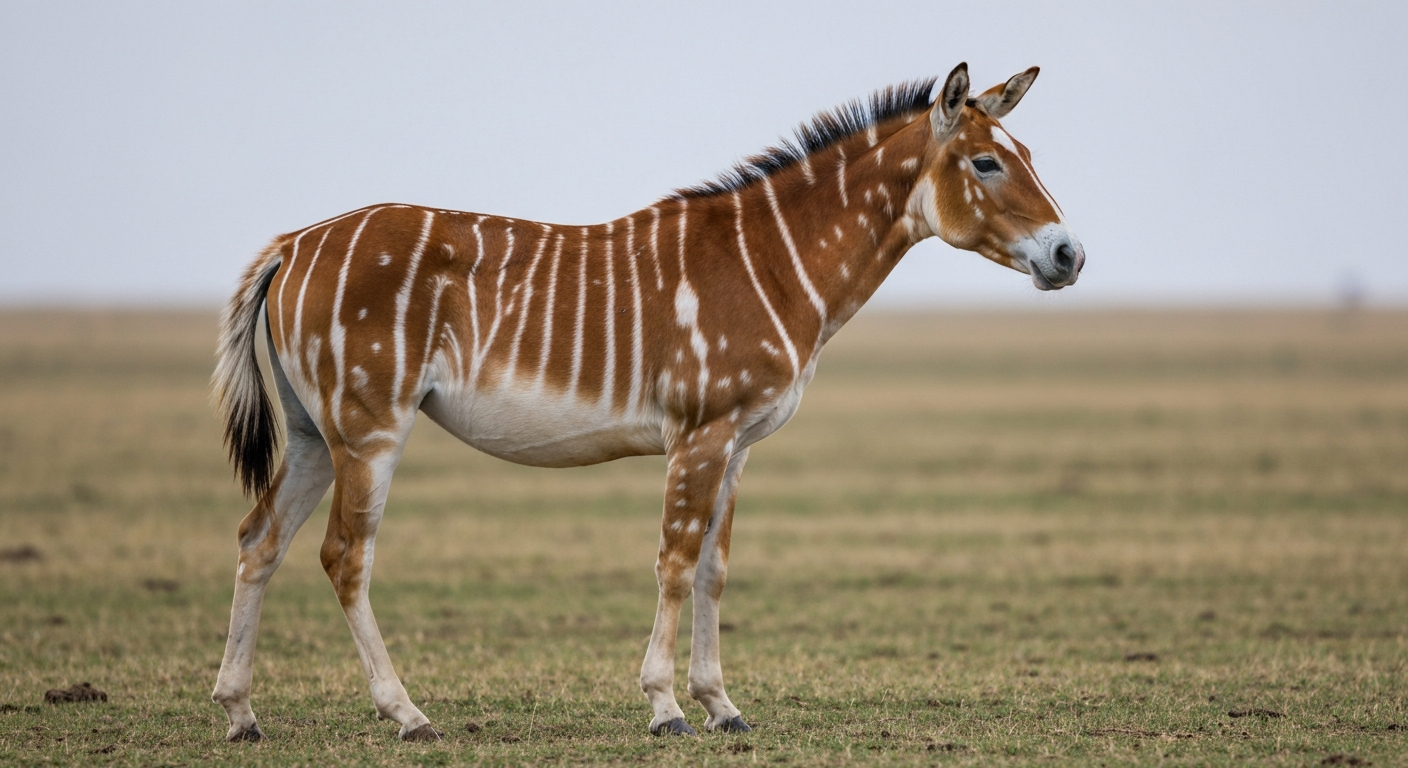
Quagga vs Bird: Is the Quagga a Zebra or a Bird? Quick ID Guide
Quagga vs bird: the quagga was an extinct zebra subspecies, not a bird, ID tips, differences, and sources