If you're staring at an animal and genuinely unsure whether it's a bird or a lizard, check one thing first: does it have feathers? Feathers are the single most reliable field mark for birds, and no lizard has them. If you can see feathers, scales, a beak, or a jaw full of tiny teeth, you have your answer. But when the animal is small, fast, partially hidden, or in bad lighting, it gets trickier. Here's exactly what to look for, step by step, so you can call it confidently in the moment.
Lizard vs Bird: How to Tell Them Apart in Seconds

Marcus Hendricks
24 Jun 2026
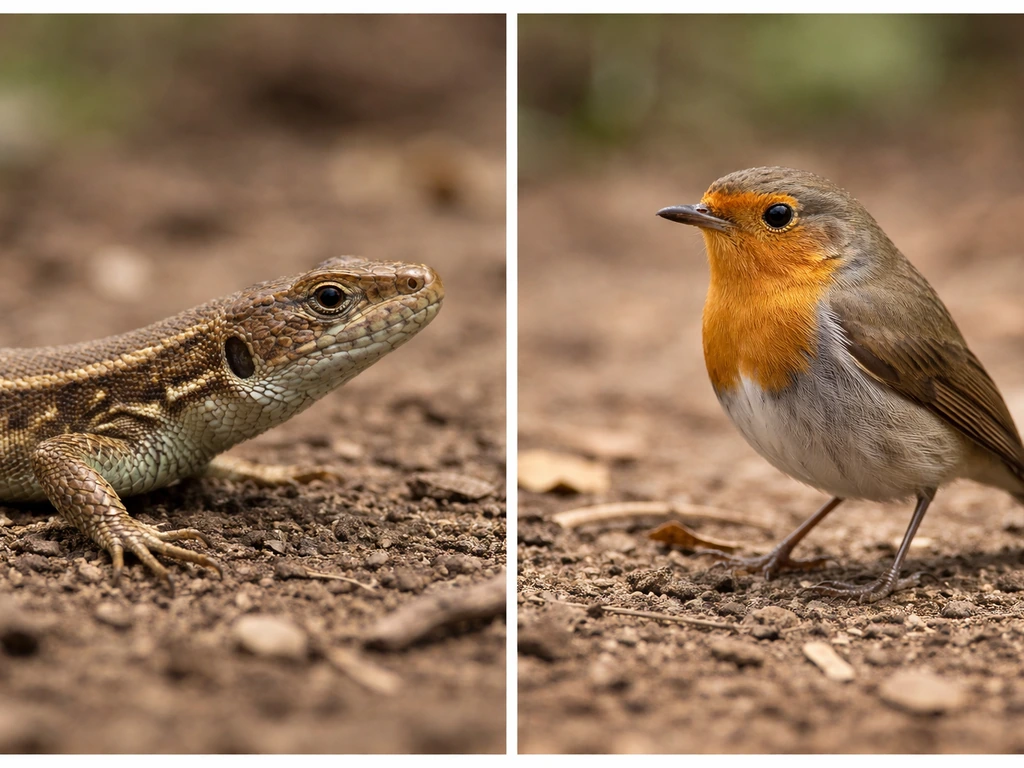
Quick identification: key traits to tell birds and lizards apart
Field biologists use a scanning approach when identifying any unfamiliar animal, and it works well here too. Rather than trying to take in the whole animal at once, focus on specific body regions in a quick sequence. The Cornell Lab teaches this exact method for birds: scan the beak, head, wings, tail, and legs in order. All About Birds also teaches this field-mark approach by scanning key body regions like the beak, head, wings, tail, and legs in a consistent order scan the beak, head, wings, tail, and legs in order. With lizards, you're looking at the head shape, skin texture, limb count and position, and tail behavior. The good news is that birds and lizards differ in almost every one of these categories.
| Trait | Bird | Lizard |
|---|---|---|
| Skin covering | Feathers (always) | Scales (always) |
| Forelimbs | Wings (even flightless birds) | Four jointed legs (most species) |
| Mouth structure | Beak or bill, no teeth | Jaws with teeth or fused tooth plates |
| Feet/toes | Typically 3 toes forward, 1 back (anisodactyly) | Five-toed clawed feet, all pointing forward |
| Tail behavior | Used for balance/steering, does not detach | Can drop off as defense (caudal autotomy) |
| Tongue use | Mostly internal, not frequently visible | Regularly flicked in and out for scent-sampling |
| Sound production | Vocalizations: songs, calls, alarm notes | Mostly silent; some hiss or chirp faintly |
The tongue-flick alone is a strong lizard giveaway. Lizards, especially skinks and monitor-type species, use tongue-flicking as chemosensory sampling, essentially smelling the air. You'll see the tongue dart out repeatedly, sometimes dozens of times a minute. No bird does this. Conversely, if the animal opens its mouth and you hear a clear song or call, it's a bird.
Body plan and anatomy differences
Birds and lizards are both vertebrates, so they share a general backbone-and-limbs body plan. But the differences in how that plan is executed are enormous and visible without any special equipment.
Feathers versus scales
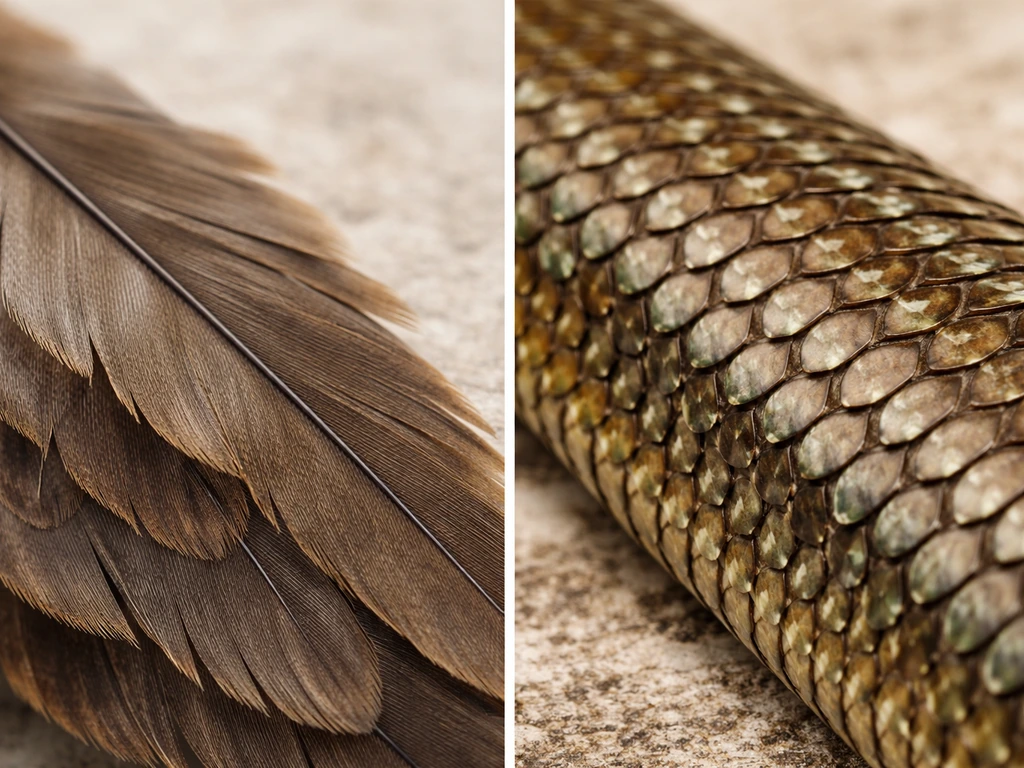
Feathers are structurally complex and unmistakable up close. Even a drab, brownish bird sitting motionless has a texture that no reptile skin can replicate: overlapping, soft-edged, sometimes iridescent structures. Lizard scales, by contrast, are flat, hard-edged, and often have a slightly shiny or matte plastic quality depending on the species. In low light or at distance, a small bird's closed wings can look vaguely scaly, but get any closer and the feather texture becomes obvious.
Wings versus legs
Every bird has wings where its forelimbs would be, even flightless species like penguins and emus. Those wings fold against the body when the bird is perching, which is why a small bird sitting still on a branch can look compact and limb-less. Lizards have four legs positioned at the sides of the body, splaying outward in a characteristic low-slung posture. A bird's legs come straight down from the body and are typically narrow, scaled (yes, bird legs do have scales), and angled at a backward-facing knee. That backward-looking joint is often called the bird's knee but it's actually the ankle, another reason anatomy can trip people up.
Beak versus jaws
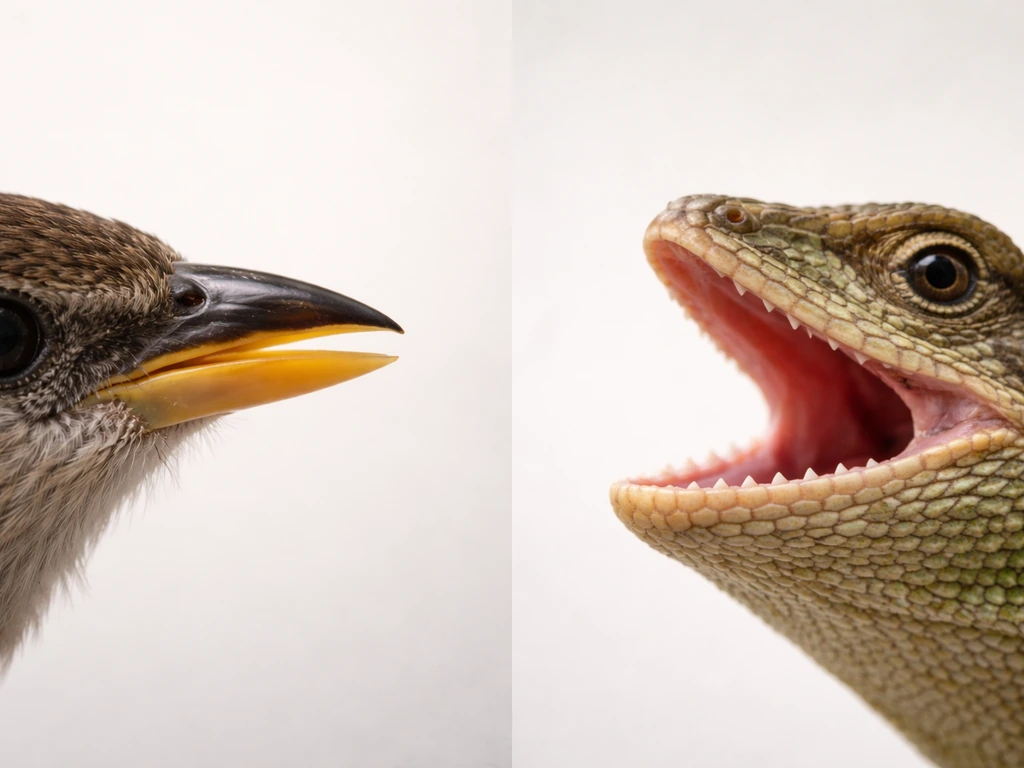
Birds have beaks. That's it. No bird has teeth, though some species have serrated beak edges that look tooth-like at a glance (mergansers, for example). The beak is a single fused structure used for eating, probing, preening, carrying food, and defending territory. Beak shape varies enormously: long and thin for probing, hooked and powerful for tearing meat, spear-shaped for stabbing fish. Lizards have a clearly defined jaw with a wide gape, and many have visible teeth, often small and pointed. The overall head shape is also different: bird heads tend to look rounded with large eyes set to the sides, while lizard heads are often flatter, more triangular, and have a wider jaw hinge.
Feet and toes
Bird feet are one of the most useful quick-check features. Most perching birds use an anisodactyl arrangement: three toes pointing forward and one long toe (the hallux) pointing backward. This gives them their reliable branch-gripping grip. Some species, like woodpeckers and parrots, use zygodactyly, with two toes forward and two back. Either way, bird feet look like they were designed for gripping a vertical or cylindrical surface. Lizard feet are five-toed, clawed, and positioned to grip horizontal surfaces. They look splayed and low, not wrapped around anything.
Movement and behavior cues in the wild
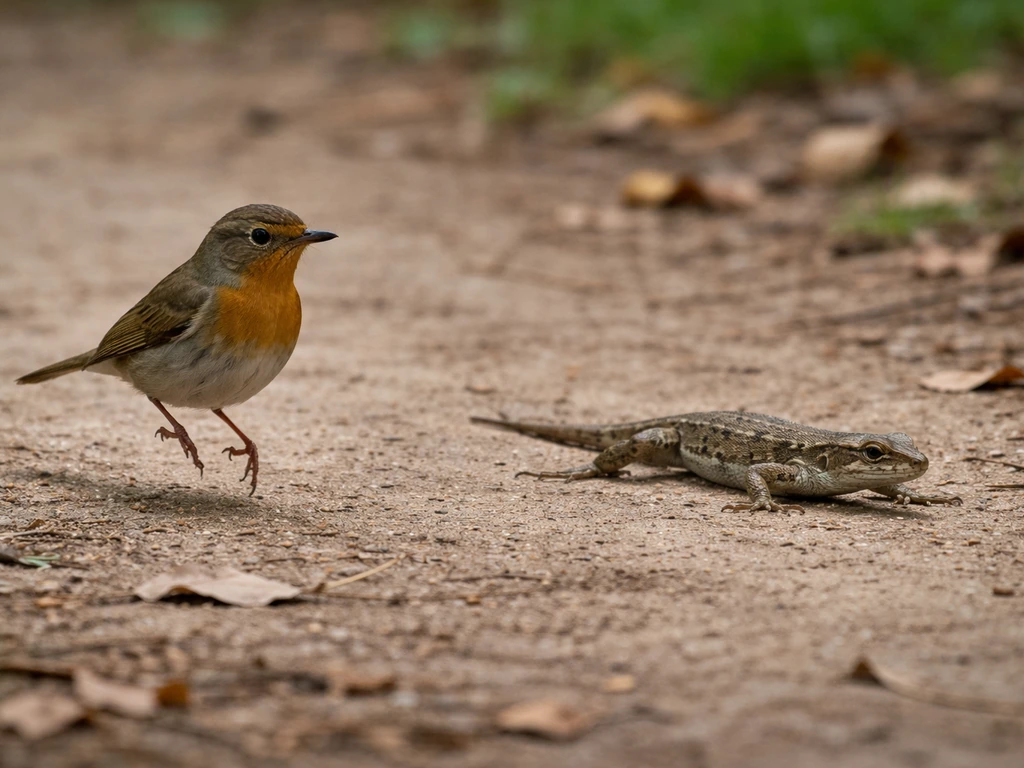
Even if you only catch a glimpse of the animal moving, the way it moves will usually tell you everything you need.
- Birds hop, walk, or run upright on two legs. Their body stays elevated off the ground. Even ground-dwelling birds like robins and thrushes have a distinctly upright, balanced gait.
- Lizards crawl with their belly close to or touching the ground, with four legs pushing outward from the sides. Their movement is a side-to-side undulation even when they're moving fast.
- Birds take off and land with a characteristic wing-opening motion, usually launching upward or at an angle. Even a bird that can't fly will flutter or flap.
- Lizards do not take off. They run, freeze, or dive into cover. The only lizards that appear to 'fly' are gliding species like the Draco (flying dragons of Southeast Asia), which extend skin flaps to glide between trees, not truly fly.
- A bird's tail is held behind the body and used actively for balance and steering. Some species wag or pump their tails rhythmically (wagtails, phoebes).
- A lizard's tail drags or is held close to the ground. If the tail detaches and keeps wriggling while the lizard escapes, you've just witnessed caudal autotomy, a distinctly reptilian defense.
Tongue behavior is one of the clearest behavioral giveaways at close range. Lizards flick their tongues out repeatedly as they move or rest, using them to sample chemical signals from the environment. This chemosensory tongue-flicking is a squamate trait (shared by lizards and snakes) and has no equivalent in birds. If you see a small animal rapidly extending a thin tongue in and out while sitting on a rock, it's a lizard.
Habitat and where you're likely to see each one
Context matters enormously in field identification. The Cornell Lab emphasizes using habitat and timing as core parts of any reliable ID: ask yourself whether this animal could realistically be here, at this time of day, in this habitat.
Birds are found in almost every habitat on earth, from open ocean to arctic tundra to dense rainforest. Most are diurnal (active during the day), though a significant number are nocturnal or crepuscular. Common nighthawks, for instance, start feeding at dusk, and owls are active well into the night. So seeing a flying animal after dark doesn't rule out birds. That said, most lizards are also diurnal and thermally active during warmer parts of the day, retreating to shade or cover when temperatures peak. Desert species like the desert night lizard shift their activity patterns around heat, becoming active during cooler morning and evening windows.
Lizards strongly favor warm, sunny microhabitats: sun-exposed rocks, log piles, bark surfaces, sandy patches in open woodland, and dry scrubby edges. They need external heat sources to regulate body temperature. Slender glass lizards, for example, prefer woodland-edge habitats with good sun exposure. Birds perch at all heights and in all thermal conditions, and they're equally happy in the shade or in sun. If the animal is basking motionless in full sun on a flat rock in a warm, dry area, lizard is a strong first guess.
Diet and feeding style differences
Watching an animal eat, or watching it search for food, is one of the quickest ways to confirm your ID. Birds and lizards both eat insects and small animals, but the mechanics of how they do it are very different.
Birds use their beaks for everything food-related: pecking at bark or soil to uncover insects, stabbing at fish, tearing flesh, cracking seeds, probing flowers for nectar, or catching flying insects in midair. The beak is the primary tool, and the tongue inside is used to manipulate food, not to capture it. Beak shape gives you an immediate clue about diet: a hooked tip signals a predator, a spear-shape signals a fish-eater, a fine curved bill signals a nectar-feeder.
Lizards use a very different capture system. Many species use tongue prehension, using the tongue itself to grab and pull prey into the mouth. Agamid lizards like bearded dragons modulate their tongue-strike kinematics depending on prey type and distance. Some larger lizards simply lunge and bite. The feeding motion is often a rapid forward lunge with the mouth gaping open, rather than a precise beak-stab. And remember that tongue-flicking before the strike, scanning for chemical traces of prey.
Common lookalike situations and how to avoid getting confused
Most honest bird-vs-lizard confusion happens in a handful of predictable situations. Knowing these scenarios ahead of time means you won't get tripped up. If the animal might be a coconut crab, comparing its overall size and movement to how typical birds move can help you avoid a false ID coconut crab vs bird.
Small birds perching motionless on branches or fences
A tiny bird sitting completely still with its feathers fluffed can look surprisingly compact and non-descript. From a bad angle, the closed wings can seem like a smooth, scaly body. The key check: look for the beak. Even the smallest bird has a clearly defined bill pointing forward from the face. Also check the feet, one backward-pointing toe is a reliable bird indicator.
Legless or near-legless lizards mistaken for snakes or birds
Glass lizards (Ophisaurus species) have no visible legs and move with a snake-like undulation. People sometimes see these moving through grass and wonder if they're watching some kind of odd bird on the ground. They're not: they have visible ear openings, moveable eyelids, and a clearly defined jaw, all lizard features. No bird moves in a legless, sinuous crawl along the ground.
Gliding lizards in Southeast Asia
Draco lizards glide between trees by extending skin flaps stretched over elongated ribs, and National Geographic has described them as looking like falling leaves mid-glide. If you're in tropical Southeast Asia and see something small launch from a tree and glide to another, it might not be a bird. Check for a pointed lizard snout and the characteristic splayed-limb posture during glide. A bird's wingbeats are obvious; a gliding Draco is completely silent and aerodynamically passive.
Ground-dwelling birds with scale-like plumage patterns
Some birds, especially quails, partridges, and nightjars, have intricate brown-and-gray plumage patterns that look almost scaly or bark-like when the bird is crouched on the ground. Nightjars in particular are masters of cryptic stillness. The key difference: even the most perfectly camouflaged bird has feathers with soft, overlapping edges, not flat hard scales. If you can get a photo and zoom in, feather barbules are unmistakable.
It's worth noting that birds and crocodilians share a common ancestor (archosaurs), and birds are more closely related to crocodiles than lizards are. This is a genuine surprise to most people, but it means that some primitive anatomical features are shared between birds and crocs, not birds and lizards. In practice, this doesn't affect field ID, but it's a useful reminder that appearance can be misleading when it comes to actual evolutionary relationships. More specifically, birds and crocodilians trace back to a bird and crocodile common ancestor in the archosaur lineage.
How to confirm your ID safely, without disturbing the animal
The NPS recommends observing from a distance using binoculars rather than approaching animals closely, and this is excellent advice for both bird and lizard observation. Getting too close will usually cause the animal to flee before you've gathered enough information, and it stresses the animal unnecessarily.
- Stay still and observe from where you are first. Note the animal's posture, leg count, how it holds its tail, and whether it's vocalizing or tongue-flicking.
- Use binoculars or your phone's zoom camera to examine skin texture, beak or jaw structure, and foot arrangement without moving closer.
- Take photos if you can. Aim to capture multiple angles: the back (dorsal view), the side, and ideally the underside or belly. Reptile documentation guides specifically recommend back and underside shots because key ID markings are often on both surfaces.
- Check the movement: walk a few steps to trigger a response. A bird will usually hop, bob, or take off. A lizard will freeze, then dart horizontally or dive into cover.
- Use habitat context: what surface is the animal on? A perch-gripping posture on a branch strongly suggests a bird. A flat-bellied position on sun-warmed rock strongly suggests a lizard.
- If you're still unsure after photos, submit your images to a free ID platform like iNaturalist, where naturalists and algorithms can confirm within hours. For birds specifically, the Merlin Bird ID app from Cornell Lab is fast and accurate.
- Do not attempt to catch or handle wild animals to confirm ID. This is unnecessary, often illegal, and stressful for the animal.
The New Zealand Department of Conservation notes that lizard identification specifically can require attention to subtle external diagnostic traits, which is exactly why photos from multiple angles matter so much. Bird-voiced tree frogs and gray tree frogs can look similar, so the call and detailed markings are often the deciding clues photos from multiple angles. One clear photo of the head, showing the jaw structure and any scale patterns, is usually enough for an expert to confirm species-level ID within minutes.
Once you've confirmed whether you're looking at a bird or a lizard, you're ready for the next step: narrowing down which species. For birds, the progression is exactly what Cornell Lab teaches, go from broad group (songbird, shorebird, raptor) before trying species-level certainty. For lizards, region and habitat narrow things down fast. Either way, the field marks you've already gathered put you well ahead of starting from scratch. If the animal is a nocturnal bird with cryptic looks, a quick comparison of potoo bird vs tawny frogmouth can help you narrow it down.
FAQ
What should I do if I can’t clearly see the head or feet, only the body silhouette (lizard vs bird)?
Use the scanning order but adapt it to what you can see. If the head is out of view, prioritize movement cues (tongue-flicking for lizards, wingbeat or hop-then-perch for birds) and look for texture at the edge of the body. Feathers show overlapping, layered edges even at distance, while lizard scales tend to look uniformly “sheet-like” and hard-bordered.
Can a bird look “scaly” when its feathers are wet, ruffled, or in low light?
Yes, but the close-up texture usually still resolves to feather overlap. In wet or ruffled conditions, focus on whether the surface is made of discrete feather structures or continuous scale plates. If you can’t get close enough for texture, rely on the presence of a beak and the ankle-like backward joint at the leg.
How reliable is toe count for telling lizard vs bird?
It’s reliable when you actually see the feet. Perching birds typically have three forward toes and one long toe back, or two and two for zygodactyl species. Lizards have five toes that look splayed for gripping horizontal surfaces. If the animal is perched low on clutter or grass, toe count can be obscured, so use it as a supporting clue, not the only one.
I saw an animal flicking something near its mouth, could that be a lizard tongue?
Most lizards that tongue-flick do it as an extend-in-and-out behavior, often repeatedly, and the tongue is thin and reaches forward. Birds may open their beaks, bob, or do quick head movements, but they do not show repeated tongue extension into open-air “sampling.” If you’re unsure, wait for a few more cycles rather than guessing after one flick.
What if the animal is moving fast and I can’t get a good look, what’s the safest field approach?
Use distance and time. Step back or zoom with binoculars if possible, then watch for one repeatable trait (tongue-flick frequency, wingbeat pattern, or perched posture) rather than trying to identify immediately from a single glimpse. Many misIDs happen because people commit after the first partial view.
Do all lizards tongue-flick, or can I rule out lizards if I don’t see it?
Not every lizard will tongue-flick when you’re watching, especially if it’s cold, basking calmly, or in heavy cover. Absence of tongue-flicking is not a full exclusion. If no tongue is visible, fall back to structural markers like beak absence (no true beak, no feathers) and the posture of legs (side-splayed for lizards vs legs coming down from a compact body plan for birds).
Can gliding lizards be mistaken for birds in flight?
Yes, and the key distinction is active flapping versus passive glide. A bird’s wingbeats are usually obvious, even if brief. A gliding lizard like a Draco typically looks like a controlled descent between trees with little to no flapping, and its posture tends to show extended gliding surfaces and a pointed snout. If it’s mostly silent and aerodynamically “settling,” treat it as a lizard candidate and look for splayed-limb glide mechanics.
Are there exceptions where a bird might have a tooth-like look on the beak?
Some birds have serrated or sharply edged beaks that can resemble teeth from far away. The decision aid is to look for a fused beak structure used as one tool, not separate visible teeth in a jaw. If you see clear feather texture or a standard beak base fused to the skull, that supports bird even when the edge looks “toothy.”
What’s the best way to confirm ID from photos when lizard vs bird is uncertain?
Get at least one photo that captures the mouth area (beak or jaw opening) and one that captures the body surface texture (feather overlap or scale plates). If possible, include a feet shot showing toe arrangement. One head photo often resolves the dilemma faster than a wide shot because jaw shape and the presence or absence of feathers are concentrated there.
Could a glass lizard (legless) be mistaken for a bird on the ground?
It’s possible if it’s moving through grass, but legless reptiles still show reptile head and jaw structure, plus features like moveable eyelids and visible ear openings. Birds on the ground have legs with a clear joint and foot grip pattern, and they do not undulate in a snake-like crawl. If you see sinuous ground motion with a reptile-style head, treat it as a glass lizard candidate.