Yes, birds and crocodiles share a common ancestor. They are both members of a group called Archosauria, and their lineages split roughly 240 to 250 million years ago during the Triassic period. That makes them closer relatives than most people realize, and closer to each other than either is to lizards, snakes, or turtles.
Bird and Crocodile Common Ancestor: How They’re Related

Marcus Hendricks
21 Jun 2026
The relationship in plain terms
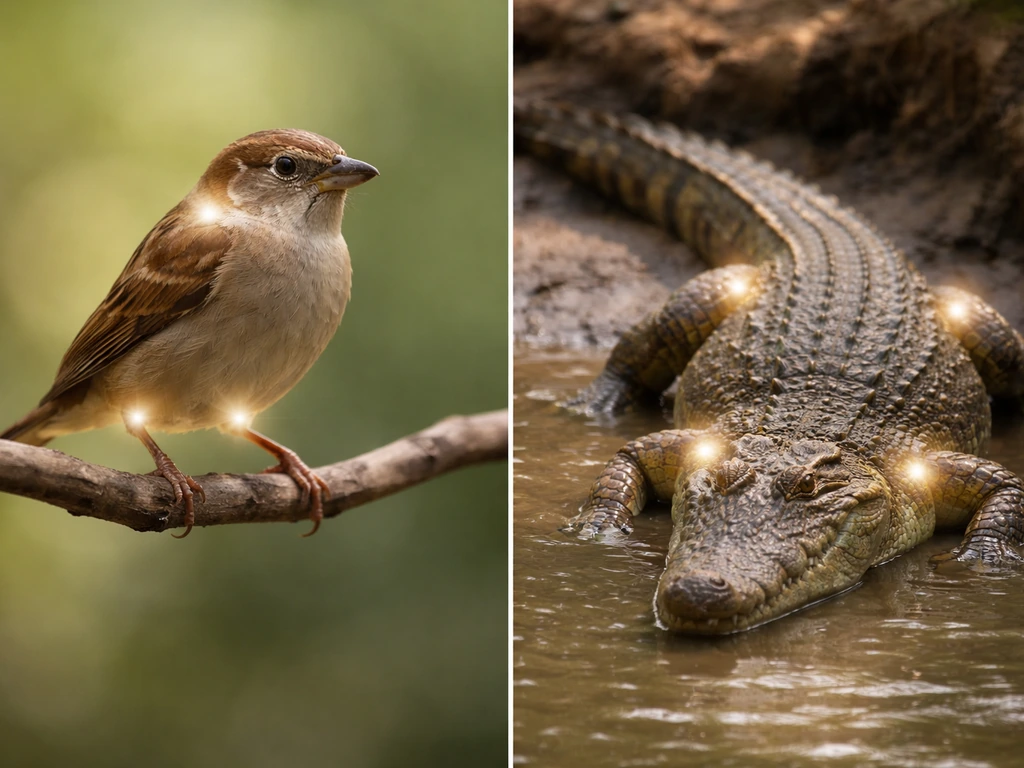
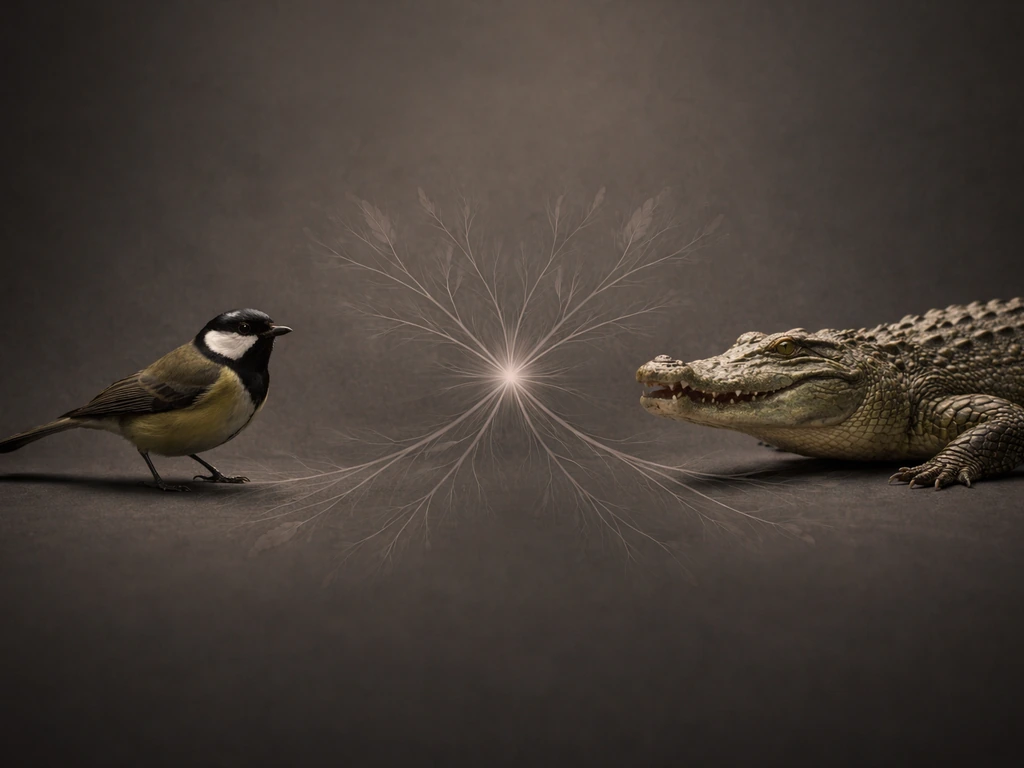
When scientists say birds and crocodiles share a common ancestor, they mean it literally, not loosely. The formal group Archosauria is defined as all living descendants of the most recent common ancestor of birds and crocodilians, plus everything in between. Both groups are the only living members of Archosauria today. Every other archosaur, including non-avian dinosaurs and pterosaurs, went extinct. So when you look at a crocodile and a crow, you are looking at the two surviving branches of what was once a much larger evolutionary tree.
That shared ancestry is not a fringe idea or a loose classification. It is backed by multiple independent lines of evidence: morphology, genetics, genomics, and the fossil record all point to the same conclusion. Crocodilians are, in fact, more closely related to birds than they are to lizards or snakes, even though crocodiles look far more like lizards on the surface.
When did their lineages split?
The Archosauria split into two main lineages sometime in the Middle to Late Triassic, approximately 240 to 250 million years ago. One lineage is called Pseudosuchia, the crocodile-line, which eventually gave rise to modern crocodilians. The other is Avemetatarsalia, the bird-line, which led to dinosaurs and ultimately to birds. A phylogenomic study using 248 nuclear genes placed the turtle-archosaur divergence at around 255 million years ago, which gives a useful bracket: the bird-crocodile split occurred somewhat after that, deep in the Triassic.
The crocodilian genome project also estimated the divergence between birds and crocodilians at approximately 240 to 250 million years ago, using calibrated molecular clock methods across multiple gene sets. These estimates are consistent across independent studies, which gives scientists high confidence in the general timeframe even if the exact number shifts slightly depending on which calibration points or fossils are used.
To put that number in perspective: the split between humans and mice happened around 80 to 90 million years ago. The bird-crocodile split is roughly three times older than that. It is genuinely ancient.
What did their last common ancestor probably look like?
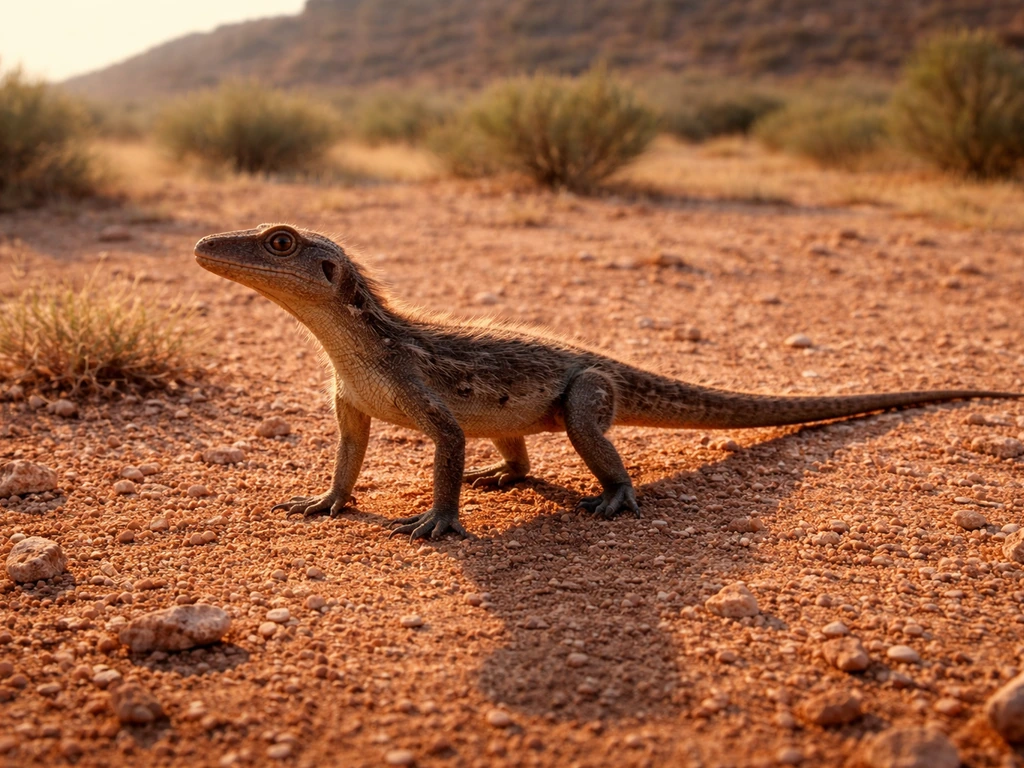
This is where things get interesting, because the ancestor was almost certainly not what most people picture. It was not bird-like, and it was not quite crocodile-like either. The last common ancestor of birds and crocodilians was a land-dwelling archosaur, probably bipedal or capable of bipedal locomotion, and likely small to medium-sized. It would have had a more upright or semi-erect posture compared to modern crocodiles, which secondarily evolved a sprawling-to-semi-erect stance suited for ambushing prey near water.
At the time of the split, the two lineages had not yet developed the specialized features that make birds and crocodiles so distinct today. The ancestor almost certainly had a four-chambered heart, a trait retained in both modern birds and crocodilians and which sets crocodilians apart from other reptiles. There is also strong evidence from respiratory biology that the archosaur ancestor had a more efficient, partitioned lung system with unidirectional airflow, a feature shared between crocodilians and birds and not found in lizards or snakes. In other words, some of the most surprising physiological features that birds and crocodiles have in common today are likely inheritances from that shared ancestor.
What the ancestor did not have: feathers, wings, a keeled sternum, or anything else we associate with modern birds. It also lacked the highly derived skull, armor, and aquatic adaptations of modern crocodilians. Think of it as a relatively generalized, active, terrestrial archosaur that was the starting point for two radically different evolutionary experiments.
Birds vs. crocodiles: what genetics and anatomy actually show
The genomic evidence is striking. The three-crocodilian-genome study found that crocodilians are the confirmed sister group of birds within Archosauria, a result supported by nuclear genes, mitochondrial data, and retroposon markers. Retroposons, specifically a type called CR1 (Chicken Repeat 1), are found across both birds and crocodilians and serve as molecular footprints of shared ancestry because they insert into the genome at specific locations and are essentially irreversible.
Anatomically, the shared traits are less obvious but genuinely there once you know where to look. Here is a direct comparison of key traits that separate birds and crocodilians from other reptiles, and what each group retained from the common ancestor versus what each evolved independently.
| Trait | Birds | Crocodilians | Other reptiles (lizards/snakes) |
|---|---|---|---|
| Heart | Four-chambered | Four-chambered | Three-chambered (mostly) |
| Lung airflow | Unidirectional (highly derived) | Unidirectional (partial) | Bidirectional (tidal) |
| Ankle joint type | Mesotarsal (bird-line adaptation) | Crurotarsal (crocodile-line) | Variable |
| Parental care | Extensive (nest guarding, feeding) | Nest guarding, young transport | Rare or absent |
| Archosaur clade | Avemetatarsalia (bird-line) | Pseudosuchia (croc-line) | Outside Archosauria |
| Genomic CR1 elements | Present and abundant | Present and abundant | Absent or rare |
| Posture of ancestor | Erect (retained/derived further) | Originally erect, later semi-sprawling | Sprawling |
The ankle morphology difference is particularly useful for understanding the split. Early in the archosaur divergence, the bird-line evolved a mesotarsal ankle, where the main joint forms between the ankle bones, giving a hinge-like structure. The crocodile-line kept and refined the crurotarsal ankle, where the joint runs between the leg and the ankle, allowing the rotating motion you see in a walking crocodile. Both designs trace back to the ancestral archosaur ankle, but each lineage modified it differently. This is a concrete, fossil-traceable signature of the divergence.
Misconceptions worth clearing up
The biggest one is this: people assume that because crocodiles look like lizards, they must be more closely related to lizards than to birds. That is completely wrong. Lizards (Order Squamata) branched off from the reptile family tree much earlier and are actually more distantly related to both birds and crocodilians than birds and crocodiles are to each other. The crocodile's scaly, four-legged, cold-blooded appearance is partly a result of secondary evolutionary changes, not a sign of closer kinship with lizards.
Another misconception is that the last common ancestor of birds and crocodiles must have looked like one of them, or at least like a primitive version of one of them. It did not. It was an archosaur that would have looked unfamiliar to most people: an active, terrestrial animal with an upright or semi-upright posture, long legs, and a body plan that had not yet committed to the specialized paths that each lineage would later take. If anything, some of the early archosaur relatives like Euparkeria looked almost generically lizard-shaped but with a fundamentally different skeletal and physiological architecture underneath.
There is also a common assumption that 'common ancestor' means the relationship is vague or loosely defined, like saying all life shares a common ancestor. That is not what is meant here. The bird-crocodile common ancestor is a specific, identifiable node on the vertebrate family tree with a reasonably well-constrained time range, anatomical inferences, and multiple lines of corroborating evidence. The relationship is tight enough that studying crocodilian biology genuinely helps scientists understand avian biology, and vice versa.
Finally, some readers conflate this with the idea that birds descended from crocodiles, or that crocodiles are a kind of primitive bird. Neither is true. Both lineages have been evolving independently for roughly 240 to 250 million years. Birds descended from theropod dinosaurs within the bird-line of Archosauria. Crocodilians descended from a completely separate archosaur lineage. They share a common ancestor the same way you and a chimpanzee share a common ancestor: you did not evolve from each other, you both evolved from something else.
This kind of confusion between appearance and actual relatedness is exactly what comes up when comparing animals that look similar but are not closely related, or look very different but actually are. It is the same principle that makes it tricky to tell ravens from crows, or falcons from hawks, but applied at a much deeper evolutionary timescale. Looks alone are a poor guide to ancestry.
How to verify this yourself today
You do not have to take anyone's word for it. There are several free, well-maintained resources that let you check the evidence directly.
- TimeTree of Life (timetree.org): Go to the site, type in 'Aves' and 'Crocodylia,' and hit search. TimeTree compiles divergence-time estimates from hundreds of published studies and returns a median estimate with confidence intervals. It cites the individual papers behind each estimate, so you can trace the claim back to the primary literature. TimeTree 5 expanded this database significantly and lets you build timetrees for any pair of taxa you are curious about.
- NCBI Taxonomy (ncbi.nlm.nih.gov/taxonomy): Search for 'Archosauria' and you will see the full taxonomic placement showing both Aves and Crocodylia as members of the same clade. This is not a single researcher's opinion; it reflects the current consensus classification used by the scientific community.
- PhyloPic (phylopic.org): Search for the Archosauria node to see a visual representation of where birds and crocodilians sit on the evolutionary tree. PhyloPic integrates with the Open Tree of Life taxonomy, so you can follow links and explore the full archosaur tree interactively.
- The published crocodilian genome paper (available via PMC): 'Three crocodilian genomes reveal ancestral patterns of evolution among archosaurs' is freely accessible and includes phylogenetic figures showing the bird-crocodile sister relationship with bootstrap support values. It is a peer-reviewed genomic study, not a textbook, so the evidence is right there.
- The BMC Biology turtle-archosaur study: 'Phylogenomic analyses support the position of turtles as the sister group of birds and crocodiles' is also freely available on PubMed Central. It used 248 nuclear genes and a relaxed molecular clock. The methods, data, and divergence estimates are all documented and independently reproducible.
- Fossil context: Search for 'Archosauria Triassic' on Google Scholar or the Paleobiology Database (paleobiodb.org) to find actual fossil taxa from the period when the bird and crocodile lineages were diverging. Taxa like Euparkeria, Postosuchus, and early dinosauromorphs give you physical anchor points for what the archosaur family tree looked like in the Triassic.
The convergence of molecular clocks, genomic data, and the fossil record on the same approximate split time, around 240 to 250 million years ago, is what gives scientists confidence in this conclusion. Any one method alone might have uncertainty, but when independent approaches using completely different types of evidence all point to the same answer, that is about as solid as evolutionary biology gets.
Why this matters for understanding birds
Knowing that birds and crocodilians are archosaur cousins reshapes how you think about bird biology. A similar comparison of two real animals, the bird-voiced tree frog and the gray tree frog, also comes down to how you interpret traits in an evolutionary context bird-voiced tree frog vs gray tree frog. Features that seem uniquely avian, like highly efficient lungs, parental nest-guarding, and even aspects of their four-chambered circulatory system, have deeper roots than just the dinosaur-to-bird transition. Some of those traits were already present or partially developed in the archosaur ancestor and were retained through both lineages while being modified in different directions.
It also puts bird diversity into a broader context. When you compare radically different-looking birds, or compare birds to other animals entirely, the shared ancestry with crocodilians is a reminder that evolutionary relationships are not always obvious from appearance. The same logic applies when you look at how dramatically different birds can be from each other despite their shared avian ancestry.
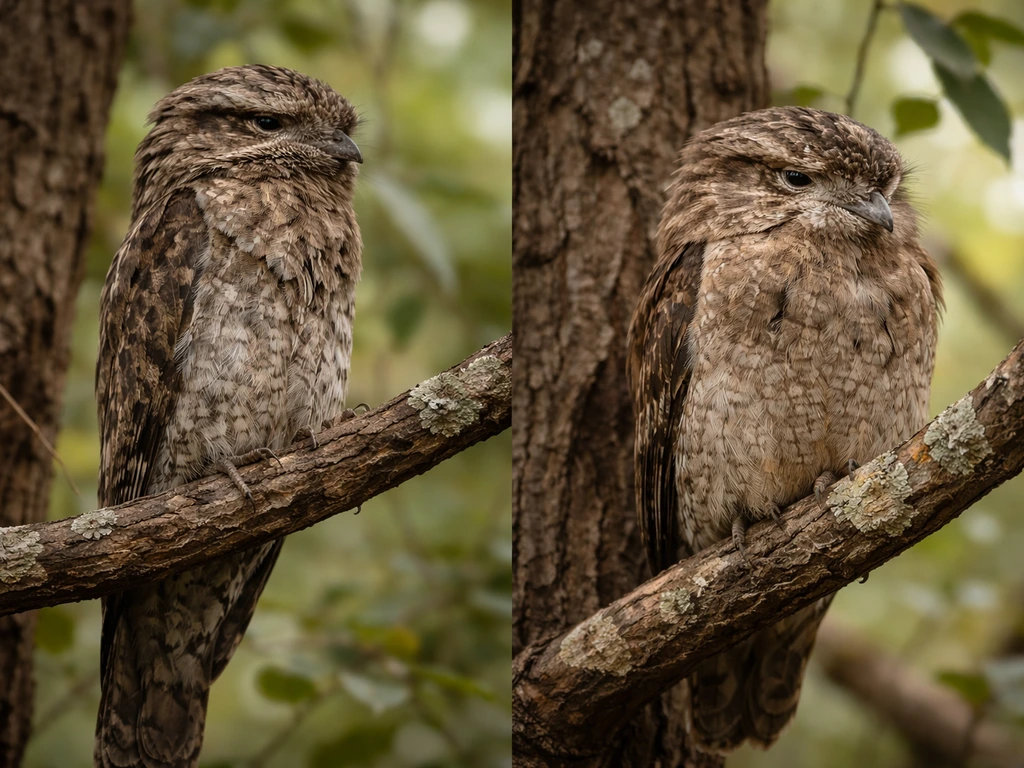
Whether you are comparing two similar-looking frog-eating birds, thinking about how crabs relate to birds ecologically, or tracing back the lizard-bird evolutionary split, the underlying principle is the same: shared ancestry leaves real, traceable biological signatures, and those signatures tell a more accurate story than surface appearances ever will. If you want a concrete example of how appearance can mislead, compare a pootoo bird versus a tawny frogmouth pootoo bird vs tawny frogmouth.
FAQ
Is this the same as saying all reptiles share a common ancestor?
No. The “bird and crocodile common ancestor” refers to the most recent common ancestor of birds and crocodilians as a specific branching point on the archosaur family tree, not to any older ancestor shared by all reptiles or all vertebrates. That node is later than the split between turtles and the archosaur lineages and is still within the Triassic timeframe discussed in the article.
Did the birds and crocodiles common ancestor live in water like crocodiles do today?
The article’s ancestor is inferred as a terrestrial, active archosaur, but “land-dwelling” does not mean the lineage never used water. Many early archosaurs could wade, hunt near water, or move between habitats. What matters is that the last common ancestor did not yet have the fully aquatic skull, armor, and feeding specializations characteristic of modern crocodilians.
Did birds evolve from crocodiles?
Not in the sense of directionality. Birds did not evolve from crocodilians, and crocodilians did not evolve from birds. Both lineages descend from a shared archosaur ancestor, then each branch evolved its own traits for millions of years, so the relationship is similar to how human and chimpanzee are cousins, not parent and child.
If birds and crocodiles share an ancestor, why did the ancestor not have feathers or wings?
Feathers and wings are not traits that appear in the shared ancestor discussed here. Feathers evolved on the bird-line after the bird-crocodile split, and wing structure followed later through dinosaur and early bird evolution. You can think of the shared ancestor as lacking bird-specific external features, even if it already had some deeper physiological foundations.
How certain are scientists about what the common ancestor looked like and how big it was?
The common ancestor is a “node,” which means scientists reconstruct it using trait inheritance patterns plus molecular and fossil constraints. But reconstruction always involves inference, so there is uncertainty about body size, exact posture, and some soft-tissue details. The timeframe and broad lifestyle are the best-supported parts, while finer anatomy is more tentative.
Why do crocodiles and lizards look similar if they are not close relatives?
Because convergent evolution can produce superficial similarity, you can get misleading answers from looks alone. Crocodiles resemble lizards because both are scaly, four-legged reptiles with similar-looking diets or lifestyles in some contexts, not because they are close relatives. The article’s point is that the reptile “surface plan” can persist or reappear even after deep divergences.
Do birds and crocodiles breathe the same way because of their shared lung traits?
An “unidirectional airflow” lung system is treated as a shared inherited feature in the article, but it does not mean birds and crocodiles have identical breathing mechanics. The key is that both lineages likely inherited a partitioned, efficient lung design framework, then each modified it to fit their own physiology, metabolism, and respiratory demands.
What does it mean practically that crocodilians can help explain avian biology?
Yes, that kind of inheritance is a testable prediction: if a trait is inherited from the shared ancestor, you should find related underlying traits across both bird and crocodilian biology, even when the visible expression differs. For example, the shared four-chambered heart plan is one reason researchers study crocodilian cardiovascular biology to understand the avian baseline.
How does ankle structure help confirm the bird-crocodile split?
The “ankle” is described as a fossil-traceable signature, meaning the joint design differs between lineages in ways that reflect the divergence. Both ankle types connect to the ancestral archosaur ankle, but each lineage remodeled it differently. This is a better indicator of shared ancestry than external resemblance because skeletal joint architecture is less likely to be mimicked by chance.
Why might different studies give slightly different dates for the common ancestor?
Not necessarily. Even if a specific gene family or genomic marker suggests relatedness, molecular clock dating depends on calibration choices (such as fossil constraints) and assumptions about evolutionary rates. That is why studies can agree on the general range while producing slightly different point estimates.
Next Article
Potoo Bird vs Tawny Frogmouth: Key ID Differences
Side by side guide to tell potoo and tawny frogmouth apart by size, plumage, perch, calls, and key ID marks.