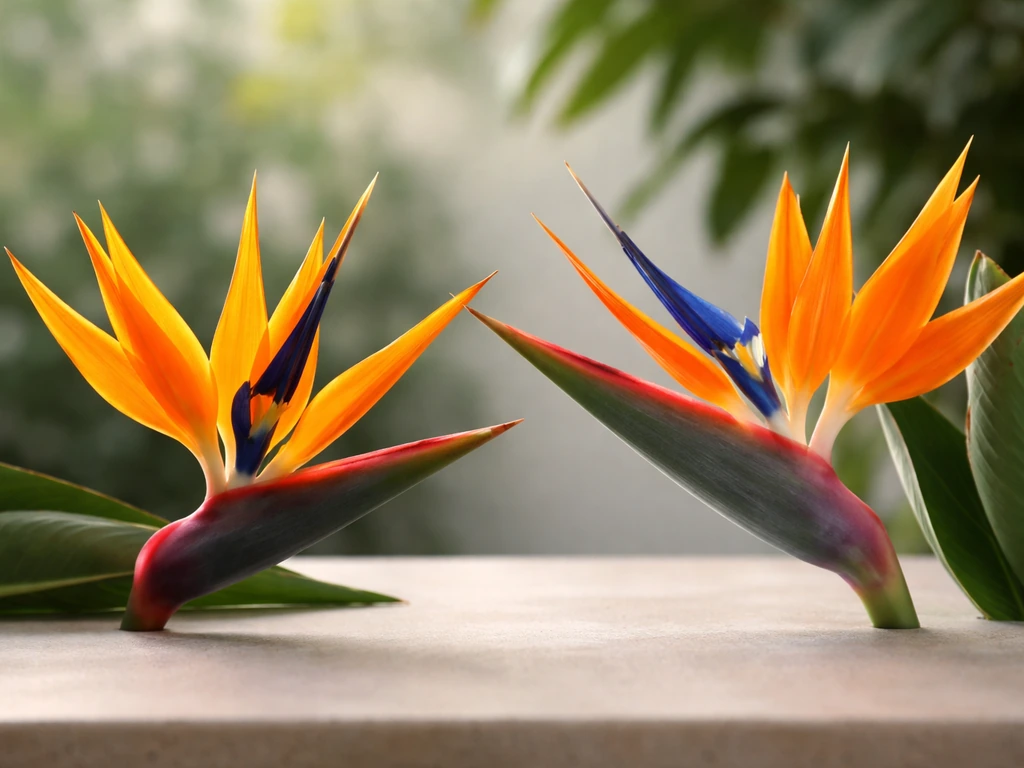
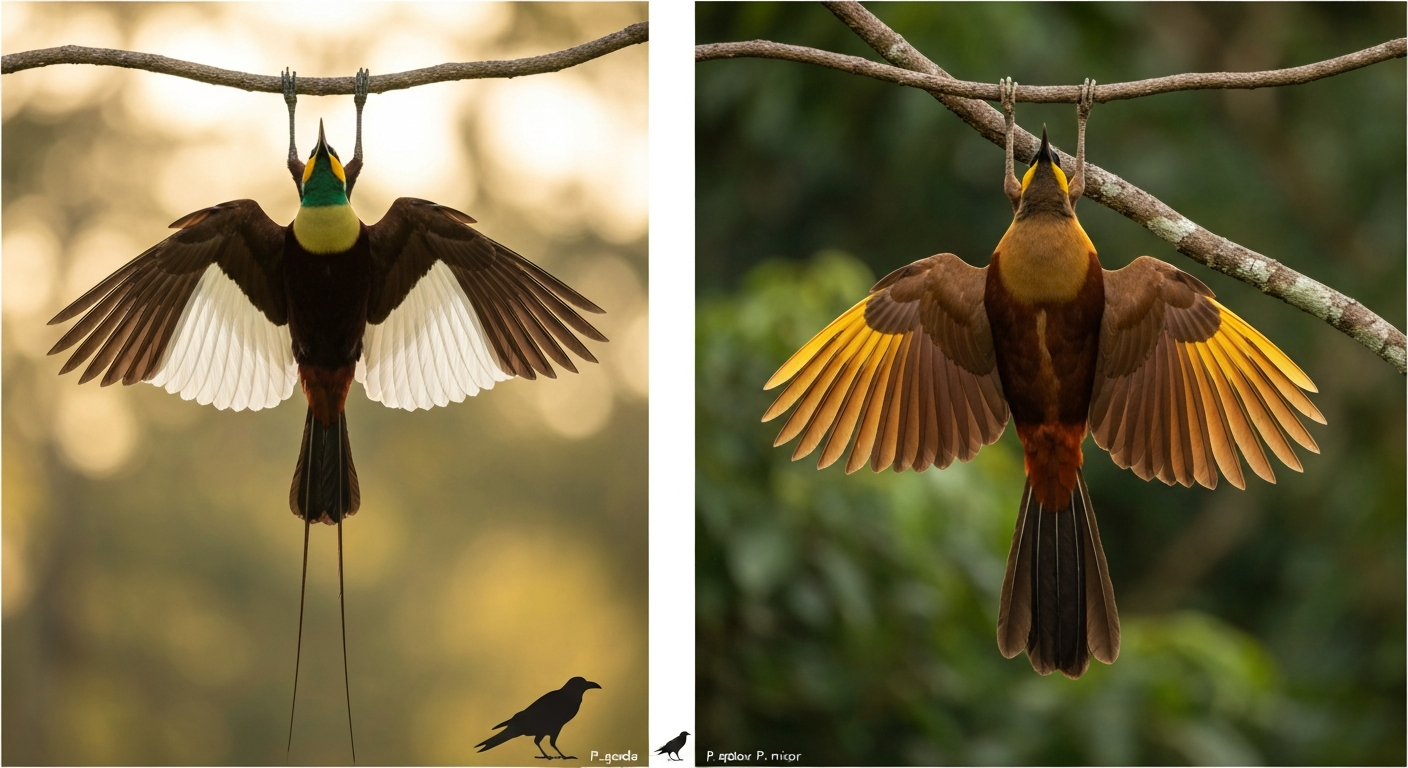
The greater bird-of-paradise (Paradisaea apoda) and the lesser bird-of-paradise (Paradisaea minor) are two of the most visually spectacular birds on Earth, and they are closely related enough that telling them apart can genuinely challenge even experienced birders. The fastest way to separate them in the field: the greater is significantly larger, its male carries longer flank plumes that grade from yellow to white, and it shows a dark maroon-brown back and wings. The lesser is noticeably smaller, its male's plumes run deep yellow throughout, and its back and wings are a cleaner chestnut-brown. Both species are found in New Guinea, but their ranges only partially overlap, and understanding where each lives helps as much as any plumage detail.
Greater bird of paradise vs lesser bird of paradise: ID Guide

This article is built for birdwatchers planning a trip to Papua New Guinea or West Papua, students writing up Paradisaeidae biology, wildlife photographers trying to identify the bird in a shot, and conservationists tracking populations and trade threats. I will walk through taxonomy, measurements, plumage, courtship behavior, range, diet, breeding biology, conservation status, and field-ID tips in enough detail to be genuinely useful. Where relevant, I will flag comparisons to other birds of paradise and briefly explain why people sometimes confuse these birds with the unrelated Strelitzia flower or with umbrella birds.
Quick comparison at a glance
| Feature | Greater Bird-of-Paradise (P. apoda) | Lesser Bird-of-Paradise (P. minor) |
|---|---|---|
| Scientific name | Paradisaea apoda Linnaeus, 1758 | Paradisaea minor Shaw, 1809 |
| Body length (male) | 43–48 cm (without tail wires ~33–38 cm) | 30–32 cm (without tail wires ~26–28 cm) |
| Tail wire length (male) | Up to 60 cm beyond body | Up to 30–35 cm beyond body |
| Weight (male) | ~170–200 g | ~100–130 g |
| Flank plume color (male) | Yellow grading to white at tips | Rich deep yellow throughout |
| Back and wing color (male) | Dark maroon-brown | Warm chestnut-brown |
| Head color (male) | Yellow-green iridescent crown and nape | Yellow crown, yellow-green nape |
| Throat patch (male) | Dark oil-green | Dark emerald-green |
| Female plumage | Dark brown above; pale buff-white below with brown barring | Similar but slightly paler; smaller overall |
| Primary range | Aru Islands (Indonesia) and SW New Guinea | Most of New Guinea mainland and satellite islands |
| Altitude preference | Lowland forest, 0–700 m | Lowland to lower montane, 0–1,500 m |
| IUCN status | Least Concern | Least Concern |
| CITES listing | Appendix II | Appendix II |
| Lekking behavior | Traditional tree-leks, multiple males | Traditional tree-leks, multiple males |
| Display posture | Inverted flap with plumes cascading | Similar inverted display, plumes shorter arc |
Taxonomy and naming: who described these birds and when
Both species belong to the genus Paradisaea within the family Paradisaeidae, the birds of paradise. Paradisaea apoda was formally described by Carl Linnaeus in his landmark Systema Naturae, 10th edition, in 1758. The species name apoda means "without feet" in Latin, a reference to the trade skins that reached Europe with legs removed, which led early naturalists to believe the birds lived perpetually in the air and never touched the ground. That misconception persisted for decades. Paradisaea minor was described by George Shaw in 1809, and its name minor simply means "smaller" or "lesser" in Latin, a direct size comparison to P. apoda.
Both species are consistently treated as full species across the major global taxonomic authorities: the IOC World Bird List, the Clements Checklist, and HBW/BirdLife. The IOC World Bird List – Master Lists (WorldBirdNames.org) treats both Paradisaea apoda and Paradisaea minor as full species. Paradisaea apoda has two recognized subspecies: the nominate P. a. apoda, found on the Aru Islands, and P. a. novaeguineae, found in southwestern New Guinea. Paradisaea minor has three recognized subspecies: the nominate P. m. minor across most of the mainland, P. m. jobiensis from Yapen Island in Cenderawasih Bay, and P. m. finschi from the islands of Manus and the Admiralties. Subspecific differences within each species are subtle and mainly involve slight variation in plume color saturation and body size, but the nominate forms are what most descriptions and field guides refer to.
Phylogeographic studies published in journals such as the Zoological Journal of the Linnean Society have confirmed that P. apoda and P. minor are close sisters within a broader Paradisaea clade that also includes the raggiana bird-of-paradise (P. raggiana) and the red bird-of-paradise (P. rubra). Hybridization between P. apoda and P. minor has been documented in zones of range contact in southwestern New Guinea, producing intermediate birds with mixed plume characters. These hybrids were historically given their own names in the literature and caused considerable taxonomic confusion before genetic work clarified their origin.
Where they live: range and habitat
The greater bird-of-paradise has a relatively restricted range centered on the Aru Islands archipelago in the Maluku province of Indonesia, with a mainland New Guinea population extending along the southwestern lowlands, roughly from the Trans-Fly region westward toward the Bird's Head Peninsula. It is a lowland specialist, most commonly encountered between sea level and about 700 meters elevation, in primary and tall secondary rainforest, forest edges, and gallery forest along rivers. The Aru Islands population is the one most often photographed, and the island of Wokam is considered one of the best places in the world to observe a lek.
The lesser bird-of-paradise is much more widespread. It occurs across most of mainland New Guinea north of the central cordillera, extending from the Bird's Head Peninsula in the west to the Huon Peninsula and the northern coast of Papua New Guinea in the east. It also occupies Yapen Island, Manus, and several smaller offshore islands. Unlike the greater, the lesser tolerates a broader altitudinal range, from sea level up to around 1,500 meters, and is regularly seen in disturbed forest, forest edges, and gardens near villages. This adaptability makes it the more commonly encountered of the two species for most visitors to New Guinea.
Where the two species meet geographically, in parts of southwestern New Guinea, the greater tends to occupy the lowland swamp forest and riverine forest below about 400 meters, while the lesser occupies slightly higher and drier hill forest. There is genuine elevational and habitat overlap in this contact zone, which is also where hybrid individuals have been recorded. Outside of that zone, if you are birding on the Aru Islands you are looking at P. apoda exclusively; if you are birding in the Sepik basin or the northern foothills of the Owen Stanley Range, you are looking at P. minor exclusively.
Precise measurements: size is the quickest field clue
Size difference is real and useful. Male greater birds-of-paradise measure roughly 43 to 48 centimeters in total body length, not counting the elongated tail wires, which can add up to 60 centimeters beyond the body tip. Body mass for males runs approximately 170 to 200 grams. Male lesser birds-of-paradise measure around 30 to 32 centimeters in total body length without tail wires, with wires adding 30 to 35 centimeters. Body mass for males is approximately 100 to 130 grams. So a male greater is roughly 50 to 60 percent heavier than a male lesser. Females of both species are smaller than males of their respective species and lack the ornamental plumes and elongated tail wires entirely.
| Measurement | Greater (P. apoda) Male | Lesser (P. minor) Male | Greater Female | Lesser Female |
|---|---|---|---|---|
| Body length | 43–48 cm | 30–32 cm | ~35 cm | ~26 cm |
| Tail wire extension | Up to ~60 cm | Up to ~35 cm | Absent | Absent |
| Wing chord | ~200–215 mm | ~165–180 mm | ~190–200 mm | ~155–168 mm |
| Bill length (culmen) | ~28–33 mm | ~22–26 mm | ~26–30 mm | ~21–24 mm |
| Tarsus length | ~42–48 mm | ~34–40 mm | ~40–46 mm | ~32–38 mm |
| Body mass | ~170–200 g | ~100–130 g | ~140–165 g | ~85–110 g |
These figures are derived from museum specimen measurements aggregated across collections including GBIF and VertNet records, which draw on major natural history museum holdings. Sample sizes in the literature are modest for some measurements, particularly tarsus and culmen, so treat the ranges as reliable guides rather than absolute limits. Females of both species are often misidentified in the field because they are substantially less distinctive than males; the size difference remains the most reliable character when male ornamental plumage is absent.
Plumage and sexual dimorphism: males vs females
Both species show extreme sexual dimorphism, meaning males and females look strikingly different. Adult males carry spectacular ornamental flank plumes that cascade from beneath the wings, along with two elongated central tail wires that spiral or droop beyond the normal tail. Females of both species are cryptically colored, with no ornamental plumes, no tail wires, and essentially brown-and-buff plumage suited to sitting quietly on a nest without drawing attention. This dimorphism is driven by the polygynous mating system, where males compete intensely for female attention and females do all the incubating and chick-rearing alone.
For a deeper dive into exactly how the male and female of each species differ in structure, age-related plumage progression, and behavior, the bird of paradise male vs female comparison page covers those details comprehensively.
Adult male plumage
The adult male greater bird-of-paradise has a yellow iridescent crown and nape, a dark oil-green throat patch that catches light with a metallic sheen, and a dark maroon-brown back, wings, and upper chest. The flank plumes are long, soft, and airy, beginning yellow at the base and graduating to white or pale cream at the tips. The belly is dark brown. The two central tail feathers are modified into long, bare-shafted wires that curl and droop. The bill is blue-grey. The iris is yellow.
The adult male lesser bird-of-paradise has a similar head pattern, with a yellow crown and yellow-green iridescent nape, and a dark emerald-green throat patch. The back and wings are a warmer, brighter chestnut-brown compared to the greater's darker maroon tones. The flank plumes are a rich, saturated yellow throughout, without the white-tipped gradient of the greater. The plumes are shorter overall and create a different silhouette at a lek. The tail wires are present but shorter and less dramatically curved. The iris is yellow, the bill blue-grey.
Female and immature plumage
Female greater birds-of-paradise are dark brown above and pale buff-white to whitish below, with a variable amount of fine dark brown barring on the underparts. The head is dark brown without any iridescent patches. Female lessers are similar but slightly paler overall, with less contrasting underpart barring, and they are obviously smaller. Immature males of both species go through a prolonged subadult plumage phase lasting several years, during which they resemble females but gradually acquire patches of adult-male color. Young males sometimes attend leks in female-like plumage, a documented phenomenon in Paradisaea and a useful reminder not to dismiss a female-plumaged bird at a lek as definitively female.
Head to tail: precise physical differences side by side
When you have both species in view or are comparing photographs, the following characters are the most reliable for identification. I have organized them from the most immediately obvious to the subtler details.
- Overall size: The greater is conspicuously larger. If you see a male and can compare it to a known reference (a pigeon, a crow), the size difference between species is real and noticeable. The greater looks bulky and substantial; the lesser looks slender and lighter.
- Flank plume color and graduation: The greater's plumes shift from yellow at the base to white or pale cream at the outer tips, giving a two-toned, airy appearance. The lesser's plumes are uniformly deep yellow with no white tipping.
- Back and wing color: The greater shows a distinctly darker, richer maroon-brown. The lesser's back is a warmer chestnut-brown, closer to a typical thrush-brown tone.
- Tail wire length and shape: The greater's wires are dramatically long, often exceeding the body length again, and they tend to droop and curl more conspicuously. The lesser's wires are noticeably shorter relative to body size.
- Throat patch tone: Both have dark iridescent throat patches, but the greater's reads as darker oil-green or blue-green, while the lesser's is a slightly brighter emerald-green. This is a subtle difference and lighting-dependent.
- Bill size: Proportionally, the greater's bill looks more robust and slightly longer. The lesser's bill is slenderer. Both bills are blue-grey.
- Crown color: Both have yellow crowns, but the greater's yellow tends to be slightly deeper gold-yellow, extending more broadly onto the nape.
- Body mass impression: In flight or when perched without ornamental display, the greater looks heavier-bodied with broader wings. The lesser looks lighter and more agile.
Courtship displays and lekking behavior
Both species are lekking birds. Males gather at traditional display trees, called leks, where multiple males display simultaneously or in close sequence over extended periods. These leks are used year after year, sometimes for generations, at the same trees. Females visit the lek, observe the displaying males, select a mate, copulate, and then depart to build a nest and raise young entirely alone. Males provide nothing beyond sperm.
Greater bird-of-paradise display
The male greater bird-of-paradise begins his display with an excited calling phase, producing loud, repeated wok or wok-wok calls that carry well through the forest. Males gather in the canopy of a large emergent tree, and as excitement increases they begin raising and spreading their flank plumes over their backs, creating a feathery fountain effect. The climactic display posture involves the male hanging upside-down from a branch, wings spread, flank plumes cascading forward and downward like a waterfall of yellow and white feathers. The tail wires droop dramatically. This inverted posture, known as the static display, is held for seconds at a time and is the single most iconic image associated with the species. Multiple males may display simultaneously, and competition between males involves both physical positioning and display quality.
Lesser bird-of-paradise display
The lesser bird-of-paradise uses a very similar behavioral sequence. Males produce loud, rhythmic calls, assemble at a lek tree, and escalate into plume-spreading and ultimately the inverted display posture. The mechanics are nearly identical, but the visual result differs because the plumes are shorter and uniformly yellow, so the cascading fountain shape is less extreme. Frith and Beehler's monograph on the Paradisaeidae documents that lesser leks tend to be at slightly lower canopy heights than greater leks where both occur, which may reflect habitat partitioning. The lesser's display call is also distinctly different from the greater's, a point covered in the vocalization section below, and this is often the first clue that you are at a lesser rather than a greater lek even before you see the birds.
Display sequence step by step
- Pre-dawn assembly: Males arrive at the lek tree before first light and begin low-intensity calling. Both species show this behavior.
- Competitive calling: Calling intensifies as more males arrive, with males moving through the canopy and calling loudly. The greater's call is a loud, explosive wok or wahk series; the lesser produces a slightly higher-pitched, more rapid wek or wek-wek sequence.
- Plume elevation: Males begin raising their flank plumes over the back, a preliminary display that signals escalating arousal. At this stage both species look like a yellow-fringed umbrella opening over the bird's body.
- Branch dance: Males bounce and hop along display branches while calling, sometimes interacting with rivals by lunging or displacing them.
- Inverted cascade display: The full display involves the male gripping a branch, leaning forward and eventually hanging inverted with wings spread, flank plumes erupting forward and downward. This is the most energy-intensive phase and draws female attention most strongly.
- Female approach and inspection: Females move through the lek tree, sometimes approaching closely. Males intensify their display. The female may visit multiple males before selecting one.
- Copulation and departure: Once a female selects a male and copulation occurs, she leaves the lek area entirely. Males resume displaying for other females.
Vocalizations: sound is often the first identifier
The display calls of the two species are different enough to be diagnostic once you have learned them. The greater bird-of-paradise produces a loud, carrying wok or wahk call, often repeated rhythmically, with a deep, resonant quality. Groups at a lek produce a cacophony of these calls that can be heard hundreds of meters away through dense forest. The lesser bird-of-paradise produces a somewhat higher-pitched, faster call, often transcribed as wek-wek-wek or a rapid chattering series, with less of the deep resonance of the greater. Spectrograms of xeno-canto recordings show the greater's calls clustered at lower dominant frequencies with cleaner, more widely spaced pulses, while the lesser's calls show higher-frequency peaks and faster pulse repetition. Both species also produce softer contact calls and alarm calls that are less well documented but broadly similar between species.
Diet and foraging
Both species are primarily frugivorous, meaning fruit is the foundation of their diet, supplemented with arthropods and occasionally small vertebrates such as lizards. Frugivory in these birds is closely tied to canopy fig trees and other large fruiting trees in primary rainforest, and both species are important seed dispersers for large-seeded forest trees. The greater bird-of-paradise forages mainly in the mid-canopy to upper canopy of tall primary forest, picking fruit while clinging and hanging acrobatically. Field data from the Aru Islands and southwestern New Guinea confirm a diet dominated by figs and other fleshy fruits, with arthropods particularly important during the breeding season when protein demands increase for egg production.
The lesser bird-of-paradise has a broadly similar diet but has been documented foraging in a slightly wider range of forest types, including forest edge and secondary growth, consistent with its broader habitat tolerance. Field notes and checklists from sites such as the Wanang forest project in Madang Province, Papua New Guinea, record lesser birds-of-paradise as regular visitors to fruiting trees within disturbed forest patches. Both species use their bills to probe bark and pull arthropods from crevices, and the bill morphology, curved and moderately long, supports both fruit-eating and probing foraging modes.
Breeding biology: nests, eggs, and parental care
Both species are polygynous with no pair bond. After mating at the lek, the female builds the nest, incubates the eggs, and rears the chicks entirely without male assistance. The nest is a bulky open cup built in a tree fork, constructed from leaves, stems, and plant fibers, typically placed at moderate height in the forest canopy, between 5 and 15 meters above the ground. Clutch size is typically one to two eggs, with two being more common in the lesser bird-of-paradise. Egg color is pale pink or cream with brownish streaking.
Incubation period for the greater bird-of-paradise is approximately 18 to 20 days, and nestlings fledge at around 20 days. Data for the lesser are similar, with incubation around 18 days documented in captive and field observations compiled by Frith and Beehler. The nestlings are altricial, meaning they hatch helpless and require sustained brooding and feeding before fledging. After fledging, juveniles remain dependent on the female for a period of several weeks. Males play no role in any of this. Breeding in both species is not strictly seasonal across their full ranges, but tends to peak during periods when fruit abundance is highest.
Conservation status and threats
Both species are currently assessed as Least Concern on the IUCN Red List, and both are listed on CITES Appendix II, meaning international commercial trade requires permits and is regulated but not banned outright. The Appendix II listing reflects the historical reality that both species were heavily hunted for the plume trade in the 19th and early 20th centuries, with enormous quantities of skins exported to Europe for the millinery industry. That trade was eventually suppressed by international pressure and legislation, and both populations appear to have recovered substantially.
The most significant ongoing threat to both species is deforestation. The greater bird-of-paradise is particularly vulnerable given its restricted range on the Aru Islands and in the southwestern New Guinea lowlands, where oil palm expansion and logging have reduced lowland forest cover. The lesser's wider distribution and tolerance of disturbed habitat make it somewhat more resilient, but it is not immune to large-scale deforestation. Subsistence hunting for food and feathers continues in some areas of Papua New Guinea, though at far lower levels than the commercial plume trade of the past. BirdLife International notes that while populations are currently stable, the rate of habitat loss in the New Guinea lowlands warrants continued monitoring.
| Conservation metric | Greater (P. apoda) | Lesser (P. minor) |
|---|---|---|
| IUCN Red List status | Least Concern | Least Concern |
| CITES listing | Appendix II | Appendix II |
| Population trend | Stable | Stable |
| Primary threat | Deforestation (oil palm, logging) | Deforestation; habitat loss |
| Secondary threat | Subsistence hunting; plume trade (historical) | Subsistence hunting; plume trade (historical) |
| Range size (approx.) | ~250,000 km² | ~800,000 km² |
| Range vulnerability | Higher (restricted range) | Lower (widespread) |
Practical field identification tips
Here is how I approach separating these two species in the field, especially in the contact zone where both could theoretically occur.
- Check your location first. If you are on the Aru Islands, it is the greater. If you are in the Sepik lowlands, northern coast PNG, or any part of north-central New Guinea, it is the lesser. Range alone resolves most identifications before you even raise your binoculars.
- Listen before you look. The greater's call is a deep, resonant wahk series. The lesser's is higher-pitched and more rapid. If you can hear the display calls, you may already have your answer.
- Assess overall size. If there are other birds nearby for scale, the greater looks conspicuously large, crow-sized or bigger. The lesser looks more like a large starling in overall bulk.
- Look at flank plume color and length on adult males. Yellow grading to white at the tips, with very long plumes falling nearly to the perch below the bird, means greater. Uniformly deep yellow plumes with a shorter cascade means lesser.
- Check back color. Dark maroon-brown is the greater. Warmer chestnut-brown is the lesser.
- Look at tail wire length. If the wires extend dramatically beyond the body, often as long as the body itself or longer, you are likely looking at the greater.
- If you see a female-plumaged bird, size and location are your primary tools. Both have similar cryptic brown plumage. The greater female is larger and shows more contrasting barring below; the lesser female is smaller and slightly paler.
- Be alert to hybrid birds in the contact zone. Hybrids may show intermediate plume color (yellowish with partial white tipping), intermediate size, or mixed back color. If something does not fit cleanly into either species, note all the characters carefully and consider hybrid status.
Avoiding common confusion with other species
People sometimes search for bird-of-paradise comparisons and land on results about the Strelitzia, the tropical plant also called bird of paradise for its colorful, bird-like flowers. The Strelitzia is not a bird, obviously, but the naming overlap causes enough search confusion that it is worth flagging: if you are looking for information about the plant, the bird of paradise vs Strelitzia comparison page addresses that directly. The birds covered in this article are entirely unrelated to it.
Within actual birds, the umbrella bird (genus Cephalopterus) is sometimes mentioned alongside birds of paradise in discussions of spectacular display plumage and elaborate crests, but it belongs to the cotinga family of South and Central America and is not closely related to Paradisaeidae at all. The umbrella bird vs bird of paradise comparison explains those differences in full. Within the Paradisaeidae family itself, the raggiana bird-of-paradise (P. raggiana), which is the national bird of Papua New Guinea, is the species most often confused with the lesser and greater in the field because all three have similar body plans. The raggiana's flank plumes are orange-red to red rather than yellow or yellow-white, which is the key distinguishing character. For a broader overview of how the major bird-of-paradise species relate to and differ from each other, the bird of paradise comparison page covers the full family in a structured format. See the bird of paradise comparison for a structured overview of how the major Paradisaeidae species relate to and differ from one another.
Which species are you more likely to see?
For most visitors to New Guinea, the lesser bird-of-paradise is the more accessible species. It is widespread, tolerates disturbed habitat, and active leks are reliably found near several tourist lodges and birding sites around Sorong, Manokwari, Nimbokrang, and multiple locations in Papua New Guinea including the Sepik region and the Crater Mountain Wildlife Management Area. The greater bird-of-paradise requires a more dedicated trip, typically involving travel to the Aru Islands, which are remote and have limited tourist infrastructure, or to specific lowland sites in the Trans-Fly region. That said, seeing a male greater in full display at an Aru Islands lek is widely regarded as one of the premier wildlife experiences in the Asia-Pacific region, and the longer plumes and larger size make it arguably the more dramatic spectacle of the two.
FAQ
What baseline taxonomic and nomenclatural data are required?
Current accepted scientific names, author citations and subspecies treatments from global taxonomic authorities (IOC World Bird List, Clements, HBW/BirdLife). Original species descriptions and type citations (Linnaeus 1758 for Paradisaea apoda; Shaw 1809 for P. minor) via primary literature (Biodiversity Heritage Library). Museum type specimen records (AMNH, natural history museums) to confirm type locality and original labels. Version/date stamps for each checklist used to document when names were current.
Which primary morphology and measurement datasets must be compiled?
Standardized specimen measurements (wing chord, tail length, bill/culmen length, tarsus, body mass) with clear measurement definitions and methods. Source specimens from museum aggregators and portals (GBIF, VertNet, iDigBio, institutional catalogs). For each measurement include specimen ID, sex, age, date collected, preparation type, geographic locality and sample size per sex/subspecies. Photographic or diagrammatic measurement examples for reproducibility.
What photographic and illustrative materials are required and what licensing must be obtained?
High-resolution, publishable photos for adult males, adult females, juveniles, and key close-ups (flank plumes, tail wires, head/gape, wing pattern). Sources: Macaulay Library, museum digital collections, professional photographers. Obtain explicit licensing/permission for publication (credit lines, commercial vs editorial use). Where useful include annotated images/diagrams and scale bars for measurement context.
What behavioral and courtship data are needed to describe displays accurately?
Step-by-step descriptions of courtship sequences from ethological/monographic sources (Frith & Beehler; field studies) and peer-reviewed papers on Paradisaea displays. Video documentation (Macaulay Library, researcher footage) with metadata (date, location, individual sex/age, behaviour context). Quantitative notes on display frequency, duration, participant roles, lek structure or solitary displays, and variability across populations.
What acoustic data must be collected for vocalization comparisons?
Raw audio recordings with full metadata (recorder, microphone, date/time, GPS location, behavioural context) from xeno-canto, Macaulay Library and field recordists. Produce spectrograms and quantitative measures (note length, frequency range, peak frequencies, repetition rate). Representative recordings for males, females and calls used in displays versus contact/territorial notes.
Which distributional and habitat data are necessary to map ranges and altitudinal limits?
Georeferenced occurrence points from BirdLife range shapefiles, GBIF, eBird; downloadable shapefiles for extent of occurrence (EOO) and area of occupancy (AOO). Elevation data extracted using DEMs for altitude ranges. Habitat descriptions from regional field guides and primary studies noting microhabitat, forest type, and vertical strata. Keep raw occurrence point lists and versions of range maps used.
Bird of Paradise vs Strelitzia: Key Differences Explained
Learn bird vs Strelitzia plant differences: quick ID cues, what the names mean, and why they overlap.