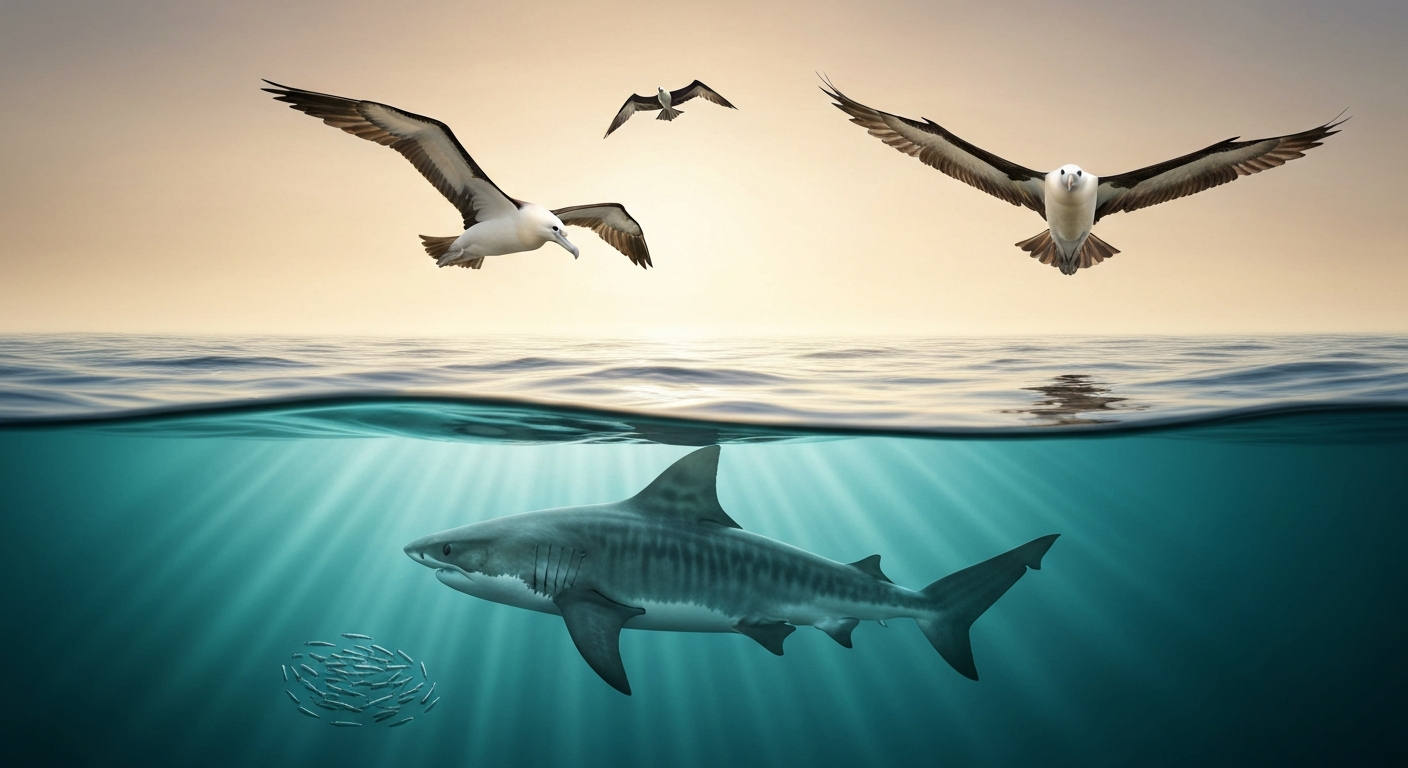
In any realistic encounter, a shark wins easily in the water, and a bird is completely out of reach in the air. Flight speed and performance of the wandering albatross with respect to wind, Movement Ecology (GPS-tracking study) notes that Wandering albatrosses (Diomedea exulans and complex) have the largest wingspans of living birds and routinely soar long distances; tracked birds show typical across-wind airspeeds around ~16 m·s⁻¹ (≈58 km·h⁻¹) in many wind conditions, with higher ground speeds in strong tailwinds Flight speed and performance of the wandering albatross with respect to wind — Movement Ecology (GPS-tracking study). These two animals almost never fight, but they do interact in fascinating ways: tiger sharks eat seabirds that land on the ocean surface, frigatebirds steal food from other seabirds right above shark-rich waters, and albatrosses soar thousands of kilometers over the same open ocean that great whites patrol below. Biologically, they are about as different as two vertebrates can possibly be, one is a cartilaginous, gill-breathing, ectothermic (mostly) fish; the other is a feathered, lung-breathing, warm-blooded flier. Understanding where those differences come from, and where the two animals genuinely overlap in the real world, turns out to be one of the more interesting cross-kingdom comparisons you can make.
Shark vs Bird: How They Differ and Who Would Win in Nature

Why people search "shark vs bird"
The search query "shark vs bird" (and its mirror, "bird vs shark") shows up for a few different reasons. Some people have just watched a video of a tiger shark pulling a seabird under, or seen a clip of a gannet rocketing into shark-churned water. Others are students working on a biology comparison assignment. And a fair number are fans of hypothetical animal matchups who want a straight answer on who would win in a fight. This article covers all of that. It walks through the taxonomy, anatomy, physiology, senses, size, speed, weapons, and ecological relationship between sharks and birds, then wraps up with documented real-world interactions and some honest answers about hypothetical encounters. If you have spent any time on this site comparing ravens to crows or falcons to hawks, you already know the format: clear, grounded, side-by-side, no padding.
Where they sit on the tree of life
Sharks and birds are both vertebrates, which means they share a common ancestor somewhere deep in the Cambrian, but their lineages diverged so long ago that they are about as distantly related as vertebrates get. Sharks belong to the class Chondrichthyes, specifically the subclass Elasmobranchii, which includes sharks and rays. Their skeletons are made entirely of cartilage, not bone, and that characteristic goes back at least 450 million years in the fossil record. The earliest shark-like fishes appear in the Silurian period; the modern order Lamniformes (which includes great whites) and Carcharhiniformes (which includes tiger sharks) diversified through the Mesozoic and Cenozoic. Birds, by contrast, belong to the class Aves and are technically a lineage of theropod dinosaurs. Archaeopteryx, the famous transitional fossil, dates to about 150 million years ago. Modern birds diversified explosively after the Cretaceous-Paleogene extinction event roughly 66 million years ago, which, incidentally, killed off most large dinosaurs but left sharks largely unaffected. Sharks were swimming through mass extinctions long before birds existed.
The practical takeaway for a biology comparison is this: you are not comparing two similar animals that evolved in parallel. You are comparing a lineage of jawed fishes with one of the longest continuous track records in vertebrate history against a highly derived group of feathered, flight-capable dinosaur descendants. Nearly every biological system they use, from their skeletons to their respiratory tracts, reflects that deep evolutionary split.
The species worth comparing directly
Abstract comparisons between "sharks" and "birds" are not very useful, because each group contains hundreds of species with wildly different sizes and behaviors. For this article, I am focusing on the species most likely to actually encounter each other in the wild, and the ones that illustrate the biological contrasts most clearly.
On the shark side, the great white shark (Carcharodon carcharias) is the most studied large apex predator and a useful benchmark for maximum size and bite force. The tiger shark (Galeocerdo cuvier) is arguably the more relevant species for bird interactions because of its coastal and nearshore range, enormous opportunistic appetite, and documented record of consuming seabirds. Galeocerdo cuvier (Tiger shark) is a large coastal and nearshore predator commonly 3.4–4.3 m in many encounters, with a very broad, opportunistic diet that includes fishes, marine mammals, reptiles, and seabirds (Galeocerdo cuvier (Tiger shark), FishBase summary) blank" rel="noopener noreferrer">Galeocerdo cuvier (Tiger shark) — FishBase summary. Shortfin mako sharks (Isurus oxyrinchus) are worth noting for their speed.
On the bird side, the wandering albatross (Diomedea exulans) represents the extreme end of avian size and long-distance oceanic travel. Brown pelicans (Pelecanus occidentalis) are large plunge-divers that share shallow coastal waters with many shark species. Frigatebirds (Fregata spp.) spend enormous amounts of time over open ocean but almost never land on the water, which is a detail that matters a great deal in a shark-vs-bird context. Gannets and boobies (family Sulidae) plunge-dive aggressively into the water and occasionally operate in proximity to feeding sharks.
Body plans compared: skeleton, skin, and structure
The structural differences between a shark and a bird start at the skeletal level and branch out from there. A shark's skeleton is entirely cartilage, which is lighter and more flexible than bone but still mineralized enough to provide structural support. There are no hollow bones, no air-filled chambers, and no fused skeletal elements optimized for flight. The body is fusiform (torpedo-shaped), designed for low-drag movement through water. The skin is covered in dermal denticles, tiny tooth-like scales made of dentine and enamel, which actually reduce turbulence and protect against abrasion. A great white shark regularly reaches 3 to 6 meters in length, with the largest reliably measured individuals on the longer end of that range. Tiger sharks commonly measure 3.4 to 4.3 meters and can exceed that.
A bird's skeleton is the opposite in almost every way. The bones of most flying birds are hollow, with internal struts (trabeculae) that maintain strength while reducing weight. Many bones are fused or pneumatized (filled with extensions of the air sac system), a direct consequence of the respiratory system described below. Feathers are the outer covering, serving functions from flight and insulation to communication and waterproofing. The forelimbs are entirely committed to wings, meaning birds have given up a pair of grasping limbs that most other tetrapods kept. A wandering albatross can have a wingspan exceeding 3.5 meters, which sounds enormous, but the bird's mass is only around 6 to 12 kilograms. A great white shark of even modest size is orders of magnitude heavier.
Wings vs fins: different solutions to the same physics
It is worth pausing on wings versus fins, because both are lift-generating surfaces that evolved independently for movement through a fluid, yet they work in media with very different densities. A shark's pectoral fins generate lift in water (density roughly 800 times that of air at sea level), which is why sharks can be relatively compact and still maneuver effectively. A bird's wings must generate enough lift in thin air to support the entire body weight, which demands a very high surface-area-to-mass ratio and a much more complex internal structure with asymmetric flight feathers. Frigatebirds have the highest known wing-area-to-body-mass ratio of any bird, which allows them to stay airborne for days using thermals and wind without flapping much. That same body plan makes them almost helpless on the water surface, as their feathers are poorly waterproofed compared to those of pelicans or albatrosses.
Thermoregulation: cold-blooded, warm-blooded, and the interesting middle ground
Most people know that fish are cold-blooded (ectothermic) and birds are warm-blooded (endothermic), but the reality is slightly more nuanced for sharks. The majority of shark species are fully ectothermic, meaning their body temperature matches the surrounding water. However, lamnid sharks (the family that includes great whites, mako sharks, porbeagle, and some threshers) have evolved a form of regional endothermy. They use a system of counter-current heat exchange in blood vessels called retia mirabilia to retain metabolically generated heat in specific tissues, particularly the red locomotor muscles, eyes, and sometimes the viscera. A great white swimming in cold water can maintain its swimming muscles and brain at temperatures significantly above ambient, which improves reaction time and sustained performance. This is convergent, in a loose sense, with what birds do systemically, but it is partial and localized, not a whole-body strategy.
Birds are fully endothermic. They maintain a core body temperature that is typically higher than most mammals, often between 40 and 42 degrees Celsius. This requires a very high metabolic rate, which in turn demands an extremely efficient oxygen delivery system. Powered flight is one of the most energetically expensive activities in the animal kingdom, and the avian body is built around sustaining it. The metabolic contrast between a resting tiger shark and a flying albatross is enormous.
How they breathe: gills versus the avian air-sac lung
Respiration is where the two animals diverge most fundamentally, and it drives almost everything else about their ecology. Sharks breathe water. Oxygen-containing water flows across gill lamellae, thin, highly vascularized filaments where gas exchange occurs. Many shark species rely on ram ventilation: they must keep swimming with their mouths open to force water across the gills, and if they stop moving, they suffocate. Some species use buccal pumping (actively pumping water with mouth and gill movements), and benthic (bottom-dwelling) species can draw water in through a spiracle, an opening behind the eye. The key constraint is simple: a shark cannot breathe air, and it cannot survive out of water for more than a few minutes.
Birds have one of the most sophisticated respiratory systems of any vertebrate. Instead of the simple tidal breathing that mammals use (air in, air out the same way), birds move air through a system of air sacs that creates a largely unidirectional flow through the gas-exchange tissue, called the parabronchial lung. Air makes two complete ventilation cycles before it exits, which means the blood is always encountering fresh, oxygen-rich air rather than a mix of fresh and stale air as happens in mammalian lungs. This system is extraordinarily efficient at extracting oxygen, which is why birds can sustain powered flight at high altitudes and high speeds. Bar-headed geese cross the Himalayas; Rüppell's vultures have been struck by aircraft above 11,000 meters. The constraint is the opposite of a shark's: birds must breathe air and cannot extract oxygen from water.
This single difference (gills vs. air-sac lungs) essentially defines the ecological boundary between them. A shark is lethal in the water and helpless on land. A bird is dominant in the air, functional on land, and in most cases very vulnerable on the water surface to anything that can reach it from below.
Senses: what each animal detects and how
Sharks hunt using a layered sensory system that works at different distances. At long range, olfaction dominates: sharks can detect trace amounts of blood or biological chemicals in the water at remarkable distances, using paired nostrils that sample the water but are not connected to the respiratory tract. At intermediate ranges, the lateral line system detects pressure waves and water movement, allowing sharks to sense a struggling animal's hydrodynamic signature. Vision becomes important at close range. At very close range (within centimeters), the ampullae of Lorenzini, jelly-filled pores concentrated around the snout, detect the weak bioelectric fields generated by all living animals' muscles and nerves. This electroreception system is what guides the final strike onto a prey item, even in total darkness or murky water. It is extraordinarily sensitive and has no equivalent in birds.
Birds rely primarily on vision, which in many lineages reaches remarkable levels of resolution. Seabirds and raptors in particular have high-density foveal regions that provide exceptional spatial detail, and many species have wide visual fields that allow simultaneous forward and lateral monitoring. Some birds have two foveal regions per eye, giving them sharp vision in two directions at once. Olfaction, long dismissed in birds, is now known to be genuinely important in several groups, particularly the Procellariiformes (albatrosses, petrels, shearwaters), which use airborne chemical cues to find food patches across open ocean. Hearing is critical for owls and many passerines. But for seabirds operating over shark-rich water, vision is the primary hunting sense: a gannet locating a fish school from 30 meters in the air, or an albatross scanning the ocean surface from a few meters up.
Size, speed, and weapons: the honest numbers
| Trait | Great White Shark | Tiger Shark | Wandering Albatross | Brown Pelican | Frigatebird |
|---|---|---|---|---|---|
| Typical adult length / wingspan | 3–6 m (body) | 3.4–4.3 m (body) | 2.5–3.5 m wingspan | 1.8–2.0 m wingspan | 2.0–2.4 m wingspan |
| Typical adult mass | 680–1,100 kg (large adults) | 300–600 kg | 6–12 kg | 1.8–4.0 kg | 1.2–1.8 kg |
| Top speed (approximate) | ~40 km/h burst (water) | ~32 km/h (water) | ~58 km/h (cruise airspeed) | ~65–70 km/h (dive approach) | ~40–56 km/h (soaring) |
| Primary weapon | Serrated multi-row teeth; bite force up to ~18,000 N (estimated) | Serrated cockscomb teeth; powerful jaws | Bill (hooked tip); foot-webbing | Gular pouch; bill for scooping | Hooked bill; agile aerial maneuver |
| Primary defense | Apex predator; size; speed | Apex predator; size; speed | Size; flight; remote habitat | Flight; speed; group behavior | Flight; speed; agility |
The bite force numbers for large great whites are staggering. Biomechanical modelling (Wroe et al., 2008) estimated posterior bite forces potentially exceeding 18,000 Newtons for a large specimen, which places them among the highest bite forces of any living predator. Combined with serrated, multi-rowed teeth and a lateral head-shaking motion that saws through flesh, a great white's jaw system is genuinely one of the most destructive weapons in the animal kingdom. A bird's beak and talons are impressive in their own right, a large eagle's talons can exert grip forces over 500 N, and a hooked beak is an excellent tool for tearing, but these are tools designed for prey measured in kilograms, not hundreds of kilograms.
Reproduction and life history: fast vs slow
Birds and sharks sit at very different points on the life-history spectrum, and that has real conservation implications. Most birds grow relatively quickly, reach sexual maturity in one to several years, and produce clutches of eggs that develop and hatch in weeks. Even the wandering albatross, which is slow-breeding by bird standards (one egg every two years, chicks fledge after about a year, breeders do not start until age 10 or so), is fast compared to large sharks.
Large sharks have K-selected life histories: late sexual maturity (great whites may not mature until their mid-teens or later), long gestation periods, small litter sizes, and long intervals between reproductive events. Sharks show diverse reproductive modes across the class, from egg-laying (oviparity, as in many smaller species) through multiple forms of viviparity including the bizarre oophagy seen in sand tigers, where embryos consume their siblings in utero. But in large, commercially important species, the reproductive rate is low enough that populations recover very slowly from overfishing. This makes many large shark species far more vulnerable to human pressure than most birds.
Diet and ecological role: what they actually eat
Great white sharks are apex predators that shift diet with age. Juveniles eat fish and smaller elasmobranchs; large adults specialize increasingly in marine mammals, particularly pinnipeds (seals and sea lions). Their ecological role as top predators structures prey communities and keeps pinniped and fish populations in balance. Tiger sharks are far more eclectic: their diet includes fish, rays, marine turtles, sea snakes, marine mammals, and yes, seabirds. Tiger sharks have been documented consuming albatrosses, shearwaters, and other seabirds that land on or are blown onto the ocean surface. The tiger shark's reputation as the ocean's garbage can is not entirely unfair, they have been found with license plates, tires, and canned goods in their stomachs.
Seabirds play their own ecological roles as nutrient conduits (guano deposits from seabird colonies are massive), top-down regulators of fish and invertebrate populations, and indicators of ocean health. Albatrosses and petrels follow ships and fishing fleets, and they are notorious for being taken as bycatch on longlines. Frigatebirds are kleptoparasites that steal food mid-air from boobies, pelicans, and other seabirds rather than catching their own fish. Brown pelicans plunge from up to 10 meters and use their expandable gular pouch to scoop up fish. None of these feeding strategies puts them in direct competition with sharks for the same prey in the same medium, which is why "competition" is rarely the right framing for shark-vs-bird ecological discussions.
Real-world interactions: where sharks and birds actually meet
The ocean surface is the interface where sharks and birds genuinely interact, and the dynamics there are more interesting than a simple predator-prey story. For a cultural or entertainment-oriented take on predator-versus-prey matchups, see batman vs bird For a cultural or entertainment-oriented take on predator-versus-prey matchups, see batman vs bird.. Seabirds benefit from sharks in one important way: when large sharks drive schooling fish toward the surface while feeding, seabirds flock to the resulting baitball to pick off fish from above. Frigatebirds, boobies, and shearwaters are regularly observed congregating above active shark feeding events. For a pop-culture take on airborne vs aquatic confrontations, see godzilla vs kong bird. This is commensalism at its most visually dramatic.
The predation runs the other way as well. Tiger sharks in particular are known to take seabirds opportunistically. Birds that land on the water, whether exhausted during migration, injured, or simply resting between dives, are vulnerable to any large predator below them. There are documented records of tiger sharks consuming albatrosses and other large seabirds. Gannets and boobies, which plunge-dive at high speed and pursue fish underwater, theoretically expose themselves to sharks during the underwater phase of their dive, though documented shark predation on actively diving gannets is rare. The more typical scenario is a bird on the water surface being taken from below.
Frigatebirds almost never land on water and are essentially immune to shark predation for that reason alone. Their extreme buoyancy and poor waterproofing mean landing on the open ocean is a death sentence by drowning regardless of sharks, so evolution has wired them to stay airborne.
Who would win? The honest answer
This depends entirely on the medium. In the water, there is no contest: a tiger shark or great white would take any bird that lands on the surface. A bird in the water is in the shark's domain, it cannot dive below a shark, it cannot outswim one, and it has no weapons that could threaten an animal weighing hundreds of kilograms. In the air, a shark cannot follow. It is completely helpless and would die within minutes of leaving the water. On land, neither animal is in its element, but at least a bird can walk or fly away while a shark can only flop and asphyxiate.
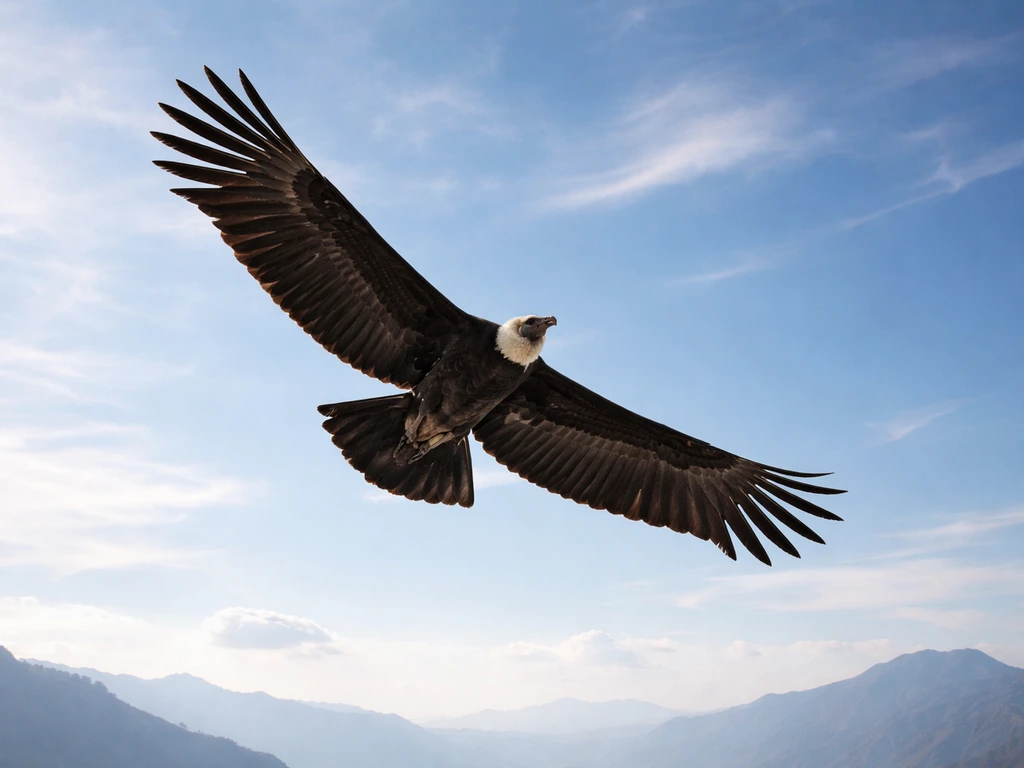
The more interesting hypothetical is a large raptor (like a bald eagle or an Andean condor) versus a small juvenile shark in very shallow water, since raptors do take small fish, but even that scenario is less dramatic than it sounds. Eagles take fish at the surface with their talons; a small juvenile lemon shark in 15 centimeters of water is within the range of what a large eagle might attempt and occasionally succeed at. But against any adult shark of meaningful size, a bird has no path to victory in the water. The weapons are simply too mismatched: an 18,000 Newton bite against a hooked beak designed for prey measured in grams to kilograms.
Common misconceptions worth clearing up
- Sharks are not mammals. They are fish, specifically cartilaginous fish. They do not breathe air, they do not nurse young with milk, and they are not warm-blooded in the full sense (though lamnids have partial regional endothermy).
- Most birds are not in any danger from sharks in everyday life. Seabirds that never land on open water (like frigatebirds) have essentially zero shark predation risk. The risk is real only for birds that regularly sit on the ocean surface.
- Sharks do not "hunt" birds as a primary strategy. Seabirds are an opportunistic item in a tiger shark's varied diet, not a target they actively seek out.
- Birds cannot eat adult sharks. The question of whether a bird can eat a shark is only meaningful for very small juvenile sharks in accessible water, and only for the largest raptors or wading birds with strong enough bills.
- Sharks and birds do not meaningfully compete. They occupy different physical media (water vs air) and eat different prey in different ways. Ecological overlap exists at the ocean surface, but it is not competition.
- The "shark" in pop culture matchups (e.g., viral videos titled "bird vs shark") is almost always a juvenile blacktip or a small reef shark, not a great white or tiger shark. The size gap in those videos is completely different from the comparison made here.
A full side-by-side biological comparison
| Biological Feature | Sharks (Chondrichthyes) | Birds (Aves) |
|---|---|---|
| Taxonomic class | Chondrichthyes (Elasmobranchii) | Aves (Theropod dinosaurs) |
| Skeleton | Cartilage (no true bone) | Lightweight bone, hollow and pneumatized |
| Body covering | Dermal denticles (tooth-like scales) | Feathers (flight, insulation, display) |
| Thermoregulation | Ectothermic (lamnids: regional endothermy) | Fully endothermic; core temp ~40–42°C |
| Respiration | Gills (ram ventilation or buccal pumping) | Air-sac parabronchial lung (unidirectional flow) |
| Dominant sense | Olfaction + electroreception + lateral line | Vision (some: also olfaction) |
| Locomotion | Swimming via tail and fins | Flight (wings), walking, swimming in some |
| Reproduction | Oviparity or viviparity; small litters; slow | Oviparity; variable clutch size; faster |
| Habitat | Marine (mostly); freshwater in a few species | All habitats including open ocean, polar regions |
| Ecological role | Apex predator in marine systems | Predator, scavenger, seed disperser, nutrient mover |
| Fossil record origin | ~450 million years ago | ~150 million years ago (Archaeopteryx) |
Safety notes for people observing both in the wild
If you are a birder who watches seabirds from boats or kayaks, the presence of active sharks in the area is worth knowing about for practical reasons. Sharks feeding on baitballs can breach or thrash at the surface, and trailing your hand or a fishing line in the water in those conditions is inadvisable. If you are observing seabirds at a known shark aggregation site (like the waters around seal colonies off the Farallon Islands or South Africa), keep limbs out of the water and avoid chumming zones. For the birds themselves, the best observation windows are at dawn and dusk when large pelagic seabirds are most active and sharks are often feeding, so the overlap in activity timing is real even if the direct interactions are rare.
How this comparison fits the bigger picture
Comparing birds to non-bird animals is genuinely useful for understanding what makes birds distinctive. The contrast with sharks is particularly clarifying because the differences are so fundamental: skeleton type, breathing method, thermoregulation strategy, and reproductive pace. If you enjoy reading comparisons like nighthawk vs whippoorwill (two birds that are easily confused by shape and behavior alone), or more unusual comparisons involving fictional and real animals, the shark-vs-bird comparison works as a useful biological anchor. It shows you what the avian body plan is optimized for, by comparing it to a very different vertebrate body plan that has been successful in a completely different medium for hundreds of millions of years.
The core result of that comparison is this: birds and sharks are both extraordinarily successful at what they do. Sharks have survived five mass extinctions with relatively minor changes to their basic design. Birds have colonized every habitat on Earth, including open ocean, Antarctica, and high-altitude glaciers, with a body plan that did not exist 200 million years ago. They succeed in different ways, in different worlds, and their rare real-world meetings at the ocean surface are just a small intersection of two very long, very different evolutionary stories.
FAQ
Short answer: Which would win in a "shark vs bird" encounter?
Short answer: It depends entirely on species, size, environment and circumstance. In water near the surface, most medium-to-large sharks (e.g., tiger, great white) can catch and kill many seabirds if the bird is on the water or injured. In the air or on land, even very large sharks cannot pursue birds. Thus there is no universal winner—environment and relative size/condition determine the likely outcome. (Sources: FishBase; peer-reviewed shark and seabird ecology literature.)
How do sharks and birds differ taxonomically and evolutionarily?
Sharks are cartilaginous fishes in class Chondrichthyes (subclass Elasmobranchii). Modern birds are in class Aves (theropod dinosaurs). These groups split hundreds of millions of years ago and followed very different evolutionary paths: sharks retain many ancient chondrichthyan traits, while birds evolved from theropod dinosaurs and developed flight-related specializations. (Sources: FishBase; IOC/Avibase; vertebrate paleontology reviews.)
What are the fundamental anatomical and physiological differences?
Key differences: skeleton (sharks: cartilage; birds: ossified bones, pneumatized for flight), respiration (sharks: gills and water flow/ram ventilation; birds: lungs with air sacs and largely unidirectional airflow), thermoregulation (most sharks are ectothermic; some lamnid sharks show regional endothermy; birds are endothermic), limbs (sharks: fins; birds: wings with feathers), and integument (sharks: placoid scales/dermal denticles; birds: feathers). These differences underlie very different ecologies and performance capacities. (Sources: comparative physiology and anatomy literature.)
How do their respiratory systems compare?
Sharks breathe using gills that extract oxygen from water; many pelagic sharks rely on ram ventilation (swimming with mouth open) while others can actively pump water over gills. Birds use lungs with air sacs and parabronchial airflow that is highly efficient for oxygen exchange, supporting high metabolic rates needed for powered flight. (Sources: FAU notes; avian respiratory reviews.)
How do thermoregulation strategies differ?
Most sharks are ectotherms—body temperature matches ambient water—though some active lamnid sharks (e.g., great white, mako) maintain elevated temperatures regionally in muscles and eyes via counter-current heat exchangers. Birds are uniformly endothermic and maintain high, stable body temperatures to support flight and sustained activity. (Sources: lamnid endothermy reviews; avian physiology.)
How do senses compare—vision, smell, electroreception, hearing?
Sharks: excellent chemical (olfactory) detection, lateral-line hydrodynamics, vision suited to aquatic light conditions, and electroreception (ampullae of Lorenzini) for very close prey localization. Birds: vision is generally dominant (high spatial resolution in many seabirds and raptors), hearing varies by species, and olfaction is well-developed in some seabirds (e.g., procellariiforms) but variable across taxa. Birds lack electroreception like sharks. (Sources: sensory biology reviews.)
Godzilla vs Kong Bird: Identify the Exact Bird Lookalike
Disambiguate and ID the exact bird behind searches like Godzilla vs Kong bird using field marks, habitat, range, behavio