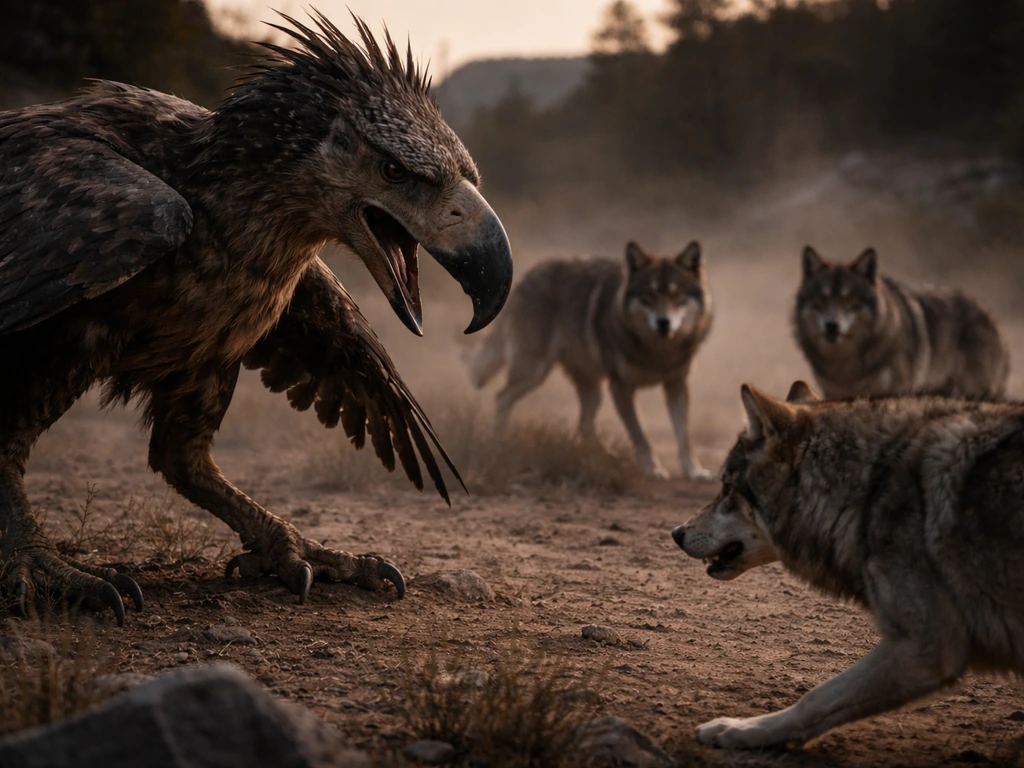
A terror bird (Phorusrhacidae) and a short-faced bear (Arctodus) look nothing alike once you know what to check: one is a massive flightless bird with a huge hooked beak and two-legged stance, the other is a long-limbed, four-legged mammal in the bear family. The confusion usually comes from the fact that both are dramatic Cenozoic megafauna people encounter in the same prehistoric 'who would win' conversations.
Terror Bird vs Short Faced Bear: How to Tell Them Apart

Marcus Hendricks
22 Jun 2026
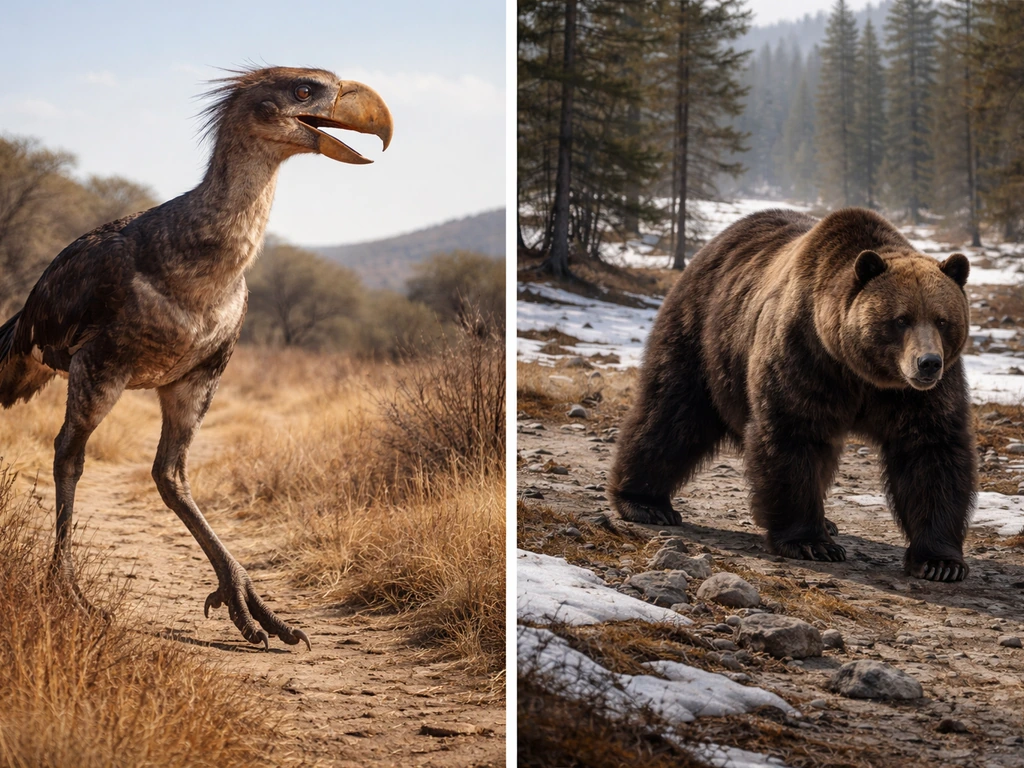
Tiger vs bird matchups often come up in prehistoric “who would win” discussions, but the key is recognizing each animal by its body plan and skull traits Terror bird. But they are separated by class, body plan, and partly by time and geography. Here is everything you need to tell them apart confidently and understand whether they ever actually shared the same world.
What each animal actually is
Terror bird (Phorusrhacidae)
Terror birds are an extinct family of large, flightless birds classified within the order Cariamiformes. The family Phorusrhacidae contains at least 13 genera and 17 recognized species, ranging from turkey-sized to genuinely enormous. The systematic revision of the Phorusrhacidae reports that the family includes multiple subfamilies, with 13 genera and 17 recognized species [at least 13 genera and 17 recognized species](https://revistas. usp.
br/paz/article/view/33623). The giants you usually see referenced include Phorusrhacos and Brontornis in South America and Titanis walleri, the best-documented North American representative. They lived from the Middle Eocene through the Late Pleistocene, making them one of the longest-running bird lineages in South American history. Titanis reached North America after the Isthmus of Panama formed roughly 2.
8 million years ago, during what paleontologists call the Great American Biotic Interchange.
Short-faced bear (Arctodus)
Arctodus is an extinct genus of bears belonging to the subfamily Tremarctinae within the family Ursidae. The two recognized species are Arctodus pristinus (the earlier, somewhat smaller form) and Arctodus simus, the giant short-faced bear. Arctodus simus is one of the largest terrestrial mammalian carnivores ever recorded, with average mass estimates commonly cited around 700 to 850 kg. Tremarctinae is an entirely New World subfamily, and its one living representative is the spectacled bear (Tremarctos ornatus) of South America. Arctodus simus is known from over 100 North American localities, ranging from Mexico to Alaska and from California to Virginia, placing it squarely in the Pleistocene megafauna of North America.
Bird vs. mammal: the body plan tells you everything
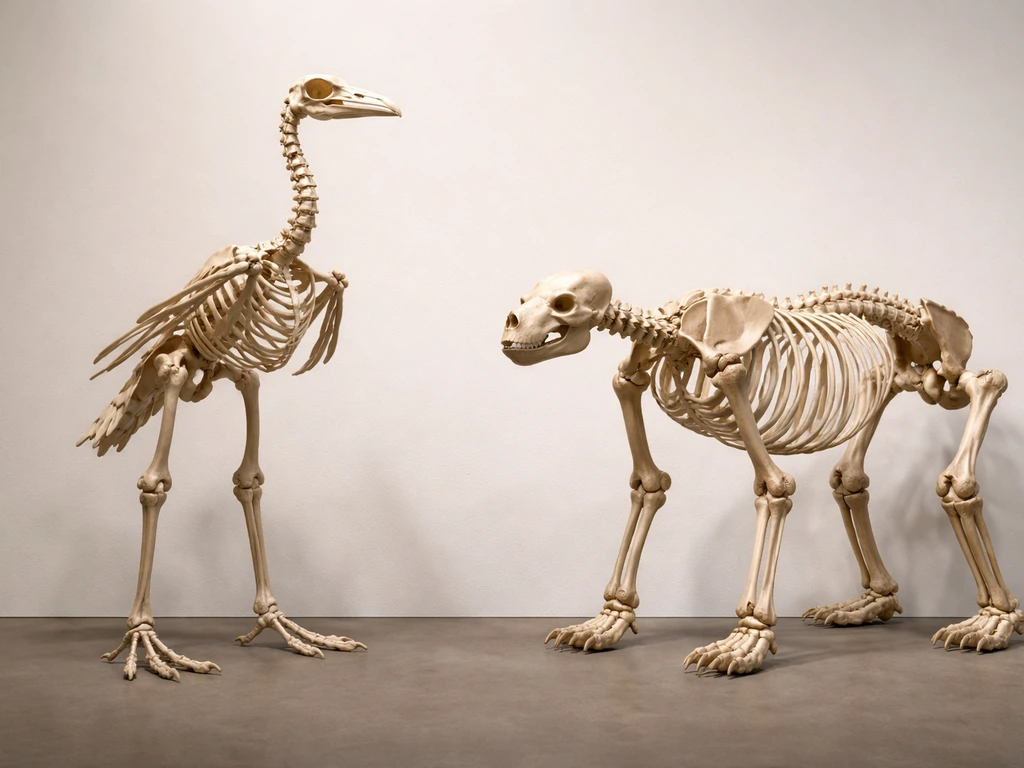
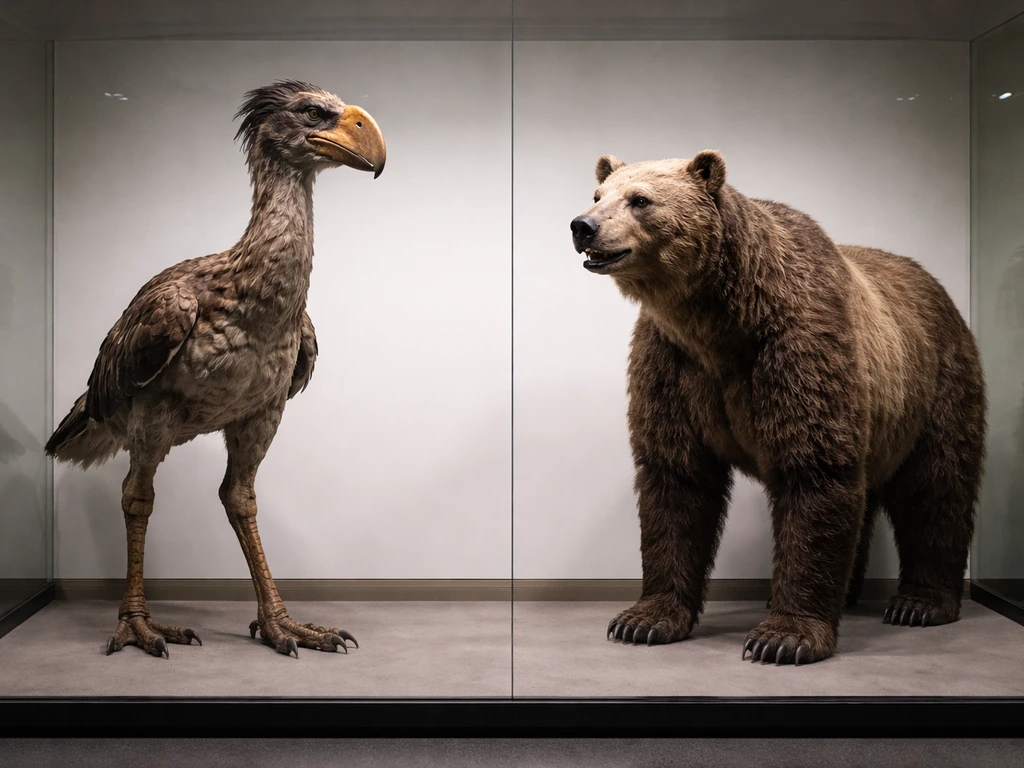
This is the fastest way to separate the two animals. Terror birds are built on the avian body plan: a lightweight (relative to size) skeleton with hollow bones, two legs, two wings (reduced to near-useless stubs in large phorusrhacids), and a skull fused to a massive beak. Everything about their posture is bipedal and upright, with a vertical body axis balanced over powerful, forward-pointing feet.
Arctodus, by contrast, is a quadruped with the full mammalian toolkit: four limbs, dense bones, fur, and a horizontal spine. Its body mass is distributed across a broad torso supported by four legs, not balanced on two. If you see a prehistoric predator standing on two legs with a giant hooked beak, you are looking at a bird. If you see a large bear-shaped animal on four legs with a notably short, domed skull, you are looking at Arctodus.
| Trait | Terror Bird (Phorusrhacidae) | Short-Faced Bear (Arctodus simus) |
|---|---|---|
| Animal class | Bird (Aves) | Mammal (Mammalia) |
| Locomotion | Bipedal (two legs) | Quadrupedal (four legs) |
| Forelimbs | Vestigial wings, not functional for grabbing | Full forelegs with large clawed paws |
| Skeleton type | Avian (hollow bones, fused clavicles) | Mammalian (dense, solid bones) |
| Posture | Upright, vertical | Horizontal spine, bear-like |
| Body covering | Feathers | Fur |
| Estimated mass (large species) | ~130–400 kg (varies by genus) | ~700–850 kg |
| Height (approx.) | Up to ~3 m tall (Brontornis) | ~1.8 m at shoulder (Arctodus simus) |
Skull and face shape: what the head tells you about function
The skull is where the comparison gets genuinely fascinating from a biomechanics standpoint. Terror bird skulls are defined by an enormous, laterally compressed, hook-tipped beak that can account for a large portion of the animal's total skull length.
CT-based mechanical studies on species like Andalgalornis steulleti have shown that large phorusrhacid skulls are functionally akinetic: the normal bird skull hinges (the craniofacial hinge, the palatine bones, and the jugal bar) were converted into reinforced, immobile junctions rather than flexible flexion zones. In plain terms, the beak could not flex side to side. Instead, it was built for one thing: powerful downward striking.
Bite force at the bill tip for Andalgalornis has been estimated at around 133 N through CT modeling, modest by absolute standards but delivered with a narrow, rigid, hatchet-like structure optimized for jabbing straight down. The attack style inferred from this architecture is a jab-and-retreat strategy: hit hard, step back, repeat, rather than grapple and shake prey like a crocodile or large raptor.
The Arctodus skull is almost the opposite in shape. 'Short-faced' refers to the foreshortened facial region relative to overall skull size: the snout is abbreviated, the zygomatic arches are wide, and the overall profile is domed and blunt compared to long-snouted bears. Paleontologists have debated what this skull shape actually means for diet.
Some argued the short face indicated a hypercarnivore with powerful bite mechanics; others point to dental microwear evidence and dental pathology (including fossil caries at Rancho La Brea) suggesting a more omnivorous diet, possibly including significant scavenging. The debate is ongoing, but the key take-away for identification is simple: the Arctodus head is a broad, mammalian, bear-type skull with a shortened snout and large canine and molar teeth.
A terror bird skull is a narrow, laterally compressed, bird skull dominated by a hooked beak with no teeth at all.
Size, speed, and how they probably hunted
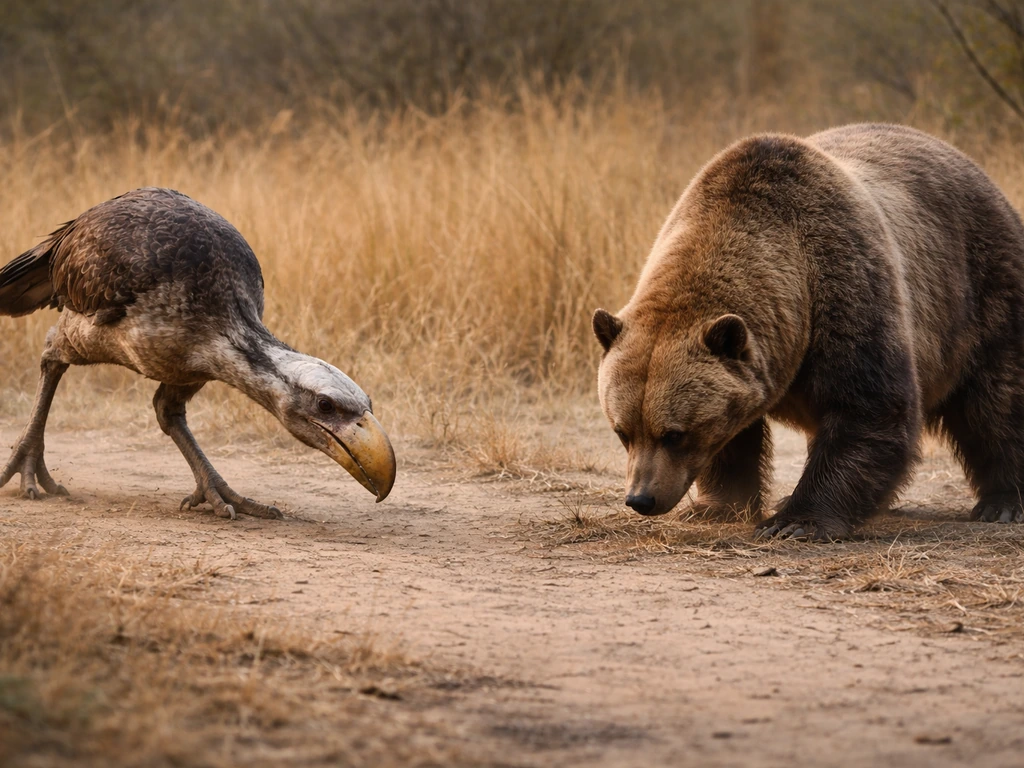
Arctodus simus is the heavier animal by a significant margin. At 700 to 850 kg on average (some specimens potentially larger), it outweighs even the biggest terror birds. Brontornis burmeisteri, one of the largest phorusrhacids, is estimated at roughly 350 to 400 kg. Titanis walleri, the North American species, was likely in the 150 to 200 kg range.
So on raw mass, the short-faced bear wins clearly. In terms of speed, Arctodus had notably gracile (slender and elongated) limbs for a bear of its size, and forelimb morphology studies suggest cursorial adaptations: it was built for covering ground efficiently, possibly over long distances, rather than short explosive sprints. Terror birds, running on two powerful legs, are generally reconstructed as fast sprinters.
The bipedal running mechanics of large ratites (ostriches, emus) give a useful analogy: two legs, no body weight offset by forelimbs, all thrust from the hindlimbs.
For feeding style, the two animals operated in entirely different ways. The rigid, narrow bill of a phorusrhacid is best explained by a strike-and-recoil predatory style: the bird likely used its beak as a hatchet, driving it down onto prey with neck and body force, targeting vulnerable areas. It would not have been grappling prey with clawed feet in the manner of hawks or eagles.
Arctodus's feeding ecology is genuinely debated: active predator, opportunistic omnivore, and bone-crushing hyper-scavenger have all been proposed and tested against different evidence lines. Large body size would have made carcass defense very effective regardless of how the carcass was obtained. Neither animal is a simple 'killer' or 'scavenger': both likely used flexible strategies, as most large predators do.
Habitat and time period: could they ever have met?
This is where the geography and timing matter. Terror birds originated and diversified in South America, starting from the Middle Eocene onward. Phorusrhacids as a family persisted into the Late Pleistocene in South America. After the formation of the Isthmus of Panama around 2.8 million years ago, Titanis walleri moved into North America, with fossil evidence from Florida and Texas. Rare-earth element dating suggests Titanis was in Texas around 5 million years ago and in Florida around 2 million years ago, though the Florida Museum's own research has challenged some of the later Texas dates and argues Titanis likely went extinct before the main Pleistocene in parts of its range.
Arctodus simus is a Pleistocene animal through and through, documented from a massive geographic range (over 100 North American localities) but most abundant roughly 1. 8 million to 11,000 years ago. If Titanis survived in Florida into the early Pleistocene around 2 million years ago, and if Arctodus pristinus (the earlier Arctodus species) was already present in Florida's early Pleistocene, then a geographic and temporal overlap is at least plausible for those two specific taxa in that specific region.
But for most of the dramatic 'terror bird vs short-faced bear' matchup implied by popular culture, you are mixing animals from different time windows and often different continents. But for popular 'terror bird vs wolves' showdowns, remember you are comparing animals that are far apart in time and place. The overlap, where it exists at all, is narrow and geographically specific.
Compare this to the broader question of how terror birds fared against other South American megafauna, or how they relate to other apex predators like Smilodon, which shared parts of the Americas with both groups at different times.
Common misconceptions worth correcting
Several popular misconceptions make this comparison harder than it needs to be. To get the closest match, you can also compare a terror bird versus lion type of predator expectations, even though they lived in different ecosystems. Here are the ones that come up most often, and how to check them against actual evidence.
- Terror birds grabbed prey with their feet like eagles: Wrong. Their wings were vestigial and their feet, while powerful, were not the raptorial foot structure of hawks or falcons. The feeding mechanics point to beak-driven strikes, not talon grappling. The side-to-side weakness of their rigid skull confirms they were not designed to shake or thrash prey.
- Arctodus was a hypercarnivore 'super predator': Not confirmed. The short-faced skull was once interpreted as evidence of extreme predatory bite force, but dental microwear studies and fossil dental pathology support omnivory as a strong possibility. The 'predaceous bear that never was' framing in paleontological literature reflects genuine scientific pushback on the popular portrayal.
- All terror birds were the same size: There were at least 17 recognized species across 13 genera. Some were roughly turkey-sized; others like Brontornis were the size of a large horse. Titanis was mid-sized by phorusrhacid standards.
- Terror birds and short-faced bears lived at the same time across the Americas: Their ranges overlapped at best in a narrow time window in specific North American locations. Most of their existence was on different continents in different epochs.
- Arctodus was a slow, heavy, 'obese bear' shape: Limb proportion studies consistently show Arctodus had elongated, gracile limbs compared to other large bears, consistent with cursorial efficiency. Popular depictions as a rounded, plodding animal misrepresent the fossil evidence.
If you want to verify these claims yourself, the best approach is to look at CT-scan-based biomechanical studies for phorusrhacid skull mechanics (search for Andalgalornis steulleti mechanical analysis) and dental microwear texture analysis for Arctodus diet. In K-pop demon hunter lore, the phrase “tiger and bird” is often interpreted as a symbolic mix of power and hunting traits tied to the tiger and bird themes dental microwear texture analysis for Arctodus diet. Both lines of evidence are peer-reviewed, published in accessible journals, and do a better job than any popular article of settling what these animals could and could not do.
How to spot them in photos and diagrams: a checklist

When you encounter a reconstruction, fossil photo, or museum diagram and need to identify which animal you are looking at, run through this checklist.
If it might be a terror bird, look for:
- Bipedal stance: the animal stands on two legs with no functional forelimbs touching the ground
- Massive, hooked beak: disproportionately large relative to body size, narrow and laterally compressed, with a sharp downward hook at the tip
- No teeth: the beak is the entire feeding instrument; no visible dentition
- Feathers: even in skeletal reconstructions, artist renderings show a fully feathered body
- Small, high-set nostrils: in species like Kelenken, nostrils sit in the upper rear corner of the beak
- Upright, bird-like posture with a relatively compact body balanced over long hindlimbs
- Vestigial wing stubs visible on the forelimb: small and non-functional in large species
If it might be a short-faced bear, look for:
- Quadrupedal stance: four limbs on the ground, horizontal spine, typical bear body layout
- Short, domed skull: the snout is notably abbreviated compared to brown bears or grizzlies, giving the face a blunt, almost 'pushed-in' look
- Visible canine and molar teeth: mammalian dentition is present and prominent
- Elongated limbs relative to body: legs look proportionally longer and slimmer than a modern grizzly bear
- Fur covering (in life reconstructions): no feathers, no beak
- Large overall body volume: Arctodus simus is considerably bulkier than Titanis or most phorusrhacids
For deeper searching, the most productive image search terms are 'Andalgalornis skull CT reconstruction,' 'Titanis walleri skeleton Florida,' 'Arctodus simus skeleton Pleistocene,' and 'phorusrhacid beak biomechanics.' Museum pages from the Florida Museum of Natural History and peer-reviewed open-access papers from PMC and MDPI give you the most reliable visual references. If you are exploring how terror birds compared to other large predators of their era, looking into their matchups against Smilodon, wolves, and lions of the Pleistocene fills out the ecological picture considerably, since those comparisons involve animals that shared geography and time in ways the terror bird and short-faced bear mostly did not. If you want a direct, head-to-head answer, the terror bird vs Smilodon who would win matchup is the most discussed comparison.
FAQ
If I only have a photo or silhouette, what single feature will let me tell “terror bird” from “short-faced bear” with confidence?
Look for the basic body plan. A terror bird shows a biped posture with a narrow, laterally compressed skull ending in a toothless hooked beak, while Arctodus is a four-legged mammal with a broad bear-type skull and visible canine and molar teeth.
Can the “short-faced” label make Arctodus easy to confuse with another bear or predator?
Yes, because “short-faced” is about skull proportions, not the whole head shape. In practice, you check for a foreshortened snout plus a domed, blunt profile and a full bear dentition (large canines and molars), not the toothless, beak-dominated head you would see in phorusrhacids.
Did terror birds have wings strong enough for flight, or were the stubby wings always useless?
In large phorusrhacids the wings were reduced to small stubs and were not functional for sustained flight. Even if smaller members of the group had slightly more developed wings, the hallmark “terror bird” silhouette for identification is the upright biped with a heavy beak rather than active flapping locomotion.
How can I tell Titanis apart from South American terror bird genera like Phorusrhacos in artwork?
Use the context clues first, not fine anatomy. Titanis is the North American representative, so museum displays or fossils labeled from Florida and Texas are strong indicators. If the material is undated or generic, treat it as “terror bird” unless the label specifies Titanis or a comparable genus.
What mistake do people commonly make when comparing these animals in a “who would win” debate?
They mix different time windows and continents. Most popular comparisons imply they lived together, but terror birds are primarily South American (with Titanis as a North American exception) while Arctodus is a Pleistocene North American bear, so true overlap is limited and region-specific.
Could a terror bird ever be mistaken for a large raptor or other bird of prey?
Yes if you focus only on the hooked beak. The discriminators are that terror birds are flightless, bipedal runners with a rigid, beak-dominated skull (no teeth), and reduced wings, whereas most predatory raptors are volant and have a more typical bird skull and toothed-diet bite mechanics.
How can I use mass estimates to avoid overconfidence from a single “biggest” number?
Treat the typical range as the guide, not the top end of one study. Arctodus is usually much heavier than the largest terror birds discussed, but estimates vary by method and specimen completeness, so it helps to compare average body mass ranges when artwork makes both animals look equally sized.
What feeding-related detail should I use for identification if diet evidence is uncertain?
Use the dentition and skull architecture. Terror birds have a toothless beak built for a specific strike-and-recoil style, while Arctodus has bear teeth suited to crushing and processing food, even if researchers debate how much of its intake was active hunting versus scavenging.
If I find claims that terror birds “grappled” prey with claws, how should I evaluate them?
Check whether the claim matches the skull mechanics. The rigid, akinetic beak architecture supports a stabbing or jabbing strategy rather than the kind of side-to-side gripping you would expect from a flexible, hinged skull. Claws alone do not override the functional evidence from the beak and cranial joint design.
Are there quick image-search terms you can use to verify an identification on museum labels or fossil plates?
Search for genus- and anatomy-specific phrases like “Titanis walleri skeleton Florida,” “Arctodus simus skull teeth,” and “phorusrhacid beak CT reconstruction.” If the label mentions CT-based studies or dental microwear, that is usually a stronger validation path than relying on generic reconstructions.
Next Article
Terror Bird vs Wolves: Who Would Win and Why
Terror bird vs wolves comparison: anatomy, hunting tactics, speed, diet, and what likely wins in a speculative matchup.