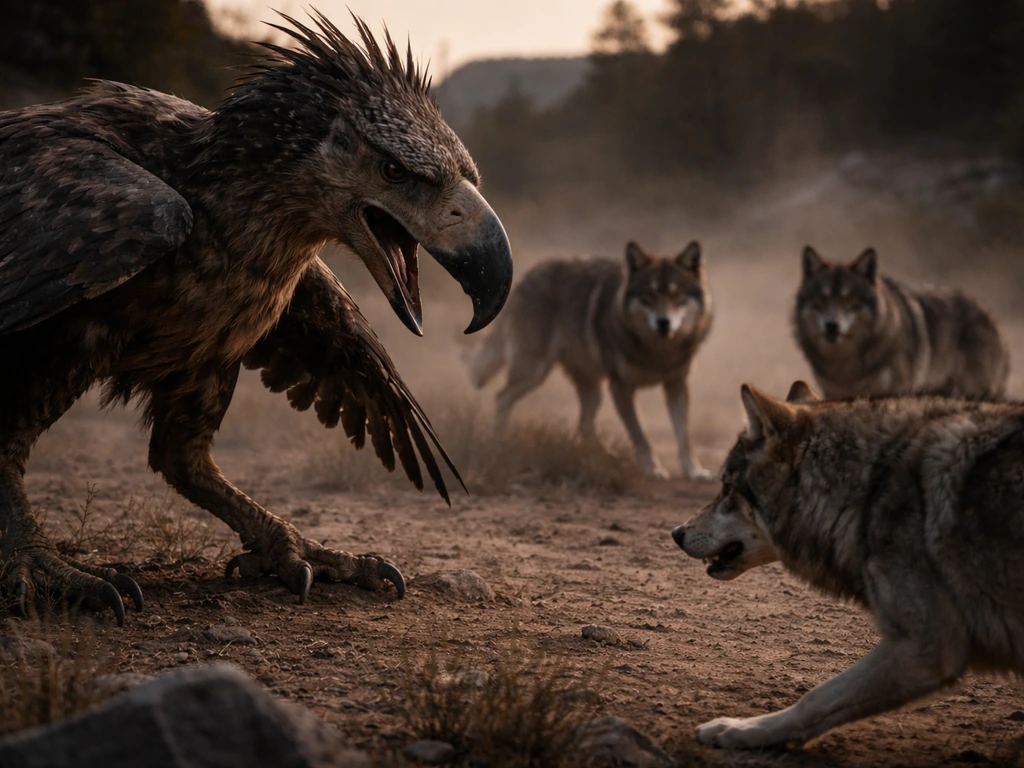
In a one-on-one encounter, a large terror bird like Phorusrhacos longissimus would almost certainly overpower a single gray wolf. At roughly 2.4 meters tall and over 130 kg, with a skull nearly 65 cm long and a hooked beak built for slicing, it outweighs even the largest wolves by a significant margin. But that framing misses a lot. Wolves hunt in packs, terror birds are extinct, and the fossil record is frustratingly patchy. What we can do is lay out the real evidence side by side, call out where speculation begins, and give you a clear-eyed answer to the question you actually came here for.
Terror Bird vs Wolves: Who Would Win and Why

Marcus Hendricks
19 Jun 2026
What a "terror bird" actually is
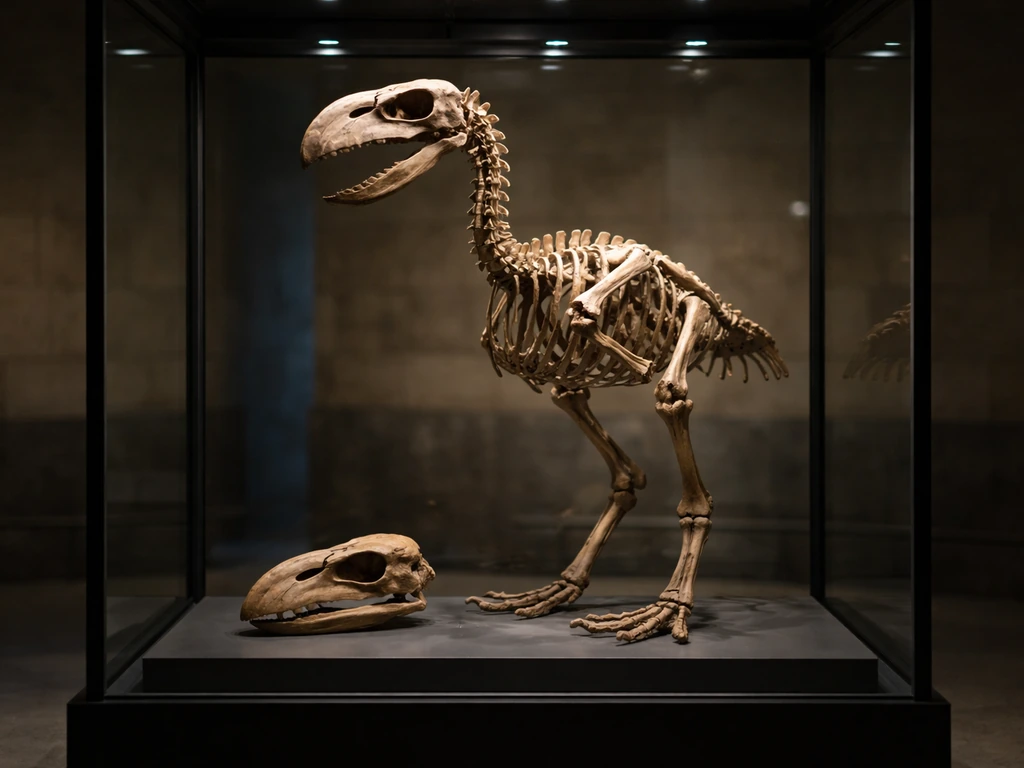
Phorusrhacidae is the formal family name for what paleontologists call terror birds. These were large, mostly flightless, carnivorous birds whose definitive fossil record runs from the Middle Eocene through the Late Pleistocene, meaning they persisted for tens of millions of years across South America. One species, Titanis walleri, even made it into North America, with fossils found in Florida. So these were not mythological creatures or oversized modern raptors. They were real birds with a long evolutionary history.
The family had considerable size diversity. Smaller species like those in the Psilopterinae subfamily were more walker or wader types, while the larger cursorial groups, particularly Mesembriornithinae and Patagornithinae, showed hindlimb proportions consistent with running. The most iconic species, Phorusrhacos longissimus, is reconstructed at about 2.4 meters tall with a body mass estimated at over 130 kg and a skull close to 65 cm in length. Andrewsornis abbotti, another member of the family, has been estimated at 60 to 89 kg depending on which skeletal proxies you use. It's worth noting that many of these mass estimates come from fragmentary remains, so there's real uncertainty baked into all these numbers.
The beak is the most distinctive feature. It was large, deep, and strongly hooked, built for tearing and slicing rather than sustained gripping. Biomechanical modeling of the skull of Andalgalornis steulleti (a smaller relative) estimated a bill-tip bite force of around 133 N, which is not jaw-dropping on its own, but the skull was also highly stiff, suggesting it was designed to resist up-and-down stress rather than twisting forces. Researchers interpret this as consistent with a "hatchet strike" style of feeding, driving the beak downward rather than wrestling prey side to side. Think of it less like an eagle gripping a fish and more like an axe coming down.
Wolf fundamentals: anatomy, hunting, and ecology
The gray wolf (Canis lupus) is one of the most well-studied large predators alive today. Adult body weight ranges from about 18 to 80 kg depending on sex and geographic population, with northern populations like those in the Greater Yellowstone Ecosystem trending toward the heavier end. Wolves are digitigrade (they walk on their toes), which gives them efficient, springy locomotion over long distances. They carry 42 teeth, including large canines for gripping and carnassial teeth for shearing meat.
What makes wolves genuinely dangerous is not raw individual power but hunting strategy. Wolves are cooperative pack hunters. Their predatory behavior follows documented sequences: locate and approach prey, watch and assess vulnerability, then coordinate an attack. Studies of wolf pack behavior in computational simulations show that this coordination can emerge from relatively simple individual rules rather than requiring complex communication, which partly explains how wolves can reliably bring down prey that massively outweighs any single wolf. In Yellowstone, wolves routinely take elk and bison, animals in the 240 to 650 kg range. That cooperative ability is the wolf's single greatest advantage in any comparison.
Wolf diet is dominated by wild ungulates across most of the world, with prey selection shifting based on seasonal availability and prey vulnerability. A large pack in a good habitat is a remarkably efficient predator, but individual wolves outside a pack context are far more limited. This distinction matters a lot for any honest comparison with a terror bird. A useful way to think about the matchup is “tiger vs bird,” where speed, reach, and predation strategy matter more than raw size.
Locomotion and physical capabilities side by side
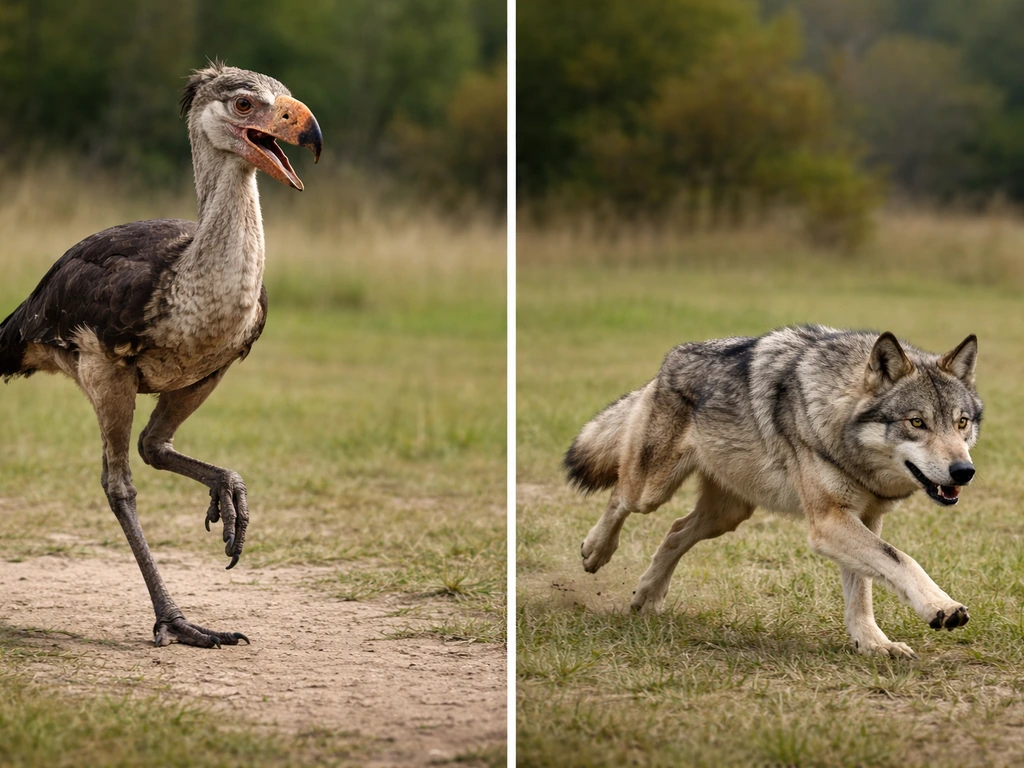
Both animals were built to move, but they moved very differently. Wolves are cursorial quadrupeds, built for endurance running and sustained pursuit across open or semi-open terrain. Terror birds, or at least the larger cursorial species, were cursorial bipeds, with strong hindlimbs suited for running. Fossil footprint evidence from the Río Negro Formation supports a functionally didactyl (two-toed) posture in some phorusrhacid lineages, consistent with fast, efficient striding rather than slow wading.
| Trait | Terror Bird (Phorusrhacos) | Gray Wolf (Canis lupus) |
|---|---|---|
| Body height | ~2.4 m | ~0.6–0.85 m at shoulder |
| Body mass | ~130+ kg (estimated) | 18–80 kg |
| Locomotion | Cursorial biped (ran on two legs) | Cursorial quadruped (endurance runner) |
| Primary weapon | Large hooked beak, hatchet-strike style | 42 teeth; canines and carnassials |
| Limb structure | Powerful hindlimbs; vestigial wings | Four legs; digitigrade stance |
| Hunting style | Inferred ambush or pursuit (disputed) | Cooperative pack pursuit |
| Social structure | Unknown; likely solitary or small groups | Pack-based, highly social |
| Status | Extinct (Late Pleistocene) | Living |
The physical gap is significant. A terror bird of the larger species would stand over three times the shoulder height of a wolf and outweigh even the largest wolf by 50 to 100 kg or more. Reach alone gives the terror bird a massive advantage in any direct confrontation. A wolf closing in to bite would be stepping directly into the danger zone of that beak.
Diet, hunting strategy, and prey
Here is where honesty about the fossil record matters. There is actually no direct fossil evidence of phorusrhacid predation, meaning we have no confirmed bite marks on prey bones or gut contents that confirm what terror birds ate or exactly how they hunted. Researchers infer hunting behavior from functional morphology: skull shape, beak structure, leg proportions, and analogies to living birds.
For example, Cambridge Core’s overview of the fossil record of predation in dinosaurs explains that diet and hunting behavior in extinct predators are inferred from functional morphology but supported by taphonomic associations, bite marks, gut contents, coprolites, and trackways. The prevailing hypothesis, based on the stiff, axe-like skull biomechanics, is that larger phorusrhacids struck downward at prey with powerful beak blows rather than wrestling it.
Some researchers suggest ambush-style hunting for certain body forms, with scavenging also being a possibility for some species. It is educated inference, not a certainty.
Wolves, by contrast, have an extensively documented diet and hunting sequence. In Yellowstone and similar ecosystems, wolves pursue large ungulates like elk, bison, and deer. Pack-coordinated hunts involve approach, assessment of vulnerability (older, injured, or young animals are strongly preferred), and a coordinated attack that often focuses on flanks and hindquarters to exhaust and bring down prey. Wolves don't typically go for a single lethal strike; they overwhelm prey through attrition and teamwork. In areas like the Slovak Carpathians, red deer, wild boar, and roe deer dominate wolf diets, with prey selection shifting as availability changes.
Defense, aggression, and behavioral differences
Wolves are aggressive predators, but their aggression is highly social and context-dependent. Studies of captive wolf packs document high frequencies of agonistic interactions, with visual signals like tail position being more reliable indicators of intent than teeth exposure alone. Wolves reconcile after conflicts within the pack and show complex social management of aggression. In a predation context, that aggression is channeled through coordinated pack behavior rather than individual combat. A lone wolf is significantly less dangerous than a wolf in a pack of six to ten animals.
Terror bird behavioral ecology is almost entirely inferred. We do not have direct observational data. What we can say from morphology is that a large phorusrhacid would have been physically intimidating: tall, fast for a biped of that size, and armed with a weapon (the beak) that could deliver concentrated force in a downward strike. The vestigial wings may have been used for balance during strikes or for display, similar to how cassowaries use their reduced wings today. Whether terror birds were solitary or moved in groups is unknown.
One important behavioral asymmetry: wolves have evolved alongside large prey and large competitors for millions of years, developing sophisticated responses to threats. A terror bird, living in a very different predator guild in Pleistocene South America, would not have encountered wolves in its natural history. That evolutionary unfamiliarity cuts both ways in any hypothetical scenario.
Size and power: what the evidence actually supports

Let's be clear about where the evidence is solid and where it gets speculative. The size estimates for large terror birds like Phorusrhacos longissimus (over 130 kg, roughly 2.4 m tall) come from real fossil material, but that material is fragmentary. Mass is estimated using skeletal proxies like limb bone circumference, not directly measured. Different estimation methods can give meaningfully different results, which is why you see ranges rather than single numbers in the scientific literature.
Wolf mass is well-documented and measured directly from living animals: 18 to 80 kg, with geographic variation. Bite force for wolves has been modeled using finite element analysis, and researchers caution that even those models are sensitive to input parameters and constraints. For terror birds, the bite-force estimate of ~133 N at the bill tip for Andalgalornis (a mid-sized species, not the largest) gives a reference point, but scaling that to a larger species like Phorusrhacos involves additional assumptions. Any specific number you see for a terror bird's bite force should be treated as an estimate with real uncertainty around it.
The raw physical advantage of the larger terror birds over individual wolves is well-supported: they were bigger, taller, and armed with a specialized weapon. Claims that a terror bird could kill a wolf in a single strike are plausible given what we know about skull mechanics, but are not directly evidenced. Claims that a pack of wolves could overwhelm a terror bird are also plausible given documented wolf pack predation on animals far larger than themselves.
Who would win, and why context is everything
A single wolf against a large adult terror bird: the terror bird wins, almost certainly. The size and reach differential is too large. A wolf trying to close in for a bite would be putting itself directly under a beak capable of delivering a powerful downward strike, attached to an animal that outweighs it by 50 to 100 kg or more. Individual wolves do not routinely take on prey this much larger than themselves without pack support.
A pack of five to eight wolves against a large terror bird: this gets genuinely uncertain. Wolves in Yellowstone have been documented bringing down bison that weigh over 600 kg through coordinated harassment and attack. A 130 kg terror bird, while formidable, is not in that weight class. A coordinated pack could potentially harass and exhaust a terror bird, attacking from multiple sides to stay out of range of the beak. Whether they would attempt this in a real-world scenario depends on prey availability, hunger, and the behavioral calculus wolves apply when assessing risk versus reward. They are smart enough to avoid suicidal attacks.
Against a smaller terror bird species (say, in the 60 to 89 kg range like Andrewsornis), even a small pack of wolves would likely prevail. Against a massive Phorusrhacos, a large healthy pack still has a realistic path to winning, but with meaningful injury risk.
One more framing note: these animals never coexisted. Terror birds were South American (with one North American outlier in Florida), and while their time ranges overlap with wolves in geological terms, there is no evidence they shared the same habitats or encountered each other. This is a thought experiment grounded in comparative biology, not a historical matchup. Smilodon is a very different kind of cat, so its hunting style and bite mechanics would matter just as much in any terror bird vs smilodon matchup thought experiment grounded in comparative biology. Treating it as anything more than that would mean overclaiming what the fossil record can tell us.
How to evaluate claims you'll find online
If you're digging into this topic and want to separate reliable information from speculation, here is what to look for. For terror birds, good sources will cite specific species (not just "terror bird" generically), acknowledge mass estimates as inferences from fragmentary material, and distinguish between what skull mechanics suggest versus what direct predation evidence shows. If you are seeing references to “tiger and bird” in K-pop demon hunter themes, the meaning is often a symbolic clue rather than a literal tie to real-world terror birds tiger and bird K-pop demon hunters meaning. For wolves, reliable sources will specify pack size and context when discussing hunting capability, because a lone wolf and a pack of eight are genuinely different predators.
- Check whether the source names the specific phorusrhacid species being discussed. Phorusrhacos, Titanis, and Andalgalornis differ significantly in size and what we know about them.
- Look for acknowledgment of uncertainty in mass estimates for extinct species. Any source giving a single precise number without error ranges is oversimplifying.
- For wolf hunting capability, good sources will specify pack size, prey type, and seasonal context rather than treating wolves as a single uniform predator.
- Biomechanical claims (bite force, running speed) for extinct animals should come from peer-reviewed studies, not just popular media reconstructions.
- Be skeptical of clean "X would always beat Y" conclusions. Both terror birds and wolves show significant within-group size variation that makes blanket statements unreliable.
This comparison sits in the same interesting space as other terror bird matchups like terror bird versus saber-toothed cat (Smilodon) or terror bird versus short-faced bear, where we're weighing a specialized avian predator against a very differently built mammalian one. You can use the same evidence-based approach to compare a terror bird to a short-faced bear as well terror bird versus short-faced bear. The methodology for evaluating those comparisons is the same: anchor claims to specific species, acknowledge what the fossil record can and cannot tell us, and be honest about where the speculation begins. That approach gives you a much more satisfying and defensible answer than any simple "winner" declaration.
FAQ
Does a terror bird’s beak work like a pecking beak, or is it more like an axe strike?
The best-supported feeding model is an impact strike driven by the stiff skull, mainly downward rather than twisting. That matters because a wolf bite often depends on angles and leverage, while a beak strike benefits from height and alignment. Also, the beak is more about concentrated force than grappling, so if the wolf stays at flank range it may force the bird into less effective angles.
If a lone wolf is unlikely to win, what about a wolf that catches the terror bird off-guard or from behind?
Even in a “surprise” scenario, wolves still need to get their jaws onto the body without being within the beak’s effective downward zone. Approaching from behind reduces immediate beak alignment, but the bird’s tall posture and reach still make it risky to close. Practically, a lone wolf has fewer ways to maintain contact while avoiding retaliation, so surprise helps less than it would in equal-size matchups.
How many wolves would it take to reliably defeat a large Phorusrhacos, not just “possibly win”?
The article frames this as uncertain, because pack size alone does not determine outcome. In real terms, wolves would need enough numbers to keep attackers from all being hit during each strike, plus a coordinated plan to stay just outside beak range. A bigger pack also increases injury probability, so “reliably” depends on whether the wolves can sustain harassment long enough to create vulnerabilities, as they do with large ungulates.
Do terror birds hunt in packs, or were they solitary, and how would that change the matchup?
There is no direct observational evidence for their social behavior, so pack behavior is speculative. If a terror bird were typically solitary, wolves would have fewer simultaneous targets to worry about, which favors the bird. If some species aggregated (even briefly), that could reduce wolf focus-fire opportunities and change how attackers manage risk versus reward.
Are wolves more dangerous because of stamina, or because of bites and tearing power?
For wolves, danger is more about sustained pursuit and coordination than raw bite strength in a one-off exchange. Pack strategy allows repeated attacks at vulnerable targets (flanks, hindquarters) and continued pressure until prey is exhausted or unable to defend effectively. In a terror bird vs wolves scenario, this means wolves win more by attrition and risk management than by overpowering the bird in a single combat event.
Could a smaller terror bird (around 60 to 90 kg) still take on multiple wolves?
Yes, but the balance shifts sharply. At smaller sizes, the beak reach and mass advantage shrink, so wolves do not need as much time or numbers to get into effective biting range. The article indicates that even a small pack could likely prevail against mid-sized species, especially if wolves can coordinate from multiple angles instead of funneling into close strike distance.
What role do height and ground position play, if the terror bird can reach from a distance?
Height is a major advantage because it changes threat geometry. A wolf trying to bite needs to approach upward and sideways relative to the bird’s beak, which increases the chance it lands in the downward-strike zone. Ground position also matters, for example, whether the bird can stand its ground on firm footing versus needing to step through uneven terrain where its strike timing could be disrupted.
Is the fight outcome the same if the wolf is injured or the terror bird is injured?
No, because the matchup is already highly risk-sensitive for wolves. In wolf predation, targeting often focuses on vulnerable individuals, including injured or young prey, because it reduces the time needed to break down defenses. If the terror bird is already compromised (limb injury, impaired balance, fatigue), wolves gain a larger advantage than the article’s “size-only” framing would suggest.
How should I interpret bite-force numbers for terror birds, given the fossil-based uncertainty?
Treat any single “bite force” figure for terror birds as a modeling estimate with assumptions, not a measured property. Scaling up from mid-sized species involves uncertainty in skull proportions and mechanics, so the beak’s real effectiveness could vary. For decision-making, it is safer to use qualitative constraints like reach advantage, skull stiffness, and strike mechanics rather than rely on one numeric bite-force claim.
Do wolves actually avoid fights if the prey is much larger, or do they sometimes take suicidal risks?
Wolves do sometimes incur risk, but their hunting behavior is shaped by risk-versus-reward decisions, especially in a pack context. They can coordinate without committing every individual to immediate contact, and they often keep attackers moving so no single wolf absorbs the full brunt of a strike sequence. That same logic is why a small pack faces uncertainty rather than automatic defeat.