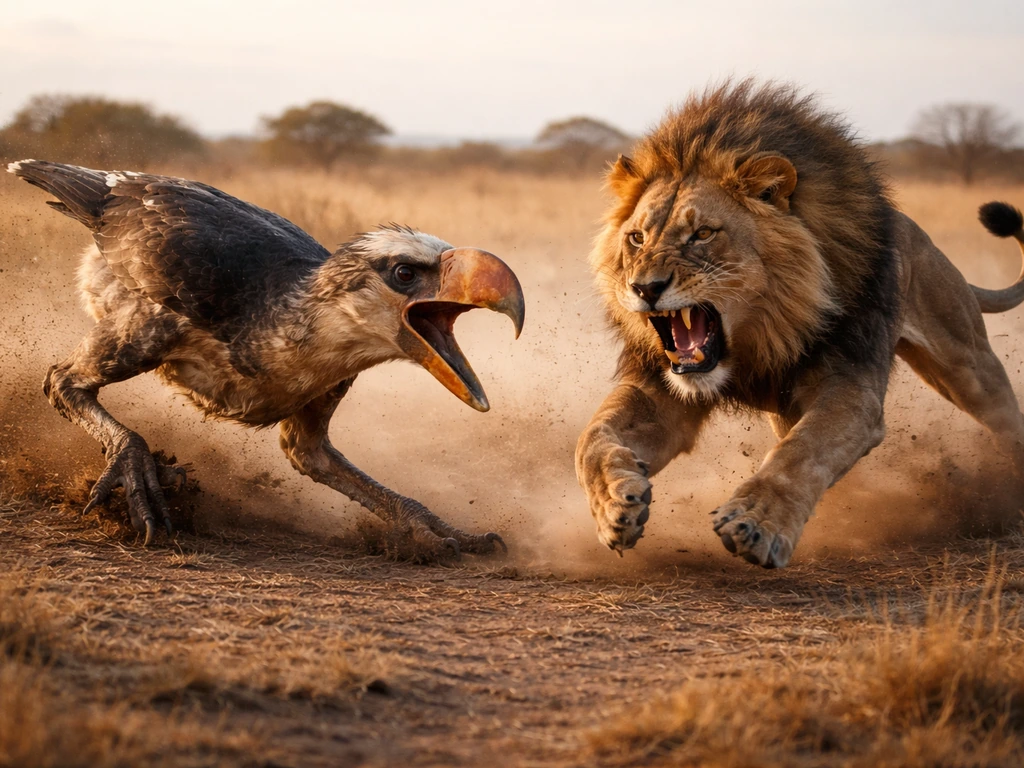
Under reasonable assumptions, a large terror bird (phorusrhacid) matching a lion one-on-one would be a genuinely dangerous contest, but a healthy adult male lion would most likely come out ahead. The lion's combination of grappling forelimbs, throat-clamping bite, and body mass gives it a decisive close-range advantage once it closes the distance. That said, the terror bird is not a pushover: its reinforced beak, powerful neck strike mechanics, and speed make it a serious threat, and the outcome shifts depending heavily on the specific species, terrain, and distance at the start of the encounter. Here is the full breakdown.
Terror Bird vs Lion: Which Predator Was More Dangerous?

Marcus Hendricks
14 Jun 2026
What we are actually talking about: terror birds and lions
The first thing to get straight: 'terror bird' is not a single species. Phorusrhacidae is an entire family of extinct, mostly flightless, carnivorous birds that lived primarily in South America from roughly the Eocene through the Pleistocene. The group includes multiple genera of very different sizes, from relatively modest forms to giants like Kelenken, which had one of the largest skulls of any known bird, and Titanis walleri, a North American species related to the South American giants.
Titanis is described as a late member of the terror-bird group with anatomy closely similar to some large South American forms, and it is often treated as comparable in size to Phorusrhacos-related forms despite uncertainty from fragmentary remains Titanis walleri, a North American species related to the South American giants. Some estimates for the largest phorusrhacids push body mass up to around 350 kg in fragmentary specimens, though most well-studied species fall in a much lower range.
The critical point: when people picture a 'terror bird,' they are usually imagining one of the larger, heavily built genera, and that is the version this comparison focuses on.
A lion (Panthera leo) is a modern big cat and one of the best-studied apex predators on Earth. Adult males typically weigh 170 to 230 kg, adult females 120 to 180 kg. Lions are social animals that often hunt in groups, but their coordination is less intentionally strategic than popular culture suggests. Research from The Lion Center at the University of Minnesota has pointed out that lions are not as deliberately cooperative as the classic 'teamwork predator' narrative implies. For this comparison, we are treating a single adult lion in a one-on-one encounter.
Beak and claws versus teeth and paws: the weapons breakdown
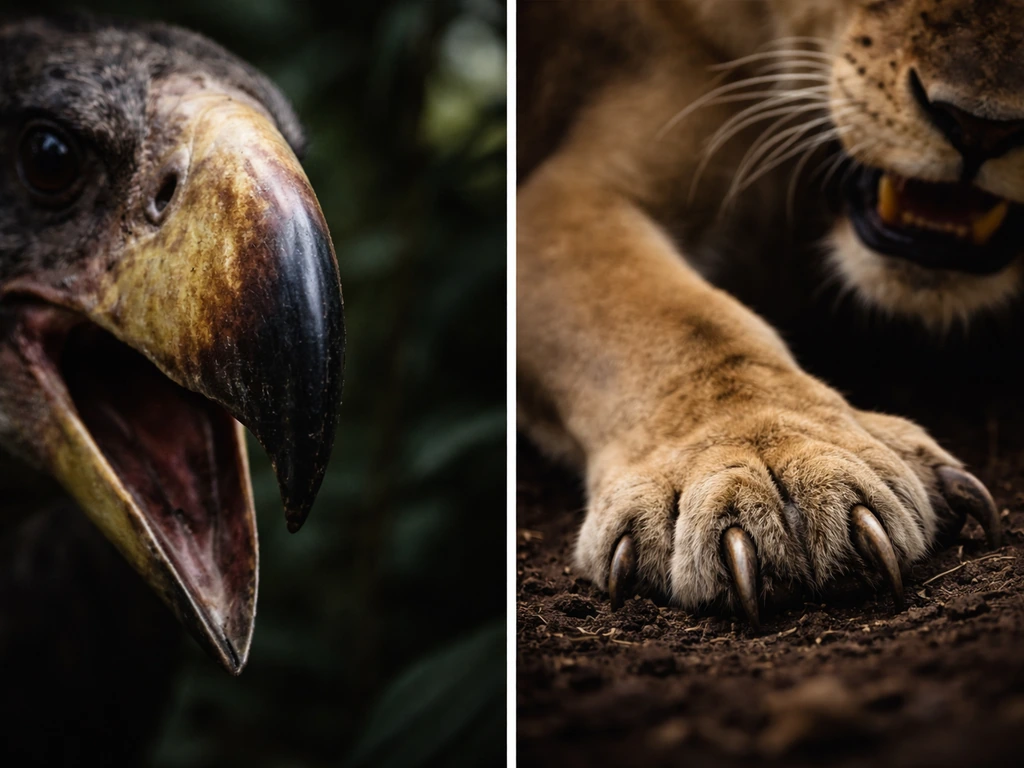
The terror bird's primary weapon is its beak: a deeply hooked, laterally compressed structure reinforced for powerful strike mechanics. Biomechanical studies, including finite-element analysis on Andalgalornis steulleti, show the skull was built to transmit large forces during feeding strikes while minimizing stress fractures. The working hypothesis, supported by skull reinforcement and neck anatomy, is a powerful downward hatchet-style strike, driving the hooked tip into prey. The neck musculature backing those strikes would have been substantial. The feet had sharp talons as well, and as a biped the terror bird could deliver powerful kicks, though its feet were more adapted for running than raking like a raptor.
The lion's weapon suite is more varied. It has retractable claws kept razor-sharp by the hyper-retractile mechanism all felids share, powerful forelimbs capable of grabbing and pinning prey, and a well-documented killing bite: a clamping hold on the throat or muzzle that suffocates or crushes. Lion bite force is estimated in the range of several hundred Newtons, with specific numbers varying by methodology, but what matters functionally is that the bite is sustained and targeted at vulnerable anatomy. Against large prey, lions shift to throat crushing and suffocation rather than a single killing strike. Those forelimbs, though, are what the lion uses first: pulling prey down and holding it in place while the kill bite is applied.
| Feature | Terror Bird (large phorusrhacid) | Lion (adult male) |
|---|---|---|
| Primary weapon | Hooked, reinforced beak (hatchet-style strike) | Retractable claws + sustained throat/muzzle bite |
| Secondary weapons | Powerful kicks, taloned feet | Forelimb grappling and pinning |
| Bite/strike delivery | Rapid downward strikes, inferred from skull mechanics | Clamping, sustained hold on throat or muzzle |
| Defensive capability | Speed, reach from height | Thick mane (males), powerful forelimbs to deflect |
| Grappling ability | Very limited (no forelimbs for grappling) | High: forelimbs and bodyweight used together |
Size, strength, and how each animal moves
Terror birds were bipedal and built for running. Hind-limb morphometry studies classify larger phorusrhacids as strongly cursorial, meaning their limb proportions are adapted for fast, sustained ground movement rather than power-based grappling or climbing. The giant genera had long, slender hindlimb elements that suggest decent speed, though modeling varies. A 2022 study of well-preserved trackways in Argentina estimated one individual's hip height at about 0.81 meters and its walking/running speed at the time of trackmaking at roughly 2.74 m/s (about 9.9 km/h). Maximum modeled speeds for larger species are debated, but the animals were clearly built to cover ground quickly. They were also tall: some estimates place the largest species at around 3 meters in height.
The lion is a burst-speed predator. It is not a long-distance endurance runner but is capable of explosive acceleration over short distances. A 2013 Nature study on biomechanics in predator-prey systems quantified lion locomotor capacity in terms of acceleration, deceleration, and muscle-fiber power output, showing that lions are optimized for a short, powerful final rush followed by a tackle. They are quadrupedal, low to the ground, and their bodyweight, roughly 170 to 230 kg in males, is distributed across four limbs with powerful hindquarters driving the charge.
| Attribute | Terror Bird (large species) | Adult Male Lion |
|---|---|---|
| Typical body mass | ~130–350 kg (varies widely by genus, uncertain for largest) | ~170–230 kg |
| Height/build | Up to ~3 m tall, slender-legged biped | ~1.2 m at shoulder, muscular quadruped |
| Locomotion type | Bipedal, cursorial (built for running) | Quadrupedal, burst-speed predator |
| Sustained speed | Moderate (trackway evidence: ~10 km/h observed) | Not a long-distance runner; built for short rush |
| Gait advantage | Reach, height, kick delivery | Low center of gravity, tackling bodyweight |
How each animal actually hunted
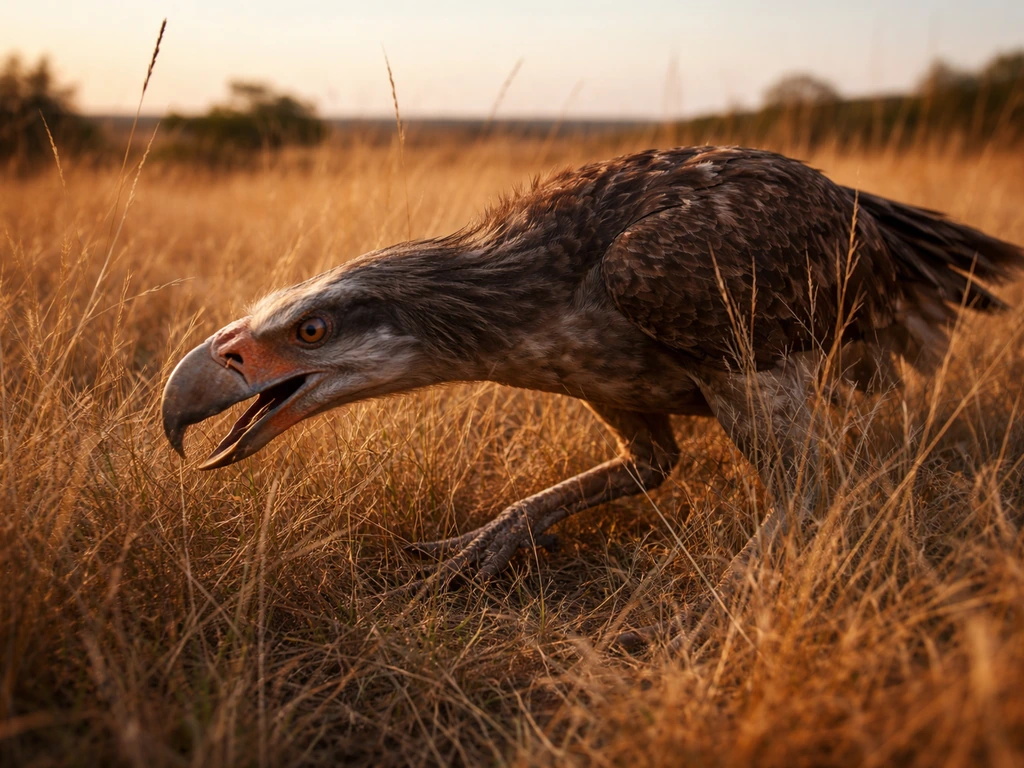
Terror birds are inferred to have been active predators of large mammals, based on fossil context and ecological reconstruction. The biomechanical evidence for their hunting method points toward a strike-and-retreat approach rather than sustained wrestling. The skull of Andalgalornis, for example, was reinforced against torsional forces but showed weaker lateral resistance, suggesting the bird drove its beak downward repeatedly rather than grappling side-to-side or shaking prey like a crocodile. Think repeated hatchet blows rather than a sustained clamp. This is inference from bone mechanics, not direct observation, and it is important to be honest about that limitation.
Lions hunt with a well-documented sequence: stalk to close range, short explosive rush, leap onto prey from behind or the side, forelimbs grapple and pull the animal down, and then a sustained bite to the throat or muzzle until the prey suffocates or its airway collapses. For smaller prey, the kill is faster. Against prey their own size or larger, suffocation is the primary mechanism. This strategy is heavily dependent on getting close and getting a grip. Once a lion has a hold, it is very difficult for the prey animal to escape.
What changes the outcome: distance, terrain, and starting conditions
This is where most versus-match arguments break down, because the answer genuinely depends on the scenario. A few key variables matter a lot here.
- Starting distance: If the terror bird has room to land repeated beak strikes before the lion closes in, it is far more dangerous. If the lion gets the initial charge and manages to grab and pull the bird down, the terror bird's lack of forelimbs becomes a critical disadvantage.
- Terrain: Open flat ground favors the terror bird's speed and reach. Dense cover, rocky terrain, or confined space favors the lion's grappling style.
- Species specifics: A smaller phorusrhacid, say around 130 kg, versus a large male lion is a very different fight than a 350 kg giant against a lioness. These are not the same matchup.
- Behavior assumptions: If you allow lion group hunting, the terror bird loses badly. Lions are not always coordinated, but even loose group pressure overwhelms a lone bird.
- Injury threshold: The terror bird's legs are its engine. A lion that targets a leg with claw rakes could immobilize the bird. The bird's beak striking the lion's mane-protected neck may reduce lethality compared to a cleaner strike on the skull or spine.
There is also the honest problem that this is a prehistoric-versus-modern matchup. We cannot run the experiment. The terror bird's behavior is reconstructed from bone mechanics and fossil context, not observation. Any absolute answer is built on inference, and you should weight it accordingly.
Who would most likely win, and why the answer comes with caveats
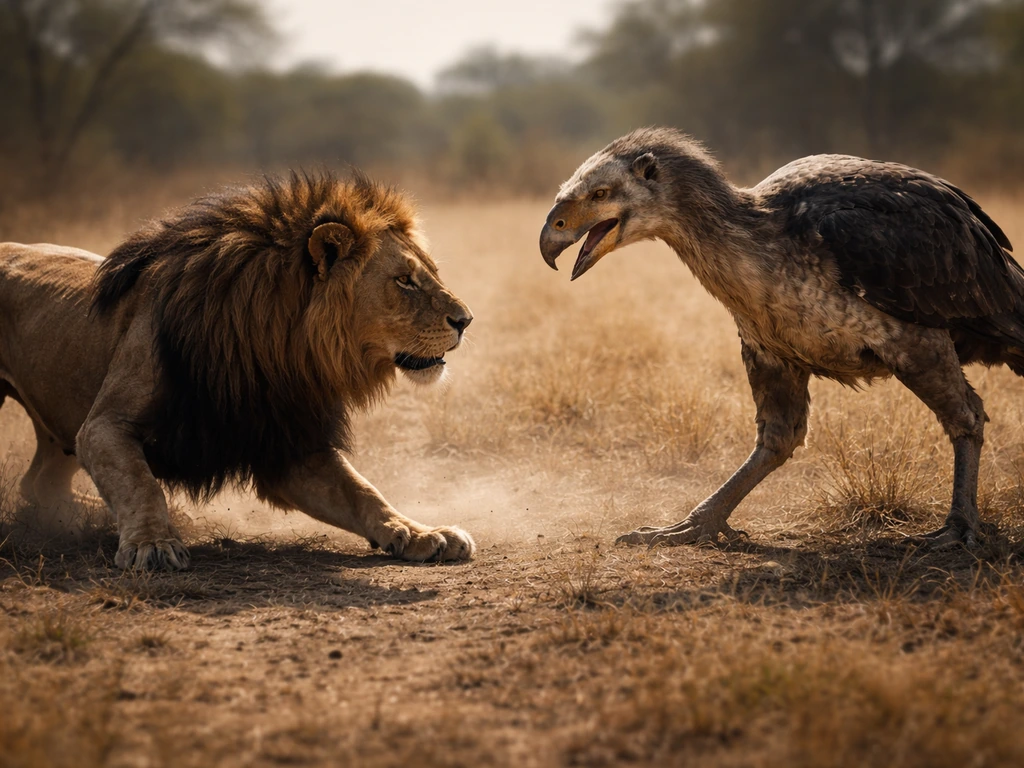
Taking a large terror bird (in the 150 to 200 kg range) against a single adult male lion on open ground with neither animal having a major head start: the lion is the more likely winner, but not by a wide margin. The terror bird has real advantages: it is potentially as heavy or heavier, it is tall (giving it strike range from above), its beak strikes could be lethal if they land on vulnerable areas, and it is fast enough that the lion cannot simply ignore it. In a contest where the bird lands several clean downward beak strikes before the lion closes, the bird could critically injure or kill the lion.
But the lion's path to winning is more reliable. If the lion can close the distance and get its forelimbs on the bird, the terror bird has almost no way to break the grip. It has no forelimbs to push away with, and its kicks, while powerful, are harder to deliver once it is being pulled sideways or down. Once the lion applies its throat bite, the outcome is essentially determined. The lion's mane also provides some protection against beak strikes to the neck. The terror bird's skull mechanics suggest it was better at a strike-and-step-back pattern than sustained ground wrestling, and on the ground next to a 200 kg cat with gripping forelimbs, that pattern becomes hard to execute.
If you scale up to a 300 to 350 kg terror bird against a single lion, the math shifts somewhat. Raw mass matters, and a bird that large can deliver enormous force in a single strike. Against a lioness rather than a large male, the bird's chances improve further. Against two or more lions, the bird loses.
The comparison to other prehistoric opponents is interesting context: terror birds share a rough ecological role with animals like Smilodon (comparing these two is its own discussion) and faced competition or coexistence with predators in shifting South American ecosystems as the Americas connected. How they would have fared against pack predators like wolves is a related question worth thinking about alongside this one. That brings up the common question of how terror birds might have fared against wolves.
Common misconceptions worth clearing up
- Terror bird is not one species: Phorusrhacidae is a whole family with dozens of genera spanning tens of millions of years. Size, limb proportions, and skull mechanics vary significantly across species.
- Flightless does not mean weak or slow: Terror birds were cursorial predators. Their locomotion was built around running, not weakness. They were the dominant large predators in South America for millions of years.
- The beak was not a biting weapon the way a carnivore's jaw is: Biomechanical studies suggest repeated downward strikes rather than sustained clamping. The skull resisted torsion poorly, meaning lateral twisting force during a grapple could be dangerous for the bird.
- Lions are not always coordinated pack hunters: Research shows lion group hunting is less intentionally strategic than popular accounts suggest. A single lion is still a formidable opponent, but assuming perfectly coordinated pride teamwork inflates the lion's advantage unfairly.
- Mass alone does not decide the winner: A heavier terror bird does not automatically win. Weapon delivery, grappling ability, and vulnerability of key anatomy all matter more than raw weight.
Quick reference: terror bird vs lion at a glance
Use this checklist to remember the key differences and evaluate the matchup yourself. If you are also looking for tiger and bird K-pop demon hunters meaning, it helps to separate the mythic wording from the specific references people are remixing or parodying. If you are also curious about how the weapons and size translate against a short-faced bear, the same scenario logic applies terror bird vs lion at a glance.
- Terror bird = prehistoric, bipedal, mostly flightless, carnivorous. Lion = modern, quadrupedal, social big cat.
- Terror bird's weapon: hooked, reinforced beak delivering repeated downward strikes plus powerful kicks. Lion's weapons: retractable claws for grappling plus a sustained throat/muzzle clamping bite.
- Terror bird moves by running fast on two legs. Lion uses burst acceleration on four legs to close distance quickly.
- Terror bird hunts by striking and retreating (inferred). Lion hunts by stalking, rushing, grabbing, and suffocating.
- Terror bird has no forelimbs. This is its single biggest disadvantage in close-quarters fighting against a grappling predator.
- Lion wins most reliably by closing distance, grappling, and applying the throat bite before absorbing too many beak strikes.
- Terror bird wins most reliably by maintaining distance, landing clean skull or spine strikes, and avoiding being pulled to the ground.
- Larger terror bird species (300+ kg) versus a single lioness: much closer contest, possible bird advantage.
- Standard large terror bird (150–200 kg) versus adult male lion, open terrain: lion is the likely but not certain winner.
- Both animals' exact capabilities involve real scientific uncertainty. No reconstruction of terror bird behavior is based on direct observation.
FAQ
How does the matchup change if the terror bird has a height or reach advantage, like being on uneven terrain or starting downhill?
Extra reach helps the bird land downward beak strikes before the lion can close, but it mainly buys time. If the lion still gets forelimbs on the bird’s body, the beak advantage drops quickly because the bird cannot reliably keep stepping back while pinned or pulled sideways.
Does the lion’s mane meaningfully protect it during beak attacks, or is it mostly cosmetic in this kind of fight?
It likely helps more against superficial neck punctures and some glancing strikes, but a lethal beak blow would not need to go deep. If the beak hits the face, throat opening, or muzzle, the mane offers much less practical protection.
Which is more decisive in practice, mass or weapon design, between a smaller terror bird and a larger one?
Mass increases the force of single strikes, but weapon design decides whether those strikes can land before the cat closes. A smaller bird can still threaten if it connects early, while a larger bird mostly improves outcomes when it is able to delay the grapple long enough to land multiple clean hits.
How much do assumptions about hunting style matter, for example strike-and-retreat versus attempted grappling?
They matter a lot. The article’s logic assumes the terror bird is better at repeated downward strikes than sustained wrestling. If you instead assume it could grapple effectively, the lion’s “close distance equals near-deterministic win” advantage would be reduced, because the lion would have to fight in a different mechanical regime.
If we swap in a lioness instead of an adult male, what changes besides raw size?
Lower mass reduces the lioness’s momentum in a tackle and likely changes how easily it can overpower and pin. That makes it slightly easier for the bird to keep striking at range, but the core requirement remains the same, the lion still needs to get forelimbs on the bird to switch the fight to a throat-bite scenario.
Would claws give the lion a big advantage immediately, even against a beak-focused opponent?
Claws matter mainly once contact happens. The key is that the lion has retractable grasping tools and a forelimb pinning sequence, which makes it hard for a biped bird to disengage after the first successful grab.
Could the terror bird win if it attacks from the side or from behind rather than facing the lion head-on?
Attacking laterally or from behind makes it more likely to land a first strike or two while the lion is still turning to establish a grip. But if the lion gets its muzzle and forelimbs wrapped around the bird, the bird’s limited ability to push away or climb back to safe distance becomes the limiting factor.
What changes if lions fight as a group, even though this comparison assumes one-on-one combat?
Multiple lions dramatically shift the outcome because the terror bird cannot afford missed or delayed grapples against one. One lion can force contact while the others cover escape angles, which directly counters the bird’s likely strike-and-step-back strategy.
How sensitive is the predicted winner to the “start distance” between them?
Extremely. The lion’s plan depends on accelerating in and getting a grip, while the bird’s plan depends on landing strikes before that happens. Even a small initial gap can favor the bird if it allows one or more clean beak hits, but once the distance collapses, the lion’s lock-in sequence dominates.
Are there any realistic ways the terror bird could protect itself against a throat-bite attempt?
Since the bird lacks forelimbs designed for counter-grappling, practical options are limited to keeping the neck out of the clamp’s angle and using space to avoid prolonged close contact. If pinned or dragged into a position where the lion’s muzzle targets the throat, successful defense becomes unlikely.
How should I compare this to other matchups like terror bird versus wolves without mixing up assumptions?
Use the same framework: who can close distance and who can land repeated damaging strikes before being pinned. Wolves are less built for the same single, decisive throat-bite mechanism, so the “close and clamp” rule may not apply the same way, but the “ability to keep enemies at striking range” still does.
Next Article
Godzilla vs Kong Bird: Identify the Exact Bird Lookalike
Disambiguate and ID the exact bird behind searches like Godzilla vs Kong bird using field marks, habitat, range, behavio