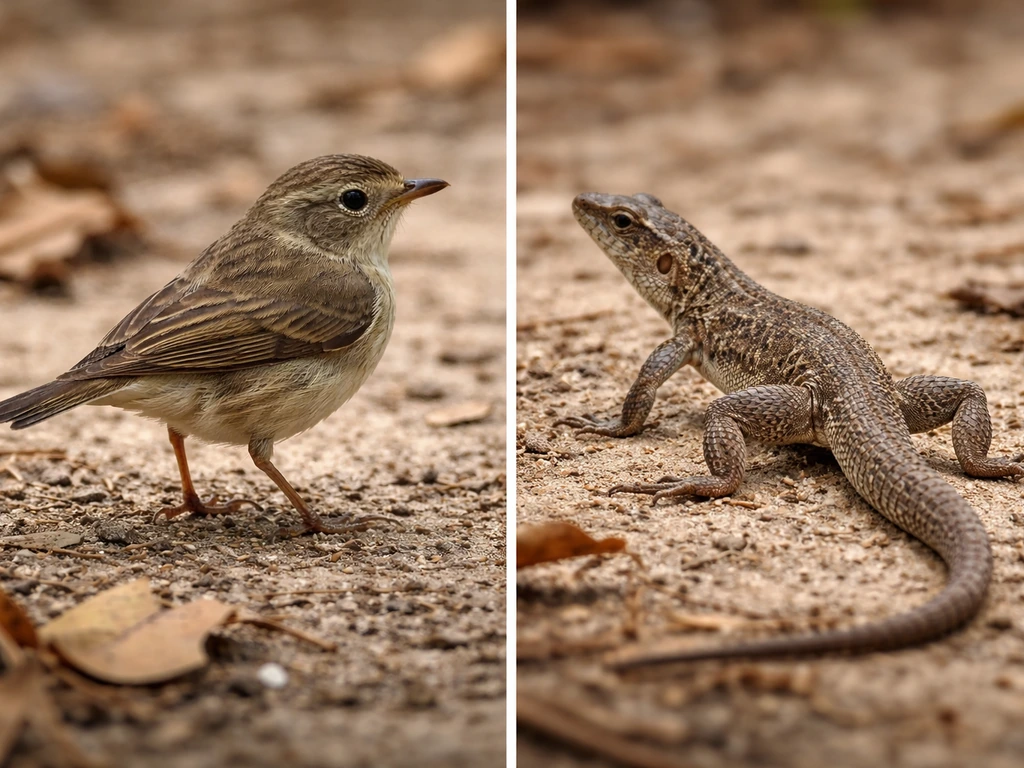
Birds are living dinosaurs, specifically a surviving lineage of theropod dinosaurs, and their skeletons carry the evidence. When you compare a modern bird skeleton to a non-avian theropod like Velociraptor or Allosaurus, you're looking at roughly 230 million years of shared ancestry interrupted by about 66 million years of flight-driven modification. The reliable comparison workflow is this: first identify the traits both groups share (furcula, antorbital fenestra, hollow bones, three-toed feet), then isolate the features that birds developed exclusively for powered flight (keeled sternum, fused pygostyle tail, fused wing bones, fused ankle), and finally watch out for the half-dozen misconceptions that trip up almost everyone doing this online.
Bird Dinosaur Skeleton Comparison: What to Look For Bone by Bone

Why this comparison actually matters
Most people come to this comparison from one of three directions: they're museum-going and want to understand what they're looking at, they're studying evolutionary biology and need a practical anatomy anchor, or they've seen a viral image of a bird skeleton next to a T. rex and want to know if it's real. All three are valid, and the answer to each is the same: the skeletal evidence for birds being theropod descendants isn't just one or two features, it runs through essentially every part of the body plan. This isn't a convenient story told around feathers. The bones themselves tell it, and understanding what you're looking for lets you read that story directly from museum displays, fossil photos, or comparative anatomy diagrams without needing a PhD.
There's also a practical identification payoff here. Sites like this one are built on the idea that side-by-side comparison resolves confusion. The bird-dinosaur skeleton comparison is one of the best examples of that principle in all of biology: the features that look similar between a crow and a Velociraptor are genuinely homologous (inherited from a common ancestor), while the features that look different reflect real functional divergence driven by flight. Learning to tell those two categories apart is the whole game.
The high-level map: what's shared and what's changed
Before going bone by bone, it helps to have a map. Think of the bird skeleton as a theropod skeleton that's been heavily modified in five specific regions: the tail, the chest, the forelimbs, the wrist and hand, and the ankle and foot. Everything else is either conserved from theropod ancestry or changed in comparatively minor ways. Here's the high-level checklist, split by category:
| Skeletal region | Shared with theropods | Bird-specific modification |
|---|---|---|
| Skull | Antorbital fenestra, lightweight cranial bones | Toothless beak (edentulous jaws) in modern birds |
| Vertebrae (neck/back) | Hollow (pneumatized) vertebrae | More extensive pneumatization; cervicals highly mobile |
| Tail | Multiple free caudal vertebrae in theropods | Terminal caudals fused into a pygostyle; total count reduced |
| Pelvis | Open acetabulum, three-toed stance | Vertebrae fused into synsacrum with pelvic girdle |
| Ribs | Uncinate processes present in maniraptorans | Uncinate processes standardized for bellows-style breathing |
| Sternum | Variable; absent or unossified in many theropods | Large keeled sternum (carina) for flight muscle attachment |
| Furcula (wishbone) | Present in many theropods including Velociraptor | Conserved in all modern birds; shape varies |
| Forelimbs | Three functional digits, elongated arms in some lineages | Carpometacarpus (fused wrist-palm), digit reduction, feather anchors |
| Hindlimbs | Three main forward-pointing toes, digitigrade stance | Tibiotarsus and tarsometatarsus fusions; reversed first digit |
The takeaway from this map: if you're looking at a skeleton and you see a keeled sternum, a pygostyle, a carpometacarpus, and fused ankle bones, you're looking at a bird or a close bird ancestor. If you see some of those features but not others, you're likely looking at a transitional taxon or an early avialian. And if you see none of them but still see a furcula and antorbital fenestra, you're probably looking at a non-avian theropod.
How the bird skeleton is adapted for flight
Flight doesn't just require wings. It requires a completely restructured body that can transfer massive muscular force, handle the stress of landing, and stay as light as possible while doing both. The bird skeleton solves this through three strategies: fusion (replacing many loose bones with rigid units), pneumatization (hollowing bones with air sacs connected to the respiratory system), and geometry (reshaping bones into levers and anchors tuned for flight mechanics).
The most visible fusion is the keeled sternum. Flying birds have a median bony projection called the carina running down the center of the sternum. This is where the pectoralis and supracoracoideus muscles (the two major flight muscles) attach. Without the keel, there's not enough surface area to anchor the muscles needed for powered flight. Flightless birds like ostriches and emus have flat sternums, which is a useful check: a keeled sternum specifically signals powered flight capability, not just bird identity.
The second major flight adaptation is pneumatization of the skeleton. Birds pump air-sac extensions into their vertebrae, pelvic girdle, sternum, and even some limb bones. This is visible in cross-section as a trabecular (lattice-like) interior rather than a marrow-filled cavity. Many theropods already had hollow bones, which is why this feature alone doesn't separate birds from non-avian relatives. But in birds, the pneumatization system is more extensive and directly connected to the respiratory mechanics.
The third adaptation is the fused hindlimb. Birds absorb landing impact through a combination of the tibiotarsus (tibia fused to the proximal tarsal bones) and the tarsometatarsus (metatarsals 2 through 4 fused to the distal tarsal bone). These fusions create a rigid column for absorbing force during perching and landing while also reducing the number of movable joints (and therefore the number of ways the foot can fail under load). Digit I (the hallux) is reversed in most perching birds, pointing backward to complete the grip.
Bone by bone: exactly what to look for
Skull
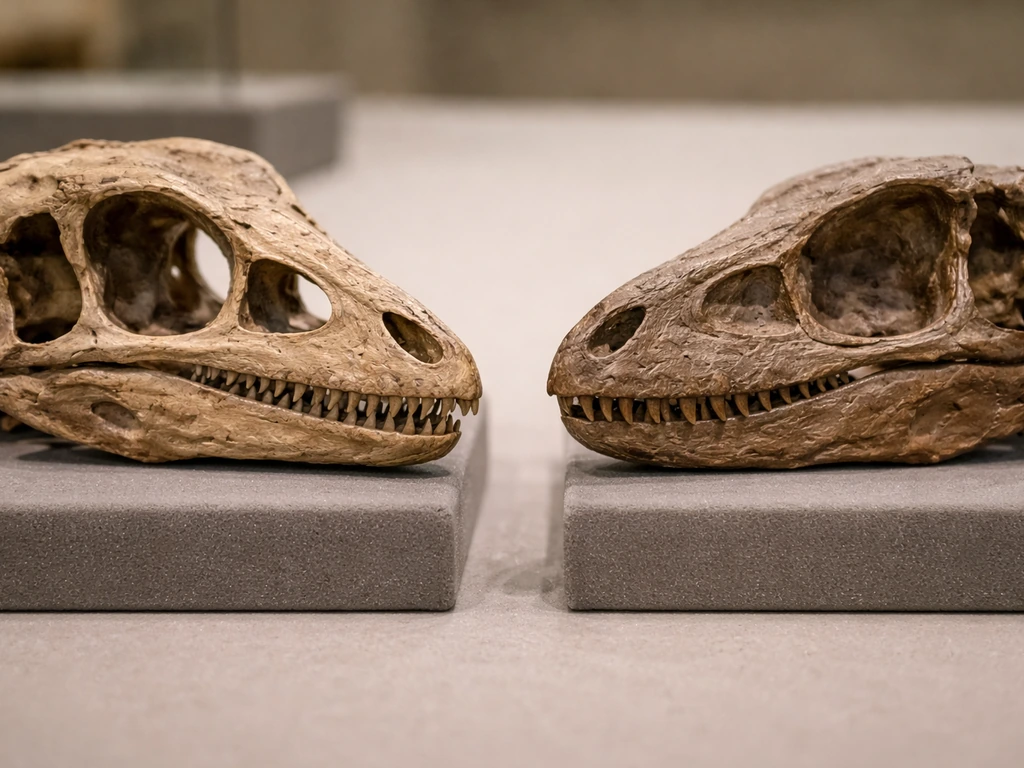
Look for the antorbital fenestra, the opening in the skull in front of the eye socket. Birds retain this as one of the few living archosaurs that do; crocodylians have lost it. Its presence in theropod skulls is one of the clearest shared-ancestry markers you can spot in a side-by-side comparison. Modern birds also have toothless beaks, but the transition was gradual: early birds and many theropods had teeth, and the repeated evolution of beak-like structures across the theropod-to-bird transition involved multiple reductions in tooth development over evolutionary time. When you see a fossil skull with partial teeth and an antorbital fenestra, you're likely in that transitional zone.
Vertebrae
Bird neck vertebrae are highly mobile and often heavily pneumatized. Moving toward the back, the vertebrae become progressively fused. The synsacrum is the key landmark here: it's a rigid block formed by the fusion of multiple thoracic, lumbar, and sacral vertebrae into a single unit that's also fused to the pelvic girdle. This creates a structurally rigid core, very different from the more flexible vertebral column of generalized reptiles. Theropods had a sacrum, but the fully fused synsacrum is a bird-exclusive feature. Posteriorly, free caudal (tail) vertebrae remain in birds before the tail ends in the pygostyle.
Tail
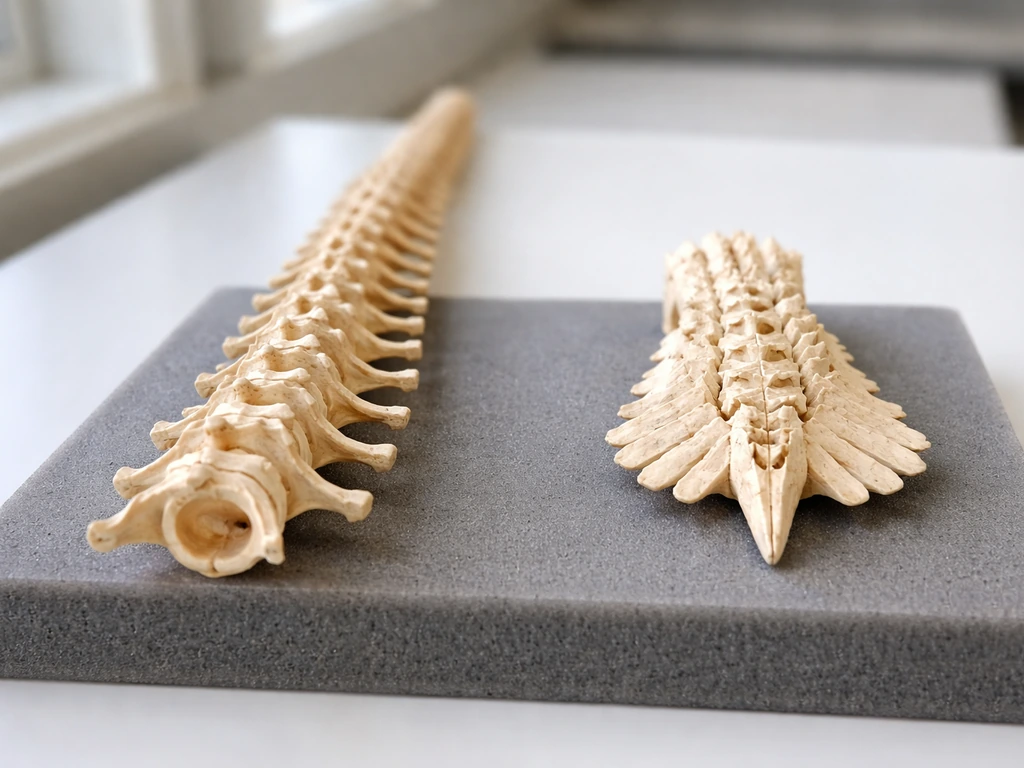
This is one of the clearest markers in the whole comparison. Non-avian theropods had long tails with many free vertebrae. Modern birds have drastically shortened tails where the terminal vertebrae are fused into the pygostyle, a ploughshare-shaped bone that anchors the tail feathers. The number of free caudal vertebrae is reduced, and the vertebral bodies themselves are shortened. One useful reality check: bird embryos actually develop longer caudal vertebrae early in development before they later fuse and shorten into the adult pygostyle. This means juvenile or partially developed specimens can look less bird-like in this region than adults.
Ribs and sternum
On the ribs, look for uncinate processes: flat, backward-pointing bony spurs projecting from the ribs. The uncinate processes on bird thoracic ribs are linked to avian-style bellows mechanics, and homologs have been reported in maniraptoran dinosaurs. These are a bird hallmark in most anatomy guides, but they also appear in non-avian maniraptoran dinosaurs, which tells you they evolved before flight as part of a shift toward avian-style breathing mechanics. Their presence in a fossil is a clue to maniraptoran affinity, not bird-exclusive status. The sternum is a different story: the keeled sternum with its carina is genuinely bird-specific for powered flight. Archaeopteryx and some very early avialians show little or no ossified sternum, which reinforces that the fully developed keel is a later evolution within the bird lineage, not something inherited directly from non-avian theropods.
Furcula (wishbone)
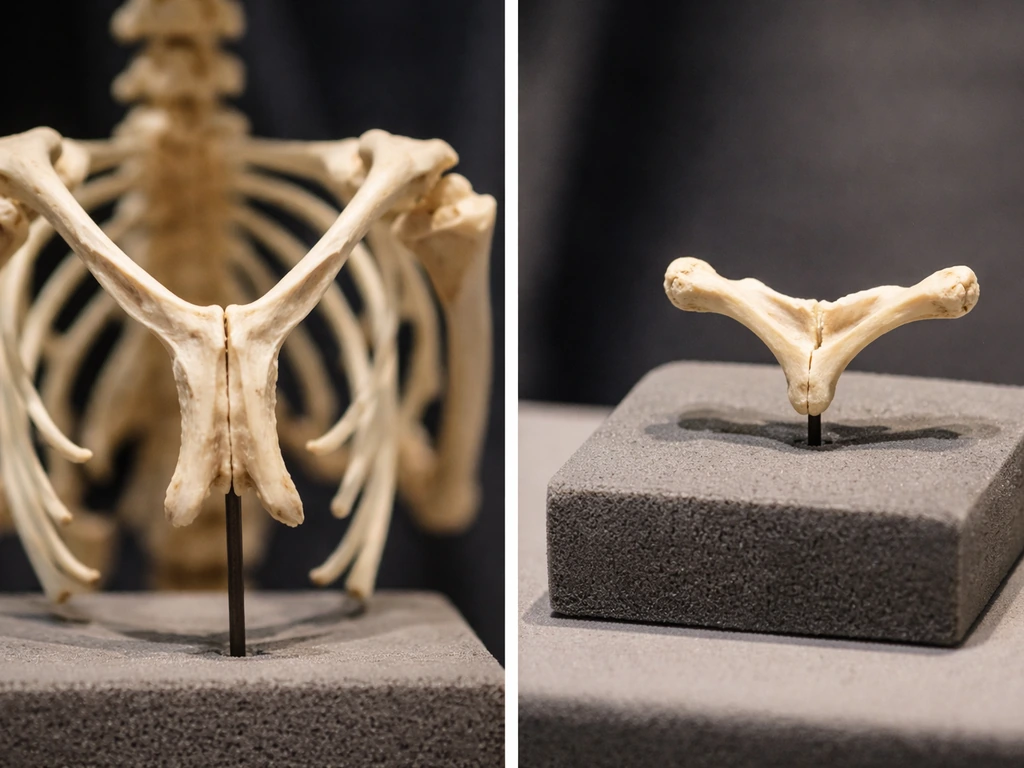
The furcula is formed by the midline fusion of the two clavicles. It's present in all modern birds and has been found in numerous theropod dinosaurs including Velociraptor. This makes it a shared derived character pointing to theropod ancestry, but not a bird-exclusive one. You cannot use furcula presence alone to call something a bird. Conversely, a fossil that preserves a furcula is almost certainly in the theropod lineage rather than some other archosaur group.
Wings and forelimbs
The most distinctive wing bone is the carpometacarpus, a fused unit formed from the carpal (wrist) and metacarpal (palm) bones. This forms the main supporting structure of the outer wing. Theropod forelimbs have separate carpals and metacarpals, so the fused carpometacarpus is specifically avian. Digit reduction is also key: bird wings have reduced the number of functional digits and largely lost the functional claws present in theropod hands. Elbow and wrist motion in birds is also constrained to a single plane, an adaptation for the folding-unfolding mechanics of the wing during flight. When you see a theropod forelimb with long independent digits ending in claws versus a bird wing with a fused wrist-palm and minimal digit bones, you're seeing roughly 80 million years of forelimb transformation.
Pelvis and hindlimbs
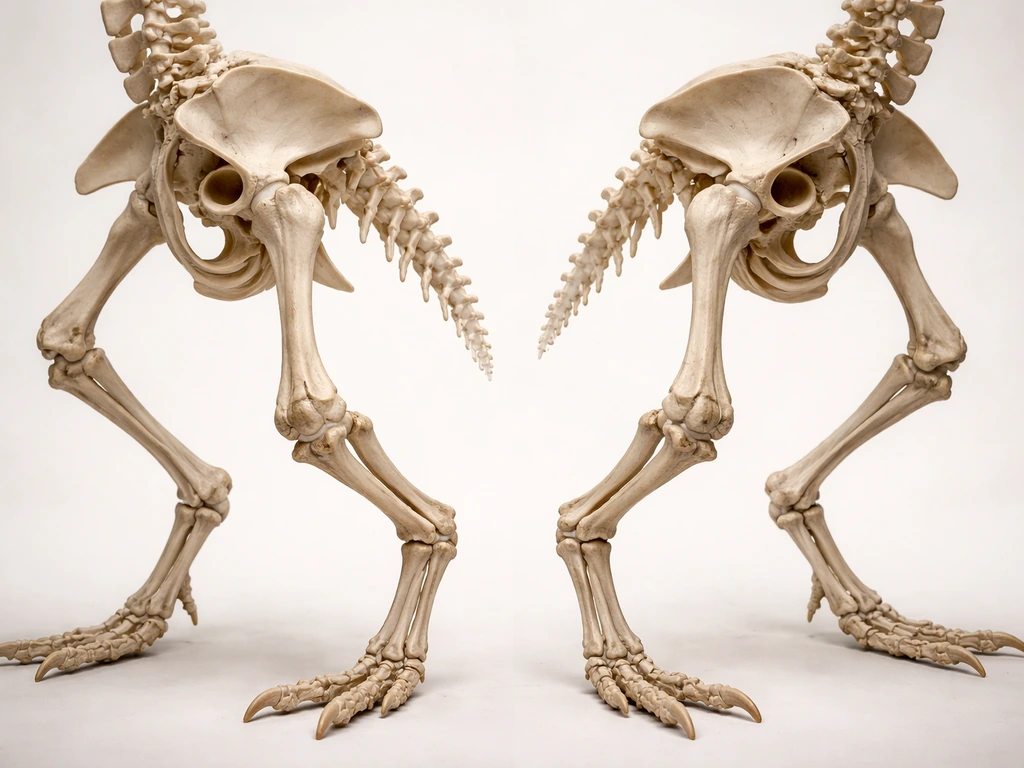
Birds and theropods both have an open acetabulum (the hip socket is perforated rather than closed), and both walk on three main forward-pointing toes in a digitigrade stance. The difference is in how the ankle is built. Birds have the tibiotarsus and tarsometatarsus fusions described above, creating a distinctive intertarsal joint that theropods lack in fully fused form. The pelvis itself is anchored into the synsacrum in birds, making the whole pelvic region a single rigid block. Theropods have a sacrum but not the full synsacrum fusion. If you're comparing hip anatomy more broadly, the relationship between bird hip and lizard hip structures is a related distinction worth exploring separately, since archosaur and lepidosaur pelvic anatomy diverged well before the theropod-bird transition. For a deeper look at what changes in the pelvic structure, see bird hip vs lizard hip.
Common confusion points and false matches to avoid
The biggest mistake beginners make is treating any one feature as a definitive bird marker. Here are the specific false matches that come up most often:
- Furcula equals bird: Wrong. Velociraptor had a furcula. So did many other theropods. A wishbone means you're looking at a theropod-lineage animal, not necessarily a bird.
- Uncinate processes equal bird: Also wrong. Non-avian maniraptorans had them too, likely for similar breathing mechanics. Their presence supports theropod affinity but doesn't confirm avian status.
- Hollow bones equal bird: Hollow (pneumatized) bones appear throughout theropods and even in some sauropods. Birds carry this further, but hollow bones alone don't separate birds from non-avian relatives.
- All dinosaurs looked bird-like: Only the maniraptoran theropods (Velociraptor, Deinonychus, Troodon, and their relatives) get genuinely close. Sauropods, ceratopsians, ankylosaurs, and stegosaurs look essentially nothing like birds skeletally.
- Fused bones always mean bird: Some fusions (furcula, partial skull fusions) appear in non-avian theropods. The specifically avian fusions are the pygostyle, synsacrum, carpometacarpus, tibiotarsus, and tarsometatarsus. Check which bones are fused, not just that fusion occurred.
- Reconstructions are always accurate: Online skeletal reconstructions and museum mounts vary in accuracy, especially for early birds and transitional fossils. Incomplete fossils get filled in by artists, and some reconstructions reflect older interpretations. Always check whether the sternum, furcula, or small hand bones are reconstructed versus directly fossilized.
- Juveniles look different: Bird juvenile skeletons have longer, less-fused caudal vertebrae before the pygostyle fully forms. A young bird skeleton can look more 'dinosaurian' in the tail region than an adult, so age of specimen matters when comparing.
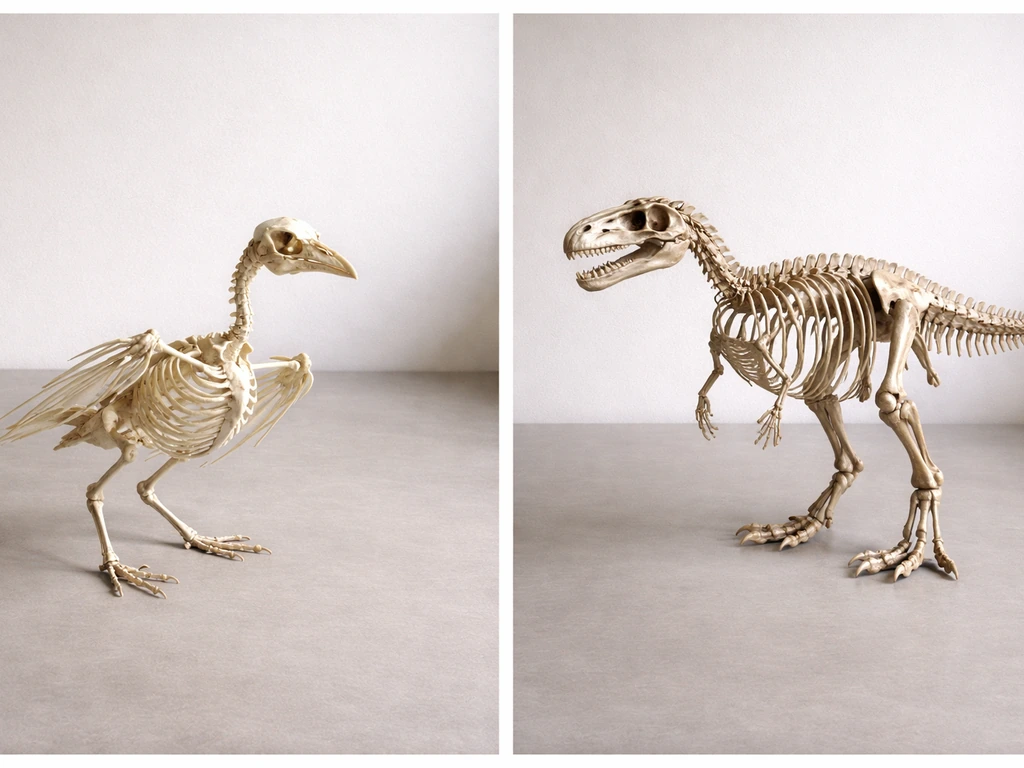
A related confusion point involves the T. rex comparison specifically. A clear way to understand the difference is to look at the bird skeleton versus T-rex skeleton side by side and compare the flight-related features birds uniquely carry T. rex comparison specifically. T. rex is a tyrannosaurid theropod, not a maniraptoran, so it's actually less closely related to birds than Velociraptor or Deinonychus are. The T. rex skeleton shares the broad theropod blueprint with birds (bipedal, hollow bones, three-toed feet, antorbital fenestra) but lacks the derived maniraptoran features like the semilunate carpal that allowed the bird-line wrist to evolve. Mixing up the T. rex comparison with the general theropod-to-bird comparison is a very common online error.
How to actually verify this yourself: fossils, references, and images
The best starting point for hands-on verification is the Smithsonian National Museum of Natural History's online fossil collections and the American Museum of Natural History's digital resources, both of which provide labeled skeletal diagrams and specimen photos. For comparative anatomy diagrams specifically, the Palaeontological Association and open-access paleontology journals regularly publish labeled skeletal reconstructions that identify which bones are directly preserved versus inferred. Always read the figure captions: they usually tell you what's real and what's filled in.
When you're working with museum photos or online images, use this practical workflow. First, identify the tail: is there a clear pygostyle, or a long string of free caudals? This single check immediately separates modern birds from nearly all non-avian theropods. Second, look at the sternum from the side: is there a visible keel? If yes, and the tail also has a pygostyle, you're almost certainly looking at a flying bird or its close ancestor. Third, check the ankle region for the tarsometatarsus fusion. If all three are present, you have a modern-style bird skeleton. If one or two are absent or ambiguous, you're likely in transitional territory, which is actually the most interesting comparison to make.
For peer-reviewed sources, the journal Palaeontologia Electronica publishes open-access comparative skeletal studies, and PubMed has free access to many key papers on avian skeletal evolution including studies on pygostyle development, furcula evolution, and maniraptoran breathing mechanics. When a claim about a specific feature (like 'Velociraptor had a furcula') is debated online, the primary literature is where you settle it. The furcula claim, for example, is backed by a direct Nature paper from the 1990s describing the actual specimen.
One more practical tip: use multiple views of the same skeleton. A side-view photo of a bird skeleton won't show the keel well; you need a frontal or three-quarter view. A top-down view won't clearly show the pygostyle; you need lateral or slightly angled. Museum skeletal mounts are often positioned for dramatic effect rather than comparative clarity, so if you're using museum photos, supplement them with the museum's own published diagrams or accompanying labels.
Once you're comfortable with the core bird-versus-non-avian-theropod comparison, there's a lot of productive territory to explore nearby. The detailed side-by-side comparison of bird skeleton versus dinosaur skeleton anatomy, the specific T. rex versus bird skeleton contrast, and the broader bird versus dinosaur skeleton framing all build on the same checklist covered here. And if the pelvis section caught your attention, the comparison between bird hip and lizard hip anatomy opens up a completely separate thread about how archosaur pelvic evolution differs from the lizard line, which helps explain why birds and crocodilians are actually closer relatives than either is to any lizard.
FAQ
How can I tell whether a fossil skeleton is truly avian versus a maniraptoran dinosaur, even if I see a few “bird-like” features?
Don’t stop at one trait. Use a combined check: powered-flight markers together (keeled sternum with carina, pygostyle, fused wing wrist-palm unit, and the fused ankle forming the intertarsal joint). If only some flight-associated traits appear, you’re likely seeing a close non-avian relative, where features like uncinate processes or furcula can occur without the full flight suite.
If the sternum doesn’t show a keel, does that automatically mean the specimen is not a bird?
Not automatically. Some very early birds and early avialians have poorly ossified or incompletely preserved sternums, and fossils can be crushed or missing the relevant portion. Treat the keel as evidence when it’s clearly present, but when it’s absent or ambiguous, lean on corroborating regions like the pygostyle, carpometacarpus fusion, and hindlimb ankle fusions.
Why do juvenile specimens sometimes look less bird-like in tail anatomy?
Bird embryos and juveniles can temporarily develop longer free caudal vertebrae before the later fusion and shortening into the adult pygostyle. So a specimen with an extended tail may still be on the bird lineage if other adult-style synapomorphies are present (like the fused ankle and avian sternum region, if preserved).
Can I use furcula presence as a reliable “bird ID” test?
No. The furcula is shared among many theropods, including bird ancestors and some close non-avian relatives. Presence supports theropod affinity, but classification as bird or non-avian depends on additional derived traits like the avian carpometacarpus, pygostyle, and the fused ankle configuration.
What should I do if an online diagram shows a “reconstructed” bird skeleton that doesn’t match the fossil photo?
Check the figure caption and the line style. Reconstructions often infer missing bones, and inferred regions can look smoother or more “complete” than the original specimen. For accuracy, compare only bones you can confirm in the photo, then treat inferred areas as tentative.
How do I avoid confusing the T. rex and Velociraptor comparisons when learning bone-by-bone?
Use relationship context, not just “bird versus dinosaur.” T. rex is a tyrannosaurid theropod, not a close bird-line relative, so it can share only the general theropod blueprint. Velociraptor (and other maniraptorans) is more informative for bird ancestry because it overlaps with the derived traits that precede flight adaptations.
If I see hollow bones, does that automatically point to birds?
No. Many theropods already had pneumatic (hollow) bones, so hollow interior alone is not enough to separate birds from non-avian relatives. The stronger cue is how extensive the air-sac related pneumatization system is, plus the presence of the bird’s other flight-associated fusions and the flight-linked sternum and tail modifications.
What is a fast “three-step” workflow that works for most museum photos?
Start with the tail (pygostyle versus a long series of free caudals). Next check the sternum from the side for a visible keel and carina. Finally verify the ankle region for fused tarsometatarsus features. If all three align, you’re likely dealing with a modern bird or close avian ancestor; missing or ambiguous findings usually shift you toward transitional territory.
Why do some photos make the keel hard to see, and how should I choose views?
Mounts are often posed for aesthetics, and the keel runs along the midline of the sternum, so it can disappear in side-only images depending on angle. Use frontal or three-quarter views for the sternum, and lateral or slightly angled views for the pygostyle, since a top-down view can hide key contours and fusions.
If uncinate processes are present, does that confirm powered flight?
Not by itself. Uncinate processes appear in many maniraptoran dinosaurs and relate to the breathing and rib-reinforcement changes that occurred before (and alongside) the full bird flight system. Consider them supportive evidence of the maniraptoran trend, then require additional flight-specific markers for powered flight inference.
How can I interpret an ankle that looks “partly fused” in a fossil or low-resolution image?
Treat partial fusion as ambiguous rather than definitive. Resolution limits can blur sutures between bones, and compression can mimic fusion. If you cannot clearly identify the bird-style tibiotarsus plus tarsometatarsus fusion pattern, rely on other regions (pygostyle presence, sternum keel visibility, and carpometacarpus fusion) before labeling it bird-like.
Bird Hip vs Lizard Hip: Quick Field ID Checklist
Quick field checklist to tell bird hip from lizard hip by stance, leg attachment, tail base, and view angles plus photo