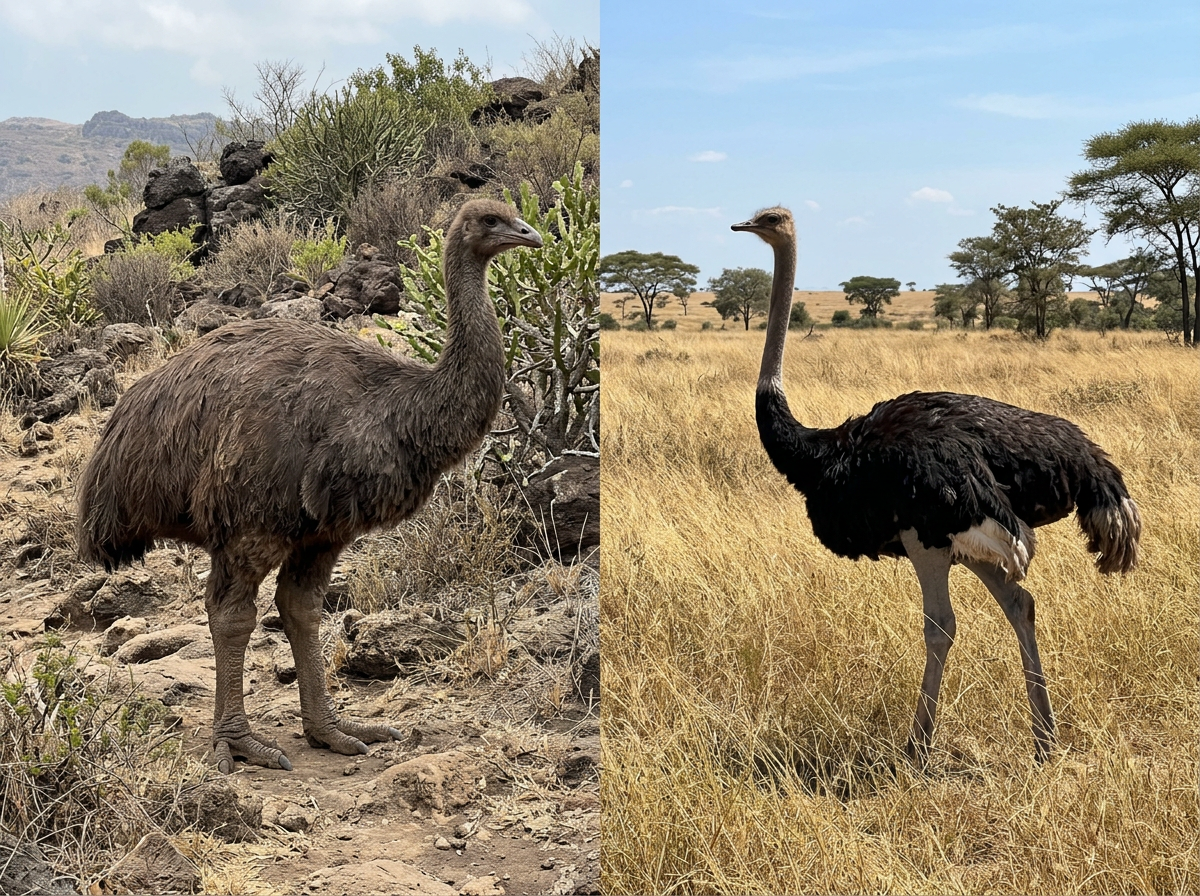
If you want a straight answer: in most realistic one-on-one scenarios, the elephant bird (specifically Vorombe titan or Aepyornis maximus) would likely come out on top against even the largest moa (Dinornis robustus), mostly because of its enormous mass advantage. But the outcome genuinely shifts depending on terrain, distance, and what each bird is doing when the encounter starts. Below I'll walk you through exactly why, using the best fossil and biomechanical evidence we have today.
Elephant Bird vs Moa: Size, Weapons, Behavior, Who Wins

Marcus Hendricks
22 Mar 2026
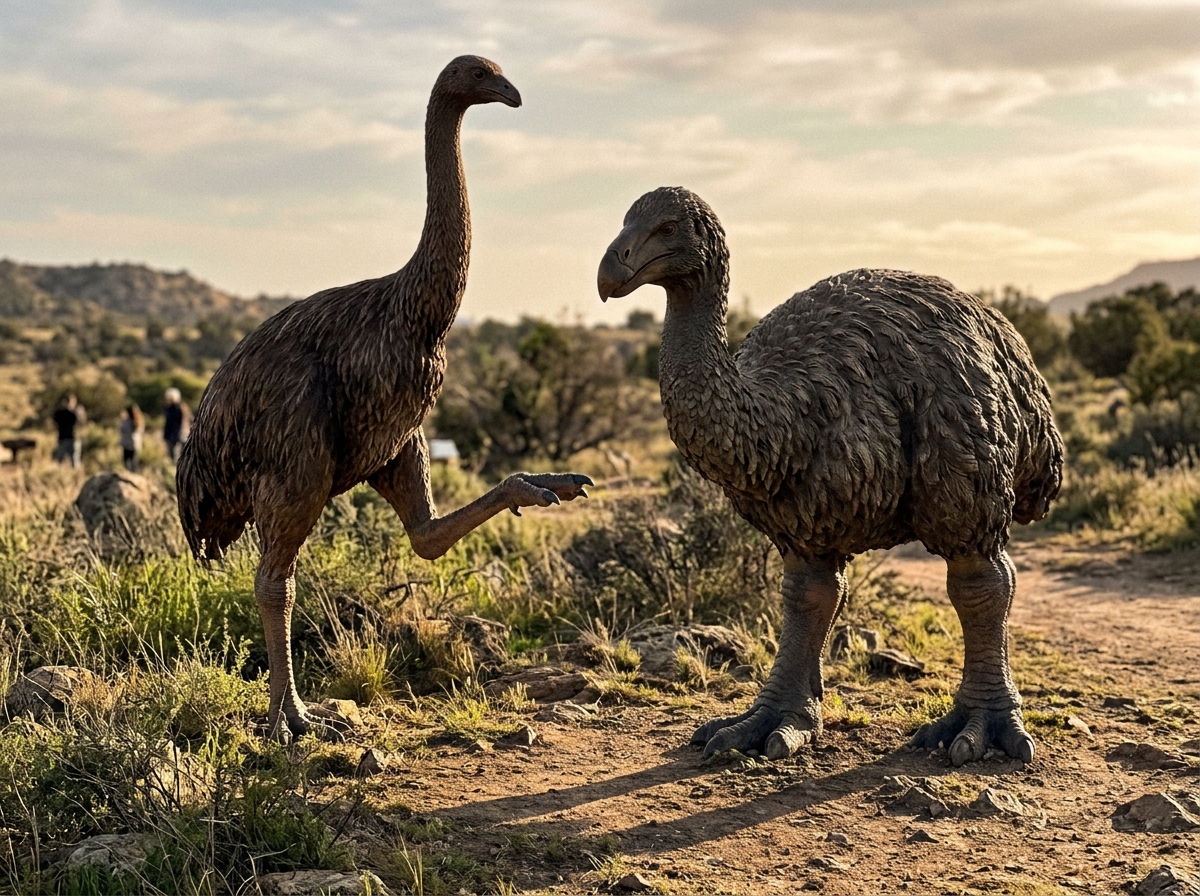
Quick ID: what these two birds actually were
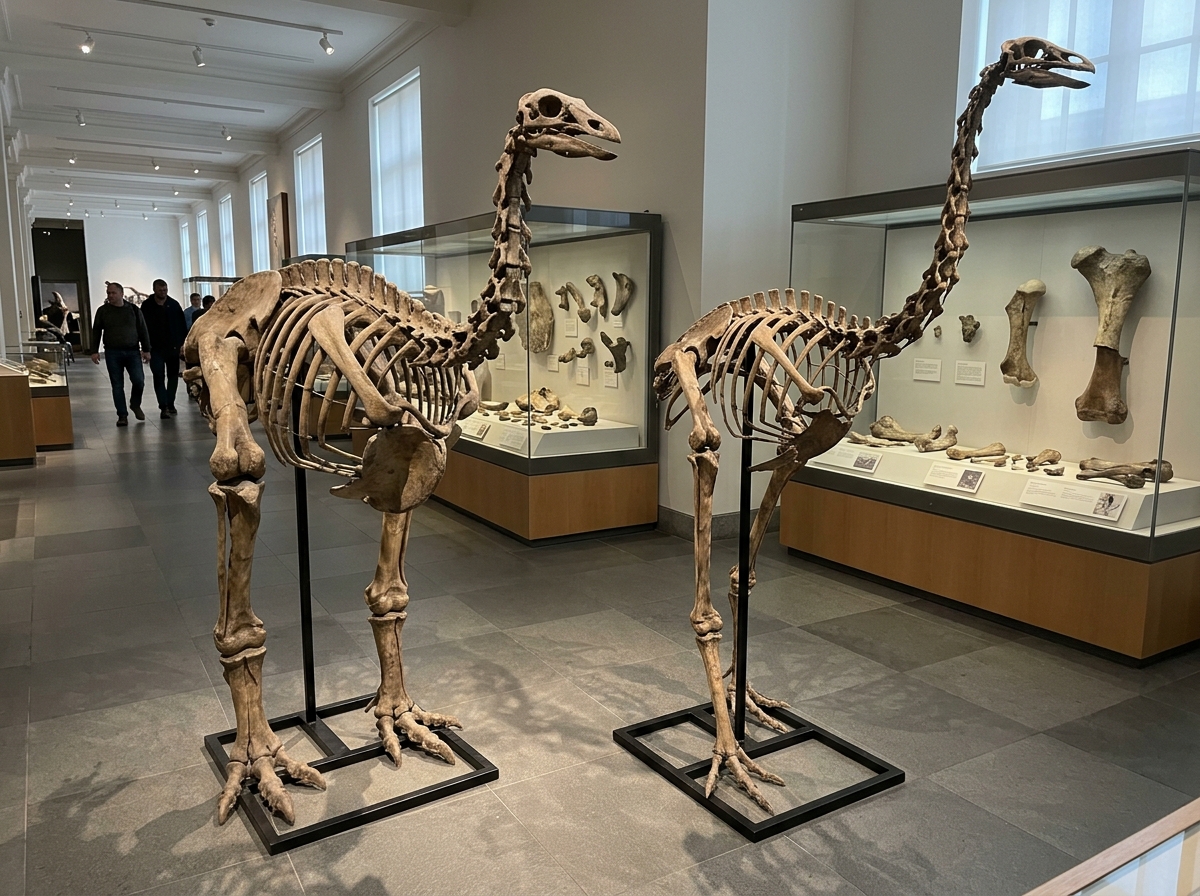
Elephant birds were a family (Aepyornithidae) of giant flightless birds that lived on Madagascar until they were driven to extinction, with butchered bones providing evidence of human hunting going back at least 10,500 years. A 2018 taxonomic study by Hansford and Turvey recognized four valid species: Aepyornis maximus, Aepyornis hildebrandti, Mullerornis modestus, and the newly described Vorombe titan, which claimed the title of world's largest bird by body mass. Their closest living relatives, surprisingly, are kiwis in New Zealand, not ostriches. For a direct comparison like kiowa vs little bird, you can use the same idea of relatives and regional context to see which traits drive the outcome.
Moa were a different order entirely (Dinornithiformes) and lived in New Zealand, not Madagascar. There were multiple moa species ranging wildly in size, from small forest browsers to the towering giant moa (Dinornis robustus and D. novaezelandiae). Their closest living relatives are South American tinamous. Both bird groups were palaeognaths (a broad grouping of mostly flightless birds), but they evolved their giant size independently on separate island landmasses, which is a crucial point when comparing them: similar lifestyles, very different builds.
| Trait | Elephant Bird (largest: Vorombe titan / A. maximus) | Moa (largest: Dinornis robustus) |
|---|---|---|
| Where it lived | Madagascar | New Zealand |
| Order | Aepyornithiformes | Dinornithiformes |
| Closest living relative | Kiwi | Tinamou |
| Estimated max height | ~3 m (stocky build) | ~3.6 m (neck outstretched, slender build) |
| Estimated max weight | ~450–540 kg | ~226–517 kg (wide range by method) |
| Body shape | Massively built, graviportal | Tall and relatively slender |
| Extinction driver | Human hunting/habitat loss | Human hunting (Polynesian settlers) |
Size, weight, and speed: what the fossils actually tell us

Elephant birds were not the tallest prehistoric birds, but they were almost certainly the heaviest. Guinness World Records lists Aepyornis maximus at roughly 450 kg, and Canterbury Museum fossil estimates push as high as 540 kg for that species. Vorombe titan, identified via limb-bone measurements by Hansford and Turvey, was likely heavier still. The build was graviportal: thick, pillar-like legs designed to carry enormous mass, more comparable to a rhino's locomotion than to a running bird.
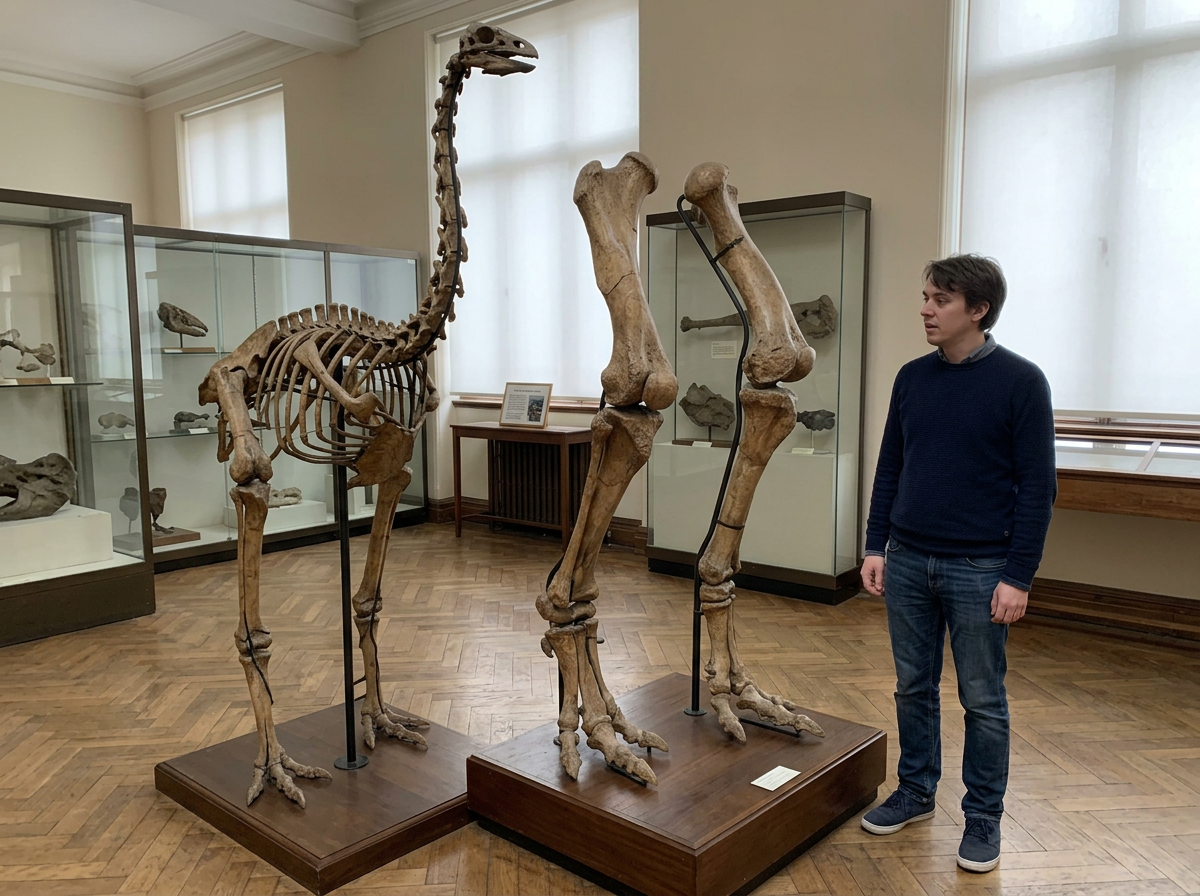
Giant moa (Dinornis robustus) could reach about 3.6 meters in height with the neck extended, which makes them taller than the elephant bird. But height and mass are different things. Moa mass estimates from fossil bones span a huge range, roughly 226 to 517 kg depending on the method used, which tells you how uncertain the numbers still are. Even at the top of that range, the largest moa were still likely lighter than the heaviest elephant birds. Moa also had a much more slender, elongated frame.
Neither bird left us footprints in the right conditions to calculate actual walking or running speeds, so we rely on hindlimb biomechanics. Research on moa hindlimb myology (muscle reconstruction) and whole-bone scaling studies show that hindlimb proportions relate predictably to body mass and locomotion style. Moa hindlimbs varied meaningfully across species, with some taxa showing more robust limbs suited to different movement strategies. Elephant birds, based on leg-bone proportions compared to other ratites, are generally thought to have been slow, graviportal walkers. Smaller elephant bird species may have been somewhat more agile than Vorombe titan or A. maximus. In a sprint, moa almost certainly had the speed advantage.
Diet and daily behavior: were either of these birds aggressive?
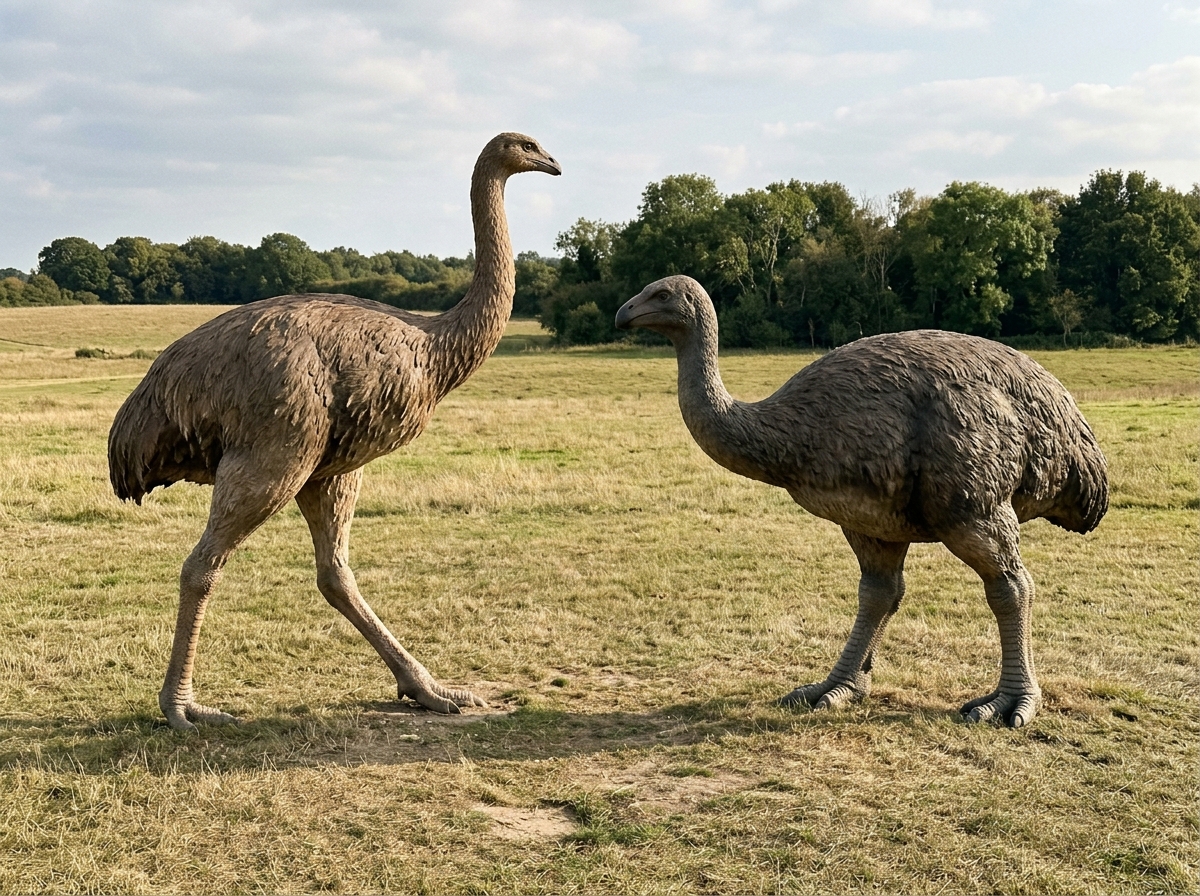
Both birds were herbivores, which matters a lot for the fight question. Neither evolved as a predator, so we're not talking about animals with instincts tuned for killing. Their "aggression" would have been defensive or territorial at most.
Moa diet is now well understood thanks to a large body of coprolite (fossil dung) research. blank" rel="noopener noreferrer">Analysis of 116 coprolites shows moa were generalist megaherbivores eating a diverse range of herbs, low shrubs, fungi, and browsed trees depending on species and habitat. The upland moa (Megalapteryx didinus) was blank" rel="noopener noreferrer">a generalist ranging across forest, shrubland, and grassland. The little bush moa (Anomalopteryx didiformis) is documented browsing trees and shrubs in forest understorey. Different moa species clearly had different feeding niches, which hints at different habitat use and possibly different stress-response behaviors.
Elephant bird diet is less thoroughly documented from direct fossil evidence compared to moa, but their massive build and beak morphology point to a similar herbivorous, foraging lifestyle on Madagascar's varied landscape. They were not ambush animals. Neither bird had any reason to seek out conflict proactively, which means the scenario of how they "meet" is actually one of the most important variables in thinking through who would win.
Weapons and defenses: beaks, legs, and sheer mass
This is where things get interesting. Both birds had no wings worth mentioning as weapons, so the fight toolkit comes down to legs, feet, beaks, and body mass.
Elephant bird: the mass weapon
The elephant bird's primary advantage is its sheer weight. Bone histology research confirms elephant birds had massive leg bones even compared to ostriches, scaled up enormously to support their bulk. Think less "karate kick" and more "crushing press" as an adjacent lens for this matchup, and then compare the specific next-step mechanics in moa bird vs ostrich. A charging or body-checking elephant bird would have been like being hit by a small car. Their beaks were large and robust, suited for breaking through tough plant material, and would have been formidable up close. Their legs and feet, while built for bearing weight rather than speed, could deliver a powerful downward stomp. Think less "karate kick" and more "crushing press."
Moa: the reach and kick weapon
The moa's biggest advantage is its height and powerful feet. Dinornis specifically is noted to have large, powerful feet capable of delivering a forceful kick when threatened. Muscle reconstruction of moa hindlimbs (from the Queensland Museum myology re-evaluation) supports genuine locomotor power in those legs. A kick from a giant moa at full extension would have serious force behind it, and the moa's height means it could potentially land strikes above the elephant bird's center of mass. Moa also likely had better mobility and could reposition faster than the heavier elephant bird.
Who would win, and when: scenario-based outcomes
There's no single answer here, and anyone who gives you one without caveats is ignoring the evidence. Here's how the outcome shifts across realistic scenarios.
| Scenario | Likely Winner | Why |
|---|---|---|
| Close-quarters grapple on flat open ground | Elephant bird | Mass and bone density win a pushing/crushing contest; the moa cannot outrun or outmaneuver at close range |
| Moa gets first strike from distance (a kick or charge) | Moa (contested) | A powerful kick landing before the elephant bird closes distance could injure or destabilize it; outcome uncertain |
| Elephant bird charges across open terrain | Elephant bird | Even at slow speed, mass impact at full body weight is devastating; moa cannot easily dodge in open space |
| Forested terrain with limited movement | Moa (slight edge) | Moa's height and narrower build may allow more effective kicks in confined space; elephant bird's bulk is a disadvantage in tight corridors |
| Extended endurance contest | Elephant bird | Graviportal animals evolved for sustained load-bearing; the moa's slender limbs are better for speed, not prolonged brute-force exchange |
| Smaller elephant bird species vs smaller moa species | Too close to call | Size gap narrows dramatically; agility and individual factors dominate |
The core logic is this: the elephant bird wins by being immovable and overwhelming at close range. The moa's best chance is keeping distance, landing a kick first, and using its speed to avoid a full body collision. In the wild, two herbivores would almost never fight to the death over territory since they lived on completely separate islands and never shared habitat. So the "who would win" framing is purely hypothetical, but it's a genuinely interesting biomechanics question.
It's also worth noting that the size comparison is not as lopsided as it sounds when you pick mid-range moa species. If you're comparing A. maximus (around 450 kg) to a mid-sized moa rather than Dinornis robustus at its maximum estimate, the mass difference shrinks and the moa's agility advantage matters a lot more. The "elephant bird wins" conclusion is most confident when you're comparing the heaviest elephant bird forms to any moa.
Common myths worth busting
- "The moa was the biggest bird ever" — Height-wise, Dinornis was impressively tall at up to 3.6 m, but Vorombe titan and Aepyornis maximus outweighed it significantly. Biggest by height and biggest by mass are different records.
- "Elephant birds were fast like ostriches" — They weren't. Their graviportal build, similar to large sauropod dinosaurs in principle, prioritized mass-bearing over speed. Ostriches can sprint at 70 km/h; elephant birds almost certainly could not approach that.
- "Both birds were aggressive predators" — Both were herbivores. Their defensive behaviors were triggered by threat, not predatory drive. Any fight scenario assumes an unusual level of stress or territorial pressure.
- "We know exactly how heavy these birds were" — We don't. Moa mass estimates range from 226 to 517 kg using different methods on Dinornis robustus alone. Elephant bird estimates span 450 to 540 kg for A. maximus across different sources. Treat all specific numbers as educated ranges, not facts.
- "Elephant birds and moa were closely related" — They were both palaeognaths, but they're not each other's closest relatives. Elephant birds are closest to kiwi; moa are closest to tinamous. Convergent evolution produced similar large flightless body plans on separate islands.
How to verify claims and avoid bad sources

If you want to dig deeper into this comparison and check what's actually supported by evidence, here's exactly how I'd approach it today.
- Start with the Hansford and Turvey (2018) paper in Royal Society Open Science for elephant bird taxonomy and size data. It's peer-reviewed, openly accessible, and gives you actual limb-bone measurements rather than recycled estimates.
- For moa size and diet, look for coprolite studies published in peer-reviewed journals (PMC and ScienceDirect have several). The large 116-coprolite dataset study and the high-resolution coproecology work on upland moa are solid starting points.
- For moa biomechanics and kick potential, the Queensland Museum hindlimb myology paper and the PMC whole-bone scaling study give you grounded, methodologically sound bases rather than speculation.
- Cross-check any mass figure you see against at least two academic or major museum sources (Canterbury Museum, Australian Museum, and Natural History Museum London all have published summaries). If a website gives a single precise number without a cited method, treat it as approximate.
- Avoid relying on general encyclopedic summaries or clickbait listicles for exact measurements. These frequently copy outdated or conflated figures, especially for elephant birds, where the taxonomy was significantly revised in 2018.
- If a source doesn't distinguish between elephant bird species (lumping Vorombe titan and A. maximus together) or doesn't mention moa species variation, it's probably oversimplifying. The comparison changes depending on which species you pick from each group.
If this comparison got you interested in how other giant birds stack up, the elephant bird vs moa and moa bird vs ostrich comparisons are worth reading next, since ostriches give you a living reference point for speed and kick force that helps calibrate these prehistoric estimates. If you want another living reference point for modern flightless bird performance, an emu bird vs ostrich comparison is also a useful sidebar. The elephant bird vs terror bird matchup is also a dramatically different kind of comparison, since terror birds were actual predators with very different weapons. If you're also curious about a straight head-to-head like kittysaurus vs opila bird, the same evidence-based setup and biomechanics logic applies. A similar evidence-based setup can also help you compare orange vs opila bird using the same biomechanics approach.
FAQ
Would elephant birds and moa really fight to the death, or would they just defend space and back off?
Probably neither, because both animals were herbivores without a predator-style weapon set or hunting drive. In a hypothetical clash, the most realistic outcomes are short defensive encounters that end once the birds disengage, rather than sustained, injury-maximizing fights.
How much does starting distance change who wins in an elephant bird vs moa scenario?
Yes, especially if you start them close. At very short range, the elephant bird’s mass and downward stomp mechanics matter most. If the moa can keep its legs and body from being “hit square” and time a kick during a step-in, its height-based foot strikes become much more decisive.
What role does terrain (mud, rocks, level ground) play in the matchup?
Terrain and footing can flip the advantage. In soft, uneven, or muddy ground, the elephant bird’s graviportal, heavy-body locomotion would be more likely to sink or lose traction, which reduces the effectiveness of body checks and crushing steps. On hard, even ground the elephant bird’s weight becomes more reliable.
If you cannot measure exact speeds, what mobility factor should I focus on for the fight outcome?
Predicted speed is the weak link in the evidence, but the article’s mechanics imply a strong tendency: moa likely had better sprint and reposition capability than the heavier elephant bird. If the moa can circle or angle its approach so the elephant bird can’t line up a full-body collision, the moa’s kick-first plan improves.
Does the moa’s kick work better against an elephant bird’s legs or upper body?
Weapon success depends on where the elephant bird’s body weight is concentrated and what the moa can physically reach. A kick that lands against the elephant bird’s legs or lower body is more likely to disrupt footing, while high, fully extended kicks matter more if the moa can maintain height advantage without being stepped into.
Which specific species pairing gives the most “fair” comparison, not an extreme outlier?
It is not one-to-one, because elephant birds range from smaller species to extreme-mass forms, and moa include both forest and upland types. The highest win confidence for the elephant bird comes when comparing Vorombe titan or the heaviest Aepyornis forms to the largest Dinornis estimates, while mid-sized comparisons increase the moa’s chances via agility and kick targeting.
How do fights change if you compare smaller elephant bird species or smaller moa species?
Yes, through scaling and muscle-capacity logic. Smaller moa species likely had shorter reach but could still deliver forceful foot strikes relative to their size, and they may have been adapted for different locomotion styles. Smaller elephant birds would reduce the mass advantage, making the fight more about timing and kick accuracy than raw crushing force.
If neither bird evolved as a predator, what does “winning” actually mean in this scenario?
Mostly, yes. Both birds were built for foraging herbivory, so neither should be assumed to have specialized instincts for killing or sustained grappling. Realistic aggression would be defensive, territorial, and brief, meaning the bird that triggers displacement or footing loss first likely determines the “winner” even if neither would be truly lethal.
What tactical pattern is most likely: elephant bird body-check first, or moa kick-and-reset first?
Think in terms of “pressure windows.” The elephant bird’s best chance is creating contact before the moa’s legs can reset, essentially forcing a collision. The moa’s best chance is a quick kick then immediate reposition, preventing the elephant bird from transitioning from stalking pressure into a full stomp or body-check.
Does the elephant bird’s beak meaningfully change the outcome, or is it mostly the legs and mass?
The elephant bird’s beak could matter more in close contact and snapping motions around the head and neck region, but the article’s main weighting is mass-supported stomping. If the moa can keep striking with the feet while staying out of beak range, the beak becomes a secondary threat rather than the decisive one.