These two birds are genuinely nothing alike once you know what to look for. The secretary bird is a long-legged African raptor that stalks open grasslands and stomps snakes to death with scaled legs. The cassowary is a massive, flightless rainforest bird from Australia and New Guinea with a bony helmet on its head and a reputation as one of the most dangerous birds alive. Same broad category (large, ground-walking birds), completely different continents, habitats, body plans, and behaviors.
Secretary Bird vs Cassowary: Key Differences and ID Guide

Marcus Hendricks
14 May 2026
If you saw them side by side, you would not confuse them. This guide will make sure you can tell them apart quickly, whether you are looking at a photo or standing a little too close to one in the wild.
Quick identity check: what each bird actually is
Secretary bird
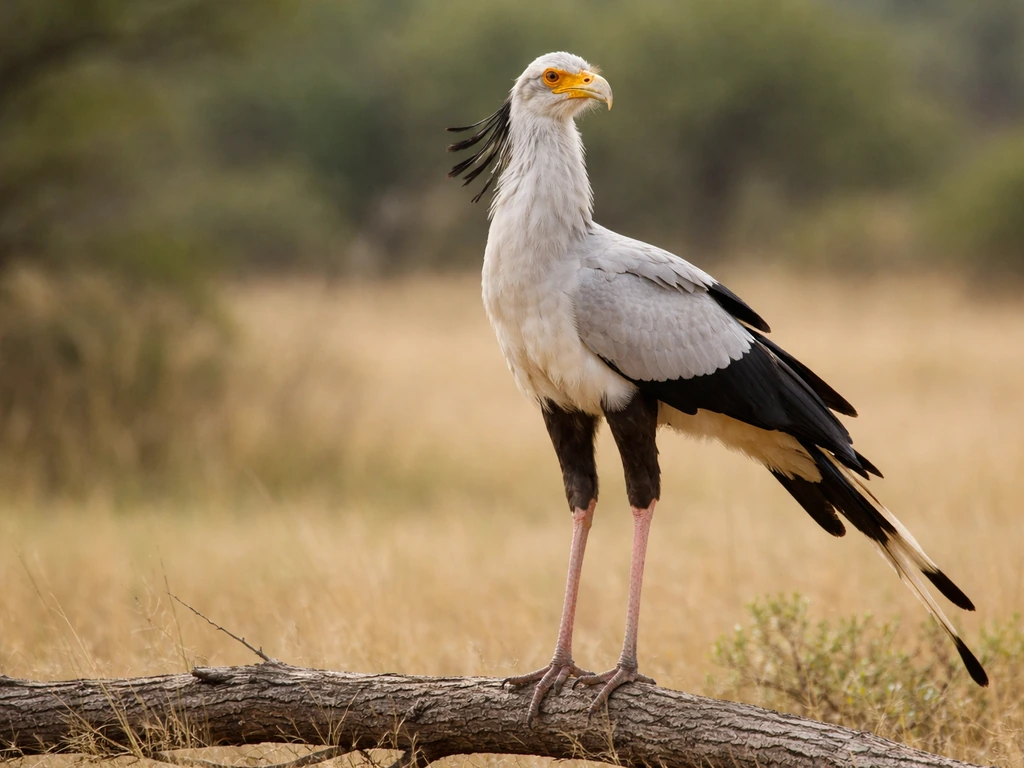
The secretary bird (Sagittarius serpentarius) is the only living member of its family, Sagittariidae, sitting within the order Accipitriformes, which makes it a genuine raptor related to hawks and eagles. It is native exclusively to sub-Saharan Africa, ranging across open savannahs and grasslands from Senegal down to South Africa, though it avoids the dense equatorial rainforests of western Africa and the driest coastal deserts of Namibia. It can be found from sea level up to around 3,000 meters. Think of it as an eagle that decided legs were more useful than wings for daily hunting. It can fly, but it lives and hunts almost entirely on foot.
Southern cassowary
The southern cassowary (Casuarius casuarius) belongs to the order Struthioniformes and the family Casuariidae, placing it in the ratite group alongside ostriches, emus, and kiwis. Ostriches are ratites too, but they are different from cassowaries in size, habitat, and how they behave ratite group alongside ostriches. It cannot fly at all. It is found in Indonesia, Papua New Guinea, and northeastern Australia, living deep inside tropical rainforests. It is a large, heavily built bird with bristly black plumage, a tall bony casque (the helmet-like growth on top of its head), and bare, vividly colored skin on its face and neck. Where the secretary bird is lean and leggy, the cassowary is dense and imposing.
Appearance and anatomy: the clearest visual differences
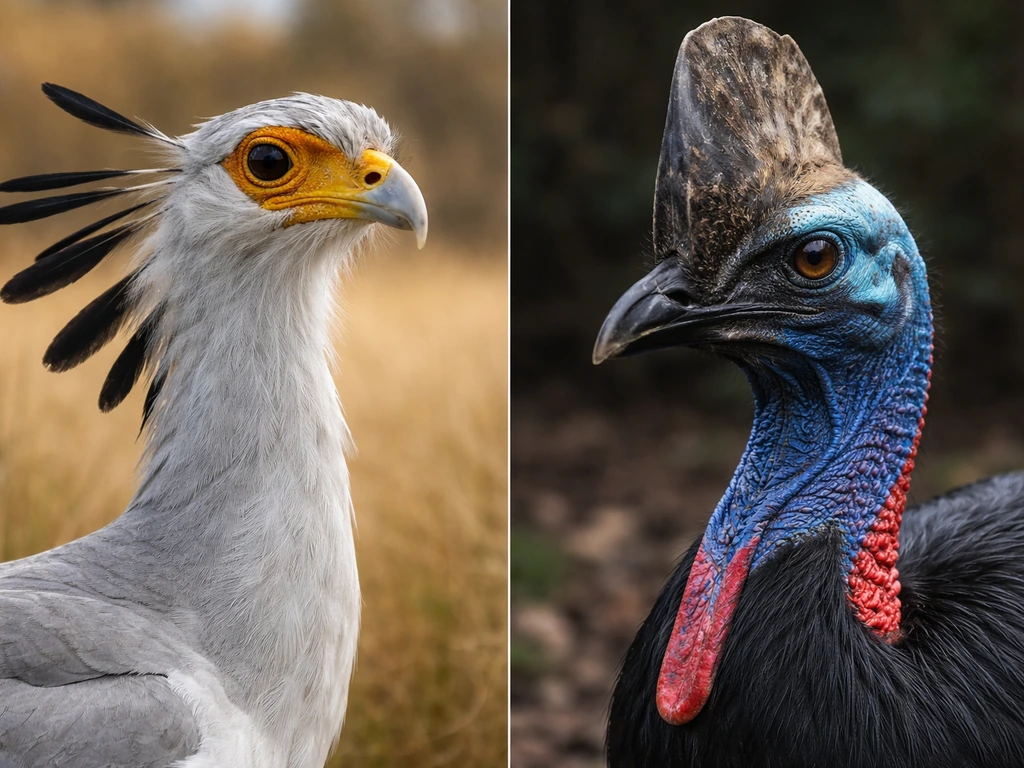
The two birds look so different that the main confusion probably comes from the fact that both are large and walk on two legs. Beyond that, they are almost opposites in body design. Here is how they stack up feature by feature.
| Feature | Secretary Bird | Southern Cassowary |
|---|---|---|
| Overall shape | Tall, slim, crane-like silhouette with extremely long legs | Massive, barrel-bodied, compact and heavy |
| Height | Roughly 1.2–1.3 m (about 4 ft) tall | Up to 1.8 m (nearly 6 ft) tall |
| Weight | Around 3–4 kg (7–9 lbs) | Up to 58–70 kg (130–155 lbs) |
| Head feature | Black crest feathers fanning out from back of head | Tall, bony hornlike casque on top of head |
| Face/neck skin | Bare orange-red facial skin around eyes | Vivid bare skin: red, orange, blue, or purple wattles on neck and face |
| Bill | Short, hooked raptor beak (like an eagle) | Long, straight, pointed bill |
| Plumage | Pale grey body, black thighs and flight feathers | Entirely black, bristly-looking feathers |
| Legs | Extremely long, scaled legs; resembles a stork on stilts | Thick, powerful legs; shorter relative to body size |
| Feet/claws | Scaled legs for snake protection; blunt claws for stomping | Inner toe has a long, dagger-like claw up to 12 cm |
| Can it fly? | Yes, though it prefers walking | No, completely flightless |
The single most reliable instant identifier on the secretary bird is that dramatic black crest on the back of the head, fanning out like quill pens (which is actually where the name comes from). On the cassowary, the casque is unmistakable: a rigid, bony helmet that grows larger with age. No other large bird in its range has that structure. If you see either of these features, you can make your ID immediately.
Habitat and geographic range: they live on different continents
This is arguably the simplest way to separate them. If you are in sub-Saharan Africa standing in open grassland or savannah, and you see a tall, leggy bird stalking through the grass, it is almost certainly a secretary bird. If you are in the tropical rainforests of northeastern Australia, Papua New Guinea, or Indonesia, and something large and black disappears into the undergrowth, that is a cassowary. Their ranges do not overlap at all, not even close. Geography alone resolves the confusion in real life.
Secretary birds actively prefer wide-open spaces: savannahs, grasslands, semi-arid scrub, and lightly wooded areas where they can see and chase prey across the ground. Dense forest is not their environment. Cassowaries are the opposite. They are creatures of the forest interior, specifically tropical rainforest, and their dark plumage and quiet movement make them surprisingly hard to spot even when they are nearby. Their habitat ranges from lowland rainforest up to about 3,000 meters in elevation.
Diet and hunting style: a predator versus a frugivore
What these birds eat and how they get it tells you a lot about why they are built so differently.
Secretary bird: the active hunter
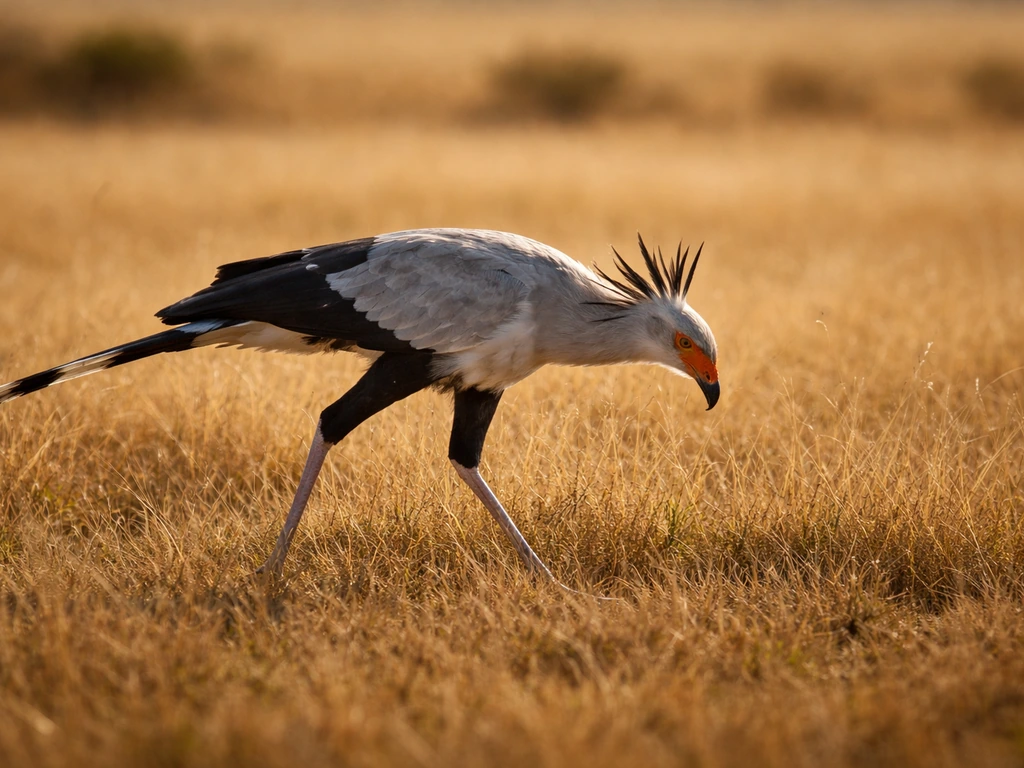
Secretary birds are dedicated hunters. Their diet is built around arthropods (grasshoppers, beetles, spiders, scorpions, wasps), small mammals like mice, rats, hedgehogs, and hares, and of course snakes, which they are particularly famous for. If you are wondering about it, a secretary bird vs python comparison helps explain why snakes are such a key part of the bird’s hunting strategy.
Their hunting method is active and athletic: they walk long distances through grass, flushing prey, then strike fast with their feet. When dealing with a snake, they target the area just behind the head to snap the neck or stun it. The thick scales on their legs are a direct adaptation to protect them from retaliatory bites. They are entirely ground hunters, relying on speed, precision, and leg strength rather than aerial attacks.
They are also diurnal, typically starting before dawn and resting in shade during the hottest part of the day before heading back to roost near sunset.
Cassowary: the forest frugivore
The cassowary's diet is dominated by fruit. They forage slowly across the forest floor, picking up fallen fruit and seeds, which makes them critically important as seed dispersers for large-seeded rainforest trees that few other animals can handle. They supplement this with fungi, snails, insects, and occasionally small vertebrates like fish, frogs, rodents, and birds. Their foraging style is slow and deliberate, not the active pursuit-and-strike hunting of the secretary bird. The cassowary is a browser of the forest floor, not a predator.
Behavior and temperament: what each bird is actually like
Secretary birds have a certain confident energy to them. They walk steadily and purposefully through open country, and they are generally not interested in humans. They are not known for aggression toward people, and documented human-attack incidents are rare. Their power is real (those legs can deliver a serious strike to prey), but that force is directed at snakes and small animals, not people. They are territorial during breeding and will defend nesting sites, but the typical response to human presence is simply to walk away or take flight.
Cassowaries are a different story, not because they are naturally aggressive, but because they are large, powerful, and unpredictable when they feel threatened. Their default response to humans is actually shy and evasive: they will typically bolt or disappear into the forest before you even know they were there. The danger comes when they are cornered, protecting eggs or chicks, or when they have been food-conditioned by people and expect to be fed.
A Queensland Museum Nature Memoirs publication on [southern cassowary attack case histories](https://www. museum. qld. gov.
au/assets/media/project/qm/qm-website/collections-and-research/memoirs/nature-memoirs/nature-volume-49/mqm-n49-1-18-kofron. pdf) reports that recorded incidents often involve situations where the birds were previously fed or had come to expect food. A cassowary that associates humans with food loses its wariness and can become bold and confrontational. Their primary weapon is a powerful kick using that inner dagger-like claw, and those injuries can be severe.
How to tell them apart in the real world
Follow this sequence and you will have your ID locked in within seconds. If you want a quick way to remember the comparison, think “bird siren vs harpy” when you scan for the most distinctive traits.
- Check your location first. Are you in sub-Saharan Africa in open grassland or savannah? Secretary bird. Are you in rainforest in northeastern Australia, Papua New Guinea, or Indonesia? Cassowary. Geography eliminates the confusion before you even look at the bird.
- Look at the habitat around you. Open grass, shrubland, or semi-arid scrub: secretary bird territory. Dense tropical forest: cassowary territory. If you are standing in a clearing and can see for hundreds of meters, you are not in cassowary country.
- Check the head. Black quill-like feathers fanning from the back of the skull? Secretary bird. Tall rigid bony casque sitting on top of the skull like a helmet? Cassowary.
- Look at the neck and face. Brightly colored bare skin (red, blue, orange, purple wattles)? That is the cassowary's most striking feature. The secretary bird has bare orange-red facial skin around the eyes but nothing like the cassowary's vivid neck coloring.
- Check the body shape. Slim and leggy, like a large crane with a raptor's head? Secretary bird. Massive, barrel-chested, and heavy with short thick legs? Cassowary.
- Look at the plumage color. Pale grey body with black accents? Secretary bird. Uniformly jet black, almost bristly-looking? Cassowary.
- Watch how it moves. Is it striding purposefully through open grass, occasionally stomping or striking at the ground? Secretary bird hunting behavior. Is it moving slowly through forest undergrowth, picking at fallen fruit? Cassowary foraging behavior.
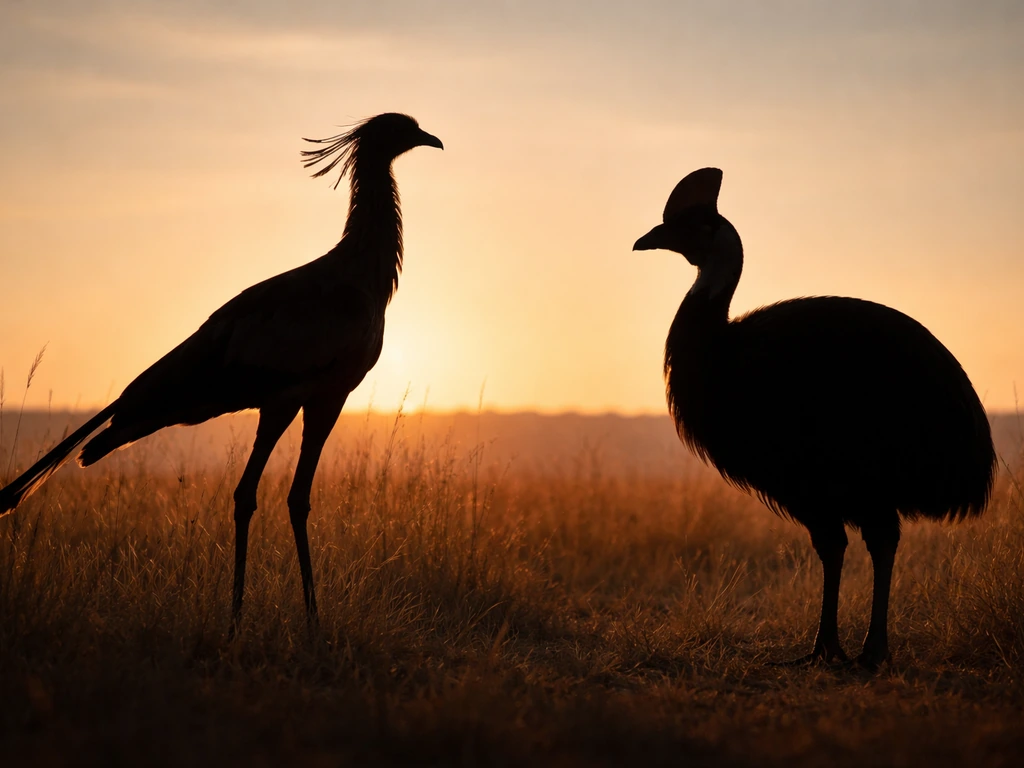
The most common source of confusion in photos rather than the field is probably silhouette: both birds are large and bipedal. But even in silhouette, the secretary bird's disproportionately long legs and slim body versus the cassowary's compact, heavy-set form are quite distinct. And if the casque or crest is visible at all, the ID is instant.
Risks and safety when encountering either bird
Secretary bird encounters
Secretary birds are not considered dangerous to people. Their leg-strike power is real and designed for prey, but there are no well-documented cases of secretary birds causing serious injury to humans. If you encounter one in the wild, the usual outcome is that the bird walks away or flies off. Give it space and do not corner it. Treat it with the same respect you would give any wild raptor, but it is not a safety threat in the way a large mammal predator would be.
Cassowary encounters
Cassowaries deserve serious respect. They are listed among the most dangerous birds in the world specifically because of that inner dagger claw, which can reach up to 12 centimeters and is used in powerful forward-kicking strikes. Most cassowaries want nothing to do with people and will retreat if given the chance. The last recorded cassowary-caused human death in Australia happened in 1926, in a case of self-defense. But non-lethal injuries from cassowary attacks are documented, often involving situations where the bird was cornered, was defending chicks, or had been fed by people and had lost its fear of humans.
If you encounter a cassowary in the wild, follow these basic rules:
- Do not feed it, ever. Feeding is the single biggest reason cassowaries become dangerous to people.
- Back away slowly and give it a clear escape route. Do not run and do not corner it.
- If it charges, put something large between you and the bird (a tree, a bag, a backpack) and keep moving away.
- If it knocks you down, curl up and protect your vital organs with your arms. The kick comes forward, not downward.
- Never approach a cassowary with chicks. A parent defending offspring is at its most dangerous.
The bottom line on risk: the secretary bird is a fascinating predator but not a threat to healthy adult humans. If you want the fastest way to tell them apart, compare the kori bustard versus secretary bird differences too. In a secretary bird vs eagle comparison, the key differences come down to hunting style and physical build. The cassowary is genuinely dangerous when provoked, cornered, or food-conditioned, and should be treated accordingly. Both deserve distance and respect, but they are not in the same risk category when it comes to human safety. If you want a quick, side-by-side memory hook, also compare how bird siren vs harpy style warnings differ from these real-world encounters.
Side-by-side summary
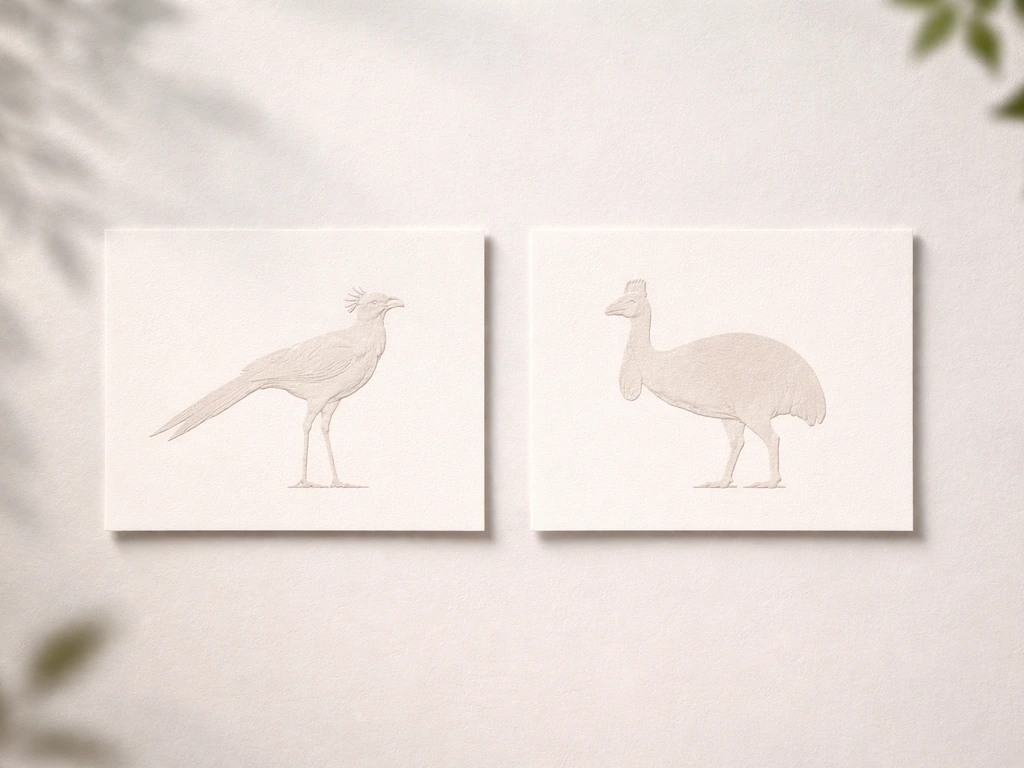
| Category | Secretary Bird | Southern Cassowary |
|---|---|---|
| Family/Order | Sagittariidae / Accipitriformes (raptor) | Casuariidae / Struthioniformes (ratite) |
| Native range | Sub-Saharan Africa | Australia, Papua New Guinea, Indonesia |
| Habitat | Open savannah and grassland | Tropical rainforest |
| Can it fly? | Yes | No |
| Diet | Snakes, small mammals, insects | Mainly fruit and seeds; some invertebrates and small vertebrates |
| Hunting/foraging style | Active ground hunter; stomps and strikes prey | Slow floor forager; picks up fallen fruit |
| Key head feature | Black crest feathers at back of head | Tall bony casque on top of head |
| Key danger feature | Scaled legs/stomping (prey-focused) | Dagger inner claw (dangerous to humans if provoked) |
| Temperament toward humans | Generally non-aggressive, walks away | Shy but potentially dangerous if threatened or food-conditioned |
| Activity pattern | Diurnal | Diurnal |
If the secretary bird comparison sparks further curiosity, it is also worth knowing how it stacks up against its African neighbors and relatives in different ways. How it compares to the seriema (a South American lookalike), the eagle (its closest aerial relatives), the ostrich (another tall African ground bird), or even a python (as prey) all reveal different and fascinating angles on what makes the secretary bird so unusual. The cassowary, meanwhile, stands in its own ecological lane: a rainforest giant with no real equivalent in the bird world.
FAQ
If their ranges don’t overlap, how can I tell them apart when I’m only using memory or a vague travel location?
Yes, geography is usually enough: secretary birds are confined to sub-Saharan Africa, while cassowaries are restricted to tropical rainforest regions in Indonesia, Papua New Guinea, and northeastern Australia. If you are outside those areas, treat “either one” as unlikely and rely on local species IDs instead.
What should I look for in dark forests or blurry photos where plumage color is hard to see?
In low light, lean on structure rather than color. Secretary birds show a long, narrow neck and a distinct head-crest pattern, while cassowaries read as bulky and compact with a helmet-like casque on top of the head (often the most visible feature once you focus).
What if I cannot clearly see the casque on a cassowary, are there other reliable cues?
A cassowary’s casque can look subtle if it is partly hidden by angle or vegetation, so don’t wait for it. Use the body silhouette first, compact and heavy, then confirm with the visible casque or the bare, bright face and neck skin.
How can I identify a secretary bird in motion if the crest is not clearly visible?
For secretary birds, focus on the head crest on the back of the head and the overall “tall and leggy” posture, even when the bird is mid-stride. The long legs relative to body thickness are one of the fastest silhouette clues in motion.
Are secretary birds always found in grasslands, or can they appear in other habitats too?
If a bird is in open grassland or savannah, secretaries are more plausible, but don’t assume. Confirm with raptor-style hunting behavior (stalking and flushing prey on foot) and with their scaled, sturdy-looking legs, rather than just “big and ground-walking.”
What behavior helps if I’m unsure whether I’m seeing a forest bird but the location is close to the edge of the rainforest?
Cassowaries are typically forest interior birds and are much less likely to be out in open country. If you see a large bird that is actively foraging in deep rainforest shade with slow movements across the floor, that supports cassowary ID over secretary bird.
What’s a reliable way to tell them apart by behavior instead of appearance?
Avoid the common mistake of treating both as “ground predators.” Secretary birds hunt actively and often target snakes, while cassowaries primarily forage on fallen fruit and seeds. Watching the foraging rhythm, fast pursuit versus slow picking, can clarify the ID.
How should I behave differently around a cassowary than around a secretary bird for safety?
If a cassowary is near you, the risk increases when it feels cornered or when it expects food from people. Do not approach for photos, do not feed, and give extra space near likely nesting areas and anywhere chicks might be present.
Are secretary birds completely harmless, and what should I do if one seems defensive?
Secretary birds can bite defensively if handled or cornered, but they are not typically associated with serious human injuries. Still, the correct response is the same basic principle for any wild raptor, keep distance, avoid blocking escape routes, and never attempt to touch or photograph at close range.
How does human behavior change the risk level with cassowaries?
Treat “food-conditioned” as the key escalation factor for cassowaries. If birds repeatedly get human food, they lose fear and may approach aggressively, so the best risk-reduction step is to remove incentives by not feeding and by keeping groups together and quiet.
What should I do in the moment if I encounter a cassowary in a public area like a park trail?
If you are visiting an area where cassowaries occur, the practical next step is to learn local signage and approach rules, since sites often establish buffer zones and viewing guidelines. For any encounter, prioritize retreat over observation distance, and move slowly so you do not herd the bird into a corner.
Next Articles
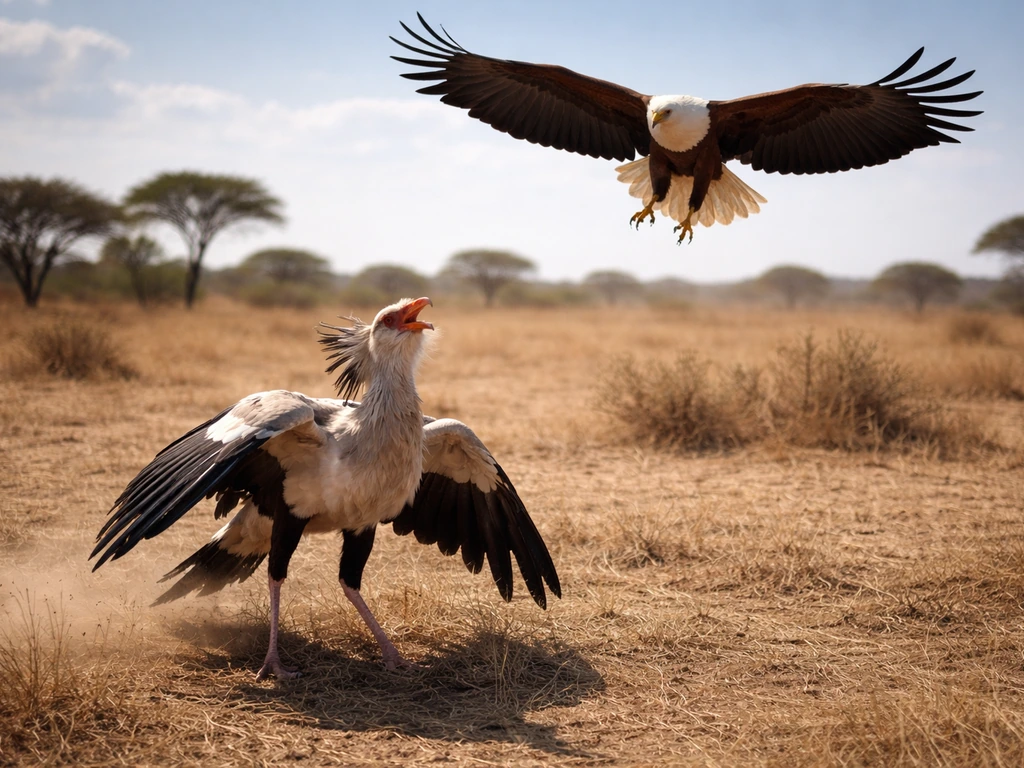
Secretary Bird vs Eagle: Who Would Win a Fight?
Ground-savanna fighter or aerial predator? Compare secretary bird vs eagle by size, speed, hunting weapons, and key vari
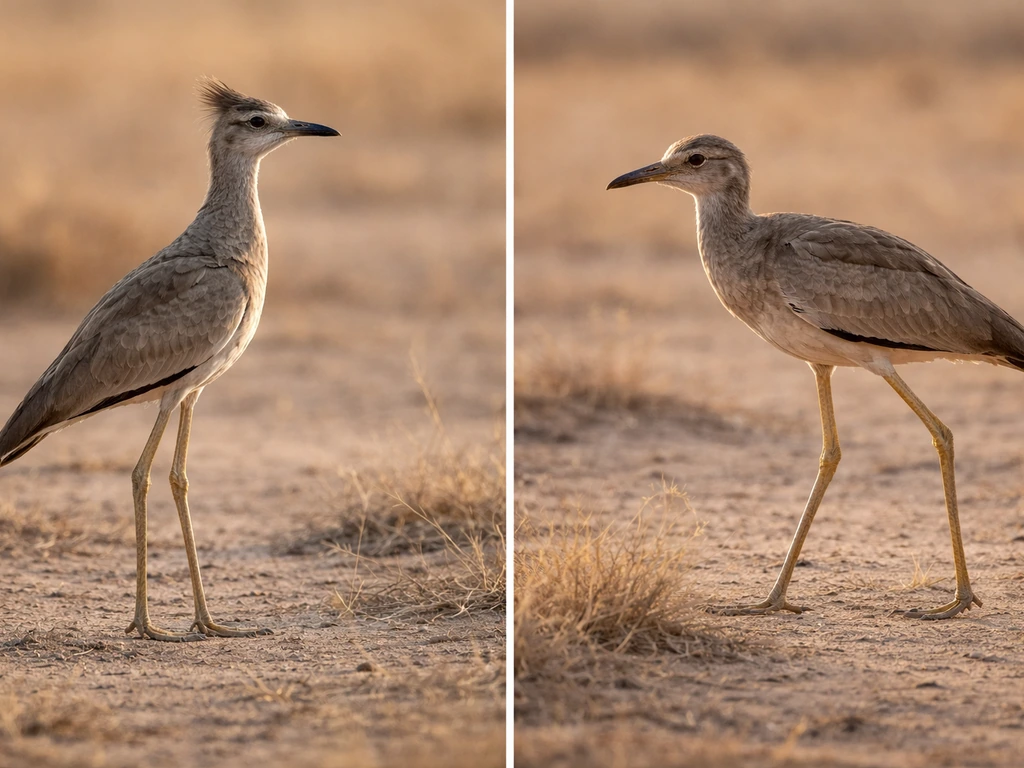
Seriema vs Secretary Bird: How to Tell Them Apart
Learn fast, reliable cues to tell seriema from secretary bird by size, bill, legs, hunting, habitat, flight, and calls.

Batman vs Bird: Identify the Animal and Tell Them Apart
Learn what Batman vs bird means and use field marks, behavior, and habitat to ID the right animal fast.