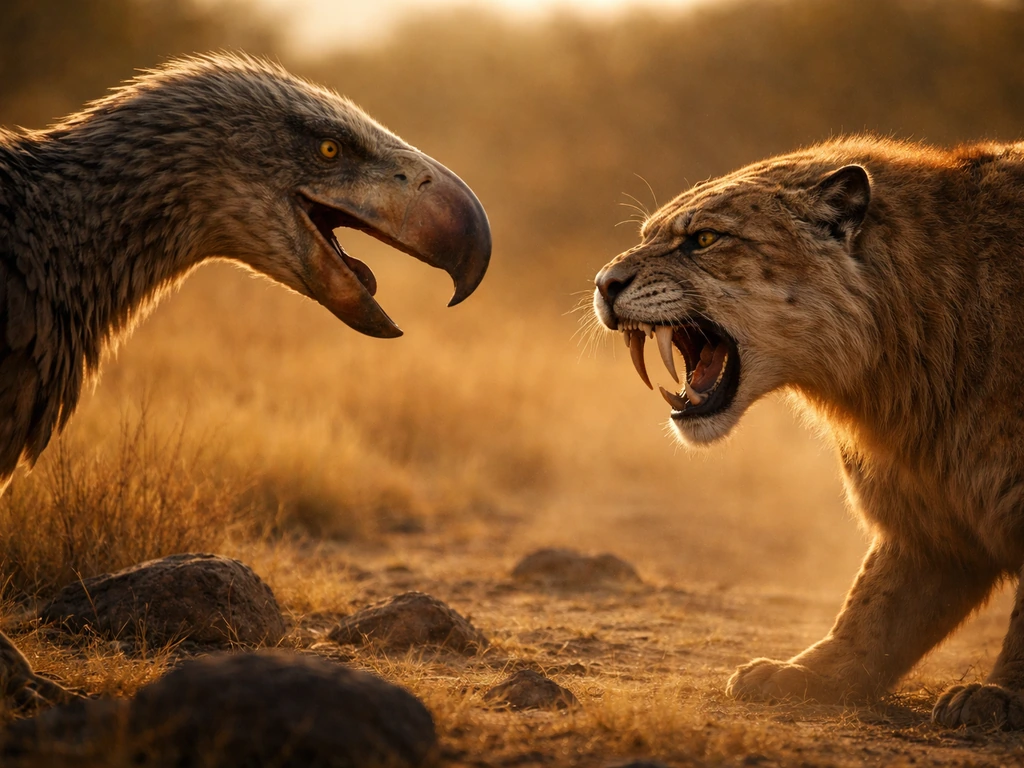
In a realistic, head-to-head matchup, a large saber-toothed cat like Smilodon fatalis would most likely have the advantage over a typical phorusrhacid terror bird. Smilodon fatalis weighed an estimated 160 to 280 kg of heavily muscled ambush predator, with robust forelimbs built for pinning prey. Terror birds were fast, had a devastating hatchet-like beak strike, and were no pushovers, but their hollow avian bone structure, limited grappling ability, and smaller mass put them at a disadvantage in close quarters against a cat that size. That said, the matchup shifts significantly depending on which specific species you're comparing, the terrain, and who gets the first move. Let's break it all down.
Terror Bird vs Sabertooth: Real Traits, Size, and Clash Outcome

Marcus Hendricks
4 Jun 2026
What we're actually talking about: quick ID check
The term 'terror bird' in paleontology refers to the family Phorusrhacidae, a group of large, mostly flightless predatory birds that dominated South American ecosystems throughout the Cenozoic era. They weren't some vague category of scary birds. They were a specific avian lineage, formally nested within the order Cariamiformes, and they filled the apex predator role on a continent that lacked large mammalian carnivores for millions of years. The most well-known genera are Phorusrhacos (a Miocene giant from South America) and Titanis, which pushed north into the United States during the Pliocene and early Pleistocene.
The term 'sabertooth tiger' is technically a misnomer that stuck around in pop culture and hasn't fully gone away. The animals people mean when they say 'sabertooth tiger' are actually saber-toothed cats in the subfamily Machairodontinae, part of the family Felidae. They are not tigers. Tigers belong to the subfamily Pantherinae, which is an entirely different branch of the cat family tree. The genus most people picture is Smilodon, particularly Smilodon fatalis from North America and Smilodon populator from South America. Neither is a tiger. Calling them 'saber-toothed cats' is the correct framing, and that's what we'll use here.
Size, skull, and build: the physical breakdown
These two animals look nothing alike, which makes the comparison genuinely interesting. Here's how they stack up physically.
| Trait | Terror Bird (Phorusrhacos) | Saber-Toothed Cat (Smilodon fatalis) |
|---|---|---|
| Height / Length | ~2.4 m tall (standing) | ~1.2 m at shoulder, ~1.7 m body length |
| Body mass | ~130 kg | ~160–280 kg |
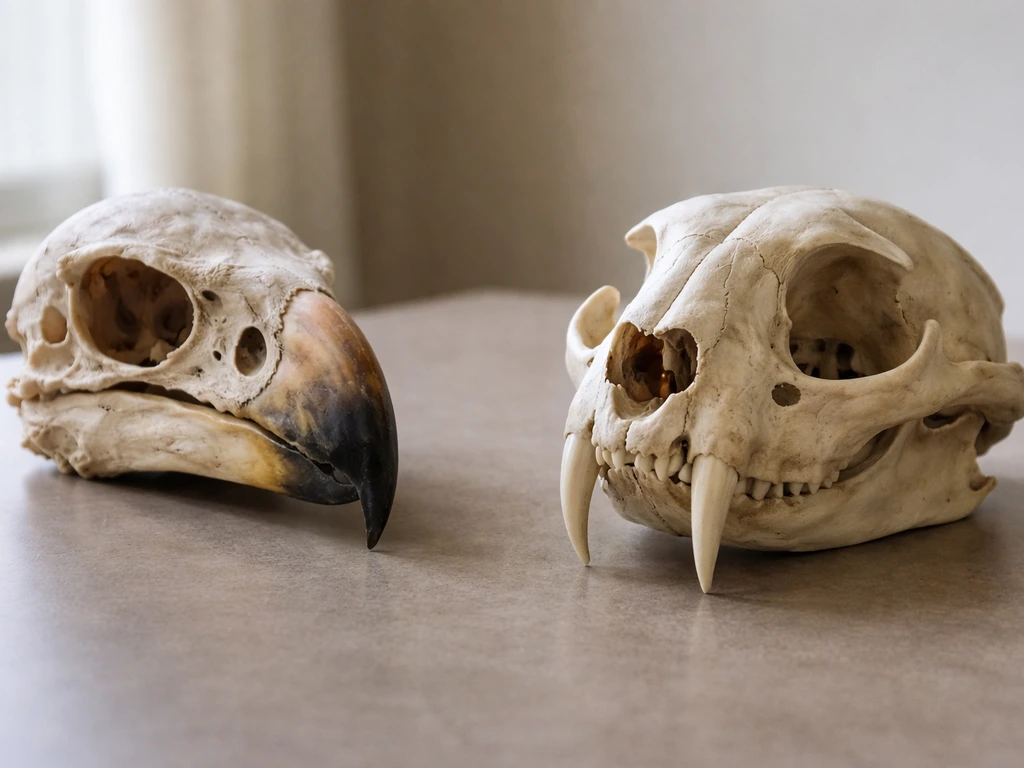
| Skull length | ~65 cm (enormous hooked beak) | ~30 cm, with canines up to 18–28 cm |
| Skull function | Reinforced for repeated axe-like strikes | Wide-gape killing bite with elongated canines |
| Limbs | Long, powerful cursorial legs; vestigial wings | Robust forelimbs with large paws for grappling |
| Bone structure | Avian (lighter, hollow) | Mammalian (denser, heavier) |
| Overall build | Tall, upright, fast-running predator | Low-slung, heavily muscled ambush predator |
Titanis, the North American terror bird, is estimated to have been heavier (possibly over 300 kg) based on fragmentary remains, though those estimates carry more uncertainty. Smilodon populator, the South American species, may have reached around 400 kg at the upper end. So if you're running the matchup with the largest known individuals from each group, the mass gap can close or even flip. But for a typical comparison, Smilodon fatalis versus Phorusrhacos is the most data-supported pairing, and Smilodon has the edge in raw mass and limb strength.
How each animal actually hunted
Terror bird: the hatchet-beak striker
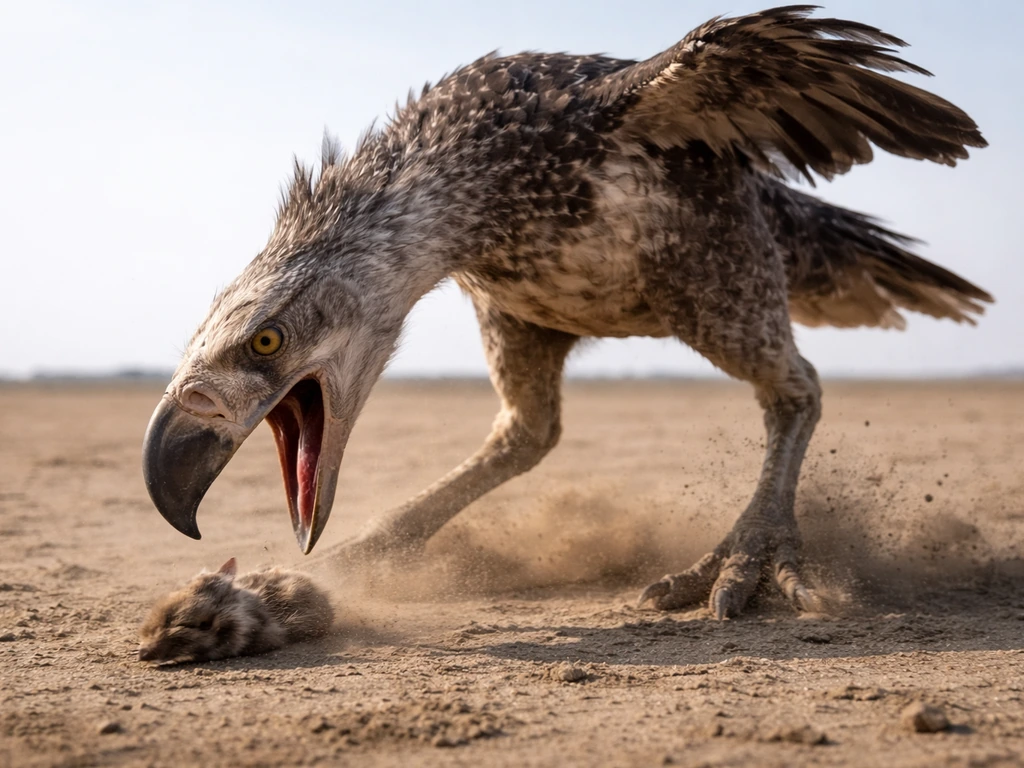
CT scan and biomechanical modeling work on phorusrhacid skulls has been remarkably revealing. Rather than a grip-and-tear attack style, terror birds appear to have used rapid, hatchet-like downward strikes with their beak tip as the primary weapon. The skull was reinforced to handle the compressive forces of repeated impact, but it was not well-suited to side-to-side twisting or sustained grip. The attack pattern reconstructed from the fossil record is more like a boxer jabbing with a pickaxe than a crocodile death-rolling its prey. They would strike, retreat, and strike again, delivering precision puncture wounds to vulnerable areas. Their long, powerful legs supported fast pursuit or evasive movement between strikes, and fossil footprint evidence confirms a functionally didactyl (two-toed dominant) cursorial posture built for running.
Saber-toothed cat: the ambush grappler
Smilodon's killing mechanics centered on a very different set of constraints. Those elongated canines required a wide gape to deploy properly, and biomechanical models of Smilodon fatalis show that the jaw mechanics were optimized for a specific killing bite rather than sustained chewing pressure. The canines were likely used to deliver a deep stab to soft tissue, particularly the throat, once prey was immobilized. The forelimbs were heavily built compared to modern big cats, consistent with holding struggling prey in place before the killing bite landed. Smilodon is generally reconstructed as an ambush predator suited to more closed, vegetated habitats, in contrast to genera like Homotherium, which showed adaptations more consistent with open-ground pursuit.
Where and when they lived
This is where the 'fight' premise gets complicated. Phorusrhacids were primarily South American animals, thriving from the Eocene through the Pliocene. Their time as apex predators in South America was largely over by the time the Great American Biotic Interchange opened land connections to North America. Titanis did migrate northward and has been found in Florida and Texas during the early Pliocene to early Pleistocene, which creates at least a geographic and temporal window where it could have shared habitat with North American saber-toothed cats. Smilodon fatalis was present across North America through the late Pleistocene, and Smilodon populator lived in South America. So a true ecological overlap between a phorusrhacid and a Smilodon is geographically plausible only in a narrow window, primarily involving Titanis in North America. The classic pairing of Phorusrhacos versus Smilodon is more of a thought experiment, as Phorusrhacos was a Miocene animal and Smilodon is Pleistocene.
Prey and behavior: what each was built to catch
Terror birds occupied the large cursorial predator niche in a South American ecosystem that lacked the big mammalian carnivores found elsewhere. They likely targeted medium to large mammals, using their speed and beak strikes to take down prey that couldn't outrun them or absorb repeated puncture strikes. Their ecology is sometimes compared loosely to that of modern ground-hunting birds of prey, scaled up dramatically and freed from the constraints of flight. It's worth noting that a separate comparison of gastornis versus terror bird raises the question of whether all large flightless birds were predators at all, since Gastornis is now thought to have been herbivorous despite its size and powerful beak. A quick aside is that Gastornis vs terror bird is a different matchup, because Gastornis is now thought to have been largely herbivorous gastornis versus terror bird.
Smilodon, on the other hand, was hunting in ecosystems with megafauna: horses, ground sloths, young mammoths, and bison. Its robust build and ambush strategy were calibrated for large, struggling prey. The wide-gape killing bite only makes sense in the context of animals with substantial soft-tissue targets. Smilodon was not a pursuit specialist. It was a power predator that needed cover and surprise. Both animals were apex predators in their own contexts, which is precisely why the matchup is so interesting to think through.
The clash scenario: assumptions and realistic outcome
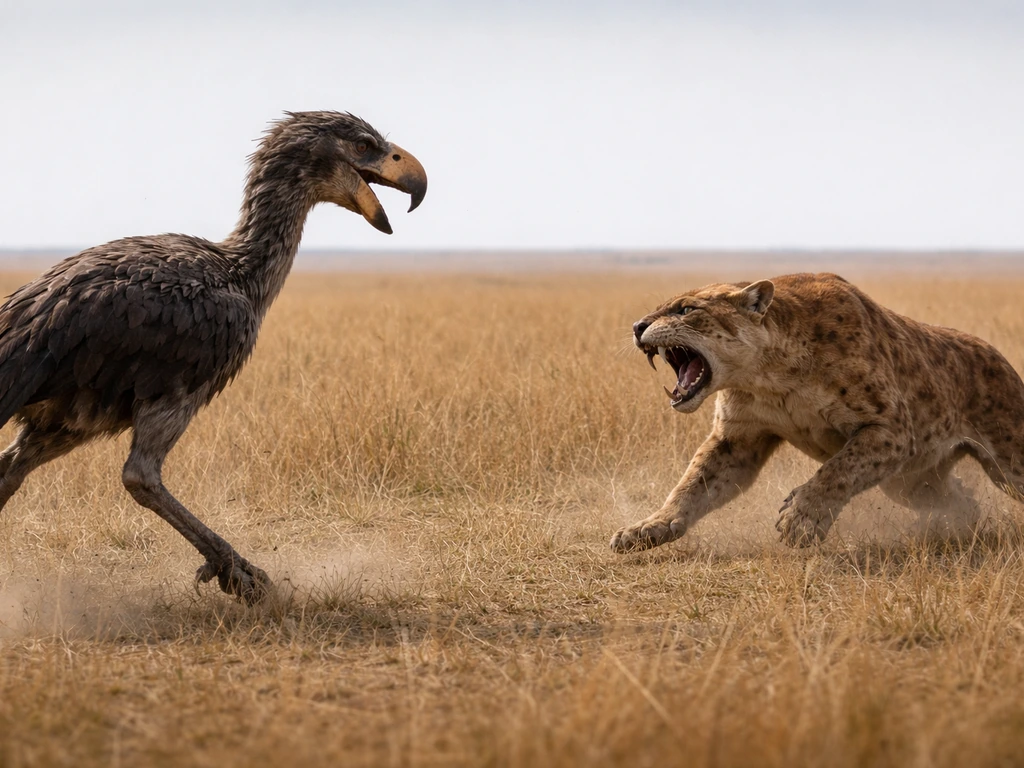
Let's be explicit about the assumptions here, because the outcome changes depending on what you specify. The most common version of this matchup pairs a mid-sized phorusrhacid (around 130 kg, say Phorusrhacos) against Smilodon fatalis (around 200 kg as a midpoint estimate). We're placing them in open-to-mixed terrain, neither animal has the ambush advantage, and both are healthy adults.
The terror bird's best-case scenario is keeping distance and using speed and beak strikes. At range, it can deliver significant damage with rapid downward strikes, and if it can stay mobile, it avoids the grapple. The problem is that Smilodon fatalis is not an animal that stays still and takes hits. Once contact is made, its forelimb strength gives it a realistic path to bringing the bird down or pinning a leg. Avian bones, even in a 130 kg bird, are structurally lighter than mammalian bones of equivalent size. A single controlled takedown by a 200 kg felid with strong forelimbs would be catastrophic for the bird.
If the terror bird lands consistent strikes before the cat closes distance, the dynamics shift. The beak can penetrate, and repeated strikes to the skull, neck, or spine could slow or disable even a large predator. But Smilodon's low center of gravity and powerful limbs make it harder to knock down or destabilize compared to upright prey. The realistic outcome in an open encounter: Smilodon has the edge due to greater mass, grappling ability, and skeletal robustness. In terrain that forces close quarters quickly, that edge becomes decisive. Give the terror bird space and the ability to disengage, and the matchup becomes much closer. If you want a clear terror bird vs dodo angle, it helps to compare how each species’ anatomy and hunting style would favor different kinds of engagements the matchup becomes much closer.
Scale the terror bird up to Titanis at 300 kg or more, and the mass advantage narrows or disappears. That version of the matchup is genuinely too close to call with confidence given how fragmentary the Titanis material is.
Pop culture versus real biology: how media gets this wrong
Both of these animals get systematically misrepresented in movies, games, and documentaries, and the mistakes tend to compound each other when they appear in the same matchup. People often mix up terms like death bird versus death rite bird when describing extinct predators, so it helps to separate correct naming from pop-culture phrasing death bird vs death rite bird.
- Terror birds in media are often shown as fast, gorilla-scaled killing machines with almost magical agility. The real biomechanical picture is more nuanced: they were likely fast and used precision strikes, but their beak was not an omnidirectional weapon and their bone structure was avian, not mammalian.
- The 'sabertooth tiger' label makes Smilodon sound like a giant version of a Bengal tiger. It wasn't. Smilodon was in a completely separate subfamily (Machairodontinae) with a fundamentally different killing mechanism, shorter limbs relative to body size, and a more ambush-focused lifestyle than modern tigers.
- Media matchups often show these two animals living side by side in a generic 'Ice Age' landscape. The actual overlap in space and time between phorusrhacids and saber-toothed cats is limited and specific, not universal.
- Smilodon's canines are often portrayed as primary slashing weapons used in open combat. The functional evidence points toward a precision killing bite delivered to immobilized prey, not a swiping sword attack.
- Terror bird media depictions sometimes blend traits from different phorusrhacid genera or even confuse them with other large flightless birds. A quick check: if the beak is large, strongly hooked, and the bird is clearly flightless with robust legs, you're looking at a phorusrhacid. If the beak is more parrot-shaped or the proportions don't match, it may be a different animal entirely (or an inaccurate reconstruction).
If you're trying to verify what you're looking at in a specific piece of media or a museum display, check the genus name first. For the bird: is it explicitly labeled as a phorusrhacid or one of the named genera (Phorusrhacos, Titanis, Andalgalornis, Kelenken)? For the cat: does it say Smilodon, Homotherium, or another machairodontine? If the source just says 'terror bird' or 'saber-toothed tiger' without a genus, take the portrayal with some skepticism. Cross-referencing with the actual subfamilies (Machairodontinae for the cats, Phorusrhacidae for the birds) will tell you quickly whether the depiction is grounded in real taxonomy or just borrowing the aesthetic.
This kind of animal-versus-animal comparison is genuinely fun to work through, and the terror bird is one of the most underrated predators in the fossil record. If you're interested in how terror birds stacked up against other prehistoric and modern animals, comparisons like terror bird versus human and gastornis versus terror bird dig into some of the same anatomical and ecological questions from different angles.
FAQ
Which exact terror bird species gives the most “fair” match-up against Smilodon fatalis?
If you want the least speculative comparison, use a mid-sized, well-documented phorusrhacid pairing with Smilodon fatalis rather than the biggest outlier. The article’s most data-supported pairing is Phorusrhacos versus Smilodon fatalis because it relies on a better geographic and temporal context than the classic head-to-head with Titanis, whose mass estimates are more fragmentary.
Does “saber-tooth tiger” change anything about how Smilodon would fight a terror bird?
It matters mainly for understanding anatomy, not for the fight mechanics. “Tiger” implies Panthera traits, but Smilodon was a machairodontine felid with very different jaw and forelimb specialization, so you should think in terms of Smilodon’s wide-gape killing bite and pinning forelimbs rather than modern tiger behavior.
Who wins if the terror bird gets the first strike?
First contact helps the terror bird, but it is not usually enough on its own in an open-to-mixed encounter. The beak can cause serious puncture damage if it lands repeated downward strikes before the cat closes, however once Smilodon reaches grappling range its forelimb strength and lower, more stable build become decisive.
What changes most if the fight happens in dense forest versus open grassland?
Dense habitat tends to favor the ambush/grapple specialist. Smilodon’s strategy is calibrated for cover and surprise, while the terror bird’s best plan depends on staying mobile at distance and repeatedly striking without being locked into close contact. Forest or brush that forces quick closing generally swings odds toward Smilodon.
Could Titanis realistically beat Smilodon fatalis if Titanis was truly over 300 kg?
It becomes too uncertain to call confidently because Titanis remains poorly sampled. The fragmentary remains introduce large uncertainty in mass and build, so if you assume Titanis is heavier and well-muscled, the mass advantage can shrink or disappear, but confidence stays low compared with Phorusrhacos versus Smilodon fatalis.
Are the beak strikes enough for the terror bird to “death-bite” through Smilodon’s defenses?
Not in the way a cat’s teeth-and-jaws kill. The terror bird’s reconstructed approach is rapid puncture or compressive impacts, but it is not described as a sustained grapple-and-tear weapon. If the beak cannot prevent closure, Smilodon’s ability to pin and land its optimized killing bite becomes the higher-probability outcome.
How much does terrain or ground type matter for the terror bird’s running strikes?
A lot, because its primary advantage is mobile strike-and-retreat behavior supported by long, powerful legs. On rough, uneven, or cluttered ground where it cannot easily disengage between jabs, it loses the key element of its best-case plan, making close quarters more likely and thus improving Smilodon’s chances.
What’s a common mistake when comparing these two animals in media?
Treating “terror bird” and “saber-toothed tiger” as single, universal animals. Both labels cover multiple genera with different sizes and anatomy, so a depiction that does not specify the genus (for example, whether the bird is a named phorusrhacid like Phorusrhacos or Titanis, and whether the cat is Smilodon) can be misleading in a specific fight scenario.
If I’m trying to identify an exhibit or character, what details should I check first?
Check the genus label or the scientific wording used. For birds, look for phorusrhacid phrasing or named genera such as Phorusrhacos or Titanis, and for cats look for Smilodon or another machairodontine genus like Homotherium. If the source only uses generic labels like “terror bird” or “saber-toothed tiger” without genus-level info, treat the portrayal as uncertain.
Does this matchup depend on age or health of the animals?
Yes, but it is often ignored. The article assumes healthy adults, and that assumption matters because Smilodon’s forelimb function and the effectiveness of its killing bite depend on prey being immobilized well enough to hit a deep target area. An injured or weaker adult in either species would shift the odds toward whichever animal can capitalize on impaired movement or delayed closure.
Next Articles
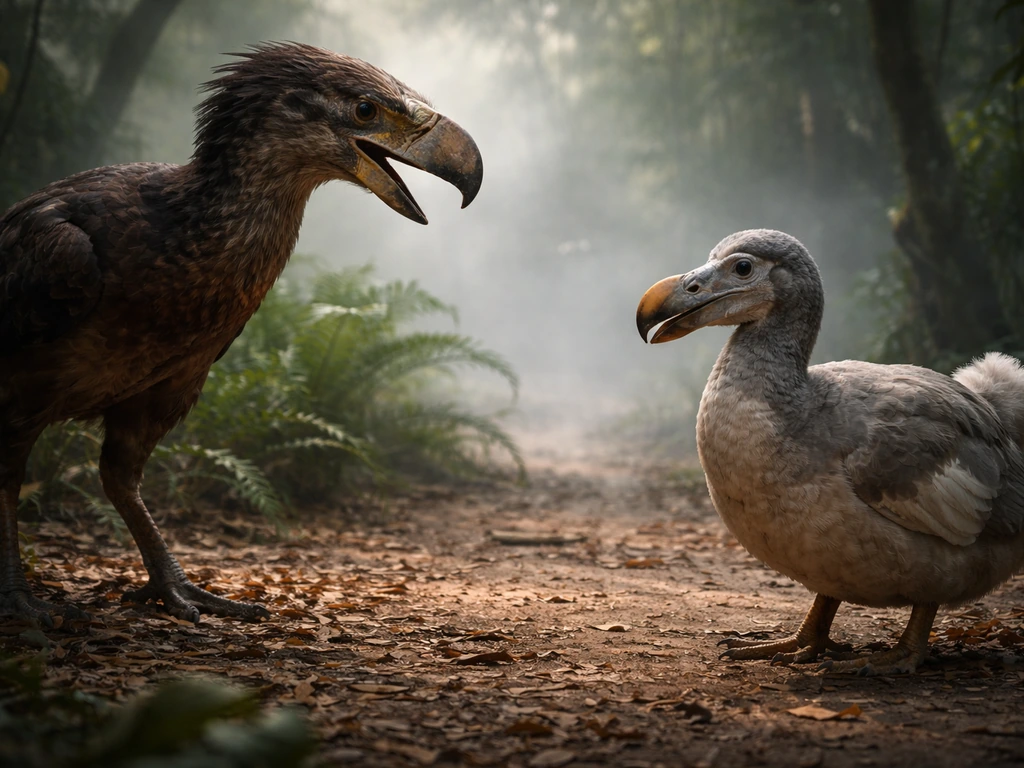
Terror Bird vs Dodo: Key Differences and How to Tell Them Apart
Compare terror birds and dodos: key differences in era, habitat, anatomy, diet, and why humans drove dodo extinction.
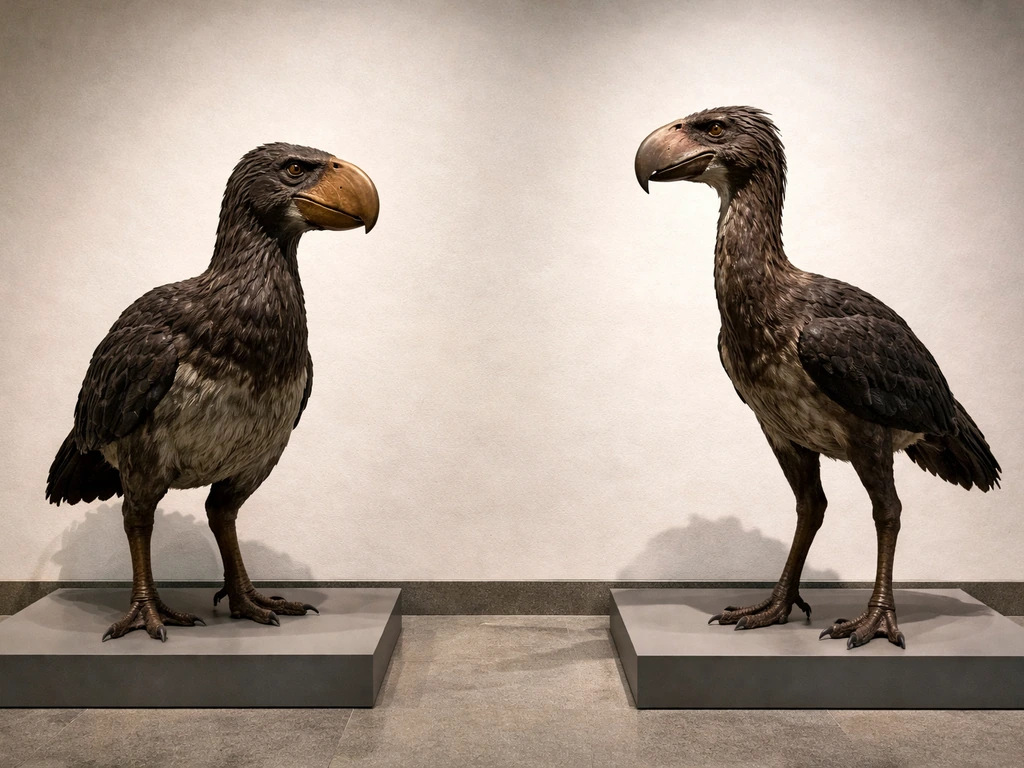
Gastornis vs Terror Bird: Key Differences, Diet, and Checklist
Gastornis vs terror bird comparison: diet, size, skull traits, habitats, and a quick checklist to tell them apart.
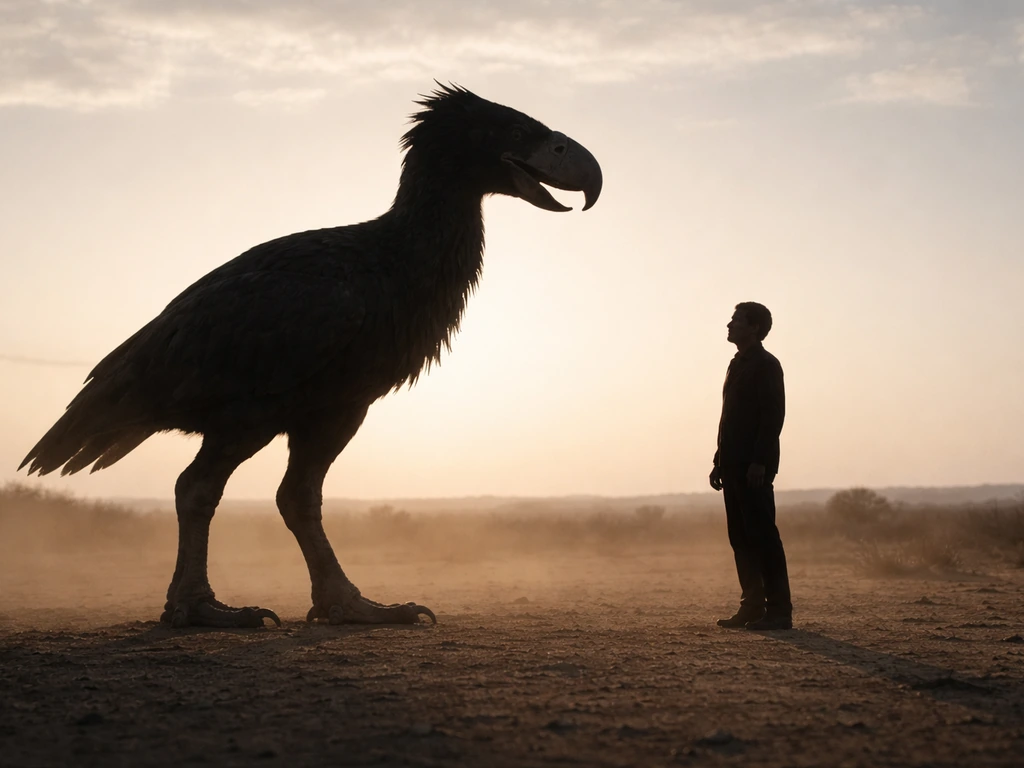
Terror Bird vs Human: Size, Diet, Movement, and Facts
Terror bird vs human comparison: size, beak and claws, movement and diet, plus what fossils do and don’t show about atta