
A terror bird and a dodo have almost nothing in common except that both couldn't fly. One was a hulking, hooked-beaked apex predator that stalked South America for tens of millions of years. The other was a plump, gentle, fruit-eating pigeon relative that lived on a single island and was wiped out within decades of humans arriving. If you can hold onto that core contrast, you already know the most important thing about this comparison.
Terror Bird vs Dodo: Key Differences and How to Tell Them Apart

Marcus Hendricks
27 May 2026
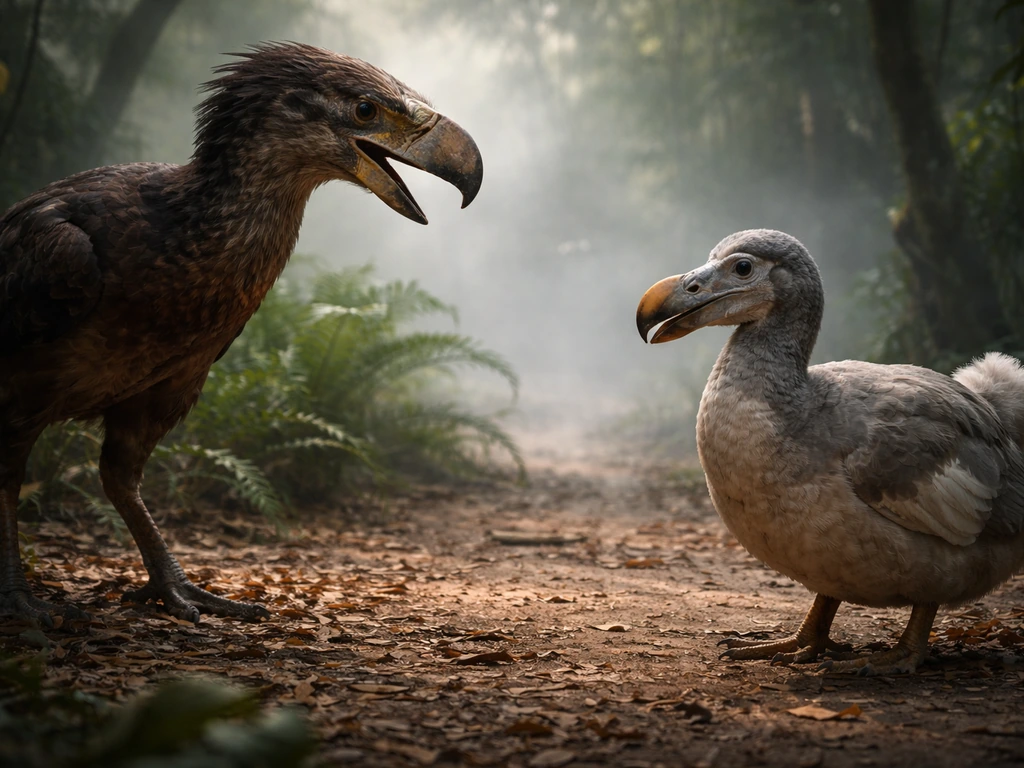
Quick IDs: What Is a Terror Bird, and What Is a Dodo?
The term 'terror bird' refers to the family Phorusrhacidae, a group of extinct, mostly flightless predatory birds that belong to the order Cariamiformes. Their only living relatives today are the seriemas, small hawk-like birds from South America. Phorusrhacids were large terrestrial hunters, and the 'terror' part of their name is entirely earned. These were not prey animals.
The dodo (Raphus cucullatus) is a completely different kind of bird. Taxonomically, it sits within the pigeon and dove family (Columbidae), making it essentially a giant, flightless pigeon. blank" rel="noopener noreferrer">It was endemic to the island of Mauritius in the Indian Ocean, east of Madagascar. It ate fruit and seeds, posed no threat to anything, and had zero defensive instincts against land predators because none existed in its environment before humans arrived.
| Trait | Terror Bird (Phorusrhacidae) | Dodo (Raphus cucullatus) |
|---|---|---|
| Family/Order | Phorusrhacidae, Cariamiformes | Columbidae (pigeon family) |
| Living relatives | Seriemas (Cariamidae) | Pigeons and doves |
| Role in ecosystem | Apex predator | Frugivore/omnivore |
| Geographic range | Primarily South America | Mauritius only |
| Time period | Eocene to late Pleistocene | Known to humans from ~1598 to ~1662–1690 |
| Extinction cause | Climatic/ecological changes | Human activity and introduced species |
When and Where They Lived

Terror birds dominated much of the Cenozoic era in South America, with a fossil record stretching from the Eocene all the way through the late Pleistocene. A well-documented specimen, Phorusrhacos longissimus, comes from the Santa Cruz Formation in Santa Cruz Province, Argentina, dating to the late early Miocene. The last confirmed terror bird fossils come from the late Pleistocene of Uruguay, meaning these animals roamed Earth for an extraordinary span of time. Evidence of phorusrhacids has also been found in Colombia, suggesting they ranged widely across South America rather than being confined to one area.
The dodo's entire world was Mauritius, a single island roughly 65 kilometers wide. There is no fossil record of dodos elsewhere. The dodo is not a prehistoric animal in the deep-time sense; it was a living species that European sailors first documented in 1598. Most of what we know about its physical form comes from subfossil bones, particularly from a site called Mare aux Songes in southern Mauritius, which has yielded the largest concentration of dodo bones ever found. Those bones have been used in mass-estimation studies and diet reconstructions that give us our clearest picture of the bird.
In terms of habitat, dodos were not strictly coastal birds despite what most old illustrations suggest. The evidence from Mare aux Songes and associated plant remains points to dodos living in forest and scrub-forest environments, including wet-forest plant communities at low elevation. A review of the dodo and its ecosystem reconstructs the Mare aux Songes area as part of wet-forest plant communities within a broader drier coastal-zone setting at low elevation wet-forest plant communities at low elevation. Terror birds, by contrast, occupied open to semi-open terrestrial environments across a continent, ranging from grassland-adjacent zones to a variety of South American Cenozoic landscapes.
Anatomy and Appearance: How to Tell Them Apart at a Glance
Body size alone is a huge tell. The largest terror birds, like Titanis and Kelenken, stood roughly 1.5 to 3 meters tall and could weigh several hundred kilograms. Even smaller phorusrhacids were formidable, athletic animals built for speed and striking. The dodo, by contrast, was approximately 1 meter tall and weighed somewhere in the range of 10 to 18 kilograms based on bone-based mass estimates. It was a chunky, round-bodied bird with small, stubby wings and relatively short legs.
The most visually striking difference is the skull and beak. Terror birds had high, narrow, elongated skulls with beaks that ended in a pronounced downward hook, described in biomechanical research as adapted for powerful striking and prey processing. Biomechanical modeling of one terror bird species, Andalgalornis steulleti, showed a skull optimized for strength rather than flexibility, consistent with a strike-and-retreat hunting strategy where the bird used its hooked beak like a hatchet. The dodo's beak was large relative to its head but hooked in a gentler, rounded way, better suited for cracking open hard fruit than dispatching prey.
- Terror bird: tall (up to 3 m), long-legged, lean and muscular, hooked predatory beak, rigid powerful skull
- Dodo: short (~1 m), round and heavy-bodied, small vestigial wings, large rounded hooked beak for fruit, bulky torso
- Terror bird legs: long, cursorial (built for running), with a functionally didactyl (two-toed) posture inferred from trackways
- Dodo legs: short and sturdy, built for walking slowly on a predator-free island, not sprinting
- Terror bird wings: vestigial but the animal was built as a ground sprinter, not a slow wanderer
- Dodo wings: tiny, functionally useless, no selective pressure to maintain them in a predator-free environment
Diet and Daily Life: Predator vs. Peaceful Forager
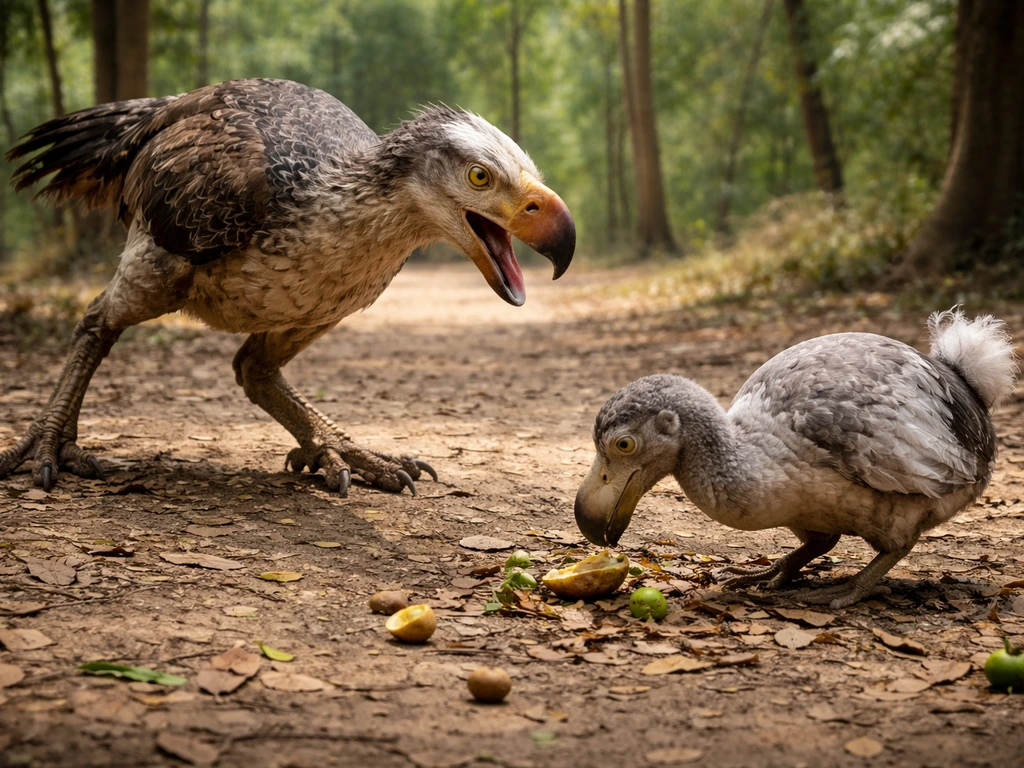
Terror birds were apex predators. Their feeding biomechanics were built for delivering powerful blows to prey rather than holding and tearing like a mammalian predator might. Studies on Andalgalornis specifically describe a system optimized for strength, with the bird likely using rapid strikes to dispatch prey before processing it. These were not patient ambush hunters waiting in trees; they were fast, ground-level pursuit predators on open terrain, using long hindlimbs to close distance quickly.
The dodo's daily life looked nothing like that. Dodos fed on fallen fruits, seeds, roots, and possibly invertebrates, using a large gizzard reinforced by swallowed stones (gizzard stones) to grind up hard food items. Isotopic and collagen analysis from subfossil bones has helped researchers reconstruct a diet rooted in the plant material available in Mauritius forest environments. These birds had no reason to be aggressive; they evolved in isolation from land predators entirely, which is a key reason they were so easy for humans and introduced animals to exploit.
Flight, Flightlessness, and How They Moved
Both animals were flightless, but the reasons and consequences of their flightlessness are completely different. Terror birds lost flight as they evolved into large terrestrial predators, and their locomotion compensated more than adequately. Hindlimb morphometry research indicates that many phorusrhacids were cursorial, meaning they were built for running. Fossil trackways have revealed a functionally didactyl (two-toed) footprint posture, pointing to an active, high-speed terrestrial lifestyle. Being flightless wasn't a disadvantage for a terror bird; it was part of the package that made them effective predators on the ground.
The dodo's flightlessness is a classic case of island evolution. With no predators on Mauritius, there was no evolutionary pressure to maintain expensive flight muscles and wings. Over generations, the dodo's wings became vestigial stubs and its body became heavy and rounded. It walked slowly through forest habitat, which was perfectly fine until humans and their accompanying animals changed everything. Flight, or the lack of it, didn't matter until the threat landscape changed overnight.
Humans and Extinction: Very Different Stories

The dodo's extinction is one of the most documented human-driven extinctions in history. Dutch settlers arrived on Mauritius in the late 1600s, and though the human population on the island never exceeded around 50 people at any one time, the real damage came from what they brought with them. Dogs, pigs, cats, rats, and crab-eating macaques were introduced to the island, and these animals raided dodo nests, ate eggs and chicks, and competed for food resources. The dodo nested on the ground, had no fear response to land animals, and reproduced slowly. It had no chance.
The last widely accepted sighting of a living dodo was recorded in 1662 by shipwrecked mariner Volkert Evertsz. By that point, the species was already extremely rare. Some extinction date estimates put the final individuals as late as around 1690 depending on the statistical model used, but either way, it was gone within roughly a century of first European contact. Britannica cites 1681 as a commonly used extinction date.
Terror birds have an entirely different extinction story. They died out tens of thousands of years before modern humans existed in their range, so there is no human culpability here. Their extinction is discussed in the context of Cenozoic ecosystem change, including climatic shifts and ecological restructuring, particularly as South America's environments transformed over millions of years. The last terror birds from Uruguay's late Pleistocene record still predate any meaningful human presence in those regions. If you're comparing 'human impact' on these two animals, only one of them has that story.
Myths, Misconceptions, and Common Confusion
The most common mistake people make is assuming terror birds and dodos were somehow contemporary or similar just because both were flightless. This terror bird vs human contrast highlights how the terror bird's threat came from its hunting niche, while the dodo's vulnerability came from human and introduced-animal pressure. They weren't. Terror birds lived tens of millions of years before dodos evolved, on different continents, in completely different ecological roles. Calling them similar because they're both flightless is like saying a domestic cat and a lion are the same because neither lives in the ocean.
Another frequent confusion involves the term 'terror bird' itself. Taxonomically, it refers specifically to Phorusrhacidae. The name has been loosely applied in popular writing to various large scary prehistoric birds, which muddies the water. If you see 'terror bird' in a serious scientific context, it means phorusrhacids, not unrelated animals like Gastornis or other large Cenozoic birds. The comparison between Gastornis and terror birds is worth exploring separately, as they're often confused for each other despite being quite different.
A persistent myth about dodos is that they were strictly beach or shoreline birds. That image comes partly from early sailor accounts and old illustrations, but bone evidence and associated plant fossils from Mare aux Songes point clearly to forest and scrub-forest habitat. Dodos were woodland animals, not beach wanderers. Another misconception is that dodos were simply too 'stupid' to survive. They weren't stupid; they were unadapted to a threat that had never existed in their evolutionary history. That's a very different thing.
| Myth | Reality |
|---|---|
| Terror birds and dodos were alive at the same time | Terror birds were gone long before dodos evolved; they lived millions of years apart |
| Both are similar because both are flightless | Flightlessness is the only commonality; their size, diet, behavior, and lineage are completely unrelated |
| 'Terror bird' applies to any scary prehistoric bird | It refers specifically to Phorusrhacidae (Cariamiformes); other large birds like Gastornis are separate groups |
| Dodos lived on beaches | Dodos were forest and scrub-forest dwellers based on bone site evidence and associated plant remains |
| Dodos went extinct because they were too stupid | They had no evolved defenses against land predators because none existed on Mauritius before humans arrived |
| Humans drove terror birds extinct | Terror birds went extinct due to ecological and climatic changes long before humans reached their range |
The One-Paragraph Version If You Need It Fast
Terror birds were giant, hooked-beaked, cursorial predators from South America that dominated their ecosystems across tens of millions of years of the Cenozoic, belonging to the family Phorusrhacidae and related to today's seriemas. Dodos were small, round, fruit-eating flightless pigeons from the single island of Mauritius, driven extinct by humans and introduced animals within decades of first contact in the late 1600s. The only thing they share is flightlessness, and even that evolved for completely different reasons. Keep those two sentences in mind and you'll never mix them up again.
Where to Go Next
If this comparison sparked more questions, there are some natural directions to explore. Looking at how terror birds compare to other prehistoric predatory birds like Gastornis is a great next step, since those two are frequently confused in popular media despite belonging to different groups entirely. You can also dig into how terror birds would have stacked up against other megafauna of their era, including prehistoric mammals.
If you want a quick reality check, a terror bird vs sabertooth matchup highlights how different ecosystems and hunting styles shape what these animals could do. On the dodo side, understanding how island evolution produces flightless birds across completely unrelated lineages (rails, pigeons, parrots) gives you a much richer picture of why the dodo looked the way it did.
When you're reading about either animal, look for the taxonomic family name as your anchor: Phorusrhacidae for terror birds, Columbidae for the dodo. Those two labels will keep you oriented no matter how loose the popular writing gets.
FAQ
Were terror birds and dodos alive at the same time?
No. A dodo is a specific species in the pigeon and dove family (Columbidae), and it lived only on Mauritius. A “terror bird” is a broader family (Phorusrhacidae) of multiple predatory bird species in South America, with a fossil record spanning tens of millions of years. So they are not just different animals, they are different types of birds from different evolutionary branches and time scales.
How can I tell if a source is using “terror bird” correctly?
If you see a “terror bird” in popular media, check whether it is actually using the scientific family name Phorusrhacidae. The term is sometimes used loosely for other large scary birds, but taxonomically those are not the same group as phorusrhacids. A reliable approach is to identify the family label first, then the continent and habitat claims second.
What visual traits are best for distinguishing them when artwork is simplified?
Beak shape is useful, but don’t rely on it alone. Terror birds also had skull profiles and neck and jaw leverage consistent with rapid, strength-focused striking, while dodos had a more rounded, fruit-cracking style and a body plan for slow walking through forest and scrub. If an image shows a hooked beak but also claims a mammal-like prey-handling lifestyle, it may be mixing up groups.
Were terror birds slow because they were flightless?
The footprint evidence points to active running in many phorusrhacids, which matters for interpreting “flightless.” In other words, they were not simply big ground birds, they had locomotion built for chasing down prey on open to semi-open terrain. If a description treats terror birds as slow scavengers, it is likely oversimplified.
Why were dodos so vulnerable to introduced animals?
Dodos were not defensive in the way people imagine because they evolved without land predators on Mauritius. “No fear response” does not mean they were helpless, it means they lacked the evolutionary pressure for behaviors and instincts that would help against dogs, pigs, cats, rats, and other introduced animals. Their nesting on the ground and slow reproduction amplified that vulnerability.
Did dodos live anywhere besides Mauritius?
No fossil dodo bones are known from anywhere beyond Mauritius, so “dodo” claims for other locations are usually incorrect or referring to different island birds. If a text mentions another region, treat it as a red flag and look for whether it still anchors the species name to Mauritius.
Were dodos strictly coastal or beach birds?
Not really. Dodos are often drawn as shoreline birds, but the strongest evidence supports forest and scrub-forest living, including wet-forest plant communities at low elevation. When someone describes them only as coastal scavengers, it conflicts with the habitat reconstruction based on bones and associated plant remains.
Did all terror birds live across the whole Cenozoic in South America at once?
Terror birds typically show up in discussions as continent-level predators across South America, but a single species range is not the whole story. Even when fossils are widespread across the region, you can still get local differences in time period and species identity. So the right comparison is “South America broadly” versus “Mauritius only,” not “one terror bird species everywhere.”
Why do size estimates for terror birds and dodos vary across books?
When estimating size from fossils, mass can vary because models depend on bone proportions and assumptions about body shape. That is why you will see ranges rather than one exact weight for both groups. Use size as a directional check, not a precise ID tool, and combine it with beak and skull morphology.
What is the fastest way to avoid mixing them up?
The quickest decision aid is taxonomic anchoring: Phorusrhacidae for terror birds (predatory, hooked-beaked, South America, long deep-time span), Columbidae for the dodo (giant flightless pigeon, Mauritius, fruit and seed diet, human-driven extinction). If a claim does not match both the family label and the geography, pause before accepting it.
Next Articles
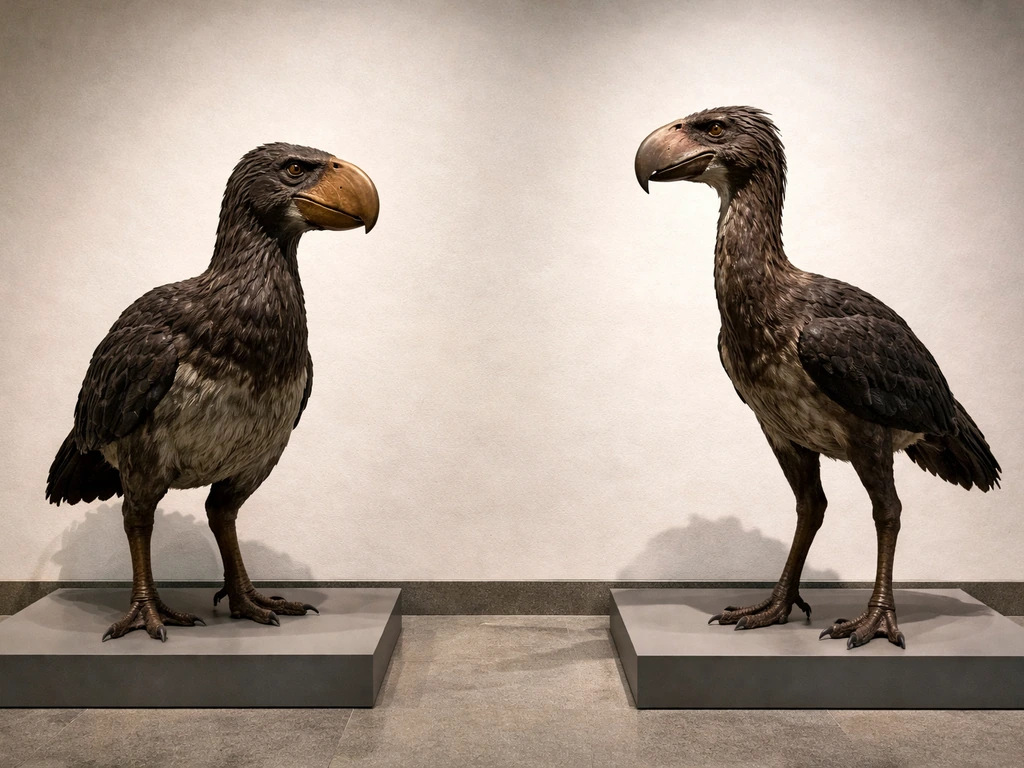
Gastornis vs Terror Bird: Key Differences, Diet, and Checklist
Gastornis vs terror bird comparison: diet, size, skull traits, habitats, and a quick checklist to tell them apart.
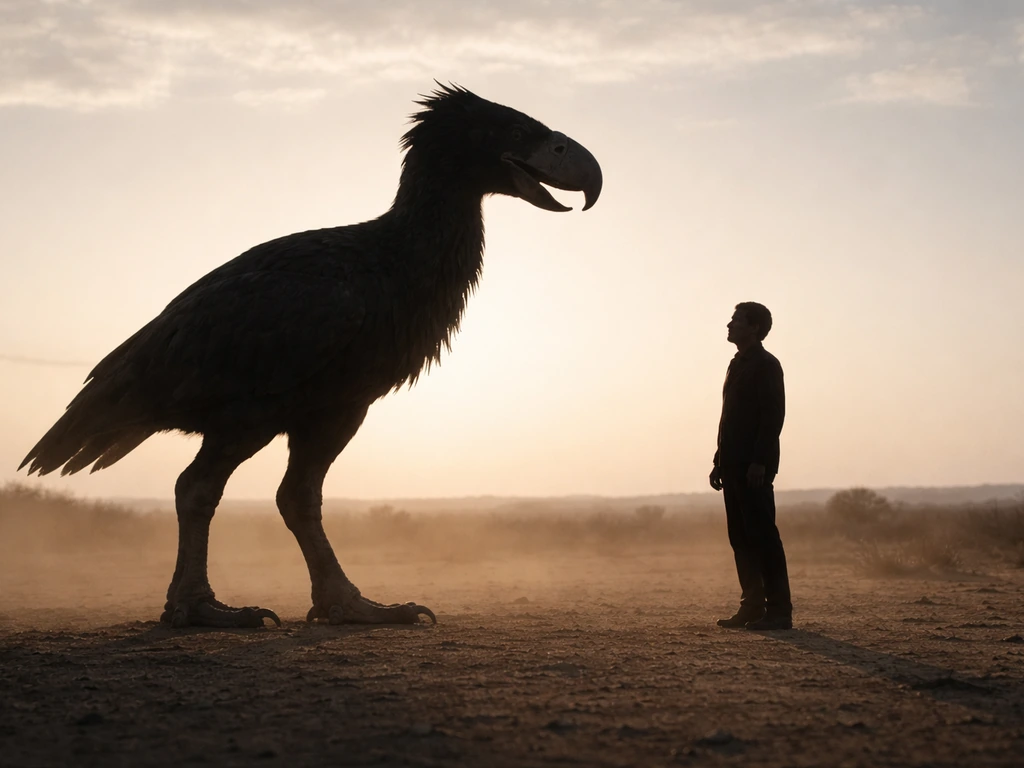
Terror Bird vs Human: Size, Diet, Movement, and Facts
Terror bird vs human comparison: size, beak and claws, movement and diet, plus what fossils do and don’t show about atta
Godzilla vs Kong Bird: Identify the Exact Bird Lookalike
Disambiguate and ID the exact bird behind searches like Godzilla vs Kong bird using field marks, habitat, range, behavio