Terror birds were not dinosaurs, and raptors are not birds, so right away the comparison gets tangled. Phorusrhacids, the real "terror birds," were giant carnivorous birds that ruled South America millions of years after the dinosaurs vanished. Utahraptor, Velociraptor, and T. rex were dinosaurs that lived tens of millions of years earlier, on entirely different continents, in entirely different ecosystems. They never crossed paths. But the "who would win" question is genuinely interesting, and working through the anatomy, hunting style, and size differences gives you a clear, evidence-based answer for each matchup.
Terror Bird vs Utahraptor and Other Raptors: A Clear Guide

Marcus Hendricks
1 May 2026
What people usually mean by "terror bird" and "raptor"
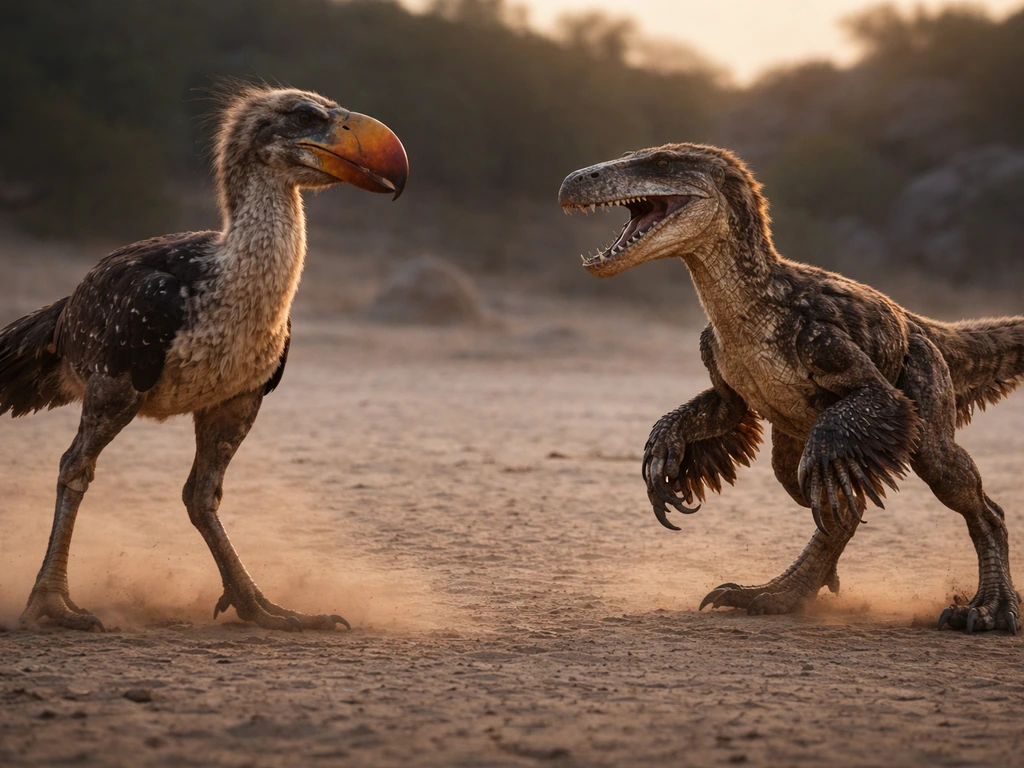
"Terror bird" almost always refers to the family Phorusrhacidae, a group of large, mostly flightless carnivorous birds that lived during the Cenozoic era, primarily in South America. They were apex predators in their ecosystems, with powerful hooked beaks, strong legs, and vestigial wings that were useless for flight but may have helped with balance or striking. The most famous genera include Kelenken (Middle Miocene), Andalgalornis (Late Miocene, Argentina), and Titanis, which actually migrated into southern North America during the Great American Interchange and may have been among the last phorusrhacids to survive into the Pleistocene.
"Raptor" is a word that does double duty and that's exactly where the confusion starts. If you extend the comparison beyond dinosaurs and raptors, it becomes just as interesting to ask how a terror bird vs shoebill matchup would play out. In everyday bird-watching, raptor means a bird of prey: hawks, falcons, eagles, owls. But in dinosaur paleontology and popular culture, raptor almost always means dromaeosaurid dinosaurs, the group that includes Velociraptor and Utahraptor. These were feathered, bipedal predators with a signature enlarged sickle-shaped claw on the second toe of each foot. When someone searches "terror bird vs raptor," they almost certainly mean the dinosaur kind, not a modern hawk.
Quick visual ID: size, head, beak, claws, and posture
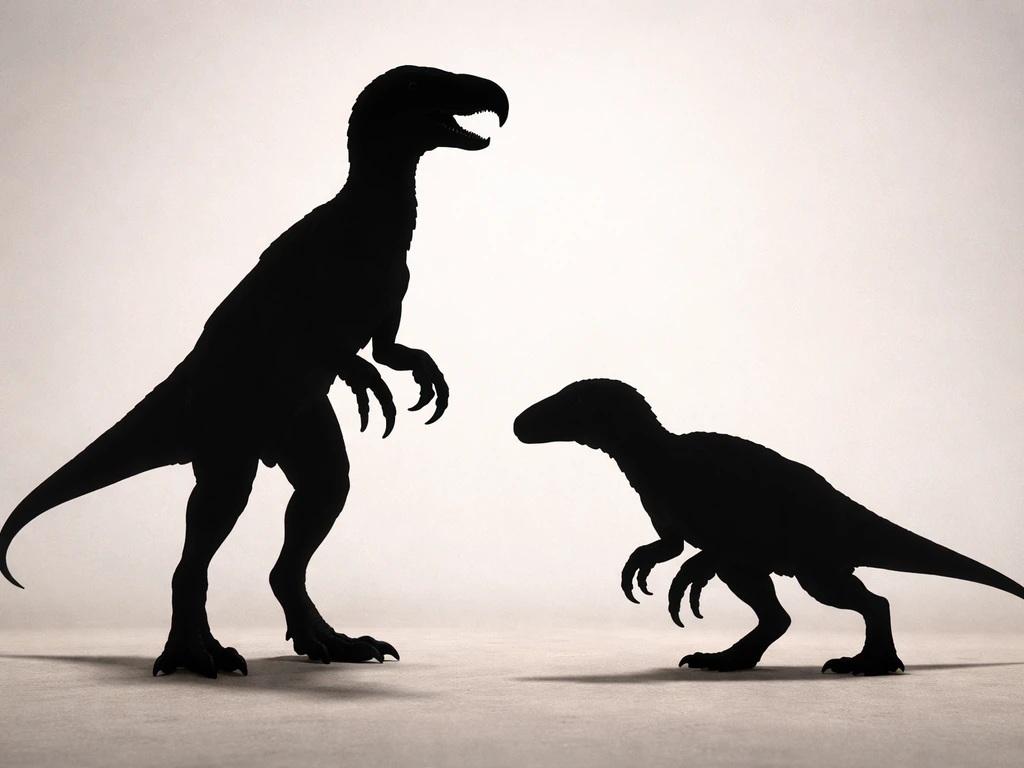
Lining these animals up visually makes the differences immediate. Terror birds stood upright like an oversized, heavily built ostrich but with a massive hooked beak instead of a flat bill. Andalgalornis, one of the better-studied species, weighed around 40 kg, while Kelenken and Titanis pushed significantly larger. The skull of a terror bird was almost comically large relative to its body, with a deep, strongly hooked rostrum optimized for delivering powerful downward strikes. Biomechanical analysis of Andalgalornis using finite element analysis showed that its skull was extraordinarily rigid, distributing stress well during axial biting (like driving the beak straight down) but poorly during lateral pulling, suggesting a hatchet-like strike rather than shaking prey side to side.
Dromaeosaurids looked nothing like this. Velociraptor was roughly turkey-sized, feathered, with a long stiffened tail for balance, a narrow snout lined with serrated teeth, and grasping hands with curved claws. Utahraptor was far larger, closer to the size of a grizzly bear, with a body mass estimated around 290 kg. Its signature feature was the enlarged sickle claw on each second toe, which trackway and skeletal evidence suggests was held off the ground during normal walking to keep it sharp, only deployed during prey capture. T. rex, for comparison, was in a completely different size bracket: up to roughly 9 meters long and weighing around 8,000 to 14,000 kg, with tiny forelimbs and a skull built for bone-crushing bites.
| Animal | Group | Approx. Body Mass | Key Weapon | Beak or Teeth |
|---|---|---|---|---|
| Andalgalornis | Phorusrhacid (bird) | ~40 kg | Hooked beak, powerful legs | Hooked beak, no teeth |
| Titanis / Kelenken | Phorusrhacid (bird) | ~130–170 kg (est.) | Hooked beak, powerful legs | Hooked beak, no teeth |
| Velociraptor | Dromaeosaurid (dinosaur) | ~15–20 kg | Sickle claw + teeth | Serrated teeth |
| Utahraptor | Dromaeosaurid (dinosaur) | ~290 kg | Sickle claw + teeth + grasping hands | Serrated teeth |
| Tyrannosaurus rex | Tyrannosaurid (dinosaur) | ~8,000–14,000 kg | Massive bone-crushing jaws | Large serrated teeth |
How they hunted: hatchet strikes vs prey restraint
Terror birds and dromaeosaurids hunted in fundamentally different ways, and understanding that is the key to any realistic comparison. The biomechanical evidence for Andalgalornis points to an ambush-and-strike strategy: the bird would likely chase down prey using its powerful legs (they were fast runners), then deliver rapid, axial downward strikes with the rigid hooked beak, essentially using its skull like a hatchet. The bite force itself was relatively modest at around 133 Newtons for Andalgalornis, but the force came from the whole-body momentum of the strike, not from static bite pressure alone. The skull's resistance to side-loading means it probably did not try to grip and shake prey like a crocodile.
Dromaeosaurids used a model researchers call "raptor prey restraint." The leading hypothesis, supported by functional morphology and comparisons to modern accipitrid raptors (hawks and eagles), is that dromaeosaurids leaped onto prey, pinned it with body weight, gripped with the sickle claws (which worked more like talons than slashing blades), and then used their toothed jaws to bite and dismember while the prey was restrained. A 2019 musculoskeletal modeling study of dromaeosaurid “sickle claws” supports the idea that after leaping onto prey, the claws helped pierce and grip to hold struggling prey before the animal delivered bites blank" rel="noopener noreferrer">gripped with the sickle claws. The blank" rel="noopener noreferrer">Fighting Dinosaurs specimen, a Velociraptor preserved locked in combat with a Protoceratops, and tooth-marked Protoceratops bones associated with shed Velociraptor teeth give us direct fossil evidence that these animals actively attacked prey of comparable size. T. rex, by contrast, was more of an ambush predator with a bone-crushing bite, capable of taking enormous prey but not built for the same kind of agile leaping attack.
Speed, agility, and fighting style
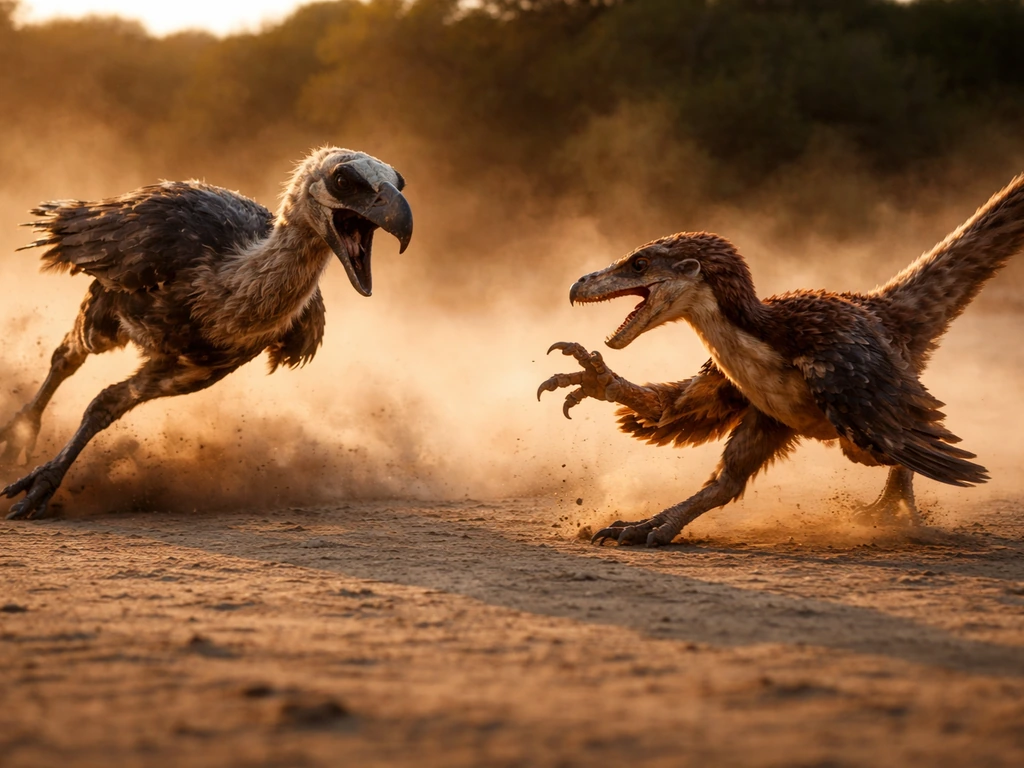
Terror birds were almost certainly fast runners. Their long, robust legs were built for ground-based pursuit, similar to modern ratites like ostriches, which can sustain speeds over 70 km/h. Exact speed estimates for terror birds are hard to pin down due to the fragmentary nature of some specimens, but the leg proportions strongly suggest they were among the faster large predators of their time in South America. Their fighting style would have been all about the beak: close in fast, strike downward, repeat.
Utahraptor was large and powerful but probably not as fast as a turkey-sized dromaeosaurid like Velociraptor. At 290 kg, it was built more for overpowering prey than outrunning it. Velociraptor was more agile and quick but physically small. In practice, when people say Kelenken. In any direct contest, agility, reach, and the ability to inflict decisive wounds early would matter enormously. A terror bird would have a significant reach and strike-rate advantage over a Velociraptor. Against Utahraptor, the matchup gets much closer in size, but the terror bird still lacks the grasping hands and tooth-based grip that Utahraptor would use to control the fight once it closed the distance.
Where they lived and what they ate
Phorusrhacids dominated as apex predators in South America throughout much of the Cenozoic, particularly during periods when the continent was isolated and large mammalian predators were absent. Andalgalornis lived in Argentina during the Late Miocene. Kelenken occupied the Middle Miocene. Titanis pushed into southern North America, with specimens documented from the Pleistocene coastal plain of South Texas, making it one of the few terror birds to ever set foot outside South America. Their prey was almost certainly contemporary mammals: early horses, rodents, and other Cenozoic megafauna of the Americas.
Utahraptor lived in the Early Cretaceous (Barremian stage), with fossils recovered from Utah's Cedar Mountain Formation. It shared its world with sauropods, ornithopods, and other dinosaurs, and likely targeted large prey given its size and powerful build. Velociraptor lived in the Late Cretaceous of what is now Mongolia, hunting animals like Protoceratops. T. rex lived in Late Cretaceous North America. None of these animals overlapped in time or geography with any terror bird; they are separated by tens of millions of years at minimum.
Head-to-head: every matchup broken down
Terror bird vs raptor (generic dromaeosaurid)
If you picture a mid-sized dromaeosaurid, the terror bird wins on reach, strike speed, and the power of its beak strike. A generic dromaeosaurid would need to get close enough to use its sickle claws and teeth, and getting inside the terror bird's beak range without taking a devastating downward strike would be extremely difficult. The terror bird's legs are also powerful weapons in their own right. Advantage: terror bird, unless the dromaeosaurid is very large.
Terror bird vs Velociraptor
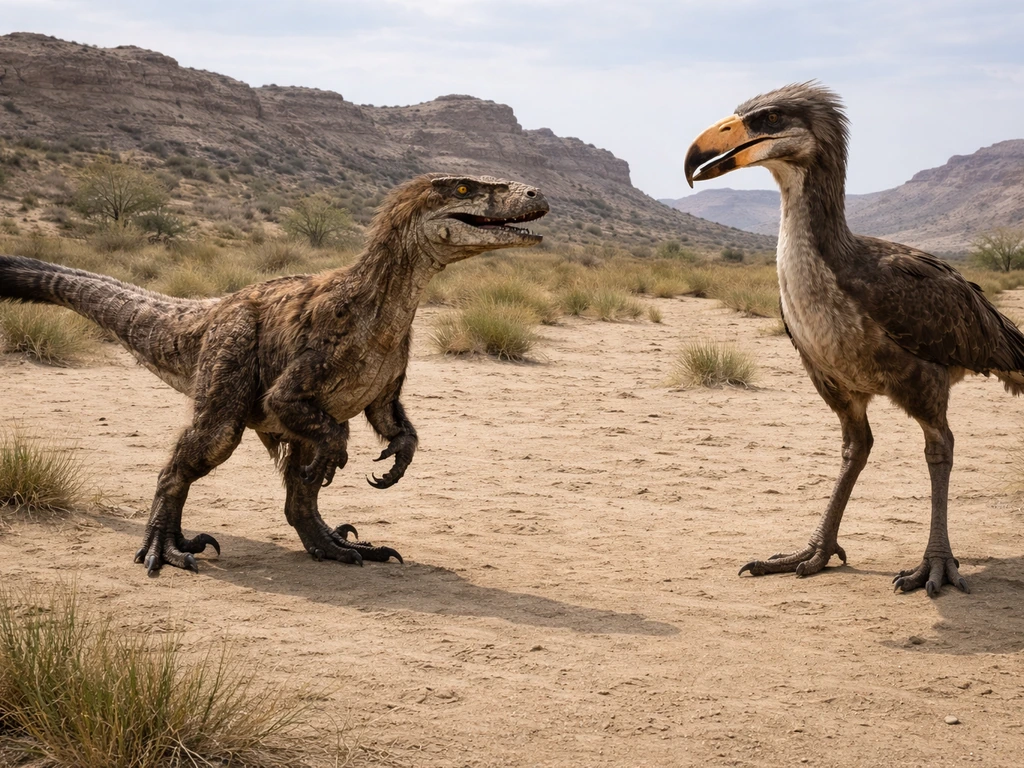
This is not a close contest. Even the smaller terror bird species outweighed Velociraptor by a factor of two or more. Velociraptor was roughly turkey-sized, around 15 to 20 kg. A large terror bird like Titanis could have been eight to ten times heavier. The size difference alone is decisive. Velociraptor's sickle claw and teeth were devastating against prey of similar size (Protoceratops-scale animals), but against a 130 kg+ bird with a reinforced hatchet beak, Velociraptor would struggle to inflict meaningful damage before being struck down. Clear advantage: terror bird.
Terror bird vs Utahraptor
This is the most competitive pairing. Utahraptor at ~290 kg outweighs even the largest terror bird estimates by a significant margin. It had grasping hands (three-fingered with large curved claws), a massive sickle claw on each foot, and serrated teeth. If Utahraptor closed the distance and got its claws into the terror bird, the terror bird would be in serious trouble because it lacks the forelimbs to break free and its beak is optimized for downward strikes, not lateral defense. The terror bird's best chance would be staying at range and landing beak strikes before Utahraptor could engage. Realistically, size and multi-weapon versatility give Utahraptor the edge in a direct confrontation. Advantage: Utahraptor, but not decisively if the terror bird controls the opening.
Terror bird vs T. rex
This one is not really a contest in terms of raw size. T. rex weighed somewhere between 8,000 and 14,000 kg. Even the largest terror bird estimates cap out well below 200 kg. T. rex's skull alone was over a meter long and designed to deliver bone-crushing bites. A terror bird would have no realistic path to inflicting decisive damage on an animal that massive, and one bite from T. rex would be fatal. The only scenario where the terror bird survives is avoidance, which it could likely manage given its speed. As a fight, though: decisive advantage to T. rex, and it isn't close. This matchup is more useful as a size-scale illustration than a genuine contest.
Terror bird vs dinosaur (the general confusion)
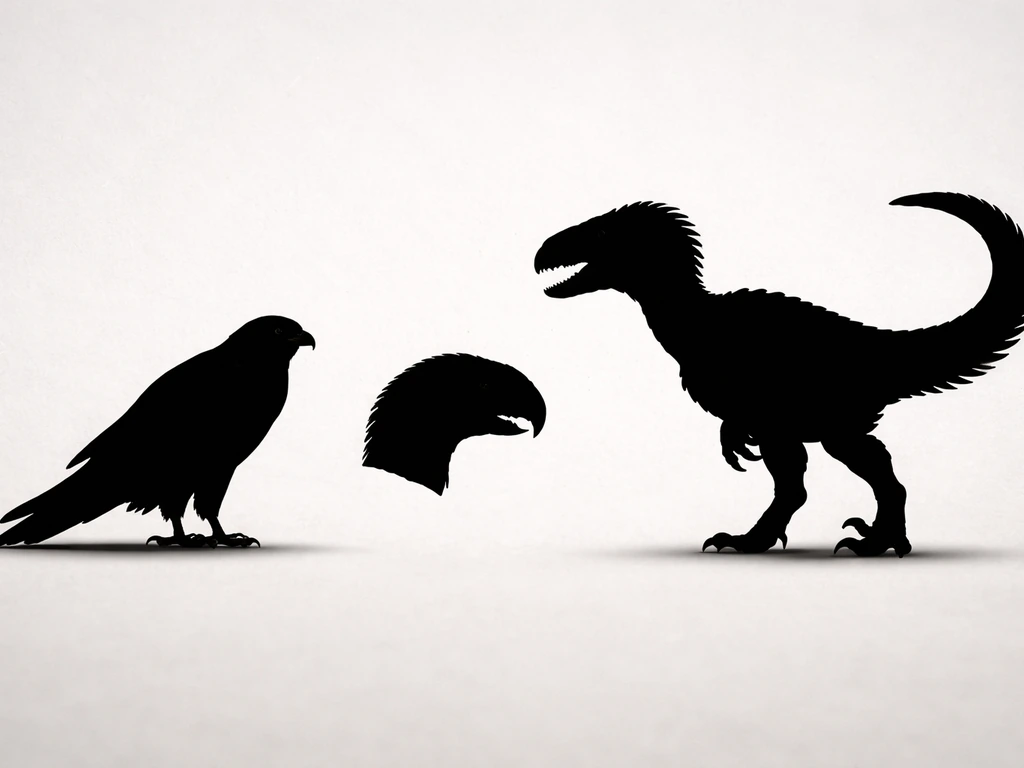
The broader "terror bird vs dinosaur" framing trips people up because terror birds ARE technically descended from the dinosaur lineage (birds are avian dinosaurs), but colloquially, when people say dinosaur they mean non-avian dinosaurs like T. rex or Utahraptor. The honest answer is: terror birds were apex predators in their own era, fully capable of dominating the animals they actually encountered (Cenozoic mammals), but they lived in a completely different world than the Mesozoic dinosaurs. Comparing them directly is like comparing a great white shark to a mosasaur: both were top predators, just not in the same ocean or the same time.
How to think about this correctly and avoid the common mix-ups
Most confusion around this topic comes from two overlapping word problems: "raptor" meaning either a bird of prey or a dromaeosaurid dinosaur, and "terror bird" sounding like it might refer to a scary modern bird rather than an extinct predator. Once you pin down what each word actually means in context, the comparison becomes much cleaner. Here's a checklist that helps sort it out quickly.
- Confirm you mean phorusrhacid when you say terror bird, not a modern bird of prey or a fictional creature.
- Confirm which raptor you mean: a modern bird of prey (hawk, eagle, falcon), or a dromaeosaurid dinosaur (Velociraptor, Utahraptor, Deinonychus).
- Remember that terror birds lived in the Cenozoic (roughly 62 to 1.8 million years ago) and dinosaurs like Utahraptor lived in the Mesozoic (around 126 million years ago). They never met.
- Use body mass as your first filter: size differences above 3x are usually decisive in predator matchups unless one animal has an overwhelming tactical advantage.
- Look at the primary weapon: terror birds used beak strikes (axial, hatchet-style), dromaeosaurids used sickle claws plus teeth (restraint and dismemberment), T. rex used bone-crushing jaws.
- Consider reach and engagement distance: terror birds needed to stay at range to use their beak; dromaeosaurids needed to close distance to use claws and teeth.
- For the most competitive matchup (terror bird vs Utahraptor), factor in that Utahraptor's grasping hands and multi-weapon toolkit give it an edge once grappling begins.
If you're interested in how terror birds stack up against other prehistoric predators of their own era, comparisons with Smilodon (the saber-tooth cat that shared some of their world) or against the largest phorusrhacids like Kelenken are genuinely revealing, since those matchups involve animals that actually overlapped in time and space. Comparing terror birds against modern large birds like ostriches or the shoebill also shows just how extreme the phorusrhacid body plan was relative to anything alive today.
The bottom line: terror birds were extraordinary predators, arguably the most formidable avian predators that ever lived, perfectly adapted for the world they ruled. Dromaeosaurids were also remarkable, with a hunting toolkit unlike anything modern. When you compare them head to head, the results depend almost entirely on size: terror bird beats Velociraptor decisively, Utahraptor edges out a large terror bird in a grapple, and T. rex makes both of them look small. No time machine required to work that out, just the anatomy.
FAQ
When I search “terror bird vs raptor,” how can I tell which animal the results are actually comparing?
First check whether “raptor” is being used in the dinosaur sense (dromaeosaurid dinosaurs with a sickle toe claw, like Utahraptor or Velociraptor) or in the bird-of-prey sense (hawks, eagles, owls). If the article or video mentions toe claws, serrated teeth, or Velociraptor, it is the dinosaur raptor. If it mentions hunting behavior like talons-on-prey and flight, it is the modern bird-of-prey raptor.
Does the terror bird in these matchups ever mean something other than Phorusrhacidae?
In most “who would win” content, yes, it means Phorusrhacidae (the flightless “terror birds”). Rarely, people loosely apply the phrase to any scary-looking prehistoric predator bird, but the size, hooked beak, and running-limb body plan described in the main comparison is specifically tied to phorusrhacids, not to other bird groups.
If terror birds were fast runners, why is their beak strike still treated like a decisive weapon?
Because their skull mechanics point to a one-direction power delivery. The hatchet-like model assumes the head can take big axial loads during a downward strike, while resisting poorly when forces pull sideways. So speed matters most for getting within striking range repeatedly, but the “winning” moment is the beak’s ability to deliver force in the right direction.
Could a dromaeosaurid defeat a terror bird through grip-and-hold rather than just slashing?
Against a terror bird, the key limitation is that dromaeosaurids are built to grapple using hands and the sickle claw, while terror birds lack forelimbs for close-range control. If the dromaeosaurid never gets its hands and toe claws into effective contact, its jaw tearing role becomes much harder, which is why distance management favors the terror bird in the smaller-size matchups.
What would decide the Utahraptor vs terror bird fight more, size or weapon timing?
Size sets the ceiling for who can absorb damage and who can force the engagement. But timing determines whether Utahraptor’s sickle claws and forelimb grip ever get established. If the terror bird lands multiple beak strikes before Utahraptor closes, it can meaningfully slow engagement, making the matchup less lopsided than “mass-only” comparisons suggest.
Is the Velociraptor matchup always “terror bird wins,” or do some cases change the outcome?
The outcome is not strictly guaranteed, but it trends the same way because the beak strike reach and repeated strike delivery favor the terror bird, and the smaller raptor has less margin for error. A raptor would need an unusually clean first contact, so its sickle-claw grip and tooth damage start quickly, before it gets stacked by downward beak blows.
How should I interpret body mass estimates, since they vary by species and specimen quality?
Treat mass numbers as ranges, not exact weights. Where the article calls a matchup “decisive,” it is usually driven by order-of-magnitude differences and multiple lines of evidence (leg proportions, robust build, and known size brackets). If you pick a smaller terror bird species and a larger dromaeosaurid species within reasonable uncertainty, the gap narrows, especially for Utahraptor-scale comparisons.
Could a terror bird realistically “out-wrestle” a larger dromaeosaurid once contact happens?
For the smaller-to-mid dromaeosaurids, the terror bird’s best odds are staying at range and striking down, not trying to win a prolonged grapple without the right forelimb toolkit. For Utahraptor, the article’s logic is that once Utahraptor gets forelimb grip plus sickle claw control, the terror bird is at a structural disadvantage, so wrestling is not its best strategy.
Why is the T. rex comparison described as more of a size illustration than a fair fight?
Because the mass and bite capability difference is so extreme that the terror bird’s primary advantages, beak strike mechanics and running speed, do not translate into a realistic path to inflicting fatal damage. The only plausible “advantage” becomes avoidance, and once you allow avoidance, you are no longer evaluating a head-to-head contest in the same way.
If I want a more scientifically grounded “what if,” what matchup should I choose?
Pick comparisons where the animals actually overlapped in ecosystem context, even if not in time or geography. For terror birds, matchups with other Cenozoic predators (like large mammals they likely hunted) usually map better onto plausible hunting constraints than comparisons with unrelated dinosaurs from tens of millions of years earlier.
Next Articles
Kelenken vs Terror Bird: Key Differences and How to Tell Them Apart
Compare Kelenken and terror birds: key ID traits, skull and legs, size, habitat, and feeding differences to tell them ap
Smilodon vs Terror Bird: Key Differences and How to Tell Them Apart
Side-by-side guide to tell Smilodon saber cat from terror bird: traits, size, habitats, hunting, and diet myths.

Shark vs Bird: How They Differ and Who Would Win in Nature
Shark vs bird: evidence-based comparison of anatomy, behavior, habitats, likely outcomes, and key FAQs.