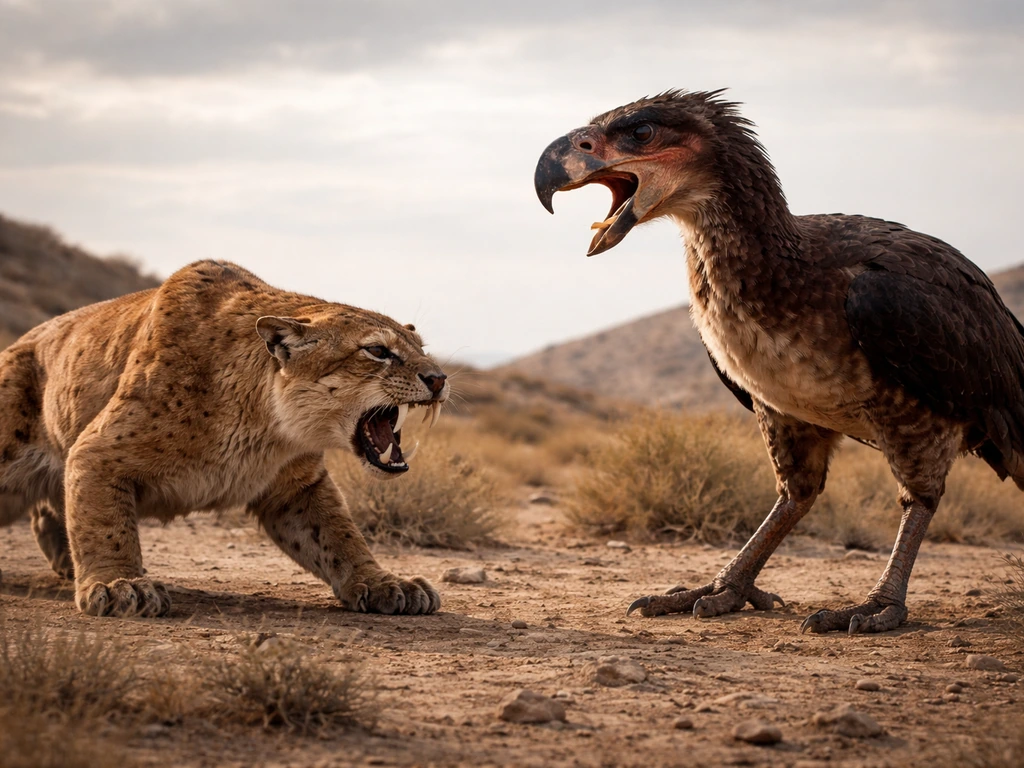
Terror birds belong to the order Cariamiformes, family Phorusrhacidae. One is essentially a heavily built prehistoric cat; the other is one of the most formidable predatory birds that ever lived. The only thing they genuinely share is that both were apex predators, both are extinct, and both show up in the same kinds of museum halls and documentary timelines, which is almost certainly why people search for them together.
When people write 'smilodon vs terror bird' they usually want one of two things: a side-by-side factual comparison, or a 'who would win in a fight' answer. This guide will give you the first in detail. The second is covered honestly in the myths section below, because the fight framing fundamentally misrepresents what we actually know about these animals.
Where each fits: time period and geography
Smilodon is a late Pleistocene predator. The two species most commonly discussed are Smilodon fatalis, which lived in North America during the late Pleistocene, and Smilodon populator, which lived in South America during the same period. A third species, Smilodon gracilis, is smaller and older, appearing in the early Irvingtonian. S. fatalis fossils have been found as far north as Alberta, Canada and as far south as parts of northwestern South America, with famous concentrations at sites like Rancho La Brea in California. The entire genus went extinct roughly 10,000 years ago at the end of the Pleistocene.
Terror birds, by contrast, have a much longer run. Phorusrhacids as a family ranged from roughly 62 million years ago (early Paleogene) into the late Pleistocene in South America. The species most often used as the 'giant terror bird' reference point in pop science is Kelenken guillermoi, described from a holotype found in Patagonia, Argentina, and formally named as a new genus in 2007. Kelenken is middle Miocene, roughly 15 million years old, which means it predates Smilodon by tens of millions of years. If you see a timeline that puts them side by side in the same ecosystem, that's worth flagging as an error unless the source is being very careful about which specific species it means.
There were later, smaller phorusrhacids that did overlap with Smilodon in time and geography as South America and North America connected via the Isthmus of Panama around 3 million years ago. So 'terror bird vs Smilodon in the same place and time' is not entirely fictional, but Kelenken specifically and Smilodon specifically never shared a landscape.
Body size, build, and key physical traits
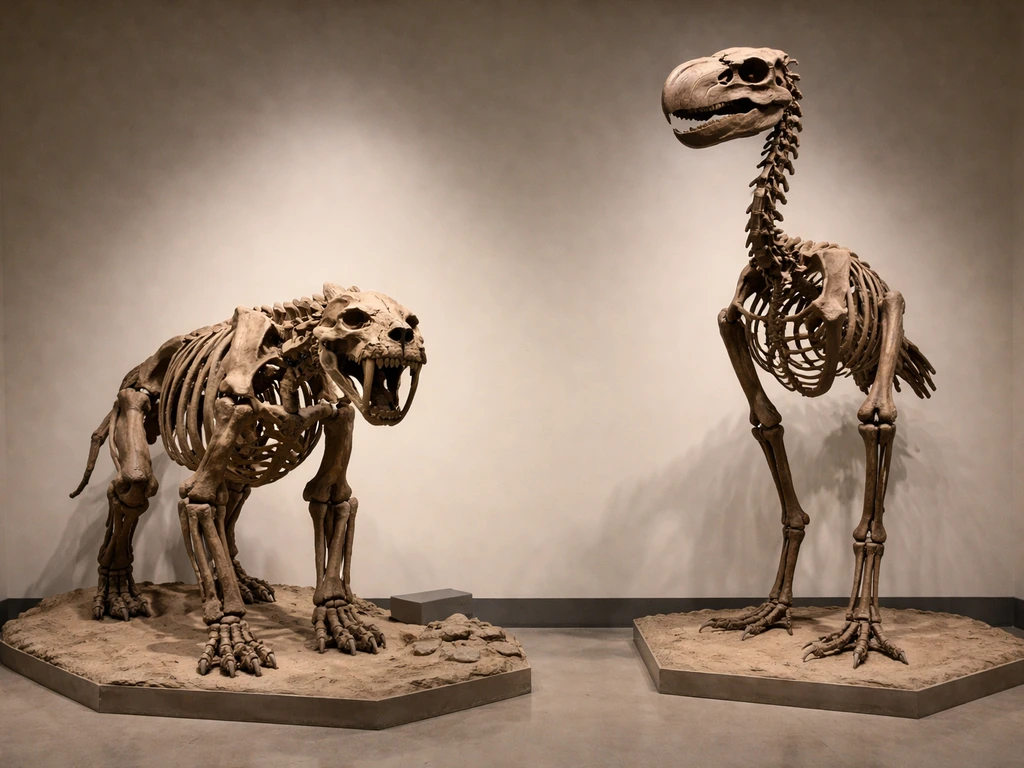
Smilodon fatalis weighed roughly 160 to 280 kg (about 350 to 620 lb) and was noticeably stockier and more robust than any living big cat. Think of a lion or tiger, then make it broader across the shoulders with heavier forelimbs built for grappling. The defining feature is the saber canines: elongated, blade-like upper canines designed for a downward stabbing action rather than a clamping bite. Smilodon also had a short tail, which mattered functionally because it meant the animal wasn't built for fast open-ground pursuit.
Kelenken is built on a completely different body plan. It was bipedal, standing somewhere around 2 to 3 meters tall depending on how you reconstruct the posture. Its most astonishing feature is its skull: the holotype skull measures approximately 71 cm from beak tip to the back of the head, making it the largest skull of any known bird. That skull is dominated by a massive hooked beak, not teeth. Kelenken had small, vestigial wings that were useless for flight and relatively short arms. Its power was entirely concentrated in its legs and beak.
| Trait | Smilodon (fatalis) | Kelenken (terror bird) |
|---|
| Taxonomy | Felidae (saber-toothed cat) | Phorusrhacidae (flightless bird) |
| Locomotion | Quadruped | Biped |
| Time period | Late Pleistocene (~10,000 years ago) | Middle Miocene (~15 million years ago) |
| Geographic range | North and South America | Patagonia, Argentina |
| Body mass (approx.) | 160–280 kg | Estimated large; skull 71 cm long |
| Primary weapon | Saber canine teeth | Massive hooked beak |
| Tail | Short | None (vestigial) |
| Wings/forelimbs | Powerful grappling forelimbs | Small vestigial wings |
Hunting style and behavior patterns
Smilodon is reconstructed as an ambush predator, not a pursuit hunter. Its limb proportions closely resemble those of modern forest-dwelling cats, and the short tail would not have helped it balance at high running speeds. The working model is that Smilodon used vegetation as cover, closed distance quickly over a short burst, and then used its forelimbs to pin or grapple prey before deploying the saber canines in a downward stabbing bite. Biomechanical studies suggest the canines were strong relative to bite force and the killing action was a canine-shear stab rather than the clamp-and-hold approach seen in some other saber-toothed predators.
The terror bird's hunting mechanics worked along a completely different axis. Biomechanical analysis of phorusrhacid skulls (particularly work on Andalgalornis steulleti, a related species) found a bite force of around 133 N from skull structure alone, which sounds modest, but the key finding was how the bird used that force. The skull was rigid and optimized for downward striking with the hooked beak, essentially driving the tip into prey like an axe. Researchers described it as 'surgical strikes' delivered with precision. What the skull was not well-suited for was lateral shaking of large, struggling prey: doing so would have risked catastrophic fracture of the skull. So the terror bird was a precision striker, not a bone-crushing grappler.
Locomotion is another major contrast. Fossil footprint evidence, including the first well-preserved phorusrhacid tracks described in a 2023 Scientific Reports study, confirms that terror birds had a functionally didactyl posture (two functional toes bearing most of the weight during locomotion) and moved as capable bipeds. Their hind-limb morphology points toward a specific locomotor style suited to their substrate and prey. Smilodon, being a quadruped, moved on four limbs with all the grappling advantage that forelimb musculature provides.
Habitat and prey: what they likely ate
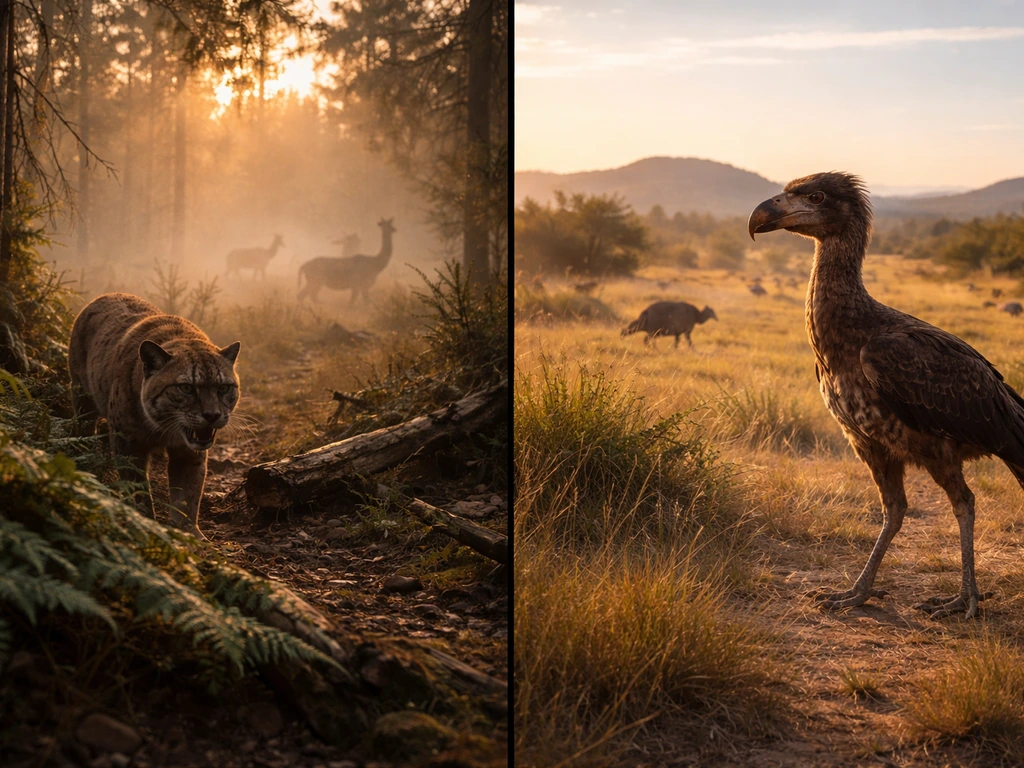
Stable isotope analysis of Smilodon fatalis material from Rancho La Brea is quite specific: Smilodon primarily ate forest-dwelling prey such as camels, tapirs, deer, and forest-dwelling bison. This lines up with the ambush-predator reconstruction, because a sit-and-wait hunter in vegetation would naturally encounter the animals that also live in or near that vegetation. At La Brea, isotope data show Smilodon preferring forest prey while contemporary dire wolves skewed toward open-grassland grazers, suggesting niche partitioning between large predators sharing the same landscape.
Terror birds like Kelenken lived in South American environments during a period when that continent was still isolated, so the available prey fauna was very different from anything Smilodon encountered. The likely prey were small to medium-sized native South American mammals. The precision-strike beak anatomy suggests smaller, more manageable prey items rather than large megafauna: drive the beak in, deliver a killing blow, move on. Given what we know about how a terror bird compares to living large birds like the ostrich in terms of leg power and build, the running ability of phorusrhacids was probably also used to chase down prey over short distances.
How to tell them apart from a distance (visual cues)
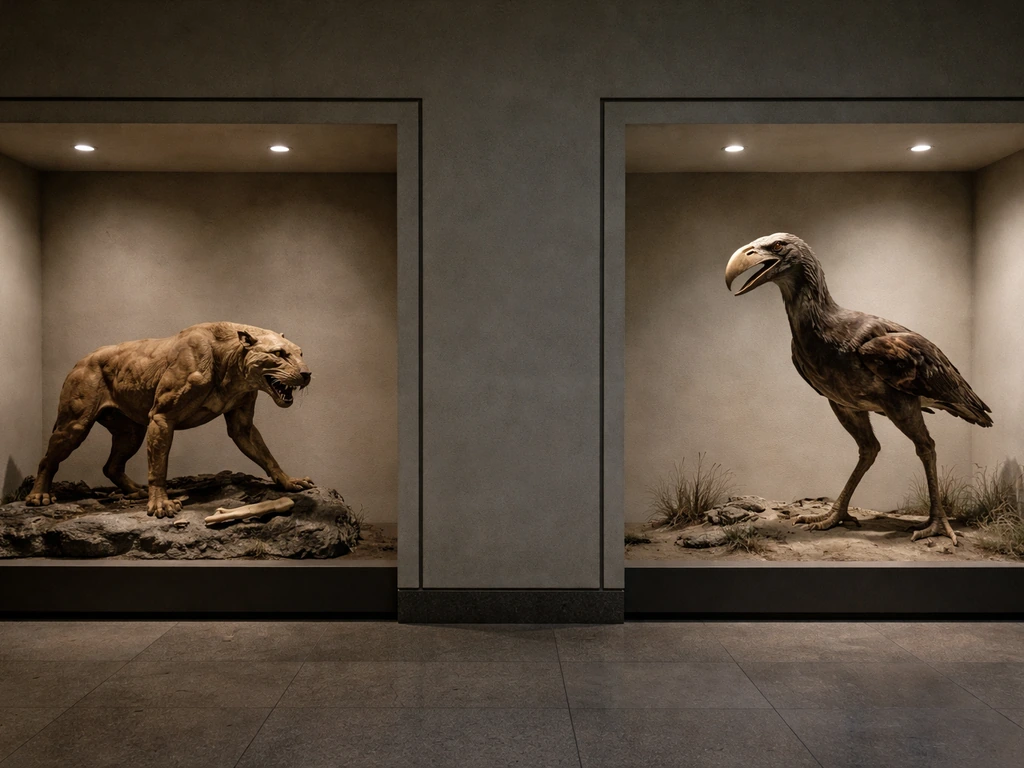
If you're looking at a museum reconstruction, a fossil cast, a documentary still, or an illustration and you need to quickly identify which animal you're looking at, here are the most reliable cues:
- Count the legs: Smilodon has four limbs on the ground; a terror bird stands on two legs with vestigial wings at the sides.
- Look at the head: Smilodon's skull is cat-like, with a wide zygomatic arch and massive upper canines projecting downward from the upper jaw. A terror bird's skull is dominated by a huge hooked beak that curves downward at the tip, with no visible canine teeth at all.
- Check the neck: Terror birds have long, muscular necks suited for driving beak strikes downward. Smilodon has a short, powerfully muscled neck typical of large felids.
- Body shape and posture: Smilodon is low-slung and broad-shouldered, roughly panther-shaped but stockier. Terror birds are tall and upright with a small body relative to the head, and tiny wing remnants.
- Feathers vs fur: Any reconstruction showing feathers and a bird-like body with no flight capability is a terror bird. A fur-covered quadruped with a cat face is Smilodon.
- Tail: Smilodon has a short cat-like tail. Terror birds have no significant tail structure.
One practical tip for museum visits: terror bird reconstructions often show the animal in a forward-leaning strike posture with the beak angled downward, which is consistent with the biomechanical evidence. If you see a large predatory bird skeleton that looks like a gigantic hawk or eagle standing on the ground without wings, that's your terror bird. If you see a massive cat with impossibly long upper canine teeth, that's Smilodon.
It also helps to know something about the internal diversity of terror birds. Comparing Kelenken to other phorusrhacid species reveals that not all terror birds looked identical: some were taller, some had proportionally larger skulls, and skull proportions varied enough that earlier reconstructions built from incomplete material were sometimes significantly off. Kelenken's 2007 description was important precisely because it gave paleontologists a more directly constrained model for giant phorusrhacid skull proportions.
Myths and misconceptions / common confusion points
Myth 1: Smilodon and terror birds lived at the same time and place
This is only partially true and very species-dependent. Kelenken, the giant terror bird most people picture, is roughly 15 million years old. Smilodon is roughly 10,000 years old at its youngest. They did not share a landscape. Some smaller, later phorusrhacids did reach North America and overlapped with Smilodon in time, but the classic 'Kelenken vs Smilodon' framing treats them as contemporaries when they were separated by millions of years.
Myth 2: Smilodon used its saber teeth to fight other predators
The saber canines were prey-killing tools, not weapons optimized for predator-on-predator combat. Functional anatomy and biomechanics point clearly toward a specialized stabbing action used to kill prey animals. Isotope evidence from sites like Rancho La Brea shows that multiple large predators (Smilodon, dire wolves, others) occupied the same ecosystems and competed for overlapping prey resources, but that tells us about trophic competition, not ritualized fights. The idea that Smilodon routinely engaged terror birds in combat is a pop-science construct, not a paleontological one.
Myth 3: Terror birds could bite through bone like a crocodile
Early reconstructions of phorusrhacid bite force estimated it as relatively weak, which led to the assumption that terror birds were limited hunters. Later CT-based biomechanical work revised this picture upward and showed that the real mechanism was downward axe-like beak strikes rather than side-to-side shaking or bone crushing. The skull's rigidity was an adaptation for precision striking, and lateral force would have risked fracturing the skull itself. So terror birds were dangerous, but in a specific and somewhat delicate way, which is itself a fascinating piece of functional biology.
Myth 4: The 'who would win' question has a real answer
It doesn't, at least not a scientifically grounded one. Reconstructing animal behavior from fossils is hard enough when you're just trying to figure out what they ate. Predicting a hypothetical combat outcome between two animals that never met, whose full behavioral repertoires we don't know, and whose relevant physical attributes we only partially understand is speculation dressed up as analysis. What functional anatomy actually tells us is how each animal was built to interact with its prey, not how it would fare against an unrelated predator in a zoo fight scenario. If you want a rigorous terror bird matchup, the terror bird vs Utahraptor comparison is a better frame because it asks directly comparable questions about two bipedal predators.
Myth 5: Terror birds were 'basically just big ostriches'
Ostriches are large flightless birds, but they're grazers and fast runners built for escape. Terror birds were apex predators with skull anatomy, leg morphology, and dietary ecology oriented entirely around killing. The functional differences are significant enough that lumping them together is misleading. If you want to understand where the differences actually lie, the anatomy, behavior, and evolutionary context separate them clearly, as explored in depth when you look at how the terror bird compares to the shoebill, another large bird with a powerful hooked bill, which helps illustrate just how specialized terror bird cranial anatomy actually was.
If you're using this for a school project, museum visit, or just settling a debate: the most important facts to lock in are the taxonomy (cat vs bird), the time gap (millions of years apart for the commonly compared species), the body plan difference (four legs vs two), and the weapon contrast (saber canines vs hooked beak with downward-strike mechanics). Those five points resolve almost every confusion this comparison generates.
If you're evaluating a fossil cast or museum model, use the visual checklist above. The skull alone settles it: a 71 cm bird skull with a hooked beak is unmistakably a terror bird. A cat skull with projecting saber canines is unmistakably Smilodon. Both are remarkable pieces of evolutionary engineering, built for killing but built in completely different ways, by completely different lineages, in completely different time periods.