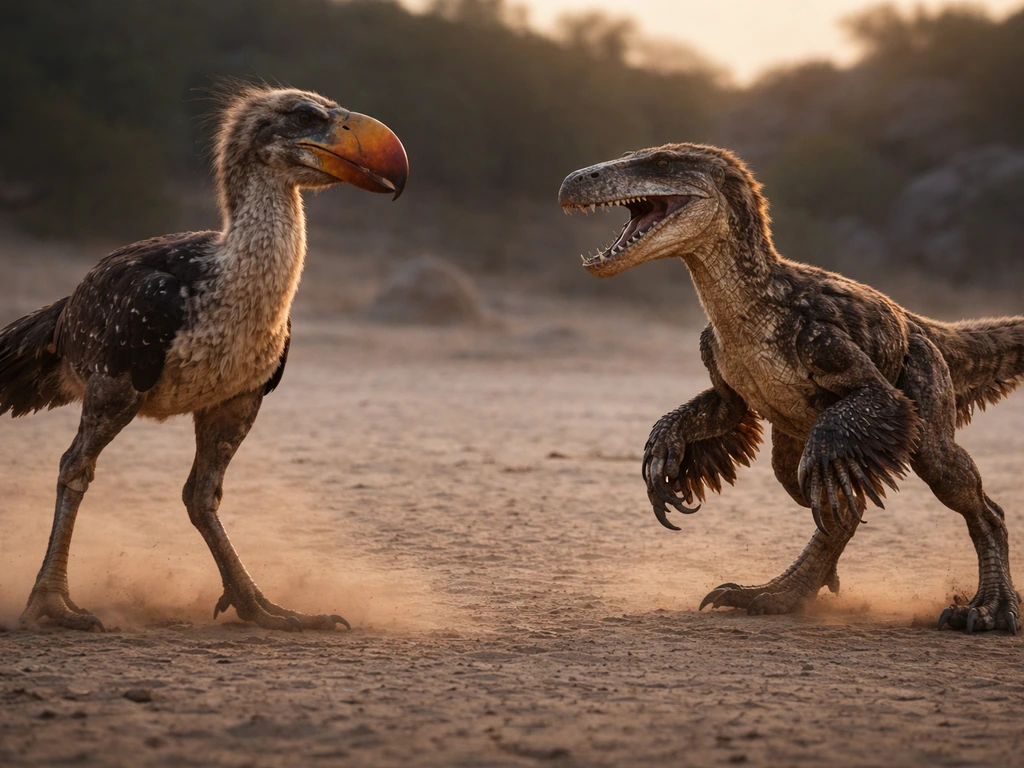
Terror birds and ostriches are both large, flightless, long-legged birds, but they belong to completely different eras, ecosystems, and ecological roles. Terror birds (family Phorusrhacidae) were apex predators that stalked South and North America millions of years ago and are now extinct. Ostriches (Struthio camelus) are living omnivores native to Africa with no close evolutionary relationship to terror birds. The similarities you see in pictures, namely the big body, the long neck, and the lack of wings, are a case of convergent evolution, not family resemblance.
Terror Bird vs Ostrich: Key Differences and If They Met

Marcus Hendricks
2 May 2026
What terror birds and ostriches actually are
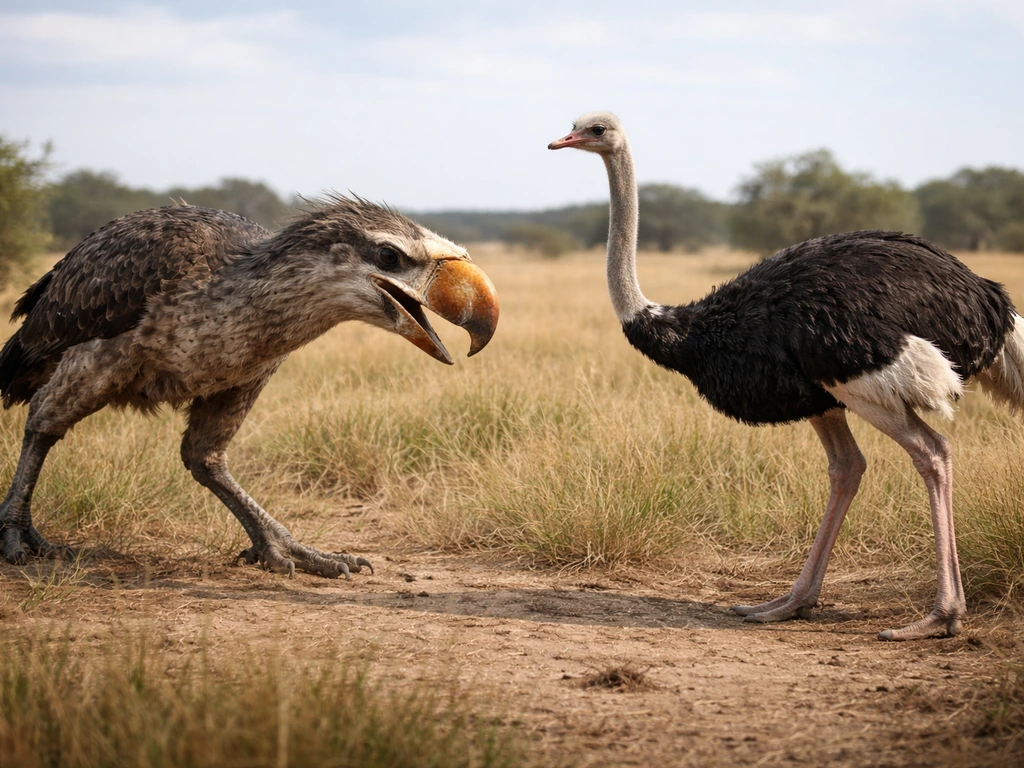
Terror birds are the informal name for Phorusrhacidae, a family of carnivorous flightless birds that dominated South America from roughly 60 to 2 million years ago. When the Isthmus of Panama formed and the Americas connected, some species, most famously Titanis walleri, pushed into North America. Fossil evidence places Titanis in Texas as far back as the early Pliocene and in Florida in later deposits.
On the Florida Museum of Natural History’s Titanis walleri species page, the fossils are discussed from two quarry age ranges, early Pliocene (Hemphillian) and late Pleistocene (Rancholabrean) Titanis walleri fossils from two age ranges at the quarry level.
They were not a single species but a diverse family with many genera ranging widely in size, and they were the top land predators in their ecosystems for tens of millions of years.
Ostriches are ratites, a group of large flightless birds that also includes emus, rheas, cassowaries, and kiwis. They are very much alive today and are classified under the order Struthioniformes. Ostriches are the largest living birds on the planet, native to the open savannas and semi-arid regions of Africa. They are not predators. They eat mostly plant material, seeds, roots, and the occasional insect or small lizard. Their lifestyle is built around covering huge distances in search of food and escaping threats, not making them.
Where they lived and how environment shaped behavior
Terror birds evolved in South America when it was an island continent, isolated from North America for tens of millions of years. With no large mammalian predators competing for the top predator niche, Phorusrhacids filled it completely. Their environments ranged from grasslands to open woodlands, habitats where pursuit hunting and ambush strategies would have been effective. When Titanis walleri eventually crossed into North America, it encountered a very different landscape populated by saber-toothed cats, wolves, and other large carnivores. The fact that Titanis persisted at all in that competitive environment is remarkable.
Ostriches live in the open savannas, grasslands, and semi-desert regions of sub-Saharan Africa. Their habitat is defined by wide visibility and the constant presence of large predators: lions, leopards, cheetahs, and hyenas. Everything about ostrich behavior reflects that pressure. They live in groups for collective vigilance, they are perpetually alert, and their primary survival strategy is to run away fast. They did not evolve as hunters. They evolved as prey animals that are hard to catch and can deliver a lethal kick when cornered.
Size, proportions, and body shape: a side-by-side look
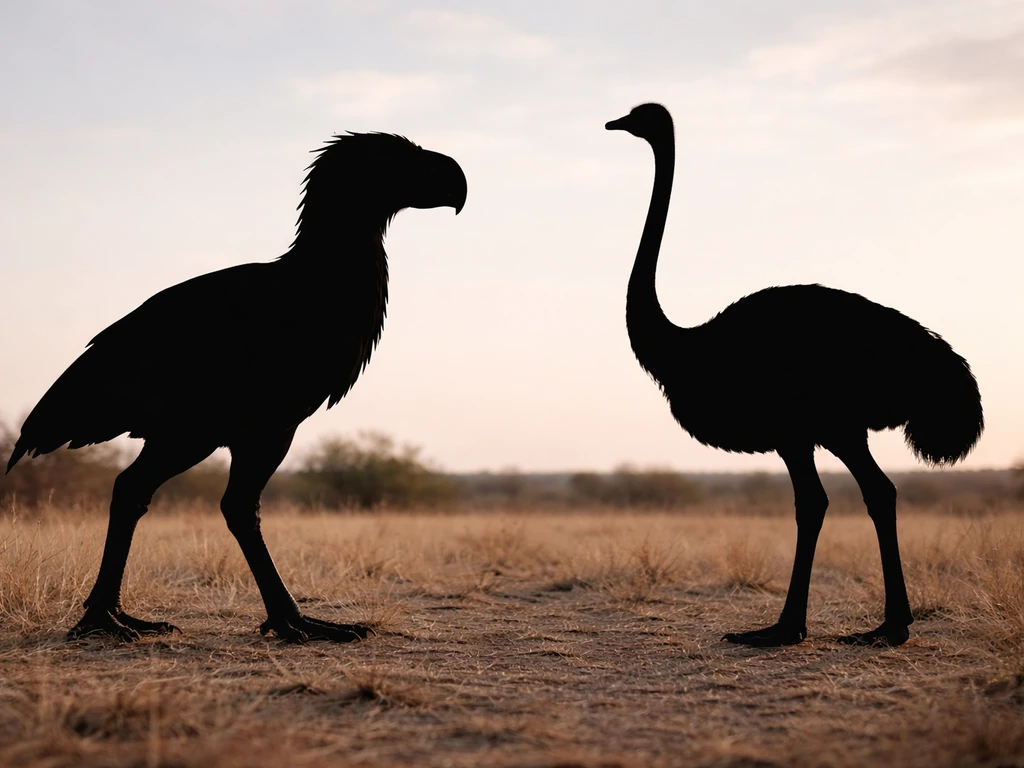
Both animals are large bipeds, but their proportions tell very different stories when you look closely. Terror birds varied enormously by species. The largest, Phorusrhacos and Kelenken guillermei, stood around 2.5 to 3 meters (roughly 8 to 10 feet) tall, while smaller genera stood closer to 1 meter. Titanis walleri, the North American species, was estimated at around 1.5 to 2 meters tall. Ostriches are consistently large: adult males stand 2.1 to 2.8 meters tall and weigh between 100 and 160 kilograms, making them reliably massive animals.
| Trait | Terror Bird (e.g., Titanis) | Ostrich |
|---|---|---|
| Status | Extinct | Living |
| Height range | ~1 to 3 meters depending on species | 2.1 to 2.8 meters |
| Weight estimate | ~100 to 300+ kg (larger species) | 100 to 160 kg |
| Neck | Shorter, thicker, more muscular | Long, slender, flexible |
| Head | Massive skull with hooked beak | Small, flat beak |
| Legs | Long, powerful, built for speed and striking | Long, powerful, built for sustained running |
| Overall build | Stocky, forward-heavy | Upright, balanced |
The most visually striking difference in body proportions is the head. Terror birds had enormous skulls relative to their body size, in some species over 60 centimeters long. The skull was deep and laterally compressed, creating a hatchet-like profile. The ostrich head, by contrast, is almost comically small relative to its body, a flat, wide bill on a small skull perched atop that long neck. If you see an image of a large flightless bird and the head looks like a weapon, you are almost certainly looking at a terror bird reconstruction.
Beak, skull, and diet: built for killing vs built for foraging
This is the single most important difference between the two birds and the easiest way to tell them apart in any image. Terror bird skulls were built for delivering powerful, downward strikes. The beak was large, deep, and sharply hooked at the tip, similar in profile to a massive eagle beak scaled up to terrifying proportions. Research on terror bird skull biomechanics suggests they used rapid, axe-like strikes to disable prey, driving the beak downward with the full force of their neck muscles rather than using a side-to-side tearing motion the way most mammalian predators do.
Ostriches have flat, broad, rounded beaks designed for cropping vegetation, picking up seeds, and occasionally snapping up small animals. There is no hook, no deep lateral blade, and no predatory structure anywhere in the ostrich skull. They swallow food whole and even ingest pebbles deliberately to help grind material in their gizzard. These two beaks are so different that a five-second look at the head of each animal tells you everything you need to know about what it eats.
How they moved and how they handled threats
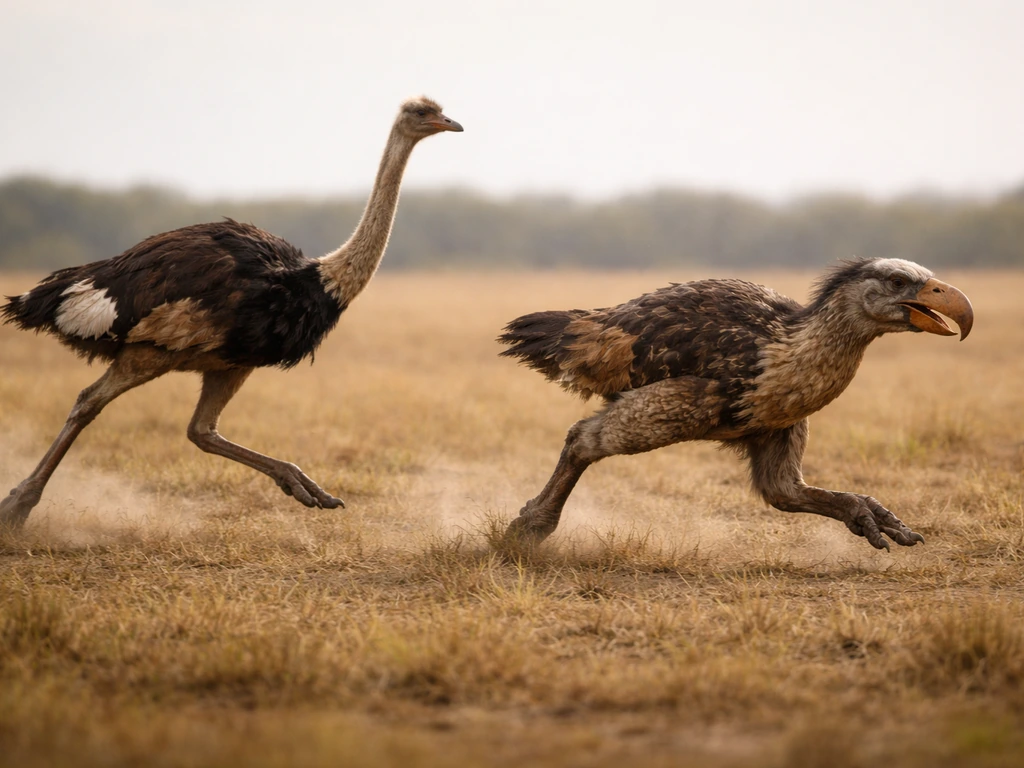
Both birds were fast runners, but the mechanics and purposes of their speed differed significantly. Ostrich running is among the most well-studied forms of bipedal locomotion in science. Ostriches can sustain speeds around 45 to 50 kilometers per hour over long distances and reach bursts up to 70 km/h. Studies examining ostrich gait show they transition between walking and running modes with a clear aerial phase at higher speeds, using long, elastic tendons to store and return energy efficiently. Their legs are optimized for endurance and economy over long distances across open terrain.
Terror bird running speed has been modeled biomechanically using tibiotarsal bone strength rather than guesswork, and estimates for taxa like Titanis suggest top speeds roughly comparable to or somewhat below ostrich peak speeds, possibly in the range of 45 to 60 km/h for smaller, more lightly built species. But terror birds were not running to escape. They were running to close distance on prey. Their legs were built for explosive acceleration and for delivering powerful downward kicks and strikes in combat, not for sustained cross-country travel. The hunting behavior was more predatory pursuit and ambush than the open-country endurance running of ostriches.
Defensive strategies diverge sharply here too. An ostrich cornered by a predator kicks forward with its powerful legs, delivering strikes capable of killing a lion. The foot has a single large toe with a flattened nail that functions like a blunt blade. Terror birds would have used their legs and feet offensively as primary weapons alongside the beak strike. Their feet, while not as specialized for kicking as ostriches, were large and strong, and combined with the beak, they were a complete predatory toolkit.
Wings and flightlessness: similar outcome, very different anatomy
Neither bird could fly, but the reason their wings look the way they do is different. Ostriches have vestigial wings that they actually use for several non-flight purposes: display, balance during running turns, shading chicks, and thermoregulation. The wings are visible and functional in a social and physiological sense even though they cannot generate lift. The feathers are soft, fluffy, and symmetrical because they never needed to be aerodynamically shaped.
Terror bird forelimbs were dramatically reduced and largely non-functional. In species like Titanis, the forelimbs were small enough that there was debate for years about whether they retained any grasping ability at all. More recent interpretations suggest the forelimbs were highly reduced and likely could not grip prey effectively. The wings were essentially vestigial stubs, far more reduced than ostrich wings, contributing nothing to balance, display, or locomotion in any meaningful way. Where ostriches use their wings as tools, terror birds had largely abandoned them entirely.
What pop culture gets wrong about terror birds
Terror birds have made appearances in documentaries, games, and prehistoric creature features, and the portrayals range from reasonably accurate to wildly exaggerated. The biggest myth is that terror birds were essentially giant, angry chickens or oversized emus. That framing undersells them completely. They were genuine apex predators that dominated entire continents and were biomechanically sophisticated hunters, not opportunistic scavengers or inflated versions of modern birds.
On the flip side, some portrayals make them into dinosaur-level monsters that could take down any animal alive. The reality is more nuanced. When Titanis moved into North America, it was competing with a mature megafauna ecosystem including saber-toothed cats like Smilodon and large canids. Terror birds were powerful but not invincible, and the fossil record suggests they eventually lost ground in North America's more competitive predator landscape. They were real, they were impressive, and they absolutely did not need exaggeration.
Another common misconception is that terror birds and ostriches are closely related because they are both large and flightless. They are not. Terror birds belong to Cariamiformes (or a closely related extinct order), while ostriches belong to Palaeognathae, a completely separate and ancient lineage. The superficial similarities come from both groups independently solving the same physical problem: how to be a large, ground-dwelling bird with no need for flight. That is convergent evolution, not family history. If you want a living relative of terror birds, look at the seriemas of South America, small and not particularly terrifying birds that share a surprisingly close ancestry.
How they would compare in a direct matchup, and how to tell them apart
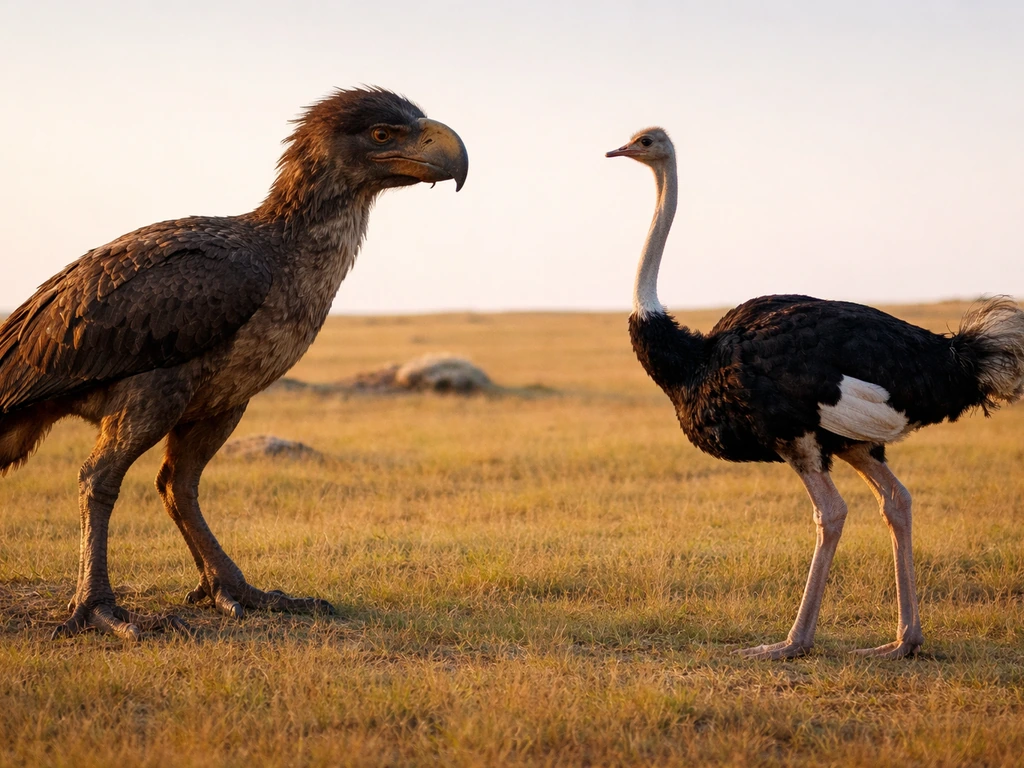
Grounding this in biology rather than speculation: a large terror bird species meeting an ostrich would present a significant mismatch in predatory capability. The terror bird's skull and beak were weapons. A downward strike from a large Phorusrhacid could deliver enormous force concentrated at the beak tip, a fundamentally different attack profile than anything an ostrich faces from modern predators.
The ostrich's defensive kick is powerful but relies on the predator approaching from a position where the kick can land cleanly. Against an animal built specifically to close distance, pin, and strike downward, an ostrich's standard defense kit would be challenged. That said, ostriches are large, strong, and capable of delivering lethal blows. A smaller terror bird species would face a genuinely dangerous opponent.
Framed purely in terms of anatomy and mechanics, a large terror bird had the tools of a predator; an ostrich has the tools of prey that refuses to cooperate.
For telling them apart in images or reconstructions, use this quick checklist:
- Check the beak first: a deep, hooked, axe-like beak means terror bird; a flat, broad, rounded beak means ostrich.
- Look at head-to-body ratio: terror birds have disproportionately large skulls; ostriches have small heads on long necks.
- Assess the neck: terror bird necks are shorter and more muscular-looking; ostrich necks are long, slender, and bare-skinned.
- Check the wings: if the wings are visible and feathered with any presence, that points toward ostrich; if the forelimbs are tiny stubs, that points toward a terror bird reconstruction.
- Note the context: if the animal is illustrated in a prehistoric scene alongside extinct megafauna, it is almost certainly a terror bird; if it is in a savanna with African animals, it is an ostrich.
- Look at the feet: ostriches have two distinctive toes (one large, one small); terror bird feet had three forward-facing toes built for gripping and striking.
These two birds occupy completely different corners of avian history, one extinct and predatory, one living and omnivorous, and once you know what to look for, they are impossible to confuse. If you want to keep exploring the terror bird family tree, comparisons with Smilodon, Kelenken, Utahraptor, and even the shoebill open up fascinating angles on where terror birds fit in the bigger picture of prehistoric and modern predatory birds. Utahraptor is a well-known dromaeosaurid from North America, often compared in pop culture with other large prehistoric predators.
FAQ
Could an ostrich ever catch a terror bird, or would the terror bird always win in a direct encounter?
A straight “always win” answer depends on size and starting distance. Ostriches are built for fast, sustained running and group vigilance, while terror birds were built for closing distance with explosive acceleration and downward strikes. In many realistic scenarios, an ostrich’s speed and evasive posture would reduce the time a terror bird could get in close enough to use its beak effectively.
What would a terror bird’s attack look like compared with an ostrich’s defense if they’re facing off?
A terror bird’s core strike is a rapid, downward beak impact that targets how prey is positioned (pinning or forcing a reachable posture). An ostrich’s defense is primarily a forward kick used when a predator commits too close. So the key moment is who controls the angle of approach, since each animal’s “best move” assumes the other one is in a specific position.
Do terror birds have any special “kicking” advantage, or is their main weapon the beak?
Their legs and feet were strong and would support kicking or stamping as part of the attack toolkit, but the standout predatory specialization was the enormous, hooked skull and beak shape for concentrated, downward force. That means their greatest advantage comes from strike timing and range, not from matching an ostrich’s optimized anti-predator kick mechanics one-for-one.
Are ostriches definitely omnivores, and does that affect how they would fight a predator-like animal?
Yes, ostriches eat mainly plant material, but they also take insects and occasionally small animals. That mixed diet does not make them predators in the way their bodies would need to be, and their behavior focuses on detection, distance management, and running. In a fight with something built to close and strike, their lack of a true hunting approach would be a disadvantage.
Why do so many people mix up terror birds and ostriches when both are flightless?
Because both groups convergently evolved large bodies, long legs, and reduced wings for life on the ground, photos can look “similar” even when the skull anatomy is completely different. The fastest reliable clue is head design, a terror bird has a disproportionately massive, hatchet-like skull and hooked beak profile, while an ostrich’s skull is relatively small with a broad, rounded bill.
Could a smaller terror bird species realistically defeat a large ostrich?
It is less one-sided than people assume, because a smaller terror bird would have less absolute striking force and may fail to dominate the range. But even a smaller terror bird could be dangerous if it could close quickly and deliver decisive beak strikes. The bigger issue is that ostriches are strong and can deliver harmful kicks when the attacker is in striking range, so the contest would hinge on whether the terror bird can repeatedly get clean downward hits.
Do ostriches use their wings in combat, or are they only for display and balance?
Ostrich wings do not function like weapons or killing tools. They can help with balance during running turns and social behavior, and they can be used for shading or thermoregulation, but when a predator closes, the practical defensive system is the running-detection-and-kick sequence. Wings are supportive, not the main “fight-ending” mechanism.
Would the different habitats (savanna vs ancient predators) change the outcome in a matchup?
Habitat changes behavior. Ostriches evolved under constant pressure from multiple large mammalian predators, so they tend to travel in groups, stay vigilant, and rely on distance and escape routes. Terror birds lived in different ancient ecosystems, where their hunting style emphasized ambush and pursuit rather than prolonged open-terrain endurance. That behavioral difference can matter as much as anatomy.
If you see a recon of a terror bird with a strange beak or head, how can you tell if it’s exaggeration?
Look for relative proportions. A credible terror bird reconstruction usually shows a very large, deep skull relative to the body and a hooked, blade-like beak tip. If the head looks “small” like a typical bird bill, or if the beak lacks the hooked shape, the artist may be blending traits from other animals, such as raptors or modern birds.
What is the closest living relative to terror birds if ostriches are not related?
Terror birds are not related to ostriches, they belong to a separate lineage of large predatory birds. If you want a living comparison within their broader ancestry, the seriemas of South America are often highlighted as a surprising modern analog, they are much smaller but share deeper evolutionary connections. This helps avoid the common mistake of equating “flightless and big” with shared family history.
Next Article
Terror Bird vs Utahraptor and Other Raptors: A Clear Guide
Side-by-side terror bird vs raptor, T. rex, Velociraptor, and Utahraptor, with anatomy, hunting, and who wins.