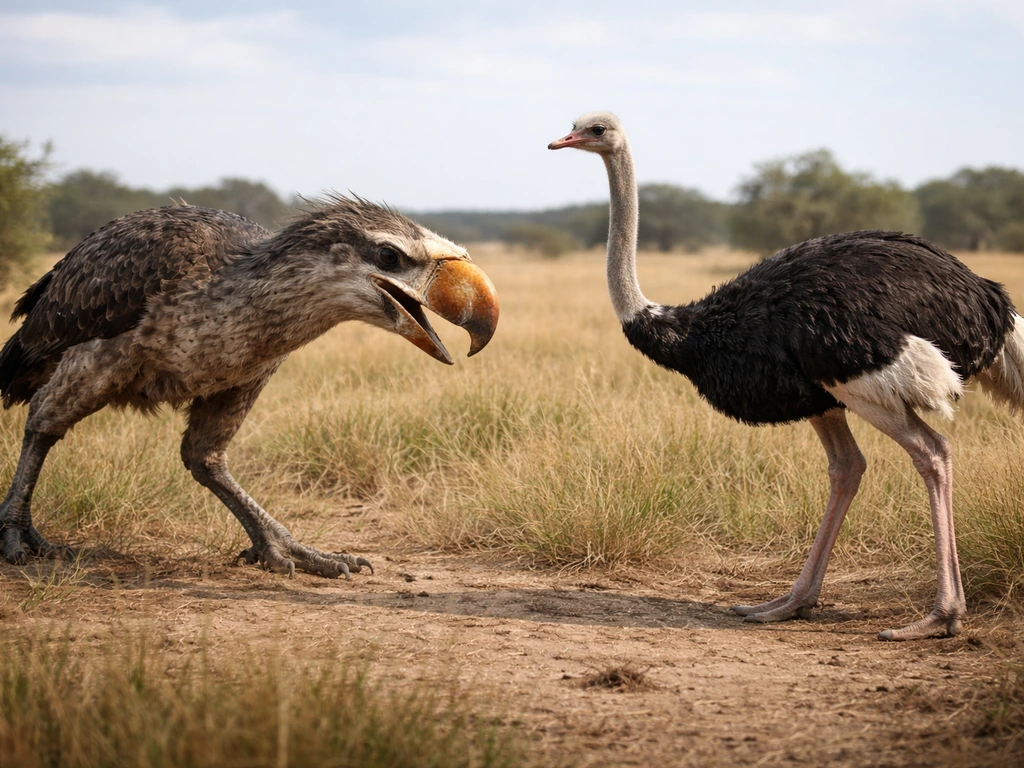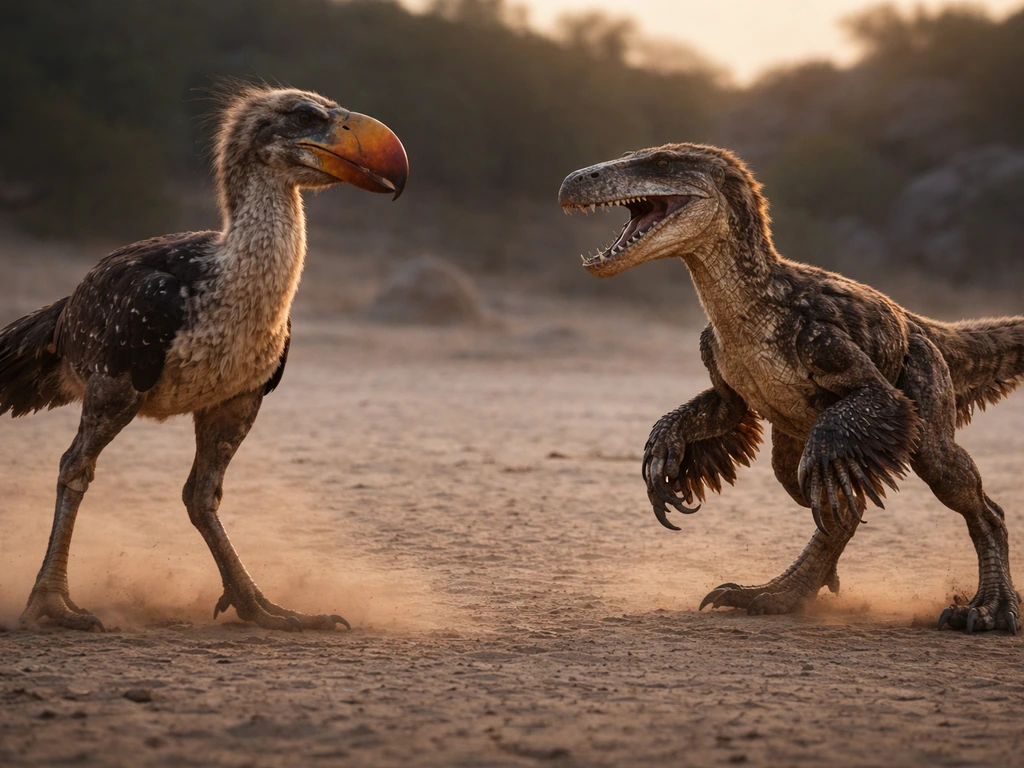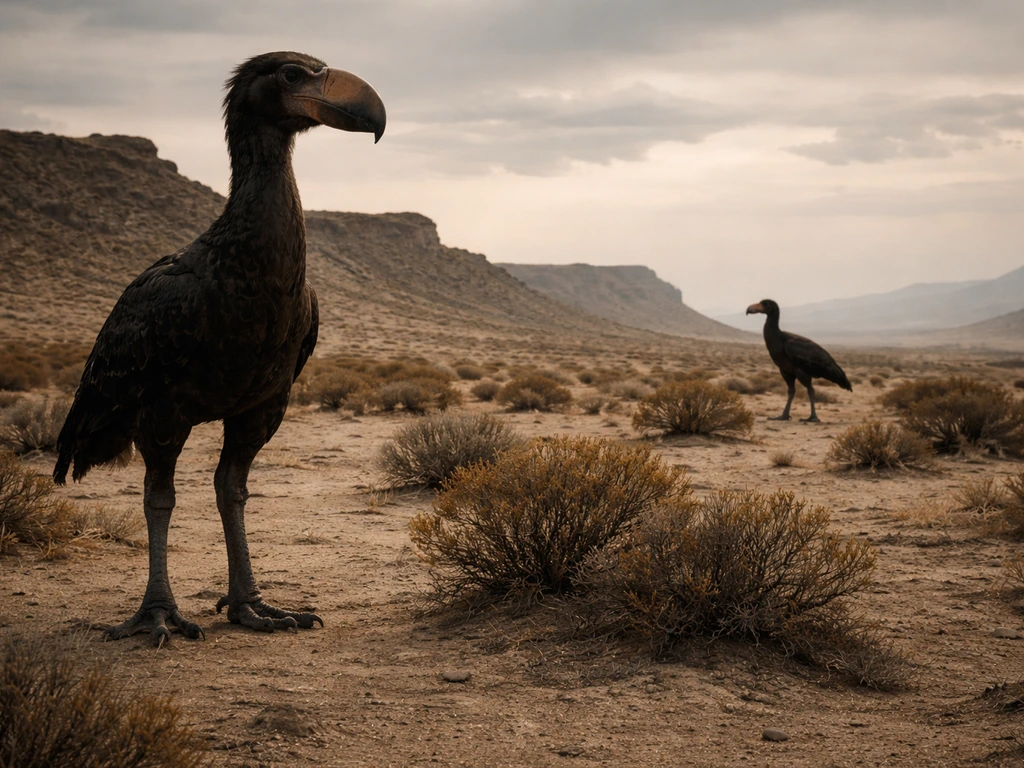
A shoebill is a living, breathing African wetland bird you can see today in Uganda or South Sudan. A terror bird is an extinct group of giant flightless predators that roamed South America millions of years ago and left only fossils behind. These two are not competing ID candidates in the field, but they come up together constantly in wildlife videos, prehistoric creature comparisons, and prehistoric-meets-modern memes, because both look startling, prehistoric, and almost unreal. If you're trying to tell them apart in a photo or video, the fastest answer is this: if the bird is standing in a swamp and lunging at fish, it's a shoebill. If it's labeled "Phorusrhacidae" and appears in a museum, a documentary reconstruction, or a fossil diagram, you're looking at a terror bird.
Terror Bird vs Shoebill: Key ID Differences and Lookalikes

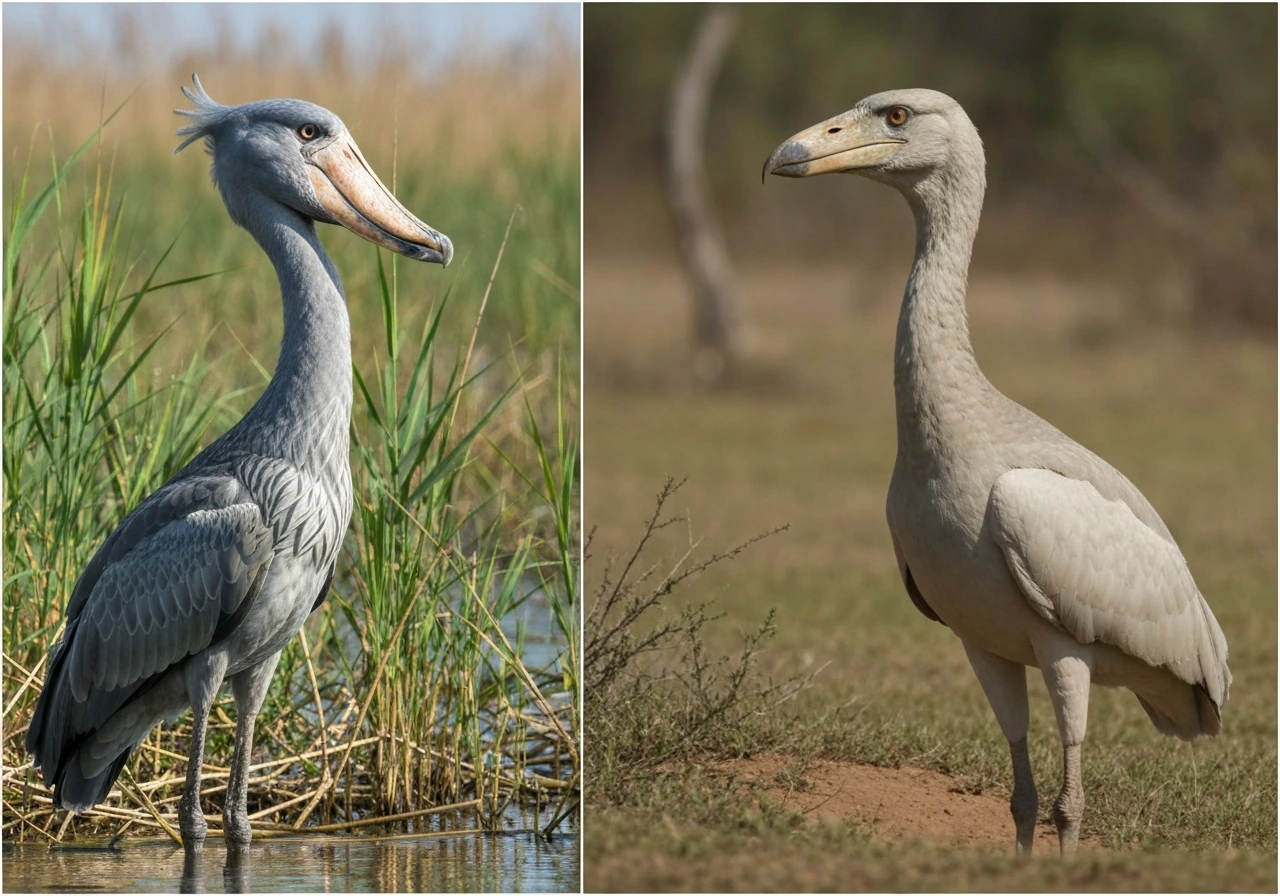
Quick identity check: who's who
| Feature | Shoebill | Terror Bird (Phorusrhacidae) |
|---|---|---|
| Scientific name | Balaeniceps rex | Family Phorusrhacidae (multiple genera/species) |
| Status | Living species | Extinct (fossils only) |
| Region | Central/East Africa (Uganda, South Sudan, Congo, Zambia) | Primarily South America; some European records |
| Time period | Extant today | Eocene to Pleistocene (~60–1.8 million years ago) |
| Height | 110–152 cm | ~90 cm to over 200 cm depending on species |
| Mass | ~4.9–5.6 kg | Estimated up to ~400 kg for largest species |
| Habitat | Freshwater swamps and wetlands | Terrestrial open environments (inferred from ecomorphology) |
| Diet | Fish, lungfish, amphibians | Terrestrial prey: mammals and other vertebrates (inferred) |
One thing worth noting upfront: the terror bird label covers an entire family with species ranging from roughly the size of a large heron to a creature taller than a professional basketball player. The shoebill, by comparison, is a single species. When people say "terror bird" in casual conversation, they usually picture the larger species like Phorusrhacos or Titanis, which were genuinely enormous. The shoebill, at up to 152 cm tall, sits at the smaller end of that size range, which is part of why the visual comparison gets traction.
Head and bill: the most important field mark
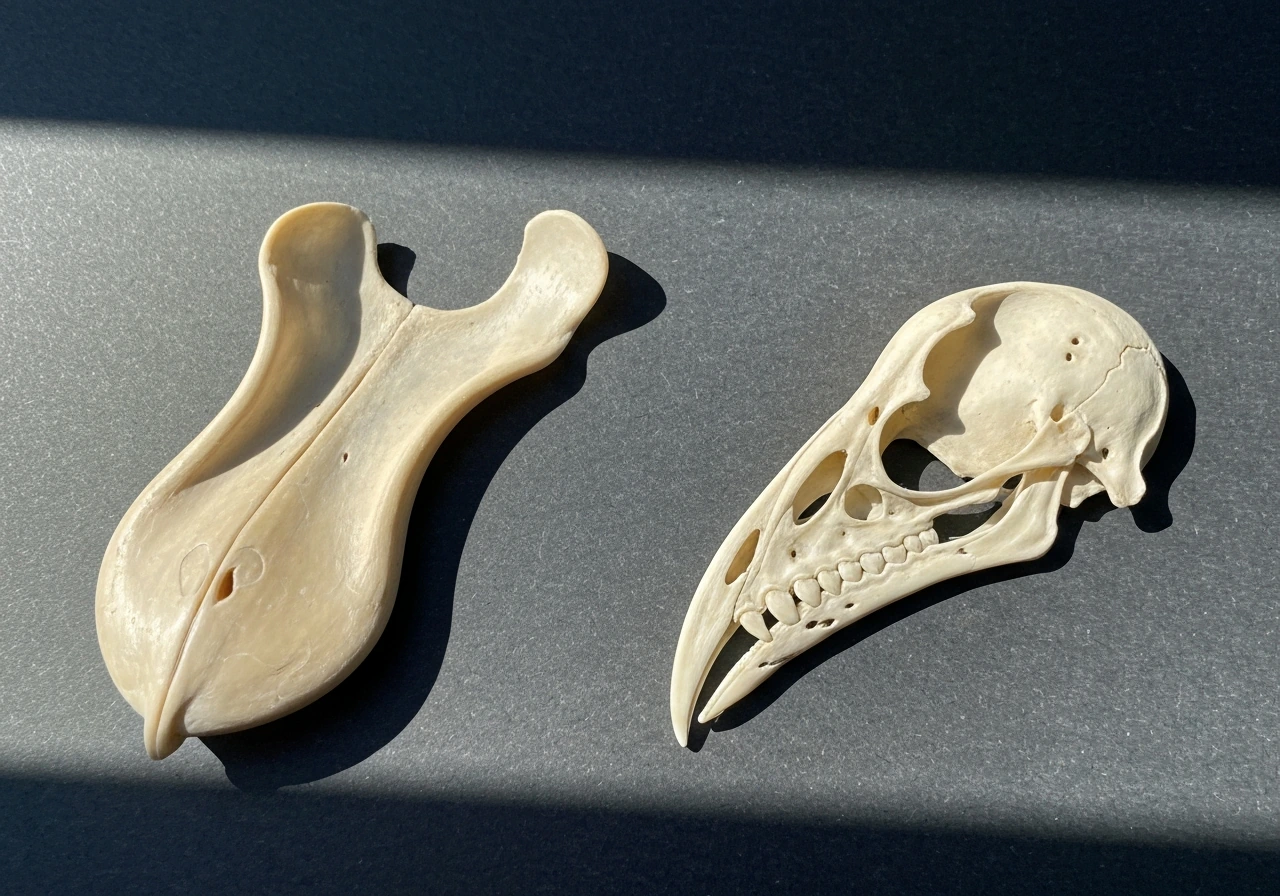
This is where the two diverge most dramatically, and it's the first thing you should look at in any photo. The shoebill's bill is its most famous feature: it is wide, deep, and rounded at the tip with a hooked nail, looking almost exactly like a Dutch clog or wooden shoe. Britannica describes it as "clog-shaped," which is accurate. The bill is enormous relative to the head, pale yellowish-gray with brown blotches, and specifically shaped to clamp down on large, slippery prey like lungfish. There's a prominent hook at the tip that helps hold struggling fish. The eyes sit forward on the face, giving the shoebill a slightly owl-like, front-facing gaze that's genuinely unsettling if you're used to other wading birds.
Terror bird skulls and bill structures are known from fossils and have been studied using CT scans and finite-element biomechanical modeling. Researchers have identified at least two distinct skull morphotypes among phorusrhacids: a "terror-bird type" with a rigid, powerful skull suited for axe-like strikes (as seen in Andalgalornis), and a smaller "psilopterine type" with different force-handling characteristics. National Geographic reported that CT and computer modeling suggested larger terror birds used a hatchet-like strike-and-retreat sequence to dispatch prey, rather than sustained biting. The beak in terror bird reconstructions is tall, narrow, laterally compressed, and strongly hooked, more like a giant raptor's beak than a shoebill's broad, flat, clog-like structure. Think eagle meets axe versus shoe meets ladle.
In a photo or reconstruction side by side: the shoebill's bill is wide and almost bulbous from the front. A terror bird's reconstructed bill is deep and narrow from the front, wide and blade-like from the side. That profile difference alone should resolve most photo ID questions immediately.
Body shape, plumage, and overall silhouette
The shoebill looks like a large stork that got its head swapped with a cartoon shoe. Its body is stocky and upright, with slate-gray plumage across most of the body and a slightly shaggy crest at the back of the head. The legs are long and dark, well adapted for wading in shallow water. The wings are broad but the bird tends to stand hunched with its neck pulled in, giving it a humpbacked silhouette that many people find eerie. In flight (which it does infrequently), it extends its neck back like a heron rather than straight out like a stork, which is one of the behavioral clues ornithologists use to place it closer to pelicans than to true storks.
Terror bird body shape is reconstructed entirely from skeletal material, so we don't know what their plumage looked like. Any feathered illustration you see is an educated guess informed by comparisons with living ratites and other large flightless birds. What the bones do tell us is that terror birds had strongly reduced wings (effectively vestigial for flight purposes), powerful hind limbs suited for terrestrial locomotion, and a very large, heavy skull. The Cambridge Core hind-limb morphometry research confirms phorusrhacids were obligate terrestrial birds based on limb function, there's no ambiguity on that point. Their overall silhouette in reconstructions tends to be more upright and ostrich-like in body proportion, but with a dramatically oversized, top-heavy head that no living bird really matches.
So in silhouette: the shoebill looks front-heavy because of the enormous bill but has a relatively small, rounded head behind it. The terror bird looks top-heavy because the entire skull, bill and cranium together, is disproportionately massive. Standing shoebill photographs also always include water, mud, reeds, or papyrus somewhere in the frame. Terror bird reconstructions are set in open grasslands or scrub. That environmental context is itself a useful ID clue.
Habitat and hunting behavior
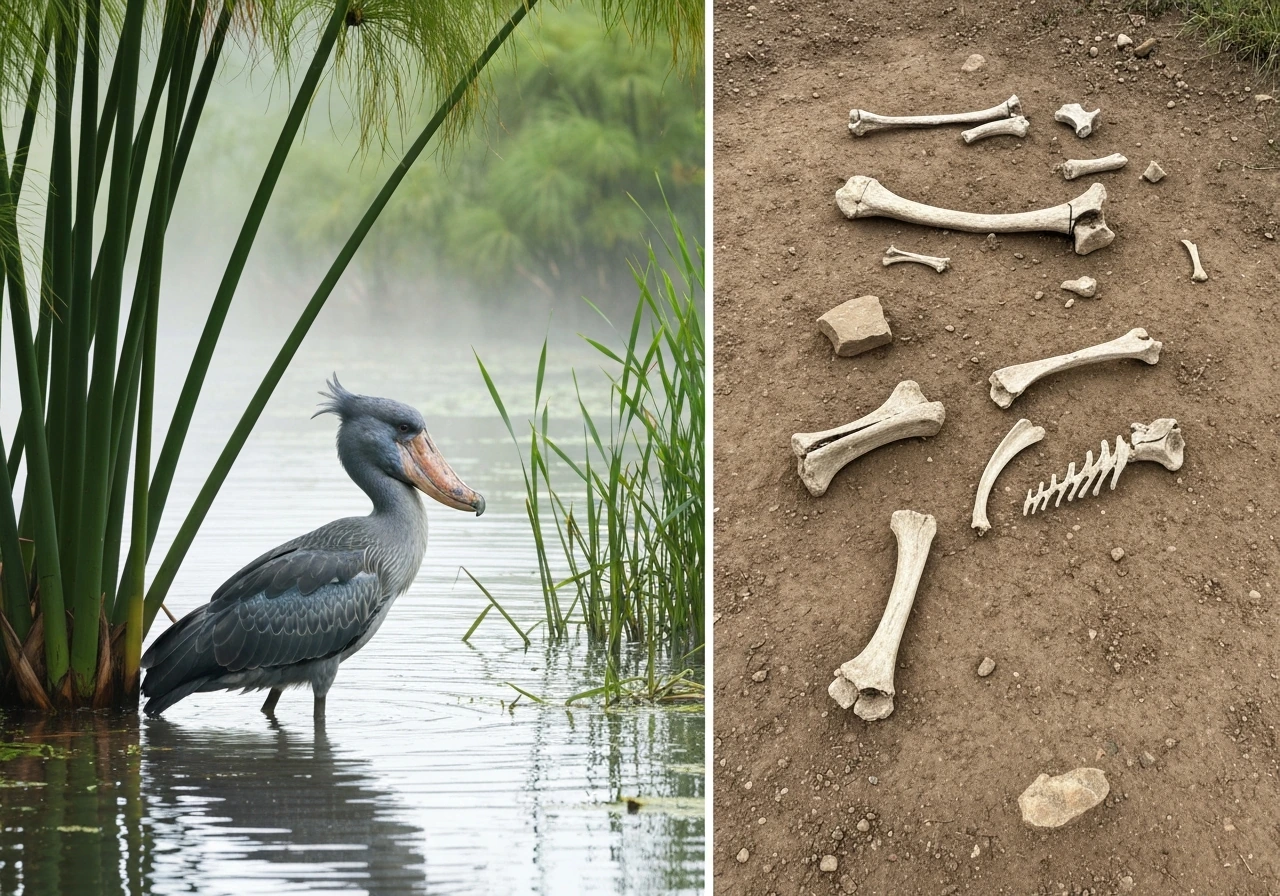
Shoebills are wetland specialists. They live in freshwater swamps, marshes, and papyrus-edged waterways across central and eastern Africa, with the Sudd in South Sudan being one of the most well-known strongholds. Research from the University of Cape Town confirms their distribution is tightly linked to swamp habitats, and they show preferences for areas with specific vegetation composition, they actually tend to avoid pure papyrus stands, preferring mixed vegetation where they can see and stalk prey at the water's edge. Their hunting strategy is ambush-based: they stand completely still for long periods, then execute a dramatic lunge forward, sometimes described as collapsing forward onto their prey, engulfing the target with their bill along with a mouthful of vegetation and water, which they then shake out before swallowing. National Geographic calls this "collapsing," and it's one of the most distinctive feeding behaviors of any large bird alive today.
Terror birds were terrestrial predators with no connection to aquatic environments. A quick way to see how they differ is to compare terror birds directly with the Utahraptor-style predator reputation people associate with certain Cretaceous theropods. Terror bird vs ostrich comparisons often focus on how different their lifestyles are, since ostriches are living ratites with a very different ecology Terror birds were terrestrial predators. The 2024 PMC study on phorusrhacid ecology frames their inferred lifestyle as niche-partitioned terrestrial predation, with different body-size classes likely targeting different prey. Their hunting behavior is inferred from ecomorphology and skull biomechanics rather than direct observation, we know how their skulls handled stress during prey capture from finite-element analysis, and the picture that emerges is of a bird that used its beak like a weapon to strike and subdue terrestrial vertebrates, probably small to medium-sized mammals. A finite-element and CT-scan study of Andalgalornis models skull stress and feeding mechanics as a basis for understanding how different phorusrhacids handled prey skull handled stress during prey capture from finite-element analysis. There are no water, fish, or aquatic contexts anywhere in the terror bird story.
Movement, calls, and temperament cues
Living shoebills are famously still. They can stand motionless for extraordinary periods while hunting, which is part of what makes footage of them so striking. When they do move, it tends to be deliberate and slow, except for the explosive lunge at prey. Their most distinctive sound is bill clapping: the mandibles snap together to produce a loud, hollow, resonant sound that Britannica describes as part of their display behavior. Avise's Birds of the World characterizes this as a loud "dok" sound. They do vocalize, but they're not vocal birds in the way herons or egrets are, the bill clap is far more characteristic than any call.
Temperament-wise, shoebills are well documented as tolerant of humans when habituated, videos from Uganda regularly show them allowing close approach, sometimes even bowing back at tourists who bow to them. This is real behavior from a real, living bird. Terror birds, being extinct, have no observable temperament. Any behavior attributed to them in documentaries or games is extrapolated from anatomy.
How to tell them apart in photos and video
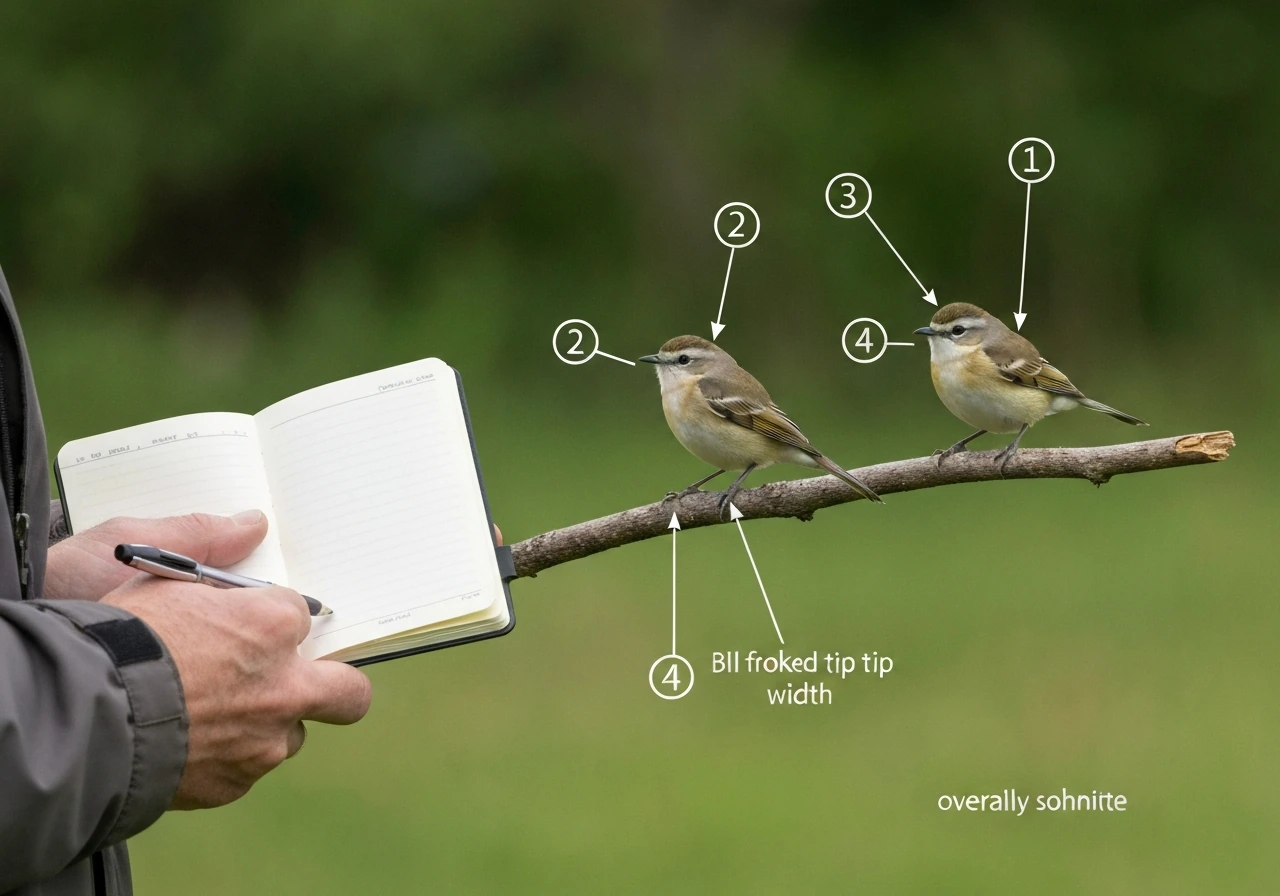
Most of the time, context resolves this immediately. But here's a practical field-mark checklist for when you're looking at a still image or a video clip and want to confirm which you're looking at.
- Check the bill shape first. Wide and shoe-like from the front with a hooked tip = shoebill. Tall, laterally narrow, and axe-like from the side = terror bird reconstruction.
- Look at the background. Water, reeds, swamp, papyrus, or African wetland = shoebill. Open grassland, fossil setting, museum exhibit, or CGI landscape = terror bird.
- Check the wings. Shoebills have full, functional wings visible when they spread them. Terror bird reconstructions show tiny, vestigial wings that are barely visible against the body.
- Look at the plumage. Shoebills are slate gray with some lighter variation. If the bird has visible, fully rendered feathers in a gray-blue tone and is standing in water, it's a shoebill. If feathering is speculative and the setting is prehistoric, it's a terror bird.
- Eye position. Shoebills have forward-facing eyes that sit prominently on either side of the bill base, giving a front-on stare that looks almost mammalian. Terror bird skull reconstructions show eye sockets positioned differently relative to the massive cranium.
- If the bird is moving: slow, deliberate wading or a sudden forward lunge into water = shoebill. Rapid terrestrial running, active pursuit of prey on land = terror bird behavioral reconstruction.
- If you hear a sound: a hollow, resonant bill clap ("dok") is a shoebill. Any sound attributed to a terror bird is invented by a filmmaker or game designer.
Similar species confusion and where this pair fits
Shoebills are sometimes confused with other large wading birds, particularly the goliath heron, the great white pelican (due to bill size), and occasionally the saddle-billed stork. The key differentiator from all of those is the bill shape: no other living bird has that flat, wide, clog-shaped bill with a hooked nail. The shoebill's hunched, stationary posture also sets it apart from the more upright and active herons.
Terror birds get confused with other prehistoric megafauna in a different way. In prehistoric creature comparisons, phorusrhacids often get stacked against saber-toothed cats like Smilodon, large dinosaurs like Utahraptor, or other giant extinct birds like Kelenken (which is actually the largest phorusrhacid known, with an estimated skull length of around 71 cm). Smilodon is another popular prehistoric comparison, but it is not a bird and never replaces the core “smilodon vs terror bird” matchup for context and contrast. Kelenken is technically a terror bird, just one of the largest members of the family. When people compare the shoebill to a "terror bird" specifically, they're usually picturing something in the Phorusrhacos or Titanis range, but it's worth knowing the family spans a huge size range.
The terror bird versus ostrich comparison also comes up regularly, mainly because both are large flightless birds. But ostriches are living birds with a completely different ecology, and the comparison mostly serves to illustrate scale. If you're navigating prehistoric bird comparisons more broadly, the terror bird family is its own distinct lineage, not related to ratites like ostriches or emus, and not related to the shoebill at all.
The bottom line on this comparison
These two birds share a certain visual drama, both are large, both have outsized heads relative to body, and both have a quality that makes people do a double take. But they are separated by millions of years, different continents, completely different diets, and radically different lifestyles. The shoebill is a real, living, findable bird in African wetlands right now, with a wide shoe-like bill built for grabbing slippery fish. The terror bird is an extinct family of terrestrial predators reconstructed from fossils, with a narrow, axe-like bill built for striking prey on dry land. If you're looking at a photo and the bird is in water with a broad, pale, clog-shaped bill, you're looking at a shoebill. If it's in a museum or a documentary and the bill looks like a curved blade on a massive skull, you're looking at a terror bird reconstruction. Those two descriptions shouldn't overlap, and if you use the bill shape and habitat context as your first two filters, you'll get the right answer every time.
FAQ
What are the fastest “first two checks” to tell terror bird reconstructions from a shoebill in a blurry screenshot?
Check the bill cross-section and the habitat at the same time. A shoebill’s bill looks broad, flat, and “clog-like” from the front and it sits in a real wetland scene. Terror bird reconstructions tend to show a tall, narrow, laterally compressed bill on a very large skull, and they’re usually placed in open grassland or scrub with no aquatic context.
Can a shoebill ever be mistaken for a goliath heron or a saddle-billed stork if the footage is low quality?
Yes, especially if the bill is only partially visible. In those cases, prioritize bill nail shape and the overall silhouette, the shoebill has a rounded, clog-shaped bill tip with a distinct hooked nail, and its signature posture is hunched and still rather than upright and actively stalking like many herons.
If a video shows a “terror bird” hunting near water, how can I tell whether it is a dramatization or a real species reference?
Use the bill geometry. Even in computer-generated clips, artists usually keep the terror-bird-style tall, narrow, blade-like bill profile. If the bill is broad, pale, and shoe-like and the scene focuses on fish hunting with a collapsing forward lunge, it is almost certainly depicting a shoebill or borrowing shoebill behavior rather than an actual phorusrhacid scenario.
Why do terror birds look so different across documentaries, some have huge heads and others don’t?
Because the family includes multiple species and researchers infer different skull morphotypes from CT and biomechanics. Smaller phorusrhine types and larger “terror-bird type” forms can vary in head and bill proportions, so a size difference in reconstructions does not necessarily mean the artist is wrong, but the bill profile and skull mass relative to the body should still fit the phorusrhacid pattern.
Are there any body-color or feather details I can rely on for terror birds?
Not reliably. Since they’re extinct, most feathering is speculative, and different paleoartists may choose different plumage patterns based on analogies with living birds. For ID, stick to skeletal-derived traits like reduced wings, strong hind limbs, and the oversized, top-heavy skull plus the specific bill shape.
How do I tell a terror bird illustration from an ostrich or from generic “prehistoric predator” art?
Focus on the bill and the head-to-body proportion. Ostriches and other ratites have different neck and head mechanics and do not have the laterally compressed, hook-shaped terror-bird beak profile. If the artwork emphasizes a massive, top-heavy skull and an axe-like, narrow bill silhouette, it is more consistent with phorusrhacid reconstructions.
What if the label on the video or museum placard says “terror bird,” but the image looks like a real bird photo?
Treat the context and bill first. Museums and documentaries can contain reconstructions, but real bird photography will show true shoebill coloration, natural wetland vegetation, and a living posture. If the scene includes realistic aquatic stalking behavior and a broad clog-shaped bill with a hooked nail, it is likely a shoebill even if a curator or editor used “terror bird” for drama.
Is the “collapsing” hunt behavior unique to shoebills, or do terror birds have something comparable?
The specific collapses-forward lunging and swallowing after an ambush is described for living shoebills. For terror birds, feeding behavior is inferred from skull biomechanics and anatomy rather than observed directly, so any direct one-to-one “collapsing” portrayal in entertainment content is an interpretation, not evidence of a recorded behavior.
Do shoebills make other calls that could confuse them with “prehistoric bird” audio in memes?
Their most characteristic sound is bill clapping (a loud, hollow snap), and they tend to be relatively quiet compared with vocal wading birds. If the audio is dominated by repeated “clap” snaps, that points strongly to shoebill footage rather than a reconstruction where sounds are often invented.