If you spotted a tall, long-legged wading bird and you're not sure whether it was a crane or a Great Blue Heron, here's the short answer: look at the neck in flight. Cranes and flamingos are another pair people sometimes mix up, so it helps to know the key silhouette and posture differences there too crane bird vs flamingo. If the neck was folded into a tight S-curve, you saw a Great Blue Heron. If the neck was stretched straight out like a flying stick, it was a crane. That single cue alone will resolve the confusion the vast majority of the time, but there's a lot more to work with once you know what to look for.
Crane Bird vs Blue Heron: How to Tell Them Apart

Marcus Hendricks
11 Apr 2026
Quick ID: crane vs blue heron body cues
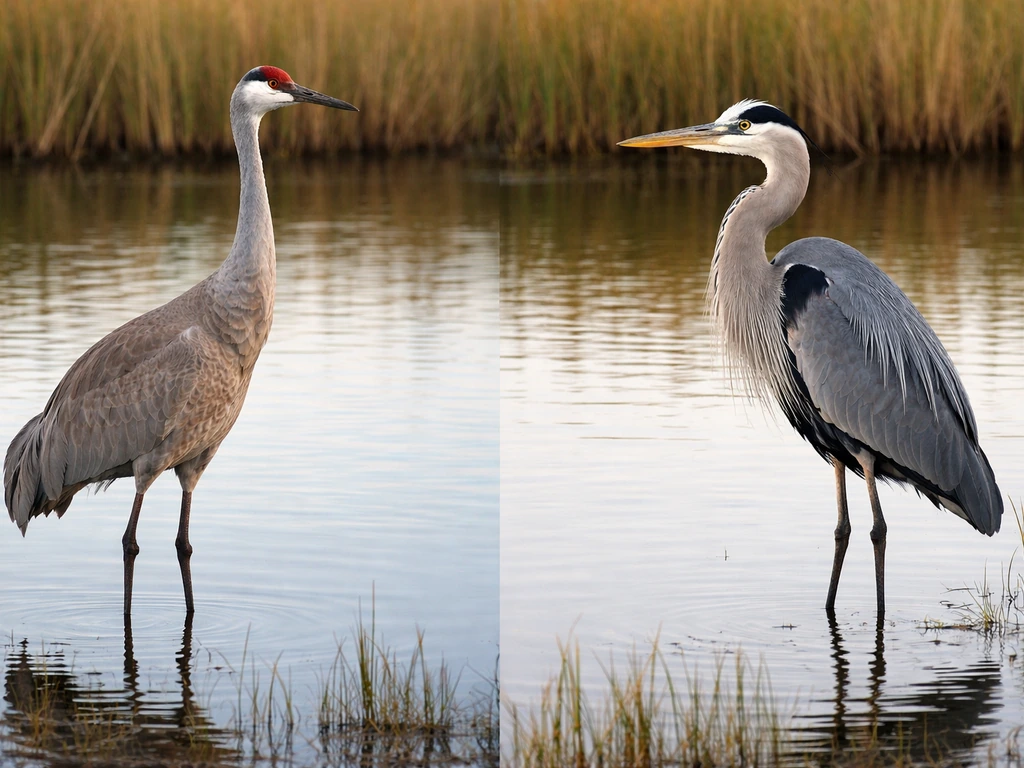
At a glance, both birds look massive, gray, and prehistoric. They share long legs, long necks, and a fondness for wetlands, which is exactly why so many people confuse them. But the differences are consistent and easy to learn once you have the right checklist in your head.
| Feature | Great Blue Heron | Sandhill Crane |
|---|---|---|
| Overall height | Up to 4.5 ft tall | Up to 4 ft tall (similar, but stockier build) |
| Neck in flight | Folded into tight S-curve | Stretched straight out |
| Neck at rest | Often kinked or pulled in | Held upright and straight |
| Wing shape | Broad, rounded, arched | Very broad, slightly flatter |
| Wingbeat style | Slow, deep flaps | Steady, relatively slow flaps with a slight upward flick |
| Bill | Long, dagger-like, orangish-yellow | Straight, longer than the head, grayish |
| Head markings | Wide black stripe over the eye | Red patch on forehead (adults) |
| Plumage | Blue-gray with white face | Gray overall, sometimes rusty-washed |
| Feeding posture | Frozen stillness, then explosive bill-stab | Walking slowly, probing ground/substrate |
Keep that table in your back pocket. The neck-in-flight rule and the feeding posture are your two fastest heuristics, and we'll break both of them down in detail below.
Head, neck, and leg differences in flight and standing
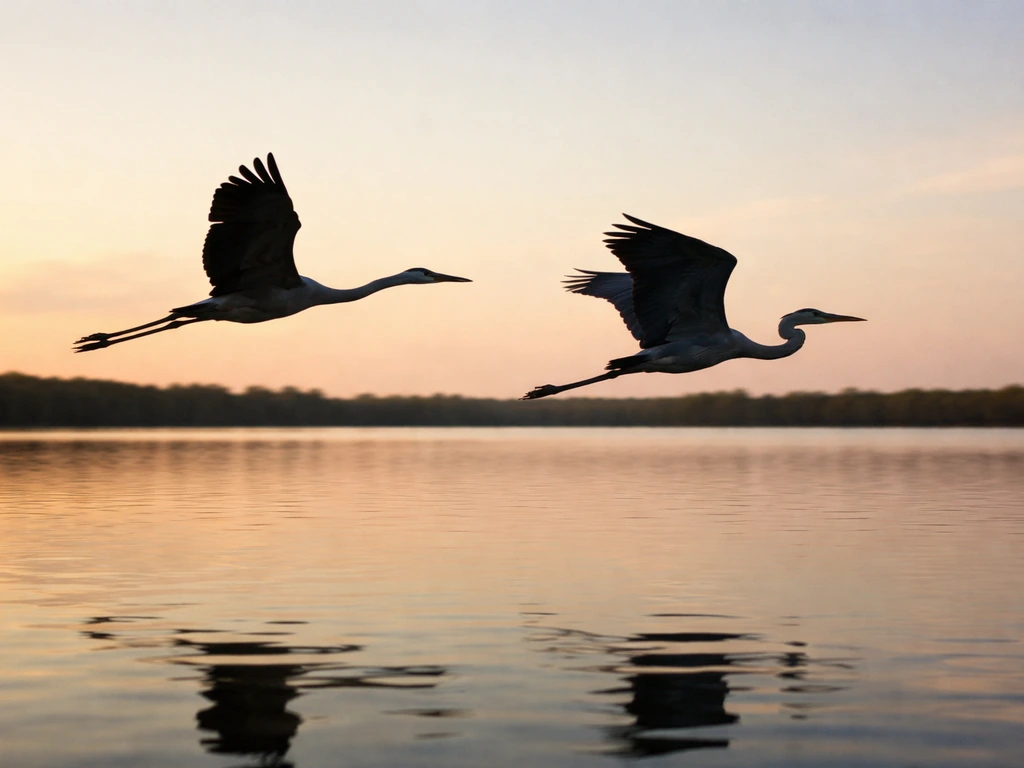
The neck is the single most reliable field mark for these two birds, especially when they're airborne. Great Blue Herons retract the neck into a tight S-curve the moment they take flight, which gives them a hunched, almost hump-backed silhouette from a distance. Their broad, rounded wings and that pulled-in neck create a look that experienced birders describe as a "flying pterodactyl." The legs trail well past the tail, which is a helpful supporting cue, but the tucked neck is the giveaway.
Sandhill Cranes do the opposite. They hold the neck fully extended and straight, both at rest and in the air. In flight, the neck and the feet point in opposite directions like a horizontal arrow, giving the bird a sleek, cross-shaped silhouette. This posture difference is so reliable that it's the first thing ornithologists and state wildlife agencies point to when teaching crane identification. If you've ever watched a flock of cranes during migration and thought they looked like flying dinosaurs with their necks spearing forward, that's exactly the right mental image to lock in.
On the ground, the distinction is a little more subtle. Herons often stand with the neck kinked or drawn back against the body, especially when resting. They'll frequently adopt a hunched, statue-like posture at the water's edge. Cranes tend to carry the neck upright and extended, giving them a taller, more "alert" look even when they're just foraging. The head shape also differs: a heron's head has a long, flat-topped profile with a prominent black eye stripe, while a crane's head is rounder and smaller-looking relative to the body, with the distinctive red patch of bare skin on the forehead in adults.
Bill, feet, and feeding style comparison
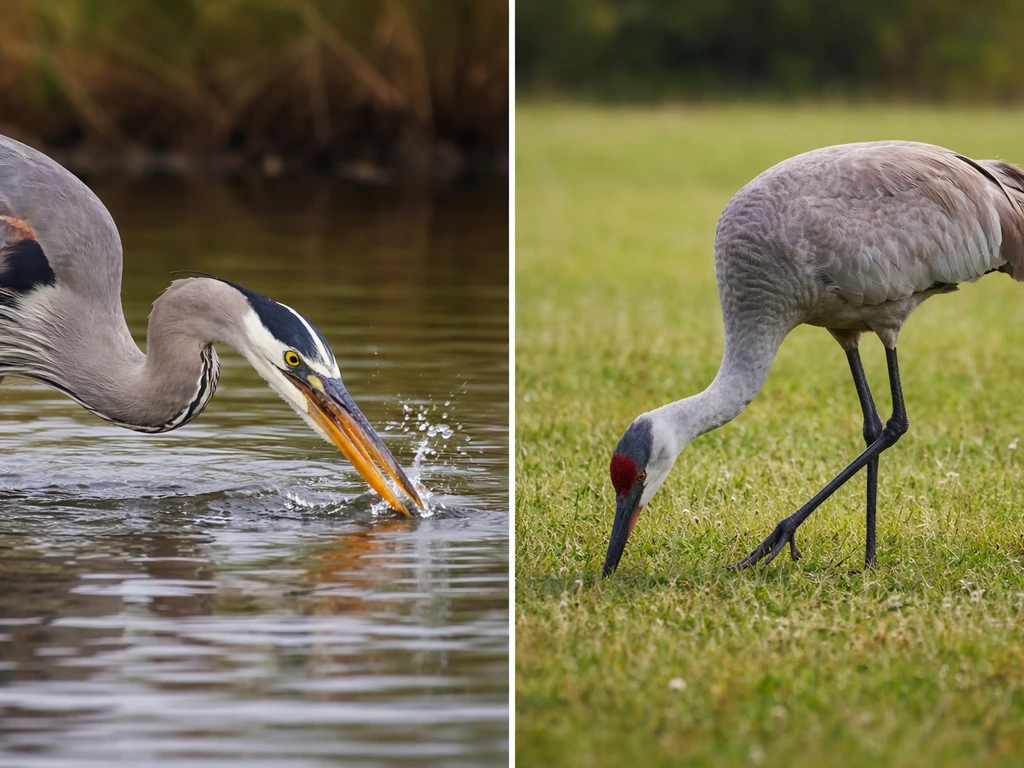
Look at the bill and you'll rarely be wrong. The Great Blue Heron carries a long, straight, dagger-shaped bill that's orangish-yellow in adults. It's designed for one thing: stabbing prey. The heron's entire hunting strategy is built around standing motionless in shallow water (or at the edge of it), waiting for a fish, frog, or small mammal to come within range, then throwing its head and neck forward with explosive speed to impale the prey with that spear-like bill. It's a "bill-stab" technique, and the stillness that precedes it is just as diagnostic as the strike itself. If you see a tall wading bird standing absolutely frozen for minutes at a time, you're almost certainly looking at a heron.
Sandhill Cranes forage completely differently. They walk slowly through fields, meadows, and shallow wetlands, probing the ground or substrate with their bills to find subsurface food items including roots, tubers, insects, small rodents, and waste grain. They rarely stand still for long. Watching a crane feed looks more like watching a chicken scratch through a yard than watching a heron hunt. That behavioral contrast alone is enough to ID the bird without ever seeing a field mark clearly.
The feet tell a complementary story. Herons have long, unwebbed toes perfectly suited for gripping underwater surfaces and perching on branches; they're comfortable roosting in trees. Cranes have shorter rear toes and are almost entirely ground birds, roosting on sandbars and in shallow water rather than in trees. If the bird you're watching has just landed in a tree, it's a heron. Cranes don't do that.
Plumage and color patterns (juveniles included)
Adult Great Blue Herons are blue-gray overall, with a white face, a wide black stripe running over the eye, and long black plumes on the chest and back during breeding season. The bill is orangish-yellow. From a distance in flat light, they just look like a large gray bird, which is part of why they get confused with cranes. In low light or at distance, focus on the black eye stripe and the pale face; those markings are visible even when the blue-gray tone washes out.
Adult Sandhill Cranes are gray overall, sometimes with a rusty or brownish wash caused by iron-stained water and mud that the birds rub into their feathers during preening. The most distinctive adult feature is the red patch of bare skin on the forehead. Up close it's unmistakable, but it can be hard to see at distance or in poor light, so don't rely on it as your only cue.
Juveniles of both species add a layer of complexity. Young Great Blue Herons, which can fly at around 60 days and leave the nest between 65 and 90 days old, lack the bold black eye stripe of adults and show a more uniformly grayish-brown head without the white face. Juvenile Sandhill Cranes are even more dramatically different from adults: they're covered in cinnamon-brown feathers rather than gray, and they lack the red forehead patch entirely.
A young crane in cinnamon plumage can look startlingly different from what most people picture when they think "crane," so if you see a large, brownish, long-legged bird walking through a field and probing the ground, consider a juvenile crane before ruling it out. The walking-and-probing behavior is the same at any age.
Behavior and habitat: where each bird is likely to be
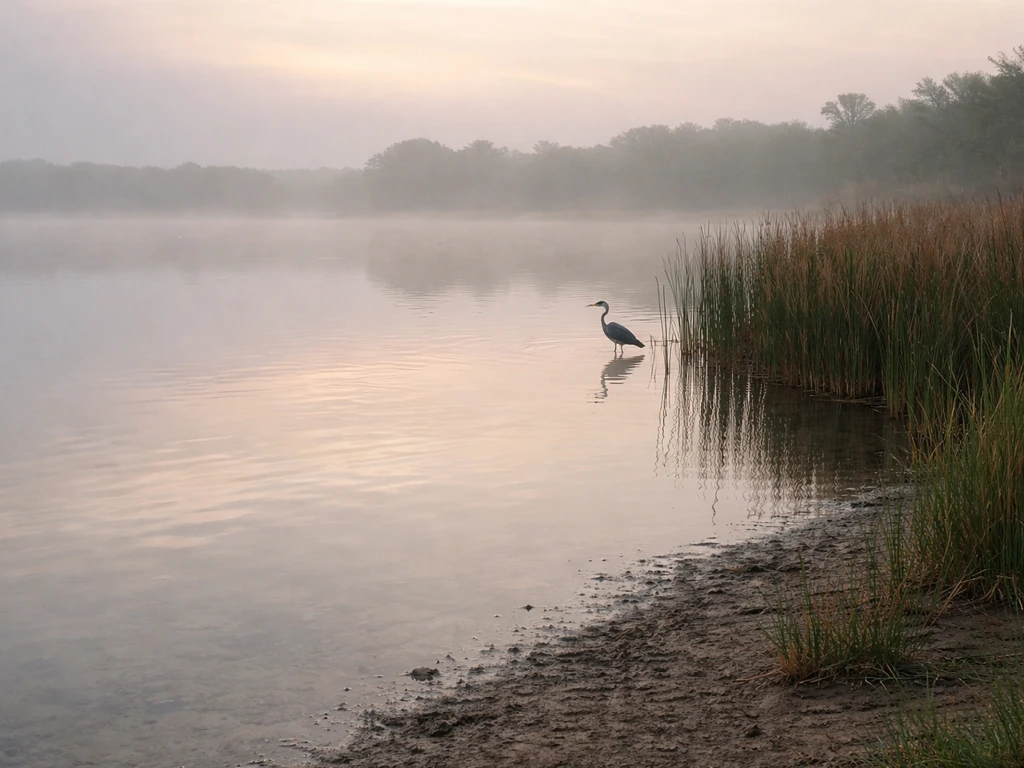
Where you are matters a lot for a fast ID. Great Blue Herons are year-round residents across most of North America and are strongly tied to water. You'll find them at the edges of lakes, rivers, marshes, tidal flats, and even small backyard ponds. They're solitary hunters and largely solitary outside of nesting season. If you're watching a single tall gray bird standing motionless at the water's edge, heron is the first guess almost everywhere in the continental US.
Sandhill Cranes have a different habitat profile. They use expansive grasslands, wet marshy meadows, and grass-succession areas as well as wetlands, shallow lakes, and harvested agricultural fields. During migration and winter, they're frequently seen in huge flocks on sandbars, shallow impoundments, and harvested cornfields. The spectacle of more than 500,000 Sandhill Cranes converging on the Platte River basin in Nebraska during spring migration is one of the most dramatic wildlife events in North America, and over 20,000 cranes use the San Luis Valley in Colorado each spring and fall. The point is: if you're seeing dozens or hundreds of large gray birds in an agricultural field or on a sandbar, they're almost certainly cranes. Herons don't flock like that.
This is also where a broader understanding of heron bird vs crane habitat patterns pays off, because the two birds genuinely do overlap in certain wetland environments. The key is to look at behavior first: is the bird standing still at the water's edge, or walking through a field? That single question almost always points you in the right direction.
One more habitat tip: if you're trying to figure out whether a large bird roosting in a tree is a heron or a crane, it's a heron. Cranes roost on the ground or in shallow water, not in trees or on branches. Herons regularly perch in trees, particularly around nesting colonies called rookeries.
Size, silhouette, and distance lookalike tips
At long range, when color and field marks are hard to see, silhouette and movement are everything. Here's a quick mental checklist to run through when a bird is too far away for detail:
- Neck position in flight: S-curve = heron, straight arrow = crane. This works even at 500 meters.
- Wing shape: both birds have very broad wings, but cranes tend to show a slightly flatter, more outstretched profile compared to the heron's more arched, boat-hull wing shape.
- Wingbeat: cranes have a steady, relatively slow wingbeat with a distinctive upward flick at the top of the stroke. Heron wingbeats are slower and deeper without that flick.
- Flock or solo: a group of large gray birds in formation is almost always cranes. A lone bird at a water's edge is almost always a heron.
- Habitat: standing water or water's edge pushes the odds toward heron. Open field, grassland, or sandbar pushes them toward crane.
- Feeding behavior: frozen stillness then a fast strike means heron. Slow walking with head down and bill probing the ground means crane.
It's also worth knowing a few other large gray birds that can cause confusion. Cranes are sometimes mixed up with storks, and if you want to go deeper on that comparison, the crane bird vs stork breakdown covers the structural and behavioral differences in detail. Cranes are also occasionally confused with swans at distance, especially in poor light when only a white or pale bird is visible; crane bird vs swan addresses those silhouette differences.
And if you're in coastal or tropical wetlands where storks and pelicans share space, understanding how pelican bird vs stork differ can help you eliminate candidates faster. Finally, if you're in Florida or another area with flamingo sightings, the crane bird vs flamingo comparison is worth a look because the size and stance can be surprisingly similar in photos.
Your fast-decision heuristics at a glance
Run through these "if you see X" rules in order and you'll have a confident answer in under a minute:
- If the neck is folded into an S-curve in flight: Great Blue Heron.
- If the neck is straight and fully extended in flight: Sandhill Crane.
- If the bird is standing motionless at the water's edge for minutes at a time: almost certainly a Great Blue Heron.
- If the bird is walking slowly through a field or grassland with its head down, probing the ground: almost certainly a Sandhill Crane.
- If there are dozens or hundreds of birds flying or feeding together: Sandhill Cranes, not herons.
- If the bird just landed in a tree: Great Blue Heron.
- If the bird has a reddish bare patch on its forehead: Sandhill Crane (adult).
- If the bird shows a bold black stripe over a white face: Great Blue Heron (adult).
- If the bird is cinnamon-brown, large, and walking through a field: juvenile Sandhill Crane.
- If it's spring and you're anywhere near the Great Plains or a major river corridor: cranes are actively migrating and are very much in play.
The neck posture is the one rule to burn into memory above all others. Every other cue is helpful, but that single feature, visible at real-world birding distances, will give you the right answer faster than any other. Pair it with a quick habitat and behavior check and you'll be confidently distinguishing cranes from Great Blue Herons every time you're in the field.
FAQ
What if the bird is walking, not flying, and I missed the neck-in-flight posture?
Use the feeding behavior first. A Great Blue Heron usually pauses for long stretches and then snaps its head forward to stab prey. A sandhill crane typically keeps moving, walking and probing the ground with short, repetitive bill-checks. If you can, add a second cue by checking whether the neck is held kinked at the water’s edge (more heron-like) versus carried more upright while foraging (more crane-like).
Can a Great Blue Heron ever look like it has a straight neck in flight?
In some angles and lighting, the S-curve can be harder to see, especially at distance. In that case, look for the overall silhouette: herons tend to look hunched due to a retracted neck plus broader, rounded wing shape, while cranes typically keep the neck fully extended and show that cross-shaped, more streamlined alignment of neck and feet. If the legs clearly trail past the tail with the neck tucked, lean heron.
How can I tell them apart when both are standing in shallow water and I can’t see fine head markings?
Switch from color to posture and stance. Herons often adopt a statue-like, motionless posture with the neck kinked or drawn back, then deliver quick stabbing strikes. Cranes more often look alert and upright while walking and foraging, with fewer long freeze periods. At that distance, behavioral rhythm (freeze-and-stab versus walk-and-probe) usually beats eye-stripe details.
Do cranes perch in trees sometimes, or is that always a heron sign?
Tree roosting strongly favors herons. Sandhill cranes are primarily ground roosters and use sandbars, shallow water, or open areas for resting. If you repeatedly see the same tall wader perched in a tree, treat heron as the leading candidate even if it is silent and far away.
What should I do if I’m watching a mixed group, like a crane flock near wetlands, and I’m worried some birds could be herons?
In flocks, cranes are the standout because they often move and feed as a group, and you may see many individuals feeding in nearby open habitat or fields. Herons are more likely to be solitary or in small, widely spaced numbers. Do a quick scan for the neck silhouette in the air, then confirm with feeding style: group walking and probing points to cranes, isolated stillness and head-stab points to herons.
How do I handle juvenile birds, especially when the crane’s red forehead patch is hard to see?
Don’t rely on the red forehead patch at distance or in poor light. Instead, use juvenile plumage plus behavior. Juvenile sandhill cranes are typically cinnamon-brown overall and still use the walk-and-probe foraging method. Young Great Blue Herons look more uniformly gray-brown on the head and often lack the crisp adult eye stripe, but their freeze-and-stab hunting pattern remains the most reliable behavioral anchor.
If the bill length is hard to judge, what’s the best “no-close-up” cue?
Bill length is difficult at long range, so prioritize motion and posture. Watch the first hunting attempt: a heron will often pause, then thrust its head and neck forward rapidly. A crane will generally keep working the ground, with continuous probing steps rather than a sudden, explosive strike.
What’s the fastest field order of checks if I only have 20 to 30 seconds?
1) If airborne, decide on neck posture, straight extended (crane) versus tight S-curve (Great Blue Heron). 2) If on the ground, check behavior rhythm, freeze-and-stab (heron) versus walk-and-probe (crane). 3) If still uncertain, use habitat and social context, solitary water-edge bird for heron, clusters on sandbars or agricultural fields for cranes.
Could I be confusing these birds with storks, swans, or pelicans if I’m only using “gray tall bird” impressions?
Yes, at distance they can all look like large waders. Before using color, look for the specific silhouette and motion cues covered here. Cranes and herons have the distinctive long-neck posture contrast (straight versus S-curve in flight) and different feeding rhythms. If the neck-in-flight cue does not match either pattern, consider that it may be a different large bird and re-check size, bill shape, and wing posture during flight.
Next Article
Godzilla vs Kong Bird: Identify the Exact Bird Lookalike
Disambiguate and ID the exact bird behind searches like Godzilla vs Kong bird using field marks, habitat, range, behavio