Herons and cranes are not the same bird, and the difference is not subtle once you know what to look for. The single biggest tell is neck posture in flight: herons fold their neck into a tight S-curve and tuck their head back onto their shoulders, while cranes fly with the neck fully extended and straight. If you catch a large wading bird in the air, that one cue alone will settle the question almost every time. On the ground it takes a few more seconds, but the ID is just as reliable once you know the key checkpoints.
Heron Bird vs Crane: Side-by-Side ID Guide

Marcus Hendricks
12 Apr 2026
Quick ID: body shape, size, and posture
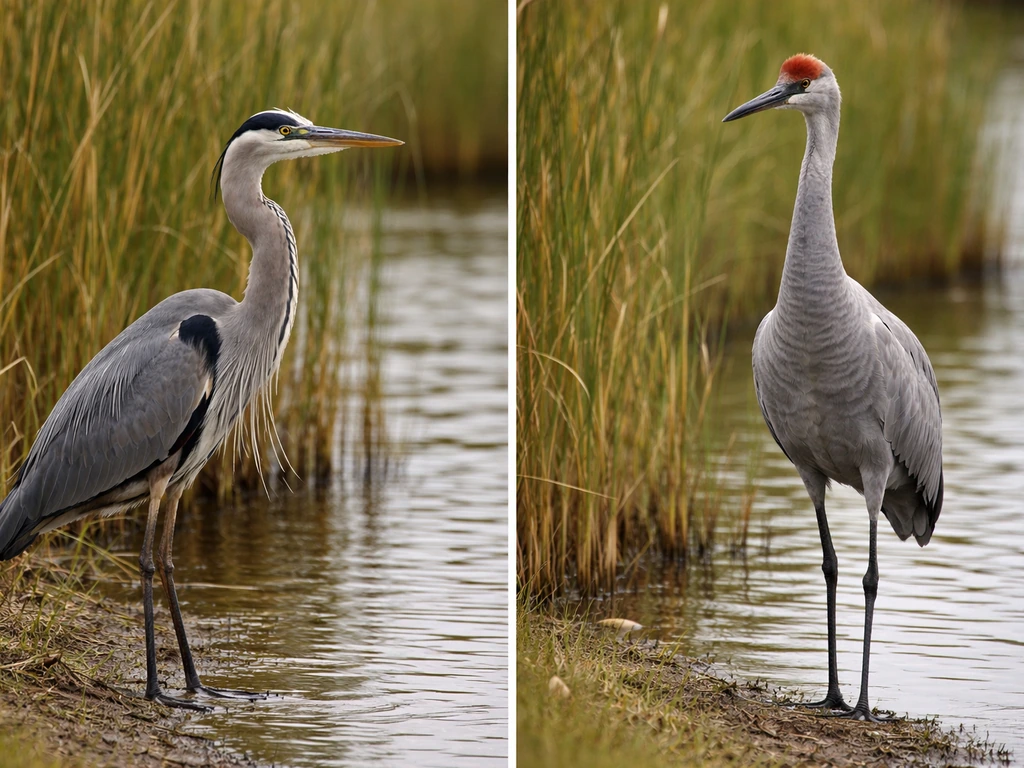
The Great Blue Heron is a big bird, running about 3 ft 2 in to 4 ft 6 in (1.0–1.4 m) in length with a wingspan of 5 ft 6 in to 6 ft 7 in (1.7–2.0 m) and a weight of roughly 4.5 to 8 lb. The Sandhill Crane overlaps in that range but trends heavier, standing about 3–5 ft tall (80–120 cm) and weighing in at 6.5–14 lb (3–6.5 kg). So cranes are generally stockier and heavier-bodied for their height, while herons look more elongated and lean, almost serpentine.
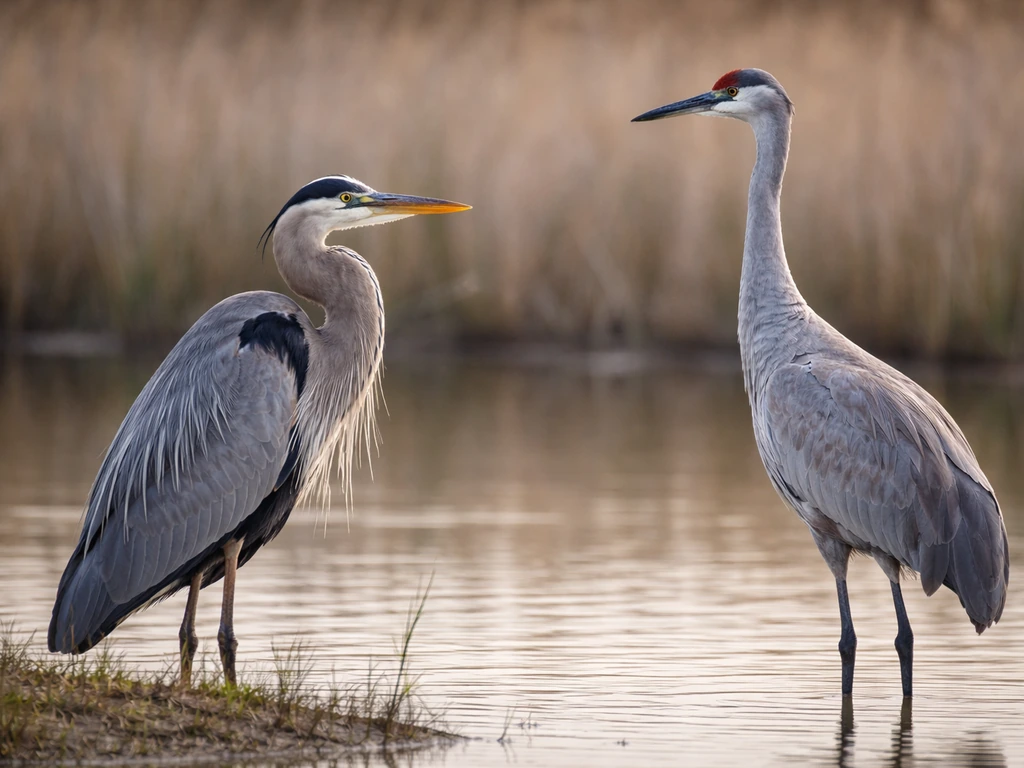
Posture is where the shape difference really shows up at rest. A heron stands with a slight forward hunch, neck often pulled in like it's thinking hard about something. A crane stands tall and upright, neck fully extended, with a more robust, barrel-chested look. If the bird looks like a prehistoric dinosaur with clean military posture, you're probably looking at a crane. If it looks like a tall, slouched aristocrat, that's a heron.
Head, neck, and bill differences in the field
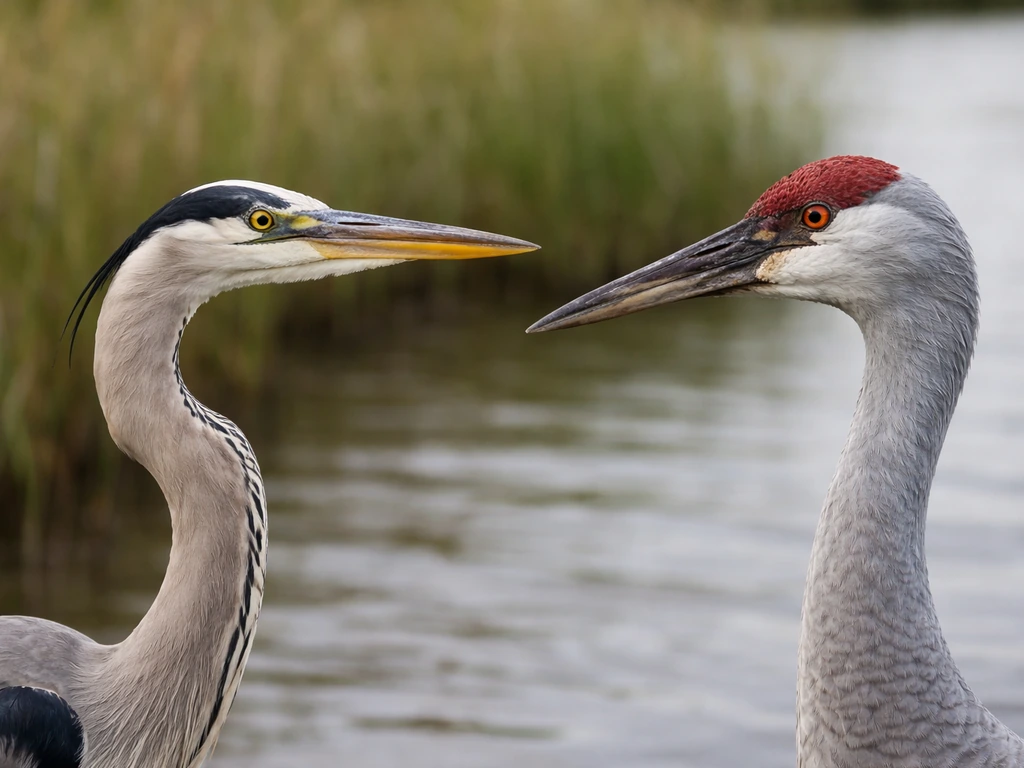
Herons have long, sinuous necks with a distinctly kinked or S-shaped curve even when extended. That kink is structural, not accidental. The neck vertebrae of herons are built to fold and spring, which is exactly what happens when they strike at prey. When a heron is at rest or alert, the neck often stays partially coiled rather than fully stretched out.
Cranes have straighter, thicker necks with very little of that S-curve tendency. Crane heads are also distinctive: Sandhill Cranes sport a bright red patch of bare skin on the forehead, something no heron has. Heron heads, by contrast, carry long plumes or crests (the Great Blue has a black stripe that sweeps back into a wispy plume). The bill is another clear marker. Herons have a long, dagger-like bill, narrow and sharp, purpose-built for spearing fish. Crane bills are shorter relative to body size and more blunt-tipped, designed for probing and picking rather than stabbing.
Leg length and stance: where the confusion comes from
This is the main source of confusion for most people, and honestly it makes sense. Both birds are tall, stand in or near water, and have long legs that make them look vaguely similar at a distance. But look more carefully and the proportions are different. Heron legs are very long and slender, almost spindly, and they tend to stand in shallow water with those legs fully submerged up to the knee joint (the joint that actually bends backward, which is the ankle anatomically). Cranes have long legs too, but they're proportionally thicker and more robust, and cranes spend more time on dry land, often walking through fields and grasslands.
Stance also differs. A heron at rest often shifts its weight and droops slightly, neck pulled in, looking like it's conserving energy. A crane standing in a field looks alert and upright even when it's relaxed. If the bird is standing in the middle of a corn stubble field a hundred yards from the nearest water, it's almost certainly a crane. Herons rarely wander far from their aquatic hunting grounds.
Wing and tail cues during flight
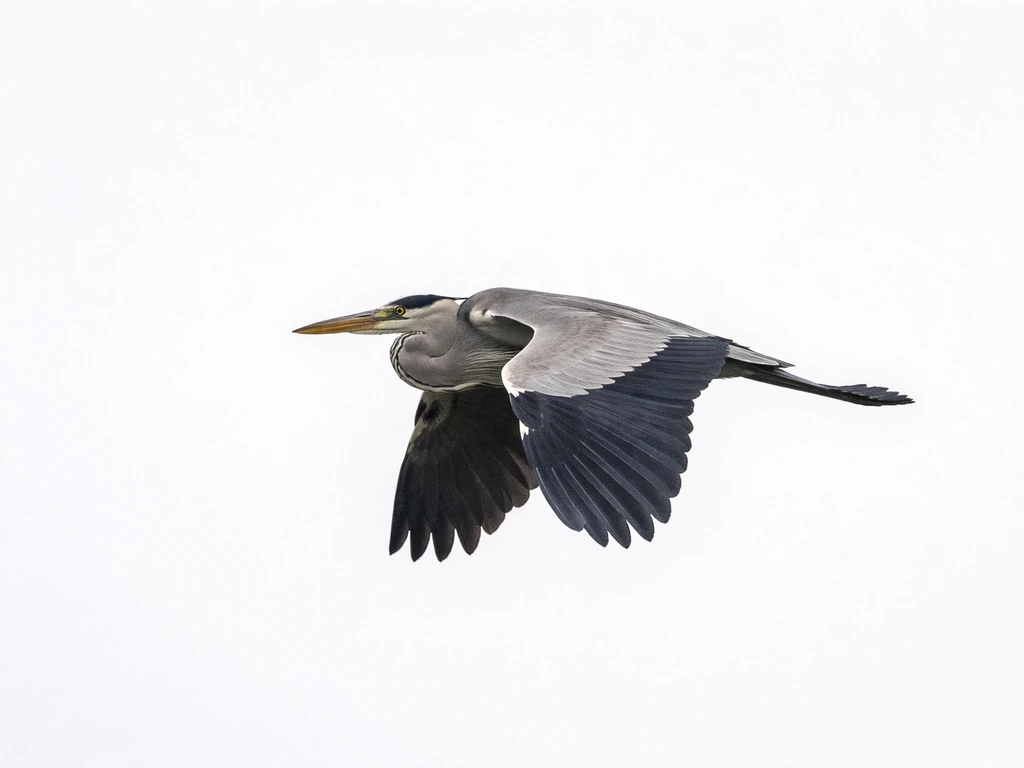
Flight is where the ID becomes near-instant. Herons fly with their neck retracted into that S-curve, head tucked back close to the body. The wingbeats are slow and somewhat floppy, with slightly bowed wings. Cranes fly with the neck fully stretched out forward and legs trailing behind, creating a straight-line silhouette from bill-tip to toe-tip. Crane wingbeats are more powerful and deliberate, and they frequently soar on thermals in ways herons typically don't.
Tail differences are minor but worth noting. Herons have a relatively short, blunt tail that's often hidden under folded wingtips. Cranes have a bushy, almost fluffy tail caused by the elongated tertial feathers that droop over the tail area, giving the back end a rounded, puffed appearance. In flight this difference disappears, but on the ground it's a useful secondary check.
Crane wings are also generally broader in proportion to body length, and when they soar, they hold the wings flat rather than bowing them downward like herons tend to do. Sandhill Cranes are famous for migrating in massive flocks called kettles, circling upward on thermals. You will never see Great Blue Herons doing that.
Behavior and feeding style: what they do differently
Feeding behavior is one of the most reliable and enjoyable ways to confirm your ID. Great Blue Herons are ambush predators. Britannica also describes Great Blue Herons as ambush predators that use a long, spear-like bill to strike prey suddenly Great Blue Herons are ambush predators. They stand motionless in shallow water for minutes at a time, waiting for a fish to swim within range, then explode forward with a lightning-fast bill-strike. The patience is remarkable and almost eerie to watch. When they do walk, it's glacially slow, every step deliberate and quiet.
Cranes are omnivores and active foragers. They walk steadily through fields, wetland edges, and agricultural land, picking up insects, grain, tubers, small mammals, and just about anything edible. They probe the ground with that blunter bill rather than spearing prey. You'll often see Sandhill Cranes moving constantly, heads bobbing as they walk, covering ground actively. They're social too, commonly feeding in pairs or large flocks, whereas herons are famously territorial and mostly solitary at feeding sites.
Crane courtship behavior is another thing entirely. Their dancing displays, with dramatic leaping and wing-spreading, are among the most spectacular things in North American birdwatching. Herons have their own displays at nesting colonies, but nothing with the same theatrical energy as a dancing crane.
Habitat and geography: where each is most likely to show up
Great Blue Herons are nearly ubiquitous across North America wherever there's water. Rivers, lakes, ponds, marshes, coastal estuaries, even drainage ditches and garden ponds. If there's shallow water and fish, a heron will find it. They're year-round residents across much of the continent and show up in some surprising places, including urban parks.
Sandhill Cranes have a more defined range and habitat preference. The Smithsonian National Zoo notes that sandhill cranes are one of only two crane species native to North America.
They breed across northern Canada, Alaska, and parts of the northern U. S. , and winter in the southern U. S.
, Mexico, and Cuba. During migration they concentrate in spectacular numbers along river corridors like the Platte River in Nebraska. They prefer open habitats: wet meadows, prairies, agricultural fields, and shallow wetlands. If you're in a coastal estuary or a forested riverbank, the tall wading bird there is probably a heron.
If you're in a flat agricultural landscape and the bird is in a grain field with dozens of its friends, crane is the better bet.
It's also worth knowing that geographic overlap creates most of the real-world confusion. Both species share habitat in many parts of the U.S., particularly in wetlands adjacent to open fields. That overlap zone is exactly where careful field ID matters most. For a deeper look at how the Sandhill Crane compares to other large wading birds, the crane bird vs blue heron breakdown goes into even finer morphological detail if you want to go further on that specific comparison.
How herons and cranes stack up side by side
| Feature | Great Blue Heron | Sandhill Crane |
|---|---|---|
| Height | 3.5–4.5 ft (45–54 in) | 3–5 ft (80–120 cm) |
| Weight | 4.5–8 lb | 6.5–14 lb (3–6.5 kg) |
| Wingspan | 5.5–6.5 ft (66–79 in) | ~6 ft (approx. 185 cm) |
| Neck in flight | Folded into S-curve, head tucked | Fully extended and straight |
| Bill shape | Long, narrow, dagger-like | Shorter, blunter, probing |
| Head markings | Black stripe, wispy plume | Red bare-skin forehead patch |
| Feeding style | Stand-and-wait ambush in water | Active walking forager on land/wetlands |
| Social behavior | Solitary at feeding sites | Often in pairs or large flocks |
| Tail appearance | Short, blunt | Bushy, drooping tertials |
| Primary habitat | Shallow water, wetlands, coasts | Open fields, wet meadows, agricultural land |
The recommendation is simple: use neck posture in flight as your primary ID cue, then confirm with habitat and feeding behavior on the ground. Those two checkpoints will resolve the vast majority of heron-vs-crane questions without needing to get close enough for bill or head detail.
Best step-by-step method to confirm your ID
Use this sequence in the field. It's ordered by speed and reliability, starting with the cues you can get from the greatest distance.
- Check flight silhouette first. If the bird is airborne, look at the neck immediately. Neck folded back and head tucked? Heron. Neck straight out with legs trailing behind? Crane. This single cue is correct nearly 100% of the time.
- Look at the habitat. Is the bird standing in water, at a pond edge, or along a stream? Lean toward heron. Is it in a dry field, pasture, or agricultural land, potentially with other large birds? Lean toward crane.
- Check the body posture at rest. Upright, tall, and alert with neck extended? Crane. Slightly hunched with neck pulled in and forward-leaning stance? Heron.
- Look at the head. Red patch of bare skin on the forehead? Crane. Black plume or crest extending from behind the eye? Heron.
- Watch the feeding behavior for 30 seconds. Standing motionless staring at water? Heron. Walking steadily and pecking at the ground? Crane.
- Check the bill. Long, pointed, and narrow like a dagger? Heron. Shorter and more tapered without that extreme spear-point sharpness? Crane.
- If you're still unsure, look for other birds nearby. A lone, patient bird at a pond edge is almost always a heron. A group of large, upright birds in a field, especially during spring or fall migration, is almost always cranes.
Why people keep mixing these birds up
The honest answer is that both birds are large, gray-ish, long-legged, and share some wetland habitat. From a car window at 50 mph, or from across a large field, they can look similar enough to cause doubt. The confusion is also partly a naming problem: in casual speech, people often call herons 'cranes' even when they're looking at a heron, and that misuse has been repeated so often that it sticks. Great Blue Herons are by far the more commonly encountered of the two in most parts of North America, so if you're second-guessing yourself, the base-rate odds already favor heron.
Context from other comparisons helps calibrate your eye too. For example, understanding how a crane differs from other long-legged birds like storks sharpens your overall gestalt for what a crane actually is. The crane bird vs stork comparison is useful for exactly that kind of calibration. Similarly, if you're in a wetland area and see something large and white that you can't immediately place, the pelican bird vs stork comparison can help you rule out other big wetland birds you might be conflating in the mix.
There's also a broader family of confusing large birds that share open water and wetland habitats. Swans and flamingos get pulled into the same visual muddle for beginners. Articles like crane bird vs swan and crane bird vs flamingo can round out your understanding of where cranes actually sit in the lineup of large, striking waterbirds.
The one-sentence rule to take into the field
If the bird is flying with its neck folded back, it's a heron. If the neck is stretched out straight, it's a crane. Everything else, the habitat, posture, bill shape, feeding behavior, is just confirmation. Get that flight silhouette into your visual memory and you'll never mix them up again.
FAQ
What if I only see the bird on the ground and it’s not feeding?
Use proportions plus stance. A crane usually looks tall and upright with thicker, more robust legs and a barrel-chested posture, while a heron often looks slightly hunched or forward-leaning with the neck pulled in or partially coiled. If you can spot leg placement, cranes stand more in open grass or fields, herons more often in shallow water with the legs submerged.
Can distance and angle make the neck-curving cue unreliable?
Yes, especially if the bird is small in the frame or you’re viewing side-on at an odd angle. In that case, don’t rely on the neck alone. Cross-check wingbeat style, herons tend to have slower, floppier wingbeats, cranes tend to look more powerful and deliberate. Also look for body silhouette, a crane’s straight line from head to feet is easier to read than a partial neck view.
How do I tell a heron from a crane when the bird is landing or taking off?
Watch the neck transition. Herons retract the neck into the S-curve and tuck the head back as they fly and maneuver, then often keep it partially coiled even at rest. Cranes keep the neck extended during flight, and in landing posture they still generally maintain that taller, more upright look compared with a heron’s slouchy, energy-conserving stance.
Are Great Blue Herons and Sandhill Cranes the only common species I’ll run into?
In many parts of North America, Great Blue Heron and Sandhill Crane are the most likely pair for this comparison, but other herons and cranes can add confusion. If the bird shows a very different head pattern, for example multiple colored facial patches or a contrasting crest, rely first on neck posture in flight and then on bill shape and habitat use rather than assuming it must be those two exact species.
What should I do if the bird is calling loudly but I can’t see neck posture clearly?
Use behavior and context. Cranes are often more visibly social around feeding, so look for multiple individuals, regular ground movement, and steady foraging in fields. Herons are more likely to be solitary and motionless at water edges, then suddenly strike. If you can get a brief view during a hop, short flight, or thermal soar, prioritize neck posture then.
How can I avoid mixing up cranes with storks, when they’re both long-legged?
Even if both can look similar at distance, storks generally have a different flight silhouette and don’t show the same consistent neck posture switch as cranes. Treat cranes as the “extended-neck” reference for flight silhouette, then confirm on the ground with the crane’s stockier build, blunter bill for probing, and tendency to roam dry habitat more often.
Do both birds ever feed in the same way that could confuse me?
Occasionally, but the tactics differ. A heron’s signature is a rapid, stabbing bill strike after a long pause in shallow water. A crane more often probes and walks steadily, picking at insects or grain. If you see extended stillness followed by a lightning-fast forward jab, that strongly favors heron.
What’s a quick field decision order when I’m unsure?
Start with the fastest cue you can reliably observe: (1) neck posture in flight (S-curve tucked for heron, straight extended for crane). (2) on-ground stance, heron hunched or forward-leaning, crane upright. (3) habitat, heron near water more consistently, crane more in fields and grasslands. (4) feeding pattern, ambush strike versus active probing.
Next Article
Crane Bird vs Blue Heron: How to Tell Them Apart
Learn crane vs blue heron ID using silhouette, neck posture, bill and flight cues, plus habitat and feeding tells.