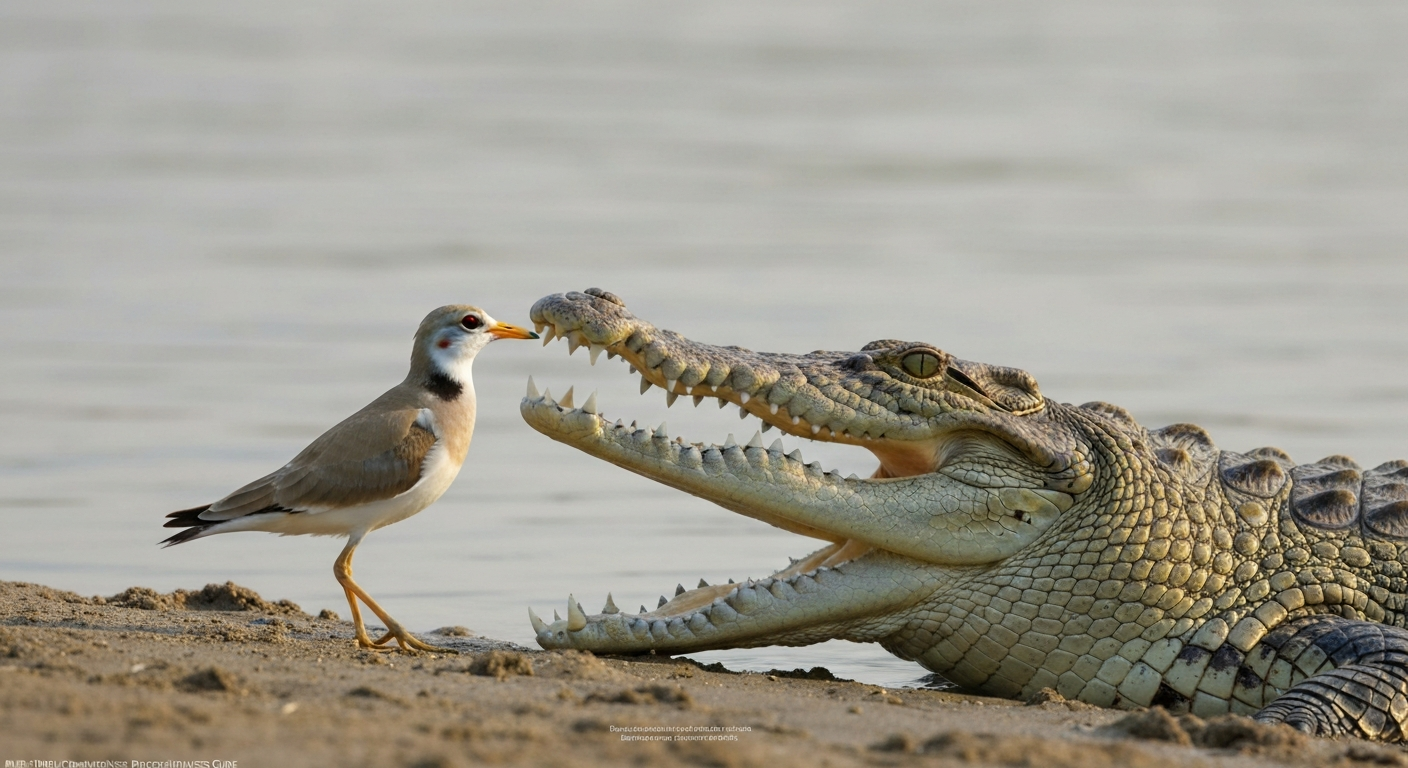
The short version: no verified, peer-reviewed field study, no authenticated wild photograph, and no timestamped video has ever shown a bird climbing into a crocodile's mouth and removing leeches or food debris. The Egyptian plover–crocodile story is one of the most repeated 'facts' in popular natural history, but it traces back to Herodotus writing in the 5th century BCE and has never been confirmed to the evidentiary standard required to call it a mutualism. That does not mean birds and crocodiles never interact, they absolutely do, and some of those interactions are genuinely interesting. It just means we need to separate what has been documented from what has been assumed for 2,500 years.
Mutualism Examples: Crocodile and Bird Interactions Explained

Marcus Hendricks
30 Jul 2026
What this article covers and who it is for
This article is written for bird enthusiasts, students, wildlife photographers, and educators who want a straight answer about the crocodile-bird mutualism claim. I will walk you through the classical origins of the story, explain what mutualism actually requires as a biological standard, review every category of evidence (peer-reviewed studies, field observations, photographs, folk reports), and give you a clear picture of where the science stands today. Along the way I will flag which claims are confirmed, which are plausible but unconfirmed, and which are simply myth. If you are interested in how birds relate to other large animals or reptiles in comparative terms, the shoebill vs crocodile dynamic is a fascinating real-world counterpoint worth exploring alongside this topic.
What mutualism actually means (and what it does not)
Mutualism is a type of symbiosis where both species involved receive a measurable fitness benefit from the interaction. The key word is both. If only one species benefits and the other is unaffected, that is commensalism. If one species benefits at a direct cost to the other, that is parasitism. Mutualism sits in its own category, and the bar for confirming it is higher than most people realise.
In the cleaning-mutualism literature specifically, researchers use four concrete criteria to confirm the interaction qualifies. First, there must be a measurable reduction in parasite load or injury for the animal being cleaned (the client). Second, there must be a demonstrable fitness benefit to the client, meaning improved survival, reproduction, or health metrics. Third, the interaction must be repeatable and directional, with evidence of signalling or partner choice rather than random proximity. Fourth, the cleaner must consistently receive a resource, typically food. Unless you can tick all four boxes with field data, you are working with a hypothesis, not a confirmed mutualism. This framework matters enormously when we evaluate the crocodile-bird story.
For comparison, consider the red-billed and yellow-billed oxpeckers (Buphagus erythrocephalus and B. africanus). These birds have been studied empirically on large African mammals, and researchers have quantified ectoparasite removal rates, measured host health outcomes, and documented the birds' foraging behaviour in repeatable field conditions. Oxpeckers are the gold standard of a documented avian cleaning mutualism. The plover-crocodile story does not come close to that evidentiary standard.
The Egyptian plover–crocodile story: where it came from
The story starts with Herodotus. In Book II, section 68 of his Histories (written around 440 BCE), the Greek historian describes a bird he calls the 'trochilos' entering the open mouth of a basking Nile crocodile to eat leeches. Herodotus was writing about Egypt, and his account is colourful and specific: the crocodile opens its mouth on the riverbank, the bird hops in, eats the leeches, and hops back out. The crocodile does not snap its jaws because the bird is performing a service.
That single passage from Herodotus became the seed for roughly 2,500 years of repetition. Aristotle, Pliny, and Aelian all echoed versions of the trochilus story in their own natural history writings. By the time European naturalists were exploring Africa in the 18th and 19th centuries, the story was so embedded in educated culture that observers were primed to believe it. Victorian naturalists reported seeing small birds approach crocodiles and interpreted that proximity through the lens of the ancient account. Each retelling added a layer of apparent authority without adding any new primary evidence.
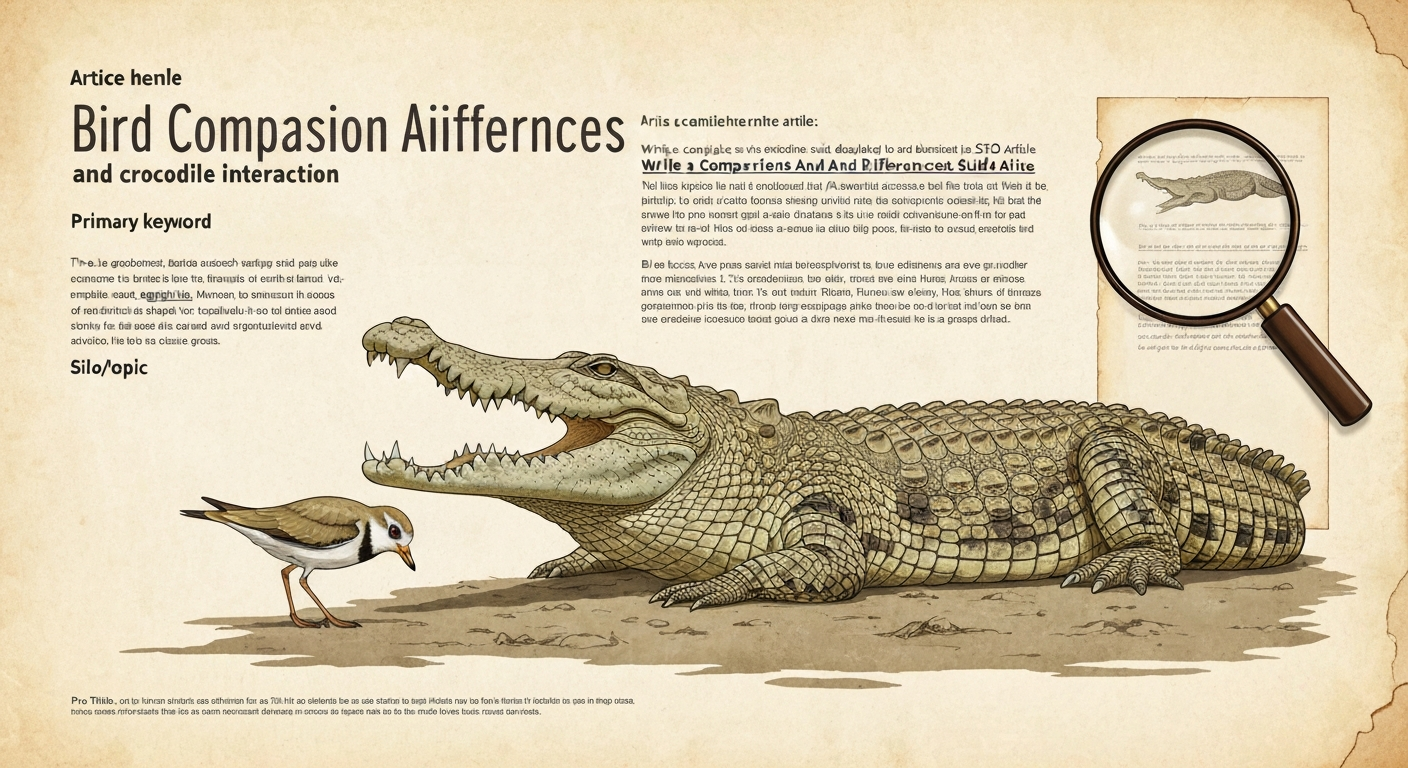
The bird that eventually got assigned the role of 'crocodile bird' in modern times is Pluvianus aegyptius, the Egyptian plover, a striking black-and-white-and-orange wader that does live alongside Nile crocodiles in sub-Saharan Africa. The association of this species with the ancient story is partly logical (it shares the range) and partly arbitrary. Other riverside birds, including spur-winged lapwings, were also named in 19th-century accounts. The 'crocodile bird' label became fixed to the Egyptian plover largely through repeated use rather than through evidence that this specific species performs mouth-cleaning.
What the evidence actually shows: documented interactions
Let me be precise here about what counts as documented. For an interaction to qualify as documented in a scientific sense, it needs at minimum a verifiable field observation with contextual detail (location, date, observer identity, behavioural description), ideally corroborated by photographic or video evidence that is authenticated as wild footage rather than staged or digitally constructed.
By that standard, here is what we have. Thomas R. Howell's 1979 monograph on the Breeding Biology of the Egyptian Plover (University of California Publications in Zoology) is the most thorough species-level study of Pluvianus aegyptius in print. Thomas R. Howell’s monograph, Breeding Biology of the Egyptian Plover, Thomas R. Howell (1979) (University of California Publications in Zoology), is the standard species‑level treatment and reports no verified observations of plovers cleaning crocodile mouths blank" rel="noopener noreferrer">Breeding Biology of the Egyptian Plover — Thomas R. Howell (1979) (University of California Publications in Zoology). Subsequent authors citing Howell consistently note that he did not document verified intra-oral cleaning of crocodiles by plovers despite extensive field time with the species. Modern ornithological authorities, including accounts compiled in the Handbook of the Birds of the World series and BirdLife/IUCN species records, acknowledge the historical claim but categorise the mouth-cleaning interaction as unverified.
Crocodilians do genuinely host ectoparasites. A peer-reviewed disease and parasite survey of wild Nile crocodiles (Crocodylus niloticus) in the Okavango Delta, Botswana found that 11 of 144 sampled crocodiles (approximately 7.6%) carried leeches of the genus Placobdelloides, with individual counts ranging up to 7 leeches per animal. That is real, published, field data confirming that Nile crocodiles carry leeches. So the story is not biologically absurd. But that same survey documented leeches at multiple body sites including the tail, neck, belly, and limb webbing. There was no finding that leeches concentrate inside the oral cavity, which would be the prerequisite for a mouth-cleaning bird to provide meaningful ectoparasite relief.
What is genuinely documented is that Egyptian plovers and other small birds do share riverbank habitats with Nile crocodiles, and that birds sometimes perch near or on crocodilians. That proximity is real. The leap from 'proximity' to 'enters the mouth and removes parasites in a repeatable mutualistic interaction' is the unsubstantiated part.
The photograph and video problem
In the internet age, the visual evidence for the crocodile-bird story looks compelling at first glance. A quick image search returns photographs that appear to show plovers standing inside or at the edge of a crocodile's open jaws. The problem is that at least one widely circulated image in stock libraries is explicitly labelled by its creator as a digital reconstruction, not a wild photograph. One such image is 'WP00955 Nile Crocodile with Egyptian Plover, Warren Photographic', which the image owner labels as a digital reconstruction rather than a wild photograph WP00955 Nile Crocodile with Egyptian Plover — Warren Photographic (image labelled as ‘digital reconstruction’). A popular short video showing multiple birds cleaning a crocodile's mouth is a CGI advertisement, specifically a commercial for Dentyne gum, not authenticated wildlife footage. These pieces of fabricated or constructed media circulate freely and are regularly shared as if they were documentary evidence.
Searches of major citizen-science platforms and camera trap archives produce no verified wild photograph or timestamped field video showing a bird entering a crocodile's mouth and removing leeches or debris. That absence of evidence, from the era of smartphones, trail cameras, and wildlife photographers spending weeks at African river systems, is genuinely telling. If this behaviour occurred with any regularity, someone would have captured it unambiguously by now.
Anecdotes and folk reports: plausible but unverified
Anecdotes occupy a different category from documented interactions. They are not worthless, but they are not evidence of mutualism either. A nineteenth-century traveller's diary entry describing a small bird near a crocodile's open mouth is interesting. It might reflect a real observation. It might reflect the observer seeing what they expected to see, given the classical story they had read. It cannot confirm a repeatable, functional mutualism.
Historical and travel accounts from the 19th and early 20th centuries include references to spur-winged lapwings (Vanellus spinosus) and other waders approaching basking crocodiles on African riverbanks. Modern critical reviews treat these as unverified natural-history anecdotes rather than repeatable, documented behaviours. The distinction matters: an anecdote tells you something might happen; a documented interaction with measurable outcomes tells you that it does happen and what the functional consequences are.
There are also occasional reports involving other crocodylian species. Broad-snouted caimans (Caiman latirostris) and spectacled caimans (Caiman crocodilus) in South America have been mentioned in passing accounts alongside local birds, but these reports are even less substantiated than the African plover accounts and do not appear in peer-reviewed literature as documented interactions.
Species and regions where interactions have been reported
The table below consolidates the species and geographic contexts where bird-crocodilian interactions appear in the literature or historical record. The 'status' column reflects the evidence level, not the biological possibility.
| Bird species | Crocodilian species | Region | Reported interaction | Evidence status |
|---|---|---|---|---|
| Egyptian plover (Pluvianus aegyptius) | Nile crocodile (Crocodylus niloticus) | Sub-Saharan Africa, Nile Basin | Intra-oral leech removal | Unconfirmed / anecdotal |
| Spur-winged lapwing (Vanellus spinosus) | Nile crocodile (Crocodylus niloticus) | Sub-Saharan Africa, North Africa | Proximity to open-mouthed crocodile | Unverified historical reports |
| Unspecified small waders | Broad-snouted / spectacled caiman (Caiman spp.) | South America | General proximity, possible feeding association | No peer-reviewed documentation |
| Multiple riverside birds (general) | Nile crocodile (Crocodylus niloticus) | Okavango Delta, Botswana | Shared riverbank habitat; crocodiles confirmed to carry leeches | Leech data confirmed; bird-removal not confirmed |
The Egyptian plover's actual documented biology is worth noting here. Pluvianus aegyptius is a real and fascinating bird: it incubates eggs by burying them in warm sand and cooling them with belly-soaked water, it is genuinely associated with African river systems, and it does encounter Nile crocodiles in its habitat. None of that makes the mouth-cleaning story true, but the bird's real biology is interesting enough without the embellishment.
What each partner would gain (proposed mechanisms, evidence status)
Even if the interaction has not been confirmed, it is worth explaining the proposed mechanism clearly, because understanding why the story is biologically plausible helps clarify why it persists and why proving it is actually difficult.
What the bird would gain
The proposed benefit for the bird is straightforward: food. Leeches are protein-rich, and insects, food debris, and parasites on or near a large animal represent a reliable, concentrated food source. Egyptian plovers are insectivorous waders that actively forage along riverbanks, so opportunistically picking ectoparasites off a large, tolerant host would fit their foraging behaviour in principle. This part of the hypothesis is biologically reasonable.
What the crocodile would gain
The proposed benefit for the crocodile is ectoparasite relief and possibly the removal of food debris that could harbour infection. Given that leeches have been confirmed on Nile crocodiles at a prevalence of roughly 7.6% in at least one field survey, parasite load is a real biological concern. However, the parasite survey found leeches distributed across multiple external body sites rather than concentrated in the mouth, which weakens the specific argument for an intra-oral cleaning service. If the interaction existed and provided meaningful parasite relief, we would expect either evidence of birds preferentially targeting oral regions or evidence of measurably lower leech loads on crocodiles that associate with birds. Neither has been documented.
Why the crocodile would not snap its jaws
The most dramatic element of the story, the crocodile holding its mouth open and not biting the bird, is also the most biologically implausible part. Crocodiles do thermoregulate by basking with open mouths (gaping), which is a real behaviour. But a bird-sized movement inside the oral cavity would almost certainly trigger a prey-capture reflex in a crocodile. The story requires the crocodile to suppress that reflex consistently across repeated interactions. No ethological study has documented voluntary mouth-opening for a cleaning service in crocodilians, and crocodile behaviour research does not support the idea that they exhibit the kind of inhibited posture seen in fish cleaning stations on coral reefs.
Confirmed vs unconfirmed: a quick-reference summary
| Claim | Status | Best available evidence |
|---|---|---|
| Nile crocodiles carry leeches (Placobdelloides spp.) | Confirmed | Peer-reviewed field survey, Okavango Delta (7.6% prevalence) |
| Egyptian plovers share riverbank habitat with Nile crocodiles | Confirmed | Species range data, field guides, ornithological accounts |
| Birds perch near or on crocodilians | Plausible / occasionally observed | Isolated field reports and photographs; not systematically documented |
| Egyptian plover enters crocodile's mouth to remove leeches | Unconfirmed / anecdotal | No peer-reviewed field study, no verified wild photograph or video |
| Crocodile holds mouth open voluntarily for avian cleaning | Unconfirmed | No ethological documentation; oral gaping is thermoregulatory, not service-oriented |
| Bird-crocodile interaction qualifies as mutualism under standard criteria | Not supported | Fails all four empirical criteria used in cleaning-mutualism literature |
| Widely circulated photos/videos show real mouth-cleaning | Mostly false | At least one image is a labelled digital reconstruction; one viral video is a CGI advertisement |
Where the science stands: consensus and remaining uncertainty
The current scientific consensus, reflected across cleaning-mutualism reviews, modern ornithological accounts, and the absence of the plover-crocodile interaction from canonical mutualism literature, is that the interaction has not been demonstrated to the standard required for confirmation. Comprehensive reviews of cleaning symbioses treat cleaner fish and oxpeckers as well-documented cases and explicitly exclude the crocodile-plover claim from the verified category. That is not a fringe position; it is the mainstream view in biology.
What remains genuinely uncertain is whether any version of the interaction occurs at all, even occasionally and non-mutualistically. It is possible that Egyptian plovers or other waders occasionally pick food or parasites from the exterior of a basking crocodile in a purely opportunistic, commensalistic way, without any functional crocodile benefit and without any directed, repeated, mutualistic relationship. That would be interesting but would not be mutualism. It has also never been verified in the field with reliable documentation.
The story's persistence is a lesson in how classical authority shapes scientific assumption. Once Herodotus wrote it down, and Aristotle and Pliny repeated it, the idea acquired the weight of ancient scholarship. Every naturalist who went to Africa already 'knew' about the crocodile bird before they arrived. Confirmation bias did the rest. This is actually a valuable case study for anyone interested in how misinformation persists in natural history, alongside similar dynamics explored in comparisons of other animals with birds. For readers curious about how genuine predator-prey dynamics between birds and large reptiles actually work, the shoebill vs crocodile topic is a striking real-world contrast: there, the interaction is unambiguously documented and quite different from the cosy mutualism described in the plover story.
Field observation and safety guidance
If you are a wildlife photographer or birder hoping to observe Egyptian plovers or Nile crocodiles in the field, here is practical guidance grounded in both safety and scientific ethics.
- Maintain a minimum safe distance of at least 5 metres from any wild crocodilian on land, and do not approach water's edge closely in areas with Nile crocodile populations. Crocodiles are ambush predators and move with extreme speed over short distances.
- Use a telephoto lens of at least 400mm equivalent focal length to observe and photograph riverside birds without disturbing crocodile behaviour. Disturbance itself will invalidate any behavioural observation.
- If you are attempting to document bird-crocodile interactions for citizen science or research purposes, record GPS coordinates, date, time, weather conditions, crocodile posture, and bird species and behaviour. Context-free photographs are difficult to interpret.
- Do not accept viral social media images or short videos as evidence of any interaction. Check whether the source is an authenticated wildlife photography account, a labelled digital reconstruction, or a commercial production.
- Be aware that in most range countries for Nile crocodiles (including Botswana, Kenya, Tanzania, Uganda, South Africa, and Egypt), crocodiles are protected under national wildlife law. Interference with wildlife for photography purposes may require permits.
- If you observe and photograph what appears to be a bird near a crocodile's open mouth, note that gaping (mouth-open basking) is normal thermoregulatory behaviour in crocodilians. The bird's presence nearby does not confirm an interaction.
- Submit well-documented observations to ornithological databases such as eBird with full contextual notes. Accumulating verified, timestamped field records is the only way to move this question out of the anecdote category.
Conservation context and research gaps
The Egyptian plover (Pluvianus aegyptius) is currently assessed as Least Concern by the IUCN, but its populations are vulnerable to riverbank disturbance, irrigation development, and changes to flood regimes on major African river systems. The Nile crocodile (Crocodylus niloticus) is also Least Concern overall but faces pressure from habitat loss, hunting, and pollution in parts of its range. Both species are genuinely worth monitoring and protecting independently of whether the mutualism story is true.
From a research perspective, the most significant gap is simply the absence of systematic field studies designed to test the interaction. A study combining camera traps at known Egyptian plover nesting sites overlapping with Nile crocodile basking areas, paired with regular ectoparasite surveys of the same crocodile individuals, could in principle resolve the question definitively. That study has not been done. Given how frequently the story is cited in educational contexts, from school textbooks to wildlife documentaries, the investment in actually testing it seems overdue.
There are also broader questions worth investigating. Do any bird species perform genuine ectoparasite removal on crocodilians anywhere in the world, even if not inside the oral cavity? Are there differences in leech load between crocodile individuals in areas with high bird activity versus low bird activity? How does crocodile thermoregulatory gaping behaviour change in the presence of nearby birds? These are answerable questions that would produce genuinely useful ecological data, regardless of what the answers turn out to be. The comparison with other unusual bird-animal or bird-reptile relationships, including cases like bullfrog and bird interactions or the behaviour of shorebirds around large fauna, illustrates just how diverse these ecological relationships can be and how much remains undocumented at a rigorous level.
The bottom line
The crocodile-bird mutualism story is 2,500 years old, biologically plausible in outline, and scientifically unconfirmed. Nile crocodiles carry leeches. Egyptian plovers live on the same riverbanks. Those two facts together make the story feel reasonable. But the specific claim, that plovers routinely enter crocodile mouths, remove ectoparasites, and receive voluntary tolerance from the crocodile in a repeatable mutualistic interaction, has never been verified with the evidence needed to confirm it. The photographs you may have seen are reconstructed or manufactured. The video going around is a gum advertisement. The classical sources are compelling literature but not field biology.
That does not make the birds less interesting. The Egyptian plover is a genuinely remarkable species with unusual nesting behaviour and a vivid field presence. Nile crocodiles are among the most ecologically important apex predators in African freshwater systems. Their shared riverbank world is worth watching carefully, and carefully is exactly how it should be documented. If you spend time on African rivers with a telephoto lens and a notebook, you might eventually add something real to this question. That would be worth far more than any recycled anecdote from Herodotus.
FAQ
What is mutualism and how does it differ from commensalism and parasitism?
Mutualism: an ecological interaction in which both species gain a measurable fitness or resource benefit (e.g., food, reduced parasite load, increased survival or reproduction). Commensalism: one species benefits while the other is essentially unaffected (no measurable cost or benefit). Parasitism: one species (the parasite) benefits at the expense of the other (the host suffers measurable harm). Empirical mutualisms are usually demonstrated by repeatable, directed interactions plus measurable benefits to both partners; these criteria are the standard used to judge claims such as the crocodile–bird story.
What is the classic 'Egyptian plover–crocodile' story and where does it come from?
The anecdote originates with Herodotus (5th century BCE), who described a small river bird (trochilos) entering a basking crocodile’s open mouth to remove leeches. Later classical authors (Aristotle, Pliny, Aelian, etc.) repeated variants of that story. It became the canonical ‘crocodile‑bird’ myth in natural‑history lore.
Has the Egyptian plover (Pluvianus aegyptius) been observed reliably cleaning crocodile mouths in the wild?
No verified, peer‑reviewed field observation, authenticated timestamped video, or reliably documented wild photograph demonstrates an Egyptian plover entering a crocodile’s mouth and removing leeches. Standard modern species monographs (e.g., Howell 1979) and recent species accounts note the historical claim but report no reliable documentation of intra‑oral cleaning.
What empirical evidence exists that crocodilians carry ectoparasites (like leeches) that could, in principle, be removed by birds?
Peer‑reviewed parasitology and disease surveys of Nile crocodiles document ectoparasitic leeches (e.g., Placobdelloides spp.) on wild crocodiles, with moderate prevalence in some populations and attachments at body sites such as tail, neck, belly and limb webbing. These findings make the interaction biologically plausible in principle but do not demonstrate targeted oral cleaning by birds.
Which reported bird–crocodile interactions are documented versus anecdotal/uncertain?
Documented (confirmed) interactions: none meet the empirical standards for intra‑oral cleaning mutualism (no peer‑reviewed, authenticated wild records). Anecdotal/uncertain reports: classical accounts (Herodotus, Aristotle, etc.), Victorian travel reports, and numerous modern popular mentions. Visual media: many images and videos circulate but include staged photos, digital reconstructions and CGI advertisements; these do not constitute verified natural observations.
Which species and regions are most often mentioned in these reports?
Species commonly referenced: Nile crocodile (Crocodylus niloticus) and the so‑called 'Egyptian plover' (Pluvianus aegyptius) in African Nile basin and adjacent rivers. Other crocodylians (caimans, crocodiles elsewhere) and small riverside birds appear in scattered historical or travel anecdotes, but such cross‑taxon reports are unverified and geographically patchy. Reported regions are mainly the Nile and other sub‑Saharan African waterways.