
Bird eggs vary more than most people realize. A Killdeer egg is roughly 38 mm long, heavily blotched in dark brown, and sits in a bare gravel scrape. A Common Loon egg is nearly 90 mm long, olive-brown with sparse dark spots, and floats just above the waterline in a mound of vegetation. Comparing those two eggs side by side reveals clutch size, nesting strategy, incubation duration, and even evolutionary history, all without seeing a single adult bird. This guide is built for birders, students, wildlife rehabilitators, and educators who want a practical, measurement-grounded framework for egg identification and comparison, covering what to measure, how to record it safely and legally, and what the data actually tells you about a bird's life history.
Bird Egg Comparison: Field Guide to ID, Traits & Evolution

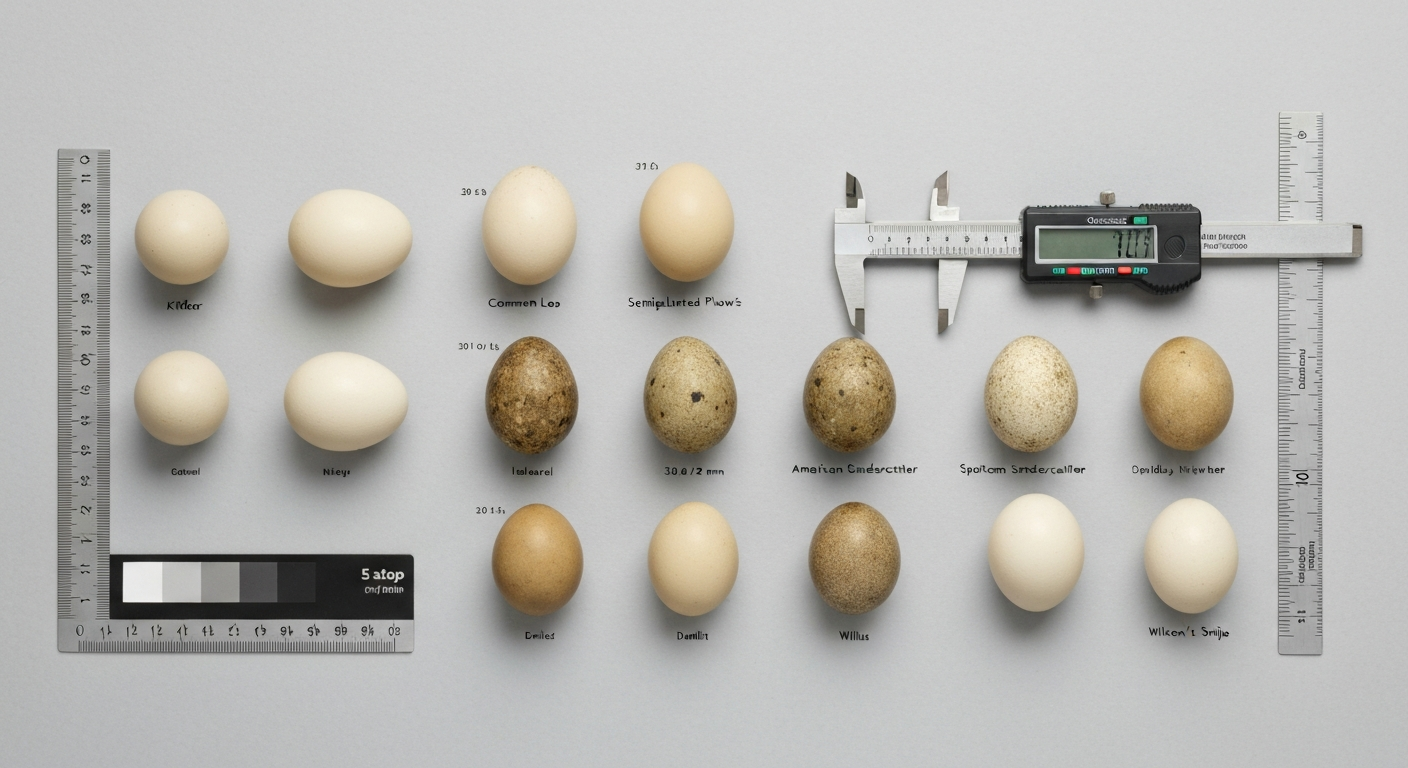
What to compare: the core egg metrics
A rigorous bird egg comparison starts with a consistent set of measurements and observations. Skip even one, and you can easily misidentify a nest or misunderstand what the egg reveals about the species. Here are the seven metrics that matter most. For further methods and examples, consult our bird comparison resource.
Size: length and breadth
Maximum length (the longest axis) and maximum breadth (the widest perpendicular diameter) are the two measurements that underpin almost every quantitative egg comparison in the scientific literature. You take both with digital or vernier calipers to the nearest 0.1 mm. From those two numbers, the Hoyt (1979) formula gives you a reliable volume estimate: Volume (cm³) ≈ 0.51 × Length × Breadth². The coefficient 0.51 was derived across a broad range of species and is accurate to within a few percent for most birds. Subsequent tests of Hoyt's equation show it is accurate to within a few percent for many avian taxa but can be biased for very atypical or highly asymmetric egg shapes, so researchers recommend validating the formula for taxa with extreme egg shapes or using species-specific coefficients when available. For species with highly asymmetric or unusually flattened eggs, species-specific coefficients exist and should be used when available.
Shape
Egg shape is often described with four basic categories: spherical (nearly round), elliptical (symmetrically elongated), ovate (one end noticeably larger), and pyriform (strongly pear-shaped, as in many shorebirds). The length-to-breadth ratio gives you a quick shape index, but recent geometric morphometric methods, including photogrammetry and 3-D landmark analysis, can capture subtler asymmetries that simple caliper ratios miss. For most field ID work, the four descriptive categories combined with the length/breadth ratio are sufficient.
Color and pattern
Background ground color and the type, density, and distribution of maculation (spots, blotches, streaks, scrawls) are the most immediately visible traits. Background colors range from white and cream through blues, greens, tans, and deep olive. Maculation can be absent entirely (many cavity nesters), lightly speckled, heavily blotched, or streaked. Research by Stoddard and Stevens demonstrated that objective image analysis, using calibrated photographs in avian tetrahedral color space, can quantify these patterns precisely enough to distinguish host and parasite eggs. For field use, recording background color, maculation type, spot density, and whether marking is concentrated at the large end is usually sufficient.
Shell structure and porosity
An avian eggshell has distinct layers: the inner shell membranes, the mammillary layer where calcification initiates, the columnar palisade layer (the thick main body), and the outer cuticle, which affects color, sheen, and microbial defense. Running through the palisade layer are pores that allow gas exchange. Pore density determines water-vapor conductance (G_H2O), and that value is tightly linked to incubation strategy. Eggs buried in soil or sand (like those of Megapodes) have high pore density to allow gas exchange through the substrate. Eggs exposed on open nests have lower pore density. This relationship is so reliable that paleobiologists use pore geometry in fossil eggshell to infer whether extinct dinosaurs buried their eggs or incubated them in the open.
Clutch size
The number of eggs in a clutch is a key life-history trait. Most passerines lay 3 to 6 eggs. Many shorebirds consistently lay exactly 4 eggs in a pyriform arrangement so the pointed ends face inward, reducing the incubation footprint. Raptors often lay 1 to 3 eggs. Cavity nesters like chickadees may lay 6 to 8. If you count the eggs in a nest, that number alone can narrow your list of candidate species considerably.
Incubation length
Incubation periods range from about 10 to 11 days in some small passerines to more than 80 days in large albatrosses. Incubation period correlates with egg size, developmental mode (altricial vs. precocial chicks), and parental strategy. Knowing where a nest is in the incubation cycle helps you assess whether eggs are fresh, mid-incubation, or close to hatching, which matters for candling assessments in rehabilitation contexts.
Nesting context and parental care
The nest structure, placement, and materials are often more diagnostic than the egg itself. A floating marsh platform of reeds points immediately to grebes or rails. A bare rock ledge with no nest material points to murres or Peregrines. Parental behavior, whether one parent incubates or both alternate, whether the nest is guarded aggressively, and what food the adults bring, all feed into the larger identification picture.
Which egg features are the most reliable for ID
Not every metric carries equal diagnostic weight. Size is highly reliable when you have calibrated measurements, because egg dimensions within a species are relatively consistent and differ substantially across taxa. A Robin's egg averaging 20 mm x 15 mm cannot be confused with a Canada Goose egg averaging 85 mm x 58 mm on measurements alone. Color and maculation are useful but variable, because intraspecific variation and fading can mislead. Pattern distribution (for example, maculation concentrated at the larger pole, a consistent trait in many shorebirds) is more reliable than exact color.
Shape, particularly the pyriform form of most shorebird eggs, is a strong diagnostic feature and is directly linked to the adaptive packing of a four-egg clutch. Shell texture (smooth vs. rough, matte vs. glossy) is quick to assess in the field and eliminates many candidates. Nest context often clinches the ID: combining substrate, structure, nest height above ground, and nest materials with egg measurements gets you to species level far more reliably than egg appearance alone.
| Metric | Reliability for ID | Notes |
|---|---|---|
| Length + breadth (caliper) | Very high | Accurate to 0.1 mm; enables volume estimation via Hoyt formula |
| Shape (pyriform, ovate, etc.) | High | Especially diagnostic in shorebirds; pyriform is strongly linked to 4-egg clutch |
| Shell texture (gloss, roughness) | High | Quick to assess; eliminates many families |
| Background ground color | Moderate | Variable within species; fades with time |
| Maculation type and distribution | Moderate-high | Pattern at larger pole is consistent; exact color less so |
| Clutch size | Moderate | Useful if full clutch present; varies with season and predation |
| Nest context (substrate, height, materials) | Very high | Often the single most diagnostic piece of information |
| Incubation length (estimated by development stage) | Moderate | Useful in rehab contexts; requires candling or flotation |
A compact field-measurement protocol
This step-by-step protocol keeps disturbance to a minimum while generating data you can actually use for comparison or submit to a database. Macaulay Library (Cornell Lab), media archive and resources for submitting/using wildlife images (contributor & metadata guidance) provides detailed contributor and metadata guidance for submitting calibrated wildlife photographs and associated permit information Macaulay Library (Cornell Lab) — media archive and resources for submitting/using wildlife images (contributor & metadata guidance). Move through these steps quickly and calmly, minimize time at the nest, and never return more than once per day.
- Confirm you have the necessary permits before touching or closely approaching any active nest. In the United States, wild birds and their nests are protected under the Migratory Bird Treaty Act. Check your jurisdiction's specific regulations before any hands-on work.
- Approach the nest quietly and note the nest substrate, height above ground, nest architecture, and materials before touching anything. Write or dictate these observations immediately.
- Photograph the full nest in context: one wide shot showing substrate and surroundings, one close shot directly above (dorsal view), and individual egg shots from the side (lateral) and large-end (apical) views. Shoot in RAW format if your camera allows it.
- Include a scale bar (a ruler or calipers open to a known distance) in at least one photograph. Also include a calibrated color standard, such as an X-Rite ColorChecker or a grayscale card, in the frame for any photograph you intend to use for color analysis.
- If measurement is permitted and eggs are unincubated or early incubation, measure maximum length and maximum breadth of each egg with digital or vernier calipers to 0.1 mm precision. Handle eggs as little as possible: cold, dry hands, gentle grip.
- Count all eggs in the clutch and note their arrangement (random vs. pyriform pattern with pointed ends inward).
- Record ambient conditions: air temperature, weather, time of day.
- Leave the nest exactly as you found it. Do not remove or reposition eggs unless you are a licensed rehabilitator responding to an emergency.
Recording standards and recommended data fields
Consistent record-keeping is what separates useful data from anecdotes. Whether you are entering nest records into a personal spreadsheet, a regional nest record scheme, or a platform like eBird, standardizing your data fields ensures the records are comparable and scientifically useful later. The Macaulay Library at Cornell, which holds the world's largest archive of wildlife media, requires contributors to supply accurate species identification, location (at minimum to county level), date, and permit or owner permissions for any restricted-access site.
| Data Field | Format / Example | Why It Matters |
|---|---|---|
| Species (confirmed or provisional) | Text + confidence level | Core ID; note if provisional and basis for ID |
| Date and time of visit | ISO 8601: 2026-07-21 08:34 | Seasonal phenology; links to incubation stage |
| GPS coordinates (decimal degrees) | Lat/Lon to 4 decimal places | Spatial analysis and revisit accuracy |
| Nest substrate and height (m) | Tree cavity, 4.5 m; ground scrape, 0 m | Diagnostic and habitat context |
| Nest materials | Grass, mud cup, hair lining | Identification and ethological data |
| Egg length (mm) | One value per egg, e.g., 38.4 mm | Volume estimation; species comparison |
| Egg breadth (mm) | One value per egg, e.g., 27.1 mm | Volume estimation; shape index |
| Estimated volume (cm³) | Hoyt formula: 0.51 × L × B² | Enables cross-species energy/resource comparisons |
| Clutch size | Integer, e.g., 4 | Life-history comparisons |
| Incubation stage (estimated) | Fresh / mid / late / candled | Phenology; rehab assessment |
| Color and maculation notes | Olive-buff, heavy dark blotches at large pole | Pattern ID |
| Photograph file names and settings | IMG_4521_RAW, 50mm, ISO 200 | Traceability for image analysis |
| Observer name and permit number | Jane Smith, MBTA Banding Permit #XXXX | Legal compliance and reproducibility |
Safety, legal rules, and when to call a professional
This is the section that casual nest-finders most often skip, and it is the one that matters most from both a legal and a conservation standpoint. In the United States, the Migratory Bird Treaty Act prohibits taking, possessing, or disturbing active nests of migratory birds without a federal permit. Equivalent protections exist across Canada (Migratory Birds Convention Act), the UK (Wildlife and Countryside Act), and the EU (Birds Directive). Photographing or measuring eggs at an active nest without a permit is, in most jurisdictions, a legal gray area at best and a violation at worst. Always check local regulations before you get close.
Beyond legality, behavioral disturbance is a real risk. Repeated visits cause adults to flush, which exposes eggs to predators and temperature extremes. Some species, particularly ground-nesting colonial birds, will abandon a nest if disturbed during early incubation. The ethical standard is to limit each nest visit to the minimum time needed, no more than two to three minutes for measurement and photography, and to avoid visits during the first three days of incubation when abandonment risk is highest.
Know when to step back entirely. If you find a nest that appears damaged, flooded, or predated, do not intervene unless you are a licensed wildlife rehabilitator. Orphaned or abandoned eggs rarely benefit from well-meaning handling by untrained observers. If a nest contains a dead adult, a displaced egg on the ground beneath a tree, or eggs that have been cold for an extended period, your first call should be to a licensed wildlife rehabilitator or your regional wildlife agency. The Smithsonian's National Museum of Natural History, which holds more than 100,000 individual bird egg specimens, also reminds researchers that provenance and proper documentation are essential: handling or collecting wild eggs without legal authority invalidates the scientific value of any data collected.
- Never pick up or move eggs from an active nest unless you are responding to an emergency and hold the appropriate permits.
- Keep your total time at any nest to three minutes or less per visit, and limit visits to once per day maximum.
- Avoid nest visits during the first three days of incubation and during the final 48 hours before expected hatching.
- Use a telephoto lens for photography wherever possible so you can capture useful images from several meters away.
- If you are working in a colonial or sensitive-species area (terns, skimmers, piping plovers), follow site-specific access protocols set by land managers.
- Report unusual findings (diseased eggs, unusually high nest failure rates, parasitized nests) to your regional wildlife authority or a licensed ornithologist.
How egg traits reflect life-history strategies
One of the most useful things about a detailed egg comparison is what it tells you about how a bird lives, not just what it looks like. Egg size relative to adult body mass, clutch size, incubation period length, and shell porosity are all tightly connected to whether chicks hatch helpless (altricial) or ready to run (precocial), whether a species breeds once a year or multiple times, and how much parental investment goes into each offspring.
Precocial species, including shorebirds, ducks, geese, and grouse, lay large eggs relative to their body size. Their yolk-heavy eggs provide the energy needed for chicks to hatch fully feathered and mobile. Incubation is relatively long given body mass. Altricial species, including most songbirds, lay smaller eggs relative to body mass, hatch naked and helpless young, and often have shorter incubation periods, sometimes as short as 11 to 12 days in small warblers. Raptors sit in between: eggs are large, incubation is long (35 to 45 days in large eagles), and chicks are semi-altricial, hatching with some down but dependent on parental feeding for weeks.
| Group | Typical Egg Size | Clutch Size | Incubation (days) | Chick Type | Shell Porosity |
|---|---|---|---|---|---|
| Shorebirds | Medium-large, pyriform | 4 (nearly always) | 21-29 | Precocial | Moderate-low |
| Songbirds (passerines) | Small, ovate | 3-6 | 11-14 | Altricial | Low |
| Raptors (eagles, hawks) | Large, ovate | 1-3 | 28-45 | Semi-altricial | Low-moderate |
| Waterfowl (ducks, geese) | Large, elliptical-ovate | 4-12 | 21-32 | Precocial | Moderate |
| Seabirds (murres, alcids) | Single large, pyriform-ovate | 1 | 28-35 | Semi-precocial | Low |
| Megapodes (mound-builders) | Very large, elliptical | Variable, laid serially | 50-90 (passive heat) | Superprecocial | Very high (buried) |
Shorebird eggs: ID tips, look-alikes, and measurable diagnostics
Shorebird eggs are among the most challenging and most rewarding to identify. They are almost universally pyriform (pear-shaped), which is an adaptation that allows four large eggs to nestle with pointed ends inward, reducing the sitting area an adult must cover and lowering heat loss. Background colors tend toward buff, olive, tan, and gray-green. Maculation is usually heavy, dark (black, brown, or reddish), and distributed across the whole egg but often concentrated toward the larger end. This combination of color and blotching provides superb camouflage on sand, gravel, and grass substrates.
The biggest identification challenge along coastlines and wetland margins is that several shorebird species overlap in habitat and produce superficially similar eggs. Size measurements are your clearest differentiator. A Semipalmated Plover egg averages about 31 mm x 22 mm. A Killdeer egg averages about 38 mm x 27 mm. An American Oystercatcher egg is substantially larger, around 56 mm x 38 mm, with heavier, more scattered blotches on a pale buff ground. Measuring and calculating estimated volume quickly separates these species even when color looks similar in the field.
| Species | Avg. Length (mm) | Avg. Breadth (mm) | Est. Volume (cm³) | Ground Color | Maculation | Clutch Size | Nest Context |
|---|---|---|---|---|---|---|---|
| Killdeer | 38 | 27 | ~14.1 | Buff to pale olive | Heavy dark blotches, concentrated at large pole | 4 | Bare gravel, open ground, rooftops |
| Semipalmated Plover | 31 | 22 | ~7.7 | Buff-olive | Black spots and blotches | 4 | Sandy or gravelly beach above tide line |
| American Oystercatcher | 56 | 38 | ~41.0 | Pale buff | Heavy brown-black blotches scattered | 2-3 | Open sandy or rocky beach, shell hash |
| Spotted Sandpiper | 32 | 23 | ~8.6 | Buff to pale olive | Dark brown spots and scrawls | 4 | Grassy or weedy edge near water |
| Dunlin | 34 | 24 | ~10.0 | Olive-green to buff | Dark brown blotches | 4 | Arctic tundra scrape, sedge tussocks |
| Willet | 53 | 37 | ~37.0 | Olive-buff | Brown and gray blotches | 4 | Grassy marsh or dune depression |
| Wilson's Snipe | 39 | 28 | ~15.6 | Olive-brown | Dark brown blotches concentrated at large pole | 4 | Wet meadow sedge, ground scrape |
One of the most common look-alike pairs on Atlantic and Gulf Coast beaches is Killdeer versus Semipalmated Plover. Both nest on open, gravelly ground, both lay four pyriform, blotched eggs, and both are small plovers. The measurement difference is reliable: Killdeer eggs are consistently around 38 mm x 27 mm, while Semipalmated Plover eggs top out around 31 mm x 22 mm. When you also factor in nest context, Killdeer readily use inland gravel, parking lots, and rooftops; Semipalmated Plovers stay close to tidal flats and open sandy beaches, the ID becomes much more confident.
Piping Plover and Snowy Plover are two federally listed species that nest on open sandy beaches and are frequently confused with each other and with Semipalmated Plover. Piping Plover eggs average about 31 mm x 23 mm with a pale, nearly unmarked or finely speckled appearance, while Snowy Plover eggs are slightly smaller (about 30 mm x 21 mm) and similarly pale with fine speckling. In the field, always cross-reference egg measurements with the presence or absence of the adults and the exact nest substrate: Piping Plovers nest above the high-tide line on open sandy beaches with little vegetation; Snowy Plovers often use slightly more inland alkali flat or sandy lake-edge habitats in western populations.
Egg evolution: from dinosaurs to modern birds
The hard-shelled, porous, calcified bird egg did not appear suddenly with the first true birds. For a related comparative-anatomy perspective, see bat skeleton vs bird skeleton to explore how mammal and avian skeletal adaptations differ (dfd1b2eb-fe6b-44ec-95fe-f32f558bddcc). Comparative microstructural studies of fossilized eggshell now show that many non-avian theropod dinosaurs, the lineage that gave rise to birds, already produced eggs with the same fundamental layered architecture: a mammillary base, a columnar palisade calcite layer, and an outer cuticle. More striking is the 2018 discovery that biliverdin and protoporphyrin, the same two pigment compounds that color modern bird eggs, were preserved in the fossil eggshell of Cretaceous oviraptorid and troodontid dinosaurs. This means egg pigmentation almost certainly evolved once in the theropod lineage, not multiple times independently in birds. See the dinosaur–bird egg comparison for detailed analyses of eggshell structure, porosity, and pigmentation across fossil and living species.
Shell porosity analysis has been used to reconstruct nesting behavior across the dinosaur-to-bird transition. Buried-egg nesters require very high pore density so oxygen can diffuse through soil to the embryo; open-nest incubators need lower porosity. Comparative studies of pore geometry and computed gas conductance across fossil and living archosaurs suggest that the shift from buried to open-nest incubation occurred within the theropod lineage before the origin of modern birds, a transition that aligns well with evidence for contact incubation in some non-avian dinosaurs. If you are interested in how dinosaur anatomy connects to modern bird anatomy more broadly, comparisons of limb and foot structure between theropods and birds offer equally fascinating parallels.
The eggshell differences that do exist between reptile eggs and bird eggs are instructive. Crocodilian eggs are hard-shelled and calcified, more similar to bird eggs than to the flexible-shelled eggs of most lizards and snakes. Turtle eggs are parchment-like in most species. The fully rigid, multi-layered, pigmented egg is a derived feature of the archosaur lineage, and modern birds carry it to its most elaborate expression in terms of color diversity, pattern complexity, and shell chemistry.
Reference sources worth having on your shelf
For North American nest and egg identification, Paul Baicich and Colin Harrison's Nests, Eggs, and Nestlings of North American Birds (Princeton Field Guides) remains the standard field reference, covering nest architecture, egg descriptions, clutch sizes, and incubation periods in a format designed for active use in the field. Mark Hauber's The Book of Eggs (Field Museum / University of Chicago Press) gives life-size photographs of 600 species worldwide and is invaluable for visual comparison and for understanding the sheer range of egg form across avian families.
For quantitative and museum-based work, the Global Biodiversity Information Facility (GBIF) aggregates egg and nest specimen records from major collections including the Field Museum, the Museum of Vertebrate Zoology, the Western Foundation of Vertebrate Zoology, and the Natural History Museum in London. The Smithsonian National Museum of Natural History's Division of Birds holds more than 100,000 individual egg specimens, and curatorial staff there can assist researchers with measurements and imagery for permissioned study. The Macaulay Library at Cornell Lab of Ornithology hosts the largest archive of wildlife media in the world and provides detailed guidance on metadata requirements for media submissions, including eggs and nests.
FAQ
What core data and specimen metadata are required for a rigorous species-level bird‑egg comparison guide?
Essential data: measured egg length and maximum breadth (to 0.1 mm), calculated volume (Hoyt 0.51 × L × B² or species‑specific coefficient), egg mass if obtainable, high‑quality calibrated photographs (RAW with scale bar and color/gray standard), clutch size and laying order where known, nest type and microhabitat (substrate, concealment, nest structure), geographic location (GPS), date/time, incubation status/age estimate, observer/photographer, and permits/collection/ownership/provenance information. Museum catalogue records and specimen accession numbers should be recorded for reference comparisons.
Which field measurement and photographic protocols should be followed to ensure repeatable and comparable data?
Use digital or vernier calipers to measure maximum length and breadth (nearest 0.1 mm). Repeat each measure once and average. Photograph eggs in RAW under diffuse, neutral lighting with a calibrated color/gray card and a metric scale bar; take dorsal, lateral and close‑up images of maculation, ends (blunt/pointed), and any shell defects. Record camera settings, distance/angle, GPS coordinates, date/time, and permit IDs. If handling, wear clean gloves and minimise disturbance; follow legal/ethical guidance and only handle eggs when authorised by permit or rehabilitation experts.
How should egg volume be estimated and when are species‑specific corrections needed?
Use Hoyt’s widely used field formula: Volume ≈ 0.51 × Length × Breadth² for a rapid estimate. This coefficient is accurate for typical prolate‑spheroid eggs but may be biased for highly asymmetric or unusual shapes; validate against museum measurements or use taxon‑specific coefficients where published. For high accuracy, use 3‑D photogrammetry or geometric morphometrics to capture shape beyond L/B indices.
What diagnostic egg traits are most useful for field identification between species?
Prioritise: size (length, breadth, volume), shape (length:breadth ratio, pointed vs blunt ends, elongation), ground colour (background hue), maculation pattern (spot size, density, distribution, contrast), shell finish (glossy, matte), distinctive markings (blotches, scrawls, crown spots), clutch size and egg uniformity within clutch, nest context (nest type and location), and incubation/parental behaviour. Combining multiple traits plus nest context gives highest ID confidence.
Which objective image and pattern‑analysis methods should be used to quantify colour and maculation?
Use calibrated image workflows (e.g., Troscianko & Stevens’ ICA toolbox): shoot RAW, include a color/gray standard, linearize and convert to calibrated RGB or reflectance units. Measure background colour in standard colour space, quantify maculation with spatial metrics (spot size distribution, coverage, contrast, spatial frequency), and apply avian visual modelling (tetrahedral colour space, JNDs) when testing biological distinctiveness. Pattern recognition algorithms and published tools can extract diagnostic signatures for species comparisons.
How can nest and parental‑care context help distinguish eggs of similar appearance?
Nest architecture (cup, scrape, burrow, cavity, domed), substrate (ground, vegetation, reed, cliff), nest placement (height, exposure), clutch size and egg arrangement, and observed parental behaviour (incubation rhythm, attendance, defensive behaviour) are often diagnostic. For example, shorebird eggs are cryptic, ground‑scraped and typically laid in 2–4 clutches; songbird eggs are often smaller, in cup nests with variable maculation; raptor eggs are larger, often unmarked or weakly spotted in high nests; waterfowl eggs are large, chalky‑colored and laid in lined scrapes.