Birds are not just "descended from" dinosaurs the way mammals descended from earlier mammal-like reptiles. Birds literally are dinosaurs, specifically a surviving lineage of theropod dinosaurs that never went extinct. Analyses place birds in the same phylogenetic position within maniraptoran coelurosaur theropods, supported by blank" rel="noopener noreferrer">osteology and fossilized feather evidence, with ongoing debates about internal theropod relationships. When you watch a crow pick apart a piece of food or a heron stalk prey through shallow water, you are watching a living theropod in action. That is the core of the dinosaur bird comparison, and once it clicks, you start seeing your backyard feeder completely differently.
Dinosaur Bird Comparison: What Matches and What Doesn’t

Marcus Hendricks
12 Jun 2026
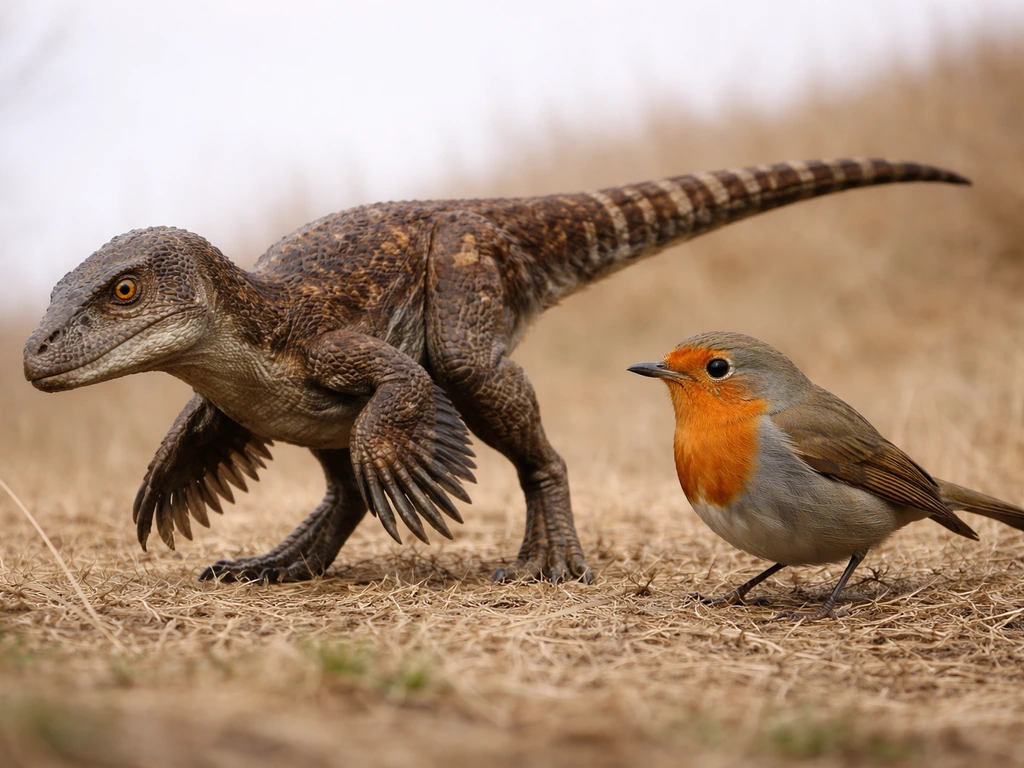
How birds and dinosaurs are actually related
The family tree goes like this: within the broader dinosaur group, there is a major branch called Theropoda, which includes the bipedal, mostly meat-eating dinosaurs like Tyrannosaurus and Velociraptor. Inside that branch sits a subset called maniraptoran coelurosaurs, and nested right inside that group is Aves, which is just the scientific name for birds. This is not a fringe idea. Fossil evidence, skeletal anatomy, and modern phylogenetic analyses all land in the same place. The earliest known bird in the fossil record is Archaeopteryx, dating to the Late Jurassic, roughly 150 million years ago, and its closest non-avian relatives are dromaeosaurid theropods like Deinonychus. That relationship is not metaphorical. It is based on dozens of matching skeletal features across the fossil record. The transition happened gradually, through multiple lineages and intermediate forms, not as a single dramatic leap from "dinosaur" to "bird."
One important clarification: when people say "dinosaurs," they sometimes lump in pterosaurs (the flying reptiles like pterodactyls) and aquatic reptiles. Pterosaurs were not dinosaurs. They were a separate reptile lineage that happened to evolve flight independently. So the flying connection between birds and pterosaurs is a case of convergent evolution, not ancestry. The bird-dinosaur link runs specifically through the terrestrial theropod line, not through any flying reptile.
What birds and theropod dinosaurs genuinely share
This is where the comparison gets really interesting. Birds carry a surprisingly large number of structural traits that trace directly back to theropod dinosaurs, and when you know what to look for, you can spot them on any bird you encounter.
The wishbone, hollow bones, and air sacs
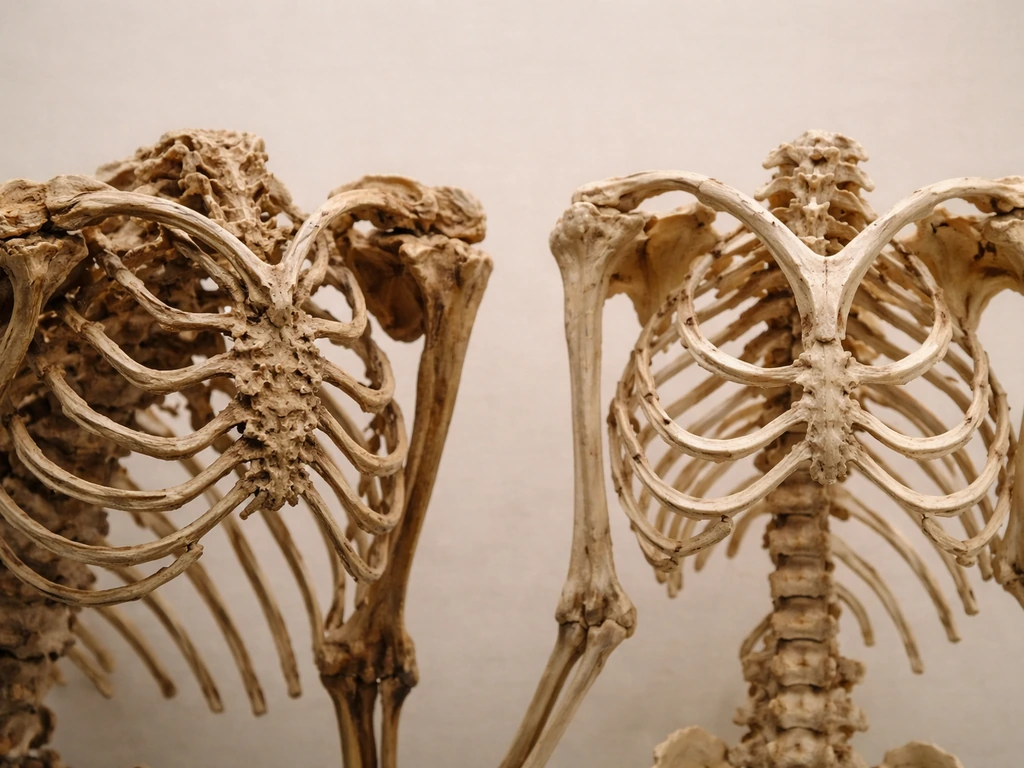
The furcula, the wishbone you snap after Thanksgiving dinner, is two fused clavicles. This same fused furcula has been identified in multiple non-avian theropod dinosaurs, including birdlike maniraptorans. It is not a bird invention. The hollow, pneumatic bones that make birds light enough to fly also appear in theropod fossils. Researchers have traced the evolution of the avian air sac system through four stages, finding skeletal evidence of air sac-related pneumaticity in non-avian theropods well before true birds appeared. So when you hold a bird's feather-light skeleton, you are holding a structure whose basic engineering was already being developed tens of millions of years before Archaeopteryx. That is why comparing a bat skeleton vs a bird skeleton quickly shows how different their evolutionary solutions are bat skeleton vs bird skeleton.
Bipedal posture and hindlimb anatomy
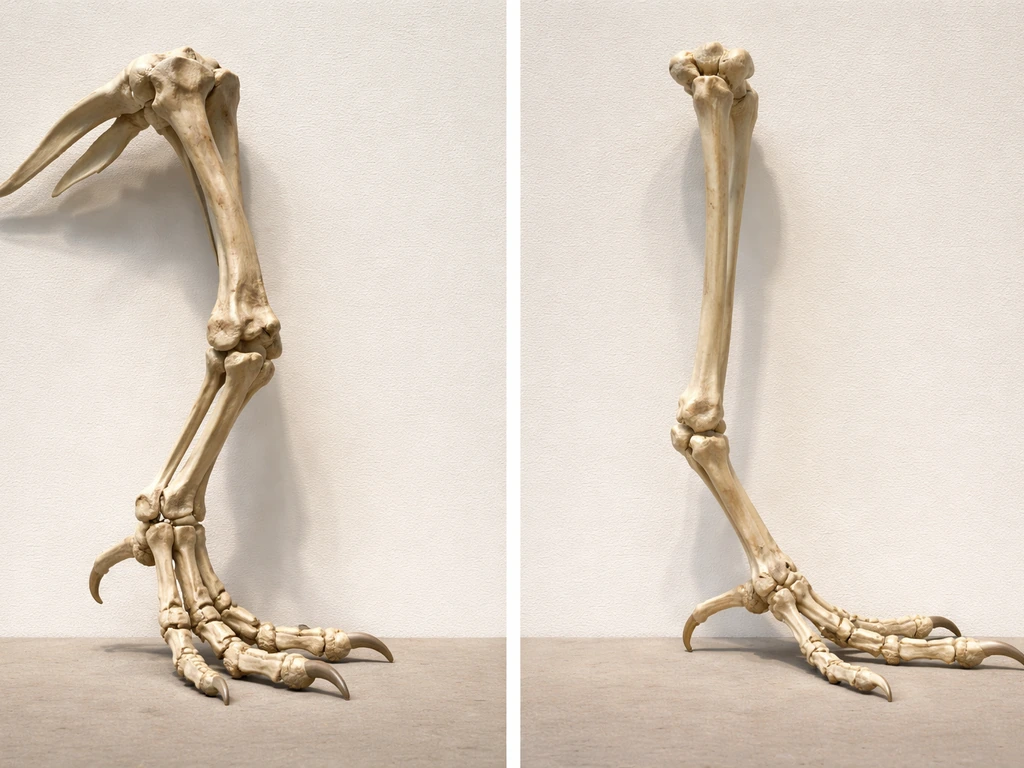
Birds walk on two legs. So did theropod dinosaurs. The overall hindlimb layout, including the arrangement of the foot bones, the presence of a rear-facing first toe (the hallux), and the general configuration of three main forward-pointing toes, is shared across the theropod-to-bird transition. Bird feet and dinosaur feet also differ in key ways, especially in how the toes and claws function for walking, grasping, and perching arrangement of the foot bones. The ancestral condition for the bird lineage was a four-toed cursorial foot, functionally similar to what you see in non-avian theropods. The reversed hallux used for perching in modern birds developed progressively through the theropod lineage and is connected to blank" rel="noopener noreferrer">increasing grasping and locomotor changes tracked in the fossil record. Even the scaly skin covering bird feet has deep roots: fossil evidence shows non-avian dinosaurs already had scales resembling those on modern bird feet, and feathers and scales can coexist on the same limb.
Feather-like structures and proto-feathers
Feathers, or at least early filamentous versions of them, were not invented by birds. Simple filamentous structures have been found on various theropod dinosaurs, and the evolutionary record shows a progression from basic protein filaments toward the complex, branched, interlocking feather structure seen in modern birds. This means feathery coverings predate birds by a significant stretch. What birds eventually developed, and what no non-avian theropod is confirmed to have had, is the fully modern feather with its rachis (central shaft), barbs, and interlocking barbules that make a feather both strong and aerodynamic.
Egg biology and nesting
Egg-laying connects birds to their dinosaur relatives in some surprisingly specific ways. Fossilized theropod eggs share microscopic structural attributes with modern bird eggs, including calcitic hard shells. That is why a bird egg comparison matters, because the same traits show up in fossils and in living nests. Research using high-resolution spectroscopy has even found that egg-color pigments preserved in nonavian dinosaur eggshells match the pigment types that produce color variation in modern bird eggs, suggesting that colored eggs evolved just once among the broader eumaniraptorans group that includes both non-avian dinosaurs and birds. That means the blue-green spotted eggs in a robin's nest carry a color system that goes back deep into the theropod family tree.
Where birds and theropod dinosaurs clearly part ways
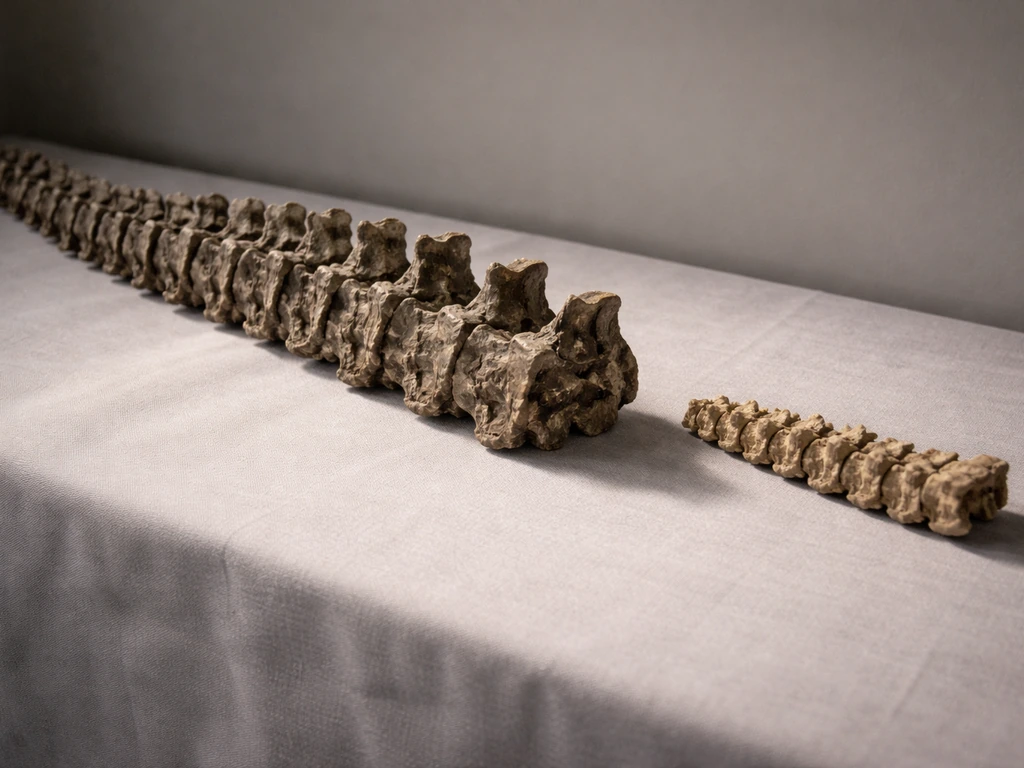
Shared ancestry does not mean birds are just small versions of Velociraptor. There are real, structural differences that define modern birds as a distinct group, and knowing these is just as useful as knowing the similarities.
| Trait | Non-avian theropod dinosaurs | Modern birds |
|---|---|---|
| Teeth/jaws | Most had teeth set in sockets in the jawbone | Toothless beak; no teeth in any living species |
| Tail | Long, stiff, muscular tail with many caudal vertebrae | Short tail; caudal vertebrae fused into a pygostyle supporting tail feathers |
| Feathers | Filamentous proto-feathers or early-stage feathers in some lineages | Fully developed feathers with rachis, barbs, and barbules |
| Forelimbs | Forelimbs present but often reduced and not flight-adapted | Forelimbs fully modified into wings |
| Eggshell layers | Mostly two-layer eggshells (mammillary + crystalline) | Additional structural complexity; more layered eggshell architecture |
| Sickle claws | Some dromaeosaurids had enlarged sickle-shaped second toe claws | No equivalent structure in living birds |
| Flight apparatus | No sternum keel; no flight muscles or flight-adapted pectoral anatomy | Keeled sternum anchoring large flight muscles; flight-adapted forelimb bones |
The tail tells a big part of the story
Non-avian theropods had long, heavy tails that acted as counterbalances for their forward-leaning bodies. Along the lineage leading to birds, the number of tail vertebrae dropped significantly, and the remaining vertebrae eventually fused into the pygostyle, the small stub at the base of a bird's tail feathers. Archaeopteryx, that earliest known bird, still had a long bony tail, not a pygostyle. The short, feathered fan tail you see on every living bird came later. This tail reduction is one of the clearest anatomical markers separating crown-group birds from their closest non-avian relatives.
Beaks replaced teeth, completely
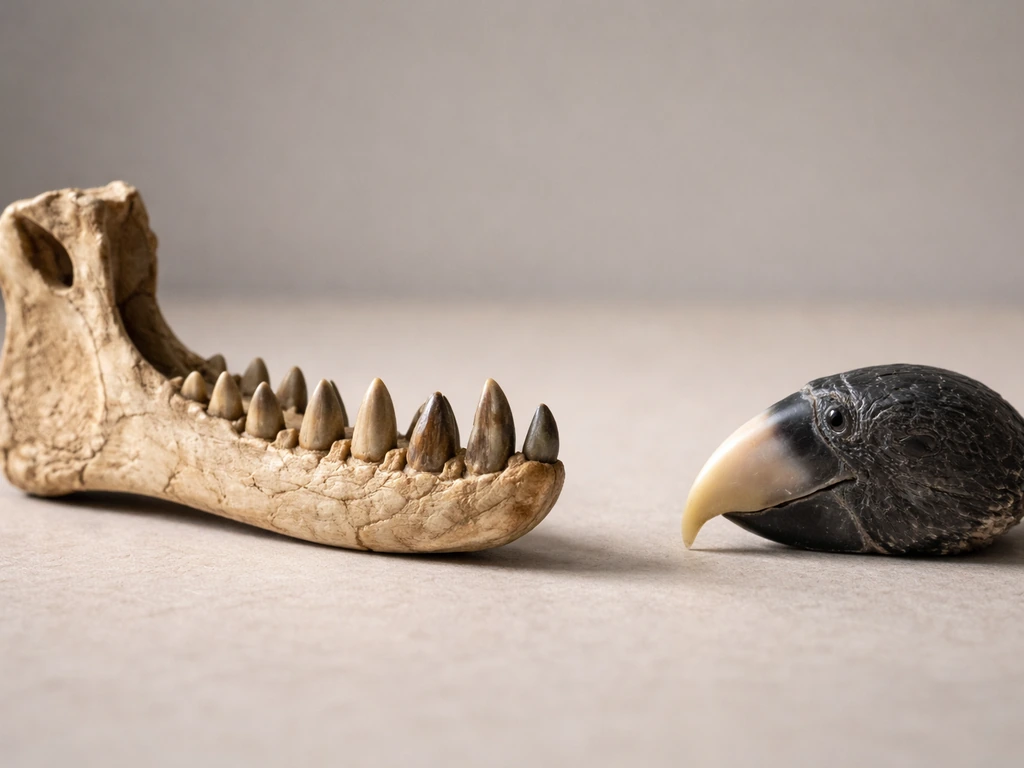
Every living bird has a beak and zero teeth. This is one of the most absolute differences between modern birds and their theropod relatives. Most non-avian theropods had socketed teeth, and even early birds like Archaeopteryx still had teeth. The full transition to a toothless beak happened within the bird lineage well after the dinosaur-bird split, and it is now one of the defining features of all living birds. If you see teeth, it is not a bird.
Flight, breathing, and how birds live versus theropod dinosaurs
Flight is the most obvious functional difference, but the respiratory system underneath it is equally important. Birds have a one-way airflow breathing system driven by air sacs, which is far more efficient than the in-and-out tidal breathing of most other animals. The evidence suggests this air sac system was already evolving in non-avian theropods, in a stepwise process tied to increasing metabolic demands and body mass, but the fully realized, flight-powering version exists only in birds. The keeled sternum, which gives the flight muscles their anchor point, is a bird-exclusive structure with no direct equivalent in any known non-avian theropod.
In terms of lifestyle, large non-avian theropods were terrestrial predators with metabolisms and behaviors that remain partly debated. Modern birds are warm-blooded (endothermic), fast-metabolizing, and capable of sustained aerobic activity far beyond what a large theropod's physiology likely supported. Some smaller feathered maniraptorans may have had elevated metabolisms closer to the bird end of the spectrum, but the full bird package, flight, high-speed aerobic capacity, air sac breathing, and feathered insulation, is exclusively avian.
Myths worth dropping right now
- "All dinosaurs had feathers": False. Feather-like filamentous structures appear in theropod lineages, particularly maniraptorans, but they were not universal across all dinosaurs. Large-bodied, distantly related dinosaurs like sauropods and ceratopsians show no evidence of feathers, and the coverage even among theropods was variable.
- "Birds evolved from pterodactyls or flying reptiles": False. Pterosaurs were a completely separate reptile lineage unrelated to the theropod ancestry of birds. Flight in pterosaurs and flight in birds evolved independently.
- "Birds are like reptiles but with feathers": Technically, birds are reptiles in the phylogenetic sense, because reptilia as a clade includes birds. But the casual use of "reptile" to contrast cold-blooded scaly animals with warm-blooded birds is misleading. Birds are endothermic, have feathers, and have a physiology distinct from the cold-blooded squamates and crocodilians people usually picture.
- "Velociraptor looked like the dinosaurs in Jurassic Park": The real Velociraptor was roughly turkey-sized, almost certainly covered in feathers, and bore much more resemblance to a large ground bird than to the scaly, dog-sized predators depicted in popular film.
- "Birds evolved once, cleanly, from one ancestor": The transition from non-avian theropods to birds involved multiple lineages, gradual accumulation of bird-like traits across millions of years, and considerable evolutionary experimentation. There was no single moment or species that switched from "dinosaur" to "bird."
What to actually look for when you watch birds today
This is where the comparison becomes practical. You do not need a fossil to see theropod dinosaur traits. They are in every bird you encounter. Here is what to pay attention to:
- Watch the feet: A bird's foot, with its three forward toes and one rear-facing hallux, directly mirrors the theropod foot plan. Birds that scratch and dig, like chickens, use that foot almost exactly as small theropods used theirs. The feet comparison between birds and their dinosaur relatives is one of the most immediately visible connections you can observe in real time.
- Notice the posture: Birds do not stand upright like people. They lean forward with the center of mass over the feet, held up by a tucked-in leg posture. This is the same basic stance theropod dinosaurs used, not the upright lizard-monster posture you see in old illustrations.
- Look at the tail: The stubby, feathered tail stub on any bird is the pygostyle, the endpoint of a major evolutionary reduction from the long bony tails of theropod ancestors. When a pigeon fans its tail to brake before landing, that fan is supported by fused vertebrae that replaced what was once a long, muscular dinosaur tail.
- Think about the wishbone: Next time you see a bird skeleton or eat chicken, find the furcula. That Y-shaped bone is one of the clearest physical links to non-avian theropod anatomy, found in fossilized form across multiple dinosaur species.
- Consider the feathers as technology: The fully structured feather, with its interlocking barbs, is genuinely more sophisticated than the filamentous proto-feathers seen in non-avian theropods. When you look at the iridescent perfection of a starling's plumage or the aerodynamic precision of a falcon's wing feather, you are looking at hundreds of millions of years of refinement on top of a structure that started as a simple filament on a dinosaur.
- Watch how they breathe and move: The one-way airflow system in birds lets them sustain flight and intense activity that no other animal their size can match. A swallow flying for hours, or a shorebird migrating thousands of miles nonstop, is running on a respiratory system with deep evolutionary roots in the theropod lineage.
The dinosaur bird comparison is not just an interesting science trivia fact. It is a lens that changes how you see every bird. The crow on your fence post, the hawk circling overhead, the sparrow at your feeder: all of them are carrying anatomical features refined over 150 million years of evolution from a line of bipedal, air-sac-breathing, feathered theropod dinosaurs. That context makes even the most familiar bird worth a second look.
FAQ
If birds are dinosaurs, does that mean all feathered dinosaurs could fly like modern birds?
No. The dinosaur-to-bird transition included feathers and more efficient breathing, but flight capability depends on a specific package of traits, including the later tail reduction, keeled sternum, and fully realized one-way airflow. Many relatives likely used feathers for insulation, display, or limited gliding, not powered flight.
How can I tell the difference between a bird and a “theropod-looking” animal in general discussions or documentaries?
Focus on defining bird traits, especially a toothless beak, a pygostyle-backed tail posture, and a bird-type respiratory setup that supports sustained high performance. If teeth are present or the tail is clearly long and bony in a way consistent with non-avian theropods, it is not a modern bird lineage.
Are pterosaurs part of the dinosaur bird comparison?
They can be confusing because both lineages evolved flight-like solutions, but pterosaurs are not on the theropod-to-bird family path. In a dinosaur bird comparison, flight similarities between pterosaurs and birds reflect convergent evolution, not shared ancestry.
What does “fully modern feather” mean, and why does it matter for the dinosaur bird comparison?
Simple filament structures in theropods show that feather-like insulation and display appeared before true bird feathers. “Fully modern” feathers refer to an arrangement with a central shaft plus interlocking components that create a stable, aerodynamic surface. This distinction helps you avoid assuming that the presence of filaments equals true bird-style aerodynamic feathers.
If feathers appeared before birds, why don’t all dinosaurs with feathers look like small birds?
Because feathers can serve different functions and appear at different stages. Early feathered relatives might have had insulation or display functions without the later structural combination needed for powered flight and the bird’s full locomotor and tail configuration.
Does the presence of scales on bird feet prove birds evolved from scaly ancestors rather than acquiring scales later?
It supports deep ancestry for the basic scale-like covering, but it does not mean every feature of today’s bird foot was inherited unchanged. You can think of it as a foundation that later evolved alongside changes in toe posture, grasping mechanics, and perching adaptations.
Are colored eggs a guaranteed sign of bird-like ancestry in fossils and living species?
Colored eggs strongly suggest shared biochemical and shell-pigment systems within the relevant dinosaur-bird relatives, but the exact color pattern and visibility depend on preservation and the shell chemistry that survives in the fossil record. In living birds, pigment expression can also vary by species, diet, and genetics even when the underlying pigment types are related.
Why do some non-avian theropods seem “bird-like” even though they were not birds?
Because the shared ancestry produces a mosaic of traits. Some relatives likely had a more birdlike front limb posture, filamentous coverings, or similar foot architecture, but they lacked defining elements such as toothless beaks and the later bird-exclusive respiratory and flight muscle anchor structures.
What is the most reliable “single test” for whether something is a bird versus a non-avian theropod?
Teeth versus beak is the cleanest rule for living birds. If there are teeth, it is not a bird. For fossils or reconstructions, the combination of toothlessness, tail structure trending toward a pygostyle, and other bird-specific anatomy gives the strongest confirmation.
What should I look for on backyard birds to connect the dinosaur bird comparison to real anatomy?
Try quick visual checks that map to the article’s traits: the beak-and-no-teeth pattern, the overall two-legged stance with rear hallux placement suited for perching, and the short tail area where the living tail feathers attach (no long bony tail). These aren’t direct fossils, but they reflect the same evolutionary endpoints.