A bird comparison chart works best when you use it in a specific order: size and shape first, then beak and feet structure, then plumage patterns, then behavior and habitat. Most ID mistakes happen because people jump straight to color, which is also the trait most affected by lighting, age, and sex. If you work through physical structure before color every time, you'll cut your confusion rate dramatically and get reliable answers even on tricky lookalike pairs like Cooper's Hawk vs. Sharp-shinned Hawk, or Common Raven vs. American Crow.
Bird Comparison Chart: How to Compare Lookalikes Fast

Marcus Hendricks
30 May 2026
What "bird comparison" actually means (and when a chart is your fastest tool)
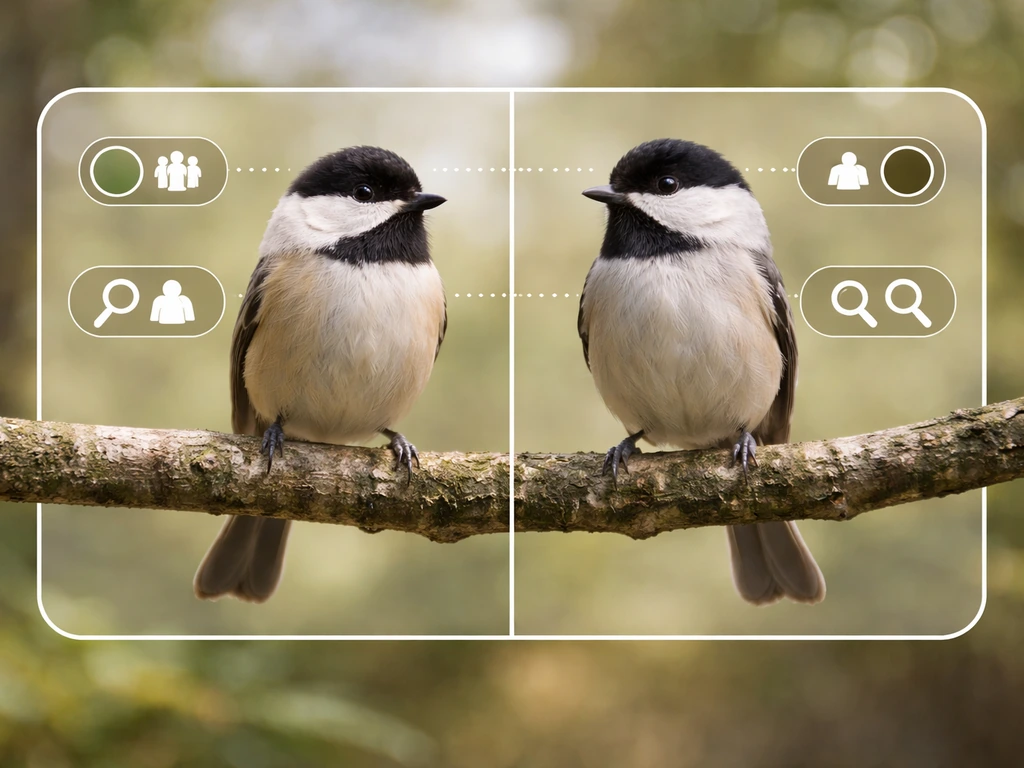
When most people search "bird comparison," they're standing in a field or backyard staring at a bird they can't name, or they've just seen a photo and want to settle an argument. Bird comparison is the practice of examining two or more species side-by-side across a consistent set of traits so you can find the feature that separates them. It's not about memorizing every bird ever drawn in a field guide. It's about having a reliable framework you run through every time.
A bird comparison chart is the fastest tool specifically when you've already narrowed things down to two or three candidates. If you're starting from scratch with no idea what family of bird you're looking at, a chart won't save you. But once you've said "this is definitely a hawk, and it's either a Cooper's or a Sharp-shinned," a side-by-side chart of those two species lets you check the deciding traits in seconds. That targeted use is where charts earn their keep.
The comparison approach on this site extends beyond just species-to-species matchups. You'll find comparisons of males vs. females within a single species, juveniles vs. adults, and even birds vs. other animals. Each of those requires a slightly different lens, and knowing which kind of comparison you're making upfront saves a lot of confusion.
How to read and use a bird comparison chart, step by step

Not all comparison charts are created equal, and a poorly structured one can actually send you in the wrong direction. Here's how to use any bird comparison chart effectively, in the right order.
- Confirm your location and time of year first. Before you look at a single trait, check whether both species on the chart actually occur where you are and in the current season. Many lookalike pairs have non-overlapping ranges, which immediately eliminates one candidate. This is the "probability filter" that experienced birders run automatically.
- Read the size row first, not the color row. Size and shape are structural, stable, and unaffected by lighting or season. If one species is consistently 30% larger than the other, that alone may settle the ID.
- Check beak and feet structure next. These are functional traits shaped by what the bird eats and how it hunts, so they're reliable and don't change with plumage cycles. A hooked raptor beak vs. a straight shorebird beak is a hard distinction.
- Move to body shape: tail length and shape, wing shape, neck length, overall silhouette. Many experienced birders ID birds entirely by silhouette in flight before they can even see color.
- Now look at plumage patterns. Focus on pattern (stripes, caps, wingbars, eye rings) before raw color. Pattern is more stable than hue across lighting conditions.
- Finally, layer in behavior and habitat. Does the bird pump its tail? Does it hover? Does it feed on the ground or in the canopy? Behavior often confirms an ID that structure and plumage already suggested.
- Use the chart as a checklist, not a single-trait lookup. The goal is to accumulate evidence across multiple rows. If five of six traits point to Species A, you have a confident ID even if one trait is ambiguous.
Side-by-side feature checklist: what to actually look at
Here's the core set of features to compare for any two bird species. Think of this as your universal field checklist. Not every feature will matter for every comparison, but running through all of them ensures you don't miss the one that cracks the ID.
Size and overall impression
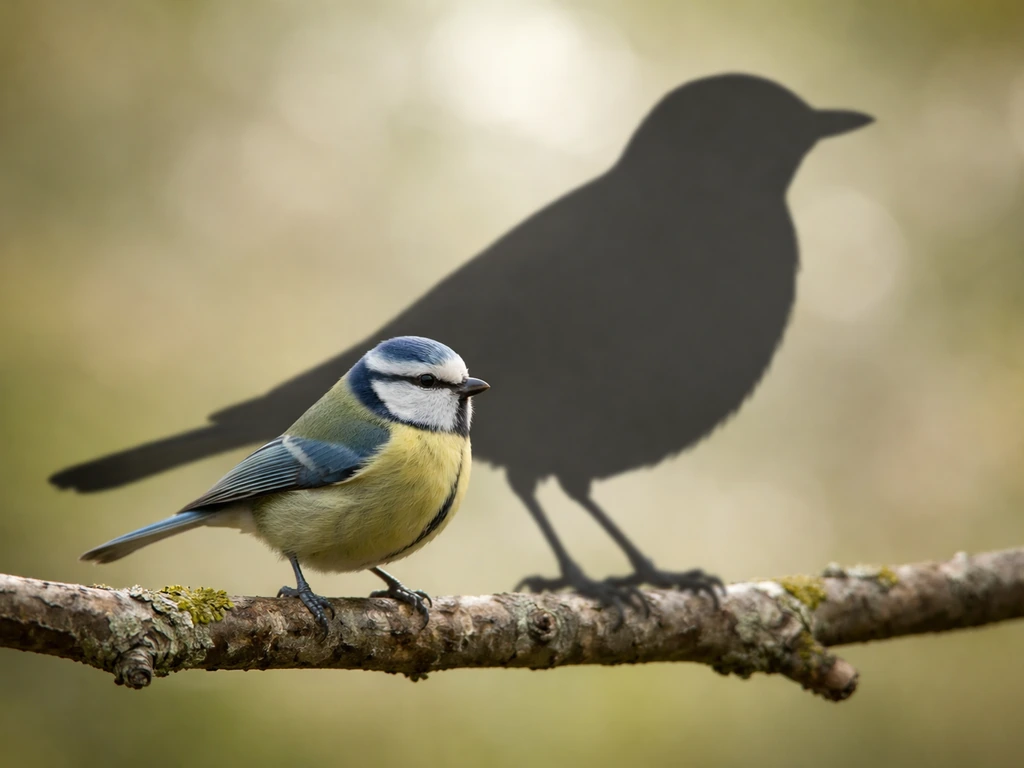
Compare body length (tip of bill to tip of tail) and wingspan when possible. More usefully, compare relative size to a reference bird you know well, like a robin, a crow, or a pigeon. "Bigger than a robin, smaller than a crow" is instantly useful in the field. Also note the bird's overall build: stocky and compact, or long and slender?
Beak shape and size
Beak shape is one of the most reliable ID features because it reflects the bird's diet and is structurally fixed. A deeply hooked beak means a raptor or a parrot. A long, thin, decurved beak means a curlew or a hummingbird family. A stout, conical beak means a seed-eater. Note beak length relative to head size, thickness at the base, and whether it curves up, down, or is straight.
Feet and leg structure
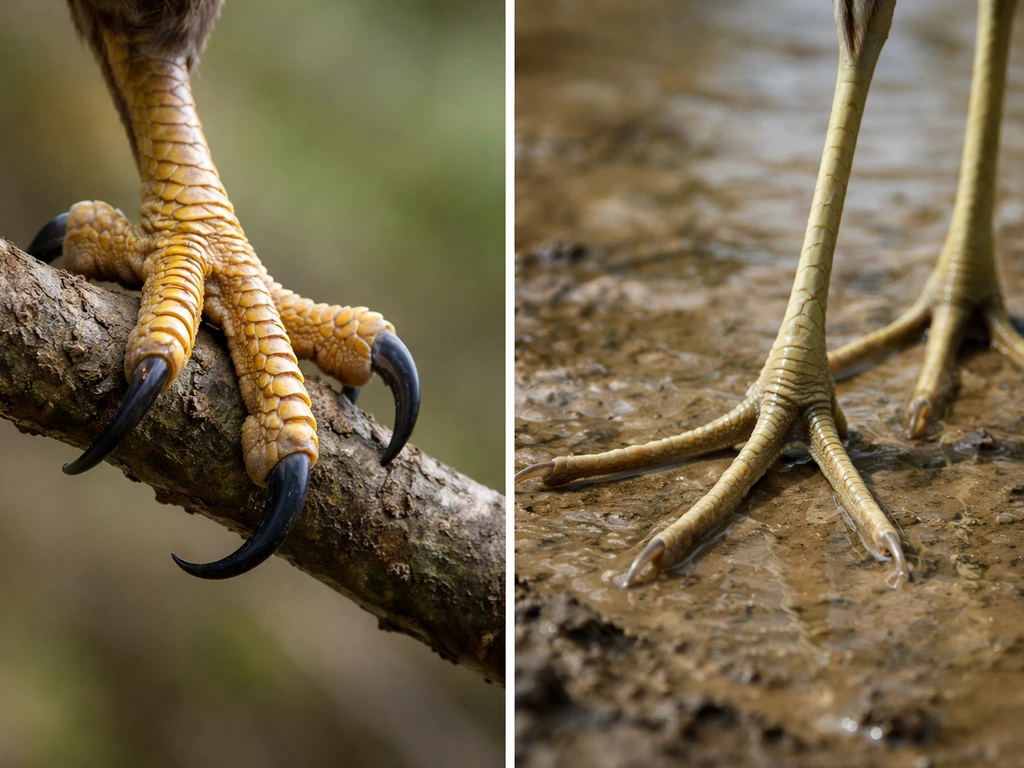
Feet tell you a huge amount about ecological role. Raptors have powerful talons with a reversed hallux toe for gripping prey. Wading birds have long, unwebbed toes for balance in mud. Waterfowl have webbing between the front toes for paddling. Even within a family, subtle differences in talon curvature or toe proportion can help separate species. The comparison between bird feet and dinosaur feet is actually a useful exercise for understanding how foot structure reflects locomotion and ecological function.
Wing shape and tail shape
In flight, wing shape and tail shape are often the most visible features at distance. Broad, rounded wings with splayed primaries (the "fingers" at the wingtip) indicate a buteo hawk or a vulture. Long, narrow, pointed wings indicate a falcon or a swift built for speed. Tail shape matters too: rounded, squared-off, notched, or deeply forked. A wedge-shaped tail in a large black bird is a strong raven indicator.
Plumage pattern (not just color)
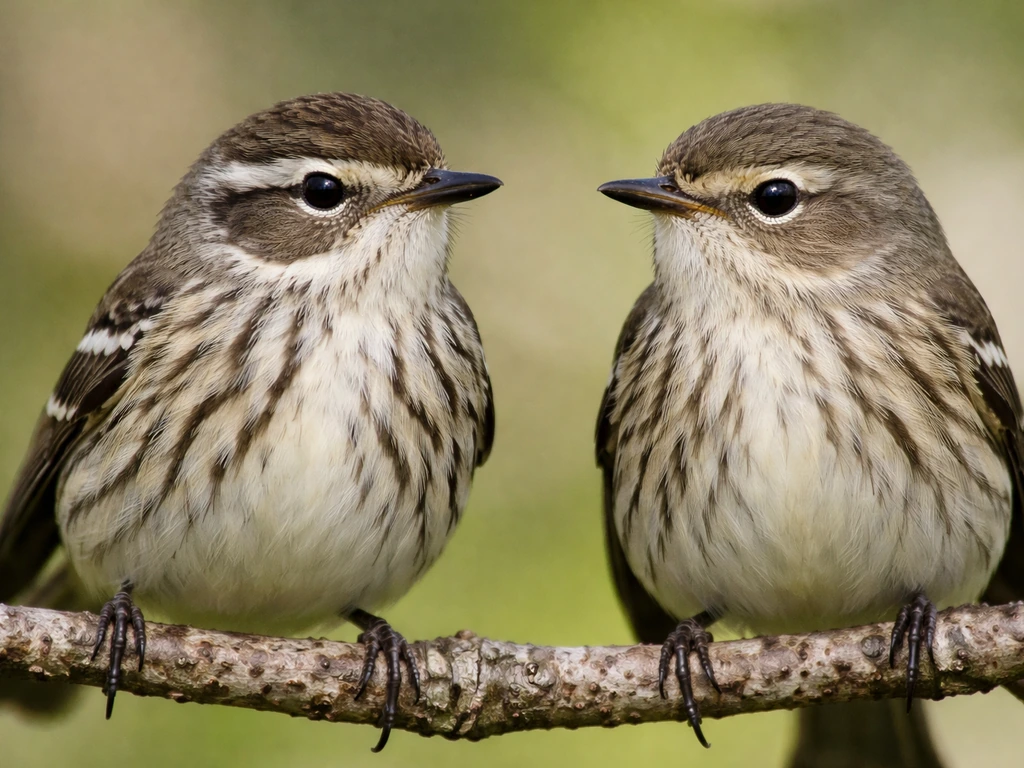
When you look at plumage, train yourself to note pattern before color. Does the bird have a distinct cap? Eye ring? Wingbars? Streaking on the breast? A bold supercilium (eyebrow stripe)? These patterns hold up even in poor light or when feathers are worn. Raw color is the least reliable field mark because it shifts with lighting angle, feather wear, and individual variation.
| Feature | What to note | Why it's reliable |
|---|---|---|
| Body size | Length vs. familiar reference bird; build (stocky vs. slim) | Structural, doesn't change with season or sex in most species |
| Beak shape | Length relative to head, curvature, thickness at base | Directly tied to diet; highly consistent within species |
| Feet/talons | Number of toes, webbing, talon size and curvature | Reflects ecological role; fixed anatomically |
| Wing shape | Pointed vs. rounded; presence of 'finger' primaries | Visible in flight at distance; reflects flight style |
| Tail shape | Rounded, squared, notched, forked, or wedge-shaped | Often visible in flight; useful for family-level ID |
| Plumage pattern | Caps, wingbars, eye rings, streaking, contrast patches | More stable than color across lighting conditions |
| Plumage color | Base tones, iridescence, seasonal changes | Useful as confirmation; least reliable in isolation |
Behavior and ecological clues that clinch the ID
Structure gets you most of the way there, but behavior often delivers the final confirmation. Experienced birders routinely ID species by behavior alone before they even get a clear look at the bird. Audubon's guidance explicitly treats actions as a key component alongside structure and plumage, and for good reason.
Flight style and movement
Does the bird flap with deep, slow wingbeats or rapid, shallow ones? Does it soar on flat wings or with wings raised in a V (dihedral)? Does it hover in place, dive steeply, or glide in long lazy circles? A Turkey Vulture holds its wings in a pronounced dihedral and rocks unsteadily. A Red-tailed Hawk soars on flat wings and holds position much more steadily. These are instant separation tools at distances too great to see color.
Feeding and hunting style
Foraging behavior reflects anatomy and diet. Herons stand stock-still and stab with their beak. Kestrels hover then drop. Woodpeckers spiral up tree trunks, while nuthatches spiral down. Ospreys plunge feet-first into water; eagles generally do not. If you can watch the bird for 30 seconds, its feeding behavior often places it at the family level or narrows it to two candidates immediately.
Habitat and microhabitat
Where exactly is the bird? Not just "forest" but where in the forest: forest edge, dense interior, high canopy, or shrubby understory? Shorebirds that look nearly identical may separate by whether they prefer open mudflats vs. vegetated marsh edges. The All About Birds framework treats habitat as one of four fundamental ID keys precisely because lookalike species often partition habitat even when they share a geographic range.
Calls and vocalizations
A call can settle an ID in under a second even when you can't see the bird clearly. The classic example is crows vs. ravens: crows give a "caw" call, while Common Ravens produce a deep, resonant, hollow-sounding "cronk." Raven calls carry much further and have a throatier quality with none of the sharp crispness of a crow. Learning the calls of your ten most common local species pays off immediately and is often the fastest single tool in the field.
Gender and age variation: the ID traps inside a single species
One of the most common sources of misidentification isn't looking at the wrong species chart. It's not realizing that the bird you're looking at is a different sex or age class than the image you're comparing it to. Many species look so different between male and female, or between juvenile and adult, that they could pass for completely different species.
Sexual dimorphism: males vs. females
In many songbirds, the male carries the bright breeding plumage while the female is cryptically colored for nest protection. A female Scarlet Tanager is yellow-green with darker wings and looks almost nothing like the brilliant red-and-black male. Female Northern Harriers are brown-streaked, while males are pale gray. If you're comparing a bird to a photo and the plumages don't match, check whether you're comparing the right sex before you assume you have a different species.
Juvenile and immature plumages
Large raptors, gulls, and shorebirds can spend two to five years cycling through immature plumages before reaching adult coloration. An immature Bald Eagle is almost entirely dark brown with variable white mottling. It takes four to five years to acquire the familiar white head and tail. Without that knowledge, an immature Bald Eagle gets misidentified as a Golden Eagle or a large buteo constantly. Always check the age-class column in a comparison chart, not just the adult male entry.
Seasonal and worn plumage
Many species look significantly different in breeding (alternate) plumage vs. non-breeding (basic) plumage. A male American Goldfinch is brilliant yellow in summer and dull olive in winter. Shorebirds molt into much plainer plumage outside the breeding season, which is exactly when many of them migrate through areas where birders see them. Worn feathers also bleach and fray, making colors paler and patterns less crisp late in the season. If your bird looks "washed out" compared to field guide images, check the date and whether you might be looking at worn or winter plumage.
Common lookalike matchups and how to crack them
A few specific pairs cause the vast majority of ID confusion. Here are the matchups I see come up most often, with the single most reliable separating feature for each.
| Lookalike Pair | Key Separating Feature | Supporting Clue |
|---|---|---|
| Common Raven vs. American Crow | Tail shape: raven is wedge-shaped, crow is fan-rounded | Raven call is a deep 'cronk'; crow says 'caw'. Ravens also noticeably larger (body ~24" vs ~17") |
| Cooper's Hawk vs. Sharp-shinned Hawk | Head projection: Cooper's has a larger head that projects well beyond wings in flight | Cooper's tail is more rounded at tip; Sharp-shinned tail is more squared or slightly notched |
| Downy Woodpecker vs. Hairy Woodpecker | Bill length relative to head: Hairy's bill is nearly as long as its head depth; Downy's is short and stubby | Hairy Woodpecker is noticeably larger overall (9" vs 6") |
| Turkey Vulture vs. Bald Eagle (in flight) | Wing shape and posture: vulture holds wings in a V (dihedral) and rocks; eagle soars flat | Vultures have a small, naked red head; eagles have a large, proportionate head and heavy yellow bill |
| Greater vs. Lesser Scaup | Head shape: Greater has a rounded, peaked crown; Lesser has a peaked crown with a sharper peak toward the back | Greater Scaup shows a longer white wingstrip extending into secondaries |
| Osprey vs. Bald Eagle | Osprey has a distinctive "crook" in its wing in flight, forming an M-shape from the front | Osprey has a white belly and dark carpal patches; adult Bald Eagle is dark-bodied with white head and tail |
Notice that in almost every case, the separating feature is structural (size, shape, body proportion) rather than color. This is why structure first is the rule, not a suggestion.
How birds compare to other animals (and what those comparisons can and can't tell you)
Comparing birds to other animals is genuinely useful when the comparison is functional and anatomically grounded, and genuinely misleading when it's just a loose visual analogy. Understanding the difference helps you use these comparisons as actual learning tools.
The most scientifically productive comparisons are between birds and their closest relatives. Modern birds are avian dinosaurs, not just vaguely descended from them, and a dinosaur-bird comparison reveals real shared anatomical features: hollow bones, wishbones (fused clavicles), and the exact same ankle and foot structure that you see in theropod dinosaur fossils. Comparing bird feet to dinosaur feet isn't a poetic exercise; it shows a direct evolutionary continuity that explains why bird feet look the way they do.
Bat and bird comparisons are another instructive case. A bat skeleton vs. a bird skeleton shows two completely independent evolutionary solutions to the same problem: powered flight. Bats use elongated finger bones to support a membrane wing. Birds use fused hand bones and a keeled sternum for flight muscle attachment. Same ecological function, entirely different anatomical architecture. That's a useful functional analogy precisely because the differences reveal how much anatomy shapes behavior and capability.
Where cross-animal comparisons go wrong is when they're purely cosmetic. Saying a bat and a swallow look alike in the dusk sky is fine as an observation, but inferring shared traits from that similarity will mislead you. Bats are mammals, echolocate, and have entirely different bone structures, thermal regulation, and reproductive biology. The visual similarity at dusk is a product of convergent evolution (both shaped for fast, maneuverable flight), not shared ancestry.
Similarly, bird egg comparisons teach real biology: egg shape varies with nesting ecology (cliff-nesting birds lay pyriform eggs that roll in a circle rather than off a ledge), and egg color reflects predation pressure and nest type. These aren't arbitrary aesthetic differences. They're functionally grounded comparisons that explain why a feature exists, which makes them far more memorable and useful than just "this egg is blue and that one is speckled."
The rule for cross-animal comparisons is this: if the comparison explains why a feature exists or reveals something about shared ancestry or convergent function, it's worth making. If it's just a surface visual similarity, treat it as a starting point for investigation, not a conclusion.
Putting it all together: your practical field routine
Every time you're trying to ID a bird you don't immediately recognize, run this sequence. It takes about 30 seconds once it becomes habit, and it works whether you're consulting a comparison chart or just working from memory.
- Filter by location and season first. What species are actually possible here, right now? This alone eliminates most candidates.
- Lock in size and shape. How big relative to something you know? What's the body build, tail shape, wing shape?
- Check beak and feet. What does this bird eat, and how does it move? The anatomy tells you the ecological category.
- Note plumage pattern (not color yet). Caps, wingbars, streaking, contrast patches. What's the layout?
- Now confirm with color. Does the color match your top candidate? Account for lighting, season, and whether you might be looking at a female or immature.
- Watch the behavior for 30 seconds. How does it move, forage, or fly? Does that match your candidate?
- Listen if you can. A call or song often settles the ID instantly.
- Use a comparison chart to confirm by checking your top two candidates side-by-side on the traits that separate them.
The biggest shift that separates confident birders from frustrated ones is accepting that no single feature gives you a certain ID. You're building a case across multiple traits, and a comparison chart is the tool that keeps those traits organized and side-by-side so nothing gets missed. Work the checklist in order, account for sex and age variation, and trust structure over color. That's the whole framework.
FAQ
What should I do if the bird comparison chart doesn’t match my bird at the first trait (like size or beak)?
Go to the next most stable trait in the order, but also sanity-check your measurement. If the bird is at an angle or perched higher or lower than you, apparent size can be skewed, so switch to relative size versus a known nearby reference (robin/crow/pigeon) or compare proportionally (head size versus beak length) before committing.
How can I compare birds when I only have blurry photos or a short video clip?
Prioritize the features you can still capture from footage: wing shape (broad versus pointed), tail shape (rounded versus squared, forked depth), and overall build (compact versus long and slender). If plumage color is unreliable, reduce it to pattern cues you can see through noise, like wingbars, cap, or streaking, and reserve color for last.
Is it okay to compare birds by color if I’m doing it last?
Yes, as long as you treat color as the tie-breaker, not the driver. Lighting and feather wear can change both hue and pattern sharpness, so confirm color against structure first (body proportions, beak thickness, wing and tail silhouettes) before concluding.
What’s the fastest way to handle sex and age when the chart I’m using doesn’t show my exact plumage?
Use the chart’s age-class column and ask one question: does the bird look like a “breeding-plumage” version or a “basic/non-breeding” version. If plumage is washed out or lacks crisp pattern edges, consider worn or winter/basic plumage and re-check beak/feet/wing silhouette against the candidates.
How do I avoid mixing up different species accounts when comparing juveniles versus adults?
Make sure you’re comparing the same life stage across both candidates (juvenile-to-juvenile, adult-to-adult). A common mistake is comparing a juvenile of species A to an adult photo of species B, which will bias everything, even if structure seems close.
If two lookalikes share the same wing and tail shape, what trait should I check next?
Move to beak thickness and how it sits relative to the head (base thickness, curvature direction, and length versus head size), then confirm with feet and foraging style. Many “same silhouette” pairs separate best by what the bird does (hovering, diving, stalking, or spiraling) and the ecological role implied by feet.
What if I can’t hear a call in a crows versus ravens type situation?
Use behavior and flight posture as a substitute. Compare how steady the bird holds itself (flat wings steadier versus unsteady rocking), and check tail shape cues at distance, like wedge-shaped tail indicators for ravens. If you later get audio, match call timing and quality rather than expecting a single perfect note.
How do I decide whether habitat is actually useful or just “background noise”?
Treat habitat as a decision aid only after you have at least a couple of structural traits that keep both candidates plausible. Then refine by microhabitat (edge versus dense interior, mudflat versus vegetated marsh edge, canopy versus understory) because lookalikes often partition those zones even when their ranges overlap.
Should I compare birds to other animals (dinosaurs, bats, eggs) while trying to identify species in the field?
Use cross-animal comparisons for learning later, not for immediate ID. In the field, rely on bird-to-bird traits that can be observed quickly. Cross-animal analogies can help you remember “why” a bird’s structure exists, but they are too indirect to replace beak, feet, wing, tail, and behavior cues.
What’s a good “minimum checklist” when I only have 30 seconds to ID a bird?
In order: overall build (compact versus slender), wing and tail silhouette in flight, beak shape versus head (especially base thickness and curvature), then one behavior cue (foraging method or flight style). Save color and fine plumage details for the last 10 seconds only if you can see them clearly.
When should I stop comparing and look for another candidate list?
If your top structural traits contradict each other across the chart (for example, the bird’s beak shape fits one family but the wing silhouette fits another), stop trying to force it. Re-narrow to two to three candidates from the correct group first, then run the structured checklist again.
Next Articles
Godzilla vs Kong Bird: Identify the Exact Bird Lookalike
Disambiguate and ID the exact bird behind searches like Godzilla vs Kong bird using field marks, habitat, range, behavio

Batman vs Bird: Identify the Animal and Tell Them Apart
Learn what Batman vs bird means and use field marks, behavior, and habitat to ID the right animal fast.
Nighthawk Bird vs Whippoorwill: Field ID Guide
Side-by-side field ID for nighthawk vs whippoorwill: size, silhouette, habitat, flight, calls, and quick checklists.