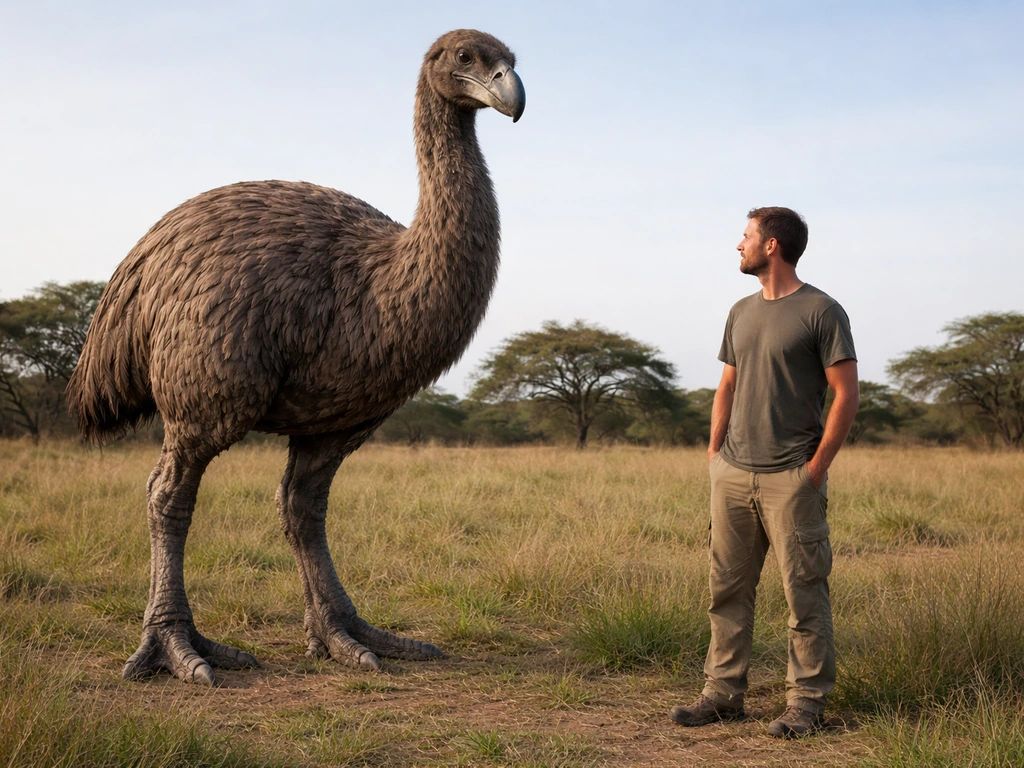
The elephant bird (Aepyornis) and the cassowary (Casuarius casuarius) are both large, flightless birds that look superficially similar in diagrams and illustrations, but they are not closely related, they lived on opposite sides of the world, and one of them has been extinct for centuries. The biggest practical difference: if you are looking at a living giant flightless bird with a bony casque on its head, vivid blue-and-red neck skin, and dagger-like toe claws, that is a cassowary. The elephant bird is known only from bones, eggshell fragments, and fossils found on Madagascar, and it died out sometime in the last millennium.
Elephant Bird vs Cassowary: Key Differences and Safety

Marcus Hendricks
27 Jun 2026
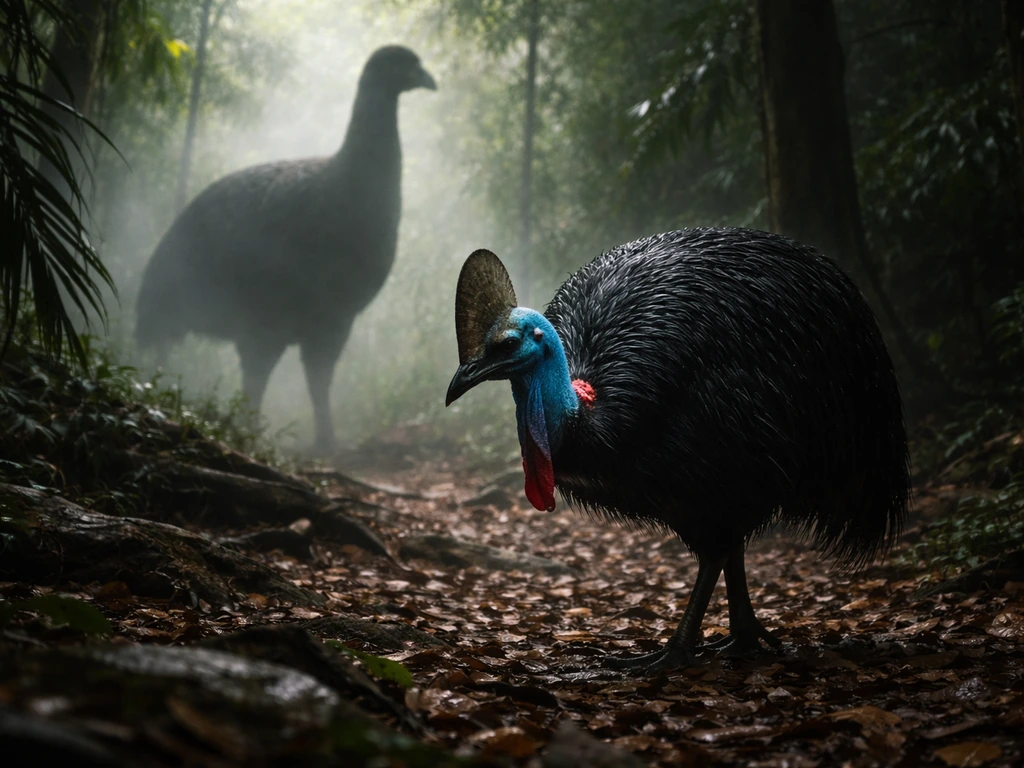
What each bird actually is
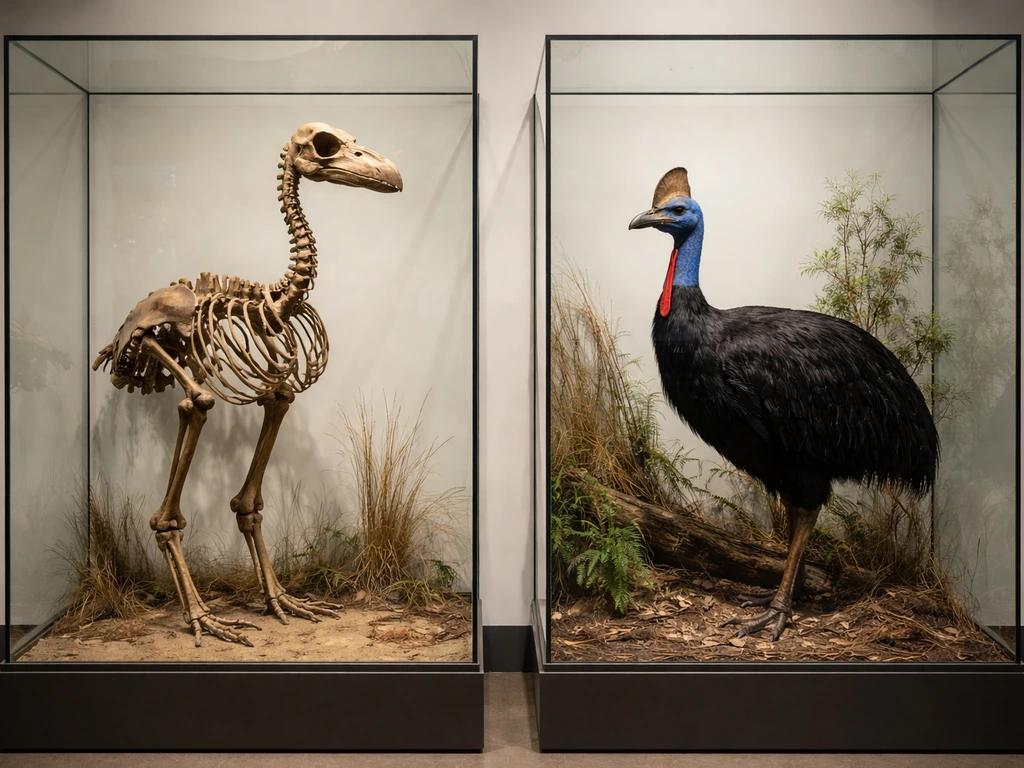
The elephant bird (genus Aepyornis, family Aepyornithidae) was a giant ratite endemic to Madagascar. It was not one species but a group of related species, with Aepyornis maximus being the most famous and Vorombe titan now recognized as a separate, even larger genus. All elephant birds are extinct, likely having disappeared between the 11th and 17th centuries as a result of human hunting pressure and habitat loss. We know them almost entirely through skeletal remains and the extraordinary eggshells they left behind, some of which are the largest single-cell objects ever produced by an animal.
The southern cassowary (Casuarius casuarius, family Casuariidae) is very much alive. It is a ratite found in the rainforests of Indonesia, Papua New Guinea, and northeastern Australia. There are three living cassowary species in total, but the southern cassowary is the largest and the one most people mean when they say 'cassowary.' Both birds belong to the broader ratite group (Palaeognathae), which also includes ostriches, emus, rheas, and kiwis, but that shared membership is a bit like saying a sparrow and a vulture are both birds: it tells you something, but it does not mean they are close cousins.
Are they actually related?
This is where the most common misconception lives. People see two big, flightless, vaguely prehistoric-looking birds and assume they must be on the same branch of the family tree. They are not. Ancient DNA work has shown that the elephant bird's closest living relatives are actually kiwis, not cassowaries or emus. The split between the elephant bird lineage and the kiwi lineage is estimated at roughly 54 million years ago. Cassowaries sit in a completely different ratite branch (Casuariidae), more closely related to emus than to elephant birds. For a quick side-by-side comparison, see how kelenken vs elephant bird differs in relationships, size, and bill traits.
The reason they look similar at all comes down to convergent evolution. Large, flightless island birds independently evolved similar body plans because that body plan works for a big terrestrial herbivore or omnivore. Their flightlessness was not inherited from a single shared flightless ancestor; it evolved separately across ratite lineages. So comparing the elephant bird and the cassowary is genuinely useful for understanding big-bird ecology, but you should not read their similarities as evidence of close kinship. Comparisons with the giant moa or the Vorombe titan follow a similar logic: these were all large ratites shaped by similar pressures, not a single clade of giants.
Size and build: how they stack up
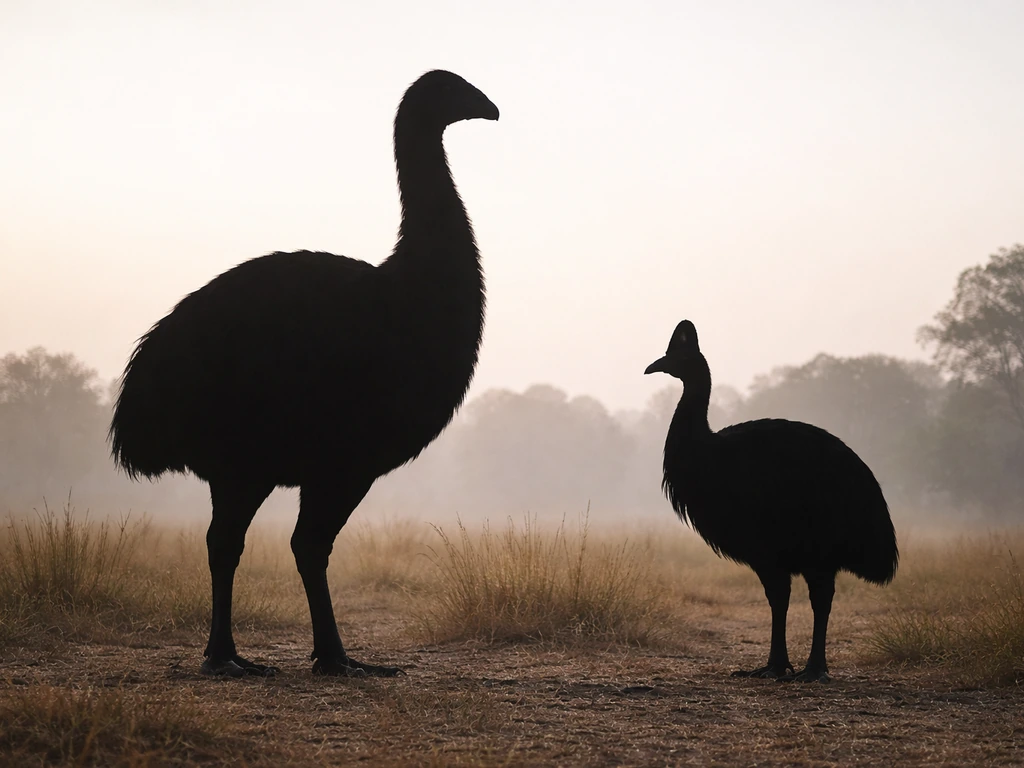
Both birds are or were enormous by any standard, but the elephant bird had a significant size advantage. Aepyornis maximus stood around 3 meters tall and weighed close to 400 kg. Vorombe titan, now recognized as a separate genus, averaged around 643 kg, which would make it the heaviest bird known to have existed. These are not small creatures by any measure.
The southern cassowary is still an impressively large animal but considerably smaller. Adults stand up to about 1.8 to 2 meters tall and weigh between roughly 35 and 75 kg, with females typically heavier and taller than males. That weight difference alone (roughly 400 kg versus 75 kg at the upper ends) is one of the clearest ways to understand that these are not equivalent birds, even if an illustration makes them look similarly sized.
| Trait | Elephant Bird (Aepyornis maximus) | Southern Cassowary (Casuarius casuarius) |
|---|---|---|
| Status | Extinct | Living |
| Height | ~3 m | Up to ~1.8–2 m |
| Weight | ~400 kg (Vorombe titan ~643 kg) | ~35–75 kg (females larger) |
| Body build | Massively heavy, round-bodied | Stocky but much lighter |
| Native region | Madagascar | New Guinea, NE Australia, Indonesia |
| Family | Aepyornithidae | Casuariidae |
| Closest living relative | Kiwi | Emu |
The features that actually tell them apart
Head and casque
This is the single fastest way to tell these two birds apart. The southern cassowary has a prominent casque, a tall, bony-looking helmet made of keratin that sits on top of its head. It also has vivid bare skin on its neck, typically bright blue, with two dangling red wattles. If you want a simple comparison of two of the most famous large flightless birds, see the moa bird vs emu matchup southern cassowary.
These features are impossible to miss. The elephant bird had none of this. Its head was actually quite small relative to its body, with a straight, thick conical beak adapted for foraging hard fruits and possibly underground tubers. No casque, no wattles, no vivid neck coloration that we know of.
Legs and feet
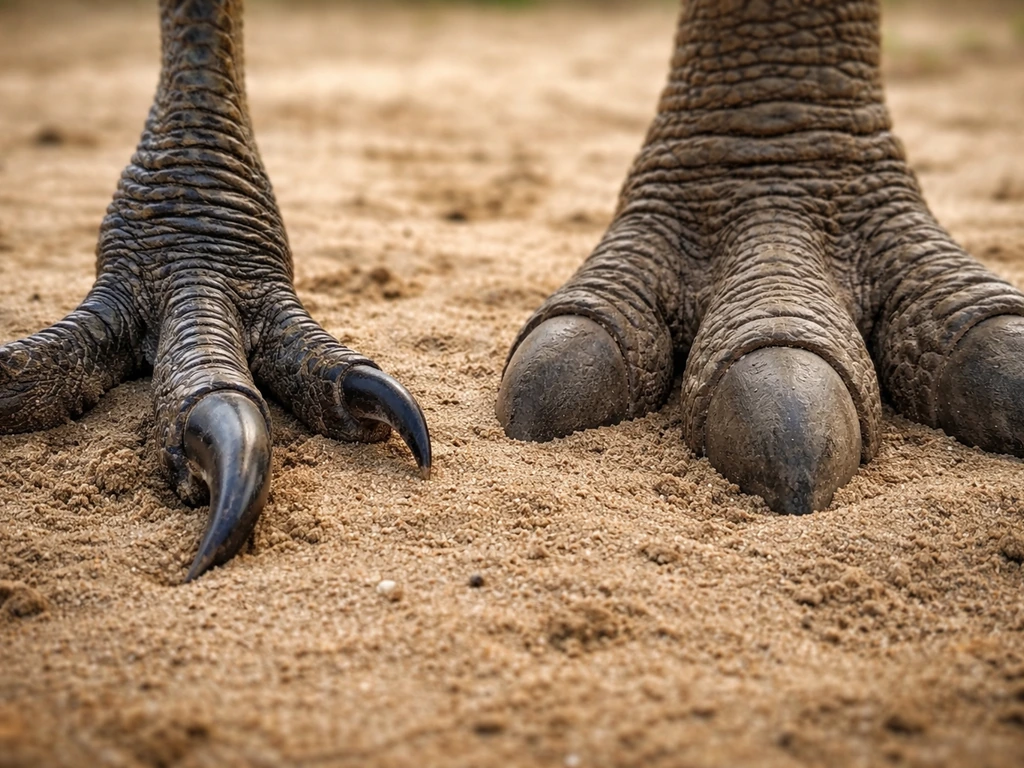
Both birds had powerful, thick legs built for a terrestrial lifestyle. The cassowary's most dangerous feature is its inner toe claw, which is dagger-like and can reach up to about 10 cm (around 4 inches) in length. Cassowaries can deliver powerful kicks with these claws and are considered the world's most dangerous bird because of it. If you are also comparing cassowaries to other big bird predators, the goliath birdeater vs bird matchup is another useful reference point. Elephant birds also had thick, column-like legs to support their massive bodies, but their threat profile was very different because, well, they are extinct and their behavior is inferred rather than observed.
Wings and bill
Both birds had vestigial, non-functional wings and neither could fly. This is one of the genuine similarities. Cassowaries also lack tail feathers. The elephant bird's bill was straight and conical, built for power feeding rather than fruit-plucking finesse. The cassowary's bill is more elongated and pointed, suited for picking up fallen fruit from the forest floor. The bills reflect very different diets and ecological roles, which we will get into below.
Behavior and temperament
The cassowary is famously aggressive, particularly when it feels cornered, is protecting eggs or chicks, or has been habituated to humans through food provisioning. They can run at around 50 km/h through dense forest and can jump up to about 1. 5 meters. A cassowary charging with its head lowered and casque pointed forward is giving you a clear threat signal.
Research on cassowary attacks on humans has found that incidents are often linked to food expectation (birds that have been fed by people) and defense of young. A similar theme helps explain why people can also confuse elephant bird behavior with human interactions, even though the elephant bird is long extinct cassowary attacks on humans. This is a bird you take seriously in the wild.
The elephant bird's temperament is, obviously, entirely inferred. Based on its body mass and beak morphology, it was likely a slow-moving, powerful forager rather than a fast runner or an active predator. There is no fossil evidence of specialized weapons like a dagger claw, and its legs, while massive, appear built for weight support rather than high-speed locomotion. Some researchers compare its ecological role loosely to a very large, terrestrial herbivore rather than an active, reactive animal like a cassowary.
Habitat and diet
The southern cassowary is a rainforest specialist. It lives and forages on the forest floor of tropical rainforests in northeastern Australia, Papua New Guinea, and parts of Indonesia. Its diet is dominated by fleshy fallen fruit, and it is recognized as a keystone seed disperser in these ecosystems, meaning it swallows large seeds whole and deposits them far from the parent tree. On top of fruit, cassowaries also eat fungi, invertebrates, small vertebrates, flowers, and occasionally carrion. They are opportunistic rather than strictly herbivorous.
The elephant bird's diet and habitat are reconstructed from stable isotope analysis of eggshell fragments, which is a genuinely elegant piece of paleoecology. The evidence suggests that different elephant bird individuals and possibly different species occupied different ecological niches on Madagascar. Some specimens show isotope signatures consistent with roughly 48% grazing on C4 grasses, suggesting open grassland or savanna use, while others look more like forest browsers.
The thick conical bill is consistent with cracking hard fruits or digging up underground tubers rather than the finer fruit-picking behavior of the cassowary. So where the cassowary is almost exclusively a rainforest fruit specialist, the elephant bird appears to have been more of a mixed-habitat, mixed-diet generalist depending on the species and region.
How to compare them fast: a quick checklist
If you are trying to quickly sort out which bird is which from a description, a museum exhibit, a documentary, or a diagram, run through these points in order: If you want an even faster mental shortcut for “behemoth vs bird watcher,” focus on the overall build and the presence of that vivid casque and neck skin on a living cassowary.
- Is it alive or extinct? Cassowary = living. Elephant bird = extinct. If someone says they saw one in the wild, it is a cassowary.
- Does it have a casque (bony helmet) and colorful neck skin with red wattles? Yes = cassowary. Elephant birds had no casque and no known wattles.
- What does the bill look like? A straight, heavy, conical beak suggests elephant bird. A more slender, pointed bill for picking up fruit suggests cassowary.
- Where is it from? Madagascar = elephant bird (or its fossils/eggs). New Guinea, Australia, Indonesia = cassowary.
- How big is it? Something described around 400+ kg or historically the 'world's heaviest bird' = elephant bird or Vorombe titan. Something in the 35–75 kg range, taller than an emu but not massively heavier = cassowary.
- Are the eggs enormous, like beach-ball-sized? Elephant bird eggs could hold up to 8.5 liters of liquid and reached up to 33 cm long. Cassowary eggs are large but nowhere near that scale.
- Is there a dagger-like inner toe claw described? That is a cassowary feature. No such specialized claw is documented for elephant birds.
- What is the closest living relative mentioned? Kiwi = elephant bird lineage. Emu = cassowary lineage.
The core mental model to keep is this: both birds belong to the ratite group and both were (or are) large, flightless, and built for terrestrial life, but they evolved independently on different continents tens of millions of years apart, and their physical and behavioral profiles reflect very different ecological niches. The cassowary is a living, aggressive rainforest frugivore with a keratin helmet and a dagger for a toe. The elephant bird was a massive, slow-moving Madagascan forager that left behind some of the largest eggs in the history of life on Earth. Once you have those two mental pictures locked in, you will not mix them up again.
FAQ
If I see a big flightless bird, how can I tell in the real world whether it is a cassowary or an “elephant bird”?
No. If the animal is alive and you see the keratin casque plus bright bare neck skin (often blue) with red wattles, you are looking at a cassowary. An elephant bird is extinct and can only be found via fossils, eggshell material, or reconstructions.
Can I use height or weight to distinguish elephant bird vs cassowary in photos or exhibits?
Don’t rely on size alone. Cassowaries can overlap in “big bird” appearance with other large ratites, and the elephant bird was far heavier (hundreds of kilograms). The fastest reliable cue is the casque and wattled neck, not just overall body scale.
What situations make cassowaries more dangerous compared with the risks people assume from “big prehistoric birds”?
In the wild, the biggest practical risk is to avoid situations that encourage charging behavior. If a cassowary has chicks, is guarding an egg, or has been fed by people (food provisioning), it is more likely to treat you as a threat or as an expected food source.
Are elephant birds and cassowaries closely related because they are both ratites?
Yes, and the confusion is common. People often mix up ratites with superficially similar “ancient bird” looks, but elephant birds and cassowaries are separated by tens of millions of years and live on different continents. Any “close cousin” claim about the two is misleading.
Is cassowary behavior mostly instinct, or is it linked to how humans interact with them?
Cassowary aggression is not just “random bad temperament.” The pattern is often tied to incentives (expecting food because humans feed them) and protective context (eggs and chicks). If you see people approaching for photos, that increases the chance of the bird becoming habituated and then defensive.
What are the most practical do’s and don’ts if I’m in cassowary territory?
For cassowary safety, the key is to keep distance and avoid cornering. If you are in cassowary habitat, give the bird space to move away, do not try to lure it closer with food, and be extra cautious when you spot a bird near nesting areas or when chicks are present.
Why is it risky to assume elephant birds behaved like cassowaries when it comes to aggression?
Elephant bird behavior is inferred from skeletal and eggshell evidence, not observed directly. Because there is no equivalent live anatomy in the same way as a cassowary’s casque and toe claw usage, any claim that an elephant bird was “as dangerous” is speculation.
Do elephant birds have the same kind of weaponry as cassowaries, like a dagger toe claw?
No. The cassowary’s inner toe claw is a major weapon, but the rest of the body plan is also adapted for fast, controlled movement in forest floor conditions. Elephant birds likely emphasize heavy terrestrial foraging, and their “threat profile” cannot be assigned the same way as a living bird’s demonstrated capabilities.
How should I interpret reconstructions and illustrations that show elephant bird vs cassowary differences?
Yes. In museums and documentaries, an artist may exaggerate casque size or neck color, or show the elephant bird with a more “birdlike” head than the fossil record suggests. Use the presence of a living cassowary casque and wattled neck skin as your main check, and treat reconstructions of elephant birds as interpretive.
What quick decision flow can I use to identify which bird is being described in text or a diagram?
If your goal is identification, prioritize this sequence: (1) Are there wattled bare neck skin and a casque, indicating a living cassowary, (2) if it is not a living animal, it cannot be an elephant bird, and (3) if comparing diets, look for clues like cassowary fruit-foraging bill shape versus the elephant bird’s thicker conical beak associated with hard food processing and digging.
Next Article
Elephant Bird vs Human: Side-by-Side Anatomy, Life, and Myths
Elephant bird vs human comparison: size, anatomy, diet, senses, and real facts plus myths and encounter scenarios.