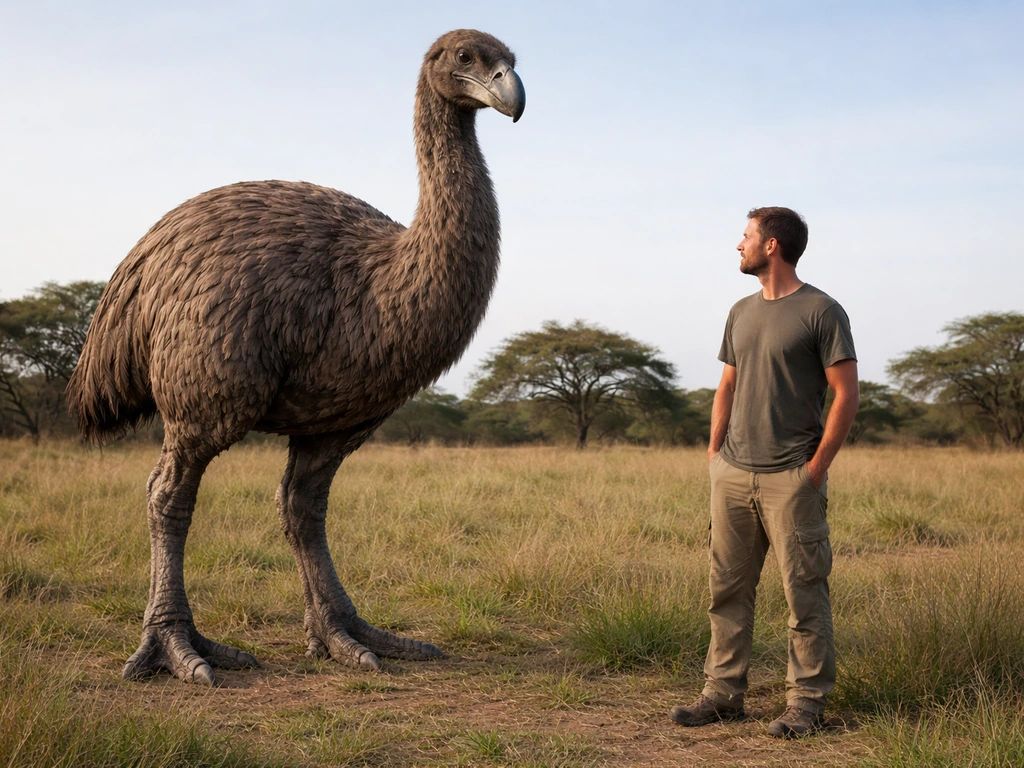
An elephant bird was a massive, flightless ratite that lived in Madagascar and went extinct roughly 1,000 to 1,500 years ago. The largest species, Vorombe titan, weighed close to 650 kg and stood around 2.7 meters tall. By comparison, the average human weighs around 62–80 kg and stands about 1.7 meters. So the heaviest elephant birds outweighed a typical person by roughly 8 to 10 times. They were herbivorous browsers, not predators, and the direct fossil evidence we have of humans and elephant birds interacting shows humans hunting and butchering them, not the other way around.
Elephant Bird vs Human: Side-by-Side Anatomy, Life, and Myths

Marcus Hendricks
7 Jun 2026
What exactly was the elephant bird
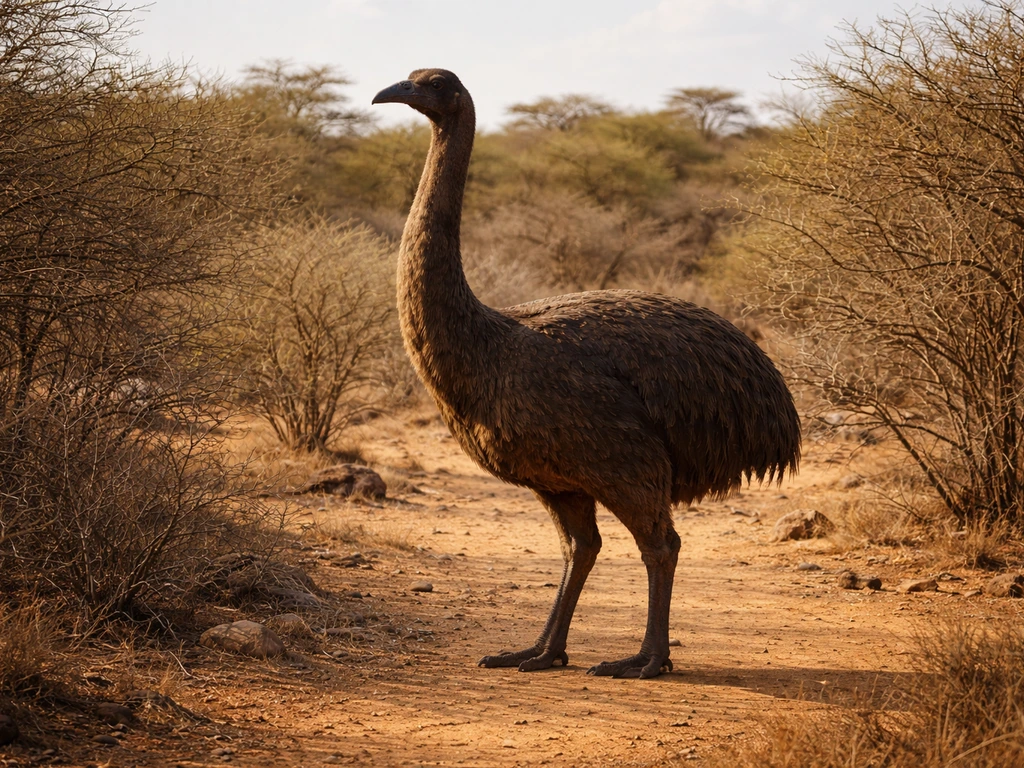
Elephant birds (family Aepyornithidae) were a group of giant ratites endemic to Madagascar. Ratites are the group that includes ostriches, emus, cassowaries, kiwis, and the extinct moas, all of which are flightless birds with a flat breastbone lacking the keel that flight muscles attach to. Cassowaries are the closest living relatives to ratites like elephant birds, but they differ greatly in size, behavior, and habitat. Elephant birds were the heaviest of the lot. A 2018 morphology-based framework by Hansford and Turvey recognized four main species-level taxa: Mullerornis modestus (the smallest), Aepyornis hildebrandti, Aepyornis maximus, and Vorombe titan, which holds the title of heaviest bird ever recorded.
They occupied multiple ecological zones across Madagascar: the arid spiny bush in the south, succulent woodlands in the southwest, and the grassland and woodland mosaic of the central highlands. Stable isotope analysis of eggshells and bones shows they were herbivores, filling browsing and grazing guilds depending on the species and region. Some Madagascar plant lineages are even thought to have evolved spiny, wire-like defensive structures specifically as a response to elephant bird feeding pressure, which tells you a lot about how ecologically dominant these birds once were.
Elephant birds survived well into the period of human habitation. A research synthesis compiled 278 age determinations for Madagascar and notes that elephant birds were still present near the end of the First Millennium AD.
Carbon dating places the last confirmed populations of Aepyornis hildebrandti in the central highlands to roughly 1,560 to 1,300 years ago. Remarkably, cut-marked and chopped elephant-bird bones have been found that date back over 10,500 years, pushing back the timeline of human presence in Madagascar significantly. A peer-reviewed report indexed on PubMed describes perimortem chop and cut marks on >10,500-year-old elephant-bird bones consistent with dismemberment [perimortem chop marks/cut marks/depression fractures consistent with immobilization and dismemberment](https://pubmed. ncbi.
nlm. nih. gov/30214938/). Humans and elephant birds shared the island for a long time, and humans clearly used them as a food source.
Size, anatomy, and how their bodies compared to ours
The numbers here are genuinely staggering when you line them up side by side. Aepyornis maximus weighed around 450 kg, and Vorombe titan averaged close to 650 kg. A competitive male Olympic weightlifter might weigh 110 kg, so even the smaller A. maximus was roughly four times heavier than a large, muscular human. Their eggs were correspondingly enormous, with A. maximus eggs reaching measurable lengths and widths far exceeding any living bird.
| Trait | Elephant Bird (Vorombe titan / A. maximus) | Modern Human |
|---|---|---|
| Height | ~2.4–2.7 m (estimated) | ~1.7 m (average adult) |
| Weight | 450–650 kg | 62–80 kg (average adult) |
| Limb structure | Short, thick legs; three-toed feet; no functional wings | Long bipedal legs with arms and hands |
| Beak/mouth | Conical beak for browsing/clipping vegetation | Omnivore jaw with flat molars and incisors |
| Flight capacity | None; wings vestigial and non-functional | None (biological) |
| Skeletal build | Massive, robust bones scaled for extreme weight | Moderate bone density, adapted for upright walking and manual dexterity |
Their leg structure is one of the most revealing anatomical contrasts. Elephant birds had short, thick legs with three-toed feet built to support enormous mass. Human legs are comparatively long and slender, built for a very different mechanical advantage. The human limb system is optimized for endurance locomotion, carrying tools, and manipulating the environment with hands. Elephant birds had no hands at all. Their wings were reduced to near-useless stubs. Everything about their anatomy was oriented around supporting and moving an enormous body mass on two legs, not precision manipulation.
Behavior, diet, and daily life compared to humans

Elephant birds were herbivores. Full stop. The isotope evidence from eggshells and bones consistently points to a diet of browsed vegetation (C3 plants, shrubs, trees) and in some species, grazed grasses and CAM plants like succulents. At an estimated height of 2.4 to 2.7 meters, they could reach browse levels unavailable to most other herbivores in Madagascar. They were ecosystem engineers in the way that elephants and giraffes are in Africa, shaping vegetation through sustained feeding pressure.
Humans, by contrast, are omnivores with highly flexible diets, social behavior, tool use, and complex language-based culture. Elephant birds had none of those things in the human sense. That’s why comparisons like elephant bird vs elephant can be confusing, because the evidence points to very different biology and behavior Elephant birds had none of those things. Their habitat was the varied landscape of Madagascar, from coastal arid zones to highland woodlands. They almost certainly did not migrate long distances the way some birds do. The evidence suggests they were relatively slow-moving, ground-dwelling birds whose daily activity revolved around finding and processing plant material.
One interesting behavioral inference: the brain reconstruction work on elephant birds found extremely reduced optic lobes, leading researchers to propose these birds may have been nocturnal or at least heavily crepuscular. If that inference holds, elephant birds were active during periods when early human hunters were likely less active, which would have made them both harder to locate and potentially easier to ambush at certain times of day.
Intelligence, senses, and communication
This is where the evidence gets thinner, and it's worth being honest about that. CT-based digital brain reconstructions of Aepyornis maximus and A. hildebrandti revealed dramatically reduced optic lobes, which in birds correlates with reduced reliance on vision. The researchers interpreted this as supporting nocturnality, meaning the birds may have relied more on senses other than sight, possibly olfaction or hearing, though the direct evidence for those is weaker.
Compare that to humans, who are intensely visual animals with large, forward-facing eyes optimized for depth perception and fine detail. Human intelligence, language, and social complexity are on a completely different tier from what any bird achieves, including the most cognitively sophisticated living parrots and corvids. Elephant birds were probably not cognitively complex in any meaningful comparative sense. Their brains, from what reconstructions show, were oriented around basic sensory processing and motor control, not problem solving or communication at a social level.
As for vocalizations: we simply do not know what elephant birds sounded like or how they communicated. No soft tissue survives, and there are no behavioral records. Extrapolating from living ratites like ostriches and cassowaries, they likely produced low-frequency vocalizations, but that remains speculative. Do not trust any source that gives you confident specifics about elephant bird calls or social behavior, because those details are not in the fossil record.
What would actually matter in a hypothetical encounter
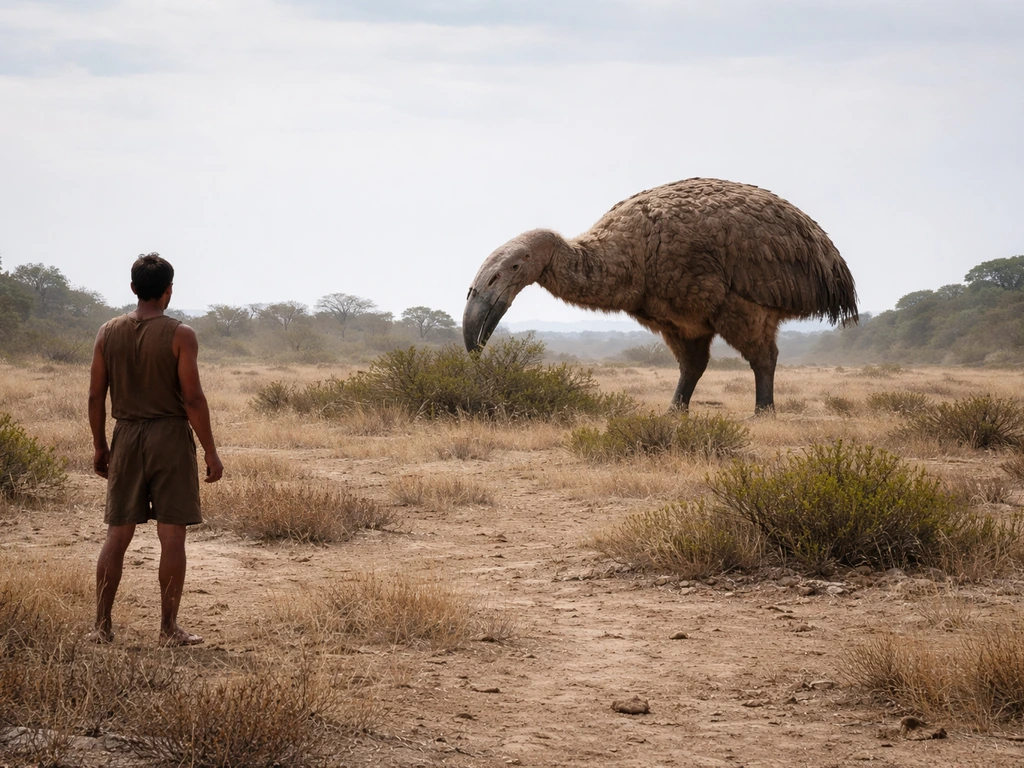
People search this comparison partly because they want to know whether a human could survive an encounter with an elephant bird. It is a fair question, and the evidence actually gives us a reasonable framework for thinking about it without resorting to pure speculation.
First, the most important thing: elephant birds were not predators. This is also why many people ask about goliath birdeater vs bird, especially compared with similarly sized threats elephant birds were not predators. They had no instinct to hunt, stalk, or ambush animals. A conical beak adapted for clipping vegetation is not a weapon optimized for attacking mammals.
So the premise of an unprovoked aggressive encounter is already biologically weak. A “behemoth vs bird watcher” scenario would come down to how a massive, non-predatory bird reacts to being approached and surprised by humans in the field unprovoked aggressive encounter. That said, any 450 to 650 kg animal is dangerous when threatened or cornered, in the same way that a cow or a horse can be lethal if panicked.
A kick from those short, thick, heavily muscled legs would be devastating.
The actual fossil record of human-elephant bird interaction tells its own story. Humans with basic tools (stone choppers, based on the cut-mark evidence) were processing elephant bird carcasses. Early Holocene hunter-gatherers were managing encounters with these birds successfully enough to butcher them. That does not mean it was easy or safe, but it does mean humans were not helpless against them. A lone, unarmed modern human would be in serious danger from a panicked or defensive elephant bird. A group of humans with even simple tools would have had the upper hand, which is exactly what the archaeological evidence suggests.
- Speed: No direct speed data exists for elephant birds. Based on their massive body mass and short, robust legs, they were almost certainly slower than an athletic human over distance. Large body mass and short legs constrain maximum speed based on basic locomotion scaling principles.
- Kick force: Given the body mass (up to 650 kg) and leg musculature, a kick would be comparable to or exceeding that of a draft horse, potentially lethal or crippling.
- Endurance: Humans have exceptional endurance locomotion by animal standards. An elephant bird trying to pursue a human over open ground would likely fatigue first.
- Vision: Reduced optic lobes suggest limited visual acuity, especially in bright daylight. A human moving at distance may have been difficult for the bird to track precisely.
- Tool advantage: Even primitive stone tools gave early humans a critical advantage for both offense and defense, as the cut-mark evidence confirms.
- Size disadvantage for humans: Up close, a human without tools against a standing elephant bird would be at a severe mechanical disadvantage purely from mass and leg reach.
The bottom line here is that elephant birds were dangerous in the way that any large, panicked herbivore is dangerous, not in the way a predator is. Humans hunted them successfully. A solo, unarmed human would be at risk. A prepared, tooled human had the ability to kill them, and demonstrably did.
Common myths and how to fact-check them
A lot of what circulates online about elephant birds is either exaggerated or outright wrong. Here is how to sort the good information from the noise.
- Myth: Elephant birds were predators that hunted humans. False. Every line of evidence points to herbivory. Their beaks were conical and adapted for plant material. Isotope data confirms plant-based diets. The ecological literature even discusses how Madagascar plants evolved defenses against elephant bird browsing. The predator narrative has no scientific support.
- Myth: Elephant birds were the tallest birds ever. Not necessarily. Height and mass are different things. Elephant birds were almost certainly the heaviest birds ever recorded (Vorombe titan at ~650 kg). Some estimates put moas taller in terms of neck-stretched height. Heaviest and tallest are not the same claim, and both should be referenced to specific species.
- Myth: Humans never encountered elephant birds directly. Disproven. Perimortem cut marks and chop marks on elephant bird bones from over 10,500 years ago confirm direct, physical human processing of these animals. Humans and elephant birds coexisted in Madagascar for a very long time.
- Myth: Elephant bird eggs were the size of a small car or comparable to dinosaur eggs. Exaggerated. A. maximus eggs were huge by bird standards, roughly the volume of 150 to 200 chicken eggs, but they have documented, measurable dimensions. Britannica and peer-reviewed eggshell studies provide the actual numbers. Use those rather than viral social media comparisons.
- Myth: There were only one or two elephant bird species. Outdated. The 2018 Hansford and Turvey morphological framework recognizes four species-level taxa across two genera (Aepyornis and Mullerornis, plus Vorombe). Molecular eggshell work has identified additional lineages. The 'single massive species' framing is a simplification from older literature.
- Myth: Elephant birds survived to be seen by Marco Polo or other medieval travelers. Unconfirmed and highly unlikely. The best-dated evidence places the last populations at roughly 1,300 to 1,560 years ago. The Marco Polo 'rukh' connection is a romantic but unsupported folk etymology. Do not treat it as documented sighting evidence.
If you want to verify claims about elephant birds, look for peer-reviewed papers using isotope analysis, CT reconstruction, or morphological taxonomy as your primary sources. Hansford and Turvey (2018) in RSOS is the current standard for species taxonomy and mass estimates. For brain anatomy and sensory ecology, the CT endocast study is the most rigorous source available. For human encounter evidence, the PubMed-indexed perimortem bone study is the paper to read. Wikipedia and press releases are fine starting points but should always be traced back to their original sources before being treated as fact.
If you are interested in how elephant birds compare to other extinct giants, the comparisons with the giant moa and with Vorombe titan specifically are worth exploring in depth, as both involve similarly large animals with distinct anatomical differences that affect similar encounter and size questions. If you're also curious about moa comparisons, see moa bird vs emu for how their sizes, traits, and evolutionary relationships stack up.
Kelenken vs elephant bird is another popular comparison, because it highlights how different extinct giants were specialized for very different ecologies. For instance, the giant moa vs elephant bird comparison can help clarify how different giant ratites dealt with similar ecological pressures. <a data-article-id="881D4C3A-0F89-472F-96AC-C3AD4AF6772D">The elephant bird vs.
cassowary comparison is also illuminating for understanding what living relatives can tell us about the behavior of extinct ratites, since cassowaries are the most dangerous living ratites and give the best proxy for what a defensive large flightless bird looks like in practice.
FAQ
Could an elephant bird realistically kill a human in an encounter?
It could injure or even kill someone if it panicked or was cornered, because its mass and leg strength make kicks dangerous. However, the key driver is defensive behavior as a herbivore, not predatory intent, so the risk depends heavily on proximity, surprise, and whether people have tools or group support.
What would be the most likely threat during a human-elephant bird encounter?
The main risk is the short, thick legs and three-toed feet, especially a forceful kick from close range. In a non-predator encounter, you should think in terms of knockdown or injury, not “hunting bites,” since the beak shape is suited for clipping plants rather than attacking mammals.
How confident are scientists about whether elephant birds were nocturnal or active at night?
The nocturnal idea is an inference from reduced optic lobes seen in CT-based brain reconstructions, which suggests reduced reliance on sight. But it is not direct proof, since vision reduction can also occur for other reasons, and there is no fossil soft-tissue or behavioral record to confirm daily activity patterns.
Why do some people claim elephant birds were predators or dangerous to babies, and what should I watch for?
Most such claims are driven by misinformation that treats a large herbivore like an animal with predatory instincts. Be cautious of any source that describes specific hunting tactics, social hierarchy, or vocalizations as facts, since those details are not preserved in the fossil record.
Could a human hunt an elephant bird alone with primitive tools?
The article’s evidence supports that humans with simple choppers could butcher elephant birds, implying capability against them, but it does not mean it was safe or easy. A solitary, unarmed person would be much more vulnerable to a defensive response, while a coordinated group using basic gear had a better chance.
Were elephant birds dangerous because they were “smart” or because they were big?
The comparison points toward “big” plus behavior consistent with browsing herbivores, not intelligence on a human-equivalent level. With reduced reliance on vision and brains geared toward sensory processing and movement control, their danger is more about physical reaction under threat than about strategic predation.
How big were the eggs compared with humans or other birds, and why does that matter for encountering adults?
Elephant bird eggs were exceptionally large for birds, with sizes far beyond any living species, which matters because nests and breeding areas can concentrate risk. If humans encountered birds near eggs, even if the birds were not predators, the birds could react defensively to protect offspring or nesting space.
Did elephant birds migrate or roam long distances like some modern birds?
The evidence in the article suggests they were likely relatively non-migratory and ground-dwelling, with daily activity focused on feeding. That implies encounter risk could be more predictable near resources and habitats across Madagascar rather than involving long seasonal movements.
What is the most reliable way to verify a claim about elephant bird biology or human encounters?
Prioritize studies that use physical evidence methods mentioned in the article, like isotope analysis for diet, CT reconstruction for brain/sensory anatomy, and direct cut-mark or perimortem bone evidence for interaction. If a claim skips these and relies on storytelling or confident audio-style descriptions of calls, treat it as unreliable.
Next Articles
Vorombe titan vs Elephant bird: key differences explained
Side by side guide to Vorombe and elephant bird differences: size, weight, anatomy, eggs, habitat, and what evidence sho
Giant Moa vs Elephant Bird: How to Tell Them Apart
Side-by-side ID guide for giant moa vs elephant bird: size, beak, legs, habitat, diet, and key differences.
Godzilla vs Kong Bird: Identify the Exact Bird Lookalike
Disambiguate and ID the exact bird behind searches like Godzilla vs Kong bird using field marks, habitat, range, behavio