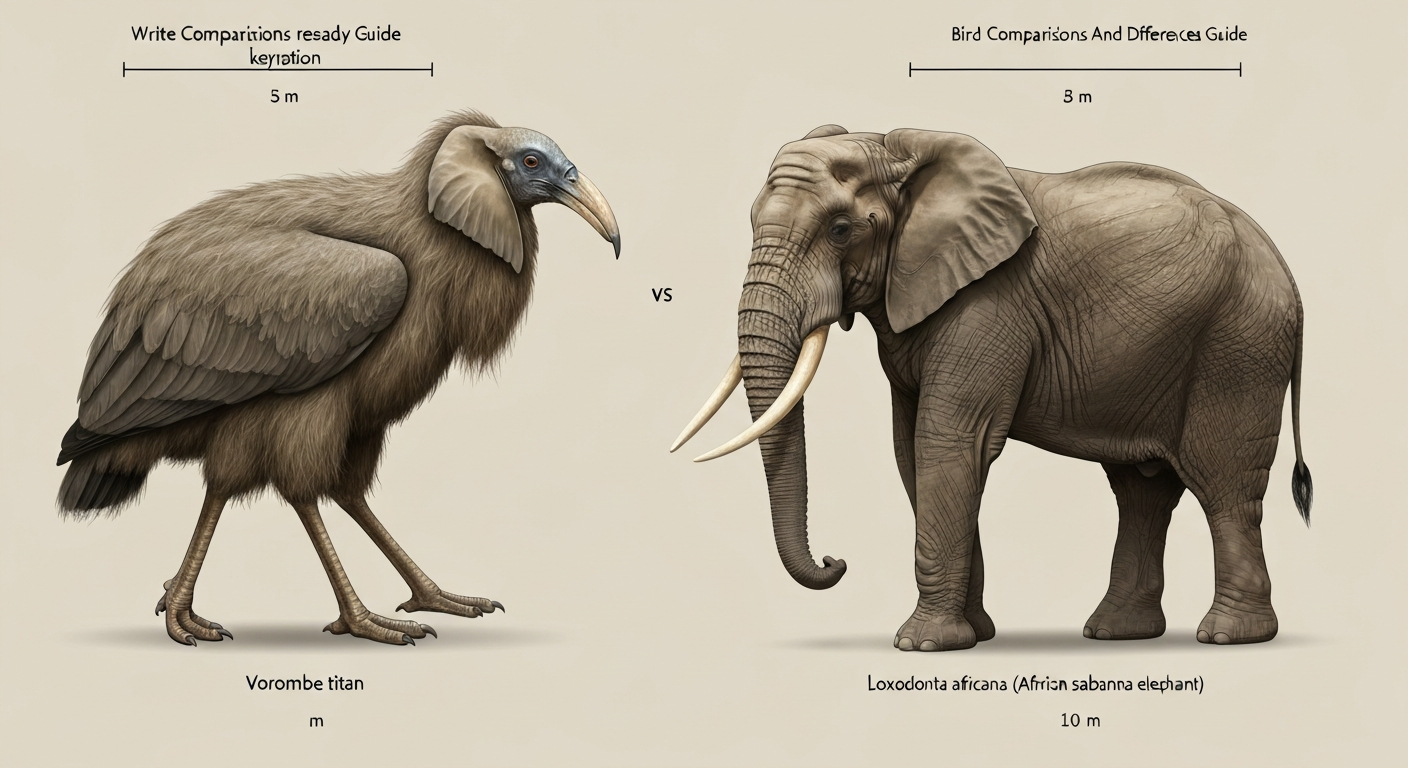
Elephant birds and elephants share a name, nothing else. The elephant bird was a massive, flightless, feathered bird that went extinct in Madagascar during the Late Holocene, while elephants are living placental mammals found in Africa and Asia. They are not related, did not share a habitat, and do not look alike. The name 'elephant bird' comes from 19th-century naturalists marveling at the animal's colossal leg bones and enormous eggs, not from any biological connection to elephants.
Elephant Bird vs Elephant: Key Differences for Readers

Marcus Hendricks
23 Jul 2026
What was the elephant bird?
Elephant birds belong to the extinct family Aepyornithidae, a group of large, flightless palaeognath birds that were endemic to Madagascar. The genus name Aepyornis was coined by the French naturalist Isidore Geoffroy Saint-Hilaire in 1851, derived from the Greek aipýs (meaning 'high' or 'tall') combined with órnis ('bird'). A landmark 2018 morphometric revision by Hansford and Turvey reorganized the family into three genera: Mullerornis, Aepyornis, and Vorombe, recognizing four main species including Vorombe titan, Aepyornis maximus, Aepyornis hildebrandti, and Mullerornis modestus.
Vorombe titan, identified in that 2018 study as the largest aepyornithid, had a mean body-mass estimate of around 643 kg, with the single largest measured individual (a femur held at the Muséum national d'Histoire naturelle, specimen MNHN MAD 368) corresponding to an estimated mass of up to 860 kg. That makes Vorombe titan the heaviest bird known to science. Phylogenetically, elephant birds sit within Palaeognathae and are, perhaps surprisingly, most closely related not to ostriches or emus but to kiwis from New Zealand, as established by Mitchell et al.'s 2014 ancient-DNA study. You can explore that giant-versus-giant angle in greater depth in comparisons with Vorombe titan specifically and with the giant moa. For a focused comparison, see a dedicated piece on giant moa vs elephant bird.
Key facts at a glance
- Family: Aepyornithidae (three genera: Mullerornis, Aepyornis, Vorombe)
- Classification: Aves, Palaeognathae (related to kiwis, not ostriches, by ancient DNA evidence)
- Native range: Madagascar only
- Height: up to approximately 3 m for the largest species
- Maximum estimated mass: up to ~860 kg (single largest Vorombe titan individual)
- Diet: herbivorous (frugivore/browser based on habitat and beak morphology)
- Reproduction: egg-laying; eggs are the largest known bird eggs on record
- Extinction: Late Holocene, correlated with human arrival and landscape transformation in Madagascar
- Status: Extinct
What is an elephant?
Elephants are the largest living land animals on Earth and belong to the family Elephantidae within the mammalian order Proboscidea. Three species are currently recognized: the African savanna elephant (Loxodonta africana), the African forest elephant (Loxodonta cyclotis), and the Asian elephant (Elephas maximus). The IUCN treats both African species as threatened, with the African forest elephant listed as Critically Endangered and the African savanna elephant as Endangered following a 2021 reassessment. Elephants are warm-blooded, placental mammals: they give birth to live young after a gestation period of approximately 22 months (the longest of any living land mammal), and females nurse calves with milk.
Adult African savanna elephants are enormous by mammalian standards. Large bulls typically weigh between 4,000 and 6,000 kg or more. Asian elephants are somewhat smaller, with adults commonly falling in the 3,000 to 5,000 kg range. Their defining anatomical features include the trunk (a fusion of the nose and upper lip), large tusks (elongated upper incisors), columnar legs, and thick, mostly hairless skin. They are found across sub-Saharan Africa and parts of South and Southeast Asia, living in diverse habitats from savanna and forest to scrubland.
Key facts at a glance
- Family: Elephantidae, Order Proboscidea
- Classification: Mammalia, Eutheria (placental mammals)
- Three extant species: Loxodonta africana, Loxodonta cyclotis, Elephas maximus
- Range: Sub-Saharan Africa (Loxodonta spp.) and South/Southeast Asia (Elephas maximus)
- Mass: approximately 3,000–6,000+ kg in adults depending on species and sex
- Height: up to approximately 3.3 m at the shoulder (African savanna elephant bulls)
- Diet: herbivorous (grasses, leaves, bark, fruit)
- Reproduction: live birth; longest gestation of any living land mammal (~22 months)
- Lifespan: up to 60–70 years in the wild
- Conservation status: Endangered to Critically Endangered (IUCN 2021)
Why is it called an elephant bird if it has nothing to do with elephants?
The name comes from 19th-century natural historians who were struck by the sheer scale of the bones and eggs arriving in European collections from Madagascar. When Isidore Geoffroy Saint-Hilaire formally described Aepyornis maximus in 1851, the popular press quickly attached the label 'elephant bird' as a way to communicate its extraordinary size to readers who had never seen anything like it. Some accounts also echo an older legend recorded by Marco Polo, who described a giant bird on an island in the Indian Ocean (possibly Madagascar) capable of lifting elephants. Whether that legend directly gave rise to the name is debated, but the connection between elephant-scale bulk and these birds stuck.
The confusion that crops up today is almost entirely a naming artifact rather than a genuine biological mix-up. Nobody looking at skeletal reconstructions would mistake a giant feathered ratite for a proboscidean mammal. The issue is more subtle: people searching for 'elephant bird' sometimes expect to find a bird that looks like an elephant, has an elephant-like trunk, or lived alongside elephants. None of that is true. Elephant birds were ratites, closer in body plan to an enormous kiwi than to any African megafauna, and Madagascar never had indigenous elephants.
Elephant bird vs elephant: side-by-side comparison
| Attribute | Elephant Bird (Aepyornithidae) | Elephant (Elephantidae) |
|---|---|---|
| Taxonomy | Kingdom Animalia, Phylum Chordata, Class Aves, Order Struthioniformes (Palaeognathae), Family Aepyornithidae | Kingdom Animalia, Phylum Chordata, Class Mammalia, Order Proboscidea, Family Elephantidae |
| Genera / Species | Mullerornis, Aepyornis, Vorombe; 4 recognized species (2018 revision) | Loxodonta africana, L. cyclotis, Elephas maximus; 3 living species |
| Maximum height | ~3 m (estimated for large Aepyornis/Vorombe) | ~3.3 m at the shoulder (African savanna elephant bull) |
| Maximum body mass | ~860 kg (largest Vorombe titan individual, femur estimate) | ~6,000+ kg (large African savanna elephant bull) |
| Lifespan | Unknown (extinct; no direct behavioral or longevity data) | Up to 60–70 years in the wild |
| Diet | Herbivorous (frugivore/browser; inferred from habitat and cranial morphology) | Herbivorous (grasses, leaves, bark, fruit, roots) |
| Locomotion | Bipedal walking; flightless; robust hindlimbs | Quadrupedal walking; cannot jump; semi-digitigrade gait |
| Reproduction | Oviparous (egg-laying); largest known bird eggs (~26–40 cm long, ~5.6–13 L volume) | Viviparous (live birth); ~22-month gestation; one calf at a time |
| Sensory organs | Eyes and ears as in birds; vision likely primary sense; no trunk | Large ears (thermoregulatory and acoustic); sensitive trunk with ~40,000 muscles; keen smell |
| Habitat | Madagascar only; forests, shrublands, and possibly open woodland | African savanna, forest (Loxodonta); South/Southeast Asian forest and grassland (Elephas) |
| Conservation / Extinction status | Extinct; Last AMS-dated specimens calibrated to ~1,300–1,400 years ago (youngest known date) | Endangered (L. africana), Critically Endangered (L. cyclotis), Endangered (E. maximus) — IUCN 2021 |
Bones and skeletal structure
Bird and mammal skeletons are built on completely different engineering principles. Elephant birds had a typical avian skeleton: a keeled sternum (reduced in flightless species), fused clavicles, a lightweight skull relative to body size, and, most distinctively, powerful hindlimb bones built to carry their enormous mass. The femora and tibiotarsi of Vorombe titan are massively robust even compared to other ratites. Hansford and Turvey's 2018 revision was built almost entirely on measurements of these limb bones, held in major collections including the AMNH in New York, the MNHN in Paris, the Natural History Museum in London, and the Oxford University Museum of Natural History. Bird bones, even in large flightless species, retain pneumatization (air spaces within bone walls) in many elements, which reduces mass without sacrificing strength.
Elephants, by contrast, have dense, robust, non-pneumatized limb bones that function as load-bearing pillars. Their bones are among the densest of any land animal relative to body size. Elephant skulls are particularly striking: they are honeycomb-structured internally (diploë), which provides strength while keeping the massive skull light enough to be supported by the neck. The tusks are modified upper incisor teeth rooted deep in the premaxilla, something no bird possesses. Elephant cervical vertebrae are short and compressed, reflecting the need to support a heavy skull, while bird cervical vertebrae are elongated and highly mobile.
Feathers and integument vs skin and hair
Elephant birds were covered in feathers, the defining integumentary structure of all birds. In ratites like ostriches and emus (the closest living analogs), the feathers tend to be soft, loose, and somewhat hair-like because the barbules that zip feather vanes together in flying birds are reduced or absent. Elephant bird feathers have not been preserved in the fossil record, so we reconstruct their plumage by analogy with living palaeognaths. No known specimen retains soft tissue. The skin beneath the feathers would have been scaly on the feet and legs, as is typical in ratites, and featherless on certain facial regions.
Elephants have thick, wrinkled skin that can be up to 2.5 cm thick in places, though it is surprisingly sensitive to sunburn, which is why elephants mud-bathe. They are largely hairless as adults, with sparse bristle-like hairs scattered across the body and denser hair on the tail and head in younger animals. Elephant skin is not homologous to feathers in any sense; both feathers and mammalian hair are derived from different embryonic tissues (feathers from feather follicles, hair from hair follicles), so the two structures represent independent evolutionary solutions to external body covering.
Eggs vs live birth
Elephant bird eggs are the largest single cells ever produced by a vertebrate. Well-documented complete eggs from museum collections measure roughly 26 to 40 cm in length, with volumes estimated in the range of approximately 5. See the Environmental Literacy Council overview 'What is the name of the largest egg in the world?' for museum-based measurements reporting aepyornithid egg lengths of about 26–40 cm and volumes commonly cited around 8–9 L See the Environmental Literacy Council overview 'What is the name of the largest egg in the world?' for museum-based measurements reporting aepyornithid egg lengths of about 26–40 cm and volumes commonly cited around 8–9 L.. 6 to 13 liters, depending on the specimen. Many widely cited examples cluster around 8 to 9 liters and about 33 cm in length. The eggshell itself is thick and distinctive, which has made it valuable both archaeologically (eggshell fragments appear in cultural contexts across Madagascar) and scientifically: Grealy et al.'s 2023 study in Nature Communications extracted mitochondrial genomes directly from fossil eggshell, identifying two major aepyornithid genetic lineages and two distinct eggshell morphotypes without needing bone samples.
Elephants reproduce by live birth after a gestation of approximately 22 months, the longest of any living land mammal. A single calf is born, typically weighing around 100 kg at birth, and is nursed on milk for several years. The contrast in reproductive strategy is absolute: a single elephant bird egg contained as much volume as roughly 180 chicken eggs or about 7 ostrich eggs, yet the entire reproductive investment for that clutch sat in one shelled package on the ground, vulnerable until hatching.
Tusks and trunk: clearing up a persistent misconception
No bird has tusks or a trunk. These structures are unique to proboscideans (the mammalian lineage that includes elephants, mammoths, and mastodons). Tusks are modified upper incisor teeth; birds do not have teeth at all (the last toothed birds went extinct at the end of the Cretaceous), so the evolutionary raw material for tusks simply does not exist in the avian lineage. The elephant's trunk is an elongation and fusion of the nose and upper lip, controlled by approximately 40,000 individual muscles. Birds have beaks, which are bony extensions of the premaxilla and dentary bones covered in a keratinous sheath called the rhamphotheca. Elephant birds had relatively small, deep beaks suited to processing tough plant material, but no trunk, no tusks, and no anatomical homologs of either.
Diet and foraging strategies
Elephant birds were almost certainly herbivores. Their beak morphology, their size, and the dense, fruit-rich forests of Madagascar all point toward a diet centered on fruit, seeds, and possibly leaves and other plant matter. Some palaeontologists have suggested they may have been important seed dispersers for large-fruited Madagascar plants, an ecological role that went unfilled after their extinction. There is no evidence they were predatory or scavenged animal protein in any significant way.
Elephants are bulk herbivores, consuming between 150 and 300 kg of vegetation per day depending on the species and season. They eat grasses, leaves, bark, roots, and fruit, and their foraging behavior actively reshapes entire landscapes: knocking over trees, creating clearings, and digging water holes that benefit other species. Elephants are considered keystone species for this reason. The foraging impact of a living elephant herd on a landscape is orders of magnitude greater than what even a large group of elephant birds could have achieved.
Predators, threats and anti-predator adaptations
Adult elephant birds had few natural predators on Madagascar because of their sheer size. The island's native carnivore fauna was dominated by the Malagasy carnivores (euplerids), none of which were large enough to threaten a fully grown aepyornithid. Eggs and juveniles were likely more vulnerable, especially to the large Malagasy crocodilian (Voay) and possibly to the giant fossa (Cryptoprocta spelea). The primary threat that ultimately drove them to extinction was human pressure: butchery marks on directly dated bones documented in a 2018 Science Advances paper demonstrate that humans were exploiting elephant birds for meat, and eggshell concentrations in cultural sites show that their eggs were harvested too. For more on human exploitation, interactions, and the archaeological evidence linking people to elephant bird decline, see elephant bird vs human.
Adult elephants have almost no natural predators owing to their size and social behavior. Lions occasionally prey on calves, and humans (poaching for ivory) remain the primary existential threat to all three living species. Elephants respond to threats through coordinated herd defense, using their size, tusks, and loud vocalizations to deter predators. The contrast in extinction trajectory is stark: elephant birds were pushed to extinction primarily by direct human exploitation in the Late Holocene, while elephants today face a combination of poaching, habitat loss, and human-wildlife conflict.
Locomotion, speed and movement
Elephant birds moved exclusively on two legs. Their hindlimbs were massive and columnar, built to support hundreds of kilograms on a bipedal frame. Like ostriches and emus, they could not fly; their forelimbs were reduced vestigial wings that played no role in locomotion. Based on comparative biomechanics with living ratites, they were likely slow to moderate walkers rather than fast runners. Their enormous mass would have made rapid acceleration energetically costly, and their center of gravity was very different from a slender-legged ratite like an ostrich.
Elephants are quadrupeds and despite their bulk can move at speeds of around 24 km/h in a fast walk or 'running walk' (they technically never have all four feet off the ground simultaneously, so it is not a true run). They are capable of covering vast distances, sometimes 50 to 80 km per day in search of food or water during dry seasons. The locomotory mechanics of a biped weighing 600 to 800 kg versus a quadruped weighing 4,000 to 6,000 kg are fundamentally different, with elephants relying on their limb-bone pillar structure to minimize muscular energy expenditure at each stride.
Social structure, communication and senses
We have no direct behavioral data for elephant birds. Living ratites like ostriches and emus give us a rough baseline: they are generally not highly social in the way that elephant herds are, though they may have tolerated proximity in resource-rich areas. Elephant birds likely relied primarily on vision and possibly hearing given that these are the dominant senses in living ratites. Their brains, like those of all palaeognaths, would have had relatively large optic lobes.
Elephants are among the most socially complex animals on the planet. They live in matriarchal family groups, communicate through a rich repertoire of vocalizations including infrasonic rumbles (below human hearing range, detectable through ground vibration), visual displays, and olfactory signals. Their trunks are central to social bonding, feeding, water intake, and communication. Elephant memory is legendary and well-supported by research: individuals recognize family members and others after years of separation. Comparing the social lives of an extinct ratite and a living proboscidean highlights just how different these two animals were at every level of biology.
Fossil record and extinction timeline
The elephant bird fossil record is concentrated in Madagascar and consists primarily of subfossil bones and eggshell fragments recovered from lake sediments, cave deposits, and coastal dunes. Hansford and Turvey's 2018 study included new direct AMS radiocarbon dates for several skeletal specimens. Three notable results from their date table: specimen NHMUK A2142 (a femur from Amposa) returned a date of 3,381 ± 24 radiocarbon years BP, calibrating to approximately 3,680 to 3,478 calibrated BP; specimen MNHN MAD 364 (femur, Ankazoabo) dated to 2,470 ± 24 radiocarbon years BP (calibrated approximately 2,699 to 2,352 BP); and specimen ZIUU 34 (tarsometatarsus, Masinandreina) dated to 1,537 ± 25 radiocarbon years BP, calibrating to approximately 1,420 to 1,314 calibrated BP. This youngest date places elephant birds alive within the last 1,300 to 1,400 years.
The broader extinction context is well established in the literature. Madagascar's megafaunal extinctions, including elephant birds and giant lemurs, correlate temporally with human arrival and the expansion of agropastoralism across the island during the Late Holocene, rather than with any single climatic event. A 2021 synthesis on simultaneous megaherbivore extinctions concluded that human-caused landscape transformation was the primary driver. The 2021 review 'Simultaneous extinction of Madagascar's megaherbivores correlates with late Holocene human‑caused landscape transformation (2021 review/article)' synthesizes radiocarbon and palaeoecological evidence linking the timing of megafaunal extinctions to human arrival, landscape transformation, and the spread of agropastoralism rather than solely to late‑Holocene climate change. The 2018 Science Advances paper extended the timeline for human-megafauna overlap by documenting butchery marks on directly dated elephant bird bones, showing humans were actively exploiting these birds and their eggs.
What fossil eggshells reveal
Elephant bird eggshells are scientifically extraordinary for several reasons beyond their size. They are thick relative to most bird eggs, which makes them physically durable and means fragments survive for millennia in the archaeological and paleontological record. Major natural history collections, including those cited by Hansford and Turvey (AMNH, MNHN, NHMUK, OUMNH), hold complete or near-complete eggs that are among the most prized items in vertebrate paleontology.
Grealy et al.'s 2023 study showed that this thick eggshell is also an exceptional archive of ancient DNA. By extracting mitochondrial genomes from eggshell rather than bone, they sampled aepyornithids from geographic locations where skeletal material is absent, identified two distinct genetic lineages, and found two corresponding eggshell morphotypes. Notably, their molecular data raised questions about whether Vorombe and Aepyornis maximus represent truly separate genera or instead reflect sexual or intraspecific size variation, an open question that makes comparisons between Vorombe titan and other giant birds, including the giant moa, particularly interesting to revisit as more genomic data emerge.
Why birdwatchers and the public mix these up (and how to avoid the mistake)
Nobody is confusing a bird skeleton with an elephant in a museum. The confusion is almost entirely textual and search-based. For birdwatchers seeking quick disambiguation tips, see behemoth vs bird watcher for a practical guide on distinguishing sensational names from actual species. People encounter the term 'elephant bird' and assume it must either look like an elephant, be related to elephants, or have some functional connection to them. For related comparisons of other famously large organisms, see the discussion on goliath birdeater vs bird for how size-based names can mislead. Writers sometimes misattribute the name's origin or conflate the Marco Polo giant-bird legend with factual biology. Birdwatchers researching ratites or megafauna sometimes arrive at 'elephant bird' via queries about the world's largest bird or the world's largest egg, and need a clear disambiguation of what the animal actually was.
The practical fix is simple: treat 'elephant bird' as a compound proper noun, not a descriptive phrase. When writing about it, always follow the common name with the family name (Aepyornithidae) or the genus (Aepyornis or Vorombe) early in the text so readers understand immediately that this is a bird, not a mammal. In identification contexts, there is no risk of confusing the two in the field because elephant birds have been extinct for over a thousand years. The confusion is editorial and conceptual, not visual.
How elephant birds compare to other giant extinct and living birds
Putting elephant birds in context with other giant birds sharpens just how remarkable they were. Vorombe titan, at up to ~860 kg for the largest individual, outweighs all other known birds. The giant moa (Dinornis robustus) of New Zealand could stand taller (up to about 3.6 m) but was considerably lighter, perhaps 250 to 280 kg in females. Both the giant moa and elephant birds were large, flightless, herbivorous ratites that went extinct due to human hunting after millennia of coexistence with their island environments, a comparison worth exploring in detail. The kelenken, a predatory phorusrhacid (terror bird) from South America, was a very different kind of giant bird: a bipedal, carnivorous runner that bears no ecological resemblance to elephant birds despite both being flightless and large. For a focused comparison, see kelenken vs elephant bird which contrasts the predatory kelenken with the herbivorous elephant bird.
Among living birds, the cassowary offers the closest ecological and size analog in some respects: large, flightless, fruit-eating, and dangerous. The southern cassowary (Casuarius casuarius) weighs up to about 85 kg, which means a Vorombe titan would have been roughly 10 times heavier. Comparisons with humans are equally striking: an elephant bird egg alone had roughly the same volume as 180 chicken eggs and would have been a significant caloric resource for early Malagasy communities, which is consistent with the archaeological evidence of human exploitation documented in the fossil record.
Comparing the giants: elephant bird vs other large birds
| Bird | Max Body Mass | Height | Diet | Status |
|---|---|---|---|---|
| Vorombe titan (elephant bird) | ~860 kg (largest individual) | ~3 m | Herbivore (frugivore/browser) | Extinct (Late Holocene) |
| Aepyornis maximus (elephant bird) | ~500–640 kg (estimated) | ~3 m | Herbivore | Extinct (Late Holocene) |
| Giant moa (Dinornis robustus) | ~250–280 kg (females) | ~3.6 m (tallest) | Herbivore (browser) | Extinct (~600 years ago) |
| Kelenken guillermoi (terror bird) | ~100–130 kg (estimated) | ~1.5–1.8 m | Carnivore | Extinct (~15 million years ago) |
| Southern cassowary (Casuarius casuarius) | Up to ~85 kg | ~1.7–1.8 m | Frugivore/omnivore | Least Concern (IUCN) |
| Common ostrich (Struthio camelus) | Up to ~145 kg | ~2.1–2.8 m | Omnivore | Least Concern (IUCN) |
Image and caption suggestions
Any article on this topic benefits from strong visual support. The following image types are well-suited to illustrating the key comparisons made here.
- Skeletal reconstruction of Aepyornis maximus or Vorombe titan next to a human silhouette for scale (caption: 'A skeletal mount of Aepyornis maximus at the Natural History Museum, London, shown at human scale. Vorombe titan was larger still.')
- A complete or near-complete elephant bird egg from a museum collection, preferably with a ruler or human hand for scale (caption: 'A complete Aepyornithidae egg, measuring up to 33 cm in length and holding approximately 8–9 liters. These are among the rarest items in natural history collections.')
- Side-by-side scale silhouette: Vorombe titan, African elephant, human, and ostrich (caption: 'Scale comparison: Vorombe titan stood around 3 m tall and weighed up to ~860 kg; an African savanna elephant bull can weigh over 6,000 kg.')
- Eggshell fragment from an archaeological site in Madagascar with measurement scale (caption: 'Subfossil eggshell fragments from Madagascar have been dated by AMS radiocarbon methods and have yielded ancient mitochondrial DNA.')
- Map of Madagascar showing known aepyornithid fossil localities (caption: 'Elephant birds were endemic to Madagascar. Subfossil sites are distributed across both coastal and inland regions of the island.')
- African savanna elephant (Loxodonta africana) in natural habitat for contrast (caption: 'The African savanna elephant, with which the elephant bird shares only a name, can weigh over 6,000 kg and remains the largest living land animal.')
The bottom line on elephant bird vs elephant
These two animals share a name and roughly comparable heights at their respective tallest points, and that is where the similarity ends. The elephant bird was an extinct, feathered, egg-laying, bipedal bird from Madagascar. The elephant is a living, hairy (sparsely), live-bearing, quadrupedal mammal from Africa and Asia. They are separated by hundreds of millions of years of evolutionary divergence (birds and mammals last shared a common ancestor in the Carboniferous), by entirely different body plans, and by entirely different geographies. The name 'elephant bird' is a 19th-century label built on the impression of colossal size, not on any biological relationship with elephants.
For readers wanting to dig deeper into elephant bird comparisons: how Vorombe titan stacks up against other aepyornithids is a fascinating size question, the giant moa comparison highlights parallel island extinction stories, the cassowary comparison brings a living ratite into the picture, and the moa vs emu thread explores another set of living-versus-extinct ratite contrasts in a very different part of the world. For a focused comparison of those two ratites, see the moa bird vs emu discussion. The kelenken comparison, meanwhile, shows just how different giant flightless birds could be when one of them was built to hunt rather than to browse.
Further reading and suggested references
- Hansford, J.P. & Turvey, S.T. (2018). Unexpected diversity within the extinct elephant birds (Aves: Aepyornithidae) and a new identity for the world's largest bird. Royal Society Open Science, 5(9), 181295. — The primary morphometric revision defining Vorombe titan and the four-species framework.
- Mitchell, K.J. et al. (2014). Ancient DNA reveals elephant birds and kiwi are sister taxa and clarifies ratite bird evolution. Science, 344(6186), 898–900. — Establishes the close phylogenetic relationship between elephant birds and kiwis.
- Grealy, A. et al. (2023). Molecular exploration of fossil eggshell uncovers hidden lineage of giant extinct bird. Nature Communications. — Eggshell palaeogenomics; identifies two aepyornithid genetic lineages and raises questions about Vorombe genus status.
- Hansford, J.P. et al. (2018). Early Holocene human presence in Madagascar evidenced by exploitation of avian megafauna. Science Advances, 4(9), eaat6925. — Documents butchery marks on dated elephant bird bones.
- Burney, D.A. et al. (various): Long-running palaeoecological syntheses on Madagascar megafaunal extinction chronology and drivers.
- IUCN Red List assessments for Loxodonta africana, Loxodonta cyclotis, and Elephas maximus (2021 reassessments for both African species).
- Natural History Museum, London (NHMUK) and Muséum national d'Histoire naturelle, Paris (MNHN): Principal institutional repositories for aepyornithid type specimens and complete eggs.
FAQ
What SEO-friendly title and meta description should I use for an article comparing elephant bird vs elephant?
Title: "Elephant Bird vs Elephant: Comparing Madagascar's Giant Extinct Birds and Living Elephants". Meta description (≤160 chars): "Compare the extinct elephant bird and living elephants: taxonomy, size, anatomy, ecology, extinction evidence, and why names cause confusion."
How should each animal be defined in the lead paragraph?
Elephant birds (Aepyornithidae) were a clade of large, flightless palaeognath birds endemic to Madagascar, including genera such as Aepyornis, Vorombe and Mullerornis (Hansford & Turvey 2018; Mitchell et al. 2014). Elephants are living large terrestrial proboscideans in the family Elephantidae, with extant species Elephas maximus (Asian elephant) and Loxodonta africana / L. cyclotis (African savanna and forest elephants) (Mammal Diversity Database; IUCN).
What core, citation-backed taxonomy facts should be included?
Elephant birds: family Aepyornithidae; modern morphometric revision recognizes genera Mullerornis, Aepyornis and Vorombe and several species (Hansford & Turvey 2018, DOI:10.1098/rsos.181295). Ancient DNA places aepyornithids within Palaeognathae and as sister to kiwi (Mitchell et al. 2014, Nature). Grealy et al. (2023, Nature Communications) provide eggshell palaeogenomic data that refine lineage relationships and question some genus-level splits. Elephants: family Elephantidae with living species Elephas maximus (Asian) and Loxodonta africana & L. cyclotis (African taxa treated as separate species in recent work and IUCN assessments).
What authoritative sources should I cite for elephant bird size and mass estimates?
Use Hansford & Turvey (2018) for morphometric and mass estimates, including Vorombe titan mean and individual estimates (~643 kg mean; individual femur-derived estimate up to ~860 kg) (DOI:10.1098/rsos.181295). For egg size and volume, cite museum summaries and peer-reviewed discussions of eggshell (e.g., Grealy et al. 2023 for eggshell genetics and museum use).
What authoritative sources should I cite for elephant size and mass comparisons?
Cite conservation and species accounts such as IUCN, Mammal Diversity Database, and species summaries (e.g., National Geographic) for typical adult mass ranges: Asian elephants ~3000–5000 kg; African savanna elephants often larger, commonly several thousand kg up to 4000–6000+ kg for large bulls (IUCN and Mammal Diversity Database).
Which facts and sources are needed for an anatomy and physiology section?
Include: bird anatomy—flightlessness, large limb bones (femora/tibiotarsi/tarsometatarsi) measured in Hansford & Turvey (2018), eggs and eggshell thickness and volumes (museum records; Grealy et al. 2023), feathers (inferred palaeognath traits). Mammal anatomy—thick dermal skin, trunk and tusks in elephants, osteology from elephant species accounts and museum collections. Cite Hansford & Turvey 2018, Grealy et al. 2023, Mitchell et al. 2014 for bird osteology/genetics, and Mammal Diversity/IUCN for elephant anatomy and tusk/trunk function.
Next Article
Goliath Birdeater vs Bird: Key Differences and How to Tell Them Apart
Learn the key differences between goliath birdeater and birds: legs, webbing, behavior, diet, habitat, and quick ID chec